Star Wars Roleplay: Chaos

Register a free account today to become a member! Once signed in, you'll be able to participate on this site by adding your own topics and posts, as well as connect with other members through your own private inbox!

Work In Progress Kyr'bes Buy'ce | Factory WIPs

DnA0tMA.png
MandoHandgun.png

OUT OF CHARACTER INFORMATION
PRODUCTION INFORMATION
TECHNICAL SPECIFICATIONS
SPECIAL FEATURES
STRENGTHS
  • "Verpine Shatter Gun: As with most Verpine Shatter Gun platforms, this one is capable of delivering extreme amounts of kinetic damage with a minimally weighted round. Even with minimal training, a relatively untrained user of the handgun would be able to fire with excellent accuracy at a great distance given their control of the heavy status of the weapon. This makes it an excellent weapon for personal security, officers, and mainline sidearms for regular infantry. In addition, its nearly soundless design and deadly precision make it an excellent choice for would be assassins and killers across the galaxy. Given only a moment's notice, and the proper aim, a murder could be committed with minimal effort or attention brought to the area of the crime. Truly an excellent handgun for the ages."
  • "Smart: Using technology borrowed from an infamous flechette pistol, it incorporates a miniature laser tracking system that tagged the target with an electronic homing signature. This enables the weapon's pellets to track and follow the target's movements, adjusting mid-flight. These electronic homing signals are capable of being linked together through the wearer's HUD (if worn) and shared with allies."
  • Can us a wide variety of slugs and slug-like ammunitions.
  • + Anti-Force materials to keep FUs from telekinetically stealing or discharging the weapon.
WEAKNESSES
  • "Time to Track: When utilizing the tracking functionality, a clear line of sight is required. Aiming the barrel at an enemy isn't good enough for the electronic signal to be tagged, it takes a full five seconds of unobscured sight to successfully place a tag. While the weapon can be fired without the electronic homing signal, operators will notice greatly reduced accuracy."
  • + Aside from standard slugs, specialized ammo is difficult to find and acquire for this weapon.
  • +Colds half the ammo capacity of a standard verpine shatter gun.
  • +The anti-Force materials only affect the gun itself, not the ammunition.
DESCRIPTION
Sahan Dragr brought this handgun to Corbin Vasher for modifications, personalizing it to better fit a Mandalorian bounty hunter. It sports tighter handling, boosted range and fire rate, and packs a bit more punch as a result. Condensed-matter composite even absorbs some of the kinetic vibration when firing, slightly reducing the recoil. FACTS gel seals the weapon, protecting it from environmental damage, such as sand, dirt, or water. This effectively erases one of the major design flaws of the original. A variety of the materials introduced in the modification provide substantial protection from ion damage and EMPs. It is generally very difficult to obtain specialized ammo for this handgun (perhaps maybe able to find one magazine now and then), though standard slugs work decently enough.

After becoming a Forgemaster himself, Sahan modified the gun himself, adding in some upgrades that boost damage. He even reforged the frame, adding voidsteel and case-hardening it with vong bonemeal, so that the gun would resist attempts by enemy Force users from attempting to telekinetically steal the weapon.

 
Last edited:

DnA0tMA.png
383993025_830348465419120_8990769631442771968_n.jpg

OUT OF CHARACTER INFORMATION
PRODUCTION INFORMATION
TECHNICAL SPECIFICATIONS
  • Classification: Beskar'gam
  • Weight: Light
  • Resistances:
    • Energy: High
    • Kinetic: High
    • Lightsabers: High
    • Disruptors: None
    • Tensor: None
    • Radiation: High
    • Extreme Elemental: High
    • EMP/Ion: High
    • Acid/Chemical: Average
    • Sonic: Average
    • The Force: Extreme
SPECIAL FEATURES
Body:
Helmet:
Arms:
Hands:
Legs:
Feet:
STRENGTHS
  • Beskar'gam with great resistances, including Force resistance almost on par with Force Dead creatures.
  • Stealth capability equivalent to a Death Trooper
WEAKNESSES
  • The armor is rather weak against disruptors.
  • The armor does not stop tensor weapons.
  • The beskar parts don't cover the entire body, leaving some parts of the body a bit more vulnerable.
  • Force resist also includes beneficial powers like Force Valor.
DESCRIPTION
Being the newly appointed Forgemaster for Clan Dragr, Sahan Dragr forged this beskar'gam for his cousin Suvi. It was made in the Dragr style, employing anti-Force materials and blood poison vibrospines. Incorporating a flight system in addition to the jetpack, the armor is more maneuverable than most beskar'gam. The golden armor has been coated with reflec polymer to color it black and enhance stealth capabilities. The Gar Tkiriyr Neural Interface system allows Sahan to control the armor systems, including the flight systems and weapons, with thought. The underlining has a layer of metal that absorbs heat to prevent overheating. The armor sports defensive systems like a shockweb and upgraded cortosis crushgaunts. The gauntlets also each contain an antitamper field that can drain energy. The gauntlets also have lightning glove and disruption glove capabilities for unarmed combat, all in addition to the standard capabilities of the Resa'geriuvr Crushgaunt, another item common to Dragr armors.
Taking cue from his own armor, Sahan also added a MGL to his jetpack and magno-locks to his holsters that could easily be controlled via the neural link in his suit. The right pauldron has the symbol for Clan Dragr, and the left has the Enclave symbol. Overall, the armor is pretty decent for use by a bounty hunter Mandalorian especially one who faces down dangerous Force users.
 
Last edited:
Cybermen.jpg
OUT OF CHARACTER INFORMATION
  • Intent: (Example: 'An advanced protocol droid for the Kathol Republic')
  • Image Source: (Please link to where you found the image, or to the original artist if possible. TinEye or Google Image Search can help.)
  • Canon Link: (Please link the canon link if applicable canon item.)
  • Permissions: (Please link any Marketplace purchase approvals or other permissions to use other Writer’s submissions as part of the submission)
  • Primary Source: (Please link and cite the sources which you are modifying for your use in the submission.)
PRODUCTION INFORMATION
  • Manufacturer: (Kuat Drive Yards, BlasTech Industries, [Character Name], etc. Please ensure you link these accordingly.)
  • Affiliation: (Individual Character Name (an individual PC/NPC who is permitted to use this item), Company Name(s) (Companies authorised to use this submission), Faction Name(s) (Factions authorised to use this submission), other potential options include a submitted NPC unit, or another general organisation/group.)
  • Market Status: (Closed-Market (Any character can use this if they have explicit permission through, for example, a marketplace purchase), Open-Market (May be used by any character without permission from the Manufacturer))
  • Model: (Example: E-11 Blaster Rifle. For submissions where a model wouldn't be appropriate, such as a custom walking stick, put 'N/A' for 'Not Applicable'.)
  • Modularity: (Can components of this submission be swapped out for other components? Is it especially easy to modify? For most submissions, put 'No'.)
  • Production: The scale is Unique (Only One Character), Semi-Unique (A single small unit, squad, or squadron), Limited (Only one small group of characters. IE: A Single Minor Faction, Company, or Group within a faction.), Minor (Large groups of characters. (IE: A Single Major Faction, a few companies, or groups.), Mass-Produced. (Anyone.) Characters refer to NPCs & PCs.)
  • Material: (What is it made out of? Certain materials are more resistant, or vulnerable to certain weapons. Example: 'Durasteel, blaster components.' If this submission uses materials not found on wookieepedia, please link. You may also be asked to link materials that are obscure or difficult to find, e.g. exist as a byline in wikia entry. )
TECHNICAL INFORMATION
  • Classification: (First Degree, Second Degree, Third Degree, Fourth Degree, or Fifth Degree)
  • Weight: (Please choose a weight between Extremely Heavy, Very Heavy, Heavy, Average, Light, Very Light, Extremely Light)
  • Height: (Please choose a weight between Extremely Small, Very Small, Small, Average, Large, Very Large and Extremely Large.)
  • Movement: (Repulsorlift, Wheels, Tracks, Bipedal, Quadrupedal)
  • Armaments: (What weapons does the droid possess, if any?)
  • Misc. Equipment: (Sensors, scanners, shields, etc.)
  • Resistances (Optional): This is suggested for Battle Droids and other Droids intended to participate heavily in direct combat. (For each category choose from: None, Very Low, Low, Average, High, Very High, Extreme. Ratings of High, Very High, and Extreme will need to be added as strengths with elaboration.) Resistance Ratings Extreme will require the submission to be Unique.
    • Energy (And other Blaster type weapons): How much protection does the armor provide against this type of damage?
    • Kinetic: How much protection does the armor provide against this type of damage?
    • Lightsabers: How much protection does the armor provide against this type of damage?
    • Other: How much protection does the armor provide against this type of damage? (Examples: Sonic, EMP/ION, Elemental. You must disclose each specific type that applies to this submission with its own rating.)
SPECIAL FEATURES
  • (Detail briefly in a list format actual contents of the known abilities, special features, qualities of note, etc. - If these are notable enough to be strengths, please add them to strengths )
STRENGTHS
  • (Provide, in list format, a minimum of 1 strength of this submission.)
WEAKNESSES
  • (Provide, in list format, a minimum of 1 weaknesses of this submission.)
DESCRIPTION
(Describe some of the histories behind the submission. Give us some idea of how it might perform its function, what it excels against and what some limitations of it are. This is where you talk about your idea, flesh it out over at least a good-sized paragraph, and address some of the ways it might be used or abused. For especially powerful or ambitious submissions, a very thorough description is recommended.) All droid characters must be approved through the Factory if their droid models are not canon.
 
Last edited:
DnA0tMA.png

OIP.jpg
il_794xN.1959075591_b84l.png
Gorgeous-Art-Deco-Locket-Amethyst-Faceted-pic-1A-720_10.10-9567f8db-f.png
OUT OF CHARACTER INFORMATION
PRODUCTION INFORMATION
SPECIAL FEATURES
  • Drains Force energy from Force users into a Kyber crystal.
STRENGTHS
  • Can weaken Force users, depending on how strong their Force connection is. Particularly strong individuals may not notice much drainage, while weak users or non-sensitives may feel weakened or sickly from it.
  • Can provide extra energy to stabilize used Kyr'lyatr Crystals or potentially turn Kyber crystals into new Kyr'lyatr Crystals.
WEAKNESSES
  • Does not work on Force Dead creatures.
  • Affected by Force nullification.
  • A Kyber crystal must be present to contain the energy absorbed.
DESCRIPTION
The Runes (inscribed by Mandokarla Shaman, not Sith) and Force Imbuement allow the antitamper field generator to siphon Force essence instead of normal energy, which is transferred into a Kyber crystal. If it is a regular Kyber crystal, with enough Force essence, the crystal can be transformed into a Kyr'lyatr Crystal. If it is already a Kyr'lyatr Crystal, it can strengthen and replenish its energy, causing a used crystal to stabilize.
soul_siphon__a_soul_stones_story_by_dleoblack_dbufnj2-414w-2x.jpg

 
Last edited:

Golden-Dragon-Ure-Drahr.png
i-ron-man-i-nfinity-war.gif
divtexture8.png

OUT OF CHARACTER INFORMATION
PRODUCTION INFORMATION
TECHNICAL SPECIFICATIONS
  • Classification: (Anti-Blaster, Anti-Ballistic, Multipurpose, Other)
  • Weight: (Please choose a weight between Extreme, Very Heavy, Heavy, Average, Light, Very Light and Weightless.)
  • Resistances: (For each category choose from: None, Very Low, Low, Average, High, Very High, Extreme. Ratings of High, Very High, and Extreme will need to be added as strengths with elaboration.) Resistance Ratings Extreme will require the submission to be Semi-Unique. This Resistance Rating is considered very strong and are usually dealing with unique items that should be restricted to Player Characters only.
    • Energy: (And other Blaster type weapons) How much protection does the armor provide against this type of damage?
    • Kinetic: How much protection does the armor provide against this type of damage?
    • Lightsabers: How much protection does the armor provide against this type of damage?
    • Other: How much protection does the armor provide against this type of damage? (Examples: Sonic, EMP/ION, Elemental. You must disclose each specific type that applies to this submission with its own rating.)
SPECIAL FEATURES
Body:
Helmet:
Arms:
Right Vambrace:
Left Vambrace:
Hands:
Legs:
Feet:
STRENGTHS
  • (Provide, in list format, a minimum of 1 strength of this submission. Any resistance ratings of High, Very High, and Extreme will need to be added as strengths with elaboration.)
WEAKNESSES
  • (Provide, in list format, a minimum of 1 weaknesses of this submission.)(If your armour is vulnerable to specific types of attack (e.g. Ion/EMP/Lightsabers) please list these here)
DESCRIPTION
Upon completing his verd'goten, Sahan Dragr obtained a M.I. Beskar'gam Mk.1 and set about modifying and upgrading it, as Mandalorians tend to do.
The suit is especially adept for aerial combat, being upgraded with better jetpack, gravpack, and repulsor boots, which suits Sahan's preference just nicely. The armor has been colored blue and gold, representing the sky and Sahan's love of flying using his armor's flight systems. The right pauldron has the symbol for Clan Dragr, and the left has the Enclave symbol. Overall, the armor is pretty decent for use by a bounty hunter Mandalorian.

Mk II
  • The armor was later upgraded to a Mk II after Sahan opened Kyr'bes Buy'ce and completed some bounties. It sports more flight systems, upgraded sensors, materials that resists the Force, a layer of metal that absorbs heat to prevent overheating, a new power core, defensive systems like a shockweb, and upgraded cortosis crushgaunts. The gauntlets also each contain an antitamper field that can drain energy. The gauntlets also have lightning glove and disruption glove capabilities for unarmed combat. (He also changed the color scheme from the original brown and grey to a blue and gold.) Aside from adding voidsteel to the vevut beskar alloy, it was also case-hardened with Vong bonemeal. The Gar Tkiriyr Neural Interface system allows Sahan to control the armor systems, including the flight systems, with thought. This allows him to deploy any of the armor systems at a moment's notice without use of his hands, as well as to finely tune and adjust the repulsors and microthrusters in his flight systems for an extreme degree of maneuverability.
    The suit was later upgraded with more tech and features to suit the Dragr style, taking inspiration from his father's heirloom Beskar'gam. In particular is the Devaronia Blood-Poison vibrospines. Also incorporated was a radio that emitted a frequency that interfered with Midichlorians, to be used in emergency situations against powerful Force users. Sahan even added a MGL to his jetpack and magno-locks to his holsters that could easily be controled via the neural link in his suit.
    The suit is worth a fortune, not only in the tech integrated, but in the materials, including both Aurodium in the Vevut Beskar to give the armor its gold coloring and Haysian Smelt/Ultrachrome alloy used in the wiring. It features an instantaneous link (using the Temiye Ansible Communications System) straight to the Mindforge Artus on Kestri, which works anywhere in the Galaxy, barring interference.
Mk III:
  • Sahan later upgraded his armor even further to the point that it couldn't really be considered the same armor set anymore, making it a Mk III version instead. It is even faster and more agile than the previous iteration, able to fly easily at Mach III speeds. It can top off at a max speed of nearly Mach VII, but only in a straight line (losing maneuverability), and it requires a considerable cooldown after going such speeds. The built-in flightsuit and inertial compensators help protect Sahan from the extreme speeds. It has an interlocking system that allows Sahan to quickly don or doff the armor at any time. It has systems that can quickly patch his armor or equipment if needed and can even slowly mend the armor to 100% over time. It can even mend internal injuries that Sahan may receive, though the process is slow. It can also be painful without sedatives. It also sports a few more upgraded weapons and designs inspired by his uncle Volo Dragr's armor. It is meant to be the epitome of beskar'gam forged by Forgemaster Sahan Dragr, Heir to the Kyron Legacy.
Mk IV:
  • After his armor was destroyed beyond use, Sahan repaired and upgraded his armor again using new blueprints he had created alongside ARTUS the Mindforge. It is the conglomeration of new research and modern thinking, making this the most advanced and least traditional beskar'gam ever seen. He completely rebuilt it from the ground up and added new upgrades, finetuning the mods it already had to boost their capabilities further. The new top speed is a blinding Mach X, though it loses mobility completely past Mach V. It still performs best at Mach III or below. The most notable feature (other than all the blue and the color of the visor being replaced by a bloodred crimson) is that the full armor was then deconstructed using specialize nanobots. These nanobots can deconstruct the entire armor on the molecular level and completely reconstruct the armor within seconds.
When not donning the armor; Sahan tends to wear a Zhinu suit, Rulariyi Mandalorian Sunglasses, and 10 Sasori Last Resort Cannons (one on each finger). He'll also often wear the cowl independently of the armor like a scarf.
divtexture8.png
 
Last edited:
Golden-Dragon-Ure-Drahr.png
i-ron-man-i-nfinity-war.gif
divtexture8.png

Ure'drahr
The Golden Dragon
Sahan Dragr's Personal Beskar'gam — MK IV


OUT OF CHARACTER INFORMATION


PRODUCTION INFORMATION


TECHNICAL SPECIFICATIONS
  • Classification: Beskar'gam
  • Weight: Medium
    Resistances:
    • Energy: Extreme
    • Kinetic: Very High
    • Lightsabers: Extreme
    • Thermal: Extreme
    • Radiation: Very High
    • EMP/Ion: High
    • Acid/Chemical: Average
    • Sonic: Average
    • The Force: Extreme
    • Disruptors: None
    • Tensor: None


SPECIAL FEATURES

Armor Shell / Deployment:
  • Nanotechnological Dragon-Scale Shell: A fully enclosed golden shell of interlocking scale plates made primarily from Ve'vut Beskar, with Trakar/voidsteel anti-Force underlayers and inlays where needed. When fully deployed, no visible bodyglove or flightsuit is exposed.
  • Adaptive Dragon-Scale Aeroform: Uses the armor's nanolattice, Sasori Materia, Changing Molecule, and collapsible microassemblies to shift between preset high-speed, braking, heat-shedding, breach-sealing, and combat configurations.
  • Distributed Nanite Reservoirs: Nanites are housed within Sahan's body, bloodstream, cellular reservoirs, subdermal channels, Ironheart core, utility belt cartridges, and external backpack module.
  • Intravenous and Subdermal Nanite Interface: Internal nanites act as a living interface between Sahan, DRAHR, the Ironheart, and the deployed armor, allowing faster response, tighter biometric feedback, improved diagnostics, emergency stabilization, and limited battlefield medical aid.
  • Partial Deployment System: Sahan can deploy individual sections of the armor without forming the full suit, including the helmet, vambraces, gauntlets, boots, Ironheart shell, or Dragonflight backpack.
  • Nanohive / Nano Assembler Repair Network: Allows breach sealing, minor repairs, armor patching, controlled reassembly, and slow restorative support when supplied with time, material, and functioning nanites.

Core / Ironheart / Software:

Body / Hidden Undersuit / Cowl / Kama:

Helmet / Visor / HUD / Recon Suite:

Back / Backpack / Dragonflight Jetpack Module:

Shields / Shockwave / Defensive Layers:

Shoulders / Pauldrons / Whistling Bird Racks:

Upper Arms / Elbows / Forearms:
  • Combat Myomer Actuation System
  • Gar Agol CNT Synthetic Muscle Fibers
  • Tensile-Durasteel Mesh
  • Banterweave
  • Retractable Devaronian Blood-Poison tipped combat vibrospines
  • Dragr Fang Elbow Vibrospikes: Single thicker retractable vibrospikes in each elbow for focused impact and piercing strikes.
  • Rising Dragon Impact Assist System: Distributed through shoulders, arms, torso, hands, hips, and boots to reinforce punches, elbows, grapples, and weapon recoil using myomer, CNT fibers, microthrusters, inertial bracing, shockwave routing, and magno-adhesion.
  • Plasma Ram Strike Sheath: A personal-scale adaptation of the Asmulr-type Plasma Ram concept, routed through the gauntlets, elbows, knees, boots, and impact-bracing systems. It can briefly wrap selected strike surfaces in a magnetically contained plasma sheath during committed high-speed impacts, helping scorch shields, stress armor surfaces, and amplify Rising Dragon collision strikes.
  • Localized Magno-Adhesion Strips: Active magnetic nodes for weapon retention, bracing, climbing, anchoring, grappling, and emergency stabilization.

Right Vambrace:

Left Vambrace:

Hands / Gauntlets:

Utility Belt / Waist / Kama:

Legs / Knees / Shins:

Feet / Boots:
  • M.I. "Halo" Jump Boots
  • Retractable Devaronian Blood-Poison tipped boot vibroknives, x2
  • Sole Shockwave Emitters
  • Sole Repulsors
  • Dragonfall Plasma Brake Impact: During high-speed descents or abrupt braking collisions, the armor can route a brief plasma-sheathed impact pulse through the knees, boots, and shockwave systems to turn momentum into a concentrated linebreaking strike.
  • Repulsor-Skate Mode: High-speed surface-skimming movement using repulsors and stabilizing microthrusters.
  • Magno-Anchor Mode: Active magno-adhesion for hull-locking, anti-throw anchoring, and sudden stops.
  • Dragonfall Braking Mode: Combines airbrakes, repulsors, reverse thrust, shockwave emitters, and magnetic anchoring to turn high-speed stops into controlled concussive landings.

Stealth / Deception / External Weapon Compatibility:


STRENGTHS
  • Dragon-Scale War Plate: Ure'drahr is a full-body shell of advanced Ve'vut Beskar dragon-scale armor, reinforced by Trakar/voidsteel layers, specialized underlayers, shields, impact webbing, and nanotechnological support. This provides a sealed armored surface with no exposed flightsuit while deployed.
  • Extreme Energy Defense: Dense Ve'vut Beskar scale plates, layered personal shields, Dragonheart power-routing, HARC-fed shield reinforcement, FACTS Gel, and active countermeasure management allow the armor to endure extraordinary blaster, plasma, particle, and energy-weapon punishment.
  • Very High Kinetic Protection: Interlocked scale plates, Tensile-Durasteel Mesh, Banterweave, inertial dampers, impact bracing, shield layering, and DRAHR-managed body support make the armor extremely resistant to slugthrowers, shrapnel, concussive impact, and blunt force trauma.
  • Extreme Lightsaber Resistance: The armor combines advanced beskar-based plating, cortosis elements, Runi Ticu'r, antitamper fields, and a fully enclosed scale shell. Lightsabers are still dangerous, but the armor is built to survive direct saber contact better than most personal armor.
  • Extreme Thermal Protection: Zûtsina Cold Steel, thermal routing, environmental sealing, FACTS Gel, Dragonheart heat management, flight cooling, carbonite/Cryoban systems, and high-speed aerospace design allow the armor to resist extreme heat, cold, plasma wash, re-entry-style heating, and thermal shock.
  • Very High Radiation Protection: The hidden undersuit, environmental underlay, regulator systems, Force-Tech sealing, sealed scale shell, diagnostic support, and internal nanite interface provide strong protection against battlefield radiation, vacuum exposure, and hostile environmental conditions.
  • Hardened Against Ion/EMP: Ionization buffers, combat de-ionizers, Haysian Smelt/Ultrachrome grounding architecture, local fallback systems, DRAHR safety routines, and Dragon's Silence mode give the armor strong resistance to EMP and ion disruption.
  • Medium, But Fully Armored: Sahan's specialized gold-toned alloy is lighter than standard beskar, allowing the suit to function as Medium armor despite full-body coverage and dense internal systems.
  • Force-Hunter's Shell: Miriskin, Trakar, Manda kyber powder, White Noise, Runi Ticu'r, antitamper fields, Taozin refraction, Null Dust, and Manda'hlirata detection make the armor exceptionally difficult to sense, read, track, or manipulate through the Force. This accounts for its Extreme Force resistance.
  • DRAHR Online: DRAHR provides near-instant local suit coordination, managing armor deployment, sensor fusion, power routing, flight correction, shockwave timing, impact bracing, and emergency response without replacing Sahan's own judgment.
  • HARC-Fed Dragonheart: The HARC Generator and Dragonheart routing system give the armor far more raw energy than most personal platforms, supporting demanding shields, flight systems, White Noise, sensors, weapons, and short overcharge functions.
  • Dragonflight: The armor is built for extreme aerial combat, combining multiple flight systems, Ethaerium X fuel, repulsors, gravitic support, microthrusters, airbrakes, vectoring systems, and DRAHR-assisted stabilization.
  • Rising Dragon Impact Assist: The armor supports Sahan's martial art by reinforcing strikes, stabilizing joints, routing recoil, enhancing high-speed impacts, and allowing punches, elbows, knees, and grapples to benefit from armor-scale bracing and propulsion.
  • Linebreaker Strike System: Tracyntium penetrator payloads and the armor's plasma ram strike sheath give Ure'drahr brutal hardpoint-breaking options against shields, armor seams, vehicles, droids, and fortified targets when Sahan commits to high-speed impact attacks.
  • Spines and Fangs: Vibrospines along the arms and legs provide ripping and slashing threats, while heavier Dragr Fang elbow and knee vibrospikes focus impact into brutal piercing strikes.
  • Rapid Nanite Deployment: Internal, Ironheart, belt, and backpack nanite reserves allow emergency armor formation, partial deployments, repairs, and full combat assembly.
  • Medical Interface: Intravenous and subdermal nanites give DRAHR direct biometric feedback, enabling improved diagnostics, motion prediction, emergency stabilization, and limited internal medical aid.
  • Layered Shielding and Countermeasures: Multiple shield systems, antitamper fields, ECM, chaff, smoke, Null Dust, Shroud, O.S.I.V.P., R.A.C.E.R., and Ironmaze give the armor strong layered defenses against physical, electronic, and sensor-based threats.
  • Adaptive Visual Deception: Reflec integration, hardlight emitters, Shroud ECM, Scan-Jam support, and armor-scale multispectrum disguise projectors allow Ure'drahr to mislead visual observers, alter markings, disguise damage, spoof broad armor profile details, or briefly present a different visual identity when conditions allow.
  • Mandalorian Walking Arsenal: Ure'drahr carries Whistling Birds, vibrospines, vibrospikes, vibroknives, darts, sonic weapons, slicer tools, Starfire, a multi-functional flamethrower/freezer, shockwaves, repulsors, and utility payloads.
  • Humbarine Legacy: The Haran'val Mark and Mandalorian Recon Helmet systems are integrated as remembrance pieces and practical upgrades earned from the Humbarine campaign.


WEAKNESSES
  • Disruptors: The armor has no meaningful resistance to disruptor weapons.
  • Tensor Weapons: The armor offers no special protection against tensor-based weaponry.
  • Extreme Does Not Mean Immune: Energy, lightsaber, thermal, and Force resistance are all extremely high, but they can still be overwhelmed by sustained pressure, specialized weapons, environmental hazards, clever targeting, or attacks focused on joints, seals, transparent components, or already-damaged sections.
  • Kinetic Trauma Still Transfers: The armor has Very High kinetic protection, not immunity. Extreme mass, vehicle impacts, crushing force, hard falls, heavy artillery, and repeated blunt trauma can still stagger, injure, pin, or incapacitate Sahan through the suit.
  • Lightsaber Resistance Has Limits: The armor is highly resistant to lightsabers, but sustained cutting, repeated strikes to the same area, attacks at joints or seams, visor edges, damaged plates, exposed weapon ports, or gaps opened during reconfiguration can still become serious threats.
  • Thermal Protection Has Limits: The armor resists extreme heat and cold, but it cannot ignore endless plasma exposure, internal heat buildup, failed cooling systems, overcharged subsystems, catastrophic re-entry conditions, or thermal attacks focused on vents, seals, reservoirs, and weapon ports.
  • Radiation Protection Is Not Absolute: Very High radiation resistance does not make Sahan immune to prolonged reactor exposure, exotic radiation, compromised seals, internal contamination, or radiation that directly disrupts biological tissue and internal nanites over time.
  • Dense, Not Light: The alloy is lighter than standard beskar and the suit is power-assisted enough to function as Medium armor, but Ure'drahr is still a dense full-body war plate packed with weapons, shields, power systems, and reservoirs. If depowered, damaged, or locked in place, it becomes far more burdensome than its rating suggests.
  • Throughput Limits: The HARC Generator provides absurd raw power, but the armor cannot use literal unlimited energy in practice. DRAHR and the Dragonheart must throttle output to prevent heat buildup, emitter burnout, conduit stress, shield instability, or subsystem overload.
  • Heat and Overcharge: Dragonheart overcharge and plasma ram strike-sheath use can temporarily boost performance, but excess energy must be vented. Overuse can disable stealth, force weapons offline, reduce speed, trigger emergency cooling, damage emitters, or cause temporary system lockouts.
  • Ion/EMP Vulnerability Still Exists: The suit has strong resistance, buffers, grounding architecture, and de-ionizers, but severe ionization can lock nanites in place, delay assembly, freeze joints, disable weapons, interrupt sensors, or degrade DRAHR coordination.
  • Sonic Stress: Sonic weapons can rattle plates, disrupt sensors, interfere with articulation, harm the wearer through concussive transfer, and destabilize delicate nanolattice sections.
  • Acid and Chemical Seepage: Acid and chemical resistance is only Average. Corrosive compounds, toxins, solvents, and chemical saturation can attack seals, cowl/kama materials, belt systems, exposed ports, internal reservoirs, and biological interface points.
  • Assembly Window: The armor is vulnerable while forming, partially disassembled, or reconfiguring. Ion pulses, electromagnetic attacks, physical separation, or targeted strikes can interrupt deployment.
  • Nanotech Is Not Infinite: Destroyed nanites must be replaced. Severe damage requires time, raw material, maintenance, or replacement cartridges. The armor cannot instantly regenerate from catastrophic destruction.
  • Internal Nanites Are Not Instant Healing: The intravenous and subdermal nanites can stabilize injuries, assist diagnostics, slow bleeding, deliver stored medications, and support minor internal repairs, but they cannot instantly heal catastrophic trauma.
  • Biological Interface Risk: Because part of the control and diagnostic system lives inside Sahan's body, severe toxins, radiation, ionization, blood loss, shock, or medical disruption can interfere with suit feedback.
  • Consumables Are Limited: Whistling Birds, darts, Tracyntium penetrators, Null Dust, S.A.N.D Powder, chaff, smoke, flamethrower fuel, carbonite, Cryoban, Ethaerium X fuel, specialty payloads, coolant, and replacement nanites can run out. The armor's nanotech can deploy launchers and route systems, but it cannot create infinite ammunition, fuel, dust, or coolant.
  • External Module Dependency: Sahan's internal reserves can form a standard combat configuration, but the external backpack and belt reservoirs carry heavier components, reloads, fuel, coolant, replacement nanites, and extended-flight hardware. Losing them limits endurance and may prevent full Dragonflight deployment.
  • Complexity Kills: Damage to DRAHR, the Nanohive, Dragonheart routing, Ironheart core, or key software can cause cascading faults across multiple systems.
  • Cybersecurity Is Not Immunity: Ironmaze, R.A.C.E.R., Shroud, and Dragon's Silence make intrusion harder, but heavy slicing, malware, sabotage, Mechu-Deru, or electronic warfare can still cause delays, lockouts, degraded responsiveness, or temporary failure.
  • ARTUS Link Can Be Cut: Interference, jamming, damage, Dragon's Silence mode, or deliberate isolation can leave Sahan with only DRAHR and local systems.
  • DRAHR Is Not a Droid: DRAHR is a heuristic assistant, not an independent combatant. It cannot replace Sahan's judgment, fight for him, or operate as a separate character.
  • Force Resistance Cuts Both Ways: Beneficial Force effects, including healing, enhancement, or allied protection, are also resisted.
  • Not Immune to Environmental Force Use: The armor resists direct Force effects on Sahan or the suit, but does not negate thrown objects, collapsing ground, pressure shifts, environmental hazards, or indirect consequences.
  • Speed Has Limits: Mach X is a maximum straight-line burst. The armor loses meaningful mobility past Mach V and performs best at Mach III or below. High-speed maneuvers require space, cooldown, and careful vector control.
  • Speed Endangers Allies: Shockwaves, exhaust, sudden braking, sonic booms, heat wash, magnetic anchoring, and high-speed impacts can endanger nearby allies, civilians, and structures.
  • Committed Impact Profile: The plasma ram strike sheath is most effective during deliberate, committed impact attacks. It requires timing, vector control, available charge, and safe engagement space. Missed strikes, sudden evasive changes, close allies, or poor angle control can waste charge, create collateral damage, or feed dangerous stress and heat back into the armor.
  • Stealth Is Imperfect: Stealth fields, Reflec integration, Taozin refraction, chaff, smoke, Null Dust, Shroud, hardlight, and multispectrum disguise effects can be defeated by specialized sensors, close inspection, sensor saturation, active countermeasures, or environmental conditions.
  • Multispectrum Disguise Limits: The disguise suite is holographic projection, not physical shapeshifting or true invisibility. It works best with stored profiles close to Ure'drahr's actual size and shape, does not hide mass or physical contact, and can blur, flicker, distort, or fail under high-speed movement, close inspection, sensor saturation, damaged projectors, EMP/Ion interference, heavy weather, smoke turbulence, or direct impacts.
  • Selective Magnetization Has Risks: While magnetized, Sahan may become more vulnerable to magnetic manipulation, metallic debris, sensor anomalies, or self-imposed mobility limits.
  • Beskadetr Is Still Transparent Armor: The visor and transparent components are stronger than conventional transparisteel or plexalloy, but they are still weaker than uninterrupted beskar plating. Sustained fire, disruptors, sonic resonance, repeated impacts, or compromised seals can damage or breach them.


DESCRIPTION

The Ure'drahr is the culmination of Sahan Dragr's work as a Mandalorian Forgemaster, warrior, and heir to the Kyron legacy. His earlier armor, the Besk'gathr Mk III, was already an extreme flight-capable suit of beskar'gam built for aerial combat, anti-Force warfare, rapid deployment, self-repair, and heavily integrated weaponry. The Mk IV is not a simple refit. It is a full rebuild around nanotechnology, ARTUS-assisted architecture, DRAHR, the Ironheart, and Sahan's own Rising Dragon combat philosophy.

Visually, Ure'drahr is unmistakably Sahan's armor. The old blue-and-gold scheme has been replaced by polished gold and vivid red-orange Clan Dragr accents. The armor forms a fully enclosed shell of interlocking metallic dragon-scales, with no visible flightsuit or bodyglove beneath the plates. Smaller overlapping scales cover the joints, hips, shoulders, elbows, knees, neck, hands, and boots, giving the armor the appearance of an unbroken golden dragon hide. The only normally visible non-metallic surfaces are the black cowl, short black kama, and black utility belt, all accented in red-orange.

The helmet is sleek, symmetrical, and sealed, with no external rangefinder or mast. Its visor remains primarily black and unreadable, though faint blood-red light may glow behind it where Sahan's eyes would be when DRAHR, the HUD, or targeting systems are active. Beneath the cowl, the compact plasma-blue Ironheart glows at the upper center of the chest, the color of infinite temperature, serving as the suit's visual and functional heart.

Ure'drahr's deployment system is divided between Sahan himself, the Ironheart, the utility belt, and an external Dragonflight module. Intravenous and subdermal nanites stored in his bloodstream, cellular reservoirs, and body channels act as both armor reserve and living interface, allowing DRAHR to read biometric signals, anticipate motion, monitor injuries, and coordinate emergency stabilization. The Ironheart serves as the central Nanohive, power-routing, and diagnostic core. The utility belt carries replacement cartridges and consumables, while the backpack module stores larger collapsible microassemblies, Ethaerium X fuel, reloads, coolant, and extended-flight systems that unfold into the primary jetpack, dorsal flight spine, airbrakes, heat sinks, and heavy thrusters.

Because of this architecture, Sahan does not need to deploy the full suit for every task. The helmet, vambraces, gauntlets, boots, Ironheart shell, or Dragonflight backpack can form independently as partial deployments. The full armor is the complete war configuration, combining internal nanites, external reserves, DRAHR, the Ironheart, and the Dragonflight module into one unified golden shell.

DRAHR, the Dragonflight Reactive Armor Heuristic Routine, is the suit's armor-local assistant. It is not a sentient droid, not a replacement for Sahan, and not ARTUS. Instead, DRAHR serves as the armor's reflex-brain, coordinating microthrusters, impact bracing, nanolattice deployment, power routing, threat warnings, emergency lockouts, sensor fusion, and shield prioritization. ARTUS remains the distant Mindforge intelligence, accessible through ansible link when the channel is safe and clear.

As a flight platform, the Mk IV is terrifyingly fast. It carries numerous thrust, repulsor, gravitic, inertial, and braking systems integrated into a single Dragonflight spine and distributed across the limbs. It can reach Mach X in ideal straight-line bursts, but loses meaningful mobility past Mach V and performs best at Mach III or below. Its high-speed combat style is not meant to replace Sahan's skill; it supports it. The Rising Dragon Impact Assist System braces his body, reinforces punches, stabilizes elbows and knees, and routes the violence of his speed through the suit so he can strike without tearing himself apart.

To push that linebreaker role even further, Ure'drahr incorporates an armor-scale adaptation of the Asmulr-type Plasma Ram concept. DRAHR and the Dragonheart can coordinate brief plasma-sheathed impact windows through the gauntlets, elbows, knees, boots, and shockwave routing, allowing Sahan to turn committed high-speed strikes into shield-scorching, hardpoint-breaking collision attacks. Tracyntium penetrator payloads in select Whistling Birds and kneepad darts give him smaller precision breaching options when full-body impact would be excessive.

For visual deception, Ure'drahr incorporates armor-scale multispectrum disguise projectors coordinated by DRAHR. These systems can overlay preloaded holographic profiles over the armor to alter markings, color scheme, damage appearance, silhouette details, or broad visual identity, especially when paired with Reflec integration, Shroud ECM, Scan-Jam support, and hardlight projection. The effect is still a projection rather than physical transformation, but it gives Sahan another way to misdirect observers before or during a fight.

The armor is also a dedicated anti-Force platform. Miriskin, Trakar, Manda kyber powder, White Noise, Taozin refraction, Runi Ticu'r, antitamper fields, Force-detection systems, and Null Dust all combine to make Sahan difficult to sense, read, manipulate, or overpower through the Force. This does not make him immune to the Force, nor does it protect him from every indirect consequence of Force use. A rock thrown by telekinesis is still a rock. The armor's Force resistance also interferes with helpful powers, which means allied Force healing, enhancement, or protection may be blunted or denied.

Ure'drahr carries the spoils of Humbarine as part of its identity. The Haran'val Mark is preserved at the waist and kama as a remembrance cloth for the fallen, while the Mandalorian Recon Helmet's reconnaissance systems are incorporated into Sahan's own helmet architecture. These are not merely trophies. They are reminders of the battle that helped forge the armor's final purpose: extraction, survival, vengeance, and the defense of vode over conquest or glory.

For all its power, Ure'drahr is not invincible. Disruptors and tensor weapons are major threats. Ion, EMP, sonic attacks, overheating, slicing, ammunition limits, fuel limits, nanite attrition, and throughput limits can all cripple the armor. Its greatest speed is dangerous, situational, and punishing. If the Nanohive, DRAHR, Ironheart core, or Dragonheart routing bus is damaged, the suit can suffer cascading failures.

Ure'drahr is therefore not merely better armor. It is Sahan Dragr's ultimate answer to what Mandalorian armor can become when tradition, bloodline, engineering, and a dragon's fury are pushed to their absolute limit.

divtexture8.png
 
Last edited:
OUT OF CHARACTER INFORMATION

PRODUCTION INFORMATION
  • Manufacturer: Kyr'bes Buy'ce
  • Affiliation: Iron Covenant
  • Market Status: Closed-Market
  • Model: Vheh'senaar Whistling Birds
  • Modularity: Can be fired from anything capable of firing regular Whistling Birds.
  • Production: Minor
  • Material: Beskar, carbon, ionite, quadranium, miniature ion capacitors, EMP pulse emitters, standard whistling bird guidance components.

TECHNICAL SPECIFICATIONS
  • Classification: Ion/EMP Whistling Bird
  • Size: Tiny
  • Weight: Very Light
  • Explosive Type: Ion / EMP
  • Delivery Method: Whistling bird launcher, Mandalorian vambrace launcher, or compatible micro-missile launcher.
  • Effective Range: Long Range
  • Area Of Effect: Small
  • Damage Output: High

SPECIAL FEATURES
  • Ionite-charged warhead for disruptive ion damage.
  • Miniaturized EMP pulse emitter for localized electronic disruption.
  • Quadranium-reinforced dart head for improved penetration against armor casings, droid chassis, and exposed mechanical components.
  • Compatible with standard whistling bird guidance and targeting systems.
  • Designed to release a short-lived ion/EMP pulse instead of relying on a conventional explosive blast.

STRENGTHS
  • Anti-Tech Hunter: Vheh'senaar birds are designed to disrupt droids, sensors, shields, cybernetics, powered armor systems, weapons, and electronics-heavy equipment.
  • Precision Disruption: Their small pulse radius allows them to disable or scramble specific targets without the wider devastation of a larger missile or grenade.
  • Swarm Interference: Multiple birds detonating near the same target can overlap pulses, increasing the chance of temporary system failure or sensor blackout.
  • Less Lethal To Organics: These are much less dangerous to ordinary flesh-and-blood targets than explosive, incendiary, or fragmentation birds.

WEAKNESSES
  • Poor Anti-Personnel Damage: Against unarmored organics or purely physical targets, these are far less dangerous than standard explosive whistling birds.
  • Hardened Systems: Ion shielding, military-grade surge protection, redundant circuitry, or hardened droid components can reduce or resist the effect.
  • Friendly Fire Hazard: The pulse does not distinguish between enemy and friendly electronics. Nearby allied armor, weapons, sensors, drones, cybernetics, or vehicles may also be affected.
  • Small Payload: These are whistling birds, not full ion torpedoes. Large vehicles, heavy walkers, and heavily shielded targets may only suffer brief disruption unless struck by several at once.
  • Manual Reload: Once fired, launchers must be physically reloaded.

DESCRIPTION
The Vheh'senaar Whistling Birds are a specialized anti-technology variant of the traditional Mandalorian whistling bird. Rather than relying on fragmentation, flame, or thermal force, each tiny missile carries an ionite-charged warhead and micro-scale EMP emitter designed to overwhelm electronics in a tight radius.

Against droids, powered armor, security systems, shields, sensors, communication equipment, and weapon electronics, the Vheh'senaar can be especially nasty. A direct hit may short out localized systems, scramble targeting, weaken a small shield, overload a weapon's power feed, or briefly stun a droid body. Multiple impacts increase the danger, especially against lightly shielded targets or complex armor systems with exposed emitters and control nodes.

The design is intentionally less destructive against living targets. A person in simple clothing or low-tech armor may be startled, burned, or knocked around by the impact, but the real danger comes from what they are wearing or relying on. As with most ion and EMP weapons, hardened military systems, redundant backups, and surge protection can reduce the effect. The birds are also hazardous around friendly electronics, making them a tool for careful use rather than indiscriminate saturation.
 
Last edited:
Iron-Clad.png

divtexture8.png
OUT OF CHARACTER INFORMATION

PRODUCTION INFORMATION

TECHNICAL SPECIFICATIONS

STANDARD FEATURES

ADVANCED SYSTEMS

STRENGTHS
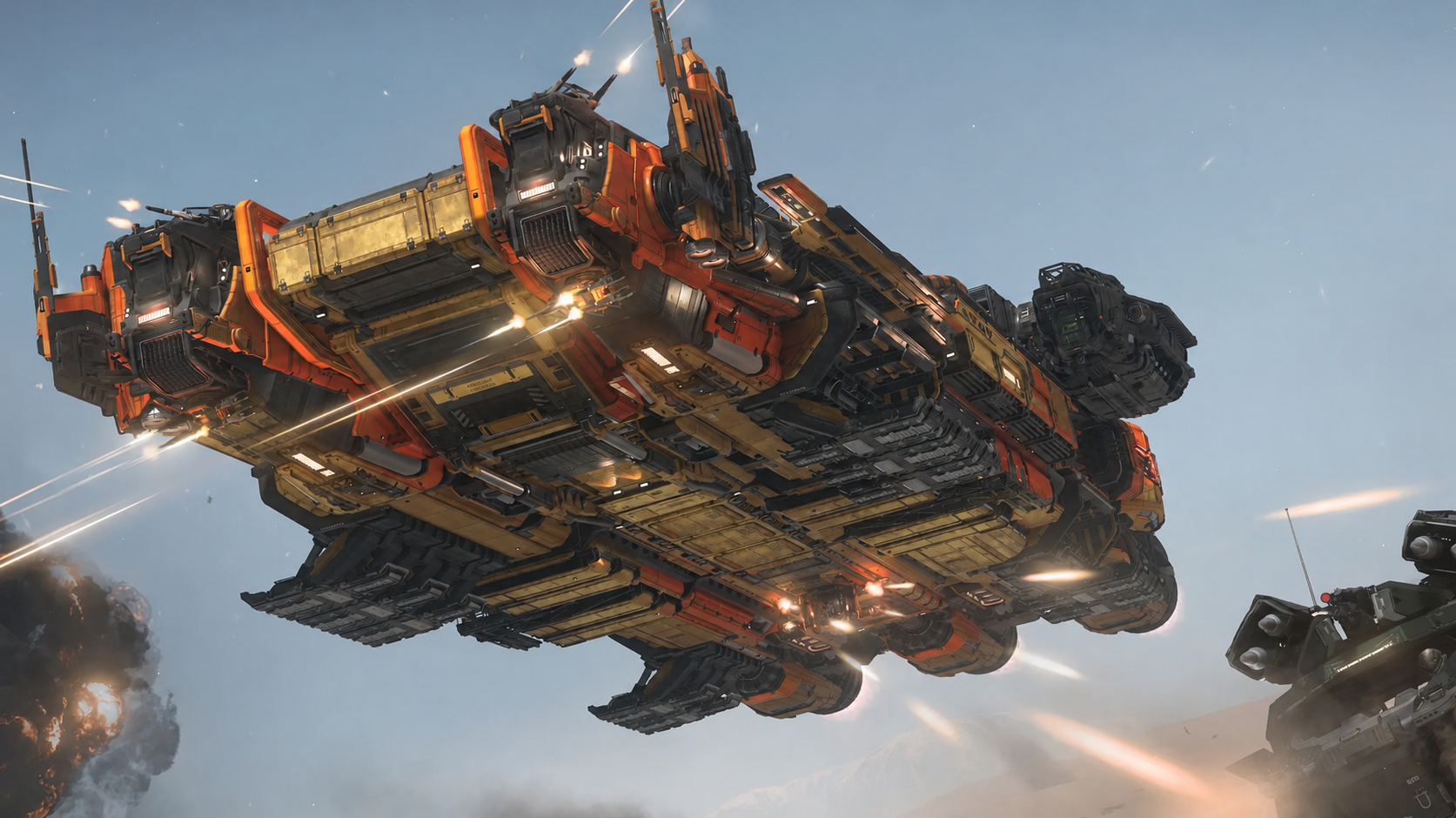
  • Armored Mobile Forge-Base: The Ironclad combines Sahan's home, forge, lab, compact medbay, cargo hold, animal habitat, vehicle bay, and Basilisk support berth in one combat-capable corvette.
  • Extreme Armored Survivability: Besk'jalya Beskar Superalloy, Ve'vut Beskar reinforcement, Digun armor, layered shields, shock absorption, fire suppression, sealing gels, shutters, and compartmentalized damage control make the ship extremely hard to destroy.
  • Crewless Operation: A limited ship AI, Sim'olan Droid Brain Core, Roble droid brains, SAMS, slave circuits, and onboard droids allow the ship to function without a conventional organic crew.
  • Fast and Agile for Its Size: Roble drives, Force-Tech maneuvering systems, AI-assisted thrust balancing, precision thrusters, and inertial compensation support High Speed and High Maneuverability.
  • Redundant Escape Systems: The Ironclad has multiple isolated FTL systems, high sublight performance, stealth options, and a last-resort plasma ram, giving it several ways to break contact or survive emergencies.
  • Stealth, EW, and Disguise Options: Stealth, holoshroud disguise, ECM, scan-jamming, rotating communications, and ansible support allow the ship to hide, spoof, jam, or mask its profile when conditions allow.

WEAKNESSES
  • Specialized, Not a Carrier: The Ironclad has Base 0 hangar space, no fighter squadrons, one single-craft berth, no barracks, and no mass-deployment facilities. Its forge, lab, medbay, habitat, cargo spaces, and Basilisk berth consume volume that could have supported larger military systems.
  • Automation Reliance: Ion damage, EMP, slicing, malware, AI disruption, droid-brain failure, or slave-circuit damage can severely degrade piloting, weapons, damage control, internal systems, cargo handling, and habitat management.
  • FTL Stack Limits: The isolation ring can lock damaged drives out until cleared or repaired, the ship cannot chain drives for repeated combat microjumps, the Astraios gravdrive depends on major gravity fields, and the OtherSlip system requires shields down for use.
  • Stealth and Signature Limits: Full stealth cannot be used during heavy weapons fire, plasma-ram charging, major drive stress, or heavy system damage. At 200 meters long and 87 meters wide, the Ironclad is a broad target when stealth is offline.
  • Power System Hazards: The HARC core can cause catastrophic internal damage if containment fails. Backup reactors and kinetic generators can keep the ship alive, but they cannot sustain the HARC's full output and bring their own fuel, coolant, radiation, startup, and overload limits.
  • Plasma Ram Commitment: The Asmulr ram requires a direct approach, predictable commitment, power rerouting, and heavy post-use inspection. A failed or badly timed ram can damage or cripple the ship.
  • Custom Maintenance Burden: The Ironclad is a one-off vessel with rare alloys, exotic power systems, superconductive circuitry, sealing gels, custom droid networks, and unusual replacement parts. Serious repairs require expert technicians, proper facilities, and Sahan's own resources.
  • Viewports Are Still Viewports: Even Beskadetr panes are weaker than uninterrupted hull plating. Sustained fire, disruptors, sonic resonance, repeated impacts, compromised seals, or shutter failure can still damage or breach them.
  • Limited Support Facilities: The medbay can stabilize and recover patients but cannot replace a hospital, while animal capable habitats require space, power, feed, water, waste processing, and constant maintenance.

DESCRIPTION
The Besk'jalya-Class Armored Expeditionary Corvette, commonly called the Ironclad, was built by Sahan Dragr as a personal answer to a problem that ordinary transports could not solve. Sahan needed more than a ship that could move him from one battlefield, forge, or contract to the next and keep up with the Iron Covenant Mythos Fleet. He needed a hardened mobile base that could carry his tools, armor projects, droid systems, animals, medical equipment, and Clan Dragr belongings without depending on a full crew or a vulnerable support vessel.

At two hundred meters in length, the Ironclad is large enough to serve as a traveling forge-lodge, but still small enough to remain Sahan's personal corvette rather than a fleet carrier or troop ship. Its internal layout reflects that purpose. The ship contains a forge-workshop, technical laboratory, compact trauma medbay, cargo and vehicle hold, large-animal habitat section, universal single-craft berth, and compact living space for Sahan and a small group of trusted companions. It is meant to support long operations away from Kestri, not to deploy armies.

The vessel's structure is built around survival first. Its armored shell uses Besk'jalya Beskar Superalloy, reinforced by Ve'vut Beskar, Digun modular armor, heavy structural metals, layered shielding, internal blast bulkheads, sealing gels, fire suppression, shock absorption, and compartmentalized damage control. Its Beskadetr viewports are protected by armored shutters during combat lockdown, giving the ship better visibility than a sealed bunker without pretending its viewports are as strong as uninterrupted hull plating.

The Ironclad is heavily automated because Sahan designed it to function without a conventional crew. A limited ship AI, layered droid-brain network, slave circuits, astromechs, construction droids, and security droids can handle routine piloting, diagnostics, repairs, cargo work, internal security, habitat management, and emergency response. Organic stations and manual overrides remain available, but the ship is most comfortable operating as a machine-supported extension of Sahan's own workshop.

The single-craft berth is one of the ship's most important features. It is optimized for Ure'adtr (AKA "Gold"), Sahan's M.I. Howler Basilisk Droid, providing repair, recharge, launch, recovery, and rearm support for the war droid. The berth can accept another compatible Basilisk or small craft if needed, but it cannot support squadrons. This limitation is deliberate: the Ironclad is a personal support ship, not a carrier.

The ship's medical and habitat systems reflect the realities of Mandalorian life. The compact trauma medbay can stabilize wounded allies, support recovery, and handle limited surgery after dangerous work or battle. The large-animal section allows Sahan to transport a small number of Kestrisaurs or other large creatures with proper restraints, environmental support, feeding systems, and acclimation equipment. These spaces make the ship more useful to Sahan, but they also consume volume that could have been used for larger military systems.

Power and propulsion are deliberately overbuilt. A HARC Power Generator feeds the primary power architecture, while backup reactors and kinetic generators help keep critical systems alive if the main core must be isolated or repaired. Multiple transit systems are tied together through a protected FTL routing spine, allowing the Ironclad to rely on a primary hyperdrive, secondary Hyperviolet drive, auxiliary gravity-field drive, and OtherSlip contingency system without allowing one damaged drive to automatically doom the rest of the stack.

The Ironclad carries serious weapons, but its armament is intended for survival, deterrence, and hard withdrawals rather than conquest. Heavy laser, ion, turbolaser, railgun, torpedo, ordnance, and point-defense systems allow the vessel to fight above its size when necessary. A concealed Second Fleet Stealth Cannon gives it a hidden emergency weapon, while the Asmulr plasma ram provides a desperate breach or escape option. Both are dangerous tools, not casual tactics.

Inside, the Ironclad is unmistakably Sahan's ship. Armored Mandalorian engineering is softened by Kestrisaur hide upholstery, Kestri hardwood, Mandalorian timber accents, Clan Dragr war-dragon motifs, gold and red-orange trim, plasma-blue diagnostics, forge lighting, weapon displays, armor maintenance alcoves, and a rugged common room built for use rather than luxury. It is a warship, workshop, home, and sanctuary folded into one armored hull.

For all its strength, the Ironclad remains a specialized one-off vessel. It cannot carry squadrons, cannot mass-deploy troops, depends heavily on automation, and requires expensive maintenance from people who understand its unusual systems. In Sahan's hands, however, it is exactly what it was built to be: a fortified Mandalorian forge-base capable of carrying its master, his work, his allies, his wounded, his animals, and his Basilisk through dangerous space and back again.


divtexture8.png
 
Last edited:
Golden-Dragon-Sword.png

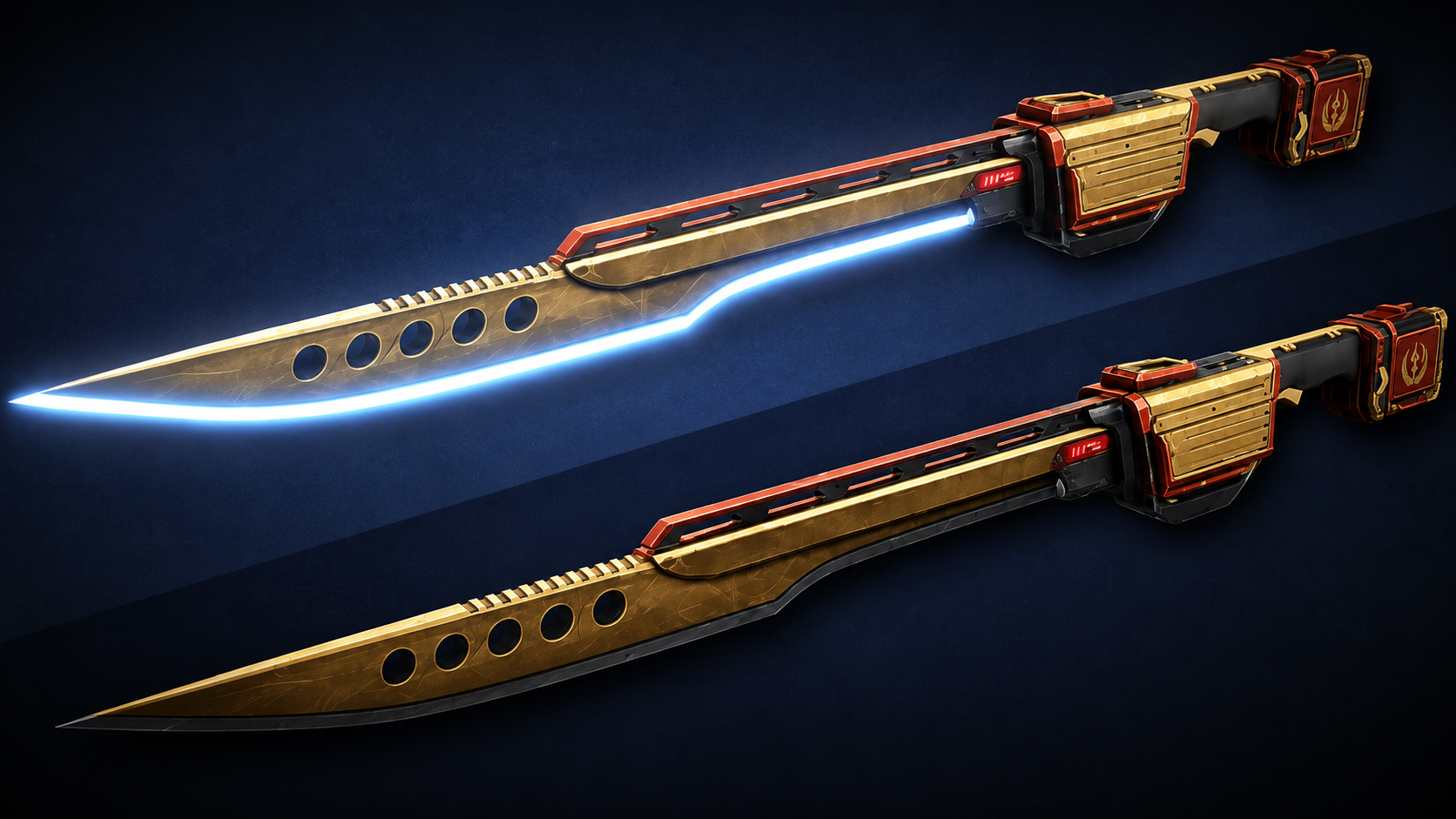
Shows the Tusurki'aa Ta'hye Beskad in both active and inactive states.

OUT OF CHARACTER INFORMATION

PRODUCTION INFORMATION

TECHNICAL SPECIFICATIONS
  • Classification: Beskad; Vibrosword; Contained-Energy Melee Weapon
  • Size: Average
  • Weight: Heavy

SPECIAL FEATURES
  • Golden Dragon Refit Package: The Tusurki'aa Ta'hye Beskad has been rebuilt around Sahan Dragr's newer armor systems, replacing older ballast-heavy internal construction with a cleaner ve'vut beskar frame, improved internal balancing, sealed electronics, and a gold/red-orange external finish. The refit does not make the blade dramatically stronger than before; instead, it makes the weapon faster to handle, safer to vent, easier to maintain, and better integrated with Sahan's modern beskar'gam.
  • Rebalanced Core: Older weight-adding elements have been reduced or repositioned into the weapon's spine and hilt, giving the sword a smoother center of balance. It remains a heavy Mandalorian blade, but it no longer fights the wielder as much during rapid cuts, reversals, and one-handed transitions.
  • Selectable Edge Profiles: The blade may be run in inactive, vibro-active, plasma-edge, or overload-venting modes. These settings let Sahan conserve power, reduce collateral damage, or bring the full contained-energy edge online when facing armor, shields, droids, or lightsaber-grade opposition.
  • Augmented Vibro-System: An ultrasonic vibration generator, augmented vibro-motor, and transonic generator allow the blade to vibrate with exceptional cutting force.
  • Contained-Energy Plasma Edge: A thin, focused plasma edge may be activated along the primary cutting surface, allowing the weapon to burn and carve into resistant materials with far greater efficiency than the physical edge alone.
  • Infinite-Temperature Coloration: The active plasma edge burns with an intense blue-white glare associated with extreme or effectively infinite-temperature plasma aesthetics. This is a visual and containment effect rather than literal limitless heat.
  • Layered Cutting Edge: Quadranium, neutronium, ionite, and Devaronian blood-poison crystal particles improve penetration, cutting trauma, ionized damage against electronics, and painful wound effects.
  • Antitamper Field Generator: The weapon can bleed off and harvest a portion of incoming energy through the blade/hilt assembly, feeding it back into the sword's capacitor system.
  • Kinetite Generator: Kinetic force from impacts and weapon clashes may be stored and released as a short-range outward concussive burst.
  • Directional Kinetite Venting: Rather than releasing stored kinetic energy in an uncontrolled burst, the refit allows Sahan to vent accumulated force through the blade's cutting line, spine, or hilt emitters. This can create a short-range concussive shove, reinforce a parry, or add a brutal impact pulse to a committed strike.
  • Armor Handshake Lock: In addition to its gene-lock, the sword can authenticate with Sahan's armor through a short-range encrypted handshake. When paired with his beskar'gam, the blade reports power levels, capacitor saturation, edge integrity, venting warnings, and diagnostic faults directly to his HUD.
  • Ultrachrome/Haysian Smelt Circuitry: High-end ultrachrome and Haysian Smelt wiring supports fast internal response, stable power transfer, edge regulation, capacitor routing, and diagnostic feedback between the hilt, blade, and armor handshake systems.
  • Sealed Service Spine: The hilt and blade spine contain protected maintenance channels sealed with Force-Tech Environmental Sealing Gel, helping shield the plasma emitters, capacitors, vibro-hardware, conductor lines, and diagnostics from dust, water, mud, vacuum exposure, and battlefield debris.
  • Anti-Force Construction: Voidsteel, Vong bonemeal case-hardening, and miriskin leather help resist direct telekinetic theft or manipulation.
  • Sahan-Locked: A gene-lock and biometric recognition system prevent the powered vibro, plasma, antitamper, and kinetite systems from activating for unauthorized wielders.
  • Safety Sheath: A reinforced sheath and lockout mode prevent the weapon from accidentally activating while carried.

STRENGTHS
  • Legendary Cutting Power: Between its physical edge, augmented vibro-system, and contained plasma edge, the Tusurki'aa Ta'hye Beskad can cut through many battlefield materials that would stop lesser melee weapons.
  • Lightsaber-Resistant Duelist's Weapon: Its beskar-heavy construction and plasma/vibro edge allow it to contest lightsabers and other high-end melee weapons, especially in the hands of a trained Mandalorian duelist.
  • Improved Handling: The Golden Dragon refit does not make the weapon light, but the rebalanced core makes it smoother and faster to control than its older configuration.
  • Energy and Impact Recycling: The antitamper and kinetite systems can convert some incoming punishment into useful power or a concussive counterburst.
  • Directional Counterforce: Directional kinetite venting gives Sahan more control over how stored impact force is released, allowing skilled parries, shoves, and strike-enhancing impact pulses.
  • Armor Integration: When paired with Sahan's beskar'gam, the sword can provide HUD feedback on charge levels, edge state, saturation, venting risk, and damage warnings.
  • Anti-Force Handling: The weapon is difficult for Force-users to directly steal, redirect, or manipulate through telekinesis compared to ordinary weapons.
  • Owner-Locked: Even if taken from Sahan, the weapon's most dangerous systems remain locked unless the gene-lock is bypassed.
  • Built to Survive: Ve'vut beskar, voidsteel, seigurium, liquid-aenite, sealed electronics, and careful Mandalorian forging make the blade and hilt highly durable under battlefield conditions.

WEAKNESSES
  • Heavy: The refit improves balance, not mass. The weapon is still intentionally dense and requires significant strength, conditioning, and training to use properly.
  • Short Reach: As a beskad, it has less reach than a full sword, spear, polearm, or lightsaber pike.
  • One-Handed Hilt: The weapon is designed for Sahan's one-handed style and cannot comfortably support a proper two-handed grip.
  • Do Not Throw: Sahan must maintain contact with the hilt for the powered systems to remain reliably active. Throwing it wastes its best features and risks losing a unique weapon.
  • Capacitor Saturation: The antitamper and kinetite systems cannot absorb unlimited energy or impact. Heavy sustained punishment can saturate the capacitors, force automatic venting, or temporarily shut down the advanced systems.
  • Not a Shield: The antitamper system is not a personal shield, lightsaber catcher, or blaster-deflection field. It is most useful during direct contact with the weapon and can be overwhelmed.
  • Venting Requires Control: Directional kinetite release is not a free omnidirectional blast. It requires timing, contact, and the correct blade angle. Poor use can waste the stored charge, throw off Sahan's own footing, or force the weapon into a cooldown cycle.
  • Manual Backup: The sword can still function without armor-sync, but Sahan loses HUD warnings, power readouts, and automated diagnostic feedback. If the handshake is jammed or disrupted, the blade defaults to its local controls and biometric lock.
  • Complex Maintenance: Plasma containment emitters, transonic systems, kinetite hardware, capacitors, sealed electronics, and HUD handshake components require careful Forgemaster-level maintenance.
  • Ion/EMP Vulnerability: The hilt is hardened and sealed, but sufficient ion or EMP damage can still disrupt the weapon's powered functions if it breaches the protections.
  • Sonic and Resonance Attacks: Specialized sonic, vibration, or resonance weapons can interfere with the vibro-system or stress the blade's layered construction.
  • Disruptors and Exotic Damage: Matter-disrupting weapons and comparable exotic effects remain dangerous to the weapon's materials and internal systems.
  • Still Dangerous When Locked: The gene-lock prevents unauthorized users from activating the advanced systems, but the inactive blade is still sharp, heavy, and painful to be struck with.
  • Anti-Force, Not Force-Proof: The anti-Force materials are strongest against direct manipulation of the weapon itself. Indirect Force attacks, environmental attacks, massive telekinetic force, and powers aimed at Sahan rather than the weapon may still work.

DESCRIPTION

The Tusurki'aa Ta'hye Beskad was originally forged by Sahan Dragr as a personal, iconic Mandalorian weapon: a heavy, advanced beskad built to inspire awe among his people and dread among his enemies. Following Sahan's rise as Clan Dragr's Forgemaster and the growth of the Iron Covenant, the blade was reforged and refinished into its Golden Dragon configuration.

The weapon remains recognizable as a traditional Mandalorian beskad in silhouette, though its internal systems are far more sophisticated. Its dense construction includes ve'vut beskar, voidsteel, seigurium, liquid-aenite, and carefully layered edge materials, giving it the heft and durability expected of a weapon made for Sahan's aggressive dueling style. Red-orange trim and gold-toned armor panels echo his newer beskar'gam, while the active plasma edge burns with a brilliant blue-white glare rather than gold or orange.

At its simplest, the sword can function as a brutally sharp heavy blade. When activated, the ultrasonic and transonic vibro-systems greatly enhance its cutting ability. At higher output, a contained-energy plasma edge forms along the primary cutting surface, turning the weapon into a hybrid of Mandalorian steelcraft and contained-energy technology. Sahan may also run the blade in vibro-only mode when a full plasma edge is unnecessary.

The Golden Dragon refit focuses less on adding raw power and more on refinement. Older ballast-heavy sections have been replaced or repositioned, giving the weapon a smoother center of balance without stripping away its heavy beskad identity. It remains a strong warrior's weapon, but it transitions better through rapid cuts, reversals, parries, and one-handed changes in direction.

Its edge is designed to be cruelly efficient. Quadranium and neutronium improve bite and penetration, ionite allows the blade to carry ionized damage into droids, electronics, shields, and powered armor, and Devaronian blood-poison crystal particles increase pain and wound severity when the physical edge makes contact with flesh.

The hilt houses two of the sword's signature systems. The antitamper field generator can bleed and harvest portions of incoming energy, feeding the weapon's capacitor system instead of relying solely on its power cell. The kinetite generator can store kinetic force from clashes and impacts, then release it as a short-range concussive shockwave. In the Golden Dragon configuration, that stored force may be vented more precisely through the blade, spine, or hilt emitters, allowing Sahan to reinforce a parry, shove an opponent back, or add a punishing impact pulse to a committed strike.

The refit also brings the weapon into Sahan's modern armor ecosystem. Ultrachrome/Haysian Smelt wiring supports rapid power transfer, capacitor routing, edge regulation, and diagnostic feedback. When paired with Sahan's beskar'gam, the weapon can report power reserves, edge state, capacitor saturation, venting risk, and internal faults directly to his HUD. If the armor handshake is disrupted, the blade remains functional through local controls, but Sahan loses that extra layer of feedback.

As with many of Sahan's creations, the blade incorporates anti-Force materials. Voidsteel, Vong bonemeal treatment, and miriskin leather make the weapon difficult to seize or manipulate directly through the Force. This does not make the blade immune to every Force power, but it does make stealing it from Sahan's grip a far more frustrating proposition than it would be with an ordinary sword.

A gene-lock and biometric recognition system restrict the sword's powered functions to Sahan Dragr. Another wielder could still use the inactive weapon as a heavy, sharp blade, but the vibro-motor, plasma edge, antitamper field, kinetite release, and armor-handshake functions remain locked without Sahan's authorization. Force-Tech Environmental Sealing Gel and reinforced internal housings help keep the weapon operating in water, vacuum, dust, mud, snow, and other battlefield environments.

The result is not a subtle weapon. It is a statement piece: a golden-red Mandalorian plasma beskad, heavy in the hand, vicious in the cut, difficult to steal, and unmistakably suited to the Golden Dragon.
 
6fe14747-2b64-44eb-96a8-99d6c58fbb9a.png

O'dteyase Saranuhlr, Sahan Dragr's Golden Dragon-refit Verpine hand cannon.​

OUT OF CHARACTER INFORMATION

PRODUCTION INFORMATION

TECHNICAL SPECIFICATIONS

SPECIAL FEATURES
  • Golden Dragon Refit: The O'dteyase Saranuhlr has been refinished and rebuilt to match Sahan Dragr's modern Golden Dragon equipment suite, using metallic gold, red-orange, and dark gunmetal external styling with improved internal diagnostics and maintenance access.
  • Verpine Shatter Gun Core: Built from a modified HG-54 Vora-Class Verpine Hand Cannon, the weapon uses magnetic acceleration to launch compact slugs at extreme velocity with minimal sound compared to conventional slugthrowers.
  • Adaptive Magnetic Accelerator: The actuating module, accu-accelerator hardware, and refined magnetic coils help tune launch force for compatible ammunition types, improving consistency across standard slugs and more exotic specialty rounds.
  • Adaptive Magazine Feed System: The weapon uses smart magazines, an adjustable feed throat, and an internally indexing magazine follower to accommodate compatible slug and slug-like ammunition of varying size. Compact Verpine-style slugs allow the highest capacity, while larger exotic payloads reduce the number of rounds that can be carried in a magazine.
  • Smart-Tracking System: A miniature laser-tracking system can tag targets with an electronic homing signature, allowing compatible smart ammunition to adjust mid-flight while linked to Sahan's HUD or allied systems.
  • Golden Dragon HUD Handshake: The weapon can authenticate with Sahan's beskar'gam, feeding ammunition count, loaded round type, barrel temperature, coil stress, tracking status, and fault warnings directly to his HUD.
  • RWA-M1 Integrated Weapons Scope: A compact integrated weapon scope links into Sahan's helmet or visor systems rather than relying on a conventional external optic alone.
  • Ultrachrome/Haysian Smelt Circuitry: Premium wiring and micro-circuitry support rapid power transfer, cleaner coil regulation, stable diagnostic response, and reliable HUD communication.
  • Sealed Service Core: Force-Tech Environmental Sealing Gel and reinforced service channels protect the weapon's electronics, accelerator coils, diagnostic hardware, magazine feed components, and smart-tracking systems from dust, mud, sand, rain, snow, and battlefield debris.
  • Ion/EMP Hardening: Combat de-ionizer hardware, insulation, sealing, and hardened circuitry improve the weapon's resistance to ionization, EMP bursts, and battlefield electrical interference.
  • Thermal Stabilization: The G'ahycaya CPU Cooler and heat management channels help prevent the weapon from overheating during rapid fire or heavy use of high-energy magnetic acceleration.
  • Anti-Force Construction: Voidsteel, Vong bonemeal case-hardening, and reinforced material layering make the weapon difficult to directly seize, discharge, or manipulate through telekinesis.
  • Sahan-Locked: A biometric lock and armor-authentication handshake restrict advanced firing profiles, smart-link features, diagnostics, and safety overrides to Sahan Dragr or authorized maintenance access.

STRENGTHS
  • Hand Cannon Bite: As a Verpine shatter handgun firing compact slugs at extreme velocity, the O'dteyase Saranuhlr hits far harder than most ordinary sidearms.
  • Long-Reaching Sidearm: Its Verpine shatter gun design, smart optics, and magnetic acceleration give it excellent range for a handgun-sized weapon.
  • High Rate of Fire: The refit preserves the older weapon's fast cycling and high fire rate, allowing rapid follow-up shots when Sahan needs to overwhelm a target or exploit an opening.
  • Wide Ammunition Compatibility: The weapon can use standard slugs and a broad range of specialized slug-like ammunition, making it highly adaptable against armor, droids, shields, Force-users, vehicles, and environmental targets.
  • Adaptive Capacity: Smart magazines and an adjustable feed system let the weapon carry up to fifty compact slugs while still accepting larger specialty payloads at reduced capacity.
  • Smart-Linked Precision: With enough clear line of sight to tag a target, compatible tracking ammunition can adjust mid-flight and share target data through Sahan's HUD or allied systems.
  • Armor Integration: When paired with Sahan's beskar'gam, the weapon provides ammunition counts, chamber status, round-type identification, heat levels, tracking status, and maintenance warnings directly to his HUD.
  • Weather-Hardened: Sealed electronics, Force-Tech Environmental Sealing Gel, and internal hardening address the usual Verpine shatter gun weakness against rain, mud, sand, dust, and battlefield contamination.
  • Ion/EMP Resistant: The weapon is significantly more resistant to ion and EMP disruption than an ordinary smart weapon or unmodified Verpine shatter gun.
  • Anti-Force Handling: Anti-Force materials make the gun difficult for enemy Force-users to directly steal, twist, or discharge through telekinesis.

WEAKNESSES
  • Variable Capacity: The weapon can carry up to fifty compact slugs in a magazine, but that number drops when using larger, heavier, or more complex specialty payloads. Exotic ammunition may also require careful loading and magazine calibration before use.
  • Feed Complexity: The adaptive feed system is more complex than a simple fixed-caliber magazine. Dirt, damage, poor maintenance, or badly made ammunition can cause feed errors, misalignment, or forced fallback to simpler ammunition profiles.
  • Specialty Ammo Problem: Standard slugs are the easiest ammunition to source. The more exotic rounds are expensive, uncommon, and often difficult to replace in the field.
  • Tracking Takes Time: Smart tracking requires a clear, unobscured line of sight and several seconds of target acquisition. Snap-shots, smoke, cover, darkness, jamming, or broken sightlines can prevent a successful tag.
  • Smart Ammo Required: The tracking system only benefits compatible ammunition. Ordinary slugs may still be fired accurately, but they do not magically become homing rounds.
  • Not a Blaster Hose: Despite its high rate of fire, the O'dteyase Saranuhlr is still a precision hand cannon, not a squad automatic weapon. Prolonged suppressive fire will overheat, drain, or empty it quickly.
  • Average Recoil: Condensed-matter composite and magnetic tuning help, but the weapon still kicks more than a light pistol or standard blaster sidearm, especially with heavy specialty slugs.
  • Cumbersome Sidearm: It is compact enough to carry as a handgun, but it remains a large and powerful hand cannon. Tight grapples, cramped quarters, or weak wrists make it harder to use properly.
  • Maintenance Hungry: Magnetic accelerator coils, adaptive feed components, smart-tracking emitters, sealed diagnostics, HUD links, and exotic material layering require careful maintenance. Neglect can degrade accuracy, tracking, feeding, or firing consistency.
  • Ion/EMP Resistant, Not Immune: Heavy ion or EMP exposure can still disrupt smart-link functions, tracking, diagnostics, or the weapon's firing systems if the protections are overwhelmed or breached.
  • Anti-Force, Not Force-Proof: The anti-Force materials protect the weapon itself against direct manipulation. They do not protect the ammunition after it leaves the barrel, nor do they stop indirect Force attacks aimed at Sahan, the environment, or his firing lane.
  • Owner-Locked Complications: If the biometric or armor-authentication systems fail, the weapon can fall back to basic local functions, but Sahan loses advanced firing profiles, HUD support, diagnostics, and some safety overrides until repaired.

DESCRIPTION

The O'dteyase Saranuhlr began life as Sahan Dragr's heavily modified O'dteyase, itself a customized HG-54 Vora-Class Verpine Hand Cannon rebuilt to better suit a Mandalorian bounty hunter, warrior, and eventually Forgemaster. The original weapon was already a dangerous sidearm: quiet, accurate, hard-hitting, and unusually adaptable thanks to its compatibility with a wide range of slug and slug-like ammunition.

The Golden Dragon refit brings the weapon in line with Sahan's modern armor, forgecraft, and Iron Covenant-era equipment standards. Its frame has been reinforced with high-carbon beskar steel, ve'vut beskar, zûtsina, condensed-matter composite, liquid-aenite, voidsteel, and Vong bonemeal treatment. The external finish now matches Sahan's newer gold, red-orange, and dark gunmetal aesthetic, making it visually consistent with his Golden Dragon beskar'gam and refit melee weapons.

Functionally, the weapon remains a Verpine shatter hand cannon. It uses magnetic acceleration to launch compact slugs at extreme velocity, delivering far more kinetic force than most conventional pistols. Its high rate of fire lets Sahan rapidly follow up shots, while its long effective range gives him more reach than many handgun users expect. Standard slugs work well enough, but the weapon truly shines when loaded with specialized ammunition such as cryo slugs, blackout rounds, anti-droid rounds, Force Breaker rounds, pyro slugs, Tracyntium rounds, or other compatible payloads.

The refit's most important improvements are not raw damage upgrades. Instead, Sahan focused on control, integration, and battlefield reliability. Ultrachrome/Haysian Smelt wiring improves power transfer and internal response. The updated accelerator assembly helps tune launch force for compatible ammunition types, while the adaptive magazine feed system allows the weapon to use compact Verpine-style slugs or larger specialty payloads. Compact slugs allow the highest magazine capacity, while bulkier exotic rounds reduce the number of shots carried and may require careful magazine calibration. The sealed service core protects the coils, electronics, diagnostics, magazine feed system, and smart-tracking components from the contamination problems that often plague delicate Verpine shatter weapons.

The weapon's smart-tracking system remains one of its most useful tools. With a clear line of sight and enough time to acquire a target, the hand cannon can mark an enemy with an electronic homing signature. Compatible ammunition can then adjust mid-flight, and the tag may be tied into Sahan's HUD or shared with allies. This is powerful, but not instantaneous. Smoke, cover, evasive movement, jamming, darkness, or broken line of sight can deny the lock, and ordinary ammunition receives no homing benefit.

The Golden Dragon HUD handshake further integrates the weapon with Sahan's beskar'gam. When linked, the gun can report ammunition count, loaded round type, chamber status, coil stress, barrel temperature, tracking status, and maintenance warnings directly to his helmet systems. If the link is disrupted, the weapon remains usable through local controls, but Sahan loses the extra diagnostic and tactical feedback.

As with many of Sahan's personal creations, the O'dteyase Saranuhlr incorporates anti-Force materials. Voidsteel and Vong bonemeal treatment make the gun difficult to seize, twist, or discharge through direct telekinesis. This protection applies to the weapon itself, not to fired ammunition, and it does not prevent indirect Force powers from affecting Sahan, his cover, his footing, or the battlefield around him.

The final result is a refined Mandalorian hand cannon: quiet, accurate, hard-hitting, smart-linked, weather-hardened, and unmistakably built for Sahan Dragr. It is not simple, cheap, or easy to maintain, and it can burn through rare ammunition quickly. In the hands of the Golden Dragon, however, it remains exactly what it was always meant to be: a brutal, precise sidearm for ending problems before they get close.
 
Last edited:


Chat-GPT-Image-Jun-30-2026-02-29-31-PM.webp
Chat-GPT-Image-Jun-30-2026-03-25-30-PM.webp


IRON COVENANT RANCOR WAR-BARDING
Heavy Battle Armor for Mandalorian War Rancors
divtexture.png

OUT OF CHARACTER INFORMATION

Intent: To create a limited-production set of practical battle armor for Iron Covenant war rancors.
Image Source: ChatGPT
Canon Link: Rancor
Permissions: N/A
Primary Source: N/A
divtexture.png
PRODUCTION INFORMATION

Manufacturer: Kyr’bes Buy’ce; The Iron Covenant
Affiliation: The Iron Covenant; approved Iron Covenant beast-handlers and rancor riders
Market Status: Closed-Market
Model: Iron Covenant Rancor War-Barding
Modularity: Yes. The armor is built around a core war-barding frame that can be adjusted for individual rancor size, removed in sections for treatment or transport, and fitted with mission-specific modules. Standard sets include heavy plating, spikes, Kestrisaur hide/down backing, Zûtsina Cold Steel lining, environmental sealant layers, a reinforced saddle, restraint points, and a diagnostic link. Optional modules include a kinetite impact lattice, Devaronian blood-poison crystal spike fittings, and a detachable heavy-drop grav-brake harness.
The armor does not support mounted cannons, missiles, powered limb systems, stealth systems, full flight systems, remote-control rigs, or other delicate battlefield gadgets unsuitable for a rancor.
Production: Limited
Material:
divtexture.png
TECHNICAL SPECIFICATIONS
Classification: Multipurpose Beast Barding / Mounted War Harness
Weight: Very Heavy
Resistances:
  • Energy: Very High
  • Kinetic: Very High
  • Lightsabers: Very High
  • Other — Thermal: High
  • Other — Ion/EMP: Average
  • Other — Acid/Corrosion: Average
  • Other — Sonic: Low
divtexture.png
SPECIAL FEATURES
  • Heavy Sectional War-Plating: Starship-grade Besk’jalya plates protect the brow, crown, neck, shoulders, upper chest, forearms, spine, legs, and upper back. These sections are deliberately limited to areas where a rancor’s mass and strength can carry the extra burden without crippling mobility.
  • Open-Face Head Guard: The head armor protects the brow, crown, cheeks, sides of the head, and upper snout while leaving the rancor’s eyes, mouth, lower face, jaw, and primary sensory areas unobstructed. The design protects without blinding, muzzling, or confusing the beast.
  • Mandalorian Beast-Plating Profile: The barding uses thick, angular, overlapping plates inspired by heavy beskar’gam construction. The result is not a smooth shell or fitted bodysuit, but external war-plating strapped over a living beast through reinforced harness points, buckles, chains, and padded contact zones.
  • Lightweight Ve’vut Reinforcement: Lighter ve’vut beskar sections reinforce articulation points, secondary plates, brow guards, claw-adjacent guards, spikes, and portions of the rider saddle where weight savings matter.
  • Impact Spikes and Brow Horns: Reinforced ve’vut beskar spikes are mounted along the brow, shoulders, forearms, knuckles, and spinal ridge to enhance the rancor’s natural charges, swipes, grapples, stomps, and body-checks.
  • Kestrisaur Hide and Down Backing: Layers of Kestrisaur hide are worked beneath the plates and around high-friction contact zones. Visible white and gray down sections act as padding, cold-weather insulation, and a distinctive Covenant aesthetic detail.
  • Zûtsina Cold Steel Lining: Thin internal Zûtsina Cold Steel lining helps draw excess heat away from the rancor beneath the heavy barding, reducing overheating during charges, prolonged exertion, and hot battlefield conditions.
  • Environmental Sealant Layers: Force-Tech Environmental Sealing Gel is applied around saddle electronics, diagnostic housings, plate seams, sensor contact points, and vulnerable internal channels to help keep out mud, water, spores, blood, dust, and battlefield grime. The gel protects the armor’s components, not the entire rancor, and does not make the barding airtight, vacuum-rated, underwater-capable, or fully environmentally sealed.
  • Reinforced Rider Saddle: A built-in saddle-howdah gives one primary rider a stable mounted position with armored leg guards, grip rails, mag-lock stirrup plates, crash straps, and emergency release clamps.
  • Handler Anchor Points: Heavy restraint rings, guide chains, transport locks, and harness attachment points allow the rancor to be secured, moved, treated, or restrained by trained handlers.
  • Beast Diagnostic Link: Simple biometric sensors built into the saddle, girth straps, collar sections, and armor contact points can transmit the rancor’s vitals, injury warnings, heat stress, strap tension, and armor integrity to a rider’s helmet or armor HUD.
  • Diagnostic De-Ion Buffer: A hardened combat de-ionizer and reserve buffer are built into the saddle diagnostic suite. The system does not prevent ion or EMP damage but can help purge residual interference and reboot the armor’s vitals link, saddle sensors, and diagnostic readouts after a disruption.
  • Optional — Kinetite Impact Lattice: Ruggedized kinetite components can be built into sections of the barding expected to receive or deliver heavy impact, including the brow plate, shoulder plates, forearm guards, knuckle spikes, claw-adjacent guards, knee guards, hip guards, chest bracing, and selected spinal spike bases. The lattice absorbs and stores kinetic energy from the rancor’s movement, charges, impacts, stomps, grapples, and collisions, allowing a trained rider to release that stored force through specific striking zones at the proper moment.
  • Optional — Devaronian Blood-Poison Crystal Spike Matrix: Selected ve’vut beskar spikes, brow horns, knuckle guards, and shoulder spurs can be set with Devaronian blood-poison crystals or crystal-lined cutting channels. These crystals give the spikes their blood-poisoning quality, causing severe pain when they cut, puncture, or become embedded in living tissue.
  • Optional — Heavy-Drop Grav-Brake Harness: Select barding sets can be fitted with a detachable grav-brake and repulsor descent harness for ship-to-ground deployment. The system uses ruggedized gravitic dampeners, repulsor-brakes, and short-burst stabilizing microthrusters to slow a controlled fall from low-altitude drops, allowing armored rancors to be deployed without requiring a full landing zone.
  • No Direct Control Interface: The diagnostic link monitors the beast but does not pilot it, override its instincts, replace training, or give the rider remote control over the rancor.
divtexture.png
STRENGTHS
  • Built for What Rancors Already Do: The barding does not try to turn a rancor into a tank, walker, or gun platform. It reinforces the beast’s natural strengths: charging, crushing, grappling, clawing, biting, and smashing through obstacles.
  • Starship-Grade Impact Plates: Besk’jalya armor sections provide far greater protection than ordinary durasteel barding, especially against heavy impacts, debris, slugs, explosions, and concentrated battlefield punishment.
  • Excellent Kinetic Protection: The armor is especially strong against impacts, slugs, debris, trampling damage, blunt trauma, and melee punishment, making it useful for a creature expected to physically crash into enemy lines.
  • Strong Blaster Resistance: Heavy plates, layered padding, and ve’vut beskar reinforcement provide very strong protection against battlefield small arms and glancing blaster fire.
  • Strong Lightsaber Resistance: Besk’jalya plating and ve’vut beskar reinforcement allow the armor to resist glancing lightsaber strikes, brief contact, and imperfect cuts far better than conventional beast barding.
  • Spiked Momentum: Shoulder, brow, forearm, knuckle, and spinal spikes make the rancor even more dangerous when it charges, swipes, pins, grapples, or body-checks opponents and obstacles.
  • Thermal Regulation: Kestrisaur down and Zûtsina Cold Steel lining help keep the rancor from freezing in hostile cold climates or overheating too quickly under heavy armor.
  • Mission-Tailored Brutality: The barding can be fielded as simple armored plating or upgraded with optional melee and deployment modules. A calmer transport beast may only need plating and diagnostics, while an elite assault mount may carry kinetite impact zones, blood-poison crystal spikes, or a heavy-drop harness.
  • Stored-Impact Brutality: The optional kinetite lattice allows the barding to store force from the rancor’s own movement and release it through impact zones, making already devastating strikes far more destructive when rider and mount are properly synchronized.
  • Blood-Poisoned Spikes: Optional Devaronian blood-poison crystals set into the spikes and horns make puncture wounds especially punishing against living targets, adding crippling pain to the rancor’s natural ability to maul, gore, pin, and crush.
  • Mounted Combat Ready: The saddle-howdah gives a Mandalorian rider a practical, secure fighting position without needing to install weapons that the rancor itself cannot use.
  • Rider Awareness: The diagnostic link lets the rider know when the rancor is overheating, bleeding, panicking, injured, exhausted, or suffering armor failure before the beast becomes uncontrollable.
  • Recoverable Armor Link: Ion and EMP attacks can still knock out the diagnostic systems, but the de-ion buffer gives the rider a chance to recover the vitals link and armor readouts instead of losing them for the entire engagement.
  • No Landing Zone Needed: The optional heavy-drop harness allows Covenant ships to deploy armored rancors into rough terrain, battlefield openings, jungle clearings, siege zones, or forward assault areas without fully landing.
divtexture.png
WEAKNESSES
  • Very Heavy: Even with lighter ve’vut beskar sections, the Besk’jalya plates make the armor massive. Prolonged use can potentially cause fatigue, overheating, reduced agility, and increased strain during long marches or extended combat.
  • Moderated Starship Armor: Besk’jalya is used in moderation, not as full-body coverage. The rancor is strong enough to carry key plates, but it cannot wear a starship hull over its entire body without losing mobility.
  • Incomplete Coverage: To preserve movement and prevent overheating, the armor does not fully enclose the rancor. Eyes, mouth, hands, feet, joints, underbelly, inner limbs, and sections of hide remain exposed.
  • Not Environmentally Sealed: The barding protects armor components from grime and weather, but it does not seal the rancor itself. Vacuum, drowning, toxic atmospheres, hard radiation, extreme pressure, chemical clouds, and hostile environments can still harm or kill the beast.
  • Poor Sonic Protection: The armor offers little help against sonic weapons, pain frequencies, disorientation pulses, and other attacks that target the rancor’s senses or nervous system.
  • Average Ion/EMP Resistance: The diagnostic link is hardened, but the armor still takes ion and EMP hits like normal. A strong enough disruption can disable sensors, garble vitals, interrupt saddle readouts, and force the rider to rely on instinct and visual checks until the system reboots.
  • De-Ionizer Is Recovery, Not Immunity: The combat de-ionizer helps restore the armor link after interference, but it does not block the initial hit, protect other electronics nearby, or guarantee instant recovery under repeated ion/EMP attacks.
  • No Behavioral Override: The armor cannot control the rancor. A panicked, enraged, wounded, starving, or poorly trained rancor remains dangerous to enemies and allies alike.
  • Requires Coordination: The optional kinetite lattice is only truly devastating when rider and rancor are synchronized. A poorly trained rider, panicked mount, disrupted saddle link, or mistimed release can waste the stored energy or even throw off the beast’s balance.
  • Conditioning Required: Rancors must be trained not to panic, buck, or frenzy when the kinetite discharges or the heavy-drop harness activates. An untrained or newly equipped rancor may react violently to the sound, shock, vibration, or pressure of these systems.
  • Impact and Motion Dependent: The kinetite lattice needs kinetic energy to absorb and store. If the rancor is restrained, bogged down, stunned, trapped, exhausted, or unable to build momentum, the system becomes far less useful.
  • Not a Ranged Weapon: The stored force is released through contact and near-contact impact zones. It cannot replace artillery, missiles, cannons, or ranged shockwave projectors.
  • Crystals Need Contact: Devaronian blood-poison crystals only matter if the spike cuts, punctures, scrapes, or embeds into a living target. Sealed armor, droids, vehicles, thick plating, heavy hide, or rapid treatment can reduce the effect.
  • Drop Only: The heavy-drop harness is designed for descent, not flight. Once the rancor is on the ground, the harness is dead weight unless detached or jettisoned.
  • Low-Altitude Requirement: The heavy-drop harness is not designed for orbital drops or high-atmosphere insertion. Extreme altitude, heavy anti-air fire, turbulence, or system damage can still turn deployment into a fatal fall.
  • Large Target During Descent: A descending armored rancor is very visible and not especially agile. Anti-air weapons, heavy repeaters, missiles, flak, and tractor systems can threaten it before landing.
  • More Modules, More Problems: Optional systems increase maintenance, training demands, risk, and handler workload. A rancor carrying kinetite impact nodes, blood-poison crystal spikes, and a heavy-drop harness is more dangerous, but also harder to transport, control, clean, repair, and safely approach.
  • Transport Burden: Armored rancors require specialized loading frames, reinforced transports, heavy restraint systems, and handlers familiar with both the beast and the armor.
  • Maintenance Intensive: After combat, the armor often needs plate realignment, strap replacement, spike repair, sensor recalibration, cleaning, and checks for wounds hidden beneath the padding.
divtexture.png
DESCRIPTION

The Iron Covenant Rancor War-Barding was developed after Covenant beast-handlers began adapting captured war rancors for battlefield use. A rancor did not need a complex weapons suite, powered armor, stealth coating, missile launcher, or delicate battlefield gadgetry. It needed protection where enemy fire was most likely to strike, reinforcement where its body already caused the most destruction, and a secure place for a Mandalorian rider to stay mounted while the beast did what rancors naturally do.

The resulting armor is intentionally practical. Heavy Besk’jalya plates protect the brow, neck, shoulders, chest, forearms, spine, and upper back, but only in sections the rancor can realistically carry without being slowed into uselessness. Lighter ve’vut beskar is used for secondary reinforcement, articulation guards, spikes, brow horns, and saddle protection, giving the barding a distinctive contrast between darker starship-grade armor and brighter Mandalorian metal.

The plating is deliberately shaped to resemble oversized Mandalorian armor rather than a vehicle shell or creature exoskeleton. Broad pauldrons, layered bracers, angular breast plates, reinforced ridge guards, and heavy segmented panels are strapped over the rancor’s body using beast-scale harnessing. The result is unmistakably armor worn by a living creature: protective, brutal, and modular, but still dependent on the rancor’s own body beneath it.

The head guard is deliberately open-faced. A rancor cannot fight effectively if it cannot see, bite, roar, smell, or use its jaws. Instead of enclosing the face, the armor protects the brow, crown, cheeks, sides of the head, and upper snout, leaving the eyes, mouth, lower jaw, and primary sensory areas free. The rancor remains the weapon. The armor simply helps keep that weapon alive.

Beneath the metal, layered Kestrisaur hide gives the barding a distinctly Covenant character. White and gray down can be intentionally left visible along some padded seams and collar sections, both as insulation and as an optional visual reminder of the armor’s Kestri origin. Zûtsina Cold Steel lining is worked into the inner armor frame and thermal-contact points, helping the rancor endure hot climates while also bleeding off excess heat during charges, prolonged movement, and heavy combat. The system is not a climate-control miracle; it simply makes a very heavy suit of monster armor less punishing for the monster wearing it.

The integrated saddle-howdah is the most refined part of the design. It gives a primary rider a protected mounted position with grip rails, mag-lock stirrup plates, leg guards, crash straps, and emergency releases. This allows a Mandalorian rider to guide the beast, fire personal weapons, coordinate with nearby infantry, or dismount quickly if the rancor becomes uncontrollable.

The diagnostic suite is similarly practical rather than miraculous. Haysian Smelt wiring, Ultrachrome micro-circuitry, and a combat de-ion buffer allow the saddle link to monitor vitals, strap tension, heat stress, injury warnings, and armor integrity. Ion or EMP attacks can still knock the system offline, but the buffer gives the rider a chance to recover the link after the hit instead of permanently losing the armor’s readouts.

The optional melee systems are deliberately simple and physical. The Kinetite Impact Lattice stores force from the rancor’s own movement and releases it through impact zones when rider and mount are properly synchronized. Devaronian blood-poison crystal fittings make selected spikes and horns nastier against living targets. Neither system turns the rancor into a gun platform. They only make its natural violence worse.

For battlefield deployment, some sets can accept a detachable heavy-drop grav-brake harness. This does not make the rancor airborne cavalry. It does not let the beast fly, hover, or maneuver like a jetpack warrior. Instead, it allows a ship, gunship, dropship, or assault transport to release the rancor from low altitude while gravitic dampeners, repulsor-brakes, and stabilizing microthrusters bleed off enough speed to keep the landing survivable.

Not every rancor receives every module. Some beasts are too easily agitated for kinetite discharges. Some missions do not justify blood-poison crystal fittings. Some deployments happen from the ground and do not require the heavy-drop harness. The armor’s greatest advantage is that it can be fitted to the beast, rider, and mission rather than forcing every rancor into the same configuration.

In Iron Covenant service, the barding is used by armored battle rancors assigned to trained handlers, mounted shock cavalry formations, siege assaults, intimidation deployments, and elite beast-riding Mandalorians. It is expensive, cumbersome, and difficult to maintain, but when used correctly, it turns an already terrifying creature into a living battering ram clad in Mandalorian steel.

f4e07c30-ef5e-480a-9768-58ce7d8c00f9.webp
 

Users who are viewing this thread

Top Bottom