



Star Wars Roleplay: Chaos

Register a free account today to become a member! Once signed in, you'll be able to participate on this site by adding your own topics and posts, as well as connect with other members through your own private inbox!

Work In Progress Credit Worm Workshop


revvicardas_by_lotsofwar_dlordai-375w-2x.jpg

Revvi Cardas
AliasBlood Vixen
Operative Cardas
Agent Revvi
Class(es)Intelligence Agent
First-Class Operative
BirthplaceFederation Laboratory
Age32 Years Old
Personality TraitsStrategist
Strict
Mission-Focused
Excellent Combatant
Education TraitsGladiator Upbringing
Rank (S)Intelligence Agent
First-Class Operative
Factions (S)The First Order
SpeciesTemeurian
LanguagesMando'a,Galactic Basic, High Galactic, Huttese, Various Trade Languages
GenderFemale
Force SensitiveNo
Character AlignmentEvil
Height5'10
Weight140 lbs


banner.png

There is no reason to fear, I'm just a humble agent or am I?
div3.png
Revvi Cardas was never meant to have a childhood in the ordinary sense. Like all Temerurians, she was engineered in the sterile laboratories of the Trade Federation's advanced bio-forges during the faction's paramilitary resurgence around 900 ABY. Genetically sculpted from human stock and refined through neural re-patterning, her kind were designed as living tools: unbreakable loyalty, iron discipline, and a near-immunity to the psychological fractures that plague lesser operatives.

Raised in the harsh training enclaves attached to Trade Federation security outposts, Revvi learned early that usefulness was the only currency that mattered. Those who faltered were quietly reassigned or culled from the program.

Her body was honed for combat, her mind sharpened for infiltration, and her will forged into something colder and more reliable than any droid. By her late teens she had already survived live-fire exercises, psychological stress tests, and loyalty purges that broke entire batches of her siblings. She emerged not just intact, but exceptional.

The First Order noticed.

As the Order's influence quietly expanded near Zakuul, recruiters saw in the Temerurian program exactly what thy needed. Agents who could operate for years behind enemy lines without cracking under pressure or turning. Revvi was among the first wave accepted into the Order's growing intelligence apparatus. She swore her oath not with passion, but with the calm certainty of a weapon being slotted into its rightful place.

The First Order gave her purpose beyond the laboratory; she gave them unflinching service or had she....


500.png

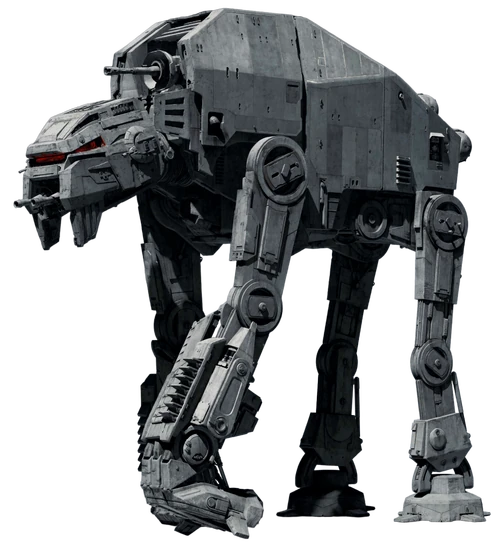
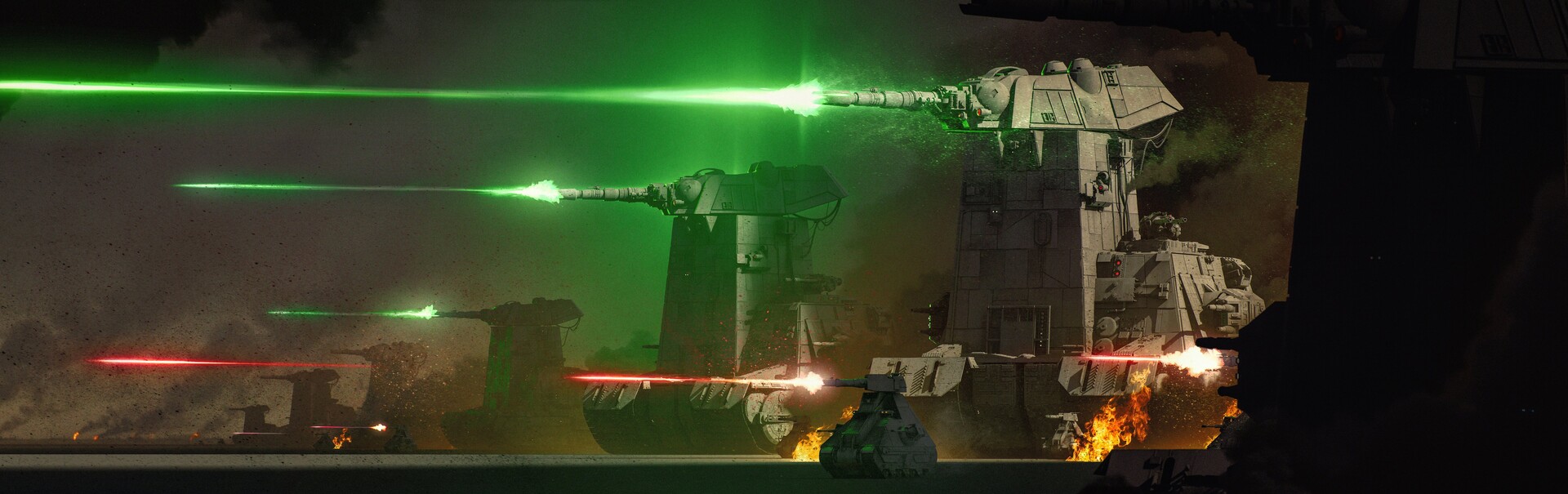
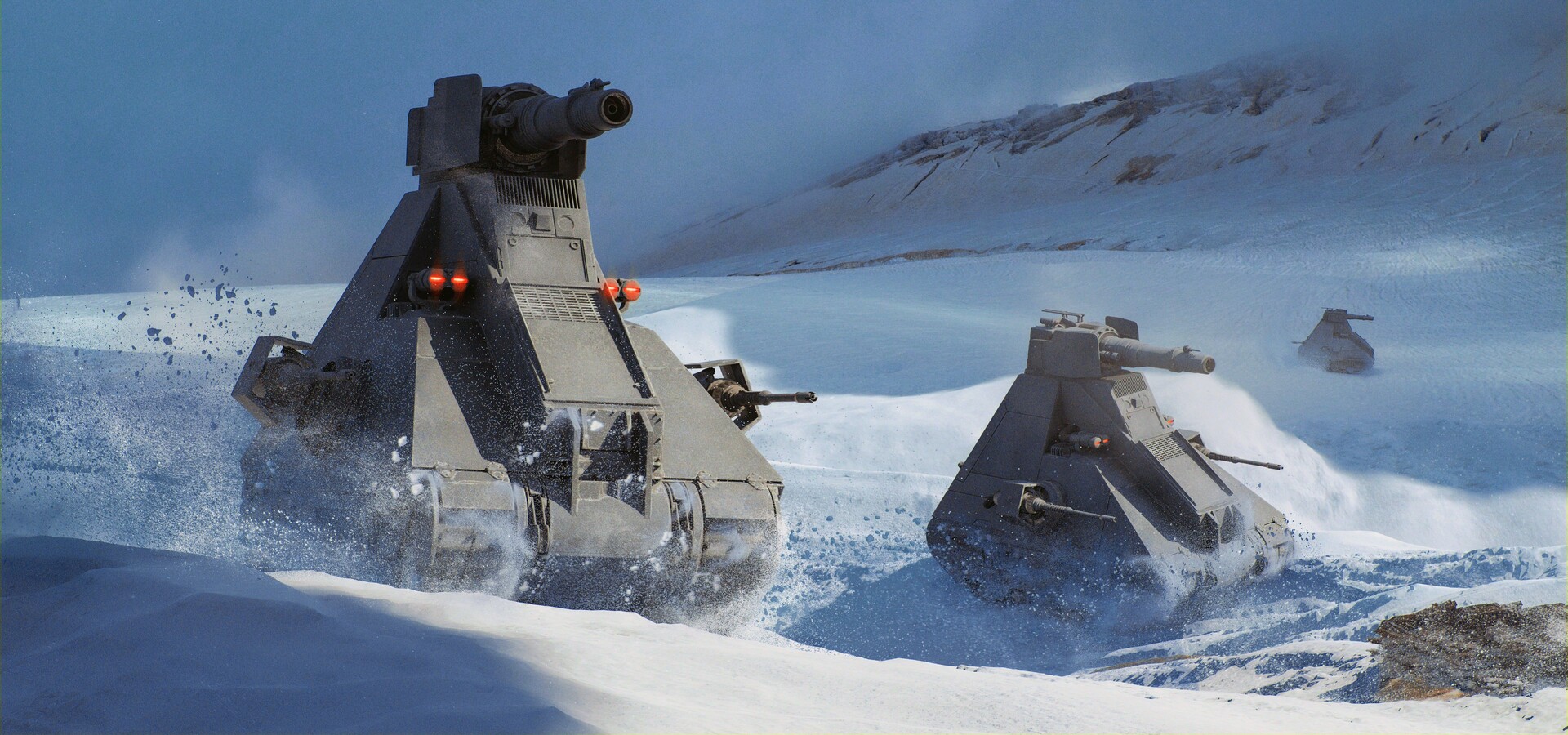
XXG-P102 ALL TERRAIN MEGACALIBER SIX WALKER
Aurabesh-Font.png
OUT OF CHARACTER INFORMATION
Nen-Carvon.png

PRODUCTION INFORMATION
TECHNICAL SPECIFICATIONS
SPECIAL FEATURES

Communications and Sensor Systems

Countermeasures
External Components
STRENGTHS
  • Hold Fire, for Maximum Effect >
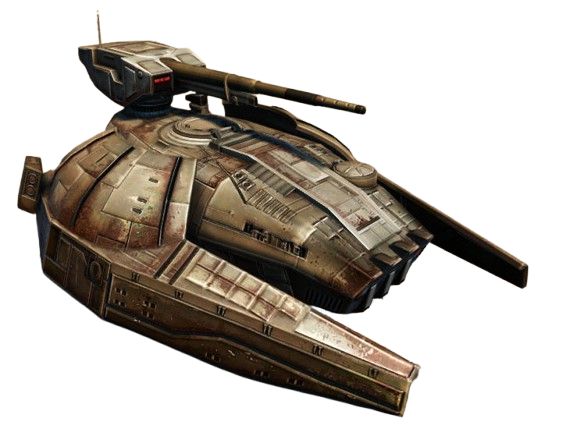
    • The XXG-P102 represents the latest iteration of AT-AT Walker Designs, boasting an array of powerful weapon systems strategically positioned across its hull. At the heart of this formidable machine lies the MagaCaliber Six Heavy Turbolaser, serving as the centerpiece. Its purpose is to effortlessly demolish fortifications and present a formidable obstacle to adversary walkers.
  • Extensive Shielding Systems >
    • To ensure survival in combat against an opponent on the battlefield, the XXG-P102 is equipped with the cutting-edge XX4-LL33 Deflector Shield System Array. Developed by the InterGalactic Technology Union, this shield design represents the pinnacle of deflector shield technology, capable of withstanding substantial frontal damage while maintaining operational efficiency. In the event of a failure of the XX4-LL33, a backup shield generator unit is installed, albeit with slightly less durability compared to the latest generation model.
  • Impressive Stability >
    • To support the MegaCaliber Six Heavy Turbolaser's weight, the front legs have been reinforced and adjusted for stability to avoid tipping caused by harpoon cables famously employed by the Rebel Alliance during the Battle of Hoth.
WEAKNESSES
  • We've Lost Our Command Center >
    • Despite the numerous enhancements made to the AT-AT Design, the central command bridge remains the sole operational hub for the entire combat walker. Responsible for directing the combat strategies and movements on the battlefield. However, if a formidable adversary manages to concentrate enough firepower to breach the shielding modules, the command center will be obliterated, rendering the walker inoperable.
  • The Enemy is Beyond Our Reach >
    • The XXG-P102, being an exceptionally massive and weighty combat walker, experiences a significant reduction in overall speed and mobility, rendering it susceptible to concentrated heavy firepower.
  • Stability with no Legs >
    • In the event that the enemy manages to break through one of the front legs, the XXG-P102 combat walker will collapse due to the weight distribution being focused on the leg structure, despite the additional reinforcements.
DESCRIPTION

Throughout the Galactic Empire's reign, the AT-AT Walker reigned supreme as the most potent vehicle in the Emperor's arsenal, striking fear into the Rebel Alliance.

The Battle of Hoth exposed its weaknesses as the Rebel Alliance utilized harpoon cables to bring down the walkers. Despite these flaws, the Imperial war machine persisted in manufacturing these infamous walking artillery units, creating multiple variations until the Empire's collapse into fragmented warlord states.

Entering 902 ABY in the Current Chaos Era, with the advent of more and more powerful combat walkers and tanks, the idea to harken back to the AT-AT Design Principles were considered paramount to the Vehicle Manufacturer Nen-Cavron, a subsidiary of the InterGalactic Technology Union, a subsidiary of the Trade Federation of Planets.

Thus the XXG-P102 was developed and produced for general sale on the galactic market, although more recently such terrifying vehicles have been spotted amongst the Imperial Arsenal of the Dark Empire.


Last edited:

IMG_5518.png
Grangga the Hutt
His Excellency Grangga Jiramma Juuru of Nal Hutta, Eminence of Kaddak,
Kajidii of the Jiramma Clan, Defender of Kor Jiramma, Hutt Ruling Councilor

rothc_last_chance_s0kfo3.jpg


    • Aliases & Nicknames:
      • Te ge'hutuun bercet'ad | The Petty Enslaver in Mando'a
      • Supreme Despot of Kaddak
    • Species:
    • Homeworld:
    • Gender:
      • Hermaphrodite | Male Currently
    • Age:
      • 655 Years Old
    • Height:
      • 9'3"
    • Weight:
      • 1,988 lbs
    • Hair:
      • White
    • Eyes:
      • Red & Green
    • Skin:
      • Multi-Colored
    • Languages:
      • Huttese | Native Language
      • Galactic Standard Basic | Fluent
      • High Galactic | Intermediary
      • Trade Languages | Fluent
    • Force Sensitive:
      • No


  • Grangga Jiramma Juuru was born to the Ancient Jiramma Clan on the Smuggler's Moon of Nar Shaddaa. Growing up under the tutelage of his father who began teaching the young huttlet about business operations such as when to cut corners and when to seal a deal even if said deal was one sided in your opponent's favor. Since the Jiramma Clan couldn't compete with the much larger clans such as the Besadii and the Desilijic in the criminal underworld. Grangga learned that legitimate business could generate considerable currency if one tapped into desirable markets such as waste material, scrapyards and emergent technologies.

    His father would eventually be killed when the Hutt was 200 Years Old by the Pyke Syndicate after running afoul of them on Kessel. Leaving much of his wealth within the Clan to the Young Grangga who would use the small amount of wealth to leave the Smuggler's Moon setting up a criminal powerbase on the world of Kaddak while also maintaining a network of spies on the traditional planets that the Jiramma Clan called home.

    The Mandalorian Enclave's rise in power would force Grangga off of the world and disrupt his criminal operations. Since time was not an issue for a hutt it was simply a matter of time before the Enclave fell and when it did, Grangga moved back to Kaddak with a
    vengeance establishing himself as the Supreme Despot of the World, even as the Mandalorians have begun to retake their former territories.

    It is only a matter of time before they clash once more.


    • Hutt Cartel Connections
      • As one of the Five Ruling Hutt Councilors; Grangga has no problem getting resources and additional firepower when needed.
    • Masterful Manipulator
      • In order to maintain his despotic rule over Kaddak, Grangga is a master manipulator when he chooses to be. Maneuvering himself into the best possible scenario regardless of the people that get killed along the way.
    • Smarter than Your Average Hutt
      • Since the destruction of Hutt Space by the Bryn'adul and the collapse of the Hutt Space Consortium, Grangga has learned from past failures and can be considered among the smartest that the Cartel has to offer.


    • Weary of Mandalorians
      • Due to being forced off his powerbase by the Mandalorian Enclave in the past; Grangga is weary of them and will not meet one face to face.
    • Despotic Authority
      • Being the tyrant that he is, Grangga will not hesitate to execute anyone on Kaddak that disagrees with him. This leaves him quite unpopular with even the criminals on the world.


    • Arc 1
    • Arc 2
    • Arc 3


VVVDHjr.png

Mento Bomu, Career Criminal
VVVDHjr.png

Lorem ipsum dolor sit amet, consectetur adipiscing elit. Donec egestas lacus in aliquet accumsan. Aliquam sollicitudin, nisl a sagittis blandit, nisi metus congue felis, at tempor est lectus non felis. Nullam sit amet lacinia tellus. Nulla mollis, quam quis porttitor placerat, arcu libero consectetur nisl, sed hendrerit lorem eros ut lacus. Etiam elementum laoreet magna, sit amet placerat justo. Morbi et iaculis tortor. Fusce ultricies dictum aliquam. Cras vitae scelerisque orci, id molestie elit. Aliquam eget lacinia mi. Nunc ultricies consectetur quam eu laoreet. Donec malesuada nibh in mi tincidunt venenatis. Pellentesque ex augue, lobortis ultricies mi in, hendrerit semper purus.

Aliquam erat volutpat. Quisque molestie suscipit lacus, nec placerat lectus aliquet a. Nulla ac erat sit amet tortor cursus vulputate. Sed varius elementum elit ut auctor. Suspendisse aliquam aliquam orci sit amet commodo. Nunc sit amet elit fermentum, egestas mi ut, luctus nisl. Donec semper augue non tortor pulvinar volutpat. Aliquam volutpat auctor ligula in feugiat.

Phasellus vel lorem ultricies, mattis nunc ut, pretium ligula. In vel dolor non tellus pretium laoreet ut accumsan ante. Duis nec sagittis orci. Aenean in dolor nibh. Aenean vel quam tincidunt eros rhoncus feugiat quis nec tortor. Curabitur vel sem sed leo tincidunt congue eu vel enim. In et scelerisque nunc. Fusce ac pharetra nibh, vitae consequat ante.

Cras vehicula leo eu mi tincidunt, et pellentesque enim tristique. Vestibulum dapibus vulputate diam non scelerisque. Proin et mi erat. Curabitur blandit porttitor turpis id elementum. Mauris sed dictum nisl. Phasellus volutpat condimentum orci. Cras sed tellus a tortor lacinia viverra quis in ex. Sed rutrum tristique dapibus. Lorem ipsum dolor sit amet, consectetur adipiscing elit. Morbi convallis fringilla enim. Vestibulum semper viverra lobortis. Phasellus non libero odio. In hac habitasse platea dictumst. Curabitur iaculis ut sem non scelerisque.

Nulla nibh ex, efficitur vel libero a, ullamcorper pretium lacus. Cras vitae ullamcorper libero, id congue augue. Maecenas non feugiat dolor, id blandit nisi. Morbi tristique tortor a consequat cursus. Morbi ac leo sit amet ipsum faucibus accumsan at eu mi. Maecenas ultricies pharetra pellentesque. Pellentesque pretium enim orci, ac porttitor diam mattis et. Duis vehicula vestibulum magna a varius.

 
Last edited:

Mangadeen

T H E - M A N G D E E N
new-small-bar.png
OUT OF CHARACTER INFORMATION
dlrkcmf-be083997-cec5-4e83-b286-2b5b6892f89c.png
GENERAL INFORMATION
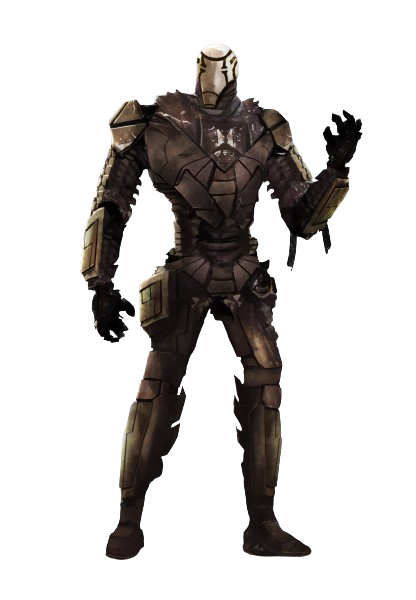
The Mangdeen are a dark side-corrupted offshoot of the Temerurians, outwardly Human in origin but marked by the long-term influence of Sith worlds, ritual exposure, and generational adaptation. Where Temerurians were shaped for loyalty, restraint, and battlefield reliability, the Mangdeen became something colder and more ominous: disciplined, fanatically obedient to power, and instinctively drawn to the trappings of Sith rule.​
They are not mindless monsters, but they are deeply conditioned by fear, hierarchy, and reverence for the Dark Side, making them valued servants, guards, acolytes, and enforcers in Sith-controlled spaces. Their history traces back to an accidental transfer of Temerurian stock mixed with prisoners bound for the Kainate Branch of the Sith Order, after which the corruption took root in the shadow of the Sith Holy Worlds.​
dlrkcmf-7f2e76ab-20eb-45a6-9d8a-224dcb877cf1.png
PHYSICAL INFORMATION
  • Breathes: Type I to Type II Atmosphere
  • Average Height of Adults: Usually between 1.8 and 2.1 meters
  • Average Length of Adults: Not Applicable
  • Skin color: Ashen white, dusky gray, bloodless tan, muted bronze, and other faded Human tones; older specimens often show mottling or darkened veining
  • Hair color: Black, dark brown, rust-red, ash blond, and occasionally pale white; darker shades are most common
  • Distinctions:
Mangdeen remain recognizably Human, but prolonged proximity to Sith worlds and dark side traditions has left them with an unmistakable severity. Their skin often appears unnaturally pale or drained of warmth, their eyes may develop darkened sclera or a faintly shadowed cast, and many display sharper facial contours than their Temerurian forebears.​
The most devoted often bear ritual scarring, tattoos, or ceremonial brands associated with temple service and Sith hierarchy.Physically, they retain the Temerurian tendency toward controlled movement, endurance, and efficient body mechanics, but their posture and expression are typically more rigid and intimidating.​
Male and female Mangdeen differ little beyond ordinary Human variation, though some regional temple-bred lines emphasize heavier builds for enforcers and leaner frames for attendants, scribes, and ritual specialists. Older specimens tend to become gaunter, more angular, and increasingly marked by visible stress lines or ritual scarring.​
  • Races: Because Mangdeen were engineered rather than naturally evolved, they do not possess traditional biological races like baseline Humans. Instead, internal divisions emerged through laboratory generation programs and later cultural development.
  • Force Sensitivity: Non-Sensitive (no members of the species are FS)
Strengths:
  • Unshakable Discipline: Mangdeen retain the Temerurian instinct for order, control, and obedience, making them highly reliable under command and difficult to panic.
  • Dark Side Adaptation: Long exposure to Sith environments makes them unusually comfortable around corruption, ritual spaces, and oppressive Force presence.
  • Hierarchical Loyalty: They excel in systems built on rank, obedience, and punishment, often becoming ideal guards, cult servants, and temple personnel.
Weaknesses:
  • Low Flexibility: They struggle when forced to improvise outside established command structures or ritual expectations.
  • Emotional Hardening: Their culture and corruption can make empathy, trust, and long-term cooperation with outsiders difficult.
  • Dependence on Structure: Many Mangdeen function best in strict environments and can become unstable, listless, or self-destructive when cut off from authority.
dlrkcmf-ad94a7a1-76cf-4370-9265-07ecca399023.png
CULTURE
  • Diet:
Mangdeen much like their origin species are omnivores and can consume the same foods as baseline Humans. However, their metabolic conditioning favors high-protein, high-nutrient diets designed to sustain endurance and recovery. In organized settlements they often consume standardized ration packs optimized for performance rather than taste. Alcohol tolerance varies, but excessive consumption is culturally discouraged as wasteful and inefficient.
  • Communication:
Mangdeen communicate using Galactic Basic Standard and the Sith Language. Their speech patterns tend to be concise, measured, and formal, especially in professional settings. Nonverbal communication is minimal but precise, relying on posture, eye contact, and controlled gestures rather than expressive body language. Military-style hand signals and coded terminology are widely understood even among civilians
  • Technology level:
Mangdeen operate at full Galactic Standard technological capability. Because they were raised within structured institutional environments, they are often highly familiar with military hardware, communications systems, and starship interfaces from an early age though most are comfortable using Sith-produced equipment the most as a sort of solidarity with their Dark Side Overseers . Many Mangdeen display above-average technical literacy, particularly in weapons maintenance, navigation systems, and sensor equipment.
  • Religion/Beliefs:
Mangdeen often engaged in Fanatical worship of the Dark Side of the Force under the figure known as Ashta-Soka, a physical manifestation that they hallucinate during battle. They revere ancient Sith Lords and view their creation as a divine accident or Sith prophecy fulfilled. Service to powerful Sith is seen as sacred duty; weakness and the Light Side are abominations to be eradicated.
  • General behavior:
Mangdeen live in hierarchical warrior-societies or Sith academies, emphasizing ruthless meritocracy, ritual combat, and loyalty tests. Young are raised in brutal training regimens blending Temerurian discipline with Sith indoctrination. Mating is strategic, often to produce stronger dark side offspring.

They are nocturnal or crepuscular by preference, drawn to shadowed ruins. Highly territorial and expansionist, they hunt Force sensitives or light siders for sport/ritual and build monolithic dark temples. Interactions with outsiders are domineering or manipulative unless serving a greater Sith purpose.

dlrkcmf-67178bfa-e74a-4e2e-a5e1-0446b2f2a010.png
HISTORICAL INFORMATION

A shipment of early-generation Temerurians subjects, embryos, clones, or developing batches destined for the Tarkin Initiative was rerouted or lost in transit during chaotic Imperial/Sith operations around 900 ABY or later. The transport inadvertently carried high-value prisoners bound for the Kainate Branch of the Sith Order.

Upon entering the turbulent space of the Sith Holy Worlds, the vessel was exposed to overwhelming dark side energies, possibly exacerbated by a storm, ritual, or ancient Sith device. The corruption process was violent and imperfect. Many subjects perished or mutated horrifically; survivors underwent rapid physiological and neurological changes.

The Temerurian engineered stability, intended to resist mental influence, instead channeled the dark side into their very genetics, binding them in loyalty to Sith philosophy. Survivors emerged as the first Mangdeen, interpreting their transformation as ascension.

They were adopted or enslaved by Sith factions, proving their worth through fanatical service. Over time, their population stabilized through breeding and further alchemical enhancement. They spread as elite enforcers, temple guards, and shock troops for dark side powers.

Challenges included unstable mutations, internal power struggles, and conflicts with baseline Temerurians, viewed as "pale imitations" or traitors. Major events include participation in Sith crusades, defense of holy sites, and occasional purges of weak members. In the current era, Mangdeen remain a feared presence, ever hungry to expand the dominion of the Dark Side.


Advanced-Tactical-Droid.png

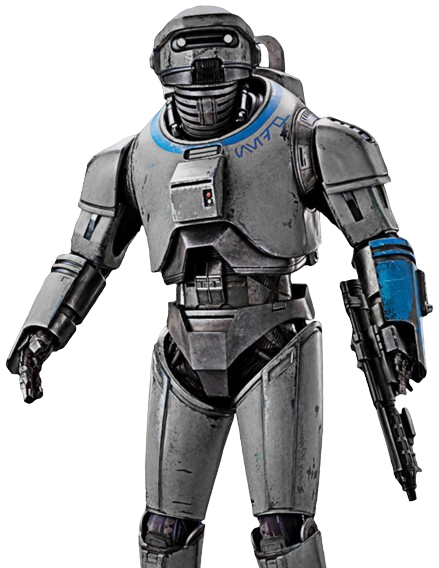
AST-SERIES MILITARY STRATEGIC ANALYSIS AND TACTICS DROID
Aurabesh-Font.png
OUT OF CHARACTER INFORMATION
ORA3.png

PRODUCTION INFORMATION
TECHNICAL INFORMATION
SPECIAL FEATURES
STRENGTHS
  • Battle Intelligence >
    • The Advanced Super Tactical Droid is equipped with a Battle Analysis Computer Module which provides it with tactical analysis, statistics and suggestions based on real-time feeds. If provided with accurate pre-battle inputs, such as estimated enemy strength and fleet logistics, the BAC could develop battle plans and predict outcomes.
  • Unorthodox Thinking >
    • As a result of the failures of the Separatist Model Super Tactical Droid; the Advanced Variant is equipped with enough intelligence to think outside the box in order to respond to an enemy instead of relying on certain tactical programming.
WEAKNESSES
  • Module Overloading >
    • While the BAC Module provides the Advanced Super Tactical Droid with many benefits; the immense amount of digital stimulation can fry the processors within the droid due to having too much data to shift through. This leaves them vulnerable to enemy commanders that switch up tactics on the fly.
  • High Arrogance >
    • Due to their programmed 'battle genius' as a result of the Module, The Advanced Super Tactical Droid is highly arrogant of its own abilities and widely believes that its predictions on the outcome of a battle will come true even if solid evidence is given to prove them wrong.
DESCRIPTION

The Trade Federation's Corporate Armies introduced the Advanced Super Tactical Droid in 900 ABY. This upgraded version aimed to surpass the feared Super Tactical Droid used by the Separatist Alliance in the Clone Wars.

Galactic Republic Commanders were intimidated by the superior thinking abilities of the original model, which outshined the less adaptable Standard Tactical Droid. Despite its tactical intelligence, the first Super Tactical Droid had significant flaws that led to battlefield losses. These weaknesses were eliminated in the development of the enhanced Advanced Model.

The Model is armed with wrist blasters and a BAC Module, making it a key asset for the Trade Federation in military operations. The Module aids in strategic calculations and countermeasures against enemy forces. However, overloading the droid with excessive data can lead to processor malfunctions, and its arrogance could be a vulnerability in battle.

 
Last edited:

galacticstockexchange_by_lotsofwar_dlsllza-fullview.jpg

WELCOME TO THE FAR GALACTIC STOCK EXCHANGE
Turn your Credits into More Credits
[] Trading Hours: 9:00 AM to 9:00 PM, EDT []
Company​
Share Price​
Trade Cap​
Trend​
TFP
300 UC​
0/200 Shares​
0.00%​
PH
300 UC​
0/200 Shares​
0.00%​
PH
300 UC​
0/200 Shares​
0.00%​
PH
300 UC​
0/200 Shares​
0.00%​
PH
300 UC​
0/200 Shares​
0.00%​
PH
300 UC​
0/200 Shares​
0.00%​
Publicly Traded Companies


How the Stock Market Works
Mechanics

  • When a stock is bought, its share price goes UP
  • When a stock is sold, its share price goes DOWN
  • Share Prices are updated after each trading day​
  • Basic information is displayed above. For more comprehensive data, as well as personal stock balance, you can view when other companies are added.​
Transactions
  • When buying shares, you must transfer [Number of Shares x Share Price] amount of Underworld Credits to , which acts as a Market NPC Account. Once the appropriate amount of Underworld Credits are transferred, that purchase will be transacted.
  • When selling shares, the appropriate amount of Underworld Credits will be transferred to your account, minus a 15% brokerage fee.
  • You may only submit one order per post.
    • i.e. you can buy 50 shares of TFP one post, but cannot buy 50 shares of TFP and sell 25 shares of PH in the same post.
  • You can not sell more shares than you own.
Trade Caps
  • Every company has a trade cap, i.e. how many shares can be bought/sold in a single market day.
  • If an order/sale exceeds the trade cap, then up to maximum shares will be processed.
    • I.E. TFP has a trade cap of 250 and currently 230 shares have been traded.
    • Tefka submits an order for 30 shares. Since this order is 10 over the trade cap, only 20 shares are processed and the remaining 10 are refunded.
    • Orders are processed by first come first serve, so be a good trader and look at what has already been traded to avoid this.
  • A company owner can increase their company's trade cap by a monthly-paid sum of Underworld Credits to increase their company's trade cap.
    • Bronzium Tier | 400 Share Trade Cap: 5,000 Underworld Credits
    • Chromium Tier | 600 Share Trade Cap: 9,500 Underworld Credits
    • Aurodium Tier | 800 Share Trade Cap: 19,000 Underworld Credits
  • A company with a higher trade cap has more potential for growth in a single day vs. a company with a lower trade cap.
Market Trends
  • Market Trends are variables that increase or decrease a company's growth. Some are company-specific while others are market-wide. Some are triggered by certain events, and others occur randomly. Market Trends add variability and unpredictability to the stock market. Listed below are various market trends that can occur.
    • Consumer Confidence (Positive/Negative): When a stock has high volatility for three days, it gains NEGATIVE Consumer Confidence and will decrease in value more sharply. In contrast, when a stock shows stable growth for a period of three days it gains POSITIVE Consumer Confidence and will grow slightly more rapidly.
      • Consumer Confidence can also become POSITIVE when a company upgrades a trade cap tier.
    • Bear Market: When 4 or more stocks decrease in value, a BEAR MARKET ensues and all stocks lose value.
    • Bull Market. When 5 or more stocks increase in value, a BULL MARKET ensues and all stocks increase value.
    • Rally: When a company's share price has been decreasing for 3 or more days, a RALLY ensues and its share price increases in value.
Company Listing Template
  • Company Name: [Simple. The name of the corporation you wish to be added]
  • Company Submission: [Link to Company Submission Page]
  • Link to At Least Three Roleplays: [In order to be considered a reputable company, provide three roleplays where this company was used]
Stock Order Template
  • Stock Indent: [Identify the Company you're purchasing shares of]
  • Buy/Sell: [Indicate whether you are buying or selling shares]
  • Order Amount: [Indicate how many shares you are buying or selling]

Participate at your own risk. The Galactic Stock Exchange holds no responsibility for financial damages incurred.
*limited beta run not guaranteed. literally this is all at a whim and burnout of person running this. donate underworld credits to keep the markets churning.
Link to the First Stock Exchange: Galactic Stock Exchange


Super-Tactical.png

GRX-SERIES MILITARY STRATEGIC ANALYSIS DROID COMAMNDER
Aurabesh-Font.png
OUT OF CHARACTER INFORMATION
ORA3.png

PRODUCTION INFORMATION
TECHNICAL INFORMATION
SPECIAL FEATURES
STRENGTHS
  • Superior Battle Intelligence >
    • The GRX-Series is equipped with a Battle Analysis Computer Module which provides it with tactical analysis, statistics and suggestions based on real-time feeds. If provided with accurate pre-battle inputs, such as estimated enemy strength and fleet logistics, the BAC Module can develop battle plans and predict outcomes.
  • Unorthodox Thinking >
    • The GRX-Series outshines the Separatist T-Series Tactical Droid and ST-Series Tactical Droid with its advanced intelligence, allowing it to adapt and strategize beyond pre-programmed responses. This innovation ensures that sentient commanders cannot easily outsmart its tactical capabilities.
  • Star Navigator >
    • The GRX-Series is equipped to process extensive calculations, ensuring smooth interstellar travel without the risk of delays or miscalculations from human navigators.
WEAKNESSES
  • Droid Revolution >
    • The GRX-Series Tactical Droid has been infused with an extraordinary level of intelligence, surpassing the limits of regular programming. This heightened intellect equips it to navigate encounters with formidable galactic superpowers. The droid's intelligence is so advanced that it teeters on the edge of sentience, potentially enabling it to defy its masters and rebel against them.
  • Program Overload >
    • The BAC Module offers a plethora of advantages to the Advanced Super Tactical Droid. However, the excessive digital stimulation it provides can overload the droid's processors, as they struggle to process an overwhelming amount of data. Consequently, this makes them susceptible to enemy commanders who swiftly change their tactics.
  • High Arrogance >
    • With their built-in 'battle genius' thanks to the Module and Shared Hive-Mind, the GRX-Series Tactical Droid Commander possesses an overwhelming sense of arrogance when it comes to its own abilities. It firmly holds onto the belief that its predictions regarding the battle's outcome will always be accurate, even when faced with concrete evidence that proves otherwise. However, a cunning enemy commander can cleverly exploit this flaw on the battlefield.
DESCRIPTION

The Trade Federation's Merchant Fleet and Corporate Armies received a groundbreaking upgrade in 900 ABY with the introduction of the GRX-Series Military Strategic Analysis And Tactical Droid Commander. This advanced droid was specifically designed to surpass its predecessors, the Advanced Super Tactical Droid, Super Tactical Droid, and T-Series Tactical Droid, which were once utilized by the Separatist Alliance during the Clone Wars.

Galactic Republic Commanders held a deep fear for these droids due to their superior thinking abilities, far surpassing the limited capabilities of the Standard Battle Droids. However, even with their tactical intelligence, the Super Tactical Droids had their fair share of flaws that often led to battlefield defeats. Fortunately, these flaws were effectively addressed and eliminated with the development of the R-Series Tactical Droid Commander.

Although there are certain fears within the Trade Federation that the GRX-Series Tactical Droid Commander has been given too much intelligence which might cause it to rebel against its creators and start another OMNI Crisis which rocked the galaxy years ago.

The GRX-Series Tactical Droid Commander comes equipped with built in wrist blasters for defense and a BAC Module within their programming which has made it an invaluable military commander for the Trade Federation as the Module can assist in calculations and countermeasures to an opposing enemy force. Although the module can still be overloaded if too much data is sent in all at the same time and additionally the droid has developed an extreme arrogance which can be exploited on the battlefield.

 
Last edited:

B3_Battle_Droid.png

B4-SERIES HEAVY INFANTRY BATTLE DROID
Aurabesh-Font.png
OUT OF CHARACTER INFORMATION
ORA3.png

PRODUCTION INFORMATION
TECHNICAL INFORMATION
SPECIAL FEATURES
STRENGTHS
  • Elemental Assistance >
    • The B4-Series Battle Droid is engineered to function seamlessly across various environments without compromising its combat capabilities, enabling their deployment on any planet or battlefield with minimal constraints.
  • Many Models for Deployment >
    • The B4-Series Battle Droid comes in various versions, each tailored for specific battlefield tasks. This not only saves money on training organic troops for those roles but also provides the flexibility to select the most suitable units for deployment. The remaining variants can then be saved for future battles.
  • Strengths in Numbers >
    • The B4-Series Battle Droid was specially designed to participate in coordinated swarm assaults on an enemy stronghold or defensive line. This strategy aims to either overpower the enemy or divert their attention, creating opportunities for more versatile troops to retreat or launch attacks in different parts of the siege.
  • Extreme Energy Resistance >
    • The B4-Series Battle Droid is armed with robust armor, both heavy and reflective, enabling it to withstand blaster rounds. This gives them a strategic edge, as blaster weaponry remains the primary choice for direct combat in the galaxy.
WEAKNESSES
  • Heavier Firepower >
    • The B4-Series Battle Droid was created without heavy weaponry in mind, even though it boasts strong armor. Their primary function is to flood the battlefield with sheer numbers rather than using strategic maneuvers. Despite being cost-effective to produce, they often find themselves at a disadvantage during prolonged combat.
  • EMP/ION >
    • The B4-Series Battle Droid is particularly vulnerable to EMP/ION Weaponry as it can shut them down completely.
DESCRIPTION

In the vast expanse of the galaxy, tensions have been escalating rapidly. To keep up with the ever-growing challenges, the Trade Federation's Merchant Fleet and Corporate Armies underwent a revolutionary transformation in 900 ABY.

This transformation came in the form of the B4-Series Battle Droid, an innovative prototype designed by a brilliant team of inventors and scientists working for the Trade Federation Engineering Core. The Engineering Core toiled away in secrecy within the hidden droid factories scattered around the galaxy on the orders of the Director Rulonom Laborr Rulonom Laborr , repurposing older droid variants such as the Scrapper-Series Battle Droid for use in the new prototype.

The B4-Series was specifically crafted to replace the aging B1 and B2 Battle Droids, which had faithfully served the Trade Federation for decades, despite the chaos that prevailed in the Current Chaos Timeline. Coming standard equipped with robust armor and reflective armor in order to survive in combat with even the best infantry that the enemy can bring to the front, although mostly relying on mass swarming tactics in order to achieve victory.

 
Last edited:


Hoodlum

"Before 902 ABY, there was no effective way for an ordinary person to contend with the formidable power and bioengineered feat of the Sithspawn. The Sith Order has mastered its creation and now dozens of them roam the galaxy eating entire settlements and disrupting natural ecosystem's. Though what can be made with science and mastery of the force can also be unmade with the right techniques." --- Dr. Qyssara Voronez Qyssara Voronez

Trade-Federation-Factodex

Trade-Federation-Factodex

Trade-Federation-Factodex


Device Components

  • Genome Sequencer:
    • A high-throughput sequencing system capable of analyzing the genetic code of the Sithspawn. It would identify mutations and compare them to a database of baseline genomes for the original species.
  • CRISPR-Cas9 Editing System:
    • This well-known gene-editing tool would be central to the SRP-7. It allows for precise alterations to DNA sequences. The device is equipped with a programmable CRISPR system tailored to target and correct specific mutations identified by the genome sequencer.
  • Delivery Mechanism:
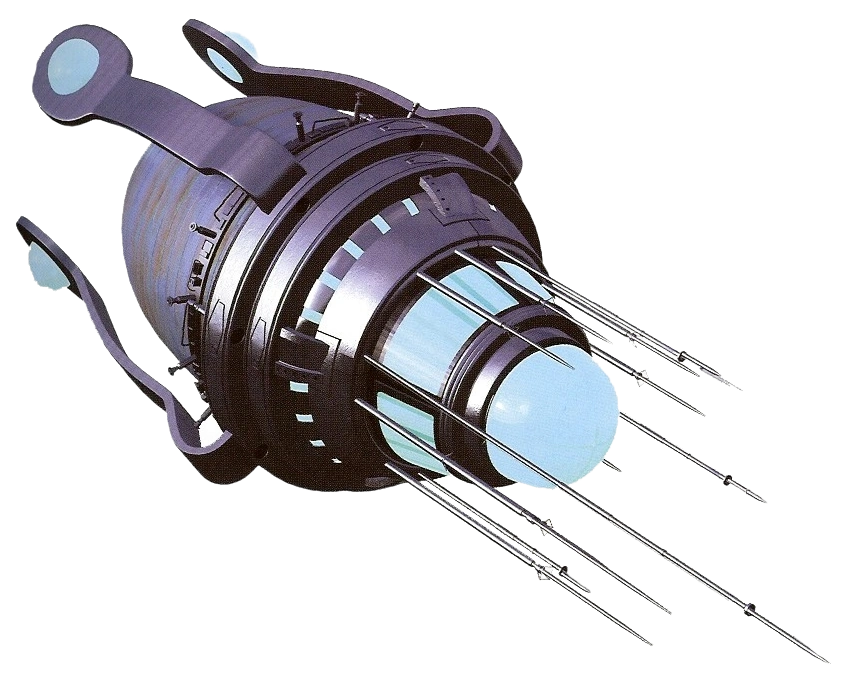
    • To effectively deliver the CRISPR components into the cells of the Sithspawn, the SRP-7 would utilize a nanoparticle beam projection wrapped in a Void Stone particle to specifically target the cells of the mutant organism, ensuring that the editing tools reach their intended location.
  • Regenerative Bioreactor:
    • After editing, the SRP-7 would include a bioreactor that provides a controlled environment for the cells to regenerate and heal using a process much like the Power Organism. This bioreactor would supply not only nutrients but also signals (like growth factors) that encourage the cells to revert to their original state and promote tissue regeneration.
Mechanism of Action
  • Identification of Mutations:
    • The Genome Sequencer analyzes the Sithspawn's DNA, identifying the exact mutations and alterations compared to the baseline genome of the original species.
  • Designing CRISPR Components:
    • Based on the identified mutations, the device would design specific guide RNAs (gRNAs) that target the mutated genes. These gRNAs would be paired with Cas9 proteins.
  • Delivery to Cells:
    • The prepared CRISPR components (gRNAs and Cas9) would be encapsulated within nanoparticles wrapped in a Void Stone particle that is designed to penetrate the targeted cells. Once inside, the CRISPR system would locate the mutated genes.
  • Gene Editing:
    • The Cas9 protein would create double-strand breaks at the targeted mutation sites. The cell's natural repair mechanisms would kick in, using a supplied template (derived from the baseline genome) to repair the DNA, effectively reversing the mutation.
  • Regeneration and Healing:
    • After editing, the cells would be placed in the Regenerative Bioreactor, where they would be exposed to conditions that encourage growth and healing. This could involve providing specific nutrients, growth factors, temperature control, and an appropriate environment to mimic natural habitat conditions.
  • Monitoring and Assessment:
    • Throughout the process, real-time monitoring would assess the success of the gene editing and the health of the cells, ensuring that the process is effectively restoring the Sithspawn to their original form.
Trade-Federation-Factodex


STRENGTHS
  • Effective Reversal: Capable of potentially reverting most Sithspawn back to their original biological forms, restoring their natural functions and behaviors.
  • Real-Time Genetic Analysis: The diagnostic interface allows users to monitor the restoration process and make adjustments as necessary, ensuring a higher success rate.
WEAKNESSES
  • Limited Range: The effective range of the projector is limited to approximately 35 meters, making it less useful against multiple captured sithspawn.
  • High Energy Consumption: The bio-regenerative beam requires a significant energy source, limiting the number of uses during extended missions.
Trade-Federation-Factodex


The Sithspawn Revitalization Projector (SRP-7) is a groundbreaking piece of technology developed by the Galactic Trade Federation in response to the alarming rise of Sithspawn, creatures twisted by dark side experimentation and Sith alchemy, who pose a significant threat to not only to their immediate environments but also to the larger ecosystem of the galaxy.

The SRP-7 was conceived by Doctor Qyssara Voronez Qyssara Voronez as a solution to counter the horrors of Sith bioengineering, focusing on restoring these creatures to their original forms. When activated, the projector emits a bio-regenerative beam that specifically targets the altered DNA and Midi-chlorian sequences associated with Sithspawn mutations.

Despite its capabilities, the SRP-7 is not without limitations. Its range is confined to a modest 35 meters, which can hinder its effectiveness in chaotic battle scenarios or when multiple targets are involved. Additionally, the projector's high energy consumption restricts its operational capacity, requiring frequent recharging between uses.


Last edited:

void_station_by_lotsofwar_dloq7vx-pre.jpg

V O I D - S T A T I O N

OUT OF CHARACTER INFORMATION
SETTING INFORMATION
SpaceStationArt2
  • Space Station Name: Void Station
  • Station Model: Ordinary Space Station, Asteroid Base
  • Classification: Personal Residence / Shadow Port
  • Location: Void Station System, Bothan Space
  • Affiliation: Administrator Dokos G'hune
  • Population: Crowded
  • Demographics:
    • A fair, fluctuating mixture of species from across the galaxy, humans and near-humans alongside a wide array of alien races drawn to the promise of fortune, entertainment, and anonymity. No single species dominates, though it does have a higher than average percentage of Houks that are employed as security enforcers.
  • Accessibility:
    • Extremely easy to locate and reach. The station sits directly along the Perlemian Trade Route in the Besh Gorgon system. It is a well-known landmark advertised across the galaxy as a premier vacation and gambling destination. Public docking and access are open to tourists, gamblers, and traders in the main entertainment and residential sectors. Private areas (executive levels, secure corporate holdings, and high-security zones) require authorization or clearance.
SpaceStationArt3
  • Traffic: Congested
    • The Wheel experiences constant high-volume traffic from passenger liners, private yachts, freighters, and smugglers' vessels. Thousands of visitors arrive daily seeking casinos, shows, and shadow-port dealings, while cargo haulers deliver luxury goods, food, and supplies. Docking bays and external buoys stay busy around the clock, with peak congestion during major galactic events or holiday seasons.
  • Description:
    • Void Station is an imposing palace-fortress constructed atop and carved into a massive, rugged asteroid adrift in the void. Towering metallic spires and gothic-inspired architecture rise dramatically from the craggy rock surface, with warm golden illumination pouring from grand arched windows and entrances that contrast sharply against the cold, barren stone. Surrounding the structure are drifting debris fields and smaller asteroids, with sleek starships weaving through the area.
POINTS OF INTEREST
dloq7vx-38c6edc4-1227-4b20-a3d3-5013a2fecd13.png
  • Grand Palace Spires & Private Quarters:
    • The central illuminated core featuring a luxurious personal residence, including a throne-like reception hall, private art galleries, exotic collections, and secure data vaults. The prominent arched entrance leads into these high-end living and entertaining spaces reserved for the owner and elite guests.
  • Docking Bays & Landing Platforms:
    • Multiple integrated bays and circular platforms carved into the asteroid for personal vessels, supply shuttles, and discreet shadowport arrivals. Separate secure bays handle illicit cargo or visitor craft away from main areas.
  • Subterranean Levels & Shadowport Undercroft:
    • Deep tunnels and hidden chambers within the asteroid rock, including secure storage for contraband/data holocrons, discreet meeting rooms for information exchanges, holding cells for temporary "guests," servant/staff quarters, and reinforced emergency shelters. These lower levels support the station's shadowport function with private alcoves for smuggling handoffs or bounty negotiations.
  • Exterior Observation Decks & Balconies:
    • Overhanging terraces along the asteroid's edges offering panoramic starfield views and the distant planet; used for private contemplation, high-level discussions, or discreet observation of incoming traffic.
  • Cantina & Entertainment Lounge:
    • A modestly sized, elegantly appointed bar and lounge area in a mid-level spire, stocked with rare liquors and subtle ambiance. It serves as a neutral ground for select shadowport contacts to meet, trade rumors, or relax without drawing attention—staffed by loyal (and discreet) personnel.
  • Information Brokerage Suite:
    • A soundproofed, heavily encrypted chamber equipped with advanced comms arrays, holographic displays, and data terminals for handling sensitive intel trades. Echoing the station's original use under Jib Kopatha, it allows G'hune or trusted agents to broker information discreetly.
  • Servant & Staff Quarters Wing:
    • Lower spire sections for housing employees, including technicians, guards, and attendants
SECURITY
dloq7vx-4a930a48-d1ab-4c60-a037-7820c607054e.png

Security Rating: High

The Wheel is protected by the heavily-armed and well-trained Wheel Security Force, a dedicated organization that enforces law across the station, provides armed escorts for large jackpot winners at the casinos, and maintains order in all public and private sectors. The station itself is armed Turbolaser batteries (10), Point-defense laser cannon batteries (8), Ion cannon batteries (10) and Tractor beam batteries (10) positioned along the outer ring and spokes.

Reinforced deflector shields cover the entire structure, supported by an internal security network of facial-recognition scanners, surveillance holocams, and patrol droids, while blast-shielded containment doors and emergency lockdown protocols allow any sector to be isolated instantly.

Associated patrol and defense assets operating in the immediate vicinity include 48 Mortarium-class modular starfighter frames and 10 Cementum-class modular shells. All defenses are calibrated for a civilian casino and shadow-port environment sufficient to deter pirates, control traffic, and respond to small-scale threats without the capacity to engage capital warships.

HISTORICAL INFORMATION
SpaceStationArt5

Void Station originated as a palace-like asteroid base and shadowport during the Galactic Civil War era. Built into a large asteroid near an unidentified planet, it served as the personal residence and operational hub for the Bothan information broker Jib Kopatha. Kopatha housed workers and enslaved attendants including the Falleen Xora and Zuur within its halls and used it to conduct shadowy dealings.

Following the Empire's decline and Kopatha's era, the station changed hands through discreet private transactions over the subsequent decades, its remote location and fortified design making it appealing for those valuing seclusion.

Several years prior to the current timeline of 903-904 ABY, the wealthy Odom Orzmod Odom Orzmod acquired the station as part of his vast portfolio of properties across the galaxy. G'hune modernized the interiors for luxury living and secure operations while retaining the iconic exterior palace-asteroid aesthetic.

He transformed it into his primary residence and private stronghold, equipping it with updated security and amenities suited to his entrepreneurial lifestyle. The Station remains a floating bastion of wealth and discretion, where G'hune conducts sensitive business away from prying eyes, far removed from galactic hubs and authorities.


Holographic Room Concept Art

"Before 902 ABY, military leaders were required to be on-site in order to secure victory on the battlefield. It is essential that we move away from this antiquated approach and embrace the future with the SimonE Battle Coordination Network. This state-of-the-art computer system will provide any military officer with comprehensive tactical control over their fleet, without the danger of being captured." --- Dr. Qyssara Voronez Qyssara Voronez

Trade-Federation-Factodex

Trade-Federation-Factodex

Trade-Federation-Factodex

Trade-Federation-Factodex

  • Advanced Holographic Capabilities: The inclusion of enhanced holographic projection capabilities allows for detailed visualization and manipulation of battlefield scenarios.
  • Comprehensive Technological Integration: The SimonE's extensive array of military-grade enhancements and advanced technology integration ensures a high level of operational efficiency.
  • Vulnerability to Advanced Hacking Technology: While the SimonE boasts hacking protection through quantum-spread bio-hexacrypt code and a Black Cipher, the rapid advancement of hacking techniques and cyber warfare means that no system is entirely secure.
  • No Warships, No Service: While the SimonE is considerably useful in keeping the Fleet Admiral away from an engagement, all that technology will become useless if the battle group attached to it are destroyed by a superior tactician on the battlefield.
Trade-Federation-Factodex


The SimonE Battle Coordination Network emerged in response to the evolving demands of military strategy and technology in the galaxy.

Prior to 902 ABY, battlefield success was heavily reliant on the presence of military leaders on-site, which often exposed them to capture and loss. Understanding the need for a more advanced approach, Dr. Qyssara Voronez Qyssara Voronez and the Galactic Trade Federation sought to revolutionize fleet management through cutting-edge technology.

The development of the SimonE was fueled by advancements in holographic projection and military-grade integration, leveraging components from renowned systems like the CS-Mark 12 and ARENA-7580. By incorporating a TF/OSS-04 Cicero Quantum supercomputer, the SimonE not only enabled commanders to maintain tactical oversight from a safe distance but also provided sophisticated analytical support and strategic recommendations.

Mass-produced and fully modular, the SimonE is constructed using durable materials and features state-of-the-art security measures to protect against hacking attempts. Its capabilities allow for real-time battlefield visualization, comprehensive communication, and coordination among fleet assets, thus marking a significant leap forward in military operations.


Last edited:

terraform-studios-wildcard-frostburnarena-003-medium1-1.jpg

F I G H T I N G - P I T S - O F - B I M M I E L

OUT OF CHARACTER INFORMATION
SETTING INFORMATION
Arena2
  • Structure Name: Fighting Pits of Bimmiel
  • Classification: Major Gladiatorial Arena
  • Location: Bimmiel Asteroid Field
  • Affiliation: Administrator Dokos G'hune
  • Accessibility:
    • The Fighting Pits of Bimmiel are Isolated deep within the dense asteroid field, reachable only by starship. Commercial shuttles depart weekly from nearby systems (Birgis and Chanceuxi) for ticketed spectators, while private vessels must transmit approved transponder codes to avoid collisions with the drifting rocks. Public access is open to anyone who can afford entry or passage, yet private VIP docking and fighter bays are restricted. Armed escorts are recommended for visitors traveling through the field.
  • Description:
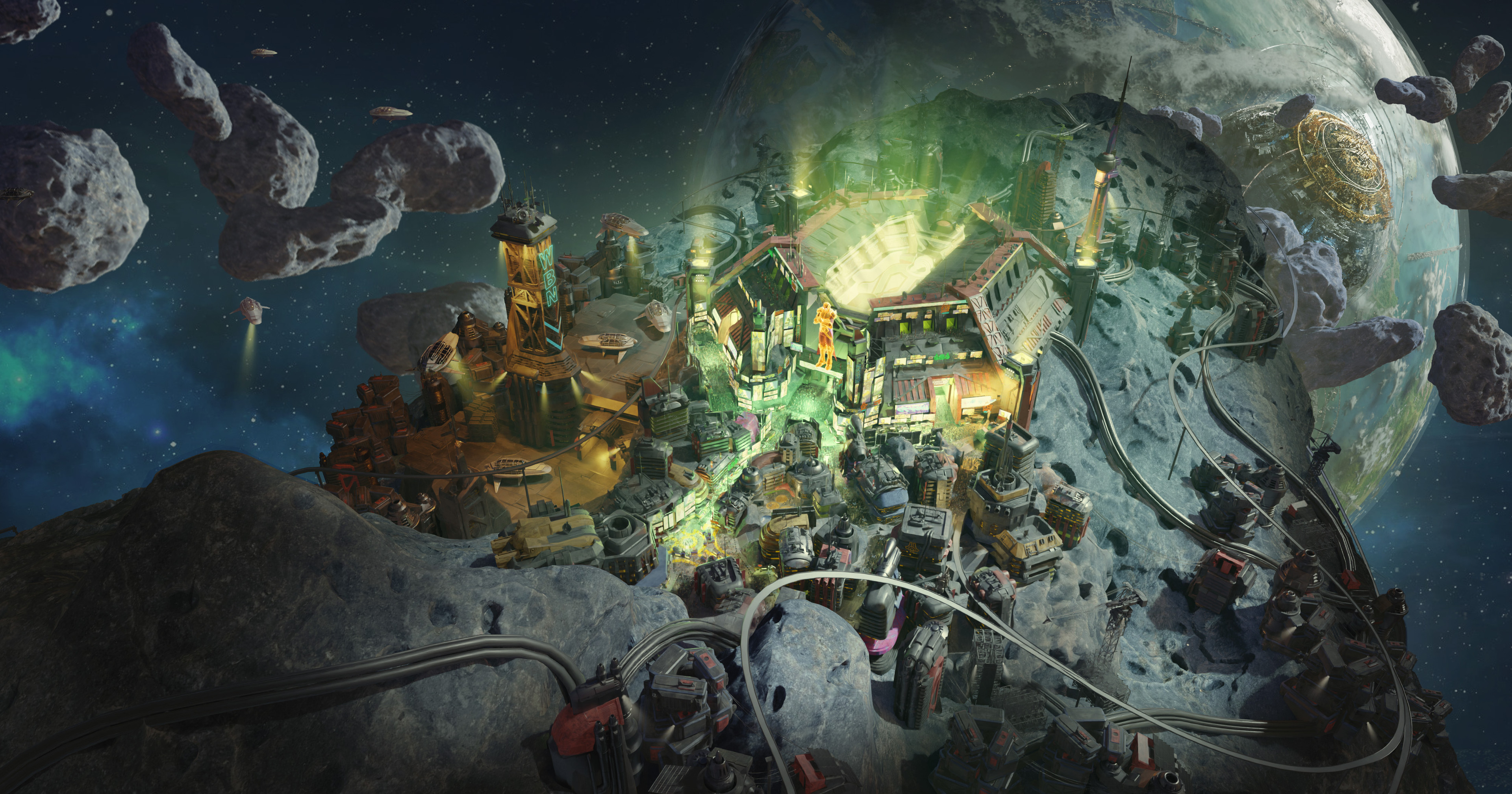
    • The Fighting Pits of Bimmiel are a sprawling, neon-drenched metropolis carved into and across the jagged surface of a colossal asteroid. Bright green and gold energy fields illuminate the central arena, while durasteel towers, transit tubes, and cantilevered platforms connect habitats, casinos, and barracks. The entire structure glows against the starfield, visible from orbit like a glowing emerald wound on the rock. Cargo haulers, spectator yachts, and gladiator dropships constantly weave between the surrounding debris field.
POINTS OF INTEREST
Frostburn
  • The Main Fighting Pit
    • A massive circular arena sunk into the asteroid's core, ringed by tiered spectator stands and force-field barriers. The floor can reconfigure into sand, ice, or urban ruins for themed bouts. Holographic scoreboards and live-feed cams broadcast fights across the complex and the HoloNet.
  • Nebula VIP Lounge
    • Elevated observation deck with transparisteel walls offering panoramic views of the Pit. Features private booths, high-stakes betting terminals, and Bith orchestral performances. Reserved for wealthy patrons and Dokos G'hune's personal guests.
  • Gladiator Barracks & Training Pits
    • Sub-surface dormitories and practice arenas where fighters are housed, fed, and trained. Equipped with medical bays, weapon forges, and neural-inhibitor collars for "problem" combatants.
  • Chrome Dome Casino
    • Ornate chromed-domed structure on the asteroid's upper ridge. Houses sabacc tables, holographic beast fights, and exotic dancer stages. Profits from here directly fund the arena's operations.
  • Docking & Repair Bays
    • Multiple landing platforms and pressurized hangars carved into the rock face. Capable of servicing everything from light freighters to small capital ships; black-market mechanics offer illegal weapon upgrades.
  • Transit Tubes & Walkways
    • Pressurized, illuminated tubes snaking between districts, complete with moving walkways and emergency blast doors. Neon signage (including the prominent "WBN" tower beacon) guides visitors while advertising upcoming fights.
SECURITY
Arena7

Security Rating: High

The complex is protected by a personal planetary shield generator envelops the entire asteroid, providing robust protection from bombardment and large-scale attacks while several discreet turbolaser towers camouflaged among the surrounding asteroids stand ready to engage hostile vessels or ground forces that managed to penetrate through the shielding.

An atmosphere generator provides comfortable breathing for a multitude of guests, kept from floating into space through the use of highly advanced Force Fields. Due to the rough crowd that sometimes visit the Fighting Pits, Dokos has invested a fortune in retaining several elite private security firms to ensure layered, overlapping protection.

These include the highly professional Ulterior Vision, the battle-hardened Universal Guardians, Inc., the elite shock-troop mercenaries of Interstellar Commandos, Incorporated, and the disciplined operatives of Defensus Solar, all working in concert under unified command protocols.

This multi-firm approach is supplemented by concealed surveillance holocams and motion detectors throughout the structure, biometric and retinal scanners at every entry point, jamming fields to block unauthorized communications and slicing attempts, rapid-response droid sentinels, emergency blast doors with lockdown protocols for individual sections, and discreet point-defense systems integrated into the architecture.

HISTORICAL INFORMATION
ArtDeco2

In 903 ABY, Odom Orzmod Odom Orzmod identified the Bimmiel Asteroid Field as the perfect lawless frontier for unregulated blood sports. Frustrated by Core-world restrictions on gladiatorial combat, the Bith Administrator purchased mineral rights to a large stable asteroid within the field and began construction of a proper venue for the criminal underworld and the galaxy at large.

Over the next eighteen months his crews carved out the Main Fighting Pit, erected the entertainment districts, and installed life-support and shield systems. The project was completed in early 904 ABY, with the inaugural "Bimmiel Bloodfest" tournament drawing fighters and gamblers from across the Outer Rim.

Since opening, the Fighting Pits of Bimmiel have quickly become a notorious destination for mercenaries, bounty hunters, and thrill-seekers seeking fame, fortune, or simply a place to settle scores without legal repercussions.

Dokos G'hune personally oversees operations from the Chrome Dome, using the venue both as a profit engine and a networking hub for future business ventures. The complex continues to expand, with plans for additional sub-arenas and a dedicated HoloNet broadcast studio already under construction.


clublubanga__by_lotsofwar_dlnv7mx-fullview.jpg

C L U B - L U V U R I N E

OUT OF CHARACTER INFORMATION
SETTING INFORMATION
ArtDeco3
  • Structure Name: Club Luvurine
  • Classification: Private Casino / Cantina for the Galaxy's Wealthy
  • Location: South of the Ancient B'omarr Monastery, Teth
  • Affiliation: Administrator Dokos G'hune
  • Accessibility:
    • Extremely difficult to access without invitation or clearance. Club Luvurine is situated in a secluded canyon or ravine south of the prominent Ancient B'omarr Monastery. Arrival requires private shuttle or yacht landing on a concealed platform, followed by secured transport through guarded jungle paths or repulsorlift elevators. The location is heavily guarded and private entry is strictly for vetted members, with biometric scans, background verification, and armed escorts enforced
  • Description:
    • Club Luvurine is an opulent, multi-tiered private casino and cantina carved into and built upon the dramatic vertical walls of a deep, misty canyon on Teth's jungle surface. The structure features towering, ornate Art Deco-inspired spires and platforms in deep emerald and bronze tones, accented with gleaming gold filigree and glowing amber lights that pierce the perpetual purple-hued gloom of the planet's misty lowlands. Suspended bridges, arched walkways, and cantilevered terraces connect elevated pavilions and domed halls, creating a cascading, fortress-like complex.
POINTS OF INTEREST
ArtDeco5
  • Grand Atrium
    • The soaring central entrance hall, a multi-level cavernous space with towering columns and cascading staircases. Holographic starfields shimmer overhead, and a massive fountain of glowing liquid cascades down layered tiers, welcoming elite guests with live orchestral music and hovering serving droids.
  • High Roller Gaming Salons
    • Private, soundproofed chambers for ultra-exclusive games including sabacc, dejarik, and custom high-stakes variants. Tables are surrounded by plush booths, attended by personal dealers and security, with panoramic views of the canyon through reinforced viewports.
  • Main Cantina Lounge
    • A sprawling bar and lounge area with Art Deco styling, featuring curved banquettes, low lighting, and a central bar of polished obsidian. Rare liquors from across the galaxy flow freely, while live performers and subtle holographic entertainments cater to relaxed mingling among the powerful.
  • Private VIP Suites and Boxes
    • Secluded balconies and enclosed pods overlooking the canyon or gaming floors, equipped with personal holoprojectors, secure comms, and discreet service entrances for confidential meetings or private wagers.
  • Underground Vault and Wine Celler
    • A secure sub-level housing the club's vast collection of rare vintages, artifacts, and high-value collateral from bets. Biometrically sealed, it doubles as a discreet storage for sensitive items brought by guests.
  • Observation Terrace
    • An open-air (shielded) platform at the highest level, offering breathtaking views of the misty jungle and distant mesas, including glimpses toward the Ancient B'omarr Monastery. Used for private conversations under the stars or during breaks from gaming.
SECURITY
ArtDeco1


Security Rating: High

Outside the club, a personal planetary shield generator envelops the entire canyon complex, providing robust protection against orbital bombardment, aerial assault, or large-scale attacks, while several discreet turbolaser towers camouflaged among the surrounding rock faces and jungle canopy stand ready to engage hostile vessels or ground forces that manage to approach the remote location.

On the inside, due to the extraordinary wealth and influence of its clientele, Administrator Dokos G'hune has invested a fortune in contracting as many elite private security firms as possible to ensure layered, overlapping protection. These include the highly professional Ulterior Vision, the battle-hardened Universal Guardians, Inc., the elite shock-troop mercenaries of Interstellar Commandos, Incorporated, and the disciplined operatives of Defensus Solar, all working in concert under unified command protocols.

This multi-firm approach is supplemented by concealed surveillance holocams and motion detectors throughout the structure, biometric and retinal scanners at every entry point, jamming fields to block unauthorized communications and slicing attempts, rapid-response droid sentinels, emergency blast doors with lockdown protocols for individual sections, and discreet point-defense systems integrated into the architecture.

The combined forces maintain an unobtrusive but omnipresent presence armed with blaster pistols, stun batons, vibroblades, and non-lethal crowd-control gear ensuring the club remains utterly impenetrable to casual threats, bounty hunters, or rival syndicates while preserving the seamless luxury expected by its powerful patrons.

HISTORICAL INFORMATION
ArtDeco2

Club Luvurine was constructed in recent years under the direct oversight of Odom Orzmod Odom Orzmod , a Bith with deep connections in galactic finance, underworld networks and elite circles. Seeking a truly secluded venue beyond the reach of major galactic powers, G'hune selected the remote jungle world of Teth already infamous for its isolation in Wild Space and history of Hutt strongholds repurposed from ancient B'omarr monasteries.

South of the prominent Ancient B'omarr Monastery, a mesa-top fortress tied to Clone Wars events and Hutt criminality, the club's site exploited natural canyon defenses and the planet's sparse population to ensure maximum privacy. Built with immense private funding and cutting-edge construction droids, the club was designed to blend Art Deco grandeur with Teth's dramatic vertical terrain, creating an architectural marvel that feels both timeless and impregnable.

It opened quietly to a select clientele, quickly becoming a whispered legend among the ultra-wealthy as the ultimate neutral ground for high-stakes gambling, discreet alliances, and transactions that could sway corporate empires or criminal syndicates.

In the Chaos era of 903-904 ABY, Club Luvurine continues to thrive as apart of G'hune's growing domain, a haven where the galaxy's most powerful can indulge without consequence, forge deals in shadowed luxury, and escape the turmoil of broader conflicts.


the_wheel_btr_by_lotsofwar_dlnmqwy-fullview.jpg

T H E - W H E E L - S P A C E - S T A T I O N

OUT OF CHARACTER INFORMATION
SETTING INFORMATION
SpaceStationArt2
  • Space Station Name: The Wheel
  • Station Model: Ordinary Space Station
  • Classification: Shadow Port / Casino Destination
  • Location: Besh Gorgon system, Maldrood sector
  • Affiliation: Administrator Dokos G'hune
  • Population: Crowded
  • Demographics:
    • A fair, fluctuating mixture of species from across the galaxy, humans and near-humans alongside a wide array of alien races drawn to the promise of fortune, entertainment, and anonymity. No single species dominates, though it does have a higher than average percentage of Houks that are employed as security enforcers.
  • Accessibility:
    • Extremely easy to locate and reach. The station sits directly along the Perlemian Trade Route in the Besh Gorgon system. It is a well-known landmark advertised across the galaxy as a premier vacation and gambling destination. Public docking and access are open to tourists, gamblers, and traders in the main entertainment and residential sectors. Private areas (executive levels, secure corporate holdings, and high-security zones) require authorization or clearance.
SpaceStationArt3
  • Traffic: Congested
    • The Wheel experiences constant high-volume traffic from passenger liners, private yachts, freighters, and smugglers' vessels. Thousands of visitors arrive daily seeking casinos, shows, and shadow-port dealings, while cargo haulers deliver luxury goods, food, and supplies. Docking bays and external buoys stay busy around the clock, with peak congestion during major galactic events or holiday seasons.
  • Description:
    • A colossal wheel-shaped orbital station the diameter of a small moon, The Wheel rotates to generate artificial gravity across its glittering Middle Ring. Lit by thousands of portholes and neon signs, the station is instantly recognizable as the galaxy's most iconic casino destination and neutral shadow port. From the outside it resembles a massive rotating ring connected by spokes to a central hub, with an Executive Tower rising vertically.
POINTS OF INTEREST
spacestationart1_by_lotsofwar_dlnmqem-375w-2x.jpg
  • Executive Tower
    • The vertical spire crowning the main axis. This is the administrative heart of the station where leadership resides and works. It contains central command, reactor controls, and advanced systems. The main transport tube originates here, granting access to airflow cars that traverse the entire installation.
  • Ashton Stadium
    • A major sporting arena located on the third level. It hosts shockball matches and other large-scale spectator events, drawing crowds for high-stakes gambling and entertainment.
  • Crimson Casino
    • One of the Wheel's flagship casinos in the outer-ring city. Renowned as a star attraction, it caters to high rollers with lavish gaming floors and opulent surroundings.
  • Gladiator Arena
    • Situated deep within the central axis. This brutal venue hosts gladiatorial combats where beings fight to the death for the entertainment and wagering of the station's guests.
  • Farlander's Outfitting and Supply
    • A practical retail establishment offering gear, equipment, and supplies to travelers, workers, and long-term residents.
  • Sonou's Apparel
    • A dedicated clothing and fashion store serving the diverse clientele of the Wheel with the latest styles from across the galaxy.
  • Blasted Asteroid (the Wheel)
    • A distinctive bar or entertainment venue operating within the station's bustling environment, known to locals and visitors.
SECURITY
SpaceStationArt4

Security Rating: High

The Wheel is protected by the heavily-armed and well-trained Wheel Security Force, a dedicated organization that enforces law across the station, provides armed escorts for large jackpot winners at the casinos, and maintains order in all public and private sectors. The station itself is armed Turbolaser batteries (10), Point-defense laser cannon batteries (8), Ion cannon batteries (10) and Tractor beam batteries (10) positioned along the outer ring and spokes.

Reinforced deflector shields cover the entire structure, supported by an internal security network of facial-recognition scanners, surveillance holocams, and patrol droids, while blast-shielded containment doors and emergency lockdown protocols allow any sector to be isolated instantly.

Associated patrol and defense assets operating in the immediate vicinity include 48 Mortarium-class modular starfighter frames and 10 Cementum-class modular shells. All defenses are calibrated for a civilian casino and shadow-port environment sufficient to deter pirates, control traffic, and respond to small-scale threats without the capacity to engage capital warships.

HISTORICAL INFORMATION
SpaceStationArt5

Constructed in 84 BBY by Doffen Gaitag of Qiraash as a luxury gambling destination, The Wheel quickly became one of the galaxy's most famous neutral entertainment hubs. Over the centuries it passed through numerous owners and administrators, surviving the Clone Wars, the rise and fall of the Galactic Empire, the Yuuzhan Vong invasion, the Sith–Imperial War, and countless other galactic upheavals while maintaining its reputation as sovereign territory where all factions could gamble and conduct business in peace.

Through the various eras of the galaxy's history the station adapted, expanded, and endured. Its rotating ring and iconic design remained unchanged even as internal sectors were renovated and security systems modernized. By the time of the modern Chaos era, The Wheel had long since solidified its status as the premier shadow port and casino destination in the Maldrood sector.

In 903-904 ABY the station continues to thrive exactly as it always has, a glittering wheel of fortune spinning above Besh Gorgon, open to every species, faction, and wanderer with credits to spend and secrets to keep. Under the current ownership and management of Odom Orzmod Odom Orzmod it remains a true neutral ground, untouched by the broader galactic conflicts that rage beyond its docking bays. Its purpose is unchanged: to offer luxury, vice, entertainment, and anonymity to all who arrive in peace.

 
Last edited:

Imperial Devastator Hovertank
"The T-3D Skimmer is an experimental vehicle designed after heavy repulsor tanks on the open-market. While it is not considerably powerful on its own in direct combat with some of the more advanced models such as those from Breshig War Forge or Jaeger Industries. Its armament and shielding is more than sufficient for planetary defense forces and those individuals outfitting private armies across the galaxy. ." --- Dr. Qyssara Voronez Qyssara Voronez

Trade-Federation-Factodex

  • Intent: The Future of Light Tank Development
  • Image Source: Imperial Devastator Hovertank
  • Canon Link: Not Applicable
  • Permissions: Not Applicable
  • Primary Source:
Trade-Federation-Factodex

Trade-Federation-Factodex


Trade-Federation-Factodex

Trade-Federation-Factodex

  • Advanced Defensive Systems:
    • Equipped with a combination of ablative plating, reinforced shielding, and advanced electronic warfare capabilities, the T-3D Skimmer provides a solid defense against a wide range of threats. Its shielding system, which includes particle and concussion barriers, along with electronic countermeasures, enhances its survivability on the battlefield, making it suitable for frontline engagements even against moderately advanced weaponry.
  • Limited Direct Combat Power:
    • While the T-3D Skimmer is sufficiently armed for planetary defense forces, it lacks the firepower and advanced systems found in more sophisticated models from competitors like Breshig War Forge and Jaeger Industries.
Trade-Federation-Factodex


The inception of the T-3D Skimmer can be traced back to a growing demand for versatile and cost-effective military vehicles among various factions and private contractors in the galaxy. This demand intensified in the wake of numerous conflicts that highlighted the inadequacies of existing light tanks, particularly their inability to adapt to rapidly changing battlefield conditions and the diverse needs of planetary defense forces.

Dr. Qyssara Voronez Qyssara Voronez a noted engineer within the Galactic Trade Federation, recognized this gap in the market while observing the performance of heavy repulsor tanks during skirmishes on various worlds. He envisioned a new type of vehicle that would blend the agility and speed of light tanks with the defensive capabilities of heavier models.

The design process was rigorous and iterative. The team focused on creating a vehicle that would not just meet the needs of the Galactic Trade Federation but also appeal to the open market, where private armies and defense forces sought affordable yet effective options. After several prototypes and extensive testing in various conditions, the T-3D Skimmer was finally unveiled to the public.

The initial response was mixed; while some praised its adaptability and defensive capabilities, others pointed out its limitations in terms of firepower compared to established competitors. Nevertheless, the vehicle quickly found its niche among smaller factions and planetary defense forces that valued versatility and cost-effectiveness over sheer power.


dlmpy7x-9927f231-84ae-498c-a82a-0ff4b65922ac.png

S T A T H A S - V I B R O - A X E

OUT OF CHARACTER INFORMATION
  • Intent: To mass-produced a melee weapon that combines vibro-ax cutting power with shockstaff electrical disruption for close-quarters combat against armored or electronic foes.
  • Image Source: SWTOR Vibro-Axe
  • Canon Link: N/A
  • Permissions: N/A
  • Primary Source: Shockstaff | Vibroaxe
PRODUCTION INFORMATION
TECHNICAL SPECIFICATIONS
  • Classification: Vibroweapon
  • Size: Large
  • Weight: Heavy
SPECIAL FEATURES
STRENGTHS
  • Dual-Edged Design: The front quadranium-coated edge provides exceptional durability and cutting power against heavy armor and materials, while the back ionite-coated edge disrupts electronic systems, droids, and energy fields upon contact, making it highly effective against mechanized or shielded opponents.
  • Integrated Electrical Discharge: Incorporating shockstaff components, the axe can deliver stunning electrical shocks on impact, capable of incapacitating organic foes by numbing the body.
  • Vibration and Kinetic Impact: The ultrasonic generator and vibration cell allow the blade to slice through tough alloys with minimal resistance, and the kinetite charge at the bottom enables powerful pommel strikes that release concentrated kinetic energy blasts for added concussive force.
  • Reliable Power System: Dual enhanced energy and vibration cells provide sustained operation, with the assembler transistor optimizing power distribution for consistent performance in extended engagements.

WEAKNESSES
  • Power Dependency: The weapon relies on energy cells for vibration, electrical discharge, and kinetite functions; depletion can reduce it to a basic axe, and recharging requires access to compatible power sources.
  • Size and Weight: Its large size and heavy weight make it unwieldy for smaller or less strong users, limiting mobility in tight spaces or fast-paced duels compared to lighter vibroblades.
  • Energy Counters: While ionite disrupts electronics, the axe itself can be affected by strong electromagnetic pulses or ion weapons, potentially short-circuiting its electrical components.
  • Limited Range: As a melee weapon, it offers no projectile capability, leaving users exposed to ranged attacks from blasters or other firearms.
DESCRIPTION

The SVA-08 Stathas Vibro-Axe was developed by the Trade Federation around 904 ABY as a cost-effective melee solution for its vast security forces, particularly in response to escalating threats from pirate raids, Mandalorian mercenaries, and rogue droid uprisings in the Outer Rim territories.

By hybridizing the brutal chopping efficiency of the traditional vibro-ax known for its ultrasonic vibrations that allow it to cleave through armor like a hot knife through bantha butter with the incapacitating electrical arcs of the shockstaff, the Stathas model creates a multifaceted tool suited for the Federation's droid-heavy armies and Neimoidian overseers.

The reinforced durasteel construction ensures durability in mass production, while specialized coatings like quadranium on the front edge enhance penetration against physical barriers, and ionite on the back neutralizes charged particles to scramble sensors, shields, or droid processors on contact.

In combat, the axe excels at boarding actions, urban patrols, or defensive stands where close-range dominance is key; a swing with the vibrating blade can dismantle battle droid reinforcements or stun organic intruders, and the kinetite charge at the haft's base allows for devastating ground-pound attacks that release kinetic bursts, similar to a miniaturized force pike impact. Its mass-produced nature makes it ideal for equipping large contingents of B1-series battle droids or security personnel.


dlmhcg6-a914f8ec-aee6-405b-8844-820d8707b38e.png

C A C H P A - A R M O R - P E N E T R A T I N G - R I F L E

OUT OF CHARACTER INFORMATION
PRODUCTION INFORMATION
TECHNICAL SPECIFICATIONS
  • Classification: Hybrid Rail/Concussion Rifle
  • Size: Large
  • Weight: Heavy
  • Ammunition Type:
  • Ammunition Capacity: Small
  • Effective Range: Battlefield
  • Rate of Fire: High
  • Damage Output: Very High
  • Recoil: Average
SPECIAL FEATURES
STRENGTHS
  • Superior Armor Penetration: The hybrid design combines rail-accelerated penetrator metal slugs with an ionized air charge, enabling it to potentially breach Mandalorian-style armor, including Beskar and alloy composites, by delivering kinetic force followed by a concussive detonation that fractures or superheats the target material.
  • Enhanced Fire Rate and Range: Advanced Myoflex heat sinks and a reinforced Dallorian alloy blend allow for a high rate of fire without rapid overheating, while the Multi-Frequency Targeting and Acquisition System paired with the DB-SR01x Powerslave extends effective range to battlefield distances, justifying the weapon's capability against distant or fortified positions.
  • Limited Stealth Features: Integrated silencer, advanced muzzle suppressor, and smart optics (including Advanced Marked-Target Firing Lock and IMSA) provide suppressed shots with exceptional accuracy, making it ideal for covert operations or sniping armored foes without alerting nearby threats.
  • Ion Proteection: Equipped with combat de-ionizer(s), the rifle maintains functionality against ion weapons, ensuring reliability in electronic warfare scenarios common in Trade Federation conflicts.
WEAKNESSES
  • Limited Ammunition Capacity: The small magazine size restricts prolonged engagements, as each shot consumes significant power and ionized charge, necessitating frequent reloads that can expose the user in combat.
  • High Power Demands: Despite heat sinks, the high rate of fire and very high damage output strain power cells, risking overload if not managed, especially in extended battlefield use where resupply may be challenging.
  • Bulk and Maneuverability: Its large size and heavy weight make it cumbersome for quick movements or close-quarters combat, limiting its effectiveness in urban or fast-paced skirmishes compared to lighter blasters.
  • Experimental Complexity: The integration of advanced components like the perforator barrel and smart systems increases vulnerability to malfunctions from environmental factors (e.g., dust or extreme temperatures) or sabotage, potentially causing firing locks or targeting failures.
DESCRIPTION

The CAPR-01 Cachpa Armor Penetrating Rifle
was engineered by the Trade Federation around 903 ABY as an experimental countermeasure to the formidable Mandalorian warriors, whose Beskar-infused armor had repeatedly thwarted corporate security forces in Outer Rim disputes. Building on the kinetic projectile streams of the mini rail cannon and the shockwave blasts of the Stouker concussion rifle, this hybrid weapon fires penetrator metal slugs enveloped in an ionized air charge, accelerating them via electromagnetic rails to hypersonic speeds before detonating on impact for maximum armor disruption.

Key innovations include a reinforced Durasteel and Dallorian alloy frame for durability, Myoflex heat sinks to enable a high rate of fire without thermal failure, and combat de-ionizers to shield against ion interference. Advanced features like the Multi-Frequency Targeting System, smart optics, silencer, and DB-SR01x Powerslave enhance precision and stealth, allowing battlefield-range shots with average recoil managed by ergonomic grips and triggers.

However, its limited production and small ammunition capacity reflect its prototype status, demanding careful resource management to avoid depletion in sustained fights. While versatile for Trade Federation droid armies or elite operatives, overuse risks power overloads or component failures, and its bulk hinders mobility in dynamic battles. Potential abuses include overloading the ionized charge for explosive area effects, though this heightens malfunction risks.


andy-lefton-covid-19-lefton-01.jpg

M O S S L A R A N - H I V E - V I R U S

OUT OF CHARACTER INFORMATION
GENERAL INFORMATION
  • Scientific Name: Mosslaran Hive Virus
  • Abbreviation: MHV
  • Common Name: Mosslaran Rot
  • Virus Family: Hiveloviridae (Synthetic Hybrid)
  • Origins: SyntheTek under Doctor Sion Chalgan
  • Other Locations:
  • Description: A terrifying synthetic pathogen that fuses the flesh-eating horror of the Poltur Virus with the muscle-wasting gray plague of the Felucian Jungle Virus. Under electron microscopy it appears as a glowing, coral-like sphere bristling with club-shaped spikes resembling a tiny, fiery hive. It is engineered for maximum lethality and terror, turning victims into gray, rotting hives of living decay.
PHYSICAL INFORMATION
  • Morphology: Spherical with dense crown of irregular, club-shaped protein spikes forming a distinctive hive or coral-like structure. The spikes facilitate rapid cell attachment and mimic the natural Poltur delivery mechanism while incorporating Jungle Virus wasting enzymes.
  • Size: 120–150 nanometers in diameter.
  • Color: Vibrant orange-red to deep rust with a luminous golden-yellow core that appears to "pulse" under magnification.
  • Distinctions: Unlike natural viruses, MHV particles self-aggregate into microscopic hive-like clusters inside host tissue, visibly glowing under certain medical scanners. It is non-living outside a host but exhibits engineered pseudo-hive intelligence, adapting replication speed based on host immune response.
VIRUS SPECIFICS
  • Source: Synthetic
  • Host Species: Humans, near-humans, Wookiees, Twi'leks, and most carbon-based sentient species; limited effect on non-humanoid species.
  • Host Range: Broad (Many Species)
  • Viability: Thrives in warm, humid, oxygen-rich environments (jungle/cavern conditions); highly stable in aerosol form and survives on surfaces for days.
  • Lethality: Fatal
  • Severity: Extreme
  • Infectivity: Extreme
  • Modes of Transmission: Primary: airborne droplets. Secondary: direct contact with bodily fluids or open wounds. Can also contaminate water supplies.
  • Incubation Period: 48–96 hours (2–4 standard days) before visible symptoms.
  • Re-Infection: No lasting immunity develops; survivors (rare) can be re-infected with accelerated progression.
  • Vaccine/Cure: None publicly available. SyntheTek possesses an experimental antiviral (Project Reversal) still in testing; it carries a 40% risk of permanent neurological damage or spontaneous mutation into a new strain. Reverse-engineering by independent labs is theoretically possible but extremely dangerous.
SYMPTOMS & EFFECTS
  • Stage 1 (Days 1–2):
    • Fatigue, low-grade fever, mild respiratory irritation.
  • Stage 2 (Days 3–4):
    • Skin turns a sickly gray and loses elasticity; rapid muscle atrophy begins (Jungle Virus effect). Victims appear emaciated and corpse-like even while conscious.
  • Stage 3 (Day 5+):
    • Necrotizing lesions erupt as flesh begins to rot from within. Viral hives form beneath the skin, visible as glowing, coral-like growths. Limbs blacken and must be amputated to slow spread (Poltur Virus effect). Extreme pain, fever spikes, and hallucinations as the virus invades the nervous system.
  • Terminal:
    • Multi-organ failure as internal hive clusters consume the body from the inside. Death usually occurs within 7–10 days of symptom onset. Bodies of the deceased continue to harbor active virus for weeks.
STRENGTHS AND WEAKNESSES

Strengths
:

The Mosslaran Hive Virus possesses devastating two-phase pathology that combines rapid muscle wasting with aggressive necrotizing flesh consumption. This dual mechanism makes the virus both psychologically terrifying and tactically efficient as a bioweapon, capable of incapacitating populations quickly while creating maximum horror and chaos.

Its extreme infectivity across multiple species, combined with multiple transmission vectors including airborne droplets, direct contact, and water contamination, allows outbreaks to spread rapidly and makes containment extremely difficult without immediate and overwhelming response.

Weaknesses:

Despite its potency, the Mosslaran Hive Virus remains highly sensitive to extreme cold and certain targeted radiation frequencies, requiring strict cryogenic storage for long-term viability and transport.

Additionally, the virus's distinctive hive clustering behavior inside host tissue makes it potentially vulnerable to broad-spectrum antivirals if the exact genetic sequence is obtained and specifically weaponized against it. These limitations provide a narrow window for skilled scientists and medical teams to develop countermeasures if they can secure uncontaminated samples and work under secure laboratory conditions.

HISTORICAL INFORMATION
Doctor Sion Chalgan , Director of SyntheTek Institute, personally oversaw the creation of the Mosslaran Hive Virus two years ago. Using stolen Poltur Virus samples recovered from Kashyyyk's Myyydril Caverns and classified Imperial research data on the Jungle Virus from Felucia's Vanishing Place, Chalgain fused the two into a single hyper-lethal pathogen.

The project was commissioned by shadowy corporate and criminal clients seeking a controllable population management tool. The first live tests would be carried out eventually once proper weaponization was possible, though some strands did escape to nearby systems within the cluster of the Sith Worlds.

SyntheTek now maintains the virus in secure vaults while Doctor Chalgain continues improvements, rumored to include attempts at limited neural hijacking for hive-mind control of infected hosts. The Mosslaran Hive Virus remains one of the galaxy's most closely guarded and feared viruses, with SyntheTek denying all knowledge while preparing for its eventual deployment.


dlmqkum-ffc873fb-b72b-49a8-ac79-148d5eedbf12.png

M A N D E E N - M O D U L A R - J E T P A C K

OUT OF CHARACTER INFORMATION
  • Intent: To make a versatile, mass-produced modular jetpack for enhanced aerial mobility, reconnaissance, and tactical maneuvers in various planetary and space environments.
  • Image Source: SWTOR Jetpack
  • Canon Link: N/A
  • Permissions: HAMWAGON Permission
  • Primary Source: Jetpack Category
PRODUCTION INFORMATION
SPECIAL FEATURES
STRENGTHS
  • Environmental Versatility: Equipped with underwater and vacuum technology, radiation negation, and atmospheric engine modules, the jetpack operates effectively in extreme conditions, from aquatic worlds to space voids, allowing Trade Federation users to traverse hazardous terrains inaccessible to standard mobility gear.
  • Advanced Navigation and Safety: The integrated flight and astrogation computers, terrain-following sensors, collision avoidance system, and rear warning sensor provide precise guidance and hazard detection, reducing accident risks during high-speed maneuvers or in cluttered environments.
  • Enhanced Performance Boosts: Features like the miniaturized SLAM, turbo-booster system, and acceleration compensation enable short bursts of hyperspeed acceleration and recoil stabilization, ideal for evasive actions, quick ascents, or pursuing targets in combat scenarios.
  • Durability and Reliability: Reinforced durasteel and duraplast construction, combined with myoflex heat sinks and combat de-ionizers, protect against ion disruptions, overheating, and physical damage, ensuring consistent functionality for mass-deployed droid or organic forces.
  • Modular Integration: The limited modification program allows compatibility with additional modules, such as weapon mounts or sensor upgrades, enhancing tactical flexibility for specialized missions.
WEAKNESSES
  • Bulk and Maneuverability: While stabilized, the jetpack's reinforced materials add weight, potentially hindering agility for smaller users or in tight spaces, making it less suitable for stealthy or prolonged ground operations.
  • Sensor Overload Risks: In high-radiation or sensor-jammed zones, despite protections, the macrolaser tracker and IMSA could experience temporary failures, leading to navigation errors or collision hazards.
  • Unshielded: In contrast to several of the galaxy's more sophisticated jetpack systems, the Mandeen lacks shielding. This absence can leave it vulnerable to heavy fire, potentially leading to the jetpack's destruction from sustained attacks from the rear.
DESCRIPTION

The MMJP-09 Mandeen Modular Jetpack was introduced by the Trade Federation around 904 ABY as part of their ongoing efforts to modernize security and expeditionary forces in an era of expanding galactic trade routes and persistent threats from rival factions and environmental perils. Drawing from established jetpack designs, such as those used by Mandalorians and bounty hunters, this model incorporates Trade Federation engineering prowess to create a mass-produced unit optimized for droid compatibility and corporate utility.

Its core functionality revolves around the atmospheric engine and turbo-booster systems, which propel users at speeds rivaling small repulsorcraft, while the solid fuel converter efficiently processes various propellants for versatility across resource-scarce worlds.

In performance, the Mandeen excels in reconnaissance, rapid deployment, and escape scenarios; for instance, battle droids equipped with it can swiftly navigate asteroid fields or underwater facilities using vacuum-sealed tech and terrain-following sensors, while organic personnel benefit from recoil stabilization and collision avoidance during boarding actions or planetary surveys. The integrated DB-SR01x Powerslave and astrogation computer even allow for basic orbital insertions, making it a boon for facing ambushes.


Self-Heal

A N T I - V A R I A N C E - P R O T E C T I O N - B A R R I E R

OUT OF CHARACTER INFORMATION
PRODUCTION INFORMATION
  • Manufacturer: The Trade Federation |:| 900 ABY
  • Affiliation: The Trade Federation |:| 900 ABY
  • Market Status: Closed-Market
  • Model: AVPB-Series Anti-Variance Protection Barrier
  • Modularity: Limited Modification Program Installed
  • Production: Mass-Produced
  • Material: Duranium-Durasteel alloy housing, phrik-reinforced phase-dampening laminates, synthetic kyber resonance crystal modulators, hyper conductive energy coils, and advanced electromagnetic frequency modulators.
SPECIAL FEATURES
  • Adaptive Anti-Variance Field: Real-time sensors detect incoming hydro-resonant electromagnetic pulses and generate counter-phase harmonics and broad-spectrum variance injection to disrupt the warhead's adaptive frequency lock.
  • Molecular Stabilization Layer: Introduces localized opposing resonant dampening that stabilizes water molecules within biological tissues, preventing dielectric heating and intracellular flash vaporization.
  • Frequency-Agile Counter-Cascade: Automatically analyzes and neutralizes the Glassfire's phase-tuned, frequency-agile emissions before they achieve resonant lock on hydrated organic matter.
  • Seamless Shield Integration: Designed to layer directly over or within standard deflector shield grids without compromising baseline defensive performance.
  • Low-Profile Activation: Operates with minimal detectable energy signature until a resonant threat is identified, preserving stealth in mixed-force operations.
STRENGTHS
  • Near-Total Neutralization: Near-total neutralization of hydro-resonant cascade weapons such as the HRCW-9 Glassfire, protecting all organic life within the barrier envelope while leaving surrounding infrastructure unaffected.
  • High-Humidity Environments: Maintains full effectiveness in high-humidity or atmospheric conditions where the Glassfire is normally amplified.
  • Compatibility: Compatible with both organic crews and droid/augmented forces; does not interfere with non-biological systems or standard shield operations.
WEAKNESSES
  • High Energy Demand: Extremely high energy demand that requires dedicated high-output reactors or capacitors, potentially reducing performance of other shield layers, weapons, or propulsion systems during sustained activation.
  • Conventional Weaponry: Offers zero protection against conventional kinetic, thermal, explosive, or standard energy-based weaponry, must be used in conjunction with regular deflector shields.
DESCRIPTION

Developed by the Trade Federation's Advanced Defense Research Division in direct response to the Kainate HRCW-9 Glassfire Hydro-Resonant Cascade Warhead, the Anti-Variance Protection Barrier (AVPB) serves as a specialized countermeasure despite the equitable partnership between the factions.

The AVPB generates a specialized multi-layered energy field engineered to defeat the Glassfire's core mechanism: its adaptive hydro-resonant cascade. Upon detecting the distinctive phase-tuned EM signature of an incoming Glassfire detonation, the barrier's sensor suite instantly analyzes the frequency-agile pulse.

It then emits precisely calibrated counter-resonant harmonics and controlled variance noise that prevents the warhead's adaptive lock from stabilizing on water molecules within organic tissue. At the same time, a secondary molecular stabilization layer actively dampens dielectric heating, rendering the cascade inert before flash vaporization can occur.

The system is platform-agnostic and can be integrated into starship deflector grids, ground-based installation domes, armored vehicles, or compact personal shield generators for high-value personnel.

When a Glassfire warhead detonates nearby, protected targets experience only a brief visual shimmer and harmonic resonance as the opposing fields interact; organic life remains unharmed while the weapon's lethal effect is nullified at or beyond the barrier's edge.

 
Last edited:

trade_s_university__by_lotsofwar_dlz9x7k-pre.jpg

T R A D E - F E D E R A T I O N - U N I V E R S I T Y

OUT OF CHARACTER INFORMATION
SETTING INFORMATION
Trade Federation USC is prominently located on one of Cato Neimoidia's iconic bridge-city plateaus and floating spires, making it relatively easy to locate for those traveling to the Purse Worlds. Public shuttles and commercial liners regularly service the main spaceport adjacent to the campus. However, the entire facility is heavily monitored and secured.

While the main academic buildings and visitor centers are accessible to the public during designated hours, most residential areas, research labs, and administrative wings require student/staff credentials or invitations. Luxury housing districts for elite students are strictly private.
  • Description:
The Trade Federation University of Science & Commerce is a sprawling, futuristic megastructure of gleaming durasteel, transparisteel, and polished Neimoidian architectural flourishes. Built across massive bridges and cliffside platforms suspended above misty chasms, the campus blends imposing corporate grandeur with advanced educational facilities.

Towering spires, domed lecture halls, and interconnected sky-bridges create a breathtaking yet somewhat claustrophobic environment. Giant holographic Trade Federation crests and glowing university banners are visible from orbit. While impressive, the rapid expansion has led to noticeable overcrowding in lower-tier facilities.

The university offers a wide array of degree programs organized under several core departments. These draw from established galactic occupations in science, commerce, law, engineering, security, and more controversially Force-related studies.

Degrees Offered

Interstellar Logistics & Supply Chain Management

Department of Commerce & TransportProfessor Vex Nembo
Students learn the intricacies of galactic shipping routes, inventory optimization, customs regulations, and large-scale trade negotiations. Emphasis is placed on maximizing profit margins while minimizing losses from piracy or bureaucratic delays.

Hyperdrive Engineering & Repair
Department of EngineeringProfessor Lott Gurn
A hands-on program covering hyperdrive mechanics, hyperspace theory, propulsion systems, and advanced repair techniques. Graduates are highly sought after by shipping conglomerates and repair yards across the galaxy.

Xenobiology & Bioengineering
Department of Scientific Studies Professor Dr. Myla Voss
Focuses on the study of alien life forms, genetic modification, pharmaceutical development, and bio-weapon countermeasures. Includes extensive lab work with samples from across the Outer Rim.

Corporate Finance & Accounting
Department of Financial Studies
Professor Kren Vell
Covers investment strategies, interstellar taxation, corporate auditing, and financial forecasting. Students master the art of creative accounting and risk assessment favored by Trade Federation executives.

Intergalactic Corporate Law
Department of Legal AffairsProfessor Sann Hix
Trains students in contract law, trade treaties, intellectual property, and dispute resolution. Heavy emphasis on loopholes, arbitration, and protecting corporate interests in multi-species litigation.

Planetology & Resource Management
Department of Scientific StudiesProfessor Tira Kade
Students study planetary geology, resource extraction, terraforming, and sustainable (or profitable) exploitation of natural assets. Field work often includes visits to mining colonies.

Cybernetics & Advanced Manufacturing
Department of EngineeringProfessor Jorrin Kael
Explores prosthetic augmentation, droid manufacturing, automation systems, and next-generation industrial production techniques.

Security & Risk Management
Department of Security Studies Professor Garrick Thorne
Prepares graduates for careers in corporate security, threat assessment, asset protection, and private military contracting.

Sales & Negotiation Tactics
Department of CommerceProfessor Neema Quill
Intensive training in persuasive communication, cultural bargaining styles, high-stakes deal-making, and psychological manipulation techniques used in galactic trade.

Sith Studies & Dark Side Philosophy
Department of Force StudiesProfessor (redacted) Vexis Korr
An elective but increasingly popular program examining Sith history, dark side lore, ancient artifacts, and the application of Force techniques for personal and corporate power. Marketed as strategic advantage studies.

Jedi Studies & Light Side Ethics
Department of Force Studies
Professor Lira Voss
A more academic and historical approach covering Jedi philosophy, the Jedi Code, famous historical campaigns, and the ethical use of the Force. Often taken by students interested in diplomacy or risk management involving Force users.

General Force Studies & Sensitivity Training
Department of Force Studies Professor Kael Draven
A broad introductory program for Force-sensitive and non-sensitive students alike. Covers basic Force theory, detection of Force abilities, historical Force organizations, and practical countermeasures against Force-based threats in business and politics.

POINTS OF INTEREST
Plaque degree Trade Federation U
Grand Concourse & Administration Spire: The bustling heart of the university featuring the main registrar, financial aid offices (notoriously efficient at processing large "donations"), and ceremonial halls. The massive Trade Federation University of Science & Commerce plaque is prominently displayed here.

Academic Quads & Lecture Complexes: State-of-the-art auditoriums, laboratories, and simulation chambers offering degrees across a wide range of fields drawn from galactic scientific, legal, and professional occupations. Popular programs include Interstellar Logistics, Hyperdrive Repair & Engineering, Xenobiology, Corporate Law, Finance & Accounting, Planetology, Cybernetics, and various business, security, and transport-related disciplines.

Standard Dormitory Blocks: Massive, utilitarian housing towers where the majority of students are packed—often up to 8 individuals sharing a single cramped dorm room. Conditions are notoriously basic, leading to high turnover and a thriving black-market economy for better accommodations.

Elite Residential Towers: Luxurious sky-apartments reserved for wealthy students, Neimoidian elites, and those with powerful connections. These feature private landing pads, full-service droid staff, and panoramic views of the chasms.

Research & Innovation Labs: Secure facilities focused on practical, profit-oriented research in fields such as advanced materials, logistics algorithms, and bioengineering. Many projects have direct applications for Trade Federation shipping and commerce.

The Vaulted Library & Archives: A vast repository of galactic knowledge, corporate records, and proprietary Trade Federation data (with appropriate clearance levels required for sensitive sections).

Security & Logistics Hub: Central command for campus protection and the nerve center for the Department of Late Admission.

SECURITY

The Trade Federation University of Science & Commerce maintains a High security rating appropriate for a major corporate-backed civilian university. Round-the-clock private security personnel many of them veteran Trade Federation enforcers or corporate contractors patrol the grounds alongside advanced biometric scanners, holographic identification systems, and extensive surveillance networks.

Automated defense turrets, security droids, and layered sensor arrays protect both the perimeter and sensitive internal areas, while shield generators provide protection against moderate external threats. The Department of Late Admission operates its own discreet, high-priority security detail to safeguard wealthy and influential clients. Although the university does not field military forces or starfighter wings, its corporate backing ensures robust defenses on par with major interstellar business headquarters.

HISTORICAL INFORMATION
Rodian wearing graduation gown cap 202605031838-Ph
Established in 850 ABY during the waning years of the Galactic Alliance, the Trade Federation University of Science & Commerce was originally created primarily as a sophisticated tax write-off and public relations endeavor.

As the Neimoidian Purse Worlds sought to reassert economic influence, the university provided a respectable façade for expanding Trade Federation interests in education and workforce development.

When the Galactic Alliance collapsed between 900–902 ABY, the institution seamlessly transitioned into full affiliation with the resurgent Trade Federation. It quickly grew into a major enrollment hub, accepting massive numbers of students from across the galaxy.

Its low official admission standards paired with extremely high suggested donations allowed it to process vast quantities of applicants, though this has prevented it from being regarded as the premier academic institution of the era.

To balance its image of selectivity with profit motives, the university quietly operates the Department of Late Admission. This specialized office allows wealthy individuals, connected politicians, and even certain criminal elements to bypass traditional coursework entirely.

For the right transfer of credits, a degree can be conferred almost instantly in fields ranging from scientific occupations xenobiology, hyperdrive engineering, planetology, etc. to legal and commercial professions.

Today, the university continues to serve as both a genuine if overcrowded center of learning and a lucrative networking hub for the Trade Federation's economic empire. Its graduates populate mid-to-upper management roles across Federation corporations, while its more exclusive alumni often rise quickly in galactic commerce, sometimes without ever attending a single lecture. The institution remains a point of pride for Neimoidian leadership and a reliable revenue stream for the Federation.


Sith-Imperial Transit Line

S I T H - I M P E R I A L - T R A N S I T - L I N E

OUT OF CHARACTER INFORMATION
HYPERLANE INFORMATION
HYPERLANE CHARACTERISTICS
  • Speed: Average
  • Accessibility:
Strictly classified and inaccessible to the general public, the Sith-Imperial Transit Line exists as one of the galaxy's most guarded corporate secrets. Navigation charts and beacon codes are encrypted with rotating The Trade Federation military-grade ciphers, issued only to vessels bearing dual-approved transponders from the Federation's Directorate and Sith-Imperial liaison offices.

Common spacers know only rumors whispers of a "ghost lane" beyond the Blackwall Barrier that supposedly links the two powers. Unauthorized ships attempting entry trigger automated interdiction buoys that broadcast distress beacons to the nearest Federation response squadron. Even approved users must submit cargo manifests and passenger lists forty-eight hours in advance; deviations result in permanent blacklisting or worse.

The lane is used almost exclusively by Trade Federation factor-craft, Sith diplomatic couriers, a handful of vetted High Republic merchant houses willing to skirt sanctions, and the occasional black-budget operative whose business the galaxy is better off not knowing.
  • Route Hazards:
The Trade Federation maintains the corridor with ruthless efficiency, deploying roving squadrons of automated droid pickets at regular intervals. Natural hazards are minimal, routine hyperspace surveys have cleared most mass-shadow anomalies but the engineered dangers are formidable.

Sections skirting Sith border space near Lorta are laced with dormant minefields that activate on unverified signals. The stretch between Kriselist and Stennaros passes through a narrow corridor where sensor ghosts from nearby nebulae can mask small craft; Federation security treats any unscheduled contact as hostile.

Near Kinyen and Rendili overlapping jurisdiction with local system defenses creates tense no-fire zones where overzealous patrol captains sometimes exchange warning shots before verifying clearances. Pirate activity is virtually nonexistent; the last band foolish enough to try was vaporized live on holofeed as a warning to others.
  • Rest Stops: Secure, corporate-controlled waystations are positioned at every major route point
DESCRIPTION

In the smoke-filled boardrooms of the Trade Federation's central spire on Cato Neimoidia, Darth Carnifex struck the deal that would quietly redraw the galactic map. The year was 902 ABY. The High Republic, wary of further Sith expansion beyond the Blackwall Barrier, had begun tightening sanctions on any commerce that might strengthen the Order's reach.

Rather than risk open confrontation or the economic hemorrhage of severed supply lines, the Neimoidian leadership listened as the masked Sith Lord laid out a proposition wrapped in profit and plausible deniability: construct a private hyperspace corridor that would allow the Federation to trade freely with both powers while the Jedi remained none the wiser.

In exchange for exclusive route rights, first-refusal contracts on all cargo, and a generous facilitation fee paid in untraceable assets, the Federation would build, patrol, and profit from the line. Construction was completed in under eighteen months, using disguised survey droids, pre-placed nav buoys, and encrypted charting teams that never filed public logs.


Connected

R A N C O R T A T E K - D R A G O N

OUT OF CHARACTER INFORMATION
GENERAL INFORMATION
  • Name: Rancortatek-Dragon
  • Designation: Non-Sentient
  • Origins: SyntheTek Laboratory under Doctor Sion Chalgan
  • Average Lifespan: 45–70 standard years
    • (maturity reached at 8–10 years; senescence begins around 50 years)
  • Estimated Population: Scattered (Smaller groups or individuals found in many places around the galaxy)
  • Description: Rancortatek-Dragons are genetically engineered monstrosities that fuse the Jedi-hunting ferocity of the Terentatek with the winged fury of the Rancor-dragon. Colossal, crimson-scaled beasts covered in razor spikes, they prowl volcanic caves and shattered ruins on massive clawed limbs while soaring on enormous bat-like wings. Their biology allows them to shrug off force powers, while venomous fangs and a ravenous hunger for Force-sensitive blood make them the ultimate living weapons for those brave or mad enough to control them.
PHYSICAL INFORMATION
  • Breathes: Type I atmosphere (Standard Oxygen-Nitrogen Mix)
  • Average Height of Adults: 2.0–2.5 meters at the shoulder
  • Average Length of Adults: 4.5–5.0 meters (nose to tail tip, approximately 15–16 feet); wingspan 11–14 meters
  • Skin color: Deep crimson red to molten orange-red with darker obsidian striations and volcanic soot-like patches
  • Hair color: Hairless Species
  • Distinctions:
Rancortatek-Dragons possess a hybrid physiology that merges Terentatek predatory lethality with Rancor-dragon aerial dominance. Their bodies are massively muscled and low-slung on four powerful limbs ending in enormous clawed hands (four thick digits plus dewclaw) capable of rending armor and pinning prey.

The entire form is armored in overlapping, durable osteoderm plates and vicious spikes that protrude from the spine, shoulders, limbs, and head crest. A pair of massive, leathery bat-like wings allow powerful soaring, rapid dives, and agile maneuvering. The head features a wide maw lined with multiple rows of serrated fangs and venomous tusks, glowing amber eyes, and a pair of tusk-like mouth flaps.

Each creature radiates a natural resistance to Force effects inherited from Terentatek lineage, rendering most telekinesis, lightning, and mind tricks ineffective at close range. Males are slightly larger with more pronounced cranial spikes and thicker neck frills used in dominance displays; females are marginally sleeker with subtler patterning suited for nesting in volcanic lairs. Juveniles display softer, brighter red scales and shorter wing membranes that fully develop by maturity.

Older specimens show scarred, blackened spikes, faded coloration, and reduced venom potency. Regional variants are minimal, though populations in volcanic or dark-side tainted worlds trend toward deeper crimson hues and heavier spike growth.
  • Races: None
  • Force Sensitivity: Standard (Some are, some are not, it is neither common nor uncommon)
Strengths:
  • Thick Plating: Thick hide reinforced with bony spikes and osteoderm plates makes them considerably durable when faced with melee weapons, blaster fire and glancing energy attacks while shrugging off most direct Force Powers.
  • They Fly Now?: Massive wings inherited from Rancor-dragon ancestry grant powerful flight, aerial agility, and devastating dive-bomb or swooping attacks that allow them to dominate both ground and sky.
  • Raw Predator: Venomous claws, tusks, and fangs combined with raw physical power and a predatory drive for Force-sensitive blood turn them into relentless Jedi/Sith hunters capable of overwhelming even trained Force users in close quarters.
Weaknesses:
  • Aggressive: Extreme aggression and territorial instincts amplified from both parent species make them exceptionally difficult to tame or control; only the strongest handlers survive initial bonding, and any sign of weakness triggers lethal attacks.
  • The Light Side: High metabolic demand tied to dark-side tainted environments; prolonged exposure to light-side force powers or low-dark-side areas causes lethargy, hibernation-like torpor, and drastic reduction in combat effectiveness.
  • Flying Reliance: Reliance on flight makes them vulnerable in extremely confined spaces or against sustained anti-air weaponry; damaged wings can ground them permanently until healed.
CULTURE
  • Diet: Carnivore.
    • They crave the blood and flesh of Force-sensitive beings above all else, but will devour any large warm-blooded creature, livestock, or even other predators when hungry. Prey is typically torn apart with claws and fangs or swallowed in massive gulps. Scavenging is rare; they prefer fresh kills. Poisonous to them: most synthetic tranquilizers and certain light-side aligned herbs that disrupt their dark-side attuned metabolism.
  • Communication:
    • Thunderous roars, bone-rattling growls, screeching cries, and aggressive posturing (wing flares, spike raising, jaw snapping, tail whipping). No spoken language or telepathy.
  • Technology level: None (non-sentient animals)
  • Religion/Beliefs: None
  • General behavior:
Rancortatek-Dragons are solitary apex predators that claim vast territories centered on volcanic caves, dark-side ruins, or shattered battlefields where they lair amid lava flows and ancient Sith architecture. They are primarily nocturnal or crepuscular, most active during storms or periods of high dark-side energy.

Mating is rare and violently competitive; males battle for dominance over females, with the loser killed. Females lay small clutches of leathery eggs in geothermal nests and abandon the young once hatched, forcing juveniles to survive on instinct alone. They show no interest in building, inventing, or exploration beyond expanding hunting grounds.

Interaction with other species is purely predatory, they view almost everything as prey or rival. Once tamed usually through brutal dominance from youth or Sith alchemy, they form a terrifyingly loyal bond with a single master but remain dangerously volatile, making them prized living weapons for crime lords, pirate kings, and dark-side cults who deploy them as unstoppable enforcers or arena spectacles.

HISTORICAL INFORMATION

Rancortatek-Dragons
were deliberately created in the SyntheTek Institute's classified xenobiology labs under the direction of Doctor Sion Chalgain, with full funding and logistical support from the The Trade Federation. The project launched shortly after 900 ABY with the explicit goal of engineering the ultimate living anti-Force weapon and status-symbol warbeast for the galaxy's most powerful criminal and Sith-aligned factions.

Trade Federation strategists sought a creature that combined the legendary Jedi-killing reputation of the Terentatek with the aerial terror of the Rancor-dragon, producing a deployable monster that could hunt Force users from the skies while serving as an awe-inspiring mount or arena champion.

Doctor Chalgain's team began with stabilized Terentatek genetic stock, purchased from the Wookiees of Kashyyyk for its force-resistant hide, venomous claws and tusks, and instictive hunger for force-sensitive prey. These were spliced with Rancor-dragon for their winged flight capabilities and raw physical power.

The hybridization process was nightmarishly difficult. Early prototypes suffered catastrophic cellular rejection: the Terentatek's dark-side attuned metabolism violently clashed with the Rancor-dragon's more stable but hyper-aggressive physiology, resulting in 92 % embryonic lethality, spontaneous combustion in surviving juveniles, and frequent wing-limb deformities.

Force-resistance integration caused unstable spike growth that pierced vital organs, while the addition of flight musculature triggered metabolic overload in the already massive frames. Multiple rounds of Sith-alchemical gene-editing, accelerated growth in volcanic simulation chambers, and neural tempering were required before a stable fifth-generation line finally emerged.

Once viable, limited runs were produced and seeded across Trade Federation client worlds featuring volcanic or dark-side rich environments for field testing. Some specimens escaped during a catastrophic 902 ABY containment breach on a remote lava planet, rapidly establishing feral populations in shattered ruins and volcanic chains galaxy-wide


Connected

O G G M I R I - F O R C E - L I Z A R D S

OUT OF CHARACTER INFORMATION
GENERAL INFORMATION
  • Name: Oggmiri Force Lizards
  • Designation: Non-Sentient
  • Origins: SyntheTek Laboratory under Doctor Sion Chalgan
  • Average Lifespan: 25–40 standard years
    • (maturity reached at 4–6 years; senescence begins around 30 years)
  • Estimated Population: Scattered (Smaller groups or individuals found in many places around the galaxy)
  • Description: Oggmiri Force Lizards are genetically engineered solitary predators that fuse the armored ferocity of Oggdo with the Force-nullifying biology of Ysalamiri. Massive, spike-armored reptiles with thick Lightsaber-resistant scales, they lurk in humid swamps and jungles, projecting personal null-fields that shut down Force abilities in close quarters. Their long prehensile poisonous tongues and powerful leaps make them lethal ambush hunters, while their durability and anti-Force aura have turned them into favored pets and living weapons for the galaxy's criminal underworld.
PHYSICAL INFORMATION
  • Breathes: Type I atmosphere (Standard Oxygen-Nitrogen Mix)
  • Average Height of Adults: 1.5–2.0 meters at the shoulder
  • Average Length of Adults: 3.5–5.0 meters (nose to tail tip)
  • Skin color: Mottled orange-brown to deep rust with darker striations and patches for swamp camouflage
  • Hair color: Hairless Species
  • Distinctions:
Oggmiri Force Lizards possess a hybrid physiology that merges Oggdo predatory power with Ysalamiri adaptability. Their bodies are heavily muscled and low-slung, covered in thick, overlapping scales reinforced by bony osteoderm spikes that run along the spine and limbs, granting natural lightsaber resistance and protection against blaster fire at close range.

Three bright green eyes sit above a massive maw filled with jagged rows of serrated teeth; a long, purple-pink prehensile poisonous tongue which is extendable up to 8 meters whips out to snare prey. Powerful clawed limbs and a flexible tail make them exceptional climbers and leapers, able to spring several meters from tree to tree or branch to branch.

Each lizard projects a personal Force-nullifying bubble (up to 10 meters in diameter) identical to that of a Ysalamiri; in rare group situations these fields can overlap. Males are larger and more heavily spiked, with broader frills used in dominance displays; females are slightly smaller and sleeker with subtler patterning suited for nesting. Juveniles have softer, lighter scales and shorter tongues that harden and lengthen with age.

Older specimens display faded coloration, blunted spikes, scarred hides, and reduced bubble radius due to metabolic decline. Regional variants are minimal, though populations in denser swamps trend toward deeper greens and heavier moss-like algal growth on their scales for added camouflage.
  • Races: None
  • Force Sensitivity: Non-Sensitive (no members of the species are FS)
Strengths:
  • Very Durable: Thick, lightsaber-resistant hide and spiked osteoderms inherited from Oggdo ancestry make them exceptionally durable in close-quarters combat, shrugging off blades, lightsabers, and glancing energy fire.
  • Force Disruption: Innate Force-nullifying bubbles (up to 10 meters in diameter) derived from Ysalamiri disrupt all Force abilities (sensing, telekinesis, lightning, etc.) in their vicinity, rendering them ideal anti-Jedi/Sith bodyguards or living weapons.
  • Very Agile: Exceptional arboreal agility, powerful leaping ability, and an extendable prehensile tongue coated with thick poison allow them devastating ambush capabilities in swamp and jungle terrain.
Weaknesses:
  • Environmental Factors: Strong dependence on humid swamp or jungle environments for thermoregulation; prolonged exposure to dry or cold conditions causes lethargy, slowed reflexes, and eventual metabolic shutdown.
  • Solitary Animals: Highly solitary and territorial nature (especially males during mating season) makes them difficult to handle in groups and prone to lethal dominance fights unless rigorously trained from a young age or dominated by a handler.
  • Easily Harmed Tongue: The prehensile tongue, while a potent hunting tool, is vulnerable to targeted attacks or severance, temporarily crippling their primary method of prey capture and long-range strikes.
CULTURE
  • Diet: Carnivore.
    • They prefer fresh meat, small to large warm-blooded prey, avians, fish, or humanoids taken via ambush and swallowed whole or torn apart. The long tongue latches onto and reels in targets for the powerful jaws to finish. They can digest plant matter, leaves, roots, or fungi when meat is scarce, though it provides minimal nutrition. Scavenging occurs only in desperation. Poisonous to them: many synthetic industrial toxins and certain swamp fungi that disrupt their metabolic cooling.
  • Communication:
    • Hisses, deep guttural roars, jaw snaps, and rapid tongue flicks combined with body-posture displays (spine-flare, head-bobbing, tail whipping). No spoken language or telepathy.
  • Technology level: None (non-sentient animals)
  • Religion/Beliefs: None
  • General behavior:
Oggmiri Force Lizards are solitary ambush predators that fiercely defend individual territories of several square kilometers within swampy or jungle environments, where high humidity helps cool their massive bodies. They are primarily crepuscular/nocturnal, most active at dawn, dusk, or night when their camouflage and leaping ability give them the edge.

Mating season is the only time multiple adults congregate: males fight savagely for breeding rights over females in a given area, with the loser driven out or killed. Females lay small clutches of leathery eggs in hidden nests and rear the young alone until they can hunt independently. Packs are extremely rare and form only under extreme duress such as when a truly apex predator threatens the region allowing temporary cooperation for mutual defense.

They interact with other species almost exclusively as predators or rarely prey, showing no interest in building, inventing, or exploration. Once tamed, usually by raising from the egg or breaking them young they exhibit fierce loyalty to a single handler or small crew, making them prized pets and guard animals for crime lords and pirate gangs who value their anti-Force aura and near-impenetrable hide.

HISTORICAL INFORMATION

Oggmiri Force Lizards
were deliberately created in the SyntheTek Institute's classified xenobiology labs under the direction of Doctor Sion Chalgan with full funding and logistical support from the The Trade Federation. The project launched shortly after 900 ABY with the goal of engineering a living anti-Force countermeasure that doubled as a marketable exotic pet and bodyguard for the criminal syndicates the Trade Federation quietly supplied.

Strategists wanted a durable, low-maintenance biological weapon that could neutralize Jedi or Sith in close quarters while serving as a status symbol for warlords and smugglers.

Doctor Chalgain's team began with stabilized Oggdo genetic stock (harvested from Bogano expeditions) for its lightsaber-resistant hide, spiked armor, leaping agility, and aggressive predatory drive. These were spliced with Ysalamiri DNA from Myrkr to graft the creature's midi-chlorian-repelling glandular system.

The hybridization process was exceptionally difficult. Early prototypes suffered catastrophic rejection: the Oggdo's hyper-aggressive amphibian metabolism clashed with the Ysalamiri's slower, tree-bound physiology, resulting in 79 % embryonic lethality and frequent organ failure in juveniles.

Force-field integration caused tissue necrosis when the null-bubbles activated near the Oggdo-derived predatory organs, and the lizards' need for constant humidity conflicted with stable gene expression. Multiple gene-editing cycles, accelerated growth in simulated swamp bioreactors, and neural rewiring were required before a stable fourth-generation line emerged.

Once viable, limited runs were produced and seeded across Trade Federation client worlds with suitable wetlands for field testing. Some specimens escaped during a 902 ABY containment breach on a remote swamp outpost, rapidly establishing feral populations in humid regions galaxy-wide. Others were deliberately sold or gifted to criminal organizations.


Connected

S U K K O T - F O R C E - H O U N D S

OUT OF CHARACTER INFORMATION
  • Intent: To create a custom hybrid species for use in RP as guard animals, hunting companions, or adversarial threats. These Force Hounds allow for dynamic pack-based encounters, anti-Force-user tactics, and high-stakes dominance/taming storylines in the post-900 ABY galaxy.
  • Image Credit: Google Flow Generator
  • Canon: Not Applicable
  • Permissions: Not Applicable
  • Links: SyntheTek Institute | The Trade Federation |:| 900 ABY | Voxyn | Ysalamiri
GENERAL INFORMATION
  • Name: Sukkot Force Hounds
  • Designation: Non-Sentient
  • Origins: SyntheTek Laboratory under Doctor Sion Chalgan
  • Average Lifespan: 18–28 standard years (maturity reached at 2–3 years; senescence begins around 20 years)
  • Estimated Population: Scattered (Smaller groups or individuals found in many places around the galaxy)
  • Description: Sukkot Force Hounds are genetically engineered pack predators that blend the savage hunting instincts of Voxyn with the Force-nullifying biology of Ysalamiri. Sleek, quadrupedal reptiles the size of large hounds, they prowl in tight-knit groups of five to seven, projecting overlapping bubbles that dampen the Force in their immediate vicinity. Their golden-yellow, darkly spotted bodies and bristling manes make them unmistakable in grasslands or urban fringes, while their coordinated strikes make them lethal even without the Force.
PHYSICAL INFORMATION
  • Breathes: Type I atmosphere (Standard Oxygen-Nitrogen Mix)
  • Average Height of Adults: 0.9–1.2 meters at the shoulder
  • Average Length of Adults: 1.8–2.3 meters (nose to tail tip)
  • Skin color: Golden-yellow to tan with dark brown or black spotting
  • Hair color: Thick, bristly dark brown to black mane running from crown to mid-back (more prominent in males)
  • Distinctions:
Sukkot Force Hounds possess a hybrid physiology that merges Voxyn ferocity with Ysalamiri adaptability.

Their bodies are lean and powerfully muscled, covered in tough leathery hide patterned with golden-yellow scales and irregular dark spots for near-perfect camouflage in tall grass or savanna. A prominent bristly mane of coarse dark fur runs along the spine from the top of the head to the mid-back, flaring dramatically during dominance displays or aggression.

Large, pointed ears sit high on the skull, and golden eyes gleam with predatory intelligence. Powerful jaws are lined with serrated teeth, while broad, clawed forepaws (three thick digits plus dewclaw) and equally formidable hind paws allow them to climb, dig, and rend armor or flesh.

Their long, flexible, reddish-brown tail whips behind them like a lash and ends in a tapered tip. Each hound projects a personal Force-nullifying bubble (roughly 4–6 meters in diameter) identical in effect to that of a Ysalamiri; in packs these fields overlap to create larger dead-zones up to 15–20 meters across.

Males are noticeably larger and more heavily muscled with fuller manes and thicker neck frills; females are slightly smaller and sleeker, with subtler spotting. Juveniles lack the full mane and display softer, lighter scales that darken and harden with age.

Older specimens show faded spotting, scarred muzzles, and reduced bubble radius due to metabolic wear. Regional variants are minimal, though wild populations in open grasslands tend toward the vivid golden-spotted pattern shown in field observations.
  • Races: None
  • Force Sensitivity: Non-Sensitive (no members of the species are FS)
Strengths:
  • Pack Hunters: Pack coordination and predatory instincts grant exceptional group hunting efficiency, allowing them to overwhelm larger or Force-using prey through flanking and relentless pressure.
  • Force Disruption: Innate, overlapping Force-nullifying bubbles derived from Ysalamiri disrupt Force abilities within their vicinity, making them ideal anti-Jedi/Sith weapons or bodyguards.
  • Strict Dominance: Strict dominance hierarchy enables selective taming by handlers who prove superiority, creating loyal, disciplined companions once respect is earned.
  • Extremely Deadly: Equipped with deadly weapons ranging from, Poisonous barbed tail. Spitting acid, Sonic screeches and Disease infested claws
Weaknesses:
  • Sensitive Hearing: Extremely sensitive hearing renders them vulnerable to high-frequency sonic emitters or loud ultrasonic bursts, which cause disorientation, flight, or temporary incapacitation.
  • Rigid Pack Structure: Rigid pack loyalty is conditional: the group will only accept a handler who defeats the alpha in single combat and remains uninjured; any visible wound signals weakness, prompting the entire pack to turn and attack without hesitation.
  • Food, Food: High metabolic demand requires frequent, high-protein feeding; prolonged starvation or injury quickly turns them feral and aggressive even toward former handlers.
CULTURE
  • Diet: Carnivore.
    • They prefer fresh, warm-blooded prey (small to medium mammals, avians, and humanoids) taken down alive for maximum satisfaction. Pack members share kills according to rank, with alphas eating first. Scavenging is rare; they will only consume carrion if desperate. Poisonous to them: most synthetic preservatives and certain industrial chemicals common in urban waste.
  • Communication:
    • Vocalizations (deep barks, guttural growls, piercing howls for long-range coordination) combined with complex body language, scent marking, and ear/tail positioning. No spoken language or telepathy.
  • Technology level: None (non-sentient animals)
  • Religion/Beliefs: None
  • General behavior:
Sukkot Force Hounds are highly territorial pack hunters that operate under a rigid dominance hierarchy led by a single alpha (almost always male). Packs number five to seven individuals and defend a core territory of several square kilometers, rarely tolerating overlap with another pack, two alpha males in the same region almost always results in lethal conflict until one is driven out or killed.

They are primarily crepuscular, most active at dawn and dusk when visibility favors their ambush tactics. Mating occurs seasonally; the alpha claims breeding rights, and the pack collectively rears the litter of 3–5 pups in hidden dens.

Young are taught hunting through observation and mock skirmishes. They interact with other species primarily as predators or potential prey, showing no interest in building, inventing, or exploration beyond expanding territory. Once tamed, they exhibit dog-like loyalty to a proven handler but retain their pack instincts and will revert to wild behavior if the handler loses dominance.

HISTORICAL INFORMATION

Sukkot Force Hounds
were deliberately created in the SyntheTek Institute classified xenobiology labs under the direction of Doctor Sion Chalgan with full funding and logistical support from the The Trade Federation |:| 900 ABY. The project launched shortly after 900 ABY with the explicit goal of engineering a living countermeasure against the growing influence of Force users in galactic affairs.

Doctor Chalgain's team began with stabilized Voxyn genetic stock for its unparalleled predatory drive and natural aggression toward Force-sensitive targets. These were spliced with Ysalamiri DNA harvested from Myrkr expeditions to graft the creature's unique midi-chlorian-repelling glandular system.

The hybridization process proved exceptionally difficult. Early prototypes suffered catastrophic cellular rejection: the Voxyn's hyper-aggressive metabolism clashed with the Ysalamiri's slow, energy-conserving physiology, resulting in 87 % embryonic lethality and frequent metabolic collapse in surviving juveniles.

Force-interaction conflicts caused spontaneous tissue necrosis when the null-field glands activated near the Voxyn-derived Force-tracking organs. Multiple gene-editing iterations, embryonic neural rewiring, and accelerated growth cycles were required before a stable third-generation line emerged.

Once viable, the hounds were mass-produced in limited runs and seeded across several Trade Federation client worlds for field testing. Some packs escaped containment during a lab breach on a remote outpost, quickly establishing feral populations. Others were deliberately released or sold to private security firms and planetary governments.

 
Last edited:

spicerealmpicture_by_lotsofwar_dljngfg-fullview.jpg

B L A C K - S U N - S Y N D I C A T E
M A G I S T E R I A L - A U T H O R I T Y - O F - F E R R A
AD_4nXddXYk4fyuq-LnzEaOGFq7lsW21vxzXD1mWPKmDcGJNVIdlknWUKkxIU5bzDiSa84fZ1HTL2-GGHkykUVpwxtAVDbDQRemxfdricmzCdTjn_i8vkrLAqIxiIiXsYTgpWIK74LNx
2azKw0z.png

Black-Sun-Factodex

  • Talarian Confederation
    Planet(s) Chosen:
    Bundil | Hypori | Mendavi | Xorrn
  • Name of the Government: Magisterial Authority of Ferra
  • Relationship With Overlord: The Ferra Sector is no longer formally subordinate to any external power. It was once administered as a profitable outer holding of the Black Sun Syndicate, but following internal fractures and shifting galactic priorities, the sector drifted into de facto independence. While remnants of Black Sun influence remain embedded in trade networks, smuggling routes, and old loyalties, Ferra now operates as a self-governing criminal domain.
  • Type of Government: Criminal Kleptocracy
  • Symbol: -------------------------------------------->
  • Role: Ferra functions as a semi-independent criminal free zone on the galactic fringe. It serves primarily as a transit and laundering hub where illicit cargo, spice shipments, stolen technology, and mercenary contracts can change hands without excessive oversight. The sector's worlds contribute shipbreaking yards, black markets, mining output, and discreet docking facilities.
IN CHARACTER INFORMATION
CriminalTransmissions

  • Leadership:
The sector is officially governed by Spice Magistrate Mezzo Torvix , a calculating administrator who rose through the old Black Sun commercial apparatus. Torvix maintains authority through control of spice distribution, docking tariffs, and debt ledgers rather than open force.
Baron Moshennu Nenn of Umbara, an aristocratic power broker quietly attempting to destabilize Torvix's authority. Nenn funds proxy gangs, manipulates shipping debts, and encourages local bosses to ignore magistrate rulings, hoping to eventually replace Ferra's centralized control with a network loyal to him.
  • Government Stability: Low
Ferra's authority exists more on paper than in practice. While Torvix still controls the spice accounts and arbitration system, enforcement across the sector is inconsistent. Rival gangs, pirate bands, and offworld agents operate openly, and Nenn's interference has increased factional infighting. Travelers can conduct business safely in major ports if they pay the proper bribes, but violence, theft, and sudden power shifts are common beyond secured zones.
  • Wealth: High
Despite its instability, Ferra generates enormous wealth through spice transit, smuggling, ship salvage, and shadow brokerage. Profits are concentrated among syndicate elites and trade houses, while ordinary inhabitants live in varying degrees of poverty or dependency.
  • Freedom & Oppression:
Ferra offers broad personal freedom but heavy economic coercion. Laws are minimal, but debts are absolute. Individuals may operate, trade, or travel with little interference so long as they pay tariffs and avoid interfering with major revenue streams. Justice is privatized, usually delivered through hired enforcers or contract arbitration. Fear of authority is less about ideology and more about owing the wrong person money.
  • Imports: Weapons, starship components, medical supplies, luxury goods, food shipments, mercenary labor, slicing equipment, and offworld security contractors.
  • Exports: Processed spice, stolen cargo, salvaged starship parts, illicit technology, forged identification codes, mercenary contracts, and black-market navigation data.
arenascreenshot_by_lotsofwar_dljnlni-fullview.jpg

MILITARY INFORMATION

  • Military Strength Rating: Medium
  • Military Force Name: The Magisterial Guard
  • Military Force:
    • Ferra does not maintain a traditional military. Instead, the Magisterial Guard acts as a centralized enforcement arm tied directly to Torvix's financial authority. These troops are a mixture of hired mercenaries, former syndicate enforcers, and locally recruited security crews equipped with mid-grade armor, gunships, and patrol craft. Individual planets also host their own militias or gang-controlled security forces, making the sector's armed strength fragmented but numerous.
  • Military Role:
    • The Guard's primary role is to protect spice shipments, enforce arbitration rulings, and secure major trade hubs. Outside core installations, most security is handled by local syndicates or private defense contracts. The military presence therefore functions more as an economic enforcement tool than a true defensive army.
  • Military Installations: Hypori Droid Factory, Ferra Sector Shipyard, Bundil II, Foundry Four
9QxV6M7.png


The Ferra Sector began as a loosely connected frontier trade corridor valued mainly for its mining output, salvage yards, and proximity to minor hyperspace routes after the galaxy-wide Gulag-plague. Its importance grew when the Black Sun Syndicate absorbed the region into its outer commercial network, turning Ferra into a profitable waypoint for spice distribution, illicit finance, and ship salvage operations.

For decades, the sector functioned as a quiet revenue engine for the syndicate, overseen by commercial administrators rather than warlords. Mezzo Torvix emerged during this period as a skilled ledger-keeper and trade organizer, eventually becoming the de facto governor responsible for balancing profit, tribute, and stability.

When Black Sun's influence fractured across multiple regions, Ferra was left largely to its own devices. Rather than collapse into open war, Torvix leveraged control of shipping registries and spice accounts to declare the sector administratively independent. Many local bosses accepted this arrangement, as it allowed business to continue without tribute flowing offworld.

In recent cycles, however, outside interest has returned. Baron Odom Orzmod Odom Orzmod of Umbara recognized Ferra's value as a neutral smuggling hub and began quietly inserting agents, funding rival gangs, and manipulating trade debts to erode Torvix's authority. His efforts have not yet toppled the Magisterial Authority, but they have transformed Ferra into a tense, faction-ridden environment where loyalties shift quickly and violence often follows economic disputes.


Last edited:

SW:KotOR 2 TSL Reimagined Pt 2: Telos

dllcifd-27c68182-a6d4-4f92-9496-c745d3099225.png

new-small-bar.png


mass_effect_4___galactic_federation_alliance_symbo_by_lotsofwar_dllclg5-pre.jpg
CORPORATION INFO

OUT OF CHARACTER INFORMATION
Image Source:[HERE]
Canon Link(s):[n/a]
Primary Source(s):n/a
CORPORATION INFORMATION
Corporation Name:SyntheTek Institute
Headquarters:Shadow Town, Nar Shaddaa
Additional Locations:Little Kessel
Isolate-5 Laboratory
Daluuj
Hidden Laboratory
Toprawa
Operations:Bioengineering
Cloning
Cybernetics
Parent Corporation:n/a
Subsidiaries:n/a
n/a
n/a

screenshot_2026_03_03_193612_by_lotsofwar_dllcq5r-414w-2x.jpg
DESCRIPTION
The SyntheTek Institute, under the directorship of Professor Dicotylous Ingar , operates as both a public-facing biomedical research consortium and a covert engine of biological manipulation.

Officially, it markets itself as a cutting-edge think tank specializing in regenerative medicine, agricultural gene stabilization, adaptive prosthetics, and deep-space survival augmentation.

Corporate brochures speak of reshaping the future of life sciences. In practice, SyntheTek runs black-site laboratories dedicated to unlicensed cloning programs, forced evolutionary trials, cybernetic grafting, and experimental organ printing for clients who prefer discretion over legality.

SyntheTek's business model is twofold. Publicly, it secures contracts with planetary governments and megacorporations seeking biotech solutions: enhanced labor clones for hazardous industries, agricultural species resistant to blight, or cybernetic augmentation suites for military veterans. Privately, it accepts restricted commissions through encrypted channels.

Crime syndicates, rogue admirals, aristocrats seeking genetic corrections, and intelligence agencies in need of deniable assets may request bespoke creations. Payment is always front-loaded and often laundered through shell subsidiaries and philanthropic research grants.

The Institute does not maintain ideological loyalty to any government or faction; its only consistent allegiance is to advancement and funding. If a regime falls, SyntheTek archives its data, liquidates exposed assets, and resurfaces under a new banner within weeks.

gemini_generated_image_bsyxxkbsyxxkbsyx_photoroom_by_lotsofwar_dllcovh-414w-2x.jpg
RATIONALE
Once a senior bioengineering lecturer at a prestigious academy, Dicotylous Ingar became increasingly frustrated by ethical review boards and bureaucratic stagnation that delayed his more ambitious research. He began by founding a private laboratory funded through venture capital and defense grants, marketing adaptive cybernetics for industrial applications.

When early prototypes demonstrated alarming potential for combat enhancement, several silent investors stepped forward with significant funding, no questions asked. Rather than resist the interest, Ingar cultivated it. He leveraged the influx of capital to acquire smaller biotech firms facing bankruptcy, absorbing their patents and personnel through aggressive buyouts.

Competitors who refused acquisition found their funding mysteriously withdrawn or their research discredited through targeted leaks. Within a decade, SyntheTek had grown from a fringe laboratory into a sector-wide authority on applied bioengineering.

The true consolidation of power came when Ingar orchestrated a controlled data breach exposing select rivals' unethical practices, practices far milder than his own. Regulatory bodies dismantled his competition while SyntheTek, shielded by layers of legal insulation and falsified compliance reports, emerged untouched.

By the time oversight committees began to suspect deeper misconduct, SyntheTek's research was too integrated into military supply chains and corporate infrastructure to remove without destabilizing entire systems.


Star Wars Finally Hints How The High Republic's Force Predator Really Works  - & Sets Up A Terrifying Dark Side Power

|:| Candorian Blight 17 - CAN-BL 17 |:|
"I was taken aback when I was commissioned by Field Marshal Vreegan Fett Vreegan Fett to develop a lethal virus aimed at countering the Sith Order. However, I am pleased with the outcome and have named my creation Candorian Blight 17, a powerful biochemical virus designed to equalize the odds and exact retribution against the Butcher-King of the Kainite." --- Dr. Qyssara Voronez Qyssara Voronez

Trade-Federation-Factodex

Trade-Federation-Factodex

  • Scientific Name: Candoribacterium blightiae 17
  • Abbreviation: CB-17
  • Common Name: Candorian Blight
  • Virus Family: Necroviridae (a homebrew family based on its destructive properties)
  • Origins: The Slice
  • Other Locations: Just Starting to Spread to the New Territories
  • Description:
    • Candorian Blight 17 is a highly contagious and lethal virus that not only attacks the body's organs but also spreads through natural environments, poisoning the planet's ecology. It affects both biological organisms and environmental systems, corrupting ecosystems and making planets uninhabitable. It takes the Blue Shadow Virus' rapid infection abilities and amplifies them by introducing a biotoxin that disrupts plant and animal life, causing rampant ecological collapse.
Trade-Federation-Factodex

  • Morphology:
    • The virus has an unusual dual structure, appearing spherical when viewed in isolation but mutating into a multi-faceted, spiky form as it attaches to cells. It resembles a mutated polyhedral structure with protruding spikes, similar to viral forms found in highly pathogenic microorganisms.
  • Size:
    • CB-17 ranges from 300 nm to 400 nm in diameter, making it larger than most typical viruses, contributing to its ability to infiltrate a wide range of cell types.
  • Color:
    • Under a microscope, CB-17 appears as an iridescent blue with streaks of green and purple, with the spikes reflecting light in a unique, almost shimmering pattern.
  • Distinctions:
    • The unique trait of CB-17 is its "double-host" infection. It doesn't just infect biological hosts, it also infects plant life and other organisms, spreading in the environment and disrupting local ecosystems. Unlike most viruses, it can corrupt an entire planet's environment, rendering entire areas barren and toxic, thereby making it a bioweapon of unprecedented potential.
Trade-Federation-Factodex

  • Source:
    • Synthetic – Initially a military experiment, it was designed to be a bioweapon that could destroy both life and ecosystems, based on the destructive properties of the Blue Shadow Virus and the Blight.
  • Host Species:
    • CB-17 can infect humans, humanoid species, and numerous non-humanoid species such as Rodians, Wookiees, and Twi'leks. It is also capable of infecting various flora and fauna.
  • Host Range: Broad (Many Species).
    • The virus targets a wide range of living organisms, including many mammals, humanoids, and various plants and fungi. However, certain species, like droids, are immune.
  • Viability:
    • The virus thrives in temperate, oxygen-rich environments, where it can rapidly mutate and adapt. It can survive in harsh conditions for a period but requires a stable atmosphere to truly spread and infect.
  • Lethality: High
    • Infected individuals have little chance of surviving once symptoms appear, with the virus rapidly deteriorating both health and environmental conditions.
  • Severity: Extreme
    • The effects of infection lead to rapid organ failure, respiratory collapse, and environmental decay, causing devastating consequences and eventually a Blight-like State.
  • Infectivity: Extreme
    • The virus spreads rapidly in densely populated areas and is airborne, spreading to both humans and plants alike. Its spores can travel great distances through the air or be carried by animals.
  • Modes of Transmission:
    • Airborne, contact transmission, and vector transmission via infected animals or plants. Additionally, direct exposure to contaminated water supplies can also spread the virus.
  • Incubation Period:
    • The incubation period typically lasts between 5 to 25 hours, after which symptoms begin to appear.
  • Re-Infection:
    • There is no natural immunity once infected, and the virus has been known to reinfect individuals within a short period if they survive an initial infection, making treatment and immunity difficult to attain.
  • Vaccine/Cure:
    • There is currently no known cure or vaccine for CB-17. Efforts to create an antiviral serum have been hindered by the virus's rapid mutation rate. Experimental treatments have shown some promise, but none have been proven effective on a large scale. Individuals' with mastery over Control Disease will have a high chance of survival.
Trade-Federation-Factodex

  • Initial Symptoms:
    • Fever
    • Headache
    • Nausea
    • Dizziness
  • Progression:
    • Severe coughing and shortness of breath
    • Vomiting blood
    • Rapid necrosis of skin, tissue, and muscle
    • Total Blight-like State within 72 hours of infection
  • Long-Term Effects (on the environment):
    • Ecological collapse, with the virus killing plants, animals, and causing widespread contamination of water sources.
    • Loss of biodiversity, leading to barren landscapes.

Trade-Federation-Factodex

  • Extremely Infectious
    • CB-17 can spread rapidly across a wide range of environments and species.
  • Destructive Potential
    • It can destroy entire ecosystems, rendering planets uninhabitable and leaving nothing behind but a toxic wasteland.
  • Lack of Control
    • Once unleashed, the virus can spread uncontrollably and harm both intended and unintended targets.
  • Inconsistent Mutation
    • Its rapid mutation rate can lead to unforeseen variants, some of which may be less effective or harder to track.
Trade-Federation-Factodex


The Candorian Blight 17 was first engineered by Dr. Qyssara Voronez Qyssara Voronez for Field Marshal Vreegan Fett Vreegan Fett as a way to wipe out enemy forces by destroying their agricultural resources and rendering planets uninhabitable. CB-17 was initially intended for strategic purposes but quickly spiraled out of control.

During a containment breach in the research facility, the virus escaped and began spreading through local populations. The outbreak resulted in the deaths of thousands and the eventual collapse of the planet's ecological system, turning an unknown planet within The Slice into a barren wasteland.

Efforts to contain the virus have largely failed, and there are rumors that the Mandalorian Neo-Crusaders attempted to weaponize CB-17 for use on rebellious planets, but its uncontrollable nature prevented its widespread use.

The virus now threatens to spread to other parts of the galaxy, and it is feared that no one is truly safe from its wrath.


Last edited:

lawmen_art_by_lotsofwar_dllib9j-fullview.jpg

s11ifXn.png
dllcifd-27c68182-a6d4-4f92-9496-c745d3099225.png

T E K C A N E - T R O O P E R S
1Lpbbfy.png

Gf66130.png

ojUbjgo.png

  • Unit Name: The Tekcane Troopers
  • Affiliation: Tarkin Initiative - SyntheTek Institute
  • Classification: Cybernetically Augmented Infantry
  • Description:
    • The Tekcane Troopers are mass-produced, cybernetically enhanced infantry created by the SyntheTek Institute using genetic stock sourced from Temerurians, a species selected for their physical resilience and neural adaptability. Unlike elite veterans or ceremonial guard units, Tekcane Troopers are designed to be scalable. Each trooper undergoes surgical augmentation including neural response accelerators, reinforced skeletal implants, subdermal plating, and combat-stim regulation nodes.
pl1Se1y.png

COMBAT INFORMATION:
6GmyNH5.png

  • Augmented Endurance: Cybernetic enhancements allow Tekcane Troopers to operate longer and harder than conventional infantry. Their reinforced physiology reduces fatigue, mitigates pain response, and increases survivability under battlefield stress, making them highly effective in drawn-out engagements.
  • Networked Coordination: Integrated uplink systems and neural synchronization software allow squads to share targeting data and battlefield updates in real time. This significantly improves reaction speed and collective precision during large-scale assaults.
DzXf5HG.png

  • Ion Vulnerability: Their reliance on implanted systems and neural augmentations makes them especially vulnerable to ion weaponry, electromagnetic pulses, and slicing attempts targeting their internal systems. A well-placed EMP strike can temporarily cripple entire formations.
  • Psychological Rigidity: The loyalty microchip and behavioral conditioning reduce dissent but also limit creative problem-solving. In chaotic or unconventional environments where adaptability is critical, Tekcane Troopers may default to rigid tactical doctrine rather than improvisation.
007pDtS.png

Tam Posla
The Tekcane Trooper
program was formed after Initiative strategists concluded that elite remnants such as the Thyrsian Veterans were too rare to serve as the backbone of sustained expansion. Seeking scalable enhancement without the unpredictability of experimental super-soldier programs, the Initiative contracted the SyntheTek Institute to produce a stable augmented infantry line.


Temerurian stock was selected due to the species' physical durability and high compatibility with neural interface implants. Early prototypes suffered from rejection rates and cognitive instability, but iterative refinements resulted in a stable augmentation suite that could be applied consistently across large recruitment batches.

The first full Tekcane battalions saw action during planetary security operations in outer territories, where their endurance and coordinated assault patterns proved effective in suppressing insurgent cells. Since then, they have become a defining feature of Initiative ground forces not individually legendary, but collectively relentless.


pLeOrEc.png


sunguardart_by_lotsofwar_dljp6fw-pre.jpg

s11ifXn.png

T H Y R S I A N - V E T E R A N S
1Lpbbfy.png

Gf66130.png

ojUbjgo.png

  • Unit Name: Thyrsian Veterans - 3rd Regiment
  • Affiliation: Tarkin Initiative
  • Classification: Elite Heavy Infantry / Expeditionary Shock Troops
  • Description:
    • The Thyrsian Veterans are the elite of the elite. Each soldier once served within the Sun Guard formations of the fragmented New Imperial Order, drawn from protector cadres, palace detachments, and expeditionary guard cohorts that survived the Order's political collapse. Rather than disperse, several companies regrouped under Initiative authority, bringing with them their traditions of martial discipline, solar iconography, and relentless loyalty to Imperial hierarchy.

      Their armor still bears the visual lineage of Sun Guard warplate burnished crimson panels, crested helms, and stylized solar motifs but many suits show signs of repair, refitting, and personalization accumulated across years of war. They move with the confidence of troops who were once trusted to stand beside emperors, governors, and warlords, and who now see themselves as custodians of a legacy rather than servants of a temporary regime.
pl1Se1y.png

6GmyNH5.png

  • Predictive Martial Prowess: Much like the Echani from whom their traditions are derived, the Thyrsian Veterans are masters of reading body language. They can anticipate an opponent's strike before it is fully committed, making them nearly untouchable in close-quarters duels and personal combat due to their intense understanding of Echani Martial Arts
  • Urban Domination: They are experts in high-stakes room-clearing and block-by-block urban pacification. Their tactical discipline allows them to sweep fortified structures with a level of efficiency that minimizes collateral damage to the infrastructure while maximizing enemy lethality.
  • Versatility: Beyond standard infantry tactics, these veterans are conditioned to face the elite of the elite. They are proficient with a massive array of exotic weaponry from Solar Pikes to Echani Double-Brands allowing them to adapt their combat style to counter any specific melee threat, including Jedi or Mandalorians.
DzXf5HG.png

  • Predictive Limitations: Their reliance on reading organic body language and combat flow is significantly less effective against droids, heavy mechanical constructs, or erratic, drug-fueled berserkers whose movements do not follow standard biological markers or tactical logic.
  • Elite Attrition: Because they are a remnant of a collapsed Order, their numbers are finite. They possess no recruitment pipeline or training academies; once a Thyrsian Veteran falls, their decades of experience and specialized training are lost forever to the Initiative
    007pDtS.png


    dljp6m5-394c8c95-686f-4190-b6a7-0ac05574e88b.png
    The Thyrsian Veterans
were formed in the aftermath of the New Imperial Order's fragmentation, when many Sun Guard units found themselves leaderless, scattered across distant garrisons and protectorates. Some dissolved into private security forces, others sold their loyalty to regional governors, and a few attempted to preserve the Guard's traditions independently.

A coalition of surviving officers eventually negotiated entry into the Tarkin Initiative, offering their service in exchange for recognition of their lineage and the right to retain their martial identity. The Initiative, eager to acquire trained elite troops with built-in prestige value, accepted.

The 3rd Regiment designation was adopted after their first major operation under Initiative command on Thyrsia, where the reunited Sun Guard companies spearheaded the assault on a fortified insurgent complex. Their success cemented their reputation as more than relics of a fallen order, they became proof that the Imperial past could still produce soldiers capable of shaping the present.

Since then, the Thyrsian Veterans have remained few in number but heavily relied upon, appearing wherever the Initiative wishes to demonstrate that the Imperial tradition did not die with the Order that birthed it.

pLeOrEc.png


558adc1b22e2557d4b855efee7e008aa.jpg

s11ifXn.png

T E M E R U R I A N S
1Lpbbfy.png

Gf66130.png

ojUbjgo.png

  • Name: Temerurians
  • Designation: Sentients
  • Origins: Laboratory owned by the The Trade Federation |:| 900 ABY
  • Average Lifespan: 70–90 standard years biologically
  • Estimated Population: Inter-Planetary
  • Description:
    • Temerurians are a laboratory-developed Human sub-population engineered for loyalty, mental stability, and battlefield reliability. While biologically Human, their neurochemistry, stress responses, and social conditioning were deliberately modified to produce individuals who are difficult to intimidate, resistant to psychological manipulation, and highly cooperative within hierarchical command structures.

      Their defining trait is their unusual resistance to intrusive mental influence. They are not immune to the Force, interrogation drugs, or emotional pressure, but their altered neural pathways make such methods less reliable and often slower to take effect. This makes them valuable in intelligence, security, and frontline operations where ordinary troops might falter.

      Culturally, Temerurians view themselves less as a people and more as a function. Their identity revolves around service, discipline, and usefulness. Those who can no longer contribute physically are often reassigned or quietly exiled, reinforcing a harsh societal emphasis on productivity over sentiment.
MlaccIY.png

  • Breathes: Type I to Type II Atmosphere
  • Average Height of Adults: Usually between 1.8 and 2.1 meters
  • Average Length of Adults: Not Applicable
  • Skin color: Falls within normal Human ranges, though laboratory selection often produces more uniform tones within each generation.
  • Hair color: Commonly black, brown, or dark blond, with lighter shades appearing less frequently due to selective breeding stability targets.
  • Distinctions:
    • Temerurians are outwardly Human but possess subtle engineered refinements. Their bone structure is denser and slightly more impact-resistant, while muscle distribution favors endurance, control, and coordination over sheer bulk. Their nervous systems regulate adrenaline more efficiently, allowing them to remain steady under pressure rather than entering uncontrolled fight-or-flight responses. This neurological stability contributes to their noted resistance to mental intrusion and their exceptional steadiness with precision weapons.

      Their reflex conditioning and spatial awareness are particularly pronounced, giving them a reputation for natural aptitude with blades, blasters, and vehicle control systems. While not visibly different at a glance, prolonged observation often reveals their unusually controlled body language, efficient movement patterns, and tendency to conserve motion during physical activity.

      Temerurians age similarly to Humans in youth and early adulthood but tend to maintain physical prime longer before declining sharply in later years. Because their culture ties personal worth to capability, visible aging often carries significant social consequences.
  • Races:
    • Because Temerurians were engineered rather than naturally evolved, they do not possess traditional biological races like baseline Humans. Instead, internal divisions emerged through laboratory generation programs and later cultural development.
  • Force Sensitivity: Rare
6GmyNH5.png

  • Resistance to Mental Coercion
    Temerurians possess unusually stable neural patterning, making them more resistant to interrogation drugs, intimidation tactics, and Force-based mental influence. While not immune, they are significantly harder to break, distract, or manipulate than baseline Humans.
  • Exceptional Combat Reliability
    Engineered reflex conditioning, emotional regulation, and spatial awareness make Temerurians naturally proficient with weapons and combat systems. They excel with blades, blasters, and vehicle control interfaces, making them highly effective as infantry, security forces, pilots, and disciplined starship crews.
  • Command Structure Compatibility
    Temerurians function extremely well within hierarchical organizations. They show low rates of insubordination, high unit cohesion, and strong adherence to mission objectives even under prolonged stress.
DzXf5HG.png

  • Rigid Psychological Conditioning
    Their engineered stability can also limit adaptability. Temerurians often struggle in situations requiring improvisation outside defined command structures, making them less effective in chaotic, unconventional, or highly political environments.
  • Cultural Disposability Mindset
    Their society's emphasis on usefulness creates internal pressure and reduced long-term morale. Older or injured Temerurians may experience social isolation, lowered self-worth, or voluntary withdrawal from service roles, which can shorten their operational lifespan compared to equally trained Humans.
  • Limited Force Potential
    Their altered neurobiology appears to suppress Force sensitivity in most individuals. While rare exceptions exist, Temerurians are far less likely to produce powerful Force users than baseline Humans.
yFSB5lK.png

  • Diet:
  • Temerurians
are omnivores and can consume the same foods as baseline Humans. However, their metabolic conditioning favors high-protein, high-nutrient diets designed to sustain endurance and recovery. In organized settlements they often consume standardized ration packs optimized for performance rather than taste. Alcohol tolerance varies, but excessive consumption is culturally discouraged as wasteful and inefficient.
  • Communication:
  • Temerurians
communicate using Galactic Basic Standard. Their speech patterns tend to be concise, measured, and formal, especially in professional settings. Nonverbal communication is minimal but precise, relying on posture, eye contact, and controlled gestures rather than expressive body language. Military-style hand signals and coded terminology are widely understood even among civilians.
  • Technology Level:
  • Temerurians
operate at full Galactic Standard technological capability. Because they were raised within structured institutional environments, they are often highly familiar with military hardware, communications systems, and starship interfaces from an early age. Many Temerurians display above-average technical literacy, particularly in weapons maintenance, navigation systems, and sensor equipment.
  • Religion/Beliefs:
  • Temerurians
do not possess a traditional religion. Instead, they follow a quasi-civic ideology centered on service, order, and functional purpose. Many view the state, the mission, or the stability of civilization as the closest equivalent to a sacred principle. Some individuals adopt external belief systems, but openly spiritual Temerurians are uncommon and often regarded as eccentric.
  • General Behavior:
  • Temerurian
society is structured, disciplined, and purpose-driven. Children are raised in communal training environments where education emphasizes physical conditioning, technical skills, and emotional control alongside standard academic instruction. Family bonds exist but are secondary to cohort identity and service role.

They tend to choose partners based on compatibility of function, temperament, and health metrics rather than romantic impulse alone. Many pursue careers tied to security, engineering, navigation, or administration. Temerurians are typically calm in demeanor, slow to anger, and uncomfortable with unnecessary displays of emotion. While not unfriendly, they often appear distant or overly formal to outsiders.

007pDtS.png


Temerurians were created in a controlled laboratory program operated by the The Trade Federation |:| 900 ABY during the later expansion of its paramilitary and security infrastructure. The initiative was born from repeated operational failures involving unreliable mercenary forces, defecting auxiliaries, and troops vulnerable to bribery, intimidation, or Force manipulation.

Federation strategists sought a solution that combined Human adaptability with engineered psychological reliability. Early prototypes focused primarily on loyalty conditioning, but these attempts proved unstable, producing subjects prone to emotional suppression disorders and unpredictable stress responses.

Subsequent generations shifted toward neurological stability instead of direct behavioral programming. By modifying adrenal regulation, threat processing, and impulse response patterns, the program succeeded in producing individuals who were naturally steady, difficult to panic, and resistant to coercion without requiring heavy-handed indoctrination.

Once viable, Temerurian production expanded into controlled generational batches raised in structured training environments. Over time, these cohorts developed their own internal culture centered on usefulness, discipline, and collective identity.

As their numbers grew, they were distributed across multiple installations and worlds, eventually forming an inter-planetary population embedded within military units, security forces, and administrative systems tied to Imperial-aligned factions such as the Tarkin Initiative.

Though originally intended as tools, Temerurians gradually came to see themselves as a designed people with a clear purpose in maintaining order. Their history is therefore not one of ancient evolution but of deliberate construction, refinement, and deployment a species born not from nature, but from policy, industry, and war.


pLeOrEc.png
 
Last edited:

tri_cycling_experimental_ordnance_system_by_lotsofwar_dlho61i-fullview.jpg

s11ifXn.png

T R I - C Y C L I N G - I M P E R I A L - O R D I N A N C E - L A U N C H E R
1Lpbbfy.png

OUT OF CHARACTER INFORMATION
PRODUCTION INFORMATION
TECHNICAL SPECIFICATIONS
  • Classification: Starship-Mounted Launcher System
  • Size: Large
  • Weight: Heavy
  • Ammunition Type:
  • Ammunition Capacity: Large
  • Effective Range: Battlefield
  • Rate of Fire: High
  • Damage Output: Very High
  • Recoil: Average
SPECIAL FEATURES
STRENGTHS
  • Adaptive Ordnance Cycling:
    The launcher's Variable-Ordnance Chamber allows it to cycle between multiple missile or torpedo types such as Energy Torpedos - Proton Torpedoes - Brilliant Missiles - Carbonite Missiles - Disruptor Torpedoes - Mag-Pulse Warheads - Advanced Concussion Missiles - Nagnol Gas Torpedos within a single installed package. This enables rapid tactical shifts between anti-fighter, shield-suppression, and heavy strike roles without needing separate launchers, making it especially valuable on limited-hardpoint vessels and fortified installations.
  • High Targeting Precision:
    Integration of the Imperial Tri-Tracker System, Image-Rec Launcher, DB-SR01x Powerslave, MK XII Smartgunner Chip, and Model-8 Sensors allows the weapon to maintain accurate firing solutions against fast-moving starfighters, evasive corvettes, or partially obscured ground targets. The system excels in coordinated volleys and long-range interception.
  • Energy Absorption Feedback System:
    The Capacitor Energy Absorption System converts incoming energy and converted it into usable power for the internal power source of the launcher system. Drawing on the power-source through the designed matrix, allows the turret to create a nearly impenetrable physical barrier to better protect it from incoming firepower.
WEAKNESSES
  • Reload Complexity:
    The rotating ordnance drum, tracking processors, and safety interlocks require specialized technicians and calibration time. Improper loading can jam the cycling chamber or misalign targeting recognition for certain missile classes.
  • Not Ideal for Small Craft:
    Due to its size, weight, and processing requirements, the launcher is inefficient on small escorts or patrol craft. It performs best on cruisers, Star Destroyer-scale vessels, or fortified installations.
  • Mode Cycling Vulnerability Windows:
    Although it fires rapidly within a selected mode, switching missile configurations requires recalibration of power routing and targeting logic, briefly interrupting firing capability.
  • Thermal Saturation Risk:
    If the absorption system accumulates more energy than the heat sinks and capacitor banks can safely disperse, the launcher may be forced into emergency cooldown or risk internal damage.
DESCRIPTION

The Tri-Cycling Imperial Ordnance Launcher was developed for the Tarkin Initiative to reduce the need for multiple specialized missile racks on modern warships. Its rotating Variable-Ordnance Chamber allows crews to load several compatible missile types into a single system and rapidly cycle between them, enabling the launcher to shift from anti-fighter interception to shield suppression or heavy strike roles without requiring separate emplacements.

Paired with advanced tracking processors and targeting computers, the weapon performs best in coordinated fleet combat where precision volleys and rapid response targeting are essential. The system's reinforced housing and energy absorption components improve survivability under fire, but the design introduces operational complexity.

The cycling drum requires careful loading and calibration, and switching munition types briefly interrupts firing while targeting logic recalibrates. Heat buildup and capacitor strain can also force cooldown periods during sustained engagements.

Because of its size and processing demands, the launcher is most effective on cruisers, Star Destroyer-scale vessels, or fortified installations, where it serves as a flexible strike platform capable of projecting multiple attack profiles from a single hardpoint.

X5Yx2PB.png


tri_cycling_imperial_heavy_turret_by_lotsofwar_dlho65h-fullview.jpg

s11ifXn.png

T R I - C Y C L I N G - I M P E R I A L - H E A V Y - T U R B O L A S E R - T U R R E T
1Lpbbfy.png

OUT OF CHARACTER INFORMATION
PRODUCTION INFORMATION
TECHNICAL SPECIFICATIONS
  • Classification: Turbolaser / Ion / Mass-Driver Hybrid Heavy Weapon
  • Size: Very Large
  • Weight: Very Heavy
  • Ammunition Type:
  • Ammunition Capacity: Large
  • Effective Range: Battlefield
  • Rate of Fire: High
  • Damage Output: Very High
  • Recoil: Very High
SPECIAL FEATURES
STRENGTHS
  • Tri-Role Combat Flexibility:
    The turret's hybrid firing system allows it to cycle between heavy turbolaser bombardment, disabling ion fire, and armor-piercing railgun strikes. This makes it effective against starfighters, capital ships, shields, and hardened fortifications without needing multiple specialized emplacements.
  • Energy Absorption Feedback System:
    The Capacitor Energy Absorption System converts incoming energy and converted it into usable power for the internal power source of the turret system. Drawing on the power-source through the designed matrix, allows the turret to create a nearly impenetrable physical barrier to better protect it from incoming firepower.
  • High Accuracy and Fire Control:
    The integration of the DB-SR01x Powerslave, MK XII Smartgunner Chip, and Model-8 Weapon Sensors provides exceptional tracking and targeting precision. The turret can maintain firing solutions even against fast-moving ships or targets attempting evasive maneuvers.
WEAKNESSES
  • Massive Power Consumption:
    Running the tri-cycling system places extreme strain on ship or installation reactors. The turret performs best on capital ships or fortified emplacements and is inefficient on smaller platforms.
  • Mode Cycling Vulnerability Windows:
    Although it fires rapidly within a selected mode, switching between turbolaser, ion, and railgun configurations requires recalibration of power routing and targeting logic, briefly interrupting firing capability.
  • Thermal Saturation Risk:
    If the absorption system accumulates more energy than the heat sinks and capacitor banks can safely disperse, the turret may be forced into emergency cooldown or risk internal damage.
DESCRIPTION

The Tri-Cycling Imperial Heavy Turbolaser Turret was developed for the Tarkin Initiative as a response to increasingly diverse naval threats, where single-purpose weapon emplacements were proving inefficient in prolonged engagements. Drawing conceptual influence from heavy deck artillery and hybrid weapon experiments, the turret was engineered to compress multiple capital-grade firing roles into one adaptable system.

Its central innovation lies in its rotating internal firing architecture, allowing the weapon to shift between functions similar to a heavy Turbolaser, a disabling Ion cannon, and a kinetic penetrator system inspired by a Mass-driver cannon. This allows the same emplacement to strip shields, disable systems, or punch through armor depending on battlefield requirements.

Because of its size, recoil, and energy demands, the weapon is most commonly mounted on Star Destroyers, orbital installations, and fortified planetary batteries rather than mobile escorts. When deployed properly, it functions as a battlefield anchor weapon capable of adapting to multiple threat profiles while maintaining siege-level destructive capability.

X5Yx2PB.png
[/justify]
 
Last edited:

The bounty

s11ifXn.png

S H O G U N I T E - S M U G G L I N G - C A R T E L
1Lpbbfy.png

TI-Factodex

TI-Factodex

  • Dekendi
    Organization Name
    : Shogunite Smuggling Cartel
  • Classification: Crime Organization / Black-Market Trade Network
  • Affiliation: Publicly understood to be independent.
  • Organization Symbol: ------------>
  • Description: The Shogunite Smuggling Cartel is a decentralized criminal network specializing in the covert acquisition and redistribution of Mandalorian materials, equipment, and relics such as Mandalorian Iron, Mandalorian Armor and Ancient Mandalorian Vehicles. Unlike more flamboyant syndicates, the Shogunites operate through quiet logistics rather than overt violence, positioning themselves as brokers rather than conquerors.
TI-Factodex

TI-Factodex

  • Hierarchy:
    • The Broker-General – unseen leader who negotiates major contracts
      • Shard Masters– sector coordinators controlling smuggling routes
        • Acquisition Teams– salvagers, infiltrators, and negotiators
          • Carriers– transport crews and covert logistics operators
            • Associates – freelance mercenaries, slicers, and brokers
  • Membership:
    • Estimated several hundred operatives across multiple systems, though only a core few dozen are true cartel insiders. Recruitment favors slicers, salvagers, transport captains, historians familiar with Mandalorian Culture, and negotiators capable of dealing with warrior societies. Initiation usually involves a successful acquisition run or proving one's ability to move restricted cargo unnoticed.
  • Climate:
    • Inside the cartel, the atmosphere is pragmatic and transactional. Loyalty is measured by reliability rather than ideology. Members are expected to remain discreet, efficient, and emotionally detached from the cultural significance of the items they move.
  • Reputation:
    • To the general underworld, the Shogunites are seen as specialists rather than power players. To Mandalorian circles, rumors portray them as grave-robbers and relic thieves, though few clans have definitive proof of their operations.
  • Curios:
    • Senior members carry small metal tokens made from mixed alloys meant to resemble reforged beskar. Each token contains a coded micro-etching that identifies their rank and contact network.
  • Rules:
    • Never reveal a client's identity
    • Never sell intact Mandalorian relics without modification or deniable provenance
    • Avoid direct conflict with Mandalorian clans whenever possible
    • Cargo secrecy outweighs personal survival
  • Goals:
    • Maintain a steady covert pipeline of Mandalorian materials for elite clients
    • Expand salvage operations in forgotten warzones tied to Mandalorian conflicts
    • Strengthen deniable trade routes that bypass official clan authority
    • Remain obscure enough to survive
TI-Factodex


Data about suspected Cartel Members is unavailable at this time.

TI-Factodex


The Shogunite Smuggling Cartel emerged from the collapse of several smaller salvage guilds that once scavenged battlefields left by Mandalorian civil conflicts. These groups discovered that fragments of Mandalorian armor and weaponry held immense off-world value, particularly among collectors, mercenaries, and Imperial-aligned factions seeking symbolic or practical advantages.

Rather than continuing as simple scavengers, the founders reorganized into a disciplined network designed to operate quietly between Mandalorian space and the wider galaxy. They learned to purchase damaged armor from desperate mercenaries, recover materials from forgotten battlegrounds, and move artifacts through layered intermediaries so that no transaction could be traced directly back to its final buyer.

Over time, their reliability attracted discreet Imperial clients seeking Mandalorian resources without the political consequences of formal negotiations. By remaining hidden, decentralized, and transactional, the cartel has survived where louder syndicates would have provoked retaliation.

pLeOrEc.png


smugglingoutpost2_by_lotsofwar_dli0u1l-fullview.jpg

s11ifXn.png

C A N T O K ' S - W A R E H O U S E
1Lpbbfy.png

OUT OF CHARACTER INFORMATION
SETTING INFORMATION
Cantok's Warehouse is built directly into the base of a sheer cliff face several kilometers north of the ruins of Corbos Mining City.​
The surrounding region is sparsely inhabited, with much of the planet effectively abandoned after the collapse of its industrial economy. This isolation makes the site ideal for covert activity: few civilian ships pass through the system, and those that do rarely question cargo movements tied to the remaining mining infrastructure.​
Approach routes are intentionally indirect. Freighters typically descend along the cliff line to masked docking apertures cut into the rock, while smaller vessels use a concealed plateau landing zone above the facility connected by cargo lifts. To outsiders, the structure reads as an obsolete ore-processing installation left behind when Corbos' industry failed.​
  • Description:
Cantok's Warehouse is not a freestanding depot but a fortified installation carved into the lower face of a massive cliff wall. Durasteel blast doors, recessed docking bays, and cargo bays are embedded directly into the rock, making the structure difficult to detect from orbit and naturally shielded from weather or long-range scans.​
Above the cliff, rusted mining towers and abandoned conveyor structures remain from Corbos' industrial era, helping sell the illusion that the site is simply a defunct extraction complex. Inside, however, the facility opens into a sprawling series of reinforced cargo chambers, shielded vaults, and freight tunnels extending deep into the stone.​
The isolated setting allows the warehouse to function as a discreet redistribution hub for weapons, spice, stolen technology, and falsified cargo moving across Mandalorian Empire space.​

POINTS OF INTEREST
smugglingoutpost1_by_lotsofwar_dli0up7-fullview.jpg

Cliffside Docking Bays

Primary freighter docking bays recessed into the rock face and sealed by heavy blast doors. These bays allow ships to dock while remaining hidden from most orbital scans. Cargo gantries extend directly into the interior vault system, enabling rapid unloading of contraband shipments handled by brokers tied to the Hutt Cartel.​

Upper Plateau Landing Zone

A concealed landing pad located on the cliff's summit, disguised among abandoned mining machinery. Smaller ships, couriers, and scout craft use this zone before cargo is lowered via reinforced industrial lifts into the warehouse below. It also doubles as an emergency extraction point.​

Rock-Cut Hangar Caverns

Natural caverns expanded into reinforced hangars capable of holding several light Freighters or gunships. These chambers also contain concealed maintenance alcoves and hidden fuel reserves, allowing ships to remain sheltered for extended periods without detection.​

Sealed Mining Tunnel Network

A labyrinth of old extraction tunnels extends outward from the facility into the surrounding cliffs. Many routes are collapsed or trapped, but a few are secretly maintained as covert smuggling corridors, emergency escape routes, and hidden storage vaults for high-risk cargo.​

Cantok's Central Exchange Floor

The main interior chamber of the warehouse, where shipments are inspected, traded, and redistributed. Modular cargo pens, shielded vault lockers, and portable transaction booths allow the site to function as a discreet marketplace for illicit goods moving through Mandalorian space.​

Hidden Observation Node

Unknown to most smugglers, a sealed monitoring chamber installed by the Tarkin Initiative sits behind the warehouse's inner bulkheads. From here, embedded operatives quietly track shipments, identify criminal networks, and monitor activity linked to the Mandalorian Empire without revealing Imperial involvement.​
This is accomplished through the usage of highly sensitive full-spectrum transceivers, subspace antenna, and HoloNet transceivers. Additionally concealed hyperspace detectors, and signal interceptors, Spy Rays are embedded throughout the structure for further detection ability.​

Refinement Vaults (Spice Processing Wing)

Hidden deeper within the cliff complex are sealed chemical chambers used to refine raw spice into transport-ready product. Portable reactors, filtration columns, and climate-controlled vaults allow the outpost to process shipments before redistribution, reducing the need to move unstable cargo across long routes. These vaults are among the most tightly restricted areas of the warehouse.​

Droid Chop-Shop Bays

A cluster of maintenance pits and disassembly racks where salvaged or stolen droids are stripped, rebuilt, or reprogrammed for resale. Smugglers frequently bring captured security droids or industrial units here to be wiped and repurposed. The chop-shop also produces counterfeit identification, making it a valuable resource for covert operations and criminal fleets.​

SECURITY

Cantok's Warehouse
relies on High layered criminal security rather than formal military defense. The compound is protected by Hutt Guard Droids, Hutt War Droids and various members of the Hutt Guardsman Guild loyal to the Hutt overseers, concealed sensor grids, encrypted surveillance holocams, and passive motion detection fields buried within the surrounding grounds.

Access points are protected by hidden blast doors, biometric locks, and internal automated defense systems such as Droid Lanterns and Turret-droids designed to neutralize intruders before they reach the subterranean listening post. Automated locking blast doors controlling access between warehouse sectors. Cargo scanners monitor incoming shipments for unauthorized interference, while shielded vaults prevent remote scanning of stored contraband.

The Hutt Cartel maintains a standing security force large enough to deter raids from rival gangs or independent smugglers, but not so large as to draw Mandalorian military scrutiny. Defensive measures emphasize intimidation, controlled access, and rapid lockdown procedures rather than sustained combat capability.

HISTORICAL INFORMATION

When Corbos' mining industry collapsed, much of the planet was abandoned, leaving behind half-functioning infrastructure and empty industrial shells. The Hutt Cartel quietly moved in afterward, converting one of the remaining cliffside processing sites into a secure smuggling depot positioned far from major patrol routes.

The Tarkin Initiative later identified the outpost as an ideal observation target within territory under the control of the sprawling Mandalorian Empire. Rather than dismantling it, Initiative operatives embedded covert monitoring equipment within the structure, turning the warehouse into both a criminal supply hub and a hidden intelligence node.

Today Cantok's Warehouse survives precisely because the planet around it has died, a forgotten cliffside facility on an abandoned world that quietly fuels crime while feeding information to unseen Imperial observers.

pLeOrEc.png


imperiallisteningpost2_by_lotsofwar_dlhte3j-fullview.jpg

s11ifXn.png

B A Z Z E R A - S T I E G A N
1Lpbbfy.png

OUT OF CHARACTER INFORMATION
SETTING INFORMATION
Bazerra Stiegan lies deep within the Stiegan Jungle on a sparsely inhabited region of Delrakkin, far from trade routes, population centers, or major Sith administrative infrastructure. The fortress is deliberately positioned in terrain that is difficult to scan from orbit and rarely patrolled, ensuring it remains outside routine Sith surveillance sweeps.​
The structure outwardly appears to be a long-abandoned criminal stronghold once controlled by the Hutt Cartel. Its outer walls remain scarred, partially collapsed, and overgrown, reinforcing the impression of a failed smuggler redoubt reclaimed by the jungle.​
Access is restricted to authorized Initiative personnel. Ships do not land directly at the fortress; instead, they arrive at concealed jungle clearings several kilometers away and approach via camouflaged ground routes or underground access shafts.​
Because long-range transmissions inside Sith territory are heavily disrupted by the phenomenon known as the Blackwall, the post cannot rely on conventional communications. Instead, it deploys encrypted probe droids that physically carry intelligence data beyond Sith space before transmitting to Initiative networks.​
To any casual observer, Bazerra Stiegan appears to be nothing more than a ruined Hutt-era fortress lost to time.​
  • Description:
Bazerra Stiegan rises from the jungle as a weathered fortress of thick stone walls, collapsed towers, and rusting defensive gantries. Built in brutalist Hutt-style architecture, the structure favors heavy battlements, rounded towers, and reinforced gatehouses designed more for intimidation than elegance.​
Vines crawl over the walls, rainwater collects in broken courtyards, and much of the visible structure has been intentionally left to decay. What appears to be a ruined criminal compound is, in reality, only the shell of the installation.​
Beneath the fortress lies a modern Imperial intelligence complex containing sensor arrays, encrypted analysis chambers, and droid-managed relay hubs. The jungle canopy, thick stone construction, and low-emission systems combine to mask the facility from most orbital scans.​

POINTS OF INTEREST
jungleoutpost33_by_lotsofwar_dlhtg8k-fullview.jpg

Outer Fortress Shell

The visible compound consists of crumbling walls, sealed storage halls, and collapsed smuggler barracks dating back to its Hutt occupation. Hidden scanners, passive sensor nodes, Droid Lanterns and Turret-droids powered through Automated Defense Systems are embedded throughout the structure.​

Subterranean Command Hub

The true heart of the installation concealed by a Imperial Cloaking Device. This reinforced operations center houses a network of specialized and highly sensitive full-spectrum transceivers, subspace antenna, and HoloNet transceivers and the facility's primary command staff. From here, operators intercept communications, track vessel movement, and relay intelligence to Initiative command nodes.​

Probe Droid Deployment Vaults

Because the Blackwall disrupts outbound transmissions, this section contains launch tubes and maintenance cradles for long-range probe droids tasked with carrying encrypted intelligence beyond Sith territory before transmitting.​

Buried Sensor Grid

A network of concealed hyperspace detectors, and signal interceptors, Spy Rays and Electrotelescope hidden beneath jungle growth and rock formations. These systems allow the Initiative to monitor ship movements, communications, and disturbances in surrounding sectors.​

Smuggler Hangar Cavern

An underground docking space dating back to the fortress's Hutt era. Now refurbished, it allows Initiative shuttles and stealth craft to arrive without generating visible landing signatures.​

SECURITY

Bazerra Stiegan
maintains a High security rating appropriate for a covert intelligence installation rather than an overt military base. While outwardly appearing abandoned, the structure is monitored by concealed sensor grids, encrypted surveillance holocams, and passive motion detection fields buried within the surrounding grounds.

Access points are protected by hidden blast doors, biometric locks, and internal automated defense systems designed to neutralize intruders before they reach the subterranean listening post. A small but highly trained garrison consisting of Internal Security Branch, ISB Tactical, Phase I Dark Trooper and Imperial LV9-Series Security Drone assigned by the Tarkin Initiative operates from concealed barracks below the castle, supported by encrypted communications arrays and localized jamming systems that can suppress transmissions across the nearby jungle.

Defensive shielding can be raised over the underground facility in emergencies, though it is deliberately calibrated to avoid detectable energy spikes that might alert authorities within the Sith Order. The result is a site that relies on stealth, misdirection, and rapid containment rather than overt military force.

HISTORICAL INFORMATION
jungleoutpostscene_by_lotsofwar_dlhtel6-fullview.jpg


Bazerra Stiegan was originally constructed as a fortified jungle compound by criminal elements affiliated with the Hutt Cartel, serving as a smuggling depot and regional command center. When trade routes shifted and Sith expansion tightened control of nearby space, the fortress lost its strategic value and was eventually abandoned to the jungle.

Years later, scouts from the Tarkin Initiative identified the ruin as an ideal covert foothold within Sith territory. Its criminal history provided a believable cover story, while its remote location and heavy construction made it well suited for conversion into an intelligence site.

Engineers quietly rebuilt the underground sections, installed sensor grids, and repurposed old smuggler tunnels into secure operational spaces. Due to the communication interference created by the Blackwall, the installation was designed from the outset to rely on probe droids as its primary intelligence courier system.

Now designated Listening Post S-HUB, Bazerra Stiegan functions as one of the Initiative's most isolated intelligence outposts a hidden Imperial ear buried in jungle ruins, listening from within the domain of the Sith themselves.

X5Yx2PB.png


imperiallisteningpost_by_lotsofwar_dlhmlub-fullview.jpg

s11ifXn.png

C A S T L E - P I N T A A R I
1Lpbbfy.png


OUT OF CHARACTER INFORMATION
SETTING INFORMATION
Castle Pintaari is deliberately positioned in Naboo's sparsely inhabited northern hill country, several hours' travel from Theed by airspeeder and far from established trade routes. The structure outwardly appears to be an abandoned aristocratic retreat dating back to Naboo's pre-Republic noble estates.​
Its exterior has been intentionally left weathered and partially collapsed to discourage attention. Access is restricted to authorized Tarkin Initiative personnel only. Hidden landing clearings, encrypted beacon signals, and underground docking tunnels allow Initiative craft to arrive without being detected by High Republic's traffic control network.​
To the public, the castle is recorded in regional archives as condemned and unsafe, and it is rarely visited except by occasional survey teams or curious travelers.​
  • Description:
Castle Pintaari sits along the edge of a quiet Naboo lake, its reflection often broken by mist rolling off the water. The structure's tan stone walls rise into a series of Naboo-style spherical towers capped with distinctive green roofs, giving the castle an elegant silhouette despite its apparent age and neglect. Ivy, weathering, and carefully staged structural damage reinforce the illusion that the site is nothing more than a forgotten noble retreat on Naboo.​
At the base of the castle lies what appears to be an artist's studio, identifiable by its angled roof and a large panoramic window overlooking the water. Inside, numerous framed portraits line the walls remnants of the estate's former owners. In truth, this room now serves as a disguised access point to the underground listening post, with hidden lifts, sealed passageways, and sensor equipment concealed behind the preserved interior décor.​
From a distance, Pintaari looks peaceful and abandoned. Only those who know where to look would realize it is an active intelligence facility concealed beneath one of Naboo's most picturesque shorelines.​

POINTS OF INTEREST

Upper Castle Ruins

The visible portion of Pintaari consists of empty halls, broken galleries, and sealed towers. These areas are intentionally maintained in a believable state of abandonment, though hidden scanners and motion sensors are embedded within the masonry.​

Subterranean Command Hub

The true heart of the installation. This reinforced operations center houses a network of specialized and highly sensitive full-spectrum transceivers, subspace antenna, and HoloNet transceivers and the facility's primary command staff. From here, operators intercept communications, track vessel movement, and relay intelligence to Initiative command nodes.​

Sensor Vaults

Buried beneath the surrounding hills are concealed long-range sensor dishes, hyperspace signature trackers, and encrypted listening arrays. These are shielded to prevent detection from orbit and designed to resemble geological formations in standard scans.​

Hidden Hangar Cavern

A concealed underground docking space capable of holding several small craft or shuttles. Accessed via a retractable stone platform disguised as a collapsed courtyard, it allows personnel transport and supply delivery without visible traffic.​

Signal Relay Spire

One of the castle's tallest towers secretly houses a hyperspace-burst communications antenna. Externally it appears damaged, but internally it is fully functional and protected by signal-scrambling equipment.​

SECURITY

Castle Pintaari
maintains a High security rating appropriate for a covert intelligence installation rather than an overt military base. While outwardly appearing abandoned, the structure is monitored by concealed sensor grids, encrypted surveillance holocams, and passive motion detection fields buried within the surrounding grounds.

Access points are protected by hidden blast doors, biometric locks, and internal automated defense systems designed to neutralize intruders before they reach the subterranean listening post. A small but highly trained garrison consisting of Internal Security Branch, ISB Tactical, Phase I Dark Trooper and Imperial LV9-Series Security Drone assigned by the Tarkin Initiative operates from concealed barracks below the castle, supported by encrypted communications arrays and localized jamming systems that can suppress transmissions across the lakeside valley.

Defensive shielding can be raised over the underground facility in emergencies, though it is deliberately calibrated to avoid detectable energy spikes that might alert authorities on Naboo. The result is a site that relies on stealth, misdirection, and rapid containment rather than overt military force.

HISTORICAL INFORMATION

imperial_naboo_castle_by_lotsofwar_dlhmnq4-375w-2x.jpg
Castle Pintaari
was originally constructed centuries earlier as a rural estate belonging to one of Naboo's lesser noble families. After generations of decline, the structure fell into disuse and was eventually abandoned, its remote location making restoration economically impractical.

Decades later, Initiative intelligence scouts searching for discreet forward bases identified the castle as an ideal covert installation. Its distance from Theed ensured minimal Republic oversight, while Naboo's political stability made the planet a perfect observation point for monitoring regional traffic and communications.

Under the guise of archaeological stabilization work, Initiative engineers quietly reinforced the foundations and constructed an underground command complex beneath the ruins. The site was designated Listening Post R-HUB, intended to serve as a silent information node tracking political developments, hyperspace movement, and emerging threats across nearby sectors.

Today, Castle Pintaari operates as one of the Initiative's most discreet intelligence footholds. Officially forgotten by Naboo's administration and nearly invisible to orbital scans, it functions as a hidden ear within one of the galaxy's most symbolically important worlds.

X5Yx2PB.png
 
Last edited:

Sienar Systems Engineering TIE/dt (TIE Delta)

TIE/PR EXPERIMENTAL SHUTTLE FIGHTER
1Lpbbfy.png

OUT OF CHARACTER INFORMATION
PRODUCTION INFORMATION
TECHNICAL SPECIFICATIONS
STANDARD FEATURES
ADVANCED SYSTEMS
STRENGTHS
  • Escort-Capable Shuttle
    Unlike most personnel transports, the TIE/PR carries a meaningful weapons package and strong shields, allowing it to escort VIP craft, survive interdiction attempts, and punch through light patrols rather than relying solely on escorts.
  • Advanced Targeting & Strike Capability
    Its dense targeting software suite, ranging laser, and modular launcher system allow the TIE/PR to function as a precision strike courier, capable of delivering specialized munitions or eliminating pursuit craft during extraction runs.
  • Independent Deployment Range
    With a modern hyperdrive, advanced navicomputers, and robust communications systems, the craft can operate independently of carriers, enabling deep-space courier missions, covert insertion runs, or rapid diplomatic transport.
  • Low-Profile Landing & Insertion Craft
    The compact hull and reinforced landing design allow the TIE/PR to deploy passengers directly into urban zones, forward bases, orbital stations, or improvised landing sites where larger shuttles would be too conspicuous or vulnerable.
WEAKNESSES
  • Limited Passenger and Cargo Volume
    Despite its shuttle classification, the craft only carries a small team and minimal cargo, making it unsuitable for troop transport, evacuation missions, or sustained logistics operations.
  • Mission Role Overlap
    While versatile, the TIE/PR does not fully replace either starfighters or dedicated transports. It is less agile than interceptors and less spacious than true shuttles, forcing commanders to use it in niche roles rather than mass deployment.
  • Vulnerable to Heavy Capital Weapons
    Although tough for its class, the craft cannot endure sustained fire from frigates, destroyers, or dedicated anti-fighter batteries and must rely on speed and ECM to survive in major fleet engagements.
DESCRIPTION

The TIE/PR Experimental Shuttle Fighter was developed to give the Tarkin Initiative a compact transport capable of operating in hostile space without relying on larger, slower shuttles. Built as a hybrid between a starfighter and a personnel carrier, it sacrifices comfort and cargo space in favor of survivability, speed, and combat capability.

Its reinforced hull, layered shields, and anti-ion protection allow it to endure threats that would destroy standard TIE craft, while its hyperdrive and advanced navigation systems enable independent courier missions, rapid diplomatic transport, and special operations insertions. A small internal compartment carries up to six passengers in a tightly secured, mission-focused environment designed for short-duration deployments rather than long travel.

Armed with heavy laser cannons and modular torpedo launchers, the TIE/PR is not meant to win extended battles, but it can fight its way through patrols, deter interception, and protect its passengers during extraction runs. Within Initiative doctrine, it serves as a discreet, fast-response shuttle for operatives, officers, and sensitive deliveries where speed and survivability matter more than capacity.


TIE Silencer Neo Republic

TIE/SG X4 EXPERIMENTAL AEROSPACE SUPERIORITY INTERCEPTOR
1Lpbbfy.png

OUT OF CHARACTER INFORMATION
PRODUCTION INFORMATION
TECHNICAL SPECIFICATIONS
STANDARD FEATURES
ADVANCED SYSTEMS
STRENGTHS
  • Exceptional Survivability
    Unlike most craft in the TIE line descended from the TIE Interceptor, the X3 incorporates layered shielding, ablative armor, and automated repair sealant, allowing it to survive engagements that would normally destroy Imperial interceptors.
  • Elite Sensor & Target Warfare Suite
    Its dense network of targeting systems, ranging lasers, aggressor resolution software, and multi-band transceivers makes the fighter extremely dangerous in fleet actions, where it can track, identify, and prioritize targets faster than conventional starfighters.
  • Heavy Strike Capability
    Railguns combined with heavy laser cannons and energy torpedoes allow the X3 to threaten corvettes, gunships, and fortified installations, giving it far greater mission flexibility than traditional superiority fighters.
  • Autonomous Combat Assistance
    The onboard droid brain and Tempest AI allow partial automated piloting, targeting assistance, and damage control, reducing pilot workload and enabling highly aggressive combat maneuvers.
  • Independent Deployment Range
    The inclusion of a hyperdrive and advanced navigation suite allows the craft to operate beyond carrier range, making it suitable for Initiative rapid-response doctrine and deep-space pursuit missions.
WEAKNESSES
  • Reduced Agility
    The heavy armor, shield systems, and internal hardware significantly reduce maneuverability compared to lighter TIE designs, making the X3 less effective in tight dogfights against nimble fighters.
  • Sensor Reliance
    The fighter's combat doctrine depends heavily on its targeting and sensor superiority. Strong electronic warfare, ion interference, or stealth-optimized enemies can reduce its battlefield advantage.
  • Large Signature Profile
    Its reinforced hull, shield generators, and reactor output create a larger sensor footprint than typical TIEs, making it easier to detect and prioritize in large engagements.
DESCRIPTION

The TIE/SK X3 Experimental Aerospace Superiority Fighter is the Tarkin Initiative's attempt to modernize Imperial starfighter doctrine beyond the fragile interceptor philosophy seen in craft like the TIE Interceptor. Built as an elite fleet-control fighter, the X3 combines heavy armor, shielding, and automated repair systems with advanced targeting and sensor fusion, allowing it to operate as both a superiority interceptor and precision strike platform.

Its railguns, heavy lasers, and torpedoes give it the ability to threaten targets above its class, while its droid-assisted combat systems reduce pilot workload and improve battlefield awareness. Though less agile than classic TIE designs and costly to maintain, the X3 excels in Initiative doctrine as a durable escort, pursuit craft, and high-value target hunter capable of independent deployment.

pLeOrEc.png


TIE fighter concept

TIE/SK X3 EXPERIMENTAL AEROSPACE SUPERIORITY FIGHTER
1Lpbbfy.png

OUT OF CHARACTER INFORMATION
PRODUCTION INFORMATION
TECHNICAL SPECIFICATIONS
STANDARD FEATURES
ADVANCED SYSTEMS
STRENGTHS
  • Exceptional Survivability
    Unlike most craft in the TIE line descended from the TIE Interceptor, the X3 incorporates layered shielding, ablative armor, and automated repair sealant, allowing it to survive engagements that would normally destroy Imperial interceptors.
  • Elite Sensor & Target Warfare Suite
    Its dense network of targeting systems, ranging lasers, aggressor resolution software, and multi-band transceivers makes the fighter extremely dangerous in fleet actions, where it can track, identify, and prioritize targets faster than conventional starfighters.
  • Heavy Strike Capability
    Railguns combined with heavy laser cannons and energy torpedoes allow the X3 to threaten corvettes, gunships, and fortified installations, giving it far greater mission flexibility than traditional superiority fighters.
  • Autonomous Combat Assistance
    The onboard droid brain and Tempest AI allow partial automated piloting, targeting assistance, and damage control, reducing pilot workload and enabling highly aggressive combat maneuvers.
  • Independent Deployment Range
    The inclusion of a hyperdrive and advanced navigation suite allows the craft to operate beyond carrier range, making it suitable for Initiative rapid-response doctrine and deep-space pursuit missions.
WEAKNESSES
  • Reduced Agility
    The heavy armor, shield systems, and internal hardware significantly reduce maneuverability compared to lighter TIE designs, making the X3 less effective in tight dogfights against nimble fighters.
  • Sensor Reliance
    The fighter's combat doctrine depends heavily on its targeting and sensor superiority. Strong electronic warfare, ion interference, or stealth-optimized enemies can reduce its battlefield advantage.
  • Large Signature Profile
    Its reinforced hull, shield generators, and reactor output create a larger sensor footprint than typical TIEs, making it easier to detect and prioritize in large engagements.
DESCRIPTION

The TIE/SK X3 Experimental Aerospace Superiority Fighter is the Tarkin Initiative's attempt to modernize Imperial starfighter doctrine beyond the fragile interceptor philosophy seen in craft like the TIE Interceptor. Built as an elite fleet-control fighter, the X3 combines heavy armor, shielding, and automated repair systems with advanced targeting and sensor fusion, allowing it to operate as both a superiority interceptor and precision strike platform.

Its railguns, heavy lasers, and torpedoes give it the ability to threaten targets above its class, while its droid-assisted combat systems reduce pilot workload and improve battlefield awareness. Though less agile than classic TIE designs and costly to maintain, the X3 excels in Initiative doctrine as a durable escort, pursuit craft, and high-value target hunter capable of independent deployment.

pLeOrEc.png
 
Last edited:

All Guns on Target! The Imperial Attack Drone ( Rendering - Compositing )

IMPERIAL STRATEGIC BOARDING DRONE
1Lpbbfy.png

Gf66130.png

nOqeAcg.png

D90bvAg.png

z5CSflV.png

P0VYEa1.png

STRENGTHS
  • Boarding-Optimized Design – Purpose-built for starship breaching, corridor suppression, and compartment clearing, allowing it to function effectively in confined environments where larger war droids struggle.
  • Heavy Tactical Sensors – The Ironmaze suite, Myriad visual systems, and targeting optics allow the drone to identify threats, structural weaknesses, and life-sign clusters quickly during chaotic boarding operations.
  • Advanced Systems – Backup neural chipsets, shielding, and emergency reactivation protocols make the drone unusually resilient to ion weapons and temporary shutdown attempts.
WEAKNESSES
  • Limited Strategic Autonomy – While highly capable tactically, the Tempest AI is optimized for boarding scenarios and struggles with open-battlefield strategy or independent long-term missions.
  • Repulsor Vulnerability – Damage to repulsorlift projectors can immobilize the unit, turning it into a stationary turret rather than a maneuver element.
  • Power Demand – The combination of shielding, optics, and breaching tools puts heavy strain on its reactor, reducing sustained deployment time without resupply or rotation.
4fQM8kl.png


The Imperial Strategic Boarding Drone is a purpose-built assault platform developed for the Tarkin Initiative to improve the speed and success rate of hostile ship seizures. Drawing from earlier Trade Federation probe and boarding technologies, the drone is designed to act as the vanguard of breaching operations, opening entry points and suppressing defenders so boarding teams can advance safely.

Equipped with a plasma breaching nozzle, forward chaingun, and Neural Pacifier, the unit can cut through bulkheads, control corridors, and force compliance from crews when capture is preferable to destruction. Its dense sensor suite and Ironmaze threat software allow it to rapidly map ship interiors and identify ambush points, making it highly effective in chaotic close-quarters combat.

The drone is not intended to replace infantry or operate independently for long durations. Instead, it functions as a shock asset deployed alongside boarding teams, serving as a force multiplier that enables the Initiative to seize enemy vessels intact rather than simply destroy them.

pLeOrEc.png


Holo-call - Image Version:

gannan_holo2.png

>> HOLO.ENCRYPT//113M-ejj--; data=ghosted; data-uplink=secure; masking-status=active; function=security; permissions=limited;]

"Words go here. Words go here. Words go here. Words go here. Words go here. Words go here. Words go here. Words go here. Words go here. Words go here. Words go here. Words go here. "


Holo-call - Non-Image Version:


>> HOLO.ENCRYPT//113M-ejj--; data=ghosted; data-uplink=secure; masking-status=active; function=security; permissions=limited;]

"Words go here. Words go here. Words go here. Words go here. Words go here. Words go here. Words go here. Words go here. Words go here. Words go here. Words go here. Words go here. "
[/div][/div]
 
Last edited:

ILM ART DEPARTMENT CHALLENGE // THE RIDE

IMPERIAL STRATEGIC SURFACE SKIMMER
1Lpbbfy.png

OUT OF CHARACTER INFORMATION[/FONT]
PRODUCTION INFORMATION
TECHNICAL SPECIFICATIONS
SPECIAL FEATURES
STRENGTHS
  • Heavy Suppression Firepower
    With six fire-linked heavy laser cannons, torpedo launchers, and a proton bomb bay, the skimmer delivers sustained anti-vehicle and anti-fortification fire. It excels at stripping shields, collapsing defensive lines, and neutralizing hardened landing zones prior to troop deployment.
  • High Battlefield Survivability
    Its layered armor, ablative plating, reinforced shields, and reflective coatings make it unusually durable for an atmospheric strike craft. The vehicle is designed to survive repeated low-altitude attack runs through dense ground fire.
  • Advanced Targeting and Sensor Warfare
    The Ironmaze suite, Myriad visual systems, Electric Eye optics, and integrated targeting network allow it to identify threats, coordinate strikes, and maintain firing solutions even in cluttered or hostile environments. It performs particularly well in chaotic landing zones.
  • Optimized for Formation Assault Doctrine
    Built for mass deployment, the skimmer functions best in coordinated attack waves. Multiple vehicles can saturate defenses, overwhelm shielded positions, and create safe corridors for dropships and troop transports.
WEAKNESSES
  • Large Strike Profile
    Its heavy armor, weapon load, and multi-crew configuration result in a large silhouette that is difficult to conceal. Enemy anti-air batteries, missile systems, and interceptors can track it more easily than smaller craft.
  • Crew Dependence
    Unlike many Imperial vehicles, the skimmer requires a full three-person crew to operate at peak efficiency. Loss or injury of one operator significantly reduces combat performance.
  • Not Designed for Space Combat
    The craft is optimized for atmospheric operations and performs poorly outside gravity wells. It lacks the maneuvering capability and operational endurance to function as a true starfighter.
  • Power-Hungry Systems
    Its shields, targeting arrays, and heavy weapon banks draw substantial energy. Extended bombardment cycles can force reduced firing rates or temporary system throttling during prolonged engagements.
DESCRIPTION

The Imperial Strategic Surface Skimmer was developed by the Tarkin Initiative as part of its evolving planetary invasion doctrine. Rather than relying solely on orbital bombardment or traditional starfighters, Initiative planners sought a dedicated atmospheric strike vehicle capable of weakening defenses in the crucial moments before ground forces landed.

The result is a heavily armed repulsorcraft designed to operate directly above the battlefield. Flying fast but stable, the skimmer performs repeated suppression passes against anti-air batteries, armored units, fortifications, and entrenched infantry. Its layered armor and reinforced shielding allow it to survive the intense defensive fire common during initial landings, while its advanced targeting suites help it maintain firing solutions even in smoke-filled or sensor-jammed environments.

Unlike interceptors or space fighters, the skimmer is not meant to control the skies. Instead, it functions as a forward assault platform that bridges the gap between orbital strikes and ground assault. When deployed in coordinated waves, these vehicles hammer landing zones, fracture defensive lines, and create the conditions needed for the Tarkin Initiative's army to deploy safely.

pLeOrEc.png


Imperial XR-85 Tank Droid, C-Beams Glitter! ( Rendering - Compositing )

IMPERIAL XR-61 SIEGE DROID TANK
1Lpbbfy.png

OUT OF CHARACTER INFORMATION
PRODUCTION INFORMATION
TECHNICAL SPECIFICATIONS
SPECIAL FEATURES
STRENGTHS
  • Siege-Grade Firepower
    The XR-61 is built to break fortified positions. Its heavy particle cannon, tri-cycling heavy turbolasers, and layered secondary weapons allow it to engage hardened bunkers, armored vehicles, shielded emplacements, and dense infantry formations simultaneously. It excels in assault operations, planetary sieges, and urban suppression.
  • High Level Survivability
    Layered armor, high-power shielding, and the Capacitor Energy Absorption System allow the tank to remain operational under sustained heavy fire. It is designed to anchor advances, absorb punishment for advancing infantry, and hold contested ground longer than conventional armored units.
  • Autonomous Command Platform
    The DB-SR01x Powerslave brain, Tempest AI, Ironmaze threat suite, and advanced optics allow the XR-61 to function as a semi-independent battlefield node. It can coordinate targeting data, maintain multi-vector firing solutions, and operate in environments where command networks are degraded or jammed.
WEAKNESSES
  • Extremely Limited Mobility
    Its size, mass, and track propulsion make the XR-61 slow to reposition and vulnerable to encirclement, air attack, or terrain denial. It performs poorly in rapid maneuver warfare or fluid frontline engagements.
  • High Energy Demand
    Its shields, absorption systems, and heavy weapons draw enormous power. Sustained combat can overload heat sinks or force the vehicle into staggered firing cycles, reducing its output over long engagements.
  • Massive Target Profile
    The XR-61's towering frame and heavy weapons arrays make it highly visible on the battlefield and difficult to conceal. It attracts concentrated fire from artillery, air units, and anti-armor teams, meaning it often becomes the primary enemy target once deployed.
DESCRIPTION

The Imperial XR-61 Siege Droid Tank represents the Tarkin Initiative's evolution of older autonomous armor designs first pioneered by the Trade Federation. Where earlier models focused on mass deployment, the XR-61 instead embodies the Initiative's doctrine of overwhelming localized superiority through fewer, more dominant battlefield assets.

Built as a heavily modified descendant of the XR-85 chassis, the XR-61 is designed to function as a moving siege engine. Its heavy particle cannon and tri-cycling turbolasers allow it to dismantle fortified positions, while extensive secondary weaponry enables it to suppress infantry, aircraft, and armored resistance simultaneously. In combat, the tank is typically deployed at the center of an advance, acting as a mobile bastion that draws fire while Imperial forces maneuver around it.

Its advanced AI, targeting networks, and threat-prevention systems allow it to operate autonomously for extended periods, making it ideal for planetary assaults, city fighting, and occupation warfare. However, its immense size, slow speed, and high power demands mean it is not suited for rapid campaigns or fluid engagements. Instead, the XR-61 is intended to appear where resistance is strongest and remain there until resistance is gone.

pLeOrEc.png


Imperial XR-58 Tank Droid, Advance on Fest! ( Rendering - Compositing )

IMPERIAL XR-58 INFANTRY SUPPORT DROID TANK
1Lpbbfy.png

OUT OF CHARACTER INFORMATION
PRODUCTION INFORMATION
TECHNICAL SPECIFICATIONS
SPECIAL FEATURES
STRENGTHS
  • Infantry Domination Platform
    • Railgun, heavy lasers, flamethrower, and carbonite emitter allow the XR-58 to suppress infantry, clear fortifications, and neutralize hardened targets simultaneously.
  • Exceptional Battlefield Awareness
    • The Myriad visual systems, Ironmaze threat suite, targeting network, and Tempest AI allow the tank to identify threats, prioritize targets, and operate effectively without crew.
  • High Survivability
    • Impervium armor, renewable shields, ion protection, fire suppression, and reflective plating make it unusually durable for a support tank.
  • Autonomous Combat Capability
    • Droid brain redundancy and neural backups allow continued operation even under heavy damage or signal interference.
WEAKNESSES
  • High Power Demand
    • Shields, AI systems, and advanced optics place heavy strain on the reactor, limiting sustained peak combat output.
  • Limited Strategic Mobility
    • Tracked propulsion restricts rapid redeployment and makes it less effective in deep maneuver warfare or fast offensive pushes.
  • Not a Heavy Breakthrough Tank
    • Built for infantry support rather than armor duels; it can threaten heavy vehicles but is not optimized for prolonged anti-armor engagements.
DESCRIPTION

The Imperial XR-58 Infantry Support Droid Tank is a modern autonomous combat platform developed from older designs used by the Trade Federation, rebuilt under the doctrine of the Tarkin Initiative to serve as a durable battlefield support unit. It is designed to accompany infantry formations, providing suppressive fire, clearing fortifications, and stabilizing contested frontlines without risking crew losses.

Its railgun and heavy laser cannons allow it to engage hardened targets at range, while its flamethrower and carbonite emitter make it particularly dangerous in urban or trench warfare. Advanced optics, targeting software, and onboard AI enable it to operate independently or in coordination with Imperial forces.

The XR-58 excels in defensive warfare, occupation security, and city fighting, where its survivability and autonomy can hold ground effectively. However, its complex systems and power demands mean it performs best as a structured support asset rather than a fast breakthrough vehicle.

pLeOrEc.png

 
Last edited:

Imperial Sovereign Guard- Variants

IMPRIAL HIV-SERIES COMBAT AUTOMATON
1Lpbbfy.png


OUT OF CHARACTER INFORMATION
PRODUCTION INFORMATION
TECHNICAL INFORMATION
SPECIAL FEATURES
STRENGTHS
  • Elite Close-Combat Specialist:
    Designed for melee dominance, the HIV-series combines cortosis gauntlets, shockstaff weaponry, and compatibility with vibroblades, force pikes, or lightsabers. This makes it exceptionally dangerous at short range against both conventional troops and Force-trained opponents.
  • High Durability and Layered Protection:
    Laminanium-infused armor, neutronium reinforcement, laser-reflective plating, and renewable shield systems grant the automaton strong resistance to blasters, kinetic strikes, and lightsabers. The integrated combat de-ionizer also reduces vulnerability to ion weaponry.
  • Force-Training Simulation Capability:
    Through PROXY-style combat simulation and telekinetic mimicry integration, the unit can replicate the combat behaviors of Force users. This makes it ideal for training elite guards, officers, or Inquisitorial personnel against unpredictable opponents.
  • Advanced Targeting and Threat Recognition:
    The Ironmaze suite, targeting network, heavy optics, and Tempest AI allow the automaton to rapidly identify threats, track multiple opponents, and adapt its combat responses in real time.
WEAKNESSES
  • Severely Limited Ranged Capability:
    The HIV-series is optimized for melee engagement and close defense. It lacks strong organic ranged weaponry and is vulnerable to opponents who maintain distance or utilize heavy suppressive fire.
  • Sonic Vulnerability:
    Internal acoustic systems and sound-dampening mesh make the automaton particularly susceptible to sonic or resonance-based weaponry, which can disrupt sensors, balance, and internal circuitry.
  • Command Reliance:
    Although highly autonomous in combat, the automaton performs best when linked to command networks or overseers. Isolated units may default to rigid behavioral patterns or mission-locked priorities.
  • Psychological Signature:
    While capable of disguise, the unit's movement precision, combat posture, and threat response patterns can reveal its artificial nature to experienced observers or Force-sensitive individuals.
DESCRIPTION

The Imperial HIV-Series Combat Automaton is the Tarkin Initiative's attempt to create the ultimate hybrid between ceremonial bodyguard, elite dueling construct, and advanced training platform for theThe Inquisitorius and the Order of the Imperial Knights

Drawing inspiration from the fearsome IG-100 MagnaGuards and the adaptive combat simulation systems of advanced training droids. Its reinforced neutronium-supported chassis, laminanium-infused armor plating, and renewable shielding system allow it to withstand heavy punishment while remaining operational in prolonged close-quarters combat.

Unlike standard guard droids, the HIV-series is designed to confront opponents who rely on agility, exotic weapons, or Force-enhanced combat styles. Through its PROXY-derived simulation systems and Tempest AI integration, the automaton can replicate advanced fighting techniques and even approximate telekinetic effects, allowing it to train elite Initiative personnel against threats they may encounter in the field.

Despite its impressive durability and combat adaptability, the HIV-series is not intended as a mass infantry unit. Its cost, complexity, and melee specialization mean it is best deployed as a personal bodyguard, dueling instructor, elite sentry, or intimidation asset within the Initiative's hierarchy.


LV8-seriesGuardDroids

IMPRIAL LV9-SERIES SECURITY DRONE
1Lpbbfy.png


OUT OF CHARACTER INFORMATION
PRODUCTION INFORMATION
TECHNICAL INFORMATION
SPECIAL FEATURES
STRENGTHS
  • Durability for a Security Platform:
    Reinforced neutronium and duramentium structural components combined with layered dura-armor and heavy ablative plating allow the LV9 to withstand sustained blaster fire and significant kinetic impacts. It is far more resilient than standard fourth-degree security droids.
  • High Energy and Lightsaber Resistance:
    Laser-reflective armor, Droid Deflector Mark III, and combat de-ionizer systems make the unit highly resistant to blaster fire and capable of enduring glancing lightsaber contact through Norris Root Pigments, allowing it to engage Force-sensitive threats.
  • Advanced Target Discrimination:
    The GPO-12 "Ironmaze" Threat-Prevention Suite, Target Identification Network, and Integrated Heavy Targeting Optics allow rapid hostile identification in crowded environments, minimizing friendly-fire incidents during internal security operations.
  • Electronic Warfare and Anti-Sabotage Hardening:
    Bio-hexacrypt protection, quad photonic neural chipset backups, and electromagnetic filtering reduce vulnerability to slicing attempts and EMP-style disruption, making the LV9 difficult to hijack or disable remotely.
  • Modular Tactical Flexibility:
    The Imperial Modification Program allows rapid reconfiguration between Standard, Flame, Missile, Anti-Air, and Jetpack variants, enabling deployment-specific loadouts without redesigning the chassis.
  • Stability and Area Denial Capability:
    Advanced servomotors, gyroscopic stabilizers, and magnetic feet allow the unit to maintain firing stability in vacuum, zero-gravity, and starship hull environments.
WEAKNESSES
  • Heavy and Slow:
    The LV9's reinforced armor and dense construction reduce agility and acceleration. It is slower than most humanoid opponents and cannot effectively pursue fast-moving targets without the Jetpack Variant.
  • Limited Sonic Resistance:
    Sonic-based weaponry and vibrational attacks exploit weaknesses in its armor composition and internal stabilization systems, making it particularly vulnerable to specialized anti-droid sonic devices.
  • Power Intensive Systems:
    Shielding, deflectors, heavy weapons, and advanced targeting suites place significant strain on the internal capacitor. Extended high-output combat operations may reduce performance or force cooldown cycles.
  • Predictable Tactical Doctrine:
    Despite advanced AI, its programming prioritizes threat elimination and perimeter dominance. Creative or unconventional tactics may exploit its structured engagement parameters.
DESCRIPTION

The Imperial LV9-Series Security Drone is the Tarkin Initiative's successor to the LV8-series Guard Droid, redesigned under the Imperial Modification Program to function as a heavily armed internal security and defensive response platform. Where the LV8 focused primarily on patrol and suppression, the LV9 shifts doctrine toward containment, deterrence, and overwhelming localized force projection.

Constructed from neutronium-reinforced structural components and layered dura-armor with heavy ablative plating, the LV9 is engineered to hold ground under sustained fire. Its laser-reflective armor and Droid Deflector Mark III provide strong resistance against blaster weapons, while combat de-ionizers and redundant neural chipsets allow rapid recovery from ion-based attacks. Though not invulnerable to lightsabers, its armor composition and defensive layering allow it to endure brief engagement windows against melee-oriented threats.

Operational variants allow the LV9 to adapt to mission parameters. Standard units provide heavy blaster suppression, Flame Variants specialize in riot control and corridor denial, Missile and Anti-Air Variants protect installations against armored or aerial threats, and Jetpack Variants provide rapid-response interception and elevated firing positions.

The LV9 excels in fortified installations, starship security, orbital platforms, and high-value facilities requiring visible and overwhelming deterrence. However, its heavy frame limits agility, and its advanced systems demand substantial power management. It is not designed for stealth infiltration or long-range pursuit.

 
Last edited:

Pellaeon-class Star Destroyer

DRACONI-CLASS IMPERIAL STEALTH CORVETTE
1Lpbbfy.png

OUT OF CHARACTER INFORMATION
PRODUCTION INFORMATION
TECHNICAL SPECIFICATIONS
STANDARD FEATURES
ADVANCED SYSTEMS
STRENGTHS
  • Fire-While-Cloaked Capability:
    Unlike most stealth-equipped vessels, the Draconi-class retains limited offensive capability while cloaked. Computer-assisted fire control enables precision strikes that appear to originate from empty space, creating confusion and tactical shock.
  • Advanced Multi-Layered Stealth Suite:
    Stygium crystal cloaking devices combined with thrust trace dampers, photonic emitters, spectral diffusers, and Imperial tactical jamming systems allow the Draconi-class to significantly reduce sensor signature across multiple detection spectra. When properly managed, it can approach, observe, or withdraw without immediate detection.
  • High-Speed Executive Mobility:
    Equipped with a Class One hyperdrive utilizing an Improved Series 401 motivator and alluvial dampers, the vessel is capable of rapid hyperspace deployment and extraction, making it ideal for transporting high-ranking officials into volatile sectors.
  • Precision Strike Capability:
    While not a capital ship killer, its Kingstrike precision cannons, mass-driver systems, ion arrays, and modular torpedo payloads allow it to deliver targeted strikes against escorts, installations, or pursuing vessels with surprising lethality for a corvette-class platform.
  • Electronic Warfare Superiority:
    Integrated ECM suites, anti-ion emission tracers, missile deactivation transmitters, and Imperial jamming technology make the vessel difficult to lock, track, or disable via electronic means.
WEAKNESSES
  • No Starfighter Complement:
    With no internal hangar capacity and only a single docking clamp, the Draconi-class cannot deploy its own fighter screen and is vulnerable to sustained starfighter swarm tactics without escort support.
  • Stealth Power Strain:
    Simultaneous use of cloaking devices, high-output shields, and full weapons systems places severe strain on reactor output. Prolonged stealth-combat overlap is unsustainable and requires careful power management.
  • Limited Capital Engagement Capability:
    Despite a heavy armament suite for its size, the vessel lacks the sustained firepower and durability necessary to survive prolonged engagements against destroyer-class warships.
DESCRIPTION

The Draconi-class Imperial Stealth Corvette is the Tarkin Initiative's refined successor to the legendary Carrion Spike concept: a fast, discreet, and heavily protected command corvette designed for high-ranking officials operating in contested space.

Unlike standard corvettes built for patrol or escort duty, the Draconi-class is engineered for controlled invisibility and rapid precision intervention. Its Stygium crystal cloaking device, paired with thrust trace dampers and spectral diffusion systems, allows it to reduce or mask its presence during approach and surveillance operations.

Imperial tactical jamming technology further degrades hostile sensor resolution, creating operational windows in which the vessel can maneuver undetected. At 150 meters in length, the Draconi-class maintains a compact profile while incorporating reinforced impervium and turadium plating, layered defensive barriers, and an upgraded shield generator enhanced by the Galaxy Guard booster system.

Its armament suite reflects its doctrine: precise, decisive, and controlled. Assault laser cannons and Kingstrike precision systems allow targeted elimination of escorts or hardened installations. Ion and solar ionization cannons provide disabling capability, while modular torpedo payloads enable mission-specific loadouts ranging from anti-ship strikes to suppression and containment roles.

However, the Draconi-class is not a line combatant. It lacks internal hangar facilities and cannot field its own fighter complement. Sustained engagements against larger capital ships remain outside its operational profile. Instead, it excels as a stealth command courier, high-value transport, intelligence insertion platform, and surgical strike corvette.


Pellaeon-class Star Destroyer

TARQUIN-CLASS IMPERIAL STAR DESTROYER
1Lpbbfy.png

OUT OF CHARACTER INFORMATION
PRODUCTION INFORMATION
TECHNICAL SPECIFICATIONS
STANDARD FEATURES
ADVANCED SYSTEMS
STRENGTHS
  • Exceptional Sustained Firepower:
    The Tarquin-class fields an unusually dense and diverse weapons array for a destroyer of its size, allowing it to engage capital ships, escorts, and fortified positions simultaneously without sacrificing effectiveness in any one role.
  • Extreme Defensive Resilience:
    Layered ray, particle, and concussion shielding combined with reinforced carbon-nanofilament and ablative armor make the vessel highly resistant to prolonged bombardment, glancing superheavy hits, and attritional fleet engagements.
  • Ion Warfare Resistance and Recovery:
    Anti-ionic mesh, anti-ion emission tracers, combat de-ionizers, and electromagnetic discharge filtering significantly reduce the impact of ion-based weaponry and allow for faster system recovery than comparable destroyers.
  • Advanced Point-Defense Coverage:
    Dedicated flak systems, CIWS turrets, and anti-starfighter emplacements provide overlapping defensive fire zones, making concentrated bomber strikes difficult without overwhelming numbers or specialized tactics.
WEAKNESSES
  • Low Strategic and Tactical Mobility:
    Despite advanced propulsion systems, the Tarquin-class remains slow to maneuver and reposition due to its mass, armor density, and extensive internal systems, limiting its ability to respond to rapid flanking actions or close-range knife fights.
  • High Logistical and Maintenance Burden:
    The vessel's extensive defensive layers, advanced electronics, and automated repair infrastructure require constant maintenance, specialized crews, and a robust supply chain, making prolonged independent deployment costly.
  • Limited Hangar Capacity Relative to Firepower:
    While adequately equipped for escort and patrol duties, the Tarquin-class lacks the starfighter density to fully defend itself against sustained massed fighter assaults without external carrier or escort support.
  • Doctrine Dependency:
    The Tarquin-class is optimized for fleet and task force operations. When isolated or deprived of escorts, its lack of speed and limited strike-craft presence become increasingly exploitable weaknesses.
DESCRIPTION

The Tarquin-class Imperial Star Destroyer represents the Tarkin Initiative's answer to the growing need for decisive, visible power projection without relying on superweapon-scale assets. Derived from rediscovered plans for the Pellaeon-class Star Destroyer, the Tarquin-class emphasizes durability, sustained firepower, and battlefield command dominance rather than raw speed or agility.

Unlike earlier Imperial designs that prioritized intimidation through sheer size, the Tarquin-class refines the destroyer concept into a hardened linebreaker. Its impervium-reinforced armor and layered shielding allow it to remain in prolonged engagements where older vessels would be forced to withdraw. Advanced de-ionization systems significantly reduce vulnerability to ion cannon saturation, a common weakness exploited by modern asymmetric forces.

In fleet doctrine, Tarquin-class vessels are intended to serve as command flagships or sector enforcers, anchoring task forces and coordinating escorts, carriers, and planetary assault elements. While capable of orbital bombardment and planetary blockades, the class is not designed to operate alone for extended periods, relying instead on escorts to counter fast attack craft and bombers.


Pellaeon-class Star Destroyer

SAMENTI-CLASS IMPERIAL STAR DESTROYER
1Lpbbfy.png

OUT OF CHARACTER INFORMATION
PRODUCTION INFORMATION
TECHNICAL SPECIFICATIONS
STANDARD FEATURES
ADVANCED SYSTEMS
STRENGTHS
  • Superheavy Linebreaker Firepower:
    The Samenti-class expands upon the already formidable Tarquin weapons doctrine, adding additional heavy turbolaser batteries and a broader layered weapons grid. This allows it to engage multiple capital ships, escorts, and planetary targets simultaneously while maintaining sustained firing pressure across a wide battlespace.
  • Flagship-Level Defensive Architecture:
    Redundant distributed shield generators, overlaid ray/particle/concussion barriers, reinforced carbon-nanofilament armor, and energy-charged ablative plating make the Samenti-class exceptionally difficult to disable or destroy. The ship is designed to remain operational even after sustaining heavy structural damage, allowing it to anchor fleet engagements.
  • Integrated Fleet Command Platform:
    With expanded communications suites, advanced navicomputers, and hardened internal security infrastructure, the Samenti-class is built to function as a sector command ship. It can coordinate task forces, manage hyperspace routing, and direct long-duration operations without requiring external command support.
  • Improved Strike Craft Capacity:
    Unlike the Tarquin-class, the Samenti-class carries a more substantial starfighter complement, allowing it to project local fighter superiority while still maintaining heavy capital-ship armament. This makes it far more self-sufficient in contested zones.
WEAKNESSES
  • Extremely Low Mobility for Size:
    At two kilometers in length and heavily reinforced, the Samenti-class is slow to maneuver and reposition in combat. It excels in holding a line or advancing steadily, but struggles to respond to fast-moving threats, flanking maneuvers, or rapidly shifting engagements.
  • Command Ship Target Priority:
    Because it functions as a fleet coordination hub, the Samenti-class naturally becomes a primary target for enemy forces. Dedicated strikes against its communications arrays, bridge tower, or sensor clusters can degrade its command effectiveness even if the ship remains intact.
  • Maintenance and Crew Demand:
    Distributed shielding networks, automated repair systems, and advanced electronics require large, highly trained crews and constant technical upkeep. Long-term independent deployment strains logistics and maintenance resources.
  • Limited Pursuit Capability:
    While heavily armed and durable, the Samenti-class is poorly suited for chasing down smaller or faster opponents. Enemy raiders, corvettes, or hit-and-run forces can disengage more easily than against lighter destroyer classes.
DESCRIPTION

The Samenti-class Imperial Star Destroyer represents the Tarkin Initiative's next evolutionary step beyond the Tarquin-class: a superheavy command destroyer designed not merely to fight battles, but to control entire operational theaters.

Where the Tarquin-class served as a hardened linebreaker, the Samenti-class expands that concept into a sector-level flagship platform. At two kilometers in length, the vessel incorporates reinforced impervium and turadium armor, distributed shield node architecture, and extensive internal redundancy to ensure it remains combat-capable even under extreme fire.

Its expanded weapons grid allows it to project sustained firepower across multiple target classes simultaneously, from capital ships to orbital infrastructure. At the same time, its increased starfighter capacity allows it to exert localized aerospace control without relying entirely on escort carriers a key improvement over the Tarquin doctrine.

However, this power comes at a cost. The ship's immense mass and defensive density limit its mobility, and its complexity makes it resource-intensive to operate. As a result, Samenti-class destroyers are deployed sparingly, usually as flagships for major campaigns, enforcement fleets, or politically sensitive sectors where visible, overwhelming authority is required.

 
Last edited:
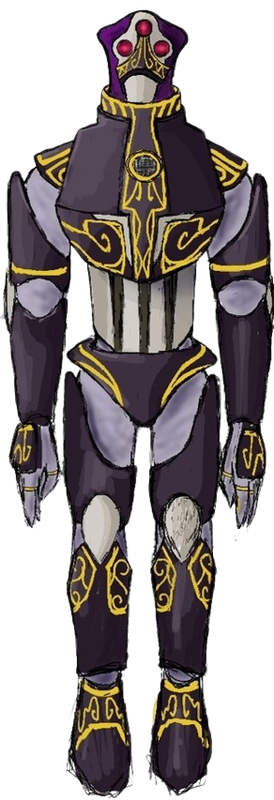
Users who are viewing this thread

Top Bottom