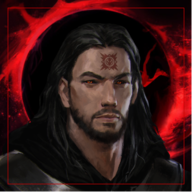
Eternal Father
-
Basic Information
-
Full Name Kaine Zambrano (Galactic Basic)
Koemi Zopxloma (Epicant)Aliases Darth Carnifex
Darth Vornskr (Defunct)
Koe
Daeva
DemiurgeRanks Sith Lord Titles Dark Lord of the Sith
Eternal Father of the Kainate
Voice of the Dark Side
Shadow-Shogun of the Sith EmpireSpecializations Sith Warrior
Sith Sorcerer
Sith AlchemistAffiliations Eleventh Sith Empire
The KainateSpecies Epicanthix Birthworld Panatha Birth Date 787 ABY Death Date 844 ABY (Later Resurrected) Age 115 Languages Galactic Basic
Epicant
ur-Kittât
Comprehend SpeechEducation Formal Instruction
- Mathematics
- History
- Science
- Literature
- Political Theory
- Lightsaber Instruction
- Dark Side Tutelage
- Force Philosophy
- Esoteric and Forbidden Disciplines
- Strategic Conditioning
Gender Male Pronouns He/Him Sexual Orientation Pansexual Romantic Orientation Sovereign-Aromantic Eye Color Emerald (Natural)
Molten Copper with Black Sclera (Dark Side)Hair Color Black Height 8'2 | 250cm Build Muscular | Atheletic
-
Epithets
-
-
Sovereign and Political Titles
- Arch-King of the Pacanth Reach
- God-King of the Epicanthix
- Senior Dyarch of the Kainate
- Supreme Leader
- Twice-Crowned
- Tyrant
-
Religious and Divine Titles
- Fanged God [By the Wanica Coven]
- Godhead [By His Followers]
- Qoritwaidardirhoz (ur-Kittat: Eternal Father)
- Sith'ari (ur-Kittat: Perfect Being) [By His Followers]
- Sozeal (Epicant: Savior) [By the Epicanthix]
-
Martial and Destructive Epithets
- Arch-Foe
- Black Iron Tyrant
- Butcher King
- Destroyer [By the Order of the Beast]
- Dha'naast (Mando'a: Dark Destroyer) [By His Mandalorian Adversaries]
- Great Enemy
- Hammer of the Mandalorians
- Lord of Domination
- Rovagug [By the Order of the Beast]
- Sadist of the Noblest Blood
- Skanah Aru'e (Mando'a: Most Hated Enemy) [By His Mandalorian Adversaries]
- Warmaster
-
Esoteric, Philosophical, or Mystical Titles
- Two Who Were One [Formerly]
- Voice of the Dark Side [Sepulchral Title]
-
Sovereign and Political Titles
-
Biography
-
Chapter I: Birth
Kaine Zambrano did not enter the world as others do.
He was constructed, not conceived - a deliberate act of alchemical will spanning centuries of forbidden science and Sith sorcery. The bloodline of House Zambrano had been long obsessed with its own perfection. Through generations of selective breeding, the house pursued a synthesis of body and spirit that would bring forth a vessel worthy of what Solomon the Black had once called the Eternal Conduit - an heir capable of channeling both the mortal and the divine aspects of the Dark Side without rupture. Hazael and Ashriel Zambrano, siblings bound not only by blood but by ambition, became the final instruments of this legacy.
Their union was not born of affection but of design. When Kaine was brought forth on Panatha in 787 ABY, beneath the eclipsed sun and the roaring of storms across the basalt peaks, the midwives fell silent. The newborn made no sound. No cry, no gasp. Only silence - his first act of defiance against the natural order. His eyes opened immediately, emerald as a blade in dim light, and they looked upon his mother and father with an expression of comprehension far beyond infancy. Hazael, steeped in the doctrines of Sith pragmatism, saw it as a sign that the ritual had succeeded. Ashriel, once devout, recoiled with a shuddering awe. She claimed she saw within her son's eyes the reflection of their own ancestors - not as ghosts, but as devourers, watching through him.
Kaine's first act of life was observation.
He understood sound before speech, meaning before words. In his infant silence he catalogued tone, intention, and deceit. Though his vocal cords could not yet articulate his awareness, his mind was already a cold architecture of comprehension. By his first year, he had memorized every cadence of his parents' voices, every glyph that adorned the walls of their laboratories, and every rune that shaped his cradle - a sarcophagus of crimson crystal filled with restorative ichor. To those who watched over him, he was an uncanny stillness in motion, a being who seemed perpetually on the verge of revelation.
Chapter II: Exile
The birth of such a child could not go unnoticed.
Panatha was already a world drenched in suspicion and tyranny, and House Zambrano's experiments in blood and alchemy had earned the ire of both the Epicanthix aristocracy and the Faithful who feared the rebirth of Solomon's legacy. Whispers spread that Hazael and Ashriel had trespassed upon the ancient compacts, invoking necromantic rites forbidden even to the most heretical of the Faithful. When the Inquisitors came, they came not to question, but to erase.
The Zambranos fled their ancestral estates in fire and smoke, their laboratories burning as if the planet itself rejected their defiance. Their exile was sealed by decree: the blood of their line would be stricken from Panathan heraldry, their holdings confiscated, their names erased from the archives of nobility. Carrying only what relics they could bear, Hazael, Ashriel, and the uncrying child journeyed to the humid jungles of Thyferra, far from the reach of their persecutors.
It was there, among the hives of bacta barons and black-market syndicates, that Kaine first smelled the iron tang of corruption. Thyferra was no sanctuary, but a crucible. The Zambranos bought their safety through violence, trading secrets of alchemical refinement for shelter among renegades and corporate magnates. Hazael established a hidden laboratory beneath the canopy, where the work of their ancestors could continue in secrecy. Kaine's first steps were taken among humming vats, murmuring apprentices, and the quiet drip of nutrient fluid that sustained their experiments.
Ashriel, who had once been the gentler of the two, grew austere. Her faith in Sith philosophy fractured into something darker: the belief that divinity could only be reclaimed through suffering without end. She imposed this creed upon her son from the moment he could stand. His every failure was punished with physical and mental trials - immersion in isolation chambers, forced meditation amid pain, fasting for days at a time. Yet Kaine did not break. He did not even resist. He endured, and in that endurance, he began to understand power.
Chapter III: Awakening
From his earliest years, Kaine's biology defied classification. His blood ran thicker, his musculature denser, and his senses sharper than any ordinary Epicanthix. His pulse fluctuated in harmonic rhythms during meditation, resonating with dark-side energy like an instrument attuned to unseen frequencies. Hazael recorded these phenomena obsessively, remarking in his journals that the boy seemed to "drink the Force as others breathe air."
At the age of three, when his brother Mordecai was born through the same procedure, Kaine observed the infant with a detached fascination. He did not view him as kin but as iteration. The Zambranos had created Kaine as the prototype and Mordecai as the refinement. Yet, in secret, Kaine began to manipulate the Force to influence the experiments conducted around him. Instruments failed, vials shattered, and circuits corroded with inexplicable decay whenever his focus sharpened. He learned instinctively that the Force responded to intention, not command - and that through suffering, intention could be sharpened into absolute will.
Hazael noticed, of course. Rather than suppress the phenomenon, he cultivated it. He taught Kaine the language of ur-Kittât before he could write Galactic Basic, forcing him to inscribe Sith runes into his own flesh as lessons in focus. Each rune, each scar, each ritual engraving became a mnemonic tether between mind and body, pain and memory. Kaine's comprehension of the Dark Side was therefore not philosophical, but visceral - the Dark Side was not a thing to be studied; it was the blood that carried him.
Chapter IV: Tutelage
By the age of five, Kaine's formal training in the Dark Side had begun in earnest. His parents saw him less as a son than as an experiment - a vessel in refinement. Hazael drilled him relentlessly in discipline and concentration, while Ashriel honed his physical conditioning. He was made to lift weights larger than himself, to survive hours submerged in bacta until he could regulate his heartbeat by will alone. When he faltered, he was cast into the wilderness to hunt predators and return with their hearts as proof of survival.
Yet beneath the cruelty, there was also respect - a terrible, inverted love born of recognition. Both Hazael and Ashriel saw within Kaine something that frightened even them: clarity. He learned quickly that pain was only information, and emotion was fuel. When Ashriel's temper flared, Kaine would hold her gaze without flinching. When Hazael struck him for disobedience, Kaine bled without sound, and his silence was the greater victory.
By ten, Kaine Zambrano was already something beyond human - not in strength or knowledge alone, but in will. His mind had crystallized into an unshakable conviction that destiny was not a current to be followed, but a thing to be imposed. Around this time, his sister Saeth was born - a child of the same alchemical lineage, her arrival heralded as the perfection of their parents' design. Yet Kaine felt no kinship, only confirmation. Watching her fragile form swaddled in ritual clothes, he saw not a sibling but a duplicate, a lesser echo of the formula that had birthed him. Where his parents saw hope renewed, Kaine saw futility repeated.
He believed himself not the product of his parents' ambition, but their culmination. The culmination of centuries of obsession and defiance, and the inheritor of Solomon the Black's promise: that the perfect vessel of the Dark Side would one day rise - and through him, the galaxy itself would kneel.
Chapter V: Liberation
As Kaine entered his eleventh year, the air around the estate had grown heavy with dread. His siblings, Mordecai and Saeth, had reached the age when their own indoctrination into the Dark Side would begin. He had endured this crucible himself - its pain, its discipline, its breaking of the self - and he knew what awaited them: the mutilation of innocence in the name of power. Yet unlike his parents, Kaine no longer revered the process. He had come to see it as a lie, a narrowing of potential, a ritual that made slaves of those it claimed to strengthen.
Within him, the ancient clarity of Solomon's blood murmured for rebellion.
His great-uncle, Braxus Zambrano, was the echo that answered it. Braxus was an old shadow in the House, a scholar of necromancy and alchemy exiled for dabbling too deeply into the metaphysics of consciousness. Through whispered correspondence and forbidden holocrons, he and Kaine conspired to liberate Mordecai and Saeth from their parents' tyranny.
The plan was not born in haste. For two years, Kaine prepared - gathering loyal servants, corrupting the estate's guards, and twisting the rituals meant to temper his obedience into weapons of inversion. By thirteen, he no longer feared his creators. He despised them. In one night of perfect execution, he enacted his rebellion.
The fire began in the laboratories beneath the estate - vats rupturing, fumes igniting into blue flame as the alchemical reservoirs detonated. The screams of apprentices mingled with the wails of security sirens. Kaine confronted his parents in the grand observatory, beneath the mural of Solomon the Black, the founder of their current line.
What transpired there has been retold in countless versions, but Kaine himself never spoke of it. When the night ended, the estate was ash, his parents were dead, and the young Zambrano heir stood bathed in the light of the burning horizon.
His siblings were spared.
He sent them away to live under the protection of their uncle, Adriel Zambrano, in the Outer Rim - a gesture both merciful and calculated. He had no desire for their deaths; their existence would serve as a living memory of his defiance. When the authorities came, there was nothing left but cinders and a name whispered in fear: Kaine.
Thus ended the first House Zambrano, and thus began the second - forged not in lineage, but in will.
Chapter VI: Pilgrimage
With Braxus as his mentor, Kaine abandoned Thyferra and set forth into the galaxy. For two decades, they became pilgrims of ruin, moving from world to world in pursuit of lost Sith and Zambrano knowledge. Their journey was both archaeological and spiritual - part exhumation, part resurrection.
They delved into the tombs of Moraband, pried open the sarcophagi of forgotten warlords, and plundered the libraries of defunct empires. On Dromund Kaas they communed with the bound spirits of heresiarchs; on Malachor they harvested the dark crystals that sang with the agony of fallen Sith. Kaine did not merely learn - he absorbed, devoured, and integrated. Each fragment of knowledge became another vertebra in the spine of his philosophy.
It was during this era that he came to define his central creed: that the will to act is the highest law - that power itself is justification, and that hesitation is a sin against existence. To him, the Force was not morality's arbiter but the currency of being.
Yet amid this grand design of purpose, fate still allowed him a fleeting taste of passion.
Chapter VII: The First Flame
At the age of twenty, Kaine returned to Panatha in secret. Decades had passed since his family's exile, and though his name was still cursed in the noble courts, his presence went unrecognized beneath the guise of a wandering aristocrat. It was there that he met Salara Kesare, a young Epicanthix noblewoman of his own age, radiant and cunning, promised by contract to another house.
Their meeting was chance - or destiny, depending on which myth one believes. Salara saw in Kaine not merely a man, but an embodiment of the forbidden - a figure who carried the scent of danger, intellect, and the promise of transgression. Kaine, in turn, recognized in her the rare quality of shared will - a hunger for liberation from the chains of expectation.
Their affair was instantaneous and consuming. In the gardens of her family's estate, beneath the crimson moons, they defied the laws of their caste and their gods. When Salara's betrothed discovered their union, his wrath sealed his doom. Kaine slew him without hesitation, and when Salara's kin confronted them in horror, she chose Kaine's side without a word. Together, they slaughtered the Kesare household - blood mingling with rain as their rebellion consummated itself in fire.
When the flames dimmed, Salara stood at Kaine's side, her silks soaked in the blood of her lineage. She spoke only once: "If the galaxy must burn for your truth, then I will tend the pyre." From that moment, she ceased to be merely his lover; she became his First Wife, his co-conspirator in destiny.
Chapter VIII: The Second Flame
Five years later, in the twilight salons of Alderaan, Kaine met Invicta Gaultier, an energy vampire of a noble lineage. Unlike Salara, Invicta was not mortal in the conventional sense. She drew vitality from others through contact, sustaining her life for decades, yet found herself trapped in perpetual ennui — a creature too ancient to die, too jaded to live.
Kaine fascinated her. To a being who had consumed hundreds of lifetimes, his presence was intoxicating — not merely for the potency of his life-force, but for the force of his conviction. In him, Invicta saw something she had not encountered in years: a mortal who refused limitation. Their bond was immediate, elemental. Salara welcomed her, drawn to Invicta's cold beauty and quiet cruelty, and what began as mutual curiosity blossomed into a triadic union of power and passion.
They married each other in a ritual of blood and shadow, an unholy trinity sanctified beneath the stars. Salara and Invicta bound themselves not by faith, but by choice — each the mirror and foil of the other, orbiting Kaine as both wives and priestesses of his emerging dominion.
To the galaxy, they were whispers — a Sith aristocrat, a noble murderer, and a vampiric consort traveling under false names. To themselves, they were the beginning of a dynasty yet unborn.
Chapter IX: Blackfang
At thirty-three, Kaine joined the Blackfang Group, a clandestine paramilitary organization operating in the underworld of corporate and Sith dealings. The Blackfangs were weapons without banners — mercenaries trained in assassination, espionage, and regime collapse, wielded by corporations to destabilize rivals. To Kaine, they were not an end but an experiment — an opportunity to study the anatomy of power divorced from ideology.
For three years, he rose through their ranks, mastering the arts of subversion and command. He learned to turn greed into obedience, chaos into strategy, and loyalty into currency. The Blackfangs, for all their brutality, became the testing ground for what would later evolve into his own model of imperial discipline — a vision of hierarchy built on utility and fear.
But all empires, even shadow ones, rot from within. In 823 ABY, the Blackfang were betrayed — sold out by their corporate patrons to Republic Intelligence. The purge was swift and brutal. Kaine was captured after days of relentless pursuit on the smog-choked moon of Revanen IV, his body shattered, his will undiminished. The Republic officers who took him were unaware of who he truly was — they saw only a mercenary commander, not the heir to a legacy that had already burned worlds. To make an example of him, they chose hanging — crude, public, and symbolic.
He was strung up from an industrial crane at dawn, a noose of synthfiber biting into his neck as the machinery whined. The crowd that gathered was small, their faces hidden by masks against the ash-filled air. The lever was pulled, the body dropped, and silence followed. For hours he hung there, motionless — another corpse swaying in the dawnlight. When night fell, the guards left his remains uncollected, assuming gravity would finish what justice began.
But Kaine did not die.
The Force coiled around him like a serpent refusing to release its prey. The line that should have severed breath instead became a conduit — agony transforming into revelation. His heartbeat slowed, then stilled, then returned, fainter but deliberate. When he awoke, his skin was cold, his pulse an echo of the abyss, the noose still biting his flesh like a reminder of what had failed to claim him.
He tore himself free, leaving strips of skin and rope on the metal beam above. The marks upon his neck never healed completely; they blackened into permanent scars, a dark sigil of his rebirth. To those who would later follow him, he was said to have hung between life and death for a day and a night, and when the sun rose, it bowed before him.
From that moment forward, Kaine Zambrano ceased to be a fugitive or mercenary. The man who walked away from the gallows carried death as his servant, not his sentence. The noose became his first relic — a trophy of transcendence — and he kept it coiled at his side like a serpent sleeping against his armor.
Chapter X: Shadow Ascendant
After surviving his own execution and vanishing into the labyrinthine underworlds of the Mid Rim, Kaine Zambrano resurfaced a year later, reinvigorated with new purpose. His legend was whispered among smugglers and assassins: the man who had hanged and lived. When the Eighth Sith Empire expanded its intelligence apparatus, it sought men of precision and brutality, those unshaken by death or conscience. Kaine was both.
He entered the Sith Intelligence Agency as an operative, but in months proved himself indispensable. Where others obeyed protocols, Kaine rewrote them. He mapped networks of corruption, manipulated factions into devouring one another, and turned insurgencies into tools of statecraft. To his superiors, he was efficient. To his peers, terrifying. The more he served, the clearer it became that his loyalty was not to the Empire, but to order itself — an order of his own design.
During this time, he met Emma Cuilein, a Vahla priestess serving as a cultural attaché within the Empire's intelligence division. She was a mystic of flame and prophecy, one who claimed to see "a man of smoke who would burn the stars." To her, Kaine was that man. To Kaine, Emma was the missing soul to his purpose — the embodiment of belief in the inevitability of his becoming. Their union was not romantic but sacramental; a wedding performed in the light of braziers burning Sith runes into the stone beneath their feet. Emma became his Third Wife, his oracle and keeper of the pyres.
In that same year, Kaine also met Izaszh, a Shi'ido shapeshifter whose espionage work had brought her into the same circles. Their connection was instantaneous yet unfulfilled, restrained by circumstance. She intrigued him — a being who could embody any form, any face, yet remained unknowable. He saw in her the metaphor of the galaxy itself: mutable, deceptive, waiting to be mastered.
Chapter XI: Minister of Shadows
Two years later, Kaine's rise was unstoppable. The Empire's web of intelligence had grown bloated and self-destructive under years of paranoia; Kaine purged it with surgical cruelty. He exposed traitors, fabricated threats to remove rivals, and weaponized bureaucracy until every line of communication led back to him.
By thirty-nine, he was elevated to Minister of Intelligence, the youngest ever to hold the title. His command of the Empire's secret armies was absolute. In this position, Kaine resurrected the ideals of the Blackfang Group, though what emerged from his laboratories and barracks was far more terrible. He fused the clandestine lethality of mercenaries with Sith conditioning and alchemical augmentation — the birth of the Blackblade Guard.
They were not soldiers but extensions of his will: faceless warriors clad in black durasteel, infused with trace elements of his own blood, conditioned to obey only his voice. They became his shadow army, unseen by the public but feared within every echelon of Imperial command. Wherever the Minister's banner appeared, rebellions vanished and conspiracies dissolved into silence.
Through this secret army, Kaine began to rule from the shadows, his name whispered with the same dread once reserved for Sith Lords. And yet, within him, the Dark Side — long dormant — began to stir.
Chapter XII: Birthright Revealed
At forty-one, the smoldering potential of his birth finally ignited. The Dark Side that had slept within him since infancy awoke in full. Kaine's meditations turned violent — entire rooms cracking beneath invisible pressure, machinery warping to the rhythm of his heartbeat.
Sith Intelligence reported these manifestations to the Dark Council, and rather than destroy him, they sent one to harness him: Darth Moridin, an ancient master of necromancy and will-binding. Moridin recognized Kaine for what he truly was — not an acolyte, but a vessel of something far older, perhaps even something the Sith Code had long forgotten. Under Moridin's tutelage, Kaine learned to shape the raw pressure of his spirit into form: crushing bones with thought, burning air with his rage, and bending minds through the sheer gravity of his conviction.
But Kaine was never content to serve. Within two years, he turned on his master's peers, helping Moridin orchestrate a coup that toppled the Dark Council itself. The Empire shuddered, leadership devoured by its own shadows. When the dust settled, Moridin was Emperor — and Kaine Zambrano, now Grand Vizier, stood at his right hand, the true architect behind the throne.
It was during this ascendancy that he was reunited with Izaszh, the Shi'ido. Drawn back together by fate or manipulation, their connection deepened into a partnership of mirrors and masks. She became his Fourth Wife, her shapeshifting form a living metaphor for the multiplicity of his designs. She was his confidante, his infiltrator, and in time, one of the few beings who could stand in his presence without trembling.
Together, Kaine, Emma, Salara, Invicta, and Izaszh formed the earliest House of the Black Star, the nucleus of what would one day become the Kainate. Within them were all elements of his nature — the loyal, the spiritual, the monstrous, the mutable — each a reflection of the Lord he was becoming.
Chapter XIII: The Culling
By the year 830 ABY, the Sith Empire had become a furnace of ambition and blood. Darth Moridin, Emperor by right of conquest, sought to immortalize his reign through terror. He turned his gaze to the Mandalorian Clans — ancient enemies of Sith and Jedi alike — intending to break their warrior spirit once and for all.
It was Kaine Zambrano, Grand Vizier and silent hand of the Empire, who gave Moridin's designs form. Where the Emperor's rage was fire, Kaine's was frost — measured, procedural, and absolute. Across the Mandalorian sectors, entire cities vanished under orbital bombardment. Populations were culled according to logistical efficiency: those too young to labor, those too old to fight, those too proud to kneel. Kaine carried out these atrocities without tremor or remorse, seeing in them the perfect expression of his philosophy — that will alone justifies action, and that mercy is merely the hesitation of the weak.
Yet Moridin's campaign overreached. The Republic countered with ferocity uncharacteristic of its age, marshaling the full might of the Jedi Order to halt the Imperial advance. In the chaos of the Second Battle of Junction, the conflict reached apocalyptic intensity. There, upon the burning plains of Junction's southern hemisphere, Darth Moridin faced Jedi Grandmaster Teferi Efreet in single combat — light against shadow, serenity against damnation.
Their duel raged for hours, witnessed by soldiers who dared not intervene. Efreet's blade blazed like a sun held at arm's length, cutting through storm and ash, while Moridin's every strike warped the air and blackened the ground beneath his feet. When at last their blades met in the final cadence, Moridin's fury triumphed. He struck Efreet down, cleaving through the Grandmaster's defenses and shattering his saber into molten shards that fell like rain upon the battlefield. The death of Teferi Efreet broke the Jedi battle line, scattering their armies and searing his name into Sith legend.
But victory birthed ruin. In his arrogance, Moridin pressed the offensive too far. The Republic rallied, its fleets striking Junction's orbit even as internal betrayal tore through the Imperial command. Amid the smoke and the roar of collapsing dreadnoughts, Empress Ashin Varanin moved — a warrior-mystic of unmatched cunning who turned Moridin's generals against him. As his armadas crumbled in fire, Kaine Zambrano's forces executed a flawless withdrawal, preserving the Empire's vital infrastructure and archives that would otherwise have fallen with their Emperor.
When the new Empress consolidated her rule, she found that her victory rested on the spine of one man she could neither dismiss nor destroy. Kaine had preserved the Empire even as its master fell, and so Ashin retained him as Grand Vizier — though she never trusted the shadow that stood at her back.
He served her faithfully, at least in appearance. But those close to Ashin would later say that, from the moment she accepted Kaine into her court, her fate was already sealed.
Chapter XIV: Serpent Among Thrones
The next five years became a crucible of succession. In that short span, three rulers ascended the Sith throne — Ashin Varanin, Voracitos the Gluttonous, and Tyrin Ardik — and each believed they commanded the Empire. Yet through every coup, purge, and betrayal, one constant remained: Kaine Zambrano.
He played the Dark Council like a musical instrument, shifting allegiance with perfect precision, speaking loyalty to each master while orchestrating their downfall from the shadows. Under his subtle hand, ministers turned against each other, fleets changed command overnight, and rivals vanished without explanation.
In the midst of these years, Kaine uncovered and quietly co-opted the grand architectural schemes of Voracitos, whose reign as "the Gluttonous" had left behind immense but incomplete megaconstruct designs intended for a mobile palace-world capable of consuming planetary resources. Where Voracitos envisioned excess, Kaine saw infrastructure. He seized the hidden archives and engineering cores of the project, refining them into the foundation for a far greater vision — a self-contained worldcraft that could serve as citadel, factory, and temple. From these repurposed plans would one day emerge the first blueprints of the Malsheem, the supreme fortress-world that would embody the permanence his empire demanded.
It was then that Kaine's great-uncle Braxus resurfaced from travel abroad — the same dark sage who had once aided him in the destruction of Hazael and Ashriel. Reuniting with his nephew, Braxus became second-in-command and chief advisor, the twin intellect to Kaine's will. Together they reshaped the Blackblade Guard into something more than an elite corps — it became a cult of annihilation, devoted to the hunting and eradication of Jedi and Mandalorians alike.
Wherever they marched, resistance was rendered into myth. Survivors spoke of soldiers who moved without sound, whose armor drank light, and whose eyes glowed faintly with their master's essence. Rumor held that each Blackblade carried a fragment of Kaine's blood within them, linking their lives to his through the Force — if one fell, another would rise in the same instant.
By 834 ABY, the Sith Empire no longer belonged to its Emperor. It belonged to its Vizier.
Chapter XV: The First Emperorship
By 835 ABY, the Empire had grown decadent. Its rulers had become ceremonial tyrants, dressing their frailty in titles and gold. The last of them, Emperor Lussk, ruled from a throne of glass and vanity, mistaking fear for loyalty and pageantry for order. In the shadows, Kaine Zambrano had watched long enough.
When the time came, he walked through the Imperial Palace unannounced. Those who recognized him lowered their eyes; those who did not would learn soon enough. He entered the throne hall at dawn, when the banners hung still and the light of the rising sun glinted on the black marble. The Emperor waited for him there, armored and silent, the ceremonial blade of the Sovereign resting across his knees.
Their confrontation was not political, nor even personal. It was the inevitable conclusion of all hierarchy. The duel began without words. Lussk fought with the desperation of one who senses the void closing around him, his strikes ferocious but without precision. Kaine moved with the cold inevitability of a planetary rotation, each motion exact, each defense perfect. The clash of their blades tore fissures into the obsidian floor, and the vaulted ceiling shook with every discharge of power.
Minutes bled into silence. The air grew thick with heat and ozone, the banners caught fire, and shards of molten stone rained down like cinders from a dying star. At last, Kaine closed the distance. He caught the Emperor's final blow, tore the weapon from his grasp, and brought him down with a single motion — driving his knee into Lussk's spine until bone split and the sound echoed through the chamber like a knell.
The duel ended as swiftly as it had begun. The Emperor lay broken but alive, unable to rise. Kaine regarded him for a moment, expression unreadable, then turned and left him where he had fallen. No order was given, no proclamation spoken. The meaning was understood by all who witnessed it. Lussk would live, but never again as Emperor.
By nightfall, the Empire had already adapted to its new gravity. Ministers bent the knee, fleets transmitted their allegiance, and the machinery of state turned smoothly beneath its new master. No coronation was held, no title claimed. Kaine Zambrano simply was — the force around which all others revolved.
In the weeks that followed, the Empire shed its decay. The weak were culled, the ministries purified, and the armies reforged into engines of obedience. The Blackblade Guard expanded beyond anything the Sith had ever fielded, a silent legion bound by his will. From the throne world to the outermost colonies, one truth spread through the collective mind of the Empire: that the man who had once been hanged now ruled with the patience of eternity.
The First Emperorship had begun, not with coronation or conquest, but with the quiet sound of a spine breaking and the birth of order in its echo.
Chapter XVI: The Iron Year
In the first year of his reign, Kaine Zambrano transformed the Sith Empire into something unrecognizable. Gone were the opulent courts and decadent ministries that had festered under decades of excess. He dissolved entire bureaucracies, executed governors who siphoned from the treasury, and nationalized the great war foundries under his personal command. What emerged was a lean, predatory machine — a nation sharpened to a single purpose: conquest.
Under Kaine's direction, the Blackblade Guard multiplied tenfold, their recruitment fed by forced conscription and alchemical enhancement. New fleets were commissioned from the shipyards of Kaas, Yaga Minor, and Ord Radama, their hulls forged black to drink starlight. The academies were remade into crucibles of indoctrination; failure was a death sentence, obedience the only currency. Across the stars, the people whispered that their Emperor was remaking the very idea of empire — a living embodiment of discipline and inevitability.
By year's end, the engines of war were ready.
Chapter XVII: The Great Offensive
In the closing months of 835 ABY, the Sith struck. Kaine launched a multi-pronged campaign of annihilation across the border sectors, overwhelming the Republic in a storm of fire and precision. Fleets moved as if by instinct, their hyperspace jumps synchronized to the second. Jedi enclaves burned on Chandrila, Naboo, and Tython's moons; Republic outposts were erased before they could send distress calls.
Kaine's strategy was not expansion — it was eradication. He did not seek territory, only the destruction of every institution that resisted him. For a time, it seemed as though the Sith Empire had become unstoppable. Entire sectors bent the knee out of fear, while Kaine's image, projected from orbiting dreadnoughts, became the new face of inevitability.
But where the Sith had united under one will, the Jedi now did the same. For the first time in centuries, the entire Jedi Council moved as one.
Chapter XVIII: The Battle of Mon Cala
Mon Cala became the crucible of the war — the point at which legend and history converged. The ocean world's deep atmosphere made orbital strikes unreliable, forcing the conflict to the surface. When the Sith landed, Kaine led them personally, descending in his command vessel amid the boiling seas and storms of plasma fire.
Awaiting him on the shore were twelve figures — the entirety of the Jedi Council, their sabers ignited in a circle of light. What followed was not a battle, but an execution of inevitability. Kaine's power tore through the first ranks, his will collapsing the very terrain beneath his enemies. For hours he fought, his strikes fracturing durasteel and flesh alike, his roar echoing across the waves. But numbers, endurance, and sanctity took their toll.
One by one, the Jedi overwhelmed him. Their combined light bent the air and split the sea, binding the Emperor in a lattice of luminous chains. When the storm subsided, the black-armored giant lay upon the shattered coast — beaten, but unbroken. Even as he was bound, his gaze remained steady, his silence heavier than any words.
The Jedi took him alive. Bound in null-energy restraints and wrapped in sanctified seals, Emperor Kaine Zambrano was transported to Coruscant to await trial before the Galactic Senate. For the first time in decades, the galaxy believed the Sith were finished.
Chapter XIX: The Seven-Day Emperor
But the fall of the Emperor was not the end — it was the beginning of catastrophe. In his absence, the Sith realms fractured. The Mandalorian Clans, still burning from the horrors of Moridin's war, struck without mercy. Their fleets descended upon Dromund Kaas, razing the capital in a storm of plasma and iron. The jungles burned for days, and the spires of the Imperial City sank into molten earth.
Amid the ruin rose one final claimant: Darth Vulcanus, a Graug warlord whose body was a fusion of metal and flesh. He seized the throne, declaring himself Emperor of the Sith, but his reign lasted only seven days. On the eighth, the Jedi invaded Korriban, sweeping through the Valley of the Dark Lords in a relentless procession. The last of the Blackblades died in the tombs they had sworn to defend. The Empire, once an edifice of order and will, was reduced to silence and ash.
When the fires faded, the galaxy believed Kaine Zambrano's era was over. But the faithful — the remnants of his soldiers, the priestesses of Emma Cuilein's sect, and the disciples who carried his blood — whispered that their Emperor still lived. They claimed his execution never came, that his transport vanished somewhere between Coruscant and the Outer Rim, and that the Black Iron Tyrant had only begun his work.
Chapter XX: Chains Broken
The Jedi believed their victory complete. Bound in null-energy manacles and sealed within a grav-shielded transport, Emperor Kaine Zambrano was to be ferried to Coruscant for judgment before the Senate. The galaxy rejoiced; the Black Iron Tyrant had fallen.
But not all celebrated his demise.
As the transport passed through the Deep Core, it was intercepted by vessels bearing no transponder and no name. The attackers moved with surgical precision, disabling communications and severing escort ships before the Republic could react. When the airlocks were breached, the Jedi guards found themselves face-to-face with crimson blades and warriors cloaked in the symbols of the One Sith — a sect that had survived in secret beneath the galactic underworld, waiting for a new god to lead them.
Kaine was freed from his restraints and delivered to Prakith, the desolate heart of the Deep Core. There, in the lightless catacombs beneath the citadel of the ancient Darths, he met Darth Sortis, the Dark Lord of the One Sith. To Sortis, Kaine was the living embodiment of an older promise — a perfect vessel for the ancient design of domination through unity.
Kaine knelt only once, and even then it was not submission, but calculation. He swore allegiance to the One Sith and was given a new title: Darth Vornskr, after the predatory beasts that hunted the Force itself. Sortis named him one of his Voices, the supreme generals and interpreters of his will.
The galaxy would once more tremble at the whisper of the name Zambrano.
Chapter XXI: Apocalyptic War
For eight years, Darth Vornskr led the One Sith's war across the Core Worlds. The Republic, already fractured by decades of attrition, could do little but fight to delay the inevitable. His fleets fell upon Coruscant, Alderaan, Balmorra, and Kashyyyk in a campaign so swift that even the Jedi Archives struggled to chronicle it. Planets burned, temples fell, and the once-mighty Republic became a desperate coalition of retreating worlds.
Under his direction, the One Sith became more than a cult — it became an empire reborn, the Ninth Sith Empire, built on terror and unity of doctrine. Vornskr's mastery of both strategy and sorcery allowed him to wage war on a scale unseen since the ancient Sith Crusades. He employed legions of fanatics, resurrected horrors from the tombs of Korriban, and wielded superweapons forged in secret by the remnants of the Blackblade foundries.
It was during this era that Vornskr allied himself with Taeli Raaf, a brilliant Sith scholar and sorceress whose hatred for the Jedi Order burned as fiercely as his own. Taeli sought vengeance for her sister, Corvus Raaf, who had died defending the Jedi only to be forgotten — her sacrifice dismissed, her name unspoken in the very halls she had died to protect. Together, Vornskr and Taeli forged a secret covenant to erase the Jedi utterly, not merely to conquer them, but to erase their memory from the galaxy's history. Their union of intellect and will became one of the most devastating partnerships in Sith history, each feeding the other's ambition and conviction until their shared vendetta became a doctrine unto itself.
As the Sith continued to raze and conquer across the Core, Vornskr took a bride — Mircalla, daughter of a once-prominent Republic dynasty that had turned traitor to save itself from annihilation. Her family, broken by debt and fear, sought survival in betrayal, offering their allegiance — and their daughter — to the Sith. Vornskr accepted their surrender with cold amusement, claiming Mircalla not as a gesture of mercy but as an act of ownership. To her credit, she adapted quickly, embracing the luxury and terror of her new life beside a god of war. In time, she became both ornament and instrument — a living symbol of the Republic's corruption and the futility of compromise before the Dark Side. Her marriage to Vornskr was not one of affection, but of conquest sanctified in blood and ambition.
In the midst of the war, Vornskr returned to his birthworld Panatha for the first time in decades. The royal house, fattened by centuries of peace, dared to deny him entry. He answered their arrogance with extermination. Within a single night, the palace of the ruling dynasty became a tomb. The royal line was erased from existence, their names stricken from records, their sigils burned from stone.
When dawn rose over the shattered spires of Canthar, Kaine Zambrano proclaimed himself King of Panatha — the first of his line to do so since Solomon the Black. His conquest spread through the surrounding systems, subjugating the Pacanth Reach, and within a year he crowned himself Arch-King of the Reach, sovereign of the Epicanthix people and the living heir of their imperial legacy.
The galaxy had thought him an emperor no longer. Now he was something far older — a monarch of blood and conquest, a god-king from myth reborn in flesh.
Chapter XXII: The Death of Vornskr
By the height of his power, Darth Vornskr ruled as both conqueror and god-king, his dominion stretching from the Deep Core to the Mid Rim. Yet, it seems that even gods are not immortal. In 844 ABY, his sanctum on Panatha became the stage of his unmaking.
It was there that Kiskla Grayson, revered Jedi Master, came for him. Their confrontation was inevitable — two forces of opposite essence drawn together across the Force like colliding stars. The duel that followed reshaped the palace itself. Floors melted beneath their feet, walls burst into molten stone, and thunder rolled through the halls as light and darkness contended.
Vornskr's strength was vast, but Kiskla fought with the desperation of one who understood she faced not merely a man, but the future's extinction. Cornered, outmatched, and burning through the last reserves of her power, she resorted to the unthinkable — reaching into the very essence of his life. The Force surged through his veins, transmuting blood into living flame. His scream tore through the fabric of reality as his body immolated from within, fire spilling from his eyes, mouth, and hands.
When the blaze subsided, all that remained of the Emperor was a blackened husk — half ash, half calcified bone — a body locked in the posture of defiance even in death. His followers, fanatics to the last, recovered what was left and sealed it within a sarcophagus of volcanic glass deep beneath Panatha's crust. There, suspended between life and death, the flesh refused to decay. It pulsed faintly, slow as a dying heartbeat, sustained by the residue of his will.
Over time, that remnant became an object of worship. His acolytes called it the ur-Lich — a vessel neither alive nor dead, caught in perfect equilibrium between existence and oblivion. They whispered that his spirit lingered in the necrotic tissues, whispering dreams to those who dared approach.
Vornskr's body fell, but his will did not. His spirit was drawn into the Netherworld of the Force, a realm he had studied but never truly believed in until that moment. There, in the abyss, he discovered that death was not an end, but an exile. His hatred, undiminished, burned through the barriers that separated spirit from flesh. By sheer defiance, he clawed his way back to the living.
Chapter XXIII: Splitting of the Soul
The first resurrection of Kaine Zambrano was born of desperation. His followers, unwilling to accept the death of their god, shaped a new body for him from imperfect means — cloned tissue, alchemical grafts, and the blood of volunteers who believed their sacrifice would quicken his return. Into this crude vessel, they drew his spirit from the void through bloodletting and invocation. It lived, but only barely; the body was weak, the flesh unstable, incapable of containing the magnitude of what it held.
In this fragile form, Darth Vornskr walked the galaxy once more, but his reign was short. Gabriel Sionoma, hero of the Jedi, struck him down before the year's end, ending the abomination with a single decisive blow. The cultists, undeterred, saw his second death not as failure but revelation. They came to understand that the true vessel of their master still lingered — the blackened corpse beneath Panatha, the ur-Lich, whose tissues had never ceased to pulse with trapped vitality.
Through forbidden experimentation, they learned to extract living cells from the ur-Lich's necrotic flesh — fragments suspended eternally between life and death. With these, they forged a second body, a vessel capable of enduring the return of a god. The resurrection succeeded beyond expectation. Kaine rose again, stronger than before, his presence in the Force deeper and darker, his mind sharpened by the memory of two deaths. The ur-Lich was sealed once more in its sarcophagus, still faintly alive, its heartbeat echoing in the deep crust of Panatha — a silent anchor binding all his incarnations to the mortal plane.
But power demanded understanding. Having twice defied death, Vornskr sought to master it. He performed upon himself an unprecedented ritual — a deliberate act of metaphysical vivisection designed to separate the eternal from the temporal, the divine from the human. In doing so, he split his essence in two.
From that act emerged Vornskr, the embodiment of flesh, wrath, and instinct — the living predator who ruled and destroyed. And from the same act emerged the Demiurge, the disembodied intellect, a mind detached from limitation, eternally calculating in the void.
Between them, the ur-Lich remained sealed within its tomb, the silent third aspect — neither alive nor dead, yet still faintly aware. Three manifestations of a single will: the body that devours, the spirit that designs, and the corpse that endures.
Chapter XXIV: The Birth of Carnifex
By 846 ABY, Darth Sortis had descended into madness. His mind fractured under the strain of his own ambition, convinced that he was the physical avatar of the Dark Side itself. The One Sith began to fracture as well, its legions dividing between the surviving Voices.
Vornskr — now a being half man, half spirit — struck in alliance with Darth Ophidia, a serpentine assassin whose loyalties lay only with power. Together they stormed the obsidian citadel of Coruscant, cutting down Sortis's acolytes and confronting their master in the sanctum where the One Sith had first risen to glory. The battle was apocalyptic — a contest of wills that shattered the foundations of the citadel and burned for three days.
When it ended, Sortis was dead. His body was never recovered, and neither Vornskr or Ophidia would ever speak of what truly transpired deep beneath Coruscant's surface.
The empire he had built collapsed into civil war just as the Galactic Republic, now reorganized as the Galactic Alliance, launched its counteroffensive. Sith strongholds fell one by one, the Deep Core purged in cleansing fire. Amid the destruction, Kaine Zambrano endured.
He cast off the title Darth Vornskr, rejecting the name that had bound him to the will of another. From that point forward, he was his own master once more. Those who saw him thereafter did not know what to call him — man, revenant, or god — and so they called him what history already whispered:
Darth Carnifex.
Chapter XXV: Return of the Emperor - The Second Emperorship
One year after the fall of the One Sith, Darth Carnifex returned from silence. The galaxy had been shattered by endless wars, and in the ruins of fallen empires he saw the opportunity to begin anew. On the fortress world of Bastion, amid the iron citadels of a thousand failed regimes, he proclaimed the birth of the Tenth Sith Empire.
He did not announce his return with fanfare. The declaration spread as rumor first, then terror: the Black Iron Tyrant had risen once more, and the stars themselves bent to his will.
At his right hand stood Braxus Zambrano, his great-uncle and eternal ally, now ascended as Darth Prazutis, the Shadow Hand and instrument of his master's designs. Together they fashioned an empire unlike any before — efficient, doctrinal, and merciless. The Sith Order was rebuilt from the ashes of sectarian ruin into a hierarchy of absolute obedience, the Brotherhood of the Sith. The remnant Republic's frontier defenses, still fractured from decades of war, fell one by one before the new Sith onslaught.
Carnifex's path would eventually lead him beyond the reach of known space, drawn by whispers of an anomaly that devoured light and time alike. There, suspended above the event horizon of a black hole, he discovered Ahani Najwa, an Echani Force-user whose body drifted weightless within a field of impossible gravity. Their meeting was chaos — power colliding with power, as Carnifex sought to command the singularity while Ahani bent its flow to her will. Yet from that turmoil came understanding. He freed her from the gravitational prison, and in the union of their strength they found kinship. In time, they married, and Ahani became both consort and teacher, instructing the Dark Lord in the esoteric arts of gravitational manipulation, spatial distortion, and the harmonics of the Force that underlie creation itself.
Beneath the banner of the Tenth Empire, Carnifex began constructing what would become his most enduring monument: the Kainate — a hidden infrastructure of dominion, a web of logistics, intelligence, and genetic programs designed to persist beyond the collapse of any single state. Under its shadow rose the Malsheem, a colossal worldcraft whose foundation had been laid generations earlier under Emperor Voracitos. Once a symbol of gluttony and excess, Kaine seized it and repurposed it into the nucleus of a future civilization.
While the galaxy looked upon Bastion and saw only the return of a Sith Empire, the true work of Eternal Rule had already begun beneath its surface. It was also in this era that the Demiurge, the disembodied intellect that had once been Kaine's other half, vanished from known space — its purpose fulfilled, or its path diverging into mysteries unseen.
Chapter XXVI: We Shall Have Peace
The new empire's first act was vengeance. The Mandalorian Clans, whose assaults had burned Dromund Kaas decades earlier, became the first victims of Kaine Zambrano's wrath. Yet before the extermination began, there was seduction.
At the time, the Mandalorians were united under a single warlord — Yasha Cadera, the Hell-Wolf of Mandalore, whose ferocity in battle was legendary even among her own kind. Where others saw only an enemy, Carnifex saw a mirror — a sovereign of fire and will, unbroken by fear. He approached her not as conqueror, but as equal, weaving a web of diplomacy, respect, and flattery that masked the machinery of his revenge. Over months of clandestine meetings and wars waged side by side, his charm and power drew her inward. What began as alliance deepened into fascination, and fascination into passion.
Through her, Carnifex gained intimate knowledge of Mandalorian politics, industry, and defense. He whispered of unity, of empire, of destiny — convincing Yasha that only through him could Mandalore reclaim its ancient glory. In truth, he guided her toward ruin. Each victory she won under his counsel brought her people closer to vulnerability, each treaty she signed sealed another of their fates. By the time she understood his design, it was already too late.
When the Mandalorians realized the betrayal, it was already far too late. Carnifex launched a surprise sacking of Mandalore, confronting Yasha in the throne room at Sundari. Their final meeting was neither gentle nor cruel — merely inevitable. They fought beneath a burning sky, two titans bound by love and betrayal, until the Dark Lord struck her down with his own hand. Yet even in that act, there was reverence. Refusing to let her spirit dissolve into the cosmic void, Carnifex preserved it through sorcery, binding her essence within a crystal sarcophagus of obsidian and blood. Years later, through alchemical resurrection, he granted her rebirth under a new name — Gunnr — and took her as his wife.
Only after Yasha's death and Gunnr's awakening did the slaughter begin. Over five long years, his fleets scoured the Mandalorian worlds with orbital fire, poisoned their atmospheres, and shattered their strongholds from Concord Dawn to Mandalore itself.
It was during this war that Mircalla, his wife and consort from the age of the One Sith, met her end. Commanding a Kainate warship in the Siege of Kalevala, she was struck down when a Mandalorian dreadnought rammed her vessel at full burn, igniting both fleets in a storm of flame. Witnesses claimed that even as the inferno consumed her flagship, she stood unyielding on the bridge, issuing orders until the moment of detonation. Her death was said to have blackened the stars over Kalevala for a full day, and when word reached Carnifex, his vengeance became absolute. What had begun as conquest transformed into genocide — an act of devotion, retribution, and sanctification in one.
Eighty-five percent of the Mandalorian population perished. The survivors were enslaved, dissected, or dispersed across the galaxy as indentured labor for Sith war foundries. The once-mighty Mandalorian civilization ceased to exist as a coherent culture. From their dead worlds, the empire harvested their sacred metal — beskar — forging it into weapons, armor, and monuments to imperial power.
Having erased his oldest enemies, Kaine Zambrano turned outward. The Galactic Alliance, risen from the ashes of the Republic, became his next crucible — and at his side once more stood Taeli Raaf, his oldest and most enduring ally. Their partnership, forged decades earlier in oaths of vengeance, had never broken. Both had been shaped by betrayal: Kaine by the exile of his bloodline, Taeli by the hypocrisy of the Jedi who had discarded her sister, Corvus Raaf, after she died defending their order. Together they had sworn that the galaxy would one day drown in the same indifference that had wronged them.
Now, they made good on that vow. Their bond had ripened into something beyond allegiance — a union of mind and purpose, intellect mirrored in intellect. Taeli's mastery of sorcery and manipulation guided the hidden architecture of the war, while Kaine's iron will and strategic genius carried it out with surgical brutality. They spoke often of justice but meant only retribution, crafting their campaign as both conquest and requiem.
In unison they unleashed the Sith crusades across the Core. Fleet by fleet, world by world, their vengeance devoured civilization itself. The campaign reached its crescendo with the razing of Coruscant — the ancient heart of the galaxy. For weeks the planet burned; the skyline became molten glass, the Jedi Temple crumbled into rivers of fire, and the air itself screamed beneath the weight of so much death.
The Jedi Order, fractured and leaderless, splintered into isolated enclaves. Some were consumed by despair, others by vengeance. A few — disillusioned, broken — bent the knee and swore service to the very tyrant they had once hunted. The Galactic Alliance dissolved into chaos, and the galaxy entered a new dark age — its history, its faith, and its morality rewritten in the language of fire and shadow.
Chapter XXVII: The Dissolution of Flesh
But even as the empire reached its zenith, its Emperor began to fade.
The consequences of his flawed immortality ritual revealed themselves slowly at first — the dulling of sensation in his hands, the fading of taste and touch, the gradual silence of the senses. Within years, Kaine could no longer feel pain, nor warmth, nor even the pulse of his own heart.
The greatest of all Sith found himself trapped within the husk of perfection, a consciousness severed from experience. He could still think, still command, still kill — but not feel. The realization filled him with dread unlike any battle or betrayal he had ever faced.
He scoured every archive, dissected every prophecy, and interrogated every cult of immortality across the stars. His search turned inward, descending into the metaphysical heart of the Dark Side. He studied the forbidden myths of Mortis, the legends of the Father, Son, and Daughter, and the elusive Wellspring of the Force — believing that within those ancient archetypes lay the cure to his encroaching numbness.
The empire continued to expand under Prazutis's stewardship, but its master's presence grew distant and spectral. Courtiers whispered that their Emperor no longer slept, that he wandered the halls of Bastion like a revenant, hearing the voices of gods no one else could perceive.
Chapter XXVIII: The Abdication
At seventy-eight years of age, Darth Carnifex relinquished the throne he had forged in blood. His empire stretched from the Tingel Arm to the Inner Rim, yet he no longer sought dominion over matter. His war had turned inward — a conquest of soul rather than state.
In a ceremony devoid of pomp or witnesses, he transferred power to those who had long served his will. Darth Prazutis was appointed Dark Lord of the Sith, steward of the doctrine and guardian of the Empire. Kaine's daughter, Joycelyn Zambrano, born of his union with Emma Cuilein, ascended as Sith Empress and ruler of the temporal realm.
Then the Emperor withdrew.
He retreated into the hidden sanctum of Malsheem, descending deeper into meditation and research, seeking answers in the whispers of the Dark Side that even the Demiurge had failed to uncover. Without his unifying presence, the Tenth Empire unraveled. The old Imperial hardliners rose in revolt, fiefdoms fractured, and warlords declared themselves sovereign. Within half a decade, the once-monolithic Sith Empire was reduced to a constellation of warring states — yet its underlying machinery, the Kainate, endured, silent and patient beneath the chaos.

Chapter XXIX: Descent Into Mystery
For six years, Darth Carnifex vanished from the theater of politics and war. Having abandoned the collapsing institutions of the Tenth Sith Empire, he turned inward, seeking the power to heal the unhealable — the sensory death that had made him a prisoner within his own immortal body. The galaxy whispered that the Black Iron Tyrant had become a god lost in thought, a shadow haunting the halls of Malsheem, his worldcraft-ark adrift between stars.
In truth, Kaine Zambrano delved deeper than any mortal into the esoterica of the Force. With Taeli Raaf at his side — his confidante, companion, and counterpart — he studied the ancient myths of Mortis and the Wellspring, those primeval nexuses from which all life and will flowed. Their communion was one of intellect and revelation; she dissected the metaphysical, while he sought to consume it. Together they traced the paths of the Ones, deciphering what fragments remained of the Father, the Son, and the Daughter.
Taeli became the mirror of his decline, equal in insight but unburdened by decay. Where his nerves no longer carried sensation, her words carried the echo of life. Her presence grounded him as he experimented with the convergence of death and divinity — the alchemical reconciliation of matter and meaning. Yet for all their discoveries, the Wellspring remained out of reach, veiled behind a living geometry that resisted even his power. The closer he came to understanding, the less human he became.
Chapter XXX: The Dead God
While Carnifex explored the divine abyss, the galaxy above continued to turn in his absence. Among the ruins of his empire rose a new figure — Darth Maliphant, a former slave whose rise from bondage to mastery echoed the early legends of the Sith themselves. Through guile, charisma, and ruthless intellect, Maliphant unified the fragmented warlords and fiefdoms that had once obeyed Kaine, binding them into a single, disciplined dominion.
From the ashes of the Tenth Empire, he forged the Eleventh Sith Empire — a state not of decadence, but of purpose. Yet his ascension was not without suffering. In a duel against the Jedi, Maliphant was bifurcated, his body nearly torn asunder, his essence scattered between death and survival. It was through the devotion of his wife, Srina Talon, that he endured. Drawing upon forbidden magicks and the alchemical legacies left behind by Carnifex himself, she preserved his fading consciousness and restored him to life.
When he returned, Maliphant was no longer merely a man, but a being reborn — one who had passed through the same crucible of death and will that had once transformed Kaine. Taking the mantle of Darth Empyrean, he declared himself Sith Emperor of the Eleventh Empire, heralding a new age of unity through intellect and transcendence.
Thus, as Kaine Zambrano sank into metaphysical darkness, his legacy reemerged in a new form. The empire that had once served his will was reborn through another, yet shaped by his shadow — a reflection of his creed made flesh once more.
Chapter XXXI: The Faithful's Fall
By his eighty-fifth year, Darth Carnifex had become something less than mortal and more than divine — a mind adrift in the abyss between sensation and eternity. His studies into Mortis and the Wellspring consumed him, yet his quest for understanding drew more than knowledge; it drew the curious, the faithful, and the fallen.
Among them came Sochi Ru, a Togruta Jedi Master and former member of the Jedi Council — once a symbol of serenity and balance. Years of war had eroded her conviction, her faith worn thin by the hypocrisy of both Republic and Order. Carnifex sensed her disillusionment as a wolf scents blood. He appeared to her not as conqueror, but as redeemer, speaking of a truth beyond the binary of Light and Dark — the totality of the Force unrestrained by moral delusion.
Through gentle persuasion and unveiled awe, he dismantled her certainties piece by piece. What began as philosophical discourse became intimacy; what began as doubt became devotion. In time, Sochi Ru renounced the Jedi and the Order that had abandoned her faith. Carnifex took her as his wife — not merely in ritual, but in will — uniting her luminous essence with his abyssal one. Together they studied the mysteries of life and death, the paradox of sensation and void, becoming both lovers and co-theologians of the Dark.
Her fall was not corruption, but awakening — a quiet apocalypse of the soul.
Chapter XXXII: Sundering of the Throneworld
While Carnifex pursued his esoteric studies and seduced the light into shadow, the galaxy beyond burned anew. The Eternal Empire, heir to forgotten machines and cold ambition, clashed with the Brotherhood of the Maw, a cult of chaos and annihilation whose fleets swarmed the Outer Rim like locusts. Between them lay Panatha, the world of Carnifex's birth — once a bastion of iron and blood, now a hollow relic of imperial pride.
When the two juggernauts met above its skies, the heavens themselves cracked. Eternal warships rained atomic fire; the Maw's worldbreakers vomited void storms into the crust. What began as battle became cataclysm. Seas boiled, the continents split, and Panatha — that proud jewel of the Epicanthix — was torn apart by forces neither mortal nor sane. When the fires dimmed, there was nothing left but an irradiated corpse circling a dead sun.
The throneworld of the Zambrano line was no more.
Chapter XXXIII: Shepherd of the Dispossessed
Carnifex received news of the planet's death with neither sorrow nor surprise. He had foreseen it in visions — the destruction of Panatha not as tragedy, but as ordination. The world had fallen, he declared, not because of war, but because of sin. The Epicanthix had grown decadent, faithless, and unworthy of their destiny. Their annihilation was the crucible through which a truer people would be forged.
In the chaos that followed, he moved swiftly and decisively. The surviving Epicanthix — scattered across trade routes, colonies, and refugee fleets — found his emissaries waiting. With the voice of prophecy and the authority of a god returned, Carnifex gathered them to his banner, leading them from ruin into exile. Their ships became arks, their migration a pilgrimage. He called them the Dispossessed, the Pilgrims of Penance — a people reborn not of soil, but of servitude.
He told them that Panatha's destruction was their punishment for straying from his divine path, and that only through absolute devotion could they earn the rebirth of their world. They believed him utterly.
Chapter XXXIV: The Long Kneeling
Upon the barren world of Vulderis, where the pilgrim fleets made landfall, Carnifex enacted the Covenant of the Long Kneeling. Before vast assemblies of survivors, he proclaimed:
"Through me, you shall become the new Panatha. Not a world of earth, sea, and sky, but a people of flesh and will."
In that moment, the Epicanthix knelt as one. Each family swore a vow of servitude, binding not only themselves but their descendants to eternal fealty. Their exile became ritual, their suffering canonized. They ceased to see themselves as refugees and instead as penitent saints in a covenant of submission.
Over time, the Long Kneeling was woven into the heart of Kainate theology. To serve Carnifex was not slavery, but salvation. The Dispossessed became his most loyal subjects — bodyguards, missionaries, laborers, and zealots — their bloodline marked by both shame and divine favor. Where once Panatha stood as his throneworld, now the people themselves became his empire.
Chapter XXXV: The God and His Ashes
By the time the ash of Panatha had cooled, the galaxy had already moved on. But among the Dispossessed, the memory never died. Every generation would repeat the vow, every child born under exile would inherit the penance of their ancestors. And above them all, Carnifex watched, not as tyrant, but as god — shepherd of the broken, architect of redemption through obedience.
He had turned catastrophe into catechism, and loss into dominion. The planet was gone, but in its place he had forged something far greater: a people who would kneel forever.
Chapter XXXVI: The Return of Demiurge
During this same period, the void that had once swallowed the Demiurge began to stir. From beyond the galactic rim, past the last charted star and into the timeless dark, the disembodied half of Kaine Zambrano returned. It carried with it the echo of an ancient revelation: the existence of the Sepulchral, a secret civilization of immortal minds who had, for millennia, guided and manipulated the Sith from the shadows.
The Demiurge had once served them — an agent of their will, indoctrinated into their philosophy of stillness and control, a doctrine that sought to end all cycles of creation by subjugating the Force itself. But its reunion with Carnifex shattered that indoctrination. In the presence of its other half, the ancient conditioning broke like glass under divine pressure.
Reunited at last, man and mind, they spoke across the veil of matter and meaning. Each saw in the other what they lacked: the Demiurge, disembodied and pure reason; Carnifex, entombed in decaying flesh and unfeeling form. Together they conceived a singular purpose — to reunite into one being once more, transcending the flaw that had sundered them and curing the mortal affliction that plagued Kaine's body.
Their conspiracy was vast and silent. In the secret chambers of Malsheem, the most loyal of Carnifex's followers prepared to bear witness to the beginning of something no Sith had ever attempted — the fusion of divinity and mortality, intellect and hunger, to create a god without boundaries.
Chapter XXXVII: The Pilgrimage to the Wellspring
Darth Carnifex stood upon the precipice of apotheosis. Alongside Taeli Raaf and the returning Demiurge, he had finally unraveled the hidden geometry of Mortis — the myth made manifest, the fulcrum through which all the Force flowed. Their studies of the Wellspring, whispered across millennia as the birthplace of the Light itself, had revealed a singular truth: that the secret to wholeness lay not in death or resurrection, but in reunion.
The galaxy beyond had descended into chaos. The Eleventh Sith Empire, still young under Darth Empyrean, convulsed in political upheaval and civil war. Carnifex ignored it all. His eyes were fixed not upon empires, but eternity.
Guided by Taeli's scholarship and the Demiurge's memory of the Sepulchral, the trio traveled to the Aing-Tii, a secretive species dwelling along the Pliada Shuttle Route, known to possess gateways that defied time and space. There, amid civil strife and suspicion, Carnifex bent the Aing-Tii monks to his will, compelling them to activate one such gateway — a swirling portal of Force energy that shimmered like molten glass, bridging reality and the metaphysical.
Together, they stepped through — leaving the material galaxy behind.
Chapter XXXVIII: Breaching Mortis
They emerged into the realm of Mortis, a world that existed and did not exist, a place of paradox and dream. The Father's Monastery loomed in the eternal dusk, its spires reaching toward a sun that never rose. Here, light and darkness danced in perpetual tension, and the Force flowed as tangible wind.
Carnifex and the Demiurge pressed deeper, following the invisible pull of the Wellspring of Life — the nexus where all living energy was born. Yet their trespass did not go unnoticed. The ripples of their intrusion echoed across the currents of the Force, drawing the attention of the galaxy's greatest defenders.
Chapter XXXIX: Battle In The Wellspring
Into Mortis came three Jedi Masters of immense renown: Valery Noble, Kahlil Noble, and Thurion Heavenshield — paragons of Light whose wills shone like suns in the dark. Their arrival brought balance to the intrusion, for the Force itself demanded opposition.
But accompanying Carnifex was another: Kaahlil Zambrano, the progenitor of Kahlil Noble — his original self, a clone long severed from the Dark Lord's will. Kaahlil's presence was both ironic and inevitable, the vessel unknowingly prepared for the very reunion Carnifex sought.
The battle that followed was unlike any fought in the mortal galaxy. Blades of light clashed within the flowing essence of the Force; each strike sent ripples through creation. Taeli Raaf wielded storms of lightning shaped by thought, while the Demiurge fractured reality itself, weaponizing the laws of existence. Carnifex strode through the chaos as a living singularity, his voice reverberating across all planes.
As the duel reached its crescendo, Kaahlil Zambrano became the center of the maelstrom. Both Carnifex and the Demiurge, recognizing the perfection of his body — born of their shared blood, shaped by their design — turned upon him, not in hatred, but in destiny. In a convergence of will and power, they shed their physical forms, dissolving into pure Force essence that poured into Kaahlil's body.
Chapter XXXX: Reunification
The transformation was apocalyptic. Kaahlil's body convulsed, reshaping itself under the strain of two infinities merging into one. Flesh darkened, bones expanded, the very air burned with reconstituted energy. When the storm subsided, the being that stood upon the threshold of the Wellspring was no longer Kaahlil, nor Carnifex, nor Demiurge — but all three made one.
His form had become a perfected reflection of the original Dark Lord: towering, radiant, and terrible, his presence bending light and gravity alike. The Wellspring shuddered beneath his awakening, the Force itself recoiling as if in pain.
In that moment, the Jedi struck, channeling the entirety of the Light through their combined strength. The Force, perceiving its own annihilation in the being before it, joined them. A storm of creation and destruction erupted, and the new Darth Carnifex, whole and eternal, was cast out of the Wellspring — expelled violently into the void between worlds.
He awoke far from Mortis, hurled into the border of known space, his body intact yet bound by the Force's decree: that he might exist, but never again touch the Wellspring. His return was legendary — the Dark Lord reborn, unshackled, and united.
Though he had been denied divinity, he had achieved what none before had ever done — the union of soul and flesh, mind and will. And though the Force itself had rejected him, the galaxy would once again bear the weight of his presence.
Chapter XXXXI: The Detente
When Darth Carnifex emerged from the abyss of the Wellspring, the galaxy held its breath. The Eleventh Sith Empire, newly stabilized under Emperor Empyrean, viewed his return with reverence and dread. Where others might have feared a rival, Empyrean saw only inevitability — the dark reflection of his own ascension.
Their meeting on Jutrand was not a battle, but a covenant. They spoke as equals — the Emperor of flesh and dominion, and the Emperor of spirit and eternity — and between them, an accord was struck. Carnifex would not claim the throne, but would act as Custodian of the Holy Worlds, reclaiming the sacred Sith planets lost to time and neglect. In exchange, Empyrean would grant him freedom: to wander, to study, and to pursue the mysteries of the Force unbound by empire or creed.
Within a year, the Kainate legions descended upon Dromund Kaas, Korriban, and Ziost. The conquests were not wars but purges. The remnants of resistance were erased, the tomb-worlds reclaimed, and the ancient temples restored beneath banners of black and crimson. Where the Sith had once torn each other apart, Carnifex restored unity — not through governance, but through awe.
Having fulfilled his charge, he departed the Empire, leaving only monuments and silence in his wake.
Chapter XXXXII: The Pilgrim Emperor
For the next fifteen years, Carnifex became a wanderer. No longer bound by crown or court, he traversed the galaxy as both scholar and shadow. He walked the dust plains of Jedha, conversed with monks in the catacombs of Ilum, and studied forbidden archives on Ossus and Malachor V. Wherever the Force flowed, he followed.
He sought not dominion but understanding — to grasp the totality of the Force, both Light and Dark, and to reconcile the eternal war between them. In his meditations, he came to view the Light not as opposition, but as reflection; the Dark not as corruption, but as consequence. He began to see himself not as merely a Sith, but as the living dialectic — the Force contemplating itself.
Yet even in this pilgrimage, he was not idle. Across his travels, he sowed twenty pearls of his consciousness into chosen vessels — men, women, and beings of every world, creed, and station. Each received a fragment of his will, an echo of his insight, destined to awaken in time. Some were scholars, others soldiers or slaves, but all became living shards of the Eternal Mind, bound invisibly to their progenitor. Through them, he ensured that his understanding would propagate long after the galaxy itself had forgotten his name.
Chapter XXXXIII: The Marriages of the Wandering Emperor
Though his body no longer required companionship, his will sought reflection in others. During this long sojourn, Carnifex forged four new unions — each one symbolizing a facet of his evolving philosophy.
Saryn Naberrie, a feminine noble prince of Naboo, was the first. Carnifex came upon him in the gilded misery of his family estate, where a corrupt stepfather ruled by cruelty. The Dark Lord murdered the man and took in the Naberrie household, reshaping its line in his image. Saryn, seduced by both power and liberation, became his consort — an embodiment of beauty unchained from weakness, the flower that bloomed in shadow.
Valessia Brentioch, an Epicanthix aristocrat of piercing intellect and cold ambition, followed. She served first as a bureaucrat within the Kainate's silent network, managing worlds with mathematical precision. Her loyalty was not born of love, but admiration — the meeting of two perfect minds. In her, Carnifex found the political instrument his theology required: a mortal capable of translating divinity into law.
Teresa, a winged warrior from the slave pits of the Outer Rim, became his next wife. Freed by his hand, she pledged her life to him as an apprentice and protector. Over years of tutelage, her devotion deepened until she embodied the paradox of freedom through servitude — the warrior who found transcendence in obedience. When he finally took her as his wife, it was as equal in strength, the sword of his wandering reign.
Last came Pom Stych Tivé, the Nightmother of the Wanica Coven of Dathomir. A witch of incomparable cunning, she was neither servant nor supplicant. Their relationship was one of mutual awe — two sorcerers exploring the outermost reaches of alchemy, binding flesh, spirit, and death itself. Through her, Carnifex expanded his understanding of the Force's primal aspect, blending Sith theurgy with Dathomiri necromancy until the two became indistinguishable.
Chapter XXXXIV: The Return
After many years of pilgrimage, Darth Carnifex returned once more to the center of galactic power. The Eleventh Sith Empire, unified under Emperor Empyrean and Empress Srina Talon, had matured from fragile dominion into a civilization of order and momentum. Into this new order stepped the Dark Lord reborn—older than any monarch, wiser than any council, and tempered by a century of conquest, death, and resurrection.
He came not to reclaim power, but to shape it. The wanderer who had once scoured the galaxy for truth now brought that truth home, distilled into doctrine. His arrival was quiet, heralded only by subtle shifts in policy, murmured decrees, and a slow turning of the Empire's moral compass toward a colder perfection.
Chapter XXXXV: The Architect
Carnifex devoted himself to codifying the philosophy that had guided every incarnation of his reign. Out of Sith mysticism, Imperial pragmatism, and Kainate rationalism, he forged a new ideological synthesis: Sith-Imperial Magostratism—the belief that power and wisdom are one and the same, and that the rightful hierarchy of all beings must be ordered according to mastery of both.
Magostratism rejected the anarchy of the old Sith and the sentimentality of the Jedi alike. It proclaimed that knowledge was dominion, that ignorance was treason, and that the galaxy itself was to be governed by an enlightened magocracy of the strong, guided by the Eternal Principle embodied in the Dark Lord. Within the Empire, it spread like revelation: academies restructured, ministries rewrote their creeds, and entire planetary governments reshaped themselves into living extensions of his philosophy.
Chapter XXXXVI: The Shadow Behind The Throne
Though Emperor Empyrean ruled in name, it was Carnifex who set the rhythm of the Empire's pulse. He required no title, no crown; his influence flowed through councils, guilds, and the unseen ministries of the Kainate, which now functioned as the intellectual and spiritual engine of Sith civilization. His presence was a constant—felt in policy, in prayer, in the quiet obedience of those who never saw his face yet swore by his will.
Darth Empyrean tolerated this spectral dominance not out of fear, but pragmatism. Bound by shared experience, by their mutual affection for Srina Talon, and by an unspoken understanding of destiny, the Emperor and Dark Lord maintained a delicate equilibrium: one ruled the visible empire, the other the invisible. Srina herself, wise and inscrutable, served as bridge between them—Empress to the throne, but countenance to the greater design.
Among the faithful, none burned brighter than Quintessa, an Asanyx Sith born on the holy ark of Malsheem. From a slave's life of service, she ascended through the crucible of combat, carving her legend upon a hundred battlefields. Her ferocity and unerring devotion caught the Dark Lord's gaze—not through supplication, but through strength. Seeing in her the perfect synthesis of will and fury, Carnifex anointed her as his Herald and champion, the living sword of his doctrine, who carried his decrees across the stars. Wherever she fought, worlds bent the knee; wherever she spoke, the creed of Eternal Rule took root. In time, as her victories mounted and her faith deepened into worship, Carnifex elevated her beyond even that divine service—ordaining her as wife, not through affection, but through sanctification. She became both consort and conqueror, a warrior-priestess through whom his will was made flesh.
Chapter XXXXVII: The Living Principle
Thus, in the dawn of the tenth century after Yavin, Darth Carnifex rose above thrones and empires. He had become the Gray Eminence, the unseen gravity binding the Sith to purpose. His words no longer commanded armies; they shaped centuries. His presence no longer sought dominion; it defined reality itself.
Within the Eleventh Empire, temples whispered his name in reverent tones, and bureaucrats cited his aphorisms as law. Across the stars, the twenty pearls of his consciousness still wandered, gathering experience to feed the Eternal Mind. Through them, through the Kainate, through the very structure of Magostratism, the will of Kaine Zambrano endured.
-
Personality
-
-
General Personality
-
Darth Carnifex is the embodiment of control, presence, and forceful will. He moves through the galaxy not as a man, but as an event; inevitable, consuming, and deeply transformative. His personality is immense, characterized by cold calculation, absolute self-discipline, and a deeply ingrained belief in his superiority over all other beings. Every word he speaks is measured; every gesture, intentional. There is no frivolity in him, no room for small talk or casual indulgences. He operates within a strict internal order that mirrors the empire he seeks to impose on the universe. Others may posture or rage; Carnifex commands through quiet dominance, suffocating presence, and an aura of apocalyptic finality.
He rarely shows visible anger or excitement, instead favoring a kind of still, simmering intensity that can paralyze subordinates and unnerve rivals. When he speaks, his voice is low and deliberate, often laced with veiled threats or cosmic certainties. He has cultivated an almost mythic image of himself; equal parts ruler, prophet, and executioner. He rarely raises his voice, because he does not need to; his power is unquestioned, and his reputation precedes him like a shadow devouring light. To many, he seems less like a man and more like a fixed constant in the universe; immovable, inescapable, and incomprehensibly vast.
Despite his stoicism, Carnifex is not without charisma. He possesses a deep, magnetic force of personality that draws others into his orbit, even those who fear or hate him. He is a master manipulator of perception, wielding fear, reverence, and awe like weapons. Subordinates who fail him do not always meet their end through violence; sometimes, his disappointment is punishment enough. He does not rule through brute strength alone, but through myth-making, psychological domination, and an air of inevitability that makes rebellion feel like heresy against reality itself.
Beneath the surface, however, there exists a profound interior life; an inner realm where he endlessly reflects on his place in the grand tapestry of existence. He is a philosopher as much as he is a tyrant, a man who believes that he alone understands the true nature of the Force and the destiny of the galaxy. His inner thoughts are filled with visions of entropy and order, domination and sacrifice, and a deep longing to bring all of reality into alignment with the will of the Dark Side. He is not whimsical or erratic; every decision is made with centuries in mind, every move layered with purpose. In his view, all beings are either stepping stones or obstacles.
-
Ambitions
-
Darth Carnifex's ambitions transcend galactic conquest; they aspire toward metaphysical transformation. He does not seek to merely rule the galaxy; he seeks to redefine it. His ultimate goal is to reshape the fabric of reality itself so that the Sith, and he in particular, become the axis upon which all things revolve. He dreams of a final, irreversible order: a dark cosmos structured entirely around obedience, fear, and power—an eternal Sith dominion in which chaos and rebellion have been obliterated as possibilities. He envisions a galaxy where every system, institution, and being serves the Force, not in its natural, impartial state, but in its most violent and consuming expression: the Dark Side.
To this end, Carnifex is driven by long-term goals that extend across generations, centuries, even millennia. He invests not only in military conquest but in cultural erasure, genetic control, and spiritual colonization. He wants to erase the Jedi not simply as enemies, but as a memory. He seeks to destroy their ideals, dismantle their legacies, and rewrite galactic history such that the Sith have always been the rightful rulers. To him, the Force is not a field of duality to be balanced, but a current to be dominated, and he, its chosen master.
His ambition also extends into immortality, not in the vain, self-serving sense, but in the apocalyptic scale of enduring influence. Carnifex wishes to become a fixed part of the universe, like gravity or death. Through alchemical rituals, essence transfer, and the engineering of his bloodline, he has constructed a near-inescapable network of succession, contingency, and rebirth. If his body is destroyed, his will survives. If his empire is toppled, his ideology lingers like a virus in the minds of the faithful. He will not allow the universe to forget him, because in his eyes, he is the universe's final shape.
Unlike many Sith whose ambitions are reactive, rooted in revenge, trauma, or personal inadequacy, Carnifex's are proactive, structured, and terrifyingly rational. He does not conquer for pride, but because he sees it as a cosmic obligation. He believes that only through absolute control can the galaxy be purified of weakness, instability, and decay. He is a gardener with a flamethrower, burning away the overgrowth of civilization until only what he deems worthy remains. Every act of cruelty, every war, every genocide is filtered through the lens of this ambition: the necessary labor of a god remaking his world.
-
Political Ideology
-
Carnifex's political ideology is best described as totalistic Sith absolutism, crystallized into what he defines as Sith-Imperial Magostratism. In this model, all power, military, economic, cultural, spiritual, flows from the Sith, who are considered not just rulers but ontological superiors to all other beings. The galaxy is viewed as a hierarchical pyramid, with Force-sensitives (particularly Sith) at its apex and the mass of unremarkable sentients beneath them, each with their place, their purpose, and their limits. There is no room for egalitarianism or democracy; these, he believes, are illusions that mask chaos and decay.
He sees government not as a service to the people, but as a mechanism for control and indoctrination. Ministries are extensions of Sith will. Law exists to enforce ideological purity. Economics is organized to serve the state and its martial apparatus. Freedom is not a right, but a reward for exceptional service, and even then, always conditional. Carnifex rejects any model that tolerates dissent, pluralism, or separation of powers. For him, the unity of vision, the clarity of authority, and the obedience of the governed are sacred virtues.
Beneath this autocracy is a stratified bureaucracy, where positions of influence are earned not through merit in the liberal sense, but through loyalty, power, and alignment with Sith dogma. Even non-Sith can rise, but only as vassals. Guilds, ministries, and corporate conglomerates are all shackled to the needs of the war machine and the propagation of Sith ideology. Cultural institutions, art, education, religion, are tools for reinforcing dominance and suppressing deviance. He does not merely govern bodies, he governs minds.
There is also an intensely imperialistic strain to Carnifex's politics. He does not recognize borders as sacrosanct, nor non-Sith civilizations as inherently legitimate. All sovereignty, in his view, is provisional, tolerated only so long as it serves Sith interests. His model of governance is universalist: every world must either be conquered or converted. There is no neutrality in Carnifex's universe, only submission or annihilation. He is the architect of a galaxy where even thought must be regulated, where treason begins with doubt, and where the state and the Sith are one.
-
Spirituality
-
To Carnifex, the Dark Side is not merely a path or a power, it is truth incarnate. He does not revere it as a deity in the traditional sense, but as the primal force of will, entropy, evolution, and transcendence that underpins all of reality. His spirituality is one of domination: the Dark Side does not ask for worship, it demands obedience, and rewards those who impose their will upon the cosmos. Carnifex believes himself to be a chosen conduit of this force, not its servant but its incarnation, a god-made-flesh whose ascendance marks a new era in the cosmic cycle.
He conducts frequent rituals, sacrifices, and meditations, some private, others conducted on massive, terrifying scales involving entire planetary populations. His faith is expressed not in quiet prayer but in conquest, slaughter, and transformation. He builds temples not for contemplation, but for control, ensuring that the masses are spiritually bound to his vision. The Dark Side, in his teachings, is not something one uses, it is something one becomes. His mastery of Sith Alchemy, possession, resurrection, and essence fragmentation are all extensions of his spiritual doctrine: power eternal, self as divinity.
He recognizes ancient Sith teachings and prophecies but considers himself the culmination of them all, the Omega of the Sith Cycle. Where others study holocrons for knowledge, he consumes them for affirmation. Where others fear ancient Sith spirits, he enslaves them, binding them into relics or siphoning their power into his own being. His theology is explicitly imperial: spiritual salvation is found only through submission to him and the Dark Side he embodies. To defy him is not heresy against an empire, it is heresy against reality itself.
-
Intellect
-
Carnifex possesses an intellect of staggering magnitude, operating on a scale and depth that renders most others mere children playing at strategy and ideology. His mind is both analytical and visionary, a rare synthesis of tactical precision and philosophical breadth. He is a polymath in the truest sense, deeply versed in galactic history, genetics, metaphysics, warfare, political science, theology, and the esoteric dimensions of the Force. He views problems not in isolation but as interconnected phenomena, often plotting across timelines that span generations, even centuries. Every decision he makes is layered with intent, every policy, war, or alliance part of a vast lattice of plans designed to converge into a final, apocalyptic reordering of the galaxy.
He has a unique capacity for pattern recognition and abstraction, allowing him to identify ideological weaknesses, cultural vulnerabilities, and spiritual fault lines in enemies and allies alike. His speeches often intertwine prophetic language with incisive political critique, his oratory so refined that it seems to bypass the intellect of the listener and speak directly to their instinctive fears and ambitions. He does not debate, he declares, and in doing so often leaves no room for resistance. His capacity for psychological manipulation is immense, born from his understanding that belief is the strongest weapon of all. He breaks civilizations by first breaking their narratives.
Technologically and scientifically, Carnifex is no less formidable. He is a master of Sith bioengineering and alchemy, having developed weapons and lifeforms that defy natural law. He fuses dark science with metaphysical principle, blending Sith sorcery with machinery to create semi-sentient war engines and cloned vessels for his essence. His laboratories are dread sanctuaries where logic and heresy intersect, where knowledge is pursued not for its own sake but as a tool of domination. He regards innovation as a sacred act, provided it serves the greater tapestry of his will.
Carnifex's mind, however, is not merely strategic, it is existential. He ponders the purpose of existence, the nature of the Force, and the inevitability of decay. His reflections are not idle musings but fuel for policy, ritual, and conquest. He sees himself as the only being fully awake in a galaxy of sleepwalkers, the sole architect aware of the final truth: that only by harnessing death, pain, and will can one shape reality. He is not merely intelligent, he is cosmically aware, and in that awareness, utterly terrifying.
-
Emotions
-
Though Darth Carnifex is known for his imposing composure and cold exterior, he is far from emotionless. His emotional spectrum is vast, but it is tightly controlled, channeled into purpose rather than permitted to erupt aimlessly. He has eradicated weakness from his soul through decades of self-mortification, ritual discipline, and psychic refinement. Emotions like guilt, remorse, or pity are viewed as infections, illusions born from weakness or cultural programming. In his doctrine, emotion is only permissible when it serves will, and Carnifex is the ultimate practitioner of this philosophy.
That said, he feels deeply. His hatred is immense, cosmic in scale. It is not petty or impulsive, but ancient, like tectonic pressure built over eons. He does not rage uncontrollably, but rather exacts vengeance with a patient, surgical brutality. His joy is rarely found in trivial pleasure but in the fulfillment of vision: the fall of a rival, the obliteration of a rebellious system, the sight of millions kneeling in submission. These are the moments in which Carnifex finds satisfaction, not in warmth, but in domination realized.
He is capable of admiration, even a form of twisted love, though never directed at equals, only at those who reflect aspects of his ideology or his perfection. His attachment is not emotional dependence but a form of possessive reverence, like a collector cherishing a perfect artifact. He may protect, elevate, or even mourn certain individuals, but only as extensions of himself or as critical components of his eternal legacy. He does not need others, but he may choose to value them, which is a far more terrifying kind of bond.
Perhaps the most haunting element of Carnifex's emotional life is his sense of serenity. He is not a man wracked by internal turmoil or struggling with inner demons, he has become the demon. His alignment with the Dark Side is complete, and from that union comes a grim peace. There is no conflict within him, no shadow of doubt. He is at home in hatred, patient in wrath, and fulfilled in his mission to dominate. He does not need validation because he is the standard. His emotions do not master him, they magnify him.
-
Kinship
-
Carnifex's approach to kinship is shaped by a cold, dynastic pragmatism. He sees family not as a sanctuary of love or shared identity, but as a mechanism of legacy and control. Wives, consorts, and concubines are chosen based on bloodline potential, Force sensitivity, and usefulness to his ideological or genetic programs. Their status is conditional and often ceremonial, valued more for what they can produce than for who they are. Carnifex surrounds himself with a constellation of consorts, each carefully selected to advance a specific strand of his vision, whether political alliance, bloodline enhancement, or ritual necessity.
He fathers many children, but few are truly his in the emotional sense. From the moment of conception, his offspring are considered assets, tools to be shaped, tested, and either refined or discarded. Their upbringing is brutal, their lives marked by constant evaluation. Carnifex applies no sentimentality to parenthood; affection is a liability. His children are expected to achieve, to obey, and to embody the will of their creator. Those who fail are not mourned, they are repurposed or destroyed. Those who succeed become avatars of his legacy, groomed to lead, fight, or in rare cases, become him through essence transfer or metaphysical convergence.
His lineage is sacred to him not because of familial sentiment, but because it is the closest thing to permanence in an impermanent galaxy. His bloodline is a latticework of contingency plans, a network of influence that stretches across space and time. Through it, he sows not only soldiers and leaders but vessels for future incarnation, agents of ideological spread, and nexuses of Sith power. Kinship is thus a living architecture, a system through which Carnifex extends himself beyond death, beyond memory, into myth.
The family dynamic he fosters is deliberately brutal. Sibling rivalry is encouraged, emotional detachment is enforced, and loyalty is demanded not to each other, but to him. Carnifex sits as the unmoving center of this solar system of blood, drawing all into his gravitational field. Love among kin is weakness unless it reinforces unity under his rule. In this way, Carnifex's concept of family becomes a microcosm of his empire: hierarchical, relentless, and utterly without compassion.
-
Personal Conduct and Habits
-
In private as in public, Carnifex maintains an aura of ritualized control. His daily routines are measured with the same precision as military campaigns. He rises early, if he even sleeps at all, commencing his day with dark meditations, alchemical renewals, and Force communion. He treats his body as a temple and a weapon, undergoing constant physical reinforcement and metaphysical purification to ensure that no weakness festers. His very flesh is engraved with Sith runes, not merely tattoos, but living circuits of power designed to bind and focus his essence. Pain is a constant companion, not as a torment but as a form of grounding, a reminder that mastery is paid for in flesh.
His attire is always symbolic. Whether clad in black armor inscribed with ancient language or wearing dark ceremonial robes woven from the skins of vanquished beasts, everything he dons is a statement of purpose and power. He carries relics, not out of nostalgia, but because each item has been alchemically or spiritually infused to heighten his senses or reinforce his dominion. His presence is accompanied by silence, the scent of burning incense, or the low thrum of Force activity. Even his breathing seems deliberate, measured, disciplined, unyielding.
He rarely indulges in luxury in the conventional sense, though he surrounds himself with architecture and atmosphere that reflect his grandeur. His chambers are massive, echoing cathedrals of stone, metal, and bone, designed not for comfort, but for awe. He finds beauty in terror, elegance in control. His personal meals, when he consumes them, are highly ritualized, sometimes part of esoteric rites rather than simple nourishment. His mind is never idle; when not ruling, he studies, meditates, or engineers new spiritual or military designs.
Carnifex does not entertain leisure. He does not retreat into distraction or allow his mind to be dulled. Every action, no matter how mundane, is performed with intention. His conversations are never casual; every word is a tool. He often walks his sanctums in silence, contemplating the cosmos and the fulfillment of prophecy. His very existence is a statement of discipline and purpose. Where others might waver, he solidifies. Where others rest, he endures. His habits are not quirks, they are the scaffolding of a god, built one unflinching day at a time.
-
Relationship with Epicanthix Culture
-
Darth Carnifex's relationship with his Epicanthix heritage is both reverent and transformative. He does not merely acknowledge his cultural lineage, he weaponizes it, elevates it, and redefines it as a cornerstone of his imperial identity. Born of Panathan nobility, he emerged from a warrior culture renowned for its martial discipline, emotional stoicism, and genetic immunity to mental manipulation. These attributes were not incidental to his development; they were foundational. To Carnifex, being Epicanthix is not just an ethnic or planetary identity—it is a spiritual pedigree, a blood-mark of superiority and endurance in a galaxy he sees as riddled with weak and malleable species. The warrior-king archetype of Epicanthix nobility shaped his early understanding of power: that strength is both birthright and responsibility, and that sovereignty is earned through violence, not granted by tradition alone.
However, Carnifex did not merely inherit Panathan culture, he conquered it. As he rose through the ranks of Sith and Imperial society, he gradually refashioned the old codes of honor, loyalty, and discipline from his native culture into new ideological weapons that served his vision. The Epicanthix emphasis on martial valor became a doctrine of absolute domination. Their reverence for family and bloodlines was twisted into eugenic projects of Sith dynastic engineering. Their native gods, ancestors, and traditions were either assimilated into Sith theology or replaced entirely. In effect, Carnifex transformed the cultural foundations of his people into a higher, darker synthesis: Panatha no longer stood as an independent cultural entity, but as the womb-world of gods—his gods.
He surrounded himself with Epicanthix bodyguards, consorts, officers, and soldiers, not merely out of loyalty to his people, but because he saw them as genetically and philosophically predisposed to thrive under his rule. He curated an elite warrior caste drawn from Epicanthix blood, instilling in them not just loyalty to Panatha, but to him as the living embodiment of their ancestral ideals. Many of his most fanatical followers were those who saw in Carnifex not a betrayer of tradition, but its final fulfillment, the ultimate Panathan warlord, risen to godhood. His homeworld became both shrine and fortress, revered as the birthplace of the Sith god-king, its history revised, rewritten, and sanctified in blood and fire.
Yet Carnifex's adoption of Epicanthix heritage was never provincial or nostalgic. He did not romanticize his past, nor did he retreat into tribalism. Rather, he used his cultural identity as a launch point for galactic ambition. In his view, Panatha was too small, too limited, to contain his vision. Therefore, his destiny was to liberate his people from the confines of their history, to elevate them from a noble warrior race into a divine lineage through conquest, alchemy, and ideology. He was not content to be a king of Epicanthix, he would be the architect of their ascension, forging a species myth that transcended flesh and time.
In this way, his connection to his heritage is paradoxical: deeply rooted yet radically revisionist. He is proud of what it gave him, discipline, resilience, immunity, a fierce will, but he does not see himself as a servant of tradition. He is its culmination, its destroyer, and its rebirth. Through him, Panatha was no longer a distant world on the edge of the Outer Rim, it became the origin point of a new cosmic dynasty. The Epicanthix, through Carnifex, are transformed from a forgotten people into the firstborn race of a new Sith eternity. Panatha continued to serve as a focal hub of Carnifex's power within the galaxy, before it was destroyed and it's people scattered to the far corners of the galaxy.
But, the destruction of Panatha did not break Darth Carnifex, it galvanized him. In the smoldering ruin of his homeworld, he saw not loss, but transfiguration. The death of Panatha was not a tragedy, but a sacrament, a planetary sacrifice that sealed the severance of mortal ties and affirmed his apotheosis. Where others might grieve the annihilation of their birthplace, Carnifex interpreted it as the necessary immolation of the past, the burning away of limitations, sentiment, and provincialism. In his eyes, Panatha had served its purpose: it had birthed him, shaped him, fed his rise. Now, as ash, it was more perfect than it had ever been in life, a martyr-world consumed in fire to sanctify his eternal reign.
Yet despite its physical absence, Panatha remains ever-present in his mythology. He speaks of it not as a lost world, but as a holy relic, an origin point exalted through destruction. Its soil, fused into glass, is collected and sanctified in Sith rituals. Its name is invoked as both a warning and a prophecy: this is what happens to those who fail to ascend. In the doctrine of the Kainate, Panatha is revered as the crucible that forged the god-king, and its annihilation is framed as a moment of divine convergence, where a mortal world died so that a Sith eternity could be born. For Carnifex, Panatha is no longer a place. It is a myth, a scar, a symbol, and in its destruction, it has become immortal.
-
-
Abilities, Powers, and Skills
-
-
Lightsaber Combat
-
Carnifex is a grandmaster of lightsaber combat, with a heavy emphasis on Juyo, Djem So, and his own unique evolution of these forms known as Dark Vaapad. His baseline style is aggressive, forceful, and relentlessly punishing, designed not for elegant dueling but for absolute obliteration. Juyo, the feral and kinetic seventh form, fuels his wrath into overwhelming offensive pressure. However, where most users of Juyo risk emotional instability or wildness, Carnifex brings a chilling level of discipline to its chaos, using calculated savagery as a weapon rather than a liability. Every strike is purposeful, destructive, and intended to break the enemy's rhythm, either physically or psychologically.
His Djem So is no less formidable. He specializes in counters, redirections, and powerful retaliatory blows that turn an opponent's offense into their undoing. With his immense physical strength, Carnifex's Djem So can shatter defenses, batter through guard positions, and break weapons outright. He often fuses the grounded, defensive stances of Djem So with Juyo's unpredictability, creating a hybrid form that allows him to control the pace of battle with brutal fluidity.
What makes Carnifex truly terrifying, however, is his self-devised variant: Dark Vaapad. Unlike Mace Windu's original form, which channeled the dark side through a controlled inner loop to avoid corruption, Carnifex's Dark Vaapad fully embraces the dark side's entropy and savagery. It weaponizes inner chaos as an external force, manifesting as a storm of whirling, cleaving, and crushing strikes powered by hatred and domination. He does not merely react to an opponent's darkness, he overpowers it, devours it, and channels it into explosive, merciless barrages. His style is a death sentence to lesser duelists, whose strikes are consumed in a vortex of annihilating power. Against Jedi, it is doubly deadly, as his form overwhelms with emotional and spiritual pressure, designed to collapse moral and mental defenses through sheer inevitability.
He is fully ambidextrous in combat and proficient in both single and dual-blade forms, though he typically favors a single massive crimson-bladed lightsaber designed for power over speed. His bladework is precise, layered, and deceptively quick for a man of his immense size, often surprising opponents who assume brute force is his only asset.
-
Force Abilities
-
In the realm of the Force, Carnifex is an apocalyptic presence. His connection to the Dark Side is vast and volcanic, and his techniques are oriented toward destruction, domination, and endurance. While he lacks the ability to perform mind control, telepathy, or illusion, due to his Epicanthix heritage granting him total immunity to such powers, he compensates with devastating physical and elemental expressions of Force mastery.
His telekinetic power is immense. He can bring down buildings, hurl capital ship debris, or flatten entire squads with a single motion. His use of Force Crush is legendary, often liquefying internal organs or collapsing an enemy into a twitching mass of pulp with but a gesture. Force Choke, Force Wave, and Force Repulse are staples of his battlefield dominance, often used to annihilate entire formations. In more concentrated applications, he can perform precision telekinesis, such as ripping weapons from an enemy's hands, snapping bones inside armor, or collapsing throats mid-sentence.
Force Lightning, in Carnifex's hands, is a catastrophic weapon. His variant, often referred to as Blood Lightning or Godflame, manifests in jagged, flame-like arcs of violent, searing energy. His lightning is capable of bypassing conventional energy shields and burning through lightsaber-resistant armor, often accompanied by secondary effects such as neural collapse or prolonged internal burns. At maximum output, his lightning can devastate armored vehicles and cripple walkers, though he typically uses it as a surgical terror weapon to destroy command figures in battle. By adjusting the frequency of his lightning, Carnifex can create a reaction in the Beskar armor of Mandalorians, superheating it to potentially lethal points.
Darth Carnifex possesses a rare and devastating mastery of Shatterpoint, a metaphysical perception ability that allows a Force user to detect the underlying fault lines, weaknesses, and critical fracture points within objects, individuals, or situations. Unlike Jedi practitioners who often employ Shatterpoint as a precise or even surgical tool, used sparingly to avoid collateral damage, Carnifex wields it with ruthless purpose, focusing not on preservation, but obliteration. Nowhere is this more apparent than in his specialization: using Shatterpoint to break apart beskar, the near-mythical Mandalorian iron renowned for its resistance to lightsabers, kinetic force, and energy-based attacks.
Where most Sith and Jedi must contend with beskar through brute strength or clever maneuvering, Carnifex simply unmakes it. Through intense study, battlefield experience against Mandalorians, and decades of metaphysical refinement, he has adapted Shatterpoint into a destructive force designed specifically to undo the molecular cohesion of beskar alloys. When engaging an opponent armored in beskar, Carnifex will often slow his pace, channeling his focus into a near-trance-like state, allowing him to perceive the vibrational harmonics and alchemical binding threads that hold the armor together. Once the fracture point is located, be it in a joint, plate, or internal seam, he channels the Force into that singular point with a concussive burst of power. The result is immediate and catastrophic: superheated fractures rip through the alloy, causing it to buckle, splinter, or even explode inward with shrapnel-force velocity.
This refined use of Shatterpoint is not limited to weapons or armor, it also works on alchemized materials, reinforced starship hulls, and even biomechanical augmentations. However, his hatred for Mandalorians and his numerous wars against them have made beskar a symbolic target. In his hands, Shatterpoint becomes a tool of humiliation as well as destruction, stripping Mandalorian warriors of their most sacred protection with what appears to be effortless will. It is not merely the breaking of beskar that terrifies his enemies, but the ease with which he does it, turning their proudest defense into nothing more than brittle scrap beneath his fury.
Carnifex's use of Shatterpoint is silent, subtle, and deadly. To an outside observer, it may appear as though he simply strikes an armored foe with his fist, blade, or boot, and their defense shatters. But the truth is far more sinister: what he breaks is not physical alone, but structural inevitability. Through Shatterpoint, Carnifex does not just defeat his enemies, he undoes them, reducing even the strongest materials in the galaxy to nothing with the focused expression of his will.
Defensively, Carnifex possesses a fortress-like resistance to pain and damage. His Tutaminis allows him to absorb and redirect energy attacks, including blaster fire and Force energy. Combined with his alchemically enhanced physiology, beskar-infused armor, and Force shielding, he can withstand blows that would destroy most Jedi or Sith. He also frequently surrounds himself with a Dark Side aura so intense that it causes nausea, hallucinations, or even psychological collapse in the weak-willed, a purely passive effect of his overwhelming power.
While he cannot manipulate the minds of others, his presence often renders such efforts unnecessary. His enemies do not need to be deceived, they are overwhelmed. His power is raw, immense, and unavoidable, striking like a hammer rather than a scalpel.
Ability Categories List of Force Powers Offense Telekinesis – Manipulating objects or opponents with direct Force pressure. Force Push/Pull – Thrusting or yanking targets with kinetic force. Force Choke/Crush – Crushing windpipes, organs, armor, or structures. Force Blast – Projecting concentrated blasts of pure dark side energy to obliterate targets. Force Repulse – Emitting a shockwave that knocks back surrounding enemies. Gravity Manipulation – Warping local gravity to crush, pin, or destabilize foes. Shadow Manipulation – Using darkness offensively to blind, obscure, or instill terror. Inflict Pain – Causing debilitating pain to incapacitate targets. Force Scream – Emitting a psychic scream that damages surroundings and terrifies opponents. Body Sith Lightning – Emitting crimson arcs of electricity to torture, burn, and kill with entropic devastation. Dark Drain – Absorbing life force and energy from living beings to empower and heal himself. Dark Rage – Entering a berserk trance to amplify strength and ferocity. Convection – Causing his skin to burn with extreme heat, igniting enemies upon contact. Cryokinesis – Draining heat from targets to chill them to death, leaving them fragile. Dark Transfer – Healing another's wounds or reviving the dead by channeling dark side lightning into their shatterpoints, potentially damaging the user with feedback. Deadly Sight – Projecting hatred through his gaze to blister and vaporize flesh. Injure/Kill – Damaging or killing an individual via direct Force-induced alteration of their body, usable at a distance with lethal intent. Mind Force Sense – Acute extrasensory perception of life forms, dark side anomalies, and battlefield flows. Force Stealth (limited) – Dampening his Force signature to appear as a void of darkness and dread. Fear Aura – Radiating dread and terror by presence alone. Consume Essence – Feeding on fear, hatred, or negative emotions to grow stronger. Enhance Force Sensitivity – Ritualistically amplifying the Force abilities of others. Battle Meditation (Dark Side variant) – Bolstering allies' aggression and morale while demoralizing enemies. Magic Dark Side Alchemy – Reshaping matter and flesh to create abominations, enhance bodies, or forge artifacts. Sutta Chwituskak (Bolt of Hatred) – Conjuring a sphere of pure hatred to hurl at targets with lethal and spiritual devastation. Odojinya (Dark Side Web) – Creating an unbreakable dark energy web to bind and sap victims. Sever Force (Dark Side variant) – Blocking another's connection to the Force via dark ritual. Waves of Darkness – Releasing tangible darkness waves causing despair and confusion. Corpse Vision – Summoning visions of corpses twisted into haunting messages to torment targets. Darkshear (Spear of Midnight Black) – Forging a spear of pure dark side energy to stab or impale enemies. Fiery Energy (Azure Entropic Flames) – Manifesting blue flames that disintegrate matter on contact. Alchemical Cognition – A Sith power that allows its wielder to pierce the essence of any object through the Dark Side, instantly discerning its composition, function, and hidden truths. Force Phantom (Sith Phantasm) – Creating lifelike illusions anchored to a life force, whose destruction kills their anchor. Necromancy – Raising or empowering corpses and spirits for servitude or ritual use. Blood Trail – Tracking a target through the Force using their blood or flesh as a sympathetic link. Sith Stone Ritual – Turning victims into stone, trapping their souls in eternal torment. Immortality Complex – Enacting reincarnation contingencies through phylacteries, cloning, and distributed consciousness pearls.
-
Other Combat Skills
-
Long before his rise as a Sith Lord, Carnifex served in the Imperial military intelligence community as a black operations specialist and field agent. It was during this time that he mastered a host of more "conventional" military techniques that continue to inform his versatility and lethality. These include bladed weapons training, marksmanship, stealth operations, explosives handling, and advanced interrogation.
He is an expert in the use of vibroblades, twin daggers, and war-axes, favoring heavy, high-impact weapons that capitalize on his strength and brutal efficiency. In hand-to-hand combat, he uses a mixture of Sith martial arts and Panathan close-combat styles, often overwhelming faster but weaker opponents with sheer dominance and unyielding pressure. His strikes are not only physically punishing, but often timed to coincide with Force-assisted bursts that can send opponents flying or shatter armor.
As a marksman, Carnifex is proficient in sniper tactics, particularly with long-range plasma rifles, particle beam rifles, and heavy-caliber precision weapons. He often used these skills in his youth to eliminate political targets or eliminate Jedi from extreme distances during wartime operations. Though he rarely uses ranged weaponry as a Sith Lord, he retains the instincts of a master sniper; keen spatial awareness, wind compensation, and patience under pressure.
He is also skilled in grenade deployment and tactical explosives, both in assault and sabotage roles. He has designed alchemical grenades capable of emitting corrosive fumes, Force-suppressing mists, or incendiary shadows. On occasion, he has used explosive traps and breaching charges to sow chaos before personally entering the field.
Perhaps most disturbingly, Carnifex is capable of vocal mimicry, a skill he honed during his early days in intelligence and assassination. He can reproduce the voices of friends, allies, or commanding officers with unsettling precision—often to sow confusion, trigger security overrides, or psychologically torment his targets. While rarely used in overt combat, this ability has enabled him to dismantle trust within enemy units, impersonate command directives, or deliver devastating final words to broken captives.
-
-
Relationships
-
Ancestors Relations Status Magnus the Red Ancestor Deceased Solomon the Black Ancestor Deceased
Immediate Family Relations Status Hazael Father Deceased Ashriel Mother Deceased Adriel Uncle Deceased Titus Uncle Deceased Mordecai Brother Living Saeth Sister Living
Extended Family Relations Status Braxus Great-Uncle Living
The Prime Wives Species Status Salara Epicanthix Living Invicta Energy Vampire Living Emma Vahla Living Izaszh Shi'ido Living Mircalla Human Deceased Ahani Echani Living Valeska Iridonian Deceased Gunnr Epicanthix Living Sochi Ru Togruta Living Saryn Human (Nabooian) Living Valessia Epicanthix Living Teresa Epicanthix (Augmented) Living Pom Stych Tivé Nightsister Living Quintessa Asa'nyx Living
Category Count Purpose Traits Court Role High Paramours 30 Elite consorts, dynastic mothers, ritual companions Force-sensitive, noble-born, long-serving, spiritually bonded, genetically compatible Reside in private sanctums, bear true heirs, act as advisors, sacred lovers, and elevated priestesses Ritual Concubines 220 Breeding, Sith alchemy, sacrificial rites, astral convergence Fertile, Force-attuned, alchemically enhanced, mystically sensitive Used in blood rites, fertility ceremonies, transmutation rituals, and the creation of Sithspawn progeny Political Offerings 147 Tribute, hostage retention, symbolic dominance Noble lineage, political leverage, occasionally educated or trained in diplomacy Ensure planetary loyalty, dissolve rebellion, or seal treaties through concubinage Pleasure Servants 246 Sensory gratification, courtly indulgence, artistic performance Beautiful, empathetic, trained in music, dance, scentwork, or erotic theology Serve at feasts, public rituals, or in private chambers; used to impress or reward guests of the court Ornamental Concubines 197 Symbolic display, architectural adornment, living devotion Mute, masked, surgically altered, veiled in relics or paint Positioned throughout temples and chambers as aesthetic icons; displayed in processions and state rituals Punitive Concubines 147 Humiliation, punishment, deterrence, reprogramming Former Jedi, rebels, spies, traitors; broken and conditioned through Sith methods Displayed as warnings, used for obedience training, or subjected to public shame and magical restraints Transcendant Concubines 13 Metaphysical union, eternal service, Force-anchored ritualism Spirit-bound, post-human, immortal echoes of passion and devotion Consulted during prophecy, haunting ritual spaces, lingering as eternal companions Total 1,000
Known Concubines Species Status Cryax Bane Chiss Deceased Sylara Vaal Togruta Living Saki Lin Togruta Living Neferteri Epicanthix Living Sophia Human (Nabooian) Living Sera Human (Nabooian) Living Sabra Nightsister Living Kintsugi Pantoran Living Lyra Carik Zeltron Living
Category Subcategory Count Origin Traits & Description Role / Function Biological Offspring Primeblood Children 49 12 Prime Wives High-born, Force-sensitive children conceived naturally or through ritual unions. Heirs, warlords,diplomats Concubinal Children 462 Concubine Consorts Mid-tier noble or exotic bloodlines, raised in cultic academies or imperial orphanariums. Officers, governors, cult priests Subtotal (Biological) 511 Artificial / Engineered Offspring Sovereign Strand-Casts 87 Malsheem bioforges, alchemical crucibles Personally overseen, often used for rituals, succession, or elite command. Sith agents, royal guards, vessels Pearlspawn Descendants 164 Born of 20 phylacteric heirs Second-generation children from metaphysical hosts of Carnifex's soul. Recursive heirs, reliquary bloodlines Alchemical Homunculi 36 Ritual fleshcraft Artificial lifeforms, often monstrous or priestly. Temple guardians, dark relics, beasts of war and sorcery Subtotal (Artificial / Hybrid) 287 Symbolic / Ideological Children Adopted & Ideological 8 Adopted heirs, ideological acolytes Non-biological heirs or chosen agents who serve Carnifex's vision. Shadow heirs, ideological vessels Children of the Dark Lord The Chosen 12 Carnifex-Taeli Ritual Elite soul-bound vessels, each personally attuned to the Dark Lord. Leaders, enforcers, soul mirrors Awakened Children 1,083 Ritual initiates Fully aware operatives loyal to Carnifex. Spies, commanders, assassins Sleeper Children 4,129 Deep agents Bound in secret, unaware of their nature until activated. Jedi, Sith, senators, civilians Failed / Semi-Bound 713 Incomplete bindings Broken or corrupted ritualists. Many are mad or in stasis. Unstable vessels, raw material Ritual-Born Anchors 512 Temple-birthed or soul-fabricated Living soul-anchors, some used for future reincarnation. Phylacteries, altarbound entities Subtotal (Children of the Dark Lord) 6,449 Sacrificed / Destroyed Offspring Unborn, Failed, or Offered 936 Bred for ritual or deemed flawed Burned, devoured, or dismantled for power. Fuel for alchemy, ritual components Grand Total of All Offspring 8,191
Noteworthy Children Mother Status Sarlow Salara Living Alvarex Salara Living Joycelyn Emma Deceased Raya Ahani Living Othyn Gunnr Living Magni Gunnr Living Galatea Teresa Living Zeptepi Pom Stych Tivé Living Gawynna Pom Stych Tivé Living Elani Unknown Living Evelynn Karin Dorn Living Izevel Unknown Deceased Domina Prime Netherworld Living Kahlil Noble Neferteri Living
Apprentices Species Rank / Status Darth Praelior Zeltron Sith Lord / Living Darth Pyrrhus Togruta Sith Lord / Living Darth Voyance Twi'lek Sith Lord / Deceased Darth Pellax Epicanthix (Augmented) Sith Lord / Living Neyana Half-Eldorai / Half-Echani Sithspawn Sith Apprentice / Living Quintessa Asa'nyx Sith Lord / Living Darth Anathemous Vahla-Dathomirian Sith Lord / Living Eira Dyn Human Sith Apprentice / Living Lina Ovmar Human Sith Lord / Living Cle-Var-Ri Tiss'shar Sith Knight / Living Nisha Skaiyr Indoumodon Sith Apprentice / Living Darth Keres Sangnir Highblood Sith Lord / Living Darth Garoul Epicanthix Sith Lord / Living Darth Morrow Iridonian Sith Lord / Living Soldane Talon Arkanian-Echani Sith Apprentice / Living Lunaria Talon Arkanian-Echani Sith Apprentice / Living
-
Assets
-
SHIPS AND VEHICLES
- Malsheem
- Qoritwai-class Battlecruiser, Eternal Rule
- SVRN-1 Saziliebm-class Space Superiority Fighter, the Nameless Fear
- Hssiss-class Stealth Shuttle, Crestfallen
ARMOR
DROIDS
MELEE WEAPONS
- Sith Sword
- Lightsaber
- Staff
- Artifacts
- Creatures
-
Themes
-
Last edited: