
Well-Known Member



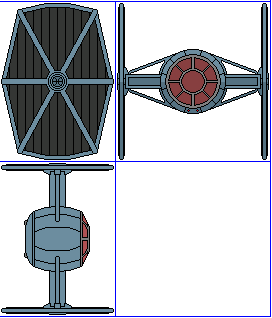
- Intent: Create another itty bitty TIE. The TIE Sprite.
- Image Source: SFS TIE/lt Light
- Canon Link: N/A
- Permissions:
- HPI - BACS-X89i | Breytast Adaptive Camouflage System (OM)
- HPI - Skuggalegt I-pattern Polymer (OM)
- FAE/SW-08 Light Beam Cannon Mk. II (N/A)
- FAE/SW-19 Light Linear Motor Autocannon (N/A)
- FAE/SW-09 Hybrid Scattercannon - Light (N/A)
- FAE/WH-04 Universal Missile Platform v1.1 (N/A)
- Solar Ray Shielding (OM)
- FAE/S-03 Inclusive Countermeasure Module (N/A)
- SUPER-9 Auxiliary Boosters (OM)
- SLAM MK. II (OM)
- HPI - ECSAI-class "Sérhannaðar" Artificial Intelligence (OM)
- FAE/G-01 Hypermatter Synthesis Engine (N/A)
- FAE/E-01 Coaxium Pulse-Detonation Drive (N/A)
- Huabing Engine (X)
- FAE/C-01 Multiphase Tensor Field Element (N/A)
- FAE/S-01 "Pentozali" Agility Array (N/A)
- Jumpmaster 1.01 Microdrive (OM)
- Sleipnir-class 0.5 Path Engine (OM)
- Jumpmaster Subdrive Module (OM)
- Microjump Capacitor (OM)
- FAE/S-04 Small Craft Support and Survival Suite (N/A)
- FAE/S-16 Aerospace Combat Sensor System Mk. II (N/A)
- O.S.I.V.P. (OM)
- FAE/S-11 Universal Communication Matrix (N/A)
- FAE/S-17 Active Airflow Management System (N/A)
- FAE/S-07 Symbiotic Ghost Link (N/A)
- FAE/S-09 Active Harmonizing System (N/A)
- FAE/S-06 Reactive Targeting Matrix (N/A)
- FAE/C-02 Tractor Guidance Network (N/A)
- FAE/S-13 Unified Engagement Network (N/A)
- TunnelNet VPN (OM)
- Aegis SH13LD (OM)
- GPO-12 "Ironmaze" Threat-Prevention Suite (OM)
- FAE/S-05 ECM Array (N/A)
- FAE/S-15 EPM Array (N/A)
- FAE/S-19 Shield Frequency Scrambler (N/A)
- Primary Source: N/A
- Manufacturer: First United Astral Engineering
- Affiliation:
- The Imperial Confederation
- Exclusive Writers and Buyers
- Market Status: Closed-Market
- Model:
- FAE/TIE Series “Sprite” Ultralight Starfighter
- TIE/ULSF Ultralight Starfighter
- Production: Minor
- Material:
- Titanium-Laminanium Alloy - Ablative Hull Armor Plating
- Alusteel - Skeletal Frame
- Reinforced Duraplast Electronic Hardening - Ion and EMP Mitigation
- Condensed Matter Composite - Distributed
- Agrinium - Solar Collectors
- Quadanium Steel-Laminanium Alloy - Solar Collector Foil Braces
- Molecularly Bonded Phototropic Transparisteel - Viewports
- Programmable Matter - Various Applications
- BACS-X89i | Breytast Adaptive Camouflage System - Hull Overcoat
- Skuggalegt I-pattern Polymer - Hull Undercoat
- Internal Circuitry and Electronics
- Various TIE Series Starfighter Components and Materials
- Classification: Starfighter
- Length: 3.38 meters
- Width: 3.81 meters
- Height: 4.51 meters
- Armament: Very Low
- Light Cannon Hardpoint (2) - Chin
- Light Cannon Hardpoint (2) - Chin
- Defenses: Low
- Polarized Solar Ray-Particle Energy Shield Array - 25 SBD
- Titanium-Laminanium Ablative Hull Plating - 6 RU
- FAE/S-03 Inclusive Countermeasure Module
- Squadron Count: Very High: 20
- Maneuverability Rating: Very High │ Very Low - SLAM MK. II
- Speed Rating: High │ Very High - SLAM MK. II
- Minimum Crew: ECSAI-class "Sérhannaðar" Artificial Intelligence
- Optimal Crew:
- Hyperdrive: Yes
- Hyperdrive Class:
- Hyperdrive: 1.0
- Path Engine: 0.5
- Power and Propulsion Systems
- FAE/G-01 Hypermatter Synthesis Engine - Primary Power System
- Solar Collection Arrays - Secondary Power System
- Solar Capacitor
- Twin FAE/E-01 Coaxium Pulse-Detonation-Huabing Hybrid Engine Array
- SLAM MK. II
- Power Conversion System
- Hyperdrive Systems
- FAE/S-04 Small Craft Support and Survival Suite
- FAE/S-16 Aerospace Combat Sensor System Mk. II
- FAE/S-11 Universal Communication Matrix
- Piloting and Control Systems
- Programmable Matter Controls and Ergonomics
- FAE/S-07 Symbiotic Ghost Link
- Offensive Support Systems
- FAE/S-09 Active Harmonizing System
- Fire Linked Weapon Systems
- Automatic Reloading Systems
- FAE/S-06 Reactive Targeting Matrix
- FAE/C-02 Tractor Guidance Network
- Computer Systems
- Computer System - ECSAI-class "Sérhannaðar" Artificial Intelligence
- Slave Circuit System
- FAE/S-13 Unified Engagement Network
- Cybersecurity Suite
- Navigation Systems
- Astrogation Computer - MicroJump and Hyperspace Skip Calculation System
- Nav Computer Route Astrogation Bypass
- Flight Avionics System
- Misc. Systems
- Ion-Flux Cooling System
- Polarity Sink - Passive Degaussing System
- Automatic Polarizing and Anti-Flash Canopy
- Superconducting Coils
- Wing Folding Capability - Solar Panel Collectors
STRENGTHS
- Sprite: The TIE Sprite is much, much smaller than a standard TIE/ln or TIE/LN. Thus, it has a tighter profile and is generally harder to hit. It is also easier to handle in confined spaces, such as dense asteroid fields, debris fields, hangar bays, or cavernous ship interiors.
- Electromagnetic Warrior: With its ECM, EPM, and shield frequency scrambler, the TIE Sprite is capable of exerting significant influence on the electromagnetic environment in almost any given battlespace. It can disrupt enemy targeting solutions while enhancing its own, pierce through concerted jamming, and execute yet more feats.
- Amphibian: The life support systems, electromotive field motors, and hydrostatic fields allow the TIE Sprite to traverse underwater and remain submerged for an indefinite period of time. In a pinch, this function could be used to hide from pursuing enemy forces or even to initiate a surprise attack!
- Low Profile: The TIE Sprite has coatings on its hull which effectively lower the craft’s sensor profile and render it more difficult to distinguish against the backdrop, thereby making it harder to register and lock onto at range. The craft's small size works further in its favor, allowing for a smaller profile. However, this does not approach true stealth capability, since it does not grant true sensor or sensory invisibility.
- Quantity is Quality: Due to its relatively small size, the TIE Sprite can be supported in large squadron sizes.
- Hummingbird: The TIE Sprite is quite balletic and maneuverable in flight, demonstrating dazzling agility that allows a skilled pilot to evade incoming fire and missiles with deft ease.
- Automation: The TIE Sprite is supported by a suite of automated processes which govern its targeting systems, power systems, flight control systems, and yet more. In the event that these systems are somehow disabled, whether via EMP/Ion discharge, concentrated slicing, or in rare cases, jamming, the operating efficiency of the craft will be negatively affected.
- Sensitive Passive Sensors: The passive sensor array on the hull of the TIE Sprite is an extreme boon to the pilot’s battlespace awareness, especially in conditions where the use of active sensors may reveal the craft’s location. However, they are also very vulnerable, as even glancing blows can destroy or disable the sensors on or around the affected areas. In essence, as the hull takes more hits, the Spyglass’ passive reception array will become increasingly ineffective.
- Straight and Narrow: The SLAM Mk. II provides a significant boost to speed and acceleration, but it compromises maneuverability while active.
- Thin Skin: The TIE Sprite has ultralight, low-grade shields and a weak, thinly armored hull. Thus, the craft is unable to withstand direct fire for long.
- Catching Flak: Although the TIE Sprite is a tiny, fast starfighter that is hard to hit, it is susceptible to high-damage area of effect munitions, typically from cluster explosives or flak. The craft’s lack of heavy armor renders it quite vulnerable to attacks from these weapon types and others of similar profiles.
- Sprite Sting: Corresponding with its small frame, the TIE Sprite has a light armament, possessing only two light cannon-grade weapons. However, it should still be noted that the craft’s weapons are small craft/vehicle-grade and thus are naturally more powerful than even heavy man-portable small arms.
A cousin of the FAE/TIE Series “Pixie” Ultralight Interceptor, the FAE/TIE Series “Sprite” Ultralight Starfighter is an ultralight superiority fighter developed by First United Astral Engineering. The craft is a miniaturized design of the ancient TIE/LN starfighter, armed with a pair of light cannon-grade weapons situated in the chin. Classed as a superiority fighter, its main role is contesting and taking control of aerospace, engaging starfighters, missiles, bombers, gunships, drones, and more in the process.
As an ultra-compact small craft, the Sprite is particularly well-suited for operating in dense aerospace environments the likes of debris fields, asteroid fields, canyons, trenches, and similar battlespaces. The Sprite’s miniature size also allows the craft to be fielded in large squadrons. The ability to store the craft in large numbers is further augmented by its folding solar panel collector wings.
Once the Sprite completed its trials and tests, it was formally christened as the TIE/ULSF before the first production batch was purchased by the Imperial Confederation. The Sprite is anticipated to see its first true en masse battlefield test soon, as the Imperial Confederation prepares its campaign to reclaim old Lost Imperial space. It is hoped that the fighter will become a key asset in extending Imperial dominance through superior numbers, tactical flexibility, and advanced technology!
Out Of Character Info
Intent:
Create another itty bitty TIE. The TIE Sprite.
Permissions:
See Body
Technical Information
Affiliation:
The Imperial Confederation, Exclusive Writers and Buyers
Model:
FAE/TIE Series “Sprite” Ultralight Starfighter, TIE/ULSF Ultralight Starfighter
Starship Class:
Small Craft (1-50m)
Starship Role:
Fighter
Modular:
Yes
Material:
See Body
Armaments:
See Body
Defense Rating:
Low
Speed Rating:
High
Maneuverability Rating::
Very High
Energy Resist:
Low
Kinetic Resist:
Low
Radiation Resist:
Low
Minimum Crew:
0
Optimal Crew:
1
Passenger Capacity:
0
Cargo Capacity:
Very Small