

The Golden Dragon





OUT OF CHARACTER INFORMATION
- Intent: To create massive mobile shipyards for the Mythos Fleet.
- Image Source: Space Station Drydock Model
- Canon Link: N/A
- Permissions:
- Primary Source: N/A
PRODUCTION INFORMATION
- Manufacturer: Iron Covenant
- Kyr'bes Buy'ce - security, sensors, force-scanning, precision calibration, counter-infiltration, and internal security systems.
- Maji Ironworks - construction craft, tugs, utility vehicles, maintenance equipment, salvage hardware, drones, and industrial support systems.
- Kestri Hypernautics - naval architecture, drydock interfaces, ship integration systems, traffic control, and fleet operations infrastructure.
- Kestri Heavy Engineering - station frame, armor integration, shipyard infrastructure, heavy industry, fabrication systems, and core industrial systems.
- Affiliation: Iron Covenant | Mythos Fleet
- Market Status: Closed-Market
- Model: Mythos Yards
- Production: Semi-Unique
- Material:
- Besk'jalya Beskar Superalloy
- Ve'vut Beskar
- Digun-type Modular Armor Components
- Beskadetr Transparent Armor Composite
- Beskar
- Quadanium Steel
- Titanium
- Impervium
- Impervium Carbide
- Seigurium
- Duranium
- Doonium
- Turadium
- Phrik
- Condensed-Matter Composite
- Plexalloy
- Agrinium
- Transparisteel, where necessary
- Glasteel, where necessary
- Haysian Smelt / Ultrachrome superconductive wiring, shield-routing circuitry, power conduits, and industrial control systems
- Gold, silver, chromium, seals, gaskets, reinforced pressure membranes, bulkhead plating, fabrication feedstock, and components of installed systems
- Force-Tech Environmental Sealing Gel
TECHNICAL SPECIFICATIONS
- Classification: Space Station | Mobile Shipyard | Deep Space Manufacturing Facility | Fleet Repair Yard
- Length: 10km
- Width: 8km
- Height: 5km
- Armament: None
- Defenses: Extreme
- Force-Tech ES-32 Shield System
- M.I. Cyclic Shield Generator
- MRS-01 Eir Defense System
- MRS-04D Omvendt Ablative Inertial Damper
- Digun-type Modular Armor Components
- Calyiud-type Star Anchor
- Besk'jalya Beskar Superalloy armored superstructure and primary shipyard frame.
- Ve'vut Beskar reinforcement around critical drydock frames, reactor sections, shield nodes, command cores, hangar pressure zones, and structural stress points.
- Beskadetr Transparent Armor Composite viewports, armored observation galleries, traffic-control ports, and shielded command windows.
- Impervium Carbide structural reinforcement around shielded fabrication chambers, heavy machinery housings, clamp towers, pressure compartments, and high-impact maintenance corridors.
- Haysian Smelt / Ultrachrome superconductive circuitry for high-load power transfer, shield routing, drydock systems, station automation, and fabrication control.
- Reinforced pressure compartments, armored internal bulkheads, blast segmentation, decompression shutters, and industrial hazard lockdown sections.
- Hangar Space: Industrial Docking and Production Capacity
- Primary Ring Drydock: Capable of constructing, repairing, or overhauling one Star Destroyer-scale vessel up to approximately 2km.
- Twin Rail Slips: Capable of handling two destroyer/cruiser-scale projects, multiple frigates, or modular hull sections.
- Clamp Towers and Auxiliary Dryberths: Used for frigate, corvette, transport, tug, salvage, and subsystem refit work.
- External Hardpoints: Used for emergency stabilization, cargo transfer, salvage intake, hull patching, and short-duration repair work.
- Secondary Smallcraft Yards: Dedicated sub-frigate production and repair spaces for corvettes, patrol craft, gunships, armed transports, customs vessels, courier ships, cargo barges, small escorts, shuttles, and utility vessels.
- Starfighter Production Bays: Industrial assembly bays capable of constructing, repairing, testing, and storing starfighters, bombers, interceptors, dropships, and other small craft before transfer to carrier vessels, clan ships, depot ships, or fleet logistics transports.
- Smallcraft Hangars: Shuttles, cargo lighters, inspection craft, repair skiffs, personnel transports, utility craft, maintenance vehicles, loader craft, and industrial support vessels.
- Industrial Support Hangars: Construction tugs, heavy tractor tugs, salvage craft, repair craft, mobile scaffold platforms, hull crawlers, drone carriers, and fabrication tenders.
- Logistics and Contractor Berths: Freighters, container haulers, fuel tenders, supply ships, ore carriers, salvage haulers, contractor vessels, and fleet support craft.
- Basilisk/War Droid Service Berths: Maintenance, refit, and transport berths for Basilisk war droids and similar Mandalorian utility/combat droids, without counting as dedicated starfighter squadrons.
- No dedicated armed starfighter squadrons are fielded by the station. Armed small craft produced, repaired, or stored aboard the yard are industrial inventory, cargo, work-in-progress, or transfer stock rather than an operational combat wing.
- Maneuverability Rating: Extreme
- Circular station geometry and distributed station-keeping thrusters.
- Force-Tech MS-16b Motile Maneuverability System Suite
- Speed Rating: Very Low
- Hyperdrive: Yes
- Primary: RMR-H11 Meili Hyperdrive Class 1
- Backup: Force-Tech Hyperviolet Series Class 1
STANDARD FEATURES
- All standard space station systems.
- Standard life support systems.
- Standard long-range sensor systems.
- Standard navigation systems.
- Standard medical facilities.
- Standard escape pods and lifeboats.
- Standard crew habitation, contractor quarters, visiting crew accommodations, worker dormitories, mess halls, refreshers, repair shops, and recreational facilities.
- Standard communications systems, including conventional subspace, hyperwave, HoloNet-compatible, encrypted fleet-band, and internal station communications.
- Temiye Ansible Comm System for long-range/FTL fleet coordination.
- M.I. Rotating Communications System for redundant encrypted communications, frequency rotation, emergency beacon routing, and backup signal management.
- Kestri Heavy Engineering Shipyard Infrastructure
- Primary ring drydock.
- Twin rail assembly slips.
- Clamp towers and exterior repair hardpoints.
- Heavy industrial fabricator arrays.
- Selective nanotechnological precision fabrication systems.
- Hull plate fabrication lines.
- Bulkhead, frame, and structural-member fabrication lines.
- Vacuum proving chambers and pressure-test bays.
- Shielded engine-test cells and reactor-test compartments.
- Ordnance-safe ship fitting bays for installing weapons, launchers, magazines, and defensive systems onto vessels under construction; these systems are not station armaments.
- Derelict quarantine berths for contaminated, unstable, trapped, or unknown salvage.
- Shielded fabrication chambers.
- Station-scale structural reinforcement grid.
- Raw material and fabricator feedstock vaults.
- Fuel bunkerage, reactor-fuel storage, coolant reserves, and consumables-transfer stations.
- Hazardous material containment vaults.
- RRM-ORS9 Orca Refining Stations
- RMM-KW5 Mackinaw Molecular Furnaces
- GDE-01 Antimatter Reactor System
- Force-Tech HARC Power Generator auxiliary industrial surge-power nodes
- M.I. Kinetic Power Generator emergency backup power nodes
- RMR-S45 Overcapacitator subsystem surge-capacitor banks
- Kestri Hypernautics Naval Integration Systems
- Drydock control systems.
- Shipyard traffic-control network.
- Fleet docking interface systems.
- Construction management systems.
- Star Destroyer-scale service architecture.
- Sub-frigate construction and repair management systems.
- Corvette, patrol craft, gunship, shuttle, transport, starfighter, bomber, interceptor, and utility-vessel service architecture.
- Smallcraft acceptance-trial, systems-check, and transfer-preparation facilities.
- Modular hull alignment systems.
- Drydock diagnostics and acceptance-trial systems.
- Starship certification, acceptance-trial, and final inspection facilities.
- Tran'ca'nara-type Astrogation Computer
- Temiye Ansible Comm System
- M.I. Rotating Communications System
- RMR-H11 Meili Hyperdrive primary hyperdrive interface architecture
- PGEM-VOId Ion Drive station-keeping and low-speed maneuvering engine clusters
- Kyr'bes Buy'ce Security and Precision Systems
- Industrial sensor suites.
- Precision fabrication calibration arrays.
- Quality-control inspection systems.
- Stationwide diagnostic monitoring.
- Controlled-access security checkpoints for sensitive industrial spaces.
- Manda'hlirata Force Scanner Network
- M.I. Scan-Jam Package
- Maji Ironworks Industrial Support Systems
- Construction drone swarms.
- Repair drone swarms.
- Inspection drone swarms.
- Welding, cutting, sealing, and plating drones.
- Smallcraft production gantries.
- Starfighter, bomber, gunship, shuttle, and corvette assembly cradles.
- Smallcraft maintenance and refit bays.
- Smallcraft maintenance gantries.
- Corvette and gunship service cradles.
- Basilisk-compatible service berths.
- Hull crawler, loader, and mobile scaffold support infrastructure.
- Heavy tractor tug support facilities.
- Loader and cargo-handling vehicle facilities.
- Salvage craft support facilities.
- Utility craft berths.
- Maintenance vehicle infrastructure.
- RMT-TR8 Hamada Tractor Beams
- Logistics, Transit, and Crew Infrastructure
- Logistics coordination center.
- Repair scheduling center.
- Cargo sorting hubs.
- GDE-MDS Modular Deck System
- GSI/DE "Synapse" Command Interface Suite
- GSI Integrator Module & Patch Suite
- SAMS - Starship Automation Management System
- Sim'olan Droid Brain Core station automation network
- RMMT-SC1/t Cargo Transport Hovertrains
- RMMT-SC1/c Mass-Transit Hovertrains
- Personnel lifts, cargo elevators, mag-rail freight systems, armored transit tubes, and secure maintenance corridors.
- Medical triage and industrial accident response centers.
- Clan liaison offices and visiting delegation spaces.
- Industrial waste processing.
- Emergency and Environmental Systems
- FES-HRE18 Fire Suppression System
- Force-Tech Environmental Sealing Gel
- Stationwide environmental sealing, emergency bulkheads, atmospheric containment systems, blast doors, decompression shutters, pressure membranes, and industrial hazard lockdown systems.
ADVANCED SYSTEMS
- Kestri Heavy Engineering
- Kyr'bes Buy'ce
- Manda'hlirata Force Scanner Network
- Precision industrial sensor architecture.
- Fabrication calibration network.
- Counter-infiltration monitoring architecture.
- Maji Ironworks
- M.I. Cyclic Shield Generator
- M.I. Rotating Communications System
- M.I. Scan-Jam Package
- M.I. Kinetic Power Generator
- Industrial tug, loader, repair-vehicle, smallcraft-production, and drone integration architecture.
- Force-Tech
- Roble Manufacturing
- Impervium Carbide
- MRS-01 Eir Defense System
- MRS-04D Omvendt Ablative Inertial Damper
- RMR-H11 Meili Hyperdrive
- RMR-S45 Overcapacitator
- SAMS - Starship Automation Management System
- RMT-TR8 Hamada Tractor Beams
- FES-HRE18 Fire Suppression System
- RMM-KW5 Mackinaw Molecular Furnaces
- RRM-ORS9 Orca Refining Stations
- RMMT-SC1/t Cargo Transport Hovertrains
- RMMT-SC1/c Mass-Transit Hovertrains
- GDI
STRENGTHS
- Mobile Shipyards: Each Mythos Yards station is a full mobile shipyard capable of relocating with fleet elements, establishing forward industrial hubs, and withdrawing from threatened regions rather than remaining bound to a single planet or orbital facility.
- Star Destroyer-Capable: The primary ring drydock is capable of constructing, repairing, or overhauling a single Star Destroyer-scale vessel up to approximately 2km, while the rail slips and auxiliary berths handle smaller vessels, modular sections, and refit work.
- Smallcraft Production: In addition to larger shipyard work, each station can construct, repair, test, and transfer starfighters, bombers, gunships, corvettes, shuttles, transports, utility craft, and other sub-frigate vessels. These craft are produced as industrial output rather than fielded as the station's own combat squadrons.
- Extreme Defenses: With no offensive armament, each station is built almost entirely around survivability. Heavy shielding, reinforced structure, advanced inertial damping, modular armor, compartmentalization, fire suppression, environmental sealing, damage-control systems, and the Calyiud-type Star Anchor allow it to endure industrial accidents, raids, sabotage, and battlefield emergencies.
- Anchored Defensive Posture: The Calyiud-type Star Anchor allows a station to enter a reinforced anchored state, improving defensive stability during siege conditions, dangerous construction operations, heavy docking maneuvers, or emergency station-keeping.
- Salvage-to-Ship Pipeline: The station can process battlefield wreckage, captured equipment, scrap hulls, raw materials, and damaged components into usable fabrication feedstock through reclamation foundries, refining stations, and molecular furnaces.
- Advanced Fabrication: Heavy industrial fabricators and selective nanotechnological precision systems allow each station to produce hull plates, structural members, internal bulkheads, spare parts, and standardized ship components on site, provided sufficient raw material and power are available.
- High Automation: Sim'olan droid brain cores, SAMS automation, GDI integration systems, construction drones, repair drones, inspection drones, and automated cargo systems reduce crew strain and improve industrial throughput.
- Redundant Long-Range Communications: Each station combines conventional communications, Ansible-based long-range coordination, M.I. rotating communications architecture, and scanner-jammer integration to maintain contact with fleet elements, supply convoys, escorts, and repair traffic even during complicated fleet movements or industrial emergencies.
- Excellent Station-Keeping: Circular geometry, distributed thrusters, PGEM-VOId ion drive clusters, and the MS-16b system give each station exceptional maneuverability relative to its immense size, especially during docking, alignment, evasive burns, and construction positioning.
- Force-Aware Security: The Manda'hlirata network allows each station to detect nearby Force-sensitive presences, active Force use, and unusual Force-based disturbances within its detection limits, improving counter-infiltration and internal security.
WEAKNESSES
- No Armament: The station carries no offensive weapons and cannot meaningfully project force by itself.
- Not a Warship: Despite its extreme defenses, a Mythos Yards station is an industrial asset rather than a combat vessel. It depends on escorts, patrol craft, allied fleets, and defensive positioning in hostile space.
- Production Is Not Deployment: The station can build, repair, test, store, and transfer starfighters and armed small craft, but it does not field dedicated armed starfighter squadrons as part of its own hangar complement.
- Very Slow: The station is highly maneuverable relative to its size, but it is not fast. It cannot chase enemies, rapidly reposition across a battlefield, or outrun dedicated warships in realspace.
- Massive Target: At 10km long, each station is enormous, difficult to hide, and easy to identify once located. It cannot rely on stealth or concealment as a primary defense.
- Material Hungry: Its fabricators, foundries, nanotechnological systems, drydocks, repair facilities, shield systems, and anchored defensive systems require huge quantities of raw material, refined feedstock, replacement components, industrial chemicals, power, and skilled oversight.
- Dock Bottlenecks: Only one Star Destroyer-scale vessel can occupy the primary ring drydock at a time. Major overhaul or construction work can monopolize a station's largest industrial space for extended periods.
- Battlecruiser Ceiling: Mythos Yards stations cannot reliably construct battlecruisers larger than roughly 2-3km. They can stabilize, service, patch, or replace individual systems on larger hulls, but sustained full construction of battlecruiser-scale vessels is beyond their design limits.
- No Sustained 5km Assembly: While these stations can perform emergency work on sections of very large vessels, they do not have the slip length, support volume, or industrial depth required for sustained full assembly of 5km hulls.
- Supercapital Limitation: Mythos Yards stations lack the infrastructure required for sustained construction of dreadnoughts, supercapitals, super-heavy reactors, super-heavy hyperdrive cores, and other exceptionally large strategic projects.
- Anchored Means Anchored: When the Calyiud-type Star Anchor is active, the station sacrifices mobility and evasive repositioning for stability and defensive reinforcement. It cannot freely maneuver while benefiting from the anchor's full effect.
- Automation Vulnerability: While automation improves throughput, heavy reliance on droid brains, automated logistics, construction drones, and integrated control systems means slicing, ion disruption, EMP damage, or catastrophic software failure can severely impair shipyard operations.
- Power Demands: The station's shields, star anchor, hyperdrive, maneuvering suite, fabricators, tractor beams, foundries, communications systems, and nanotechnological systems place extreme demands on its reactors. Heavy combat damage or reactor disruption can force the station to prioritize survival over production.
- EWAR Is Not Perfect: The station's jammers, scanners, rotating communications, and Ansible systems improve security and coordination, but they do not make it immune to slicing, spoofing, comm-array destruction, sensor deception, localized interference, or dedicated counter-EWAR operations.
- Communications Are Not Invulnerability: The Ansible and rotating communications systems improve range, redundancy, and signal management, but they do not make the station immune to jamming, slicing, physical comm-array destruction, localized interference, or loss of compatible receiving infrastructure.
- Manda'hlirata Limitations: The Force scanner network is a warning and detection system, not Force nullification, Force resistance, perfect tracking, or a substitute for proper security patrols.
- Tran'ca'nara Dependency: The Tran'ca'nara-type Astrogation Computer is designed around authenticated Iron Covenant navigation infrastructure. If that connection is interrupted, compromised, or unavailable, the station must rely on more conventional backup navigation procedures.
DESCRIPTION
Crew: Approximately 50,000 skeleton crew; approximately 250,000-400,000 optimal operational crew including yardmasters, engineers, shipwrights, industrial laborers, droid technicians, security personnel, medical personnel, logistics staff, administrative support, and rotating ship crews.
Passengers: Variable. Each station can host large numbers of transient ship crews, contractors, clan specialists, salvage teams, inspectors, and visiting delegations depending on operational tempo.
Cargo Capacity: Massive, primarily dedicated to raw materials, fabrication feedstock, spare parts, armor plate, industrial chemicals, salvage, replacement components, consumables, and station maintenance reserves.
Consumables: Approximately 2 years under normal fleet-supported operation. Actual endurance varies heavily based on population, industrial output, damage state, and resupply frequency.
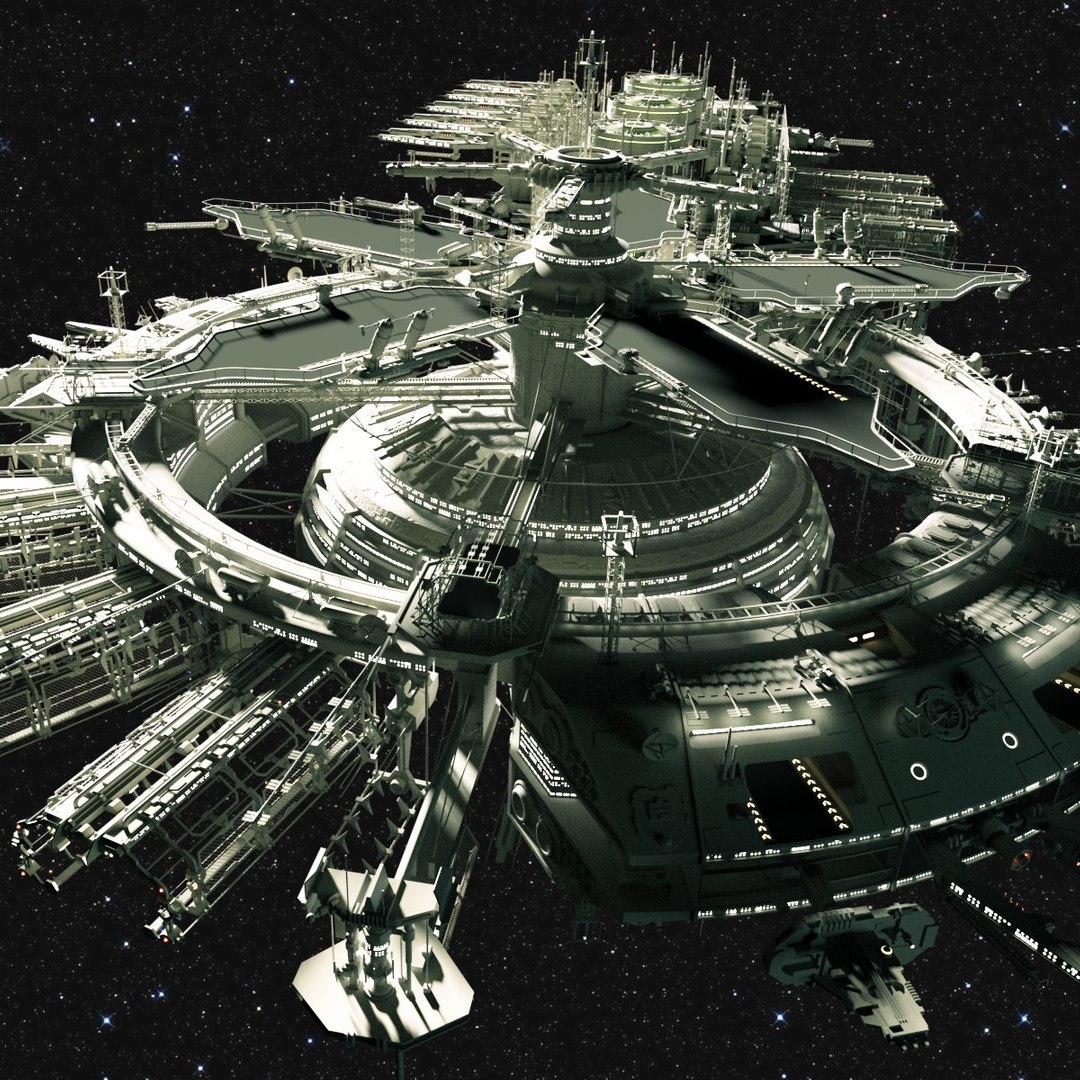
The Mythos Yards are ten-kilometer Mandalorian industrial stations built to serve as the distributed shipbuilding and repair backbone of the Mythos Fleet. Rather than functioning as combat stations, fortresses, or warships, the Mythos Yards exist to keep Mandalorian vessels alive, repaired, refitted, and ready for war across long campaigns far from permanent shipbuilding worlds.
The design is divided among four Iron Covenant prime contractors. Kestri Heavy Engineering provides the station frame, armor integration, heavy fabrication systems, salvage foundries, reactor and power infrastructure, and core industrial machinery. Kestri Hypernautics provides the naval architecture, drydock interfaces, shipyard traffic control, docking standards, astrogation integration, communications integration, and fleet compatibility systems. Kyr'bes Buy'ce provides sensors, precision calibration systems, counter-infiltration screening, secure access architecture, and Manda'hlirata Force Scanner integration. Maji Ironworks provides the rugged practical hardware that keeps each yard moving: tugs, loaders, construction drones, repair drones, salvage equipment, maintenance vehicles, smallcraft production gantries, and utility craft support infrastructure.
At the heart of each station is its primary ring drydock, sized for the construction, repair, or overhaul of a single Star Destroyer-scale vessel up to approximately two kilometers. Two rail slips handle destroyer, cruiser, frigate, and modular hull assembly work, while clamp towers and external hardpoints provide additional refit, repair, stabilization, and cargo-transfer capacity. Each station can work on many vessels at once, but its largest drydock remains a finite resource. A single major Star Destroyer project can monopolize the primary ring for extended periods.
Beneath that capital-scale infrastructure, the Mythos Yards maintain extensive sub-frigate and smallcraft production facilities. Corvettes, patrol craft, gunships, shuttles, starfighters, bombers, interceptors, cargo lighters, repair skiffs, utility vessels, and industrial support craft can be assembled, repaired, tested, and transferred to the ships or depots that will actually field them. Armed small craft may pass through a station as products, cargo, or work-in-progress, but the yards themselves do not operate them as dedicated combat squadrons.
The Mythos Yards' industrial doctrine is built around salvage, fabrication, and mobility. Damaged hulls, battlefield wreckage, captured equipment, scrap components, and raw resources can be broken down by refining stations, reclamation foundries, and molecular furnaces before being converted into fabrication feedstock. Heavy fabricator arrays then produce hull plates, structural members, replacement bulkheads, standardized ship components, and repair sections. More expensive nanotechnological precision fabrication systems are reserved for high-tolerance parts, emergency repairs, and delicate assembly work rather than full-scale instant ship construction.
Because the stations carry no offensive armament, their combat balance is concentrated almost entirely into defense and survivability. Layered shield systems, reinforced armor, modular protective components, inertial damping, compartmentalized construction, blast doors, emergency bulkheads, fire suppression, environmental sealing, powerful damage-control systems, and the Calyiud-type Star Anchor help each station withstand attacks and industrial disasters long enough for allied forces to respond. The Aal'briik jammer suite, M.I. Scan-Jam Package, Temiye Ansible Comm System, and M.I. Rotating Communications System further support defensive operations by complicating hostile scanning, preserving communications redundancy, and improving coordination during raids or industrial emergencies.
The Calyiud-type Star Anchor is used in two primary roles: stabilizing a station during intense construction, docking, and heavy industrial operations, and hardening it during siege or emergency defensive conditions. This makes an anchored Mythos Yards station exceptionally difficult to shove, dislodge, or disrupt, but the same system also limits mobility. When the Star Anchor is active, the station is not free to maneuver at the same level it can under normal station-keeping operations.
The Mythos Yards are highly automated, but not unmanned. Sim'olan droid brain cores, Roble SAMS automation, GDI integration systems, cargo-management networks, construction drones, and repair drones allow each station to coordinate enormous industrial workloads, but skilled workers remain essential. Yardmasters, shipwrights, engineers, clan specialists, droid technicians, security personnel, and logistics officers are required to keep their systems operating efficiently.
Despite their immense capabilities, Mythos Yards stations have clear limits. They cannot reliably construct battlecruisers above roughly two to three kilometers. They cannot sustain full assembly of five-kilometer hulls. They cannot fabricate super-heavy reactors, super-heavy hyperdrive cores, dreadnoughts, or supercapital warships at scale. Their role is fleet sustainment, not supercapital construction. Each station is a mobile forge, a salvage citadel, a repair haven, and an industrial lifeline for the Mythos Fleet.
Individual Mythos Yards stations are identified by Iron Covenant yard-cant site names, a compact industrial shorthand used by Covenant shipwrights, dockmasters, traffic controllers, and fleet logistics crews. These designations are treated as working callsigns rather than ceremonial names, allowing each mobile yard to be referenced quickly across encrypted fleet traffic and shipyard command channels.
Known site designations:
- Mythos Yards Site I'o
- Mythos Yards Site Do
- Mythos Yards Site Mra
- Mythos Yards Site Bac
- Mythos Yards Site Bid
- Mythos Yards Site Tay
- Mythos Yards Site Tav
- Mythos Yards Site Um
- Mythos Yards Site Vat
- Mythos Yards Site Dam
- Mythos Yards Site Dah'e'o
- Mythos Yards Site Dah'no
Out Of Character Info
Intent:
To create massive mobile shipyards for the Mythos Fleet.
Permissions:
Listed
Technical Information
Affiliation:
Iron Covenant | Mythos Fleet
Model:
Mythos Yards
Starship Class:
Other
Starship Role:
Mechanical
Modular:
No
Material:
Listed
Armaments:
None
Defense Rating:
Extreme
Speed Rating:
Very Low
Maneuverability Rating::
Extreme
Energy Resist:
Extreme
Kinetic Resist:
Extreme
Radiation Resist:
Very High
Other Resistance(s):
Thermal: Very High
Ion/EMP: High
Sonic: Average
Minimum Crew:
50000
Optimal Crew:
350000
Cargo Capacity:
Extreme