
Sʜᴀᴅᴏᴡ Lᴏʀᴅ




RATINGS
| Armament: | Defenses: | Speed: | Maneuverability: | Hangar Space: | Squadron Count: |
|---|---|---|---|---|---|
| High | High | Very High | Average | Extreme | # 0 |
.

.
════ ✦ MUD DUCK ✦ ════
Classification: Payday Class: Heavy - Cargo Transport Freighter Model: Mud Duck |
|---|
Length: | Width: | Height: |
|---|---|---|
125 meters | 92.5 meters | 22.5 meters |
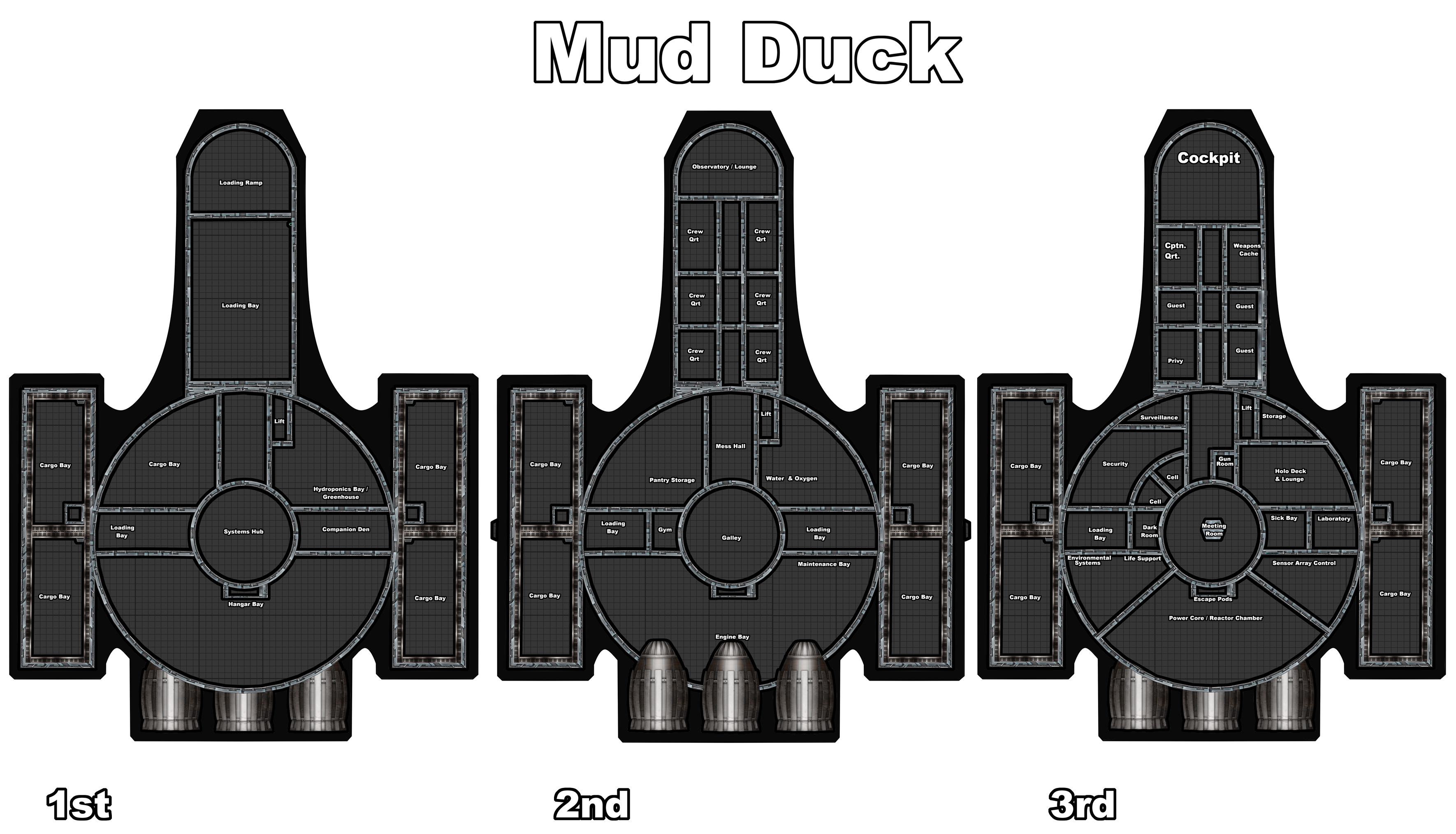
- ◆ SHIP INTERIORS IMAGE GALLERY ◆
-


OUT OF CHARACTER INFORMATION
PRODUCTION INFORMATION
TECHNICAL SPECIFICATIONS
STANDARD FEATURES & SYSTEMS
EXTRAS
STRENGTHS
WEAKNESSES
DESCRIPTION
-
Categories Details Intent To create a unique, cargo frigate for independent use by Braze Kai'el and his Phoenix Crew. Image Source I drew up the ship map
Ship Exterior by [X]
Ship Interiors made by me with : [X]Canon Link N/A Permissions Previous Ship: [Here]
- Breshig War Forged Consolidated [X] [X] Shuklaar Kyrdol
- ATC Purchases [X] [X] Danger Arceneau
- Concord Specialized Technologies Purchases [X] Mig Gred
- Dracken Pryce [X]
Primary Source N/A -
Categories Details Manufacturer This retrofitted junker of a light freighter, is a ship with a rich and elusive history, has been lovingly refurbished despite its age. Few of its kind were ever produced, originating from a small, now-defunct manufacturer that remains largely unrecognized. Its unique character and craftsmanship make it a rare gem in the vast cosmos. Affiliation Braze Kai'el / Phoenix Crew / Market Status Closed-Market Model "Mud Duck" Production Unique Material Titanium Outer Hull, Durasteel Inner Hull, reinforced composite bulkheads, Plating -
Categories Details Classification Modular Cargo Freighter / Light Frigate Length 125 meters Width 92.5 meters Height 22.5 meters Armament High Defenses High Hangar Space Extreme Squadron Count None Maneuverability Rating Average Speed Rating Very High Hyperdrive Primary: Class 0.5 / Backup: Class 4 -
- Navigation Systems / Propulsion / Power — Advanced
-
Power Systems
- HPI - HAPU | Hybrid Antimatter Power Unit - Hybrid antimatter reactor and self recharging power core that can scale from small devices to major ship and facility power.
- Backup generators - Conventional auxiliary power sources that keep critical systems online if the main core is disrupted.
- Backup solar generator - Surface based solar reactor that converts stellar radiation into electrical power as a passive backup.
- Cryogenic capacitors - High density energy storage banks that hold reserve power in super cooled cells for surge draw or emergencies.
- Power routing redundancy - Parallel conduits and automatic switching that keep priority systems online after localized damage.
Engine Array
- Sublight ion engines ×6 - Primary realspace drives that move the ship at high velocity below lightspeed.
- Tri-ion drives- Efficient ion propulsion clusters that provide sustained thrust with low maintenance demand.
- SLAM Mk II overthrust system - Sublight Acceleration Motor upgrade used to push the ship toward maximum straight line speed at the cost of maneuverability.
Core Navigation
- Avionics package - Integrated flight electronics suite tying sensors, controls, and guidance into a unified stack.
- Flight control systems - Flight computers and control hardware that translate pilot inputs into stable ship handling.
- BWFC Ori'karbakar Advanced Hyperdrive Navicomputer Module- Advanced combined hyperdrive and navicomputer package with early warning, precision micro jumps, and low observability features.
- Hyperdrive backup: Class 0.5 - Redundant high performance backup motivator for rapid strategic redeployment.
- Hyperdrive backup: Class 4 - Secondary, slower, but more conservative backup drive for emergency use.
- Warp vortex stabilizer - Hyperspace safety device that helps prevent catastrophic premature reversion events.
- Beckon call / slave circuit control - Remote control link that lets the pilot summon or manage a slave rigged ship and coordinate automated maneuvers.
- Inertial dampeners - Acceleration compensators that protect crew from lethal g forces during hard maneuvers.
- Additional general navigation systems
- Astrogation computer - Hyperspace navcomputer that plots safe, efficient jump solutions and routes.
- Navigational deflector system - Forward deflector field that clears small debris from the ship's path.
- Flight assist AI / autopilot - Automated pilot aid that can hold course, stabilize attitude, and manage routine flight profiles.
Maneuverability Subsystems
- Aerodynamic control surfaces (atmospheric flight) - Fins, flaps, and control vanes for precise handling in atmosphere.
- Gyrostabilizers and dampeners - Internal stabilization systems that keep the ship level and smooth out sudden rotational forces.
- Maneuvering thrusters / attitude jets - RCS thrusters used for fine pointing, docking, and low speed vector changes.
- Reaction thrusters - High impulse directional jets for snap turns, braking burns, and evasive bursts.
Command & Control
- Bridge / cockpit / auxiliary stations
- KM-1 "Merlin" Holographic Display
- Breshig War-Forge-Consolidated Manda GM Tactical Battlenet- Fleet-linked tactical network that synchronizes targeting data, sensor sweeps, and engagement solutions across allied vessels.
- Breshig War Forge Consolidated 'Manda'-M Tactical Battlenet (Space)
- Breshig War-Forge-Consolidated Manda Battlenet Bridge Module- Dedicated bridge-side control module that interfaces the ship's command core with the wider Battlenet grid.
- Tactical holo-display / command table - 3D battlespace display for plotting courses and coordinating engagements.
- Command AI core / oversight system - Supervisory decision support AI that manages ship wide data and assists command.
- Autopilot and flight computer - Core flight logic that handles routine piloting tasks and complex programmed maneuvers.
- Reactive Targeting Matrix / Active Harmonizing Suite - Fire control enhancers that refine targeting solutions and weapon harmonization in real time.
- Threat prevention and intrusion countermeasures - Electronic warfare and cybersecurity tools that guard against hacking, jamming, and sensor intrusion.
- Fleet coordination node - Networking suite for synchronizing maneuvers and fire plans across allied vessels.
- Universal fire control system (FCS) integration - Unified fire control backbone that ties weapons, sensors, and targeting suites together.
- Integrated propulsion control cluster (ion drives, hyperdrive, sublight engines) - Central management hub for all main drive systems and power routing to propulsion.
- Emergency manual override - Hard mechanical and analog backups that let crew bypass automation in a crisis.
- Silent alert network - Discreet triggers and internal routing that notify command stations without audible shipwide alarms.
Sensor and Scanning Subsystems
- Primary sensor array (gravitic, electromagnetic, biological) - Multi spectrum sensor suite for detecting ships, fields, emissions, and life signatures.
- Predictive targeting AI - Fire control intelligence that anticipates target motion and refines lead solutions.
- Counter scanning suite - Anti detection tools that watch for hostile sensor sweeps and help reduce the ship's own signature.
- Internal communications and data network - Encrypted shipwide datanet handling comms, telemetry, and control traffic.
- Data security and bio hexacrypt layer - High grade encryption and biometric keyed access to protect critical systems.
- Behavioral flagging - Movement-pattern alerts for suspicious routing.
- Thermal / mass tracking - Passive presence verification; catches hidden occupants.
- Inventory tagging - Alerts if sensitive gear leaves authorized zones.
- FalconMark Precision Targeting System - Modular precision targeting suite that integrates with sensors to improve acquisition and identification of targets.
- Counterdetective - Compact detector that warns the crew when hostile active scanning sensors are probing the ship.
- Lock-Threat Warning System - Indicator system that alerts pilots when another vessel has achieved a torpedo or missile lock.
- Defenses — Advanced
-
SS Military Grade Defense Package: Advanced
- Integrated starship defense suite that layers multiple shield types, armor enhancements, and specialized protection around the hull to create a heavy, multi axis defensive envelope.
Shielding Systems
- Internal shield generators and emitters - Distributed generators and emitters that project overlapping shield bubbles around key hull zones.
- Ray shields - Energy shields that block blaster bolts, plasma, and other directed energy while allowing most solid objects to pass.
- Particle shields - Shields that stop physical matter such as shrapnel, missiles, and micro debris before it contacts the hull.
- Stealth shields - Low emission shielding that dampens the ship's sensor profile and makes active scans harder to resolve.
- Deflector shields - General purpose defensive barriers used to deflect both energy and high velocity particles away from the ship.
- Shield dome / full-envelope lockdown - Full-coverage posture for boarding alerts or bombardment risk, prioritizing sealing and survivability.
Hull and Armor
- Durasteel plating - Standard armored hull plating that provides robust baseline resistance to impacts and weapons fire.
- Laminanium reactive armor - Shape memory armor that deforms to absorb strikes and slowly flows back toward its original form between engagements.
- Glasteel viewports - Transparent armored viewports that provide visibility while resisting pressure, micro impacts, and light weapons fire.
- Reinforced titanium alloy hull plating - Additional structural plating that stiffens the frame and improves survivability under sustained fire.
- Seigurium armor ring - High durability armor band around critical sections that adds an extra layer of physical protection.
Countermeasures
- Chaff and flares - Disposable decoys that confuse sensor tracking and divert most guided missiles toward false signatures.
- Sensor jammers - Broad spectrum jamming systems that degrade enemy targeting, ranging, and fire control solutions.
- Missile deactivators - Systems that attempt to prematurely detonate, disable, or confuse inbound warheads through remote interference.
- Full spectrum distortion projector - Projector that scrambles the ship's readings across multiple bands and produces false echoes on hostile sensors.
- Docking guns - Close defense gun mounts that protect docking ports and blind spots against small craft and boarding attempts.
- Hard sound gun - Short range sonic weapon used for point defense and anti boarding actions, focused on hull contact zones.
- Electromagnetic pulse emitters - Limited-use directed EMP to disrupt hostile machinery, targeting, propulsion, or heavy equipment.
- 220 SIG Tactical Sensor Jamming Device - Tactical jammer designed to disrupt hostile sensors and targeting sweeps in the ship's local battlespace.
- Antimissile octets - Point defense launchers that fire interceptor projectiles to destroy or divert incoming missiles and torpedoes.
- Electronic countermeasure suite - ECM package that supports jamming, deception, and spoofing against enemy radar, comms, and guidance systems.
- BWFC "Ori'ga'yusr" Electronic Warfare Suite - Advanced modular EW suite that combines jamming, false target generation, and signal manipulation for fleet level electronic warfare.
- Decoy signal beacons - False transponder echoes to misdirect scanners and dilute tracking confidence.
Special Defensive Subsystems
- Null-series Gravity Well Neutralizer - System that mitigates or interferes with artificial (Gravity Well) effects, improving chances of escape from interdiction fields.
- Energy safety fields - Automatic low power containment fields that snap into place during hull breaches or internal accidents to limit decompression and arcs.
- Atmospheric isolation / segmented bulkhead network - Rapid compartment sealing for hazards or intruders; preserves safe routes.
- Airlock-style sluice points - Sequential doors for delay, checks, and containment.
- Local lockdown authority - Independent section sealing and route control without shipwide disruption.
- Lift destination control - Unauthorized decks don't appear as options.
- Time-based permissions - Access shifts by schedule.
- Revocation system - Command can pull permissions instantly across the network.
- Anticoncussion field generators - Projectors that create magnetic fields to absorb and disperse kinetic shock from explosions and high impact strikes inside or near the hull.
- Antimissile octets - Integrated here as both countermeasure and special defense, providing automatic point defense against guided munitions.
- AR 0B damage reduction component - Armor component that reduces incoming damage through layered materials and energy absorption.
- Assault shield - High output shield generator pattern designed to provide intense but short duration protection during attack runs and breach operations.
- Composite shield generators - Generators that blend deflector, particle, ray, and specialty shields into a single layered projection for broad spectrum defense.
- Deflector plates - Hull plates that incorporate shield projectors directly, reinforcing local defense against concentrated fire.
- Deflector shield generators - Primary generators that provide the main deflector shields for energy and debris protection.
- De icing system - Environmental system that prevents ice buildup on external surfaces during cold climate and atmospheric operations.
- Galaxy Guard shield booster - Auxiliary unit that amplifies shield strength and recharge rate when engaged.
- Heat dispersion vents - Vented structures that radiate excess heat from shields and reactors to reduce overload risk.
- Ion shield generator - Shield generator that offers focused protection against ion storms and ion based weaponry to keep systems online.
- Molecular shield generator - Advanced shield that absorbs incoming energy and converts a portion into usable power for the ship's systems.
- Ray shield generator - Dedicated generator for ray shields that hardens defenses specifically against directed energy weapons.
- Resonance absorptive shield - Shield that absorbs and disperses resonance and vibrational energy, cutting down damage from sonic and shock based weapons.
- BWFC "Buurenaar'aran" Environmental Shield System - Environmental shielding that maintains atmosphere, temperature, and radiation protection while also reinforcing hull integrity against breaches.
- BWFC "Caritr" Shield Generator - High performance, multi role shield generator that can modulate between defensive modes depending on threat profile.
Defensive Profile Summary
- Deflector / particle / ray / molecular shields - Layered shield types that distribute energy and kinetic protection across different bands.
- Hull armor and reinforced bulkheads - Heavily plated frame with reactive and specialized armor components.
- Laminanium and reactive plating - Self adjusting armor that helps blunt repeated impacts over time.
- Shield emitter arrays and backup deflectors - Multiple emitters and generators that keep coverage active even when individual nodes fail.
- Countermeasures (chaff, flares, decoys) - Soft kill systems that divert hostile fire and confuse tracking.
- ECM and jamming suites - Electronic warfare tools that interfere with targeting, guidance, and battlefield awareness.
- Stealth coating and signature dampeners - Systems that lower emissions and sensor cross section when required.
- Threat prevention suite and AI defenses - Automated software and AI routines that flag and react to incoming threats.
- Energy containment and safety fields - Emergency fields that help contain fires, decompression, and power surges.
- Radiation screeners and environmental safety fields - Subsystems that filter radiation, toxins, and hazardous atmospherics to keep the crew alive.
- Utilities — Advanced
-
Communications & Sensor Network
- Primary Intelligence Suite
- SS Military Grade Intelligence Package: Advanced - Integrated intelligence, comms, and sensor backbone.
- Core Communications
- Long and short range transceivers
- Encryption suites
- Scramblers and comms jammers
- Holotransceiver
- Holotransmitter
- Holonet transceiver
- Subspace transceiver
- Hyperwave transceiver
- Hyperwave transmitter
- Telesponder
- Broadcast relay
- Com scan
- CC C S20 Comm Scan Package
- Information Security
- Compartmentalized data layers - No single terminal has the whole map.
- Decoy data architecture - False schematics and curated layouts for intruders.
- Intrusion logging and quiet flagging - Attempts recorded, time-stamped, and routed without spectacle.
- Communication & Response
- Guardian recall beacons - Encrypted summons to defenders through secure channels.
- Visitor escort protocols - Guest access tied to a host; separation narrows routes automatically.
- Battle Management & Tactical Links
- Battlefield Holographic Control Interface
- Battle Net
- Universal fire control compatibility layer
- Reactive Targeting Matrix / predictive AI
- Targeting computer linkup helmets
- Electronic Warfare & Signal Security
- Encryption module
- Communication wave descrambler
- Frequency jammer
- Ion scramblers
- PTP encryption device
- PTP link
- "Blinder" 4B2 jamming array
- Sensor mask
- Data and information security suite (bio hexacrypt, genetic locks)
- Sensor Arrays & Detectors
- 5 Node sensor
- ANq 51 sensor array
- ANs 9.5 sensor system
- Sensor array (gravitic, electromagnetic, biological)
- Aural sensors
- Electro photo receptors
- Energy wave detector
- Gravitic sensors
- Life form indicator
- Radiation screener
- KT ALR 88 sensor warning receiver
- Anti ion emission tracer
- Counter scanning and signal scramblers
- Internal communications network / PA
Breshig War-Forge-Consolidated Aquaponics Cultivation Module- Closed-loop food production system integrating hydroponics and protein cycling for extended deployments.
- Life Support Suites
- Crew Comfort
- Life Support Hardware
- Waste & recycling systems - Processors, composting, and material reclamation for long-duration operations.
- General Ship Systems
- Acceleration compensator
- Anti shock fields
- Code breaker
- Containment shield
- Damage control system
- DPU7 heat sink
- Escape pods
- Advanced flight and navigation computers
- Augmented reality HUD linkup
- Automated repair drones with animated metal sealant
- Internal Security
- 57c holocams
- Blast Doors: The Mud Duck's internal compartments are protected by reinforced blast doors built from layered durasteel plates supported by turadium ribs and a honeycombed impact frame, giving them the strength to withstand heavy blaster fire, explosive shock, and severe pressure shifts while maintaining the ship's structural integrity. Integrated with the vessel's damage-control systems, the doors can seal automatically in response to hull breaches, fires, decompression, or hazardous atmospheres, isolating affected sections of the ship in seconds to prevent further loss of air or structural failure. Access is governed through encrypted security protocols that include passcodes, crew ID chips, biometric scanners, and bridge-level overrides, allowing the ship to shift from routine free-pass circulation to full security lockdown where corridors compartmentalize and intruders can be contained. Each door is powered through redundant energy systems with dedicated capacitor backups and mechanical locking braces that default to a sealed position if power fails, while heavy magnetic bolts anchor the door into the surrounding bulkhead once closed, effectively turning it into a reinforced extension of the hull itself. Control interfaces are available from the bridge, engineering, local wall panels, and portable command datapads, and the doors include proximity sensors and warning alarms to prevent accidental closure on crew while still allowing rapid emergency sealing. In practice, these blast doors serve not merely as passageways but as hardened defensive bulkheads capable of protecting critical areas such as the bridge, reactor spaces, engineering, and cargo holds during boarding actions or catastrophic damage.
- Code cylinder readers
- Klaxon alarms
- Walkthrough identification scanners
- Weapon detectors
- Trap-door corridor network - Concealed drop panels that reroute intruders into containment paths rather than causing injury.
- Nonlethal deterrent turrets - Retractable nodes firing stun bolts, binding nets, or expanding foam to contain without escalation.
- Somnolent mist vents - Mild sedative haze followed by purge cycles; used for pacification and de-escalation.
- Airlock-style corridor sluices - Sequential barriers that delay movement and enable identity checks or containment.
- Restricted lift platforms - Keyed transit; can pause, reroute, or seal during alerts.
- Segmented bulkhead network - Hidden partitions enabling partial lockdowns and guided evacuation routing.
- BWFC "Morut'yc" Security System
- 57c holocams
- Primary Intelligence Suite
- Weapon Systems — Standard
-
Armament
Armament Overview
- Fire Control / Targeting
- Primary Laser / Ion / Plasma Cannons – Main ship-to-ship energy armament
- Turbolasers / Heavy Batteries – Long-range heavy energy weapons
- Light Twin Turbolasers x2
- Twin Dual Barrel Thunderer Turbolasers
- Railguns / Mass Drivers – Kinetic penetration weapons
- Missile & Torpedo Launchers – Guided ordnance systems
- 4x MMOL-03C Modular Mass-driver Ordnance Launcher
Capacity: 32 missiles each - 4x MMOL-02C Modular Mass-driver Ordnance Launcher
Capacity: 64 missiles each - Flex Tube Proton Torpedo Launchers
- 2x Port Concussion Missile Launchers
- Deployable Tusk Missile Launchers
- 4x MMOL-03C Modular Mass-driver Ordnance Launcher
- Point-Defense Systems – Anti-fighter and anti-missile coverage
- Electronic Warfare
- Area Denial Systems
- Tractor / Pressor Systems
- Countermeasures
- Fire-link controller / harmonizing system - Synchronizes multiple weapons into unified volleys.
- Oversight AI / autonomous fire-control brain - Central logic that manages targeting priorities and engagement timing.
- Targeting & fire-control systems - Sensors and processors that calculate firing solutions.
- Weapon cooling / power conduits - Regulates heat and power flow to sustain firing cycles.
- Automatic reloading / cooling and gimbal stabilization - Maintains rate of fire and tracking stability.
- Ammunition & ordnance storage - Secure magazines for missiles, shells, and torpedoes.
- Bio-locked security systems (genetic / retinal) - Restricts weapon arming and activation to authorized personnel.
- Crystal housing / energy focusing (kyber / prismatic) - Stabilizes and shapes crystal-based energy output on compatible systems.
- Modular energy modes (disruptor, plasma, ion, EMP) - Allows compatible weapons to alter output type.
- Polarity sink & magnetic flashback suppression - Prevents energy feedback from damaging internal systems.
- Radiation screeners & safety field projectors - Shields crew areas from residual weapon discharge.
- Plasma Lances ×2 - Heavy plasma cannons for close and mid range strikes.
- Laser cannons ×2 - Standard ship-to-ship energy weapons.
- Light twin turbolasers ×2 - Medium grade long range turbolaser batteries.
- Ion cannons ×2 - Designed to disable shields and onboard systems.
- Twin dual barrel Thunderer turbolasers - Heavy siege class turbolasers for extreme range impact.
- Deployable twin Warthog ball turrets - Rapid fire blaster turrets for flexible defense coverage.
- Rail guns ×2 - Electromagnetic cannons firing high velocity solid projectiles.
- Flex Tube torpedo launchers - Modular torpedo racks supporting varied warhead types.
- Port concussion missile launchers ×2 - Medium yield guided missile systems.
- Minelayer with seismic charges - Deploys explosive mines for area control.
- Deployable Tusk missile launchers - Extendable pods for rapid missile salvos.
- SS Kraken homing torpedoes - Heavy armor penetrating homing torpedoes.
- SS Leviathan homing torpedoes - Ion payload torpedoes for system disruption.
- SS Tidebreaker homing torpedoes - Baradium based shockwave torpedoes.
- SS Hydra Shard homing torpedoes - High speed supercavitating torpedoes.
- SS AquaDart homing torpedoes - Compact plasma strike torpedoes.
- SS Riptide homing torpedoes - Agile torpedoes optimized for shallow engagements.
- Heavy point defense ion cannons - Disables incoming fighters and missiles.
- Heavy point defense laser cannons - Rapid tracking anti fighter laser systems.
- Antimissile octets - Dedicated anti ordnance gun arrays.
- PCBL 01 point defense cluster bomb launcher - Disperses bomblets into incoming attack paths.
- CL 02 countermeasure launcher - Deploys decoys and defensive munitions.
- NF 01 nano flares - Smart flares to disrupt targeting locks.
- FalconMark Precision Targeting System - AI assisted targeting and weapon linking suite.
- Oversight AI / autonomous fire control brain - Automated engagement management system.
- Fire link controller and harmonizing systems - Coordinates multiple weapons into unified volleys.
- Fire control AI and targeting computers - Computes lead, drift, and impact solutions.
- Crystal housing / energy focusing (kyber / prismatic) - Mounting assembly for exotic energy crystals.
- Modular energy modes (disruptor, plasma, ion, EMP) - Adjustable energy output configuration.
- Polarity sink and magnetic flashback suppression - Dissipates stray electrical feedback.
- Weapon cooling loops and power conduits - Circulates coolant and routes power to weapons.
- Automatic reloading, cooling and gimbal stabilization - Maintains reload speed and tracking precision.
- Ammunition and ordnance storage magazines - Secured internal storage for munitions.
- Radiation screeners and safety field projectors - Protects crew compartments from weapon discharge.
- Bio locked security systems (genetic / retinal) - Prevents unauthorized arming or firing.
- Hangar Systems — Standard
-
Hangar Space
- Launch bays - Rail systems and lazy susan style rotating deck plates to reposition and load small craft.
- Catapults - Assisted launch tracks for rapid deployment.
- Tractor beam landing pads - Stabilizes and secures incoming vessels during recovery.
- Hangar deck cranes & rails - Overhead systems for moving cargo and ship components.
- Maintenance bays / repair platforms - Dedicated service, refit, and inspection areas.
- Docking ports / airlocks - External access for personnel and vessels.
- Launch coordination systems - Controls traffic flow, clearance windows, and sequencing.
- Hangar crew stations / droid servitors - Personnel consoles and automation support hubs.
- Refuel / re-arm stations - Supplies fuel and munitions to embarked craft.
- Maintenance droid bays - Storage and deployment hubs for service droids.
- Basic maintenance arms - Mechanical service manipulators for small craft upkeep.
- Utility loading rails - Floor mounted cargo guidance rails for positioning freight.
- Port Authority: Dock Compliance Retrofit Package
Squadron Operations
- Fighter or shuttle complements - Embarked small craft capacity.
- Launch coordination terminals - Control consoles for squadron deployment timing.
Advanced Additions:
- Breshig War-Forge-Consolidated Ori'ga'yusr Electronic Countermeasure Suite
- Breshig War-Forge-Consolidated 'Shereshir' Heavy Long-Range Tractor/Pressor Beam Projector
- Breshig War-Forge-Consolidated Araniik Point-Defense System
- Breshig War-Forge-Consolidated Morut'yc Security System
- Breshig War-Forge-Consolidated 'Caritr' Shield Generator
- Breshig War-Forge-Consolidated CL-02 Countermeasure Launcher
-
-
- Modular cargo zones with rapid ejection systems
- Rugged construction built for long hauls and rough terrain
- Multi-use decks allow cargo, operations, and habitation all at once
- Packed with advanced subsystems from SS modules
-
- Limited firepower compared to combat vessels
- Lumbering and slow in sublight
- Damage to key modules (life support, nav, etc.) can cripple operations
- Exposed docking clamps make landing in unstable terrain risky
-
The Mud Duck is a heavily customized cargo frigate designed to serve as a mobile command, cargo, and operations vessel for the Phoenix Crew. Originally built as a massive ore hauler, it has since been cut down to a more maneuverable 125m frame and refitted with the latest modular systems acquired through legal and questionably legal means.
It boasts three decks, each roughly 7.5 meters in height, and houses everything from bunk quarters and command stations to large-scale cargo bays and a small hangar. Thanks to a suite of SS-Military Grade modules, it's capable of maintaining long-term deployments without support — offering emergency medical services, advanced intel operations, and survival infrastructure on par with military-grade starships.
It's not fast. It's not sleek. But the Mud Duck is dependable, self-sustaining, and built like a flying fortress full of secrets.
Out Of Character Info
Intent:
To create a unique, cargo frigate for independent use by Braze Kai'el and his Phoenix Crew.
Permissions:
listed in sub
Technical Information
Affiliation:
Braze Kai'el / Phoenix Crew /
Starship Class:
Corvette (50-200m)
Starship Role:
Freighter
Modular:
Yes
Material:
listed in sub
Armaments:
listed in sub
Defense Rating:
High
Speed Rating:
Very High
Maneuverability Rating::
Average
Energy Resist:
Average
Kinetic Resist:
Average
Radiation Resist:
Average
Minimum Crew:
3
Optimal Crew:
14
Cargo Capacity:
Extreme
Last edited: