FN-999 (restored)
The real real Nines.




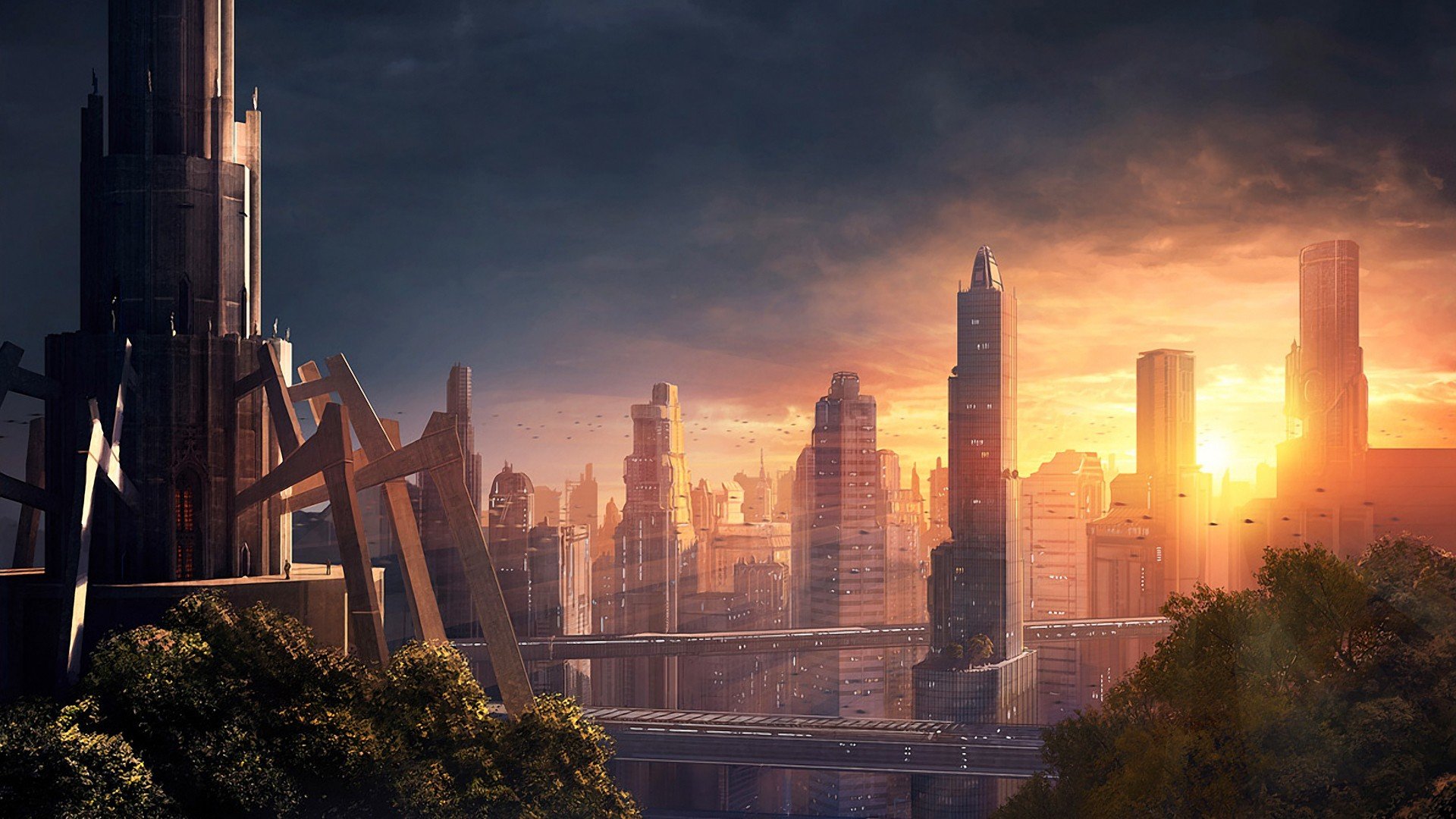
Above: The Homestead spires of District 4, as seen from a rooftop park.
- Intent: To update Borosk’s largest and only major city.
- Image Credit: Futuristic Skyline Wallpaper by Alpha Coders (cityscape image), myself using Google Drawings (city district map)
- Canon: N/A
- Permissions: x
- Links:
- Alge (original submission)
- Borosk
- Cassel Point (referenced)
- City Name: Alge
- Classification: Metropolis/Planetary Capital
- Location: Borosk
- Affiliation:
- The Diarchy (901 ABY-present*)
- Population: Heavy
- 89,217,490 sentient beings
- Demographics: Alge has an overwhelming majority (>90%) Human or Near-Human population; however, there are also millions of non-Humans that call Borosk’s largest city home. All sentient beings have equal protection under the law, and racial discrimination is officially illegal. However, social prejudices against non-Humans exist amongst a significant minority of the Human population, especially the more affluent and legacy Imperial neighborhoods.
- Wealth: Low - Wealthy
- Alge is home to both concentrations of the ultra-wealthy and the countless millions whose jobs are barely enough to make ends meet. While a sizable lower class exists, actual poverty is fairly rare in Alge owing to extensive government housing and employment programs. As a result, the scale of wealth inequality in Alge is considerably lower than that of comparable galactic metropolises.
- Stability: High
- Overseeing decades of relative peace and prosperity with few interruptions, the government of Alge is seen as legitimate by the vast majority of its population, even among some clandestine opposition groups. With Borosk’s successful integration into the Diarchy, the debate over the Imperial inheritance has been almost completely quashed, ridding the Alge government of one of the most contentious issues amongst its top-level officials.
- Freedom & Oppression:
- The personal freedoms of most residents of Alge are restricted by strict laws enforcing security and obedience to the government. Independent political parties are illegal, and unauthorized demonstrations are swiftly broken up by security forces. Outside media must be reviewed by Borosk Communications (BORCOM) before being allowed to distribute in Alge. While BORCOM is remarkably permissive about approving outside media and literature, articles that are explicitly anti-Imperial or politically divisive are often extensively censored before they can be marketed in Alge. BORCOM also has the power to censor individuals deemed unsavory by the Alge government.
- While dissidents rightly claim that government oppression is pervasive and significant, none would argue that any significant amount of oppression has come from the criminal underworld. The Alge government is extremely proactive in striking down criminal networks, some of whom are wiped out before they can harm a single person. As a result, generally illegal forms of oppression such as extortion rackets and human trafficking are extremely rare even in Alge’s poorest districts.
- Description: Alge is the capital and by far the largest city of Borosk, home to 84% of the planet’s population and 91% of its economic output. While a relatively young metropolis, Alge has experienced rapid growth and development due to mass immigration of Imperial sympathizers from former New Imperial Order planets. The city's relatively high population of Imperial expatriates gives its Imperial-style government a highly loyal urban base to administer.
The city of Alge is a planned city divided into seven districts grouped into two unofficial regions, the Old City and the New City.
- Old City: Built during the eight year reign of the New Imperial Order, the Old City forms the core of Alge. The Old City is the political center of Alge and all of Borosk, being home to nearly all its government offices.
- District 1, City Center
- The Hub: At the very center of Alge stands a large dome-shaped building known as The Hub. Modeled after the Senate Building in Coruscant but about a third of its size, The Hub nonetheless provides more than enough space for the politicians and diplomats of Borosk to work comfortably within its halls. Each department of planetary government has its own cluster of offices within The Hub. The personal offices of the Governor of Borosk are located on The Hub's top floor.
- Fortress Cassel: The former city hall of Alge before its rapid expansion, Fortress Cassel is a ten-story duracrete cube that has been repurposed as the official headquarters of the planetary defense forces. The fortress is thoroughly guarded at all times and its defenses can be augmented by multiple laser cannons hidden inside its walls.
- Imperator Suites: A series of upscale apartment buildings and penthouses suitable for the political and economic elites of Alge. Situated close to The Hub and Fortress Cassel, the Imperator Suites allows Alge’s elites quick access to the levers of power.
- Alge Central Power: Buried deep underground beneath the Hub is Alge Central Power, an enormous nuclear fusion generator providing for the overwhelming majority of Alge’s energy needs. Owned and staffed directly by the planetary government, Alge Central Power requires security clearance to access and is patrolled by Imperial Gendarmeries at all times.
- District 2, Imperial Legacy
- Imperial Patriots Monument: Northeast of the Hub is a large, circular, grass-filled public park designed to resemble the Imperial Emblem. Six equally spaced paths extending from the entrance of the park lead to a colossal granite spear at its center. The spear, which rises fifty meters into the air, is hollow on the inside and can be climbed up via a staircase or an elevator. Inscribed on the walls inside the spear are the names of members of the Imperial Military born in Borosk who were killed in action. At the top of the spear is an observation deck, giving civilians a view of the entire park and much of the Old City. Around the main spear are hundreds of three meter tall granite spears serving as graves for distinguished Borosk-born officers of the New Imperial Order, Dark Empire, the Imperial Confederation, and the Diarchy, all of whom are regarded by the government of Alge as true Imperials.
- Jared Cassel Memorial: A few blocks away from the Patriots Monument lies a smaller but equally well-maintained public park with a five meter stainless steel statue of Jared Cassel at its center. The statue, which depicts Cassel in stormtrooper armor standing defiantly with an Imperial flag in one hand and a rifle in another, honors the captain's valiant leadership in the old 908th Legion's last stand against the Sith invaders of Borosk. Stationed nearby are multiple terminals that access a database showing the names of all Imperial soldiers past and present who have died in action on Borosk.
- District 3, The Port
- Irveric Tavlar Regional Spaceport (ITRS): The Irveric Tavlar Regional Spaceport is an immense complex of hangars and spaceports through which over 90% of interplanetary traffic to Borosk passes through. In the past decade, the formerly medium-sized spaceport has undergone massive expansion to support Alge's surge of immigration, frequently managing thousands of capital ships a day. ITRS is the primary station for commerce inspection and employs a large team of naval officers to ensure that all operations run smoothly.
- District 1, City Center
- New City: Hastily built to accommodate the massive influx in Imperial refugees, the New City is a sprawling metropolis filled with large, modern apartment buildings known as Homesteads. A melting pot of beings from all across the former New Imperial Order and Dark Empire, the New City is the growing economic and cultural center of Alge.
- District 4, Living & Learning
- The Homesteads: The most numerous structures in the New City, if not all of Alge, are the massive, spire-shaped apartment buildings lining the streets of District 4. Officially referred to as New Apartment Blocks, the buildings have become commonly referred to as Homesteads in reference to Alge's rapid outward expansion. Each Homestead is a kilometer tall and can house around twenty thousand sentient beings across the upper 195 of its 200 vast floors, with the bottom five floors devoted to general stores, pharmacies, restaurants, and cafes. Prioritizing simplicity, durability, and living space above all else, Homesteads typically come with no decorations and only basic furniture in a two or three room apartment setup. However, the plain durasteel-plated rooms often become much more lively as their residents introduce new decorations and mementos from homes left behind. Homestead apartments are fairly affordable compared to apartments in other galactic urban centers, and their residents are overwhelmingly working-class or middle class.
- Alge Academy System (AAS): The Alge Academy System, also known as the AAS, is the government-run network of youth and military academies in Alge, centered on sprawling campuses within District 4. The primary function of the AAS is to educate or re-educate citizens of Alge to become patriotic Imperial citizens, with significant emphasis placed on discipline, martial arts, the sciences, and above all else an appreciation of the Empire in its many historic iterations. AAS academies are headquartered in large, blocky, often square-shaped structures built of sturdy duracrete and titanium, earning them the nickname of “Imperial Holocrons”.
- District 5, Recreation
- Park District: Recognizing the health benefits of providing open, natural space for its inhabitants, the government of Alge has established a network of sprawling public parks full of flora and small animals from all across the known galaxy. Unlike almost every other space in Alge, no two parks are alike.
- District 6, Central Business District
- Mega-Malls: Standing at twenty stories tall and over five kilometers in diameter, mega-malls are massive centers of commerce that tend to the needs of a rapidly expanding population. Stores in the mega-malls often number in the low thousands, selling every conceivable manner of produce and services to the residents of Alge. Mega-malls are one of the leading sources of employment and economic output on Alge, employing millions of people and producing billions of credits of revenue every day.
- It is rumored that the galactic fast-food giant Emperor’s Burgers is descended from a single restaurant in a Mega-Mall on Alge.
- Stock Exchange of Borosk (SEB): Towering above the Mega-Malls of Alge’s CBD is the Stock Exchange of Borosk. While the Stock Exchange building externally resembles a half-size Homestead, the moment one steps inside they are greeted by an interior quite unlike that of any other building in Alge. A grand, terraced lobby grants passage to entire floors full of actual and projected stock listings from across the galaxy as well as the software needed to perform advanced financial calculations. Employing thousands of economists and stock analysts, the Stock Exchange of Bastion is the third largest stock exchange in the Diarchy, only behind those of Munnilinst and Bastion.
- Bank of Borosk (BOB): Adjacent to the Stock Exchange is the Bank of Borosk, a columned rectangular ten-story building with a Neoclassical facade. Despite its decadent facade, the Bank of Borosk is one of the most secure locations in Alge, the enormous wealth stored within protected by biometric scanners, meter-thick titanium doors, a labyrinth interior layout, and a permanently stationed company of stormtroopers. The Bank even has its own onsite composite shield generator and independent power generator to protect it from external assault.
- Mega-Malls: Standing at twenty stories tall and over five kilometers in diameter, mega-malls are massive centers of commerce that tend to the needs of a rapidly expanding population. Stores in the mega-malls often number in the low thousands, selling every conceivable manner of produce and services to the residents of Alge. Mega-malls are one of the leading sources of employment and economic output on Alge, employing millions of people and producing billions of credits of revenue every day.
- District 7, Industry
- The Factories: Alge’s District 7 is the developing core of Borosk’s emerging heavy industry sector. Its factories are organized into multiple Factory Zones, each consisting of dozens of grey factory blocks topped by towering smokestacks. Each Factory Zone has a shared power source and the factories within a zone generally cater to similar industries.
- Outer Shipyards: Over the past two years, dozens of shipyards have sprung up in the southern fringes of Alge within the vast plains of the Myrtle River Valley. Ranging in size from tiny artisan facilities specializing in luxury sloops and shuttles to factory towns churning out vessels the size of Star Destroyers or even larger, the shipyards of District 7 give Alge and Borosk as a whole a decent shipbuilding capacity, though dwarfed by the vast orbital rings and shipyard-cities of worlds such as Kuat, Mon Calamari, and Corellia. One notable operator of shipyards in District 7 is Alge Imperial Shipyards Incorporated, which owns two of the five largest facilities in the district.
- District 4, Living & Learning
Alge is by all regards a well-defended city with a large network of ground and air forces that can be mobilized at a moment's notice.
Alge is host to a garrison consisting of 24,000 stormtroopers split into two legions as well as 200,000 Imperial Gendarmeries, a military police unit consisting primarily of army reservists, the majority of whom were recruited directly from Borosk. The Imperial Gendarmeries take on the bulk of day-to-day security tasks and are specially trained primarily for riot suppression and counterterrorism rather than fighting large armies in pitched battle. For heavy-duty combat, the two stormtrooper legions provide a powerful vanguard when not deployed offworld to support the Diarchy’s galactic campaigns.
Important buildings such as The Hub, Fortress Cassel, and the Bank of Borosk are further protected by composite shield generators capable of resisting turbolaser fire.
HISTORICAL INFORMATION
The history of Alge can be divided into three major eras: the Foundational, Classical, and Postclassical Eras.
The Foundational Era (868-876 ABY)
In terms of galactic history, Alge is a fairly young city, founded in 868 ABY.
The Foundational Era (868-876 ABY)
In terms of galactic history, Alge is a fairly young city, founded in 868 ABY.
Originally, Alge was a prefabricated civilian center of government for Borosk, which had just been annexed by the New Imperial Order. Its first residents were civil administrators and the families of soldiers stationed at the newly built Cassel Point, about eight hundred kilometers away. By 871 ABY, the population grew to about 150,000 due to a growing military presence and vast amounts of undeveloped land, with urbanization began to emerge around the town hall that would later become Fortress Cassel. With the completion of the first components of the Irveric Tavlar Regional Spaceport near Fortress Cassel, commercial and passenger traffic increased, bringing Alge's population up to four million by 879 ABY. It seemed as if the city's prosperity was secured for centuries to come, protected by the iron fist of the Empire.
That was, until the iron fist shattered.
The Classical Era (876-900 ABY)
Following the Third Imperial Civil War and the collapse of the Empire's vast territorial holdings, Alge was thrown into chaos as the remaining loyal commanders and bureaucrats struggled to make sense of the situation at hand. Ultimately, it took the intervention of two powerful men with ties to Borosk to right the ship: Moff Calkon Quennis of the Borosk sector and FN-999, Baron of Borosk. The pair entered the chaos and soon asserted themselves as the leading figures of Borosk, retaining most of the civil service while transforming the previous government structure into a diarchy in which Moff Quennis taking the lead in civil affairs while FN-999 took over military affairs. With responsibilities effectively delegated between the two, the diarchy went to work stabilizing Borosk as a whole and Alge in particular.
As Moff Quennis oversaw civilian affairs, he introduced multiple key growth-oriented policies. In response to rapidly growing immigration from chaos-stricken ex-Imperial worlds, the Moff offered subsidized apartment housing and greatly loosened existing immigration laws, requiring only a valid ID and a background check. To provide housing and employment for the tens of millions of incoming refugees, Moff Quennis introduced an employment mandate requiring all resettled residents to be employed in order to receive subsidized housing, enabling rapid urban development and leading to the birth of Alge's New City.
At the same time, the Baron of Borosk went to work balancing the armed forces, expanding the presence of the Imperial Army and military police while mothballing needlessly large capital ships. Under his orders, Borosk Communications was established to replace the largely defunct IMPCOM, providing continuation of Imperial messaging in a time of uncertainty. As Alge's fortunes began to recover and grow alongside its population, the Baron led expeditionary raids on and near ex-Imperial worlds, culminating in a convoy raid on the edge of the Thyrsus system and a very successful retrieval of Imperial assets abandoned on Cathar. As a result of the success of both missions, the Baron was able to recommission many Army and Navy units as well as strengthen the expeditionary forces in preparation for a campaign of reconquest.
In 900 ABY, Alge stood on the precipice of greatness, its armies and fleet at last ready to reclaim the Imperial legacy.
However, Borosk was not the only world that claimed to possess the Empire’s heirs.
The Post-Classical Era (900-902 ABY)
In Alge’s moment of greatest potential, tragedy struck.
While FN-999 and the majority of Borosk’s fleet were in Munnilinst attending a conference of the Imperial Military Protectorate, the forces of the Dark Empire struck. In a matter of hours, Alge had been forced into surrender and a large fleet had been assembled in orbit, giving Borosk’s diarchy no other option but to accept their new masters.In Alge’s moment of greatest potential, tragedy struck.
Despite its brief duration compared to the Classical Era, the year and a half of Dark Imperial occupation brought equally profound changes to Alge - both physical and societal.
The ruling diarchy that had governed Borosk since the late 870s was abolished practically overnight, civil and military powers being united in a single person for the first time since the New Imperial era. Moff Quentis was forced into early retirement, thrusting FN-999 into the roles of both governor and commander in his first real political leadership role.
Almost immediately after the Dark Imperial takeover, FN-999 was forced to implement policies far harsher than those him or Moff Quentis had ever designed. For the first time in Alge’s history, slavery was legalized. In the following months, tens of thousands of indebted laborers were forced into bondage, whether repairing the damage that the Dark Imperials themselves had done to Alge or being shipped offworld to have their labor sold to the highest bidder. Agents of the Sith actively roamed the streets of Alge, terrorizing Homesteads and Mega-Malls with impunity.
All the while, the city continued to grow. District 7 emerged during the early days of the Dark Imperial occupation, made possible by a significant investment from the Imperial government meant to transform Borosk into a major military stronghold. Despite the tight stranglehold of government on the city, private businesses continued to grow, with two in particular flourishing in the new framework: fast food chain Emperor’s Burgers and recently privatized ship manufacturer Alge Imperial Shipyards. Their rapid growth brought in new streams of revenue for Alge, allowing for the construction of infrastructure extensive enough to cross what had previously been considered its natural borders.
After a year and a half long period of occupation, the Dark Empire abruptly contracted before vanishing altogether, leaving Borosk a free world once more.
In the place of the Dark Empire emerged the Diarchy, filling the power vacuum in the Tingel Arm in a matter of months. When the Diarchy Armed Forces approached Borosk, FN-999 did not bother to fight a second battle. Instead, he made favorable economic and political arrangements with the Diarchy ahead of their annexation of Borosk, ensuring that the world would continue to prosper. FN-999’s last act in office as Governor-Baron was to abdicate both his titles, not fully trusting the Diarchy’s leadership and desiring to instead serve the Imperial Confederation.
Under the rule of the Diarchy, Alge has experienced the beginnings of a second golden age. Classical-era policies were restored and slavery was abolished, loosening the belt without encouraging sedition. Alge fares well in the present day*, its growth sustained by a diverse modern economy, population growth, low housing costs, and federal direct investment.
*902 ABY as of 2/14/26
Last edited: