Star Wars Roleplay: Chaos

Register a free account today to become a member! Once signed in, you'll be able to participate on this site by adding your own topics and posts, as well as connect with other members through your own private inbox!

Work In Progress Nines’ Pre-Codex Goodies


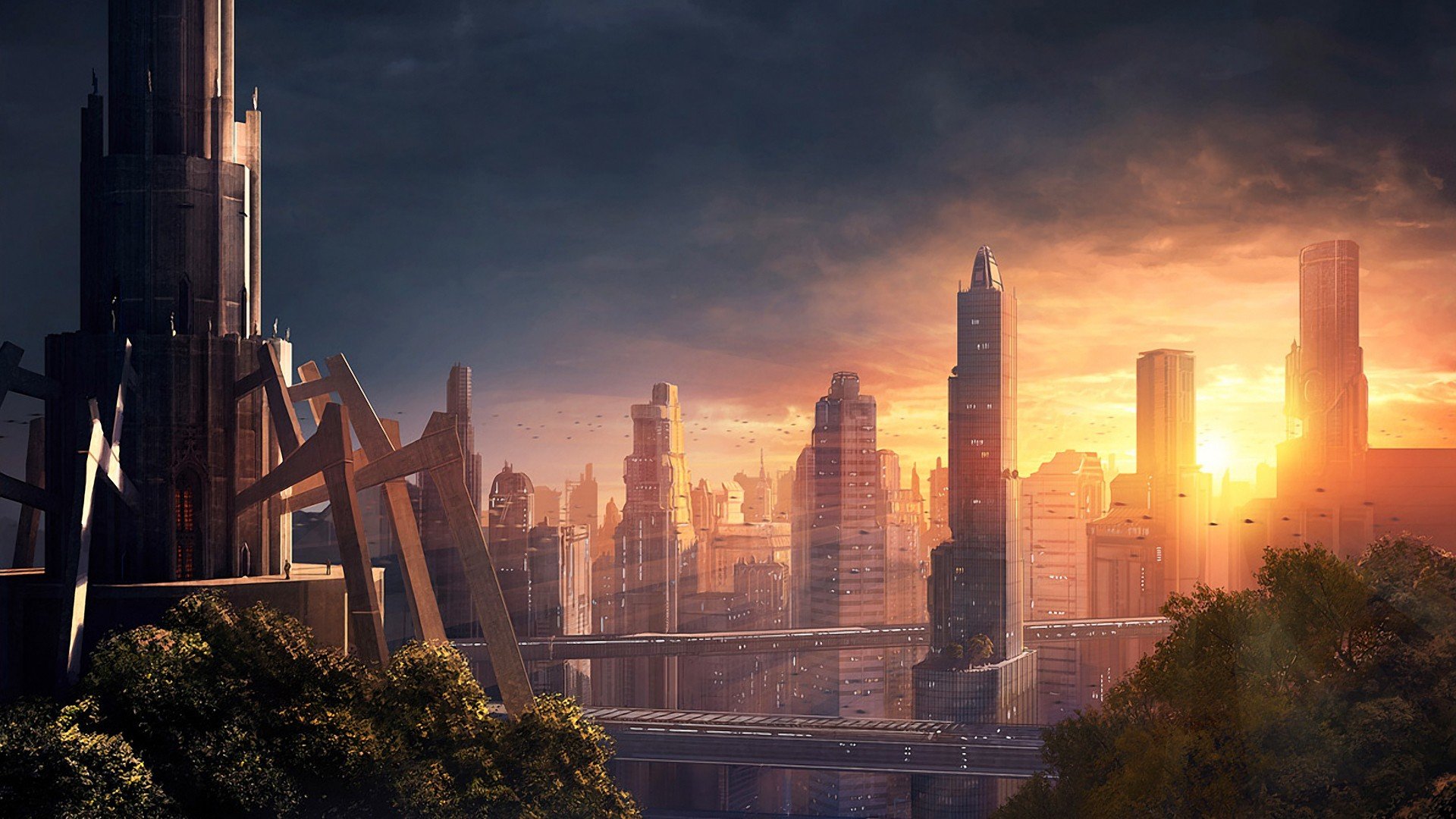
thumb-1920-331778.jpg

Above: The Homestead spires of District 4, as seen from a rooftop park.
OUT OF CHARACTER INFORMATION
SETTING INFORMATION
  • City Name: Alge
  • Classification: Metropolis/Planetary Capital
  • Location: Borosk
  • Affiliation:
  • Population: Heavy
    • 89,217,490 sentient beings
  • Demographics: Alge has an overwhelming majority (>90%) Human or Near-Human population; however, there are also millions of non-Humans that call Borosk’s largest city home. All sentient beings have equal protection under the law, and racial discrimination is officially illegal. However, social prejudices against non-Humans exist amongst a significant minority of the Human population, especially the more affluent and legacy Imperial neighborhoods.
  • Wealth: Low - Wealthy
    • Alge is home to both concentrations of the ultra-wealthy and the countless millions whose jobs are barely enough to make ends meet. While a sizable lower class exists, actual poverty is fairly rare in Alge owing to extensive government housing and employment programs. As a result, the scale of wealth inequality in Alge is considerably lower than that of comparable galactic metropolises.
  • Stability: High
    • Overseeing decades of relative peace and prosperity with few interruptions, the government of Alge is seen as legitimate by the vast majority of its population, even among some clandestine opposition groups. With Borosk’s successful integration into the Diarchy, the debate over the Imperial inheritance has been almost completely quashed, ridding the Alge government of one of the most contentious issues amongst its top-level officials.
  • Freedom & Oppression:
    • The personal freedoms of most residents of Alge are restricted by strict laws enforcing security and obedience to the government. Independent political parties are illegal, and unauthorized demonstrations are swiftly broken up by security forces. Outside media must be reviewed by Borosk Communications (BORCOM) before being allowed to distribute in Alge. While BORCOM is remarkably permissive about approving outside media and literature, articles that are explicitly anti-Imperial or politically divisive are often extensively censored before they can be marketed in Alge. BORCOM also has the power to censor individuals deemed unsavory by the Alge government.
    • While dissidents rightly claim that government oppression is pervasive and significant, none would argue that any significant amount of oppression has come from the criminal underworld. The Alge government is extremely proactive in striking down criminal networks, some of whom are wiped out before they can harm a single person. As a result, generally illegal forms of oppression such as extortion rackets and human trafficking are extremely rare even in Alge’s poorest districts.
  • Description: Alge is the capital and by far the largest city of Borosk, home to 84% of the planet’s population and 91% of its economic output. While a relatively young metropolis, Alge has experienced rapid growth and development due to mass immigration of Imperial sympathizers from former New Imperial Order planets. The city's relatively high population of Imperial expatriates gives its Imperial-style government a highly loyal urban base to administer.
POINTS OF INTEREST

The city of Alge is a planned city divided into seven districts grouped into two unofficial regions, the Old City and the New City.

  • Old City: Built during the eight year reign of the New Imperial Order, the Old City forms the core of Alge. The Old City is the political center of Alge and all of Borosk, being home to nearly all its government offices.
    • District 1, City Center
      • The Hub: At the very center of Alge stands a large dome-shaped building known as The Hub. Modeled after the Senate Building in Coruscant but about a third of its size, The Hub nonetheless provides more than enough space for the politicians and diplomats of Borosk to work comfortably within its halls. Each department of planetary government has its own cluster of offices within The Hub. The personal offices of the Governor of Borosk are located on The Hub's top floor.
      • Fortress Cassel: The former city hall of Alge before its rapid expansion, Fortress Cassel is a ten-story duracrete cube that has been repurposed as the official headquarters of the planetary defense forces. The fortress is thoroughly guarded at all times and its defenses can be augmented by multiple laser cannons hidden inside its walls.
      • Imperator Suites: A series of upscale apartment buildings and penthouses suitable for the political and economic elites of Alge. Situated close to The Hub and Fortress Cassel, the Imperator Suites allows Alge’s elites quick access to the levers of power.
      • Alge Central Power: Buried deep underground beneath the Hub is Alge Central Power, an enormous nuclear fusion generator providing for the overwhelming majority of Alge’s energy needs. Owned and staffed directly by the planetary government, Alge Central Power requires security clearance to access and is patrolled by Imperial Gendarmeries at all times.
    • District 2, Imperial Legacy
      • Imperial Patriots Monument: Northeast of the Hub is a large, circular, grass-filled public park designed to resemble the Imperial Emblem. Six equally spaced paths extending from the entrance of the park lead to a colossal granite spear at its center. The spear, which rises fifty meters into the air, is hollow on the inside and can be climbed up via a staircase or an elevator. Inscribed on the walls inside the spear are the names of members of the Imperial Military born in Borosk who were killed in action. At the top of the spear is an observation deck, giving civilians a view of the entire park and much of the Old City. Around the main spear are hundreds of three meter tall granite spears serving as graves for distinguished Borosk-born officers of the New Imperial Order, Dark Empire, the Imperial Confederation, and the Diarchy, all of whom are regarded by the government of Alge as true Imperials.
      • Jared Cassel Memorial: A few blocks away from the Patriots Monument lies a smaller but equally well-maintained public park with a five meter stainless steel statue of Jared Cassel at its center. The statue, which depicts Cassel in stormtrooper armor standing defiantly with an Imperial flag in one hand and a rifle in another, honors the captain's valiant leadership in the old 908th Legion's last stand against the Sith invaders of Borosk. Stationed nearby are multiple terminals that access a database showing the names of all Imperial soldiers past and present who have died in action on Borosk.
    • District 3, The Port
      • Irveric Tavlar Regional Spaceport (ITRS): The Irveric Tavlar Regional Spaceport is an immense complex of hangars and spaceports through which over 90% of interplanetary traffic to Borosk passes through. In the past decade, the formerly medium-sized spaceport has undergone massive expansion to support Alge's surge of immigration, frequently managing thousands of capital ships a day. ITRS is the primary station for commerce inspection and employs a large team of naval officers to ensure that all operations run smoothly.
  • New City: Hastily built to accommodate the massive influx in Imperial refugees, the New City is a sprawling metropolis filled with large, modern apartment buildings known as Homesteads. A melting pot of beings from all across the former New Imperial Order and Dark Empire, the New City is the growing economic and cultural center of Alge.
    • District 4, Living & Learning
      • The Homesteads: The most numerous structures in the New City, if not all of Alge, are the massive, spire-shaped apartment buildings lining the streets of District 4. Officially referred to as New Apartment Blocks, the buildings have become commonly referred to as Homesteads in reference to Alge's rapid outward expansion. Each Homestead is a kilometer tall and can house around twenty thousand sentient beings across the upper 195 of its 200 vast floors, with the bottom five floors devoted to general stores, pharmacies, restaurants, and cafes. Prioritizing simplicity, durability, and living space above all else, Homesteads typically come with no decorations and only basic furniture in a two or three room apartment setup. However, the plain durasteel-plated rooms often become much more lively as their residents introduce new decorations and mementos from homes left behind. Homestead apartments are fairly affordable compared to apartments in other galactic urban centers, and their residents are overwhelmingly working-class or middle class.
      • Alge Academy System (AAS): The Alge Academy System, also known as the AAS, is the government-run network of youth and military academies in Alge, centered on sprawling campuses within District 4. The primary function of the AAS is to educate or re-educate citizens of Alge to become patriotic Imperial citizens, with significant emphasis placed on discipline, martial arts, the sciences, and above all else an appreciation of the Empire in its many historic iterations. AAS academies are headquartered in large, blocky, often square-shaped structures built of sturdy duracrete and titanium, earning them the nickname of “Imperial Holocrons”.
    • District 5, Recreation
      • Park District: Recognizing the health benefits of providing open, natural space for its inhabitants, the government of Alge has established a network of sprawling public parks full of flora and small animals from all across the known galaxy. Unlike almost every other space in Alge, no two parks are alike.
    • District 6, Central Business District
      • Mega-Malls: Standing at twenty stories tall and over five kilometers in diameter, mega-malls are massive centers of commerce that tend to the needs of a rapidly expanding population. Stores in the mega-malls often number in the low thousands, selling every conceivable manner of produce and services to the residents of Alge. Mega-malls are one of the leading sources of employment and economic output on Alge, employing millions of people and producing billions of credits of revenue every day.
        • It is rumored that the galactic fast-food giant Emperor’s Burgers is descended from a single restaurant in a Mega-Mall on Alge.
      • Stock Exchange of Borosk (SEB): Towering above the Mega-Malls of Alge’s CBD is the Stock Exchange of Borosk. While the Stock Exchange building externally resembles a half-size Homestead, the moment one steps inside they are greeted by an interior quite unlike that of any other building in Alge. A grand, terraced lobby grants passage to entire floors full of actual and projected stock listings from across the galaxy as well as the software needed to perform advanced financial calculations. Employing thousands of economists and stock analysts, the Stock Exchange of Bastion is the third largest stock exchange in the Diarchy, only behind those of Munnilinst and Bastion.
      • Bank of Borosk (BOB): Adjacent to the Stock Exchange is the Bank of Borosk, a columned rectangular ten-story building with a Neoclassical facade. Despite its decadent facade, the Bank of Borosk is one of the most secure locations in Alge, the enormous wealth stored within protected by biometric scanners, meter-thick titanium doors, a labyrinth interior layout, and a permanently stationed company of stormtroopers. The Bank even has its own onsite composite shield generator and independent power generator to protect it from external assault.
    • District 7, Industry
      • The Factories: Alge’s District 7 is the developing core of Borosk’s emerging heavy industry sector. Its factories are organized into multiple Factory Zones, each consisting of dozens of grey factory blocks topped by towering smokestacks. Each Factory Zone has a shared power source and the factories within a zone generally cater to similar industries.
      • Outer Shipyards: Over the past two years, dozens of shipyards have sprung up in the southern fringes of Alge within the vast plains of the Myrtle River Valley. Ranging in size from tiny artisan facilities specializing in luxury sloops and shuttles to factory towns churning out vessels the size of Star Destroyers or even larger, the shipyards of District 7 give Alge and Borosk as a whole a decent shipbuilding capacity, though dwarfed by the vast orbital rings and shipyard-cities of worlds such as Kuat, Mon Calamari, and Corellia. One notable operator of shipyards in District 7 is Alge Imperial Shipyards Incorporated, which owns two of the five largest facilities in the district.
SECURITY: High

Alge is by all regards a well-defended city with a large network of ground and air forces that can be mobilized at a moment's notice.

Alge is host to a garrison consisting of 24,000 stormtroopers split into two legions as well as 200,000 Imperial
Gendarmeries, a military police unit consisting primarily of army reservists, the majority of whom were recruited directly from Borosk. The Imperial Gendarmeries take on the bulk of day-to-day security tasks and are specially trained primarily for riot suppression and counterterrorism rather than fighting large armies in pitched battle. For heavy-duty combat, the two stormtrooper legions provide a powerful vanguard when not deployed offworld to support the Diarchy’s galactic campaigns.

Important buildings such as The Hub, Fortress Cassel, and the Bank of Borosk are further protected by composite shield generators capable of resisting turbolaser fire.

HISTORICAL INFORMATION


The history of Alge can be divided into three major eras: the Foundational, Classical, and Postclassical Eras.

The Foundational Era (868-876 ABY)

In terms of galactic history, Alge is a fairly young city, founded in 868 ABY.

Originally, Alge was a prefabricated civilian center of government for Borosk, which had just been annexed by the New Imperial Order. Its first residents were civil administrators and the families of soldiers stationed at the newly built Cassel Point, about eight hundred kilometers away. By 871 ABY, the population grew to about 150,000 due to a growing military presence and vast amounts of undeveloped land, with urbanization began to emerge around the town hall that would later become Fortress Cassel. With the completion of the first components of the Irveric Tavlar Regional Spaceport near Fortress Cassel, commercial and passenger traffic increased, bringing Alge's population up to four million by 879 ABY. It seemed as if the city's prosperity was secured for centuries to come, protected by the iron fist of the Empire.

That was, until the iron fist shattered.


The Classical Era (876-900 ABY)

Following the Third Imperial Civil War and the collapse of the Empire's vast territorial holdings, Alge was thrown into chaos as the remaining loyal commanders and bureaucrats struggled to make sense of the situation at hand. Ultimately, it took the intervention of two powerful men with ties to Borosk to right the ship: Moff Calkon Quennis of the Borosk sector and FN-999, Baron of Borosk. The pair entered the chaos and soon asserted themselves as the leading figures of Borosk, retaining most of the civil service while transforming the previous government structure into a diarchy in which Moff Quennis taking the lead in civil affairs while FN-999 took over military affairs. With responsibilities effectively delegated between the two, the diarchy went to work stabilizing Borosk as a whole and Alge in particular.

As Moff Quennis oversaw civilian affairs, he introduced multiple key growth-oriented policies. In response to rapidly growing immigration from chaos-stricken ex-Imperial worlds, the Moff offered subsidized apartment housing and greatly loosened existing immigration laws, requiring only a valid ID and a background check. To provide housing and employment for the tens of millions of incoming refugees, Moff Quennis introduced an employment mandate requiring all resettled residents to be employed in order to receive subsidized housing, enabling rapid urban development and leading to the birth of Alge's New City.

At the same time, the Baron of Borosk went to work balancing the armed forces, expanding the presence of the Imperial Army and military police while mothballing needlessly large capital ships. Under his orders, Borosk Communications was established to replace the largely defunct IMPCOM, providing continuation of Imperial messaging in a time of uncertainty. As Alge's fortunes began to recover and grow alongside its population, the Baron led expeditionary raids on and near ex-Imperial worlds, culminating in a convoy raid on the edge of the Thyrsus system and a very successful retrieval of Imperial assets abandoned on Cathar. As a result of the success of both missions, the Baron was able to recommission many Army and Navy units as well as strengthen the expeditionary forces in preparation for a campaign of reconquest.

In 900 ABY, Alge stood on the precipice of greatness, its armies and fleet at last ready to reclaim the Imperial legacy.

However, Borosk was not the only world that claimed to possess the Empire’s heirs.


The Post-Classical Era (900-902 ABY)

In Alge’s moment of greatest potential, tragedy struck.

While FN-999 and the majority of Borosk’s fleet were in Munnilinst attending a conference of the Imperial Military Protectorate, the forces of the Dark Empire struck. In a matter of hours, Alge had been forced into surrender and a large fleet had been assembled in orbit, giving Borosk’s diarchy no other option but to accept their new masters.

Despite its brief duration compared to the Classical Era, the year and a half of Dark Imperial occupation brought equally profound changes to Alge - both physical and societal.

The ruling diarchy that had governed Borosk since the late 870s was abolished practically overnight, civil and military powers being united in a single person for the first time since the New Imperial era. Moff Quentis was forced into early retirement, thrusting FN-999 into the roles of both governor and commander in his first real political leadership role.

Almost immediately after the Dark Imperial takeover, FN-999 was forced to implement policies far harsher than those him or Moff Quentis had ever designed. For the first time in Alge’s history, slavery was legalized. In the following months, tens of thousands of indebted laborers were forced into bondage, whether repairing the damage that the Dark Imperials themselves had done to Alge or being shipped offworld to have their labor sold to the highest bidder. Agents of the Sith actively roamed the streets of Alge, terrorizing Homesteads and Mega-Malls with impunity.

All the while, the city continued to grow. District 7 emerged during the early days of the Dark Imperial occupation, made possible by a significant investment from the Imperial government meant to transform Borosk into a major military stronghold. Despite the tight stranglehold of government on the city, private businesses continued to grow, with two in particular flourishing in the new framework: fast food chain Emperor’s Burgers and recently privatized ship manufacturer Alge Imperial Shipyards. Their rapid growth brought in new streams of revenue for Alge, allowing for the construction of infrastructure extensive enough to cross what had previously been considered its natural borders.

After a year and a half long period of occupation, the Dark Empire abruptly contracted before vanishing altogether, leaving Borosk a free world once more.

In the place of the Dark Empire emerged the Diarchy, filling the power vacuum in the Tingel Arm in a matter of months. When the Diarchy Armed Forces approached Borosk, FN-999 did not bother to fight a second battle. Instead, he made favorable economic and political arrangements with the Diarchy ahead of their annexation of Borosk, ensuring that the world would continue to prosper. FN-999’s last act in office as Governor-Baron was to abdicate both his titles, not fully trusting the Diarchy’s leadership and desiring to instead serve the Imperial Confederation.

Under the rule of the Diarchy, Alge has experienced the beginnings of a second golden age. Classical-era policies were restored and slavery was abolished, loosening the belt without encouraging sedition. Alge fares well in the present day*, its growth sustained by a diverse modern economy, population growth, low housing costs, and federal direct investment.


*902 ABY as of 2/14/26
 
Last edited:

ZMuv6kQ.png
OUT OF CHARACTER INFORMATION
SETTING INFORMATION
  • Shipyards Name: Alge Imperial Shipyards Incorporated, Orbital Primary Shipyard
  • Classification: Orbital Shipyard
  • Location: Borosk, geostationary orbit above a point approximately 550 km west of Alge
  • Affiliation: Alge Imperial Shipyards Incorporated
  • Population: Moderately Staffed (50-100 permanent organic crew)
  • Accessibility: AISI Orbital Primary is easy to locate on approach to Borosk, being a very large object in geostationary orbit without any stealth or camouflage features. However, actually accessing the orbital shipyard is a task far more challenging than locating it. AISI Orbital Primary is considered both private property and militarily sensitive, requiring verification of credentials and a complete record of a visiting ship’s whereabouts over the previous 48 hours in order to receive a valid clearance code.
  • Description: From humble beginnings as Borosk's first step towards naval self-sufficiency, AISI Orbital Primary, formerly known as Borosk Imperial Shipyards, has grown dramatically. The creation of surface-based shipyards in Alge has enabled AISI Orbital Primary to specialize in constructing larger capital ships that might have difficulty escaping Borosk’s atmosphere. Construction occurs in two locations: the sprawling Outer Ring and the Battlecruiser Chamber, an immense hole-shaped production facility in the very center of the shipyard.
OPERATIONS INFORMATION
  • Production: Warships between 500m and 5000m in dimensions
  • Specialty: Star Destroyers and heavy cruisers
  • Output: On average, AISI Orbital Primary has the following annual output, assuming no supply or manpower issues:
    • 1-2 battlecruisers
    • 10 Star Destroyers
    • 21 cruisers
  • Market: The main market for AISI Orbital Primary’s products are corporations, guilds, and factions within the Tingel Arm.
POINTS OF INTEREST
  • Outer Ring: The Outer Ring refers to the ring of facilities on the outermost perimeter of AISI Orbital Primary, connected to core facilities by six (four until 901 ABY) equally spaced connector halls. At 20km in diameter and around 800m in width, the Outer Ring is the location of all production facilities in the shipyard outside the Battlecruiser Chamber.
    • Starship Production Facilities: In total, the Outer Ring has four 2km x 780m x 780m dry docks designated for Star Destroyer construction and eight 1km x 650m x 650m dry docks for cruiser construction, all of whom are connected by a wide hallway on the inner edge of the Outer Ring. All production facilities are manned primarily by a small army of labor droids overseen by a team of organic engineers, architects, and technicians. Equipped with enormous magnetic cranes and other forms of heavy construction equipment, both the cruiser and Star Destroyer dry docks are optimized for the mass production of large capital ships. The main difference between the two types of dry dock is scale: Star Destroyer dry docks are over double the size of cruiser dry docks and operate machinery the size of frigates.
    • Exterior Docking Clamps: Between each internal dry dock is an external docking clamp, with a total of twelve lining the Outer Ring. Each clamp can extend or contract to secure a vessel between 300m and 780m wide at its narrowest point. Once a capital ship is locked firmly in a docking clamp, boarding gates attached to the clamp are deployed, allowing for the transfer of personnel and supplies between ships.
    • Crew Quarters: Quarters for shipyard staff and security personnel are concentrated in hallways opposite the cruiser drydocks. The 900-902 ABY shipyard expansion has resulted in upgrades to all crew quarters, with large rooms full of bunk beds replaced by dormitory-style rooms accommodating three people each. In all, the crew quarters can hold up to 1,000 staff, security, and guests.
    • Mess Halls: AISI Orbital Primary Shipyard has four dedicated mess halls, one opposite each Star Destroyer dry dock. They provide not only nutrients and sustenance but also entertainment: large wall-mounted holoscreens allow crew and security alike to distract themselves by watching a grav-ball game or comedy skit.
  • Connector Halls: Six connector halls allow for factory droids and ship parts alike to be transferred between the Outer and Inner Rings. At the center of each connector hall are two large conveyor belts, one of which runs from the Outer Ring to the Inner Ring and one of which runs from the Inner Ring to the Outer Ring. Both conveyor belts are used to transport crates of supplies between the two rings. On the perimeter of each connector hall are pedestrian footpaths used by labor droids, specialists, and personnel to walk between the rings.
  • Gate One: An approximately 1.5km gap known as Gate One exists in the Outer Ring, its primary purpose being to provide supply ships with direct access to the Inner Ring from outside the shipyards.
  • Inner Ring: The Inner Ring is the innermost portion of the Borosk Imperial Shipyard, fully encircled by the Outer Ring to which it is connected via Connector Halls and itself encircling the Battlecruiser Chamber. Its dimensions are approximately a quarter of those of the Outer Ring, from which it is separated on all sides by around a kilometer.
    • Supply Hangar: Inside the gap produced in the Outer RIng by Gate One is the entrance to the sole large hangar in the Inner Ring. Its main function is to receive supply vessels delivering raw materials, mail, and sustenance for the crew.
    • Administrative Floor: Often simply referred to as "Admin", the Administrative Floor is located near the center of the Inner Ring, around halfway between the Battlecruiser Chamber and the gap created by Gate One. The floor consists of several large rooms and office spaces split into two headquarters, with a short hall separating the two. A high-security elevator with its own clearance code takes individuals up to Admin from the edge of the Hollow, near the third of the four connector halls.
      • Security Headquarters: To the left of the Admin hall is Security Headquarters, where security for the entire shipyard is overseen. Within Security Headquarters, a dedicated team of security officers oversee security cameras and command the companies of PMCs stationed on the shipyard. The security officers also hold the master controls for the hangar gates, internal blast doors, and exterior point-defense batteries.
      • General Headquarters: To the right of the Admin hall is General Headquarters, the center of all operations in Borosk Imperial Shipyard. It is within General Headquarters where the shipyard director, foremen, supervisors, and starship engineers oversee the construction and maintenance of ships in Borosk Imperial Shipyard. All proposed construction, repair, and maintenance must be approved by General Headquarters before it can commence.
  • Battlecruiser Chamber: By widening the former Hollow and opening it to the vaccum of space, Alge Imperial was able to transform the center of AISI Orbital Primary into a single, enormous battlecruiser production facility. Two kilometers in diameter and with zero restrictions on length, the Battlecruiser Chamber is by far the most formidable shipbuilding station in AISI Orbital Primary. Exposed fully to the vaccum of space, all work in the Battlecruiser Chamber must be done by droids with limited organic supervision. A trio of wedge-shaped projections extending out from the underside of the Inner Ring serve to secure battlecruiser hulls in place and provide a platform to transport ship components.
SECURITY: High

AISI Orbital Primary is protected externally by two hundred automated point-defense laser cannons, designed primarily to destroy the starfighters and light freighters fielded by pirates. It relies entirely on the presence of the Diarchy Navy in the Borosk system to deter larger capital ships. All hangars for supply craft and visiting officials can be sealed off with reinforced titanium gates to prevent ships from entering or leaving.

AISI Orbital Primary’s interior is normally patrolled by 300 private military company soldiers, though this number has doubled ever since the Sith placed a bounty on sabotage or destruction of Alge Imperial facilities. Doors leading directly to drydock facilities are locked behind thick titanium doors requiring the insertion of specific code cylinders in an electronic keyhole to access. Motion and sound sensors are discretely placed on walls near the doors to ensure that anyone who bypasses the code cylinders by destroying the door will trigger a station-wide alert.

HISTORICAL INFORMATION


Alge Imperial’s first shipyard has come a long way since its creation.

Constructed in 886 ABY and at the time the only shipyard on or near Borosk, what was then known as the Borosk Imperial Shipyard consisted solely of what is now the facility's Inner Ring. It was designed not to create large warships, but to maintain the limited fleet available to the Borosk Imperial remnant and build a limited amount of escort craft. Despite breaking even in mid-889 ABY, the profits produced by the Borosk Imperial Shipyard were for many years too small to facilitate expansion while also securing funds for Borosk’s government. Only in the late 890s ABY was expansion seriously considered.

Despite taking considerable damage during the Dark Empire's invasion of Borosk in 900 ABY, Borosk Imperial Shipyard was able to be restored to working order in a matter of months due to continued Imperial interest in the station’s capabilities. Additionally, as Borosk Imperial Shipyard was acquired as the cornerstone of the newly privatized Alge Imperial Shipyards Incorporated, there was no longer as strong of an obligation to reinvest profits into the rest of Borosk. As a result, the shipyard, newly renamed to AISI Orbital Primary Shipyard, was flush with funds and able to undergo expansion at a record pace.

Between 900 and 902 ABY, the orbital shipyards above Borosk underwent a radical transformation. The former Outer and Inner Rings were fused into a single Inner Ring to increase storage capacity while a brand new, significantly larger Outer Ring was constructed to serve as the primary drydock area. The construction of new shipyards in the city of Alge gave the operators of AISI Orbital Primary the flexibility to specialize production, combining drydocks that had formerly birthed corvettes and frigates to manufacture and maintain far larger warships. For the latter operation, large docking clamps were installed in the Outer Ring, enabling entire fleets to be repaired and resupplied simultaneously.

The most recent project in AISI Orbital Primary was the Battlecruiser Chamber, a massive battlecruiser production facility carved out of almost the entirety of the original Inner Ring. Completed shortly after the Diarchy replaced the Dark Empire’s dominion over Borosk in late 901 ABY, the Chamber is only just beginning to churn out giants.

 
Last edited:

tanker39_scene-1024x640.jpg

The Perseverance-class frigate Bacca refuels several other ships in Task Force 231.

OUT OF CHARACTER INFORMATION
GENERAL INFORMATION
  • Fleet Name: Task Force 231
  • Classification: Multirole Fleet
  • Affiliation: The Imperial Confederation
  • Fleet Symbol: The underside of an adult aiwha with its wings fully spread.
  • Description: Task Force 231 is a task force as organized by the Navy of the Imperial Confederation, consisting of a group of smaller warships that can operate either in support of larger fleets or independently in operations outside the frontlines.
SOCIAL INFORMATION
  • Headquarters: Imperial Center for Military Operations (Cholganna)
  • Ports of Call: New Alderaan, Cholganna, Tion, Chandaar, Ingo, Lakonia
  • Goals:
    • Escort: Task Force 231 is well-suited escorting fleets of larger, heavier capital ships such as Star Destroyers and battlecruisers. Thanks to the relatively light and versatile armaments of its ships, the task force excels at screening hostile starfighters and corvettes to keep them away from the main battleline.
    • Patrol: The high endurance and low supply demand of Task Force 231 makes it excellent for patrolling Imperial space. Additionally, the speed and agility of the task force allows it to escape larger invading forces and warn Imperial defenses long before their arrival.
    • Counterinsurgency: Task Force 231’s versatility makes it great for counterinsurgency operations. Its lighter vessels are great counters for the starfighter swarms usually deployed by rebel factions while its cruiser arm and Extoller-class frigate killers carry more heavy firepower than the vast majority of insurgent forces. Finally, its interdictor cruiser ensures that even the craftiest of rebels cannot escape the iron fist of the Imperial Confederation.
  • Reputation:
    • To its myriad crew and officers, Task Force 231 is a home away from home. Camaraderie and brotherhood is encouraged, creating an environment in which crews are fiercely loyal to their captains. At the same time, strict discipline is enforced on every ship and crews are expected to carry out even the most unreasonable of tasks without fail.
    • Most outside observers and even many admirals of the Imperial Confederation overlook Task Force 231. It does not boast the overwhelming firepower of fleets with Imperial Star Destroyers, nor does it have any highly advanced or experimental technology that can turn the tide of battle in an instant. However, underestimating the capabilities of the Aiwhas in their three main roles is a grave mistake.
COMPOSITION INFORMATION
MEMBERS
HISTORICAL INFORMATION

Task Force 231 is one of the younger task forces in service with the Imperial Confederation.
Formed in early 902 ABY, the task force was envisioned as a response to defeats suffered in fleet actions where Star Destroyers were given insufficient support to handle massed starfighters and fast corvettes. While only one of many task forces formed out of smaller Imperial warships in 902 ABY, Task Force 231 is notable for its experienced commander, Felix Yorwell, and the charisma he brings to the flotilla.

Under the commodore’s leadership, Task Force 231 has emerged as a great training ground for young pilots and officers looking to experience their first taste of naval combat. At the same time, a core of veterans with years or even decades of naval experience provide an invaluable core of knowledge and strategy to the task force. Seasoned officers and fresh recruits alike are encouraged to intermingle in onboard grav-ball courts and mess halls, promoting a sense of brotherhood and loyalty amongst the men and women who proudly serve the Empire and call themselves the Aiwhas.

IMPERIAL NAMING CONVENTION
FRIG: Species
CRUS: Worlds along hyperlanes
SD: Imperial worlds or synonyms for justice
BC: Famous Imperial battles
CV: Important Imperial worlds
BB/CV (5k+): Current/former Imperial capital + melee weapon
 
Last edited:
OUT OF CHARACTER INFORMATION
  • Intent: [ State why you are making this submission and what purpose it will fulfill in RP. ]
  • Image Credit: [ Provide credit to the original artist of the images in your submission. Link to the web page where it can be found and state the name of the original artist if possible. Each image used must be credited. Use TinyEye, Google Image Search, or the Image Credit FAQ to help.]
  • Canon: [ Is this a canon location? If yes, link to the original wiki article here, if no simply put N/A. ]
  • Permissions: [Please link any Marketplace purchase or similar approvals to use other Writers' content as part of this submission.]
  • Links: [ Provide links to any relevant threads, characters, companies, locations, etc here. Canon or otherwise. Especially obscure references, or events important to the submission.]
SETTING INFORMATION
  • Shipyards Name: [ Name of the shipyards. ]
  • Classification: [ The types of classification are, but are not limited to: Dry-dock, Deep-dock, Planetary Shipyards, Orbital Ring Shipyards, etc. ]
  • Location: In orbit of Corvus
  • Affiliation: Alge Imperial Shipyards Incorporated
  • Population: [ Choose between: Unstaffed/Automated, Insignificantly Staffed, Sparsely Staffed, Moderately Staffed, Heavily Staffed. ]
  • Accessibility: [ Describe logistical information on how easy it is to find/access this location. Is it hidden? Is it isolated from society deep in space or is it in the middle of civilization near busy hyperlanes and star systems? Is it guarded? Open to the public or private access only? ]
  • Description: [ Provide a description of this location at a glance. More in-depth descriptions can be added in points of interest below. ]
OPERATIONS INFORMATION
  • Production: [ What is this location capable of producing? Starfighters? Passenger ships? Star Destroyers? ]
  • Specialty: [ Does this location specialize in anything in particular? This should detail a limited amount of productions it can make above the usual quality. ]
  • Output: [ Do they produce ships at an alarming rate? Do they handcraft the ships one by one? A mixture of both? ]
  • Market: [ Does it produce ships for a particular part of the Galaxy? This is mostly for commercial shipyards that don't have a distinct affiliation with another faction. ]
POINTS OF INTEREST
[ What areas within the station are significant? Give a description of each point listed. You may link factory-approved add-ons here as well, for instance if your shipyard consists of multiple smaller components. ]

SECURITY
[ Provide a Security Rating (choose from: None, Low, Medium, High, Maximum) and any specific security assets in list format. What defenses does this location have, including internal and external defenses? Please note that the rating is relative to the type of location this is. A civilian shipyard will have a different scope in security, compared to a military shipyard. This should highlight the components of the shipyard itself, such as defensive shields or blaster turrets. There should not be entire armies or fleets detailed within the submission. Nor should it have enough armaments to destroy an opposing fleet. The security listed should reflect the model presented earlier in the submission. Shipyards with custom defenses not standard in a canon model and without a Factory submission will be referred to Factory. Please link rare or uncommon tech/equipment to the SW wiki article or Factory-approved submission. Common canon items do not need to be linked.
Note: You may also include or reference associated assets that are not attached to the shipyard, such as security patrols, but it should not be so comprehensive as to detail a specific army or fleet. The focus of this submission is the shipyard. If you need to codify an Army or Fleet you must utilize the correct Lore Template. You can then link it accordingly.]

HISTORICAL INFORMATION
[ Include a description on the shipyard's history here. Include who created it and why. Who supports this shipyard now? What purpose did/does it serve? For older shipyards you can include historical events from the Chaos Canon timeline or board history where appropriate. ]
 
Last edited:

OUT OF CHARACTER INFORMATION
SETTING INFORMATION
  • Structure Name: Cassaro Warship Armory (CWA)
  • Classification: Weapons Factory
  • Location: Cassaro
  • Affiliation: Alge Imperial Shipyards Incorporated
  • Accessibility: The Cassaro Warship Armory is entirely situated inside a hollowed out mountain situated in the center of a sprawling mountain range on Cassaro’s surface, making it both highly inaccessible by foot and challenging to locate. Practical entry and exit can only be done with a starship, with two separate parallel gated passages for entry and exit. Each circular passage is wide enough to fit a large corvette. To open the gates, a clearance code must be provided to the operators of the gates from the ship seeking entry. The clearance code is updated monthly.
  • Description: Buried deep within the mountains of Cassaro, Alge Imperial’s Cassaro Warship Armory is responsible for the production of the vast majority of the corporation’s ship-mounted weapon systems. Within the armory's subterranean assembly rooms, a small army of labor droids and semi-autonomous machines produce deadly equipment ranging in size from the Firebearer CIWS chaingun to the formidable heavy turbolasers of the Palmerian-class heavy cruiser and Extoller-class frigate killer. The completed products are then placed onto large conveyor belts and loaded onto waiting freighters to be shipped either to an Alge Imperial shipyard or directly to customers.
POINTS OF INTEREST
  • Entry/Exit Tunnels: Carved directly out of the mountains of Cassaro are a pair of parallel tunnels situated in the middle of a sheer cliff face. The tunnel on the left (north) is the designated entry tunnel for freighters, while the tunnel on the right (south) is the exit tunnel. Both tunnels are 250m long and 30m in diameter, allowing most corvettes and light freighters to access the interior of Cassaro Warship Armory.
  • Load/Unload Hangar: At the interior end of the tunnels is a 200m x 200m x 30m square hangar intended to serve as a staging area for unloading raw goods and loading finished weapon systems.
  • Assembly Room: At the center of Cassaro Warship Armory is a large assembly room, nearly two kilometers in length and subdivided into twenty different chambers, each containing equipment and materials for manufacturing specific weapons such as turbolasers or ion cannons.

SECURITY: Medium

Cassaro Warship Armory’s main forms of external protection are stealth and its relatively inaccessible location. Since the armory is built inside a mountain, it is very difficult to locate from orbit without explicit knowledge of its location. Additionally, the location of Cassaro Warship Armory in the center of a mountain range makes it challenging to stage a ground assault or launch an artillery bombardment. The armory's passages for starship entry and exit are sealed away behind three meter thick titanium gates that can be closed from inside, blocking off access to attacking vessels.

The armory’s interior is defended by a company of hired mercenaries distributed relatively evenly through the facility. Should the mercenaries be subdued however, the facility’s only other interior defense are the retractable titanium bulkhead doors separating the halls from the interior hangar and the assembly room.

HISTORICAL INFORMATION

As Alge Imperial Shipyards Engineering began to grow beyond its core facilities in the Borosk system, its stakeholders recognized the value in having a production facility closer to Imperial Confederation space in order to shorten shipment times to one of its largest customers. Furthermore, AISI’s existing facilities were all shipyards dedicated to the construction of ship hulls, requiring expensive imports to acquire necessary engines and weapon systems.

Cassaro Warship Armory is Alge Imperial’s first step towards solving both problems. On one hand, the armory is located deep in what once was Imperial Confederation space, allowing it to quickly supply customers within the former Confederation. On the other hand, Cassaro Armory is purpose-built for weapons production, enabling Alge Imperial to mass-produce its own ship-mounted weapons for the first time.

 
Last edited:

nora-pikoszky-bodyshapes-1.jpg
OUT OF CHARACTER INFORMATION
GENERAL INFORMATION
  • Name: Kogai
  • Designation: Sentient
  • Origins: Caragach
  • Average Lifespan: 80-90 years
    • Youth: 0-12
    • Adulthood: 13-65
    • Elderly: 65-90
    • Venerable: 90-110
  • Estimated Population: Planetary (~692 million as of 905 ABY, 91% of which are on Caragach)
  • Description: Part mammalian, part reptilian, and part avian, the Kogai are one of two sentient species native to the planet of Caragach. Kogai are natural predators whose speed, strength, and endurance make them among Caragach’s greatest warriors. Yet in spite of their savage appearance, the Kogai are a highly disciplined species whose civilization has travelled the stars and flourished for millennia.
PHYSICAL INFORMATION
  • Breathes: Type 1
  • Average Height of Adults: 1.85m (female), 1.70m (male)
  • Average Length of Adults:
    • Excluding Tail Length: 27 cm (female), 25 cm (male)
    • Including Tail Length: 1.30m (female), 1.16m (male)
  • Skin color: Green, brown
  • Hair color: Brown, black, white (elderly individuals)
  • Distinctions: The Kogai have a blend of mammalian, reptilian, and avian features that make them evolutionarily distinct from nearly any other species in the galaxy. As a result of Caragach’s relatively strong gravity, Kogai are short and stocky compared to other species with similar mass. Their heads are distinctly reptilian, with a toothy maw and large, well-developed nostrils. Kogai have hair on the back of their head, which while surprisingly similar in structure to the hair follicles of humanoids are far thicker and less numerous. Kogai exhibit sexual dimorphism, with females on average being larger and broader than males. Notably, Kogai do not weaken until very late in their lifespans, making most elderly Kogai just as physically powerful as their younger counterparts with the benefit of further wisdom.
  • Races: Kogai ethnic groups are largely determined by two factors: skin color and the world they’re raised on. Green-skinned Kogai and brown-skinned Kogai are considered separate ethnic groups, and green-skins have historically been discriminated against by their brown counterparts. Around 5% of Kogai are neither distinctly green or brown, instead being a blend of the two colors. Such individuals are often considered an entirely separate ethnic group with highly varied relations with other Kogai. Additionally, Kogai born on worlds with weaker gravity compared to Caragach can grow over generations to be slightly taller and leaner than their Caragachi counterparts.
  • Force Sensitivity: Standard
Strengths:
  • Lizardman Strength: Kogai are a naturally muscular species that can easily overpower most humanoids.
  • Speedy: Kogai can sprint at over 50 km/h and sustain speeds of up to 30 km/h for tens of kilometers before tiring.
  • Hellhounds: Kogai have a superb sense of smell, capable of tracking far subtler scents over far longer distances than most humanoids.
  • Tail Strike: The muscular tail of an adult Kogai can be swung like a whip with enough force to break bones.
Weaknesses:
  • Overstimulated: Especially strong or pungent smells can temporarily stun a Kogai or even knock it out in extreme cases.
  • You Can’t Make Me Eat My Broccoli: Nearly all edible plants are poisonous to Kogai, even killing them in sufficient doses.
  • Tail Struck: A Kogai’s tail is generally exposed and highly sensitive to stimulation. Seriously wounding it or cutting off the tail is almost guaranteed to put a Kogai in a comatose state.
CULTURE
  • Diet: Kogai are exclusively carnivorous creatures that especially prefer fresh meat. Though most Kogai prefer meat cooked or with a little bit of seasoning, they are perfectly capable of eating unspoiled meat raw without any health issues. On the other hand, plant tissues as well as fruits and vegetables are poisonous to Kogai since they their digestive enzymes actively degrade in their presence.
  • Communication: Kogai have vocal cords similar to those of humanoids, allowing them to naturally speak Basic as well as most other common galactic languages. The Kogai are unique among the natives of Caragach in their extensive vocal and linguistic range, having dozens of native languages with various degrees of mutual intelligibility. Regardless of what language they speak, all Kogai have a low growl to their voice that becomes increasingly prominent the louder they speak.
  • Technology level: Galactic Standard
  • Religion/Beliefs: The Kogai have no unifying religion or beliefs as a species. However, many Kogai worship the mythical leviathans of Caragach and seek the spiritual guidance of their ancestors during times of strife.
  • General behavior: Kogai are raised in broods corresponding to sets of eggs laid by females. Young Kogai are quickly encouraged to pick up practical skills in order to leave the brood and most Kogai seek careers as soon as they become adults. As a highly individualistic species, the Kogai value entrepreneurship and personal success above all else. They desire in partners other Kogai who they believe share their drive to succeed and can produce promising children to further honor their legacy. Kogai are a naturally aggressive species, often manifesting in the form of ambition, martial pride, and an unrelenting drive to innovate. A sizable portion of Kogai serve in armed forces or mercenary groups across the Unknown Regions, where their speed and strength makes them skilled soldiers.
HISTORICAL INFORMATION

The Kogai species first developed sentience in 11,982 ABY, which would henceforth become the first year of the Caragachi calendar. Soon afterwards, the Kogai encountered the Vasir, the planet of Caragach’s other sentient species. Despite initial strife between the Kogai and the “walking boulders”, the Kogai recognized the strength of the Vasir and thus sought to cooperate, if only to use them to their own ends. As civilization on Caragach developed, the Kogai and Vasir developed an effective segmentation of responsibilities across nations: the Kogai were the generals, engineers, researchers, and warriors, while the Vasir were bureaucrats, farmers, diplomats, and laborers.

Several thousand years later, the nations of Caragach developed spaceflight and as they attempted to settle the planet’s nine moons, they had first contact with the Zuti-zudi of Malkin, Caragach’s fourth and largest moon. Viewing the Zuti-zudi as weak and senile, it was the Kogai that most eagerly pushed for war over Caragach’s moons. After a series of escalating diplomatic and military incidents, the Vasir were convinced as well, beginning a brutal 40-year war between the Kogai-Vasir alliance of nations and the Zuti-zudi. Over the course of the war, the Kogai gained a degree of respect for the Zuti-zudi thanks to their advanced technology and formidable military capabilities. Once a peace deal was finally reached, most Kogai were more than willing to cooperate with the Zuti-zudi for the collective advancement of Caragach and its moons.

The first golden age of the Kogai came to an end with the emergence of the Gulag Plague. In a matter of weeks, the offworld populations of Kogai had been eradicated and the Kogai on Caragach and its moons did not fare much better. The devastation brought about by the Gulag Plague was so great that the surviving Kogai gladly acceded to the Act of Union forming the united Caragachi Enclave. Over the next two centuries, the Kogai slowly but surely rebuilt their number, eventually rising to become the most populous species on Caragach - as numerous as the Vasir and the Zuti-zudi combined.

In recent history, many Kogai have supported the conservative Principlist alliance in the Caragachi Senate, sympathizing with its support for traditional values and strong centralized authority. Following the Principlist victory in the Four-Day War, it was the Kogai who saw the greatest benefit, with many taking prominent government offices formerly held by Vasir in the Progressive alliance. Nonetheless, not all Kogai support the new order in Caragach and some even seek to end the treaty-enforced Principlist domination of Caragachi politics.
 
Last edited:

ekaterina-yastrubetskaya-img083-col.jpg

OUT OF CHARACTER INFORMATION
GENERAL INFORMATION
  • Name: Vasir
  • Designation: Sentient
  • Origins: Caragach
  • Average Lifespan: 150 years
    • Youth: 0-26
    • Adulthood: 26-100
    • Elderly: 100-150
    • Venerable: 150-200
  • Estimated Population: Planetary (~503 million as of 905 ABY, 90% of which are on Caragach)
  • Description: The Vasir are a short, stocky nonhuman species native to the planet of Caragach. The entire bodies of Vasir are covered in gray scales with a facial region studded with numerous small eyes. Generally the most outgoing of Caragach’s sentient species, the Vasir can be found not only in their home system but in smaller diaspora populations across the wider Unknown Regions.
PHYSICAL INFORMATION
  • Breathes: Type I
  • Average Height of Adults: 1.45m (male & female)
  • Average Length of Adults: 28cm (male & female)
  • Skin color: Gray, brown, or green, notably darker on the front of the body and lighter on the head and the back.
  • Hair color: N/A
  • Distinctions:
    • Vasir are far shorter, stockier, and heavier than the average humanoid, which combined with their large plates of hardened tissue leads to some other species referring to them as “walking boulders”. These plates, called fiduola, extend across the Vasir’s entire body and are often different shades of gray depending on the individual and the body part that is covered. The fiduola are resistant to physical blows as well as plasma fire, functioning as a form of natural armor for the skin and muscles beneath. Sticking out from the fiduola of the Vasir on their “face” region are between 14 and 18 small eyes, giving them a wider field of view compared to Humans at the cost of inferior depth perception. Vasir have a small mouth near the top of their face, but it is not used for eating. Instead, the mouth is linked directly to the primary lung and vocal cord, enabling Vasir to breathe and speak respectively.
    • Young Vasir resemble smaller variations of their adult counterparts, whose appearance in turn changes little until the very end of their lives. Vasir express very little sexual dimorphism, with males and females having nearly identical average dimensions. The only obvious physical distinction between the genders are their heads: in males the head is hammer-shaped for females it is far more ovular.
  • Races: There are four major ethnic groupings of Vasir: Iyliat, Tarqa, Peylyo, and Bataag. Ilyiat Vasir are the most numerous, notable for having the lightest colored fiduola of all the Vasir. Tarqa Vasir are most common in the Gacian Plateau and have fiduola that are tinted green. Peylyo Vasir are the most frequently found Vasir on Caragach’s moons and have darkly colored fiduola, often black or dark brown across most of the body. The Bataag (Vasir for “Offworld”) Vasir are by far the most geographically dispersed as well as the most physically diverse of the Vasir ethnic groups. Bataag Vasir have formed small but tight-knit communities in numerous sectors across the eastern Unknown Regions and their coloration is largely determined by the climate of their environment as well as the food they eat over generations.
  • Force Sensitivity: Standard
Strengths:
  • Hard as Rock: Vasir have thick, stony scales that are resistant to both physical blows and blaster fire.
  • Heavy Weapons Guy: Vasir are a naturally muscular, physically strong species on par with Wookies.
  • All-Seeing Eyes: Thanks to their many eyes, Vasir have a very wide field of view.
Weaknesses:
  • Like a Bantha: Vasir have heavy, bulky bodies that prevent them from running at high speeds or making agile maneuvers.
  • Out of Focus: Vasir have poor depth perception and as a result struggle to make out details from a long distance away.
CULTURE
  • Diet: Vasir are omnivorous creatures that consume food by processing it into a liquid and absorbing it through tiny pores in the gaps between their fiduola. Food preferences vary by individual, but Vasir will consume nearly anything edible to most sentient species as long as it can be broken down into a liquid or pieces small enough to be absorbed into their bloodstream.
  • Communication: Vasir speak through their mouth in the form of low grunts and growls organized in unique patterns to form words or phrases. The native language of the Vasir, Wj, is fully translatable into Galactic Basic. Outside of Caragach, the Vasir make extensive use of translation devices to speak in Basic as well as other languages they are physically incapable of vocalizing.
  • Technology level: Galactic Standard
  • Religion/Beliefs: As a whole, the Vasir have no unifying religious faith. However, many Vasir choose to worship the mythical leviathans of Caragach’s macroforests, believing that their spirits have tangible effects on the real world.
  • General behavior: Nearly all Vasir form tightly-knit family units including both biological family and relatives, all headed by the oldest and wisest of their family. Vasir care deeply for their young, nurturing them and providing them with education in order to ensure their success in life. Vasir are an adventurous species, and despite having a reputation as below-average pilots, with the help of astromech droids they have become the most widely distributed of Caragach’s native sentient species, found somewhat commonly throughout most of the southern Unknown Regions. Most Vasir are diurnal, but some have adopted a nocturnal schedule to perform more specialized tasks in society.
HISTORICAL INFORMATION

The story of the Vasir begins on 50 AE (Caragachi calendar) / 11,952 BBY, when the first of their kind rose to sentience on the planet of Caragach. Early in their history, the Vasir encountered the Kogai, Caragach’s other native sentient species, and the two soon began to intermingle. Vasir and Kogai alike formed nations on all four of Caragach’s inhabitable continents, building cities and waging war with each other just as often as they formed alliances. As civilization on Caragach expanded, the once unkillable leviathans that had terrorized frontier villages were hunted to extinction, making the Vasir and Kogai nations the uncontested masters of their homeworld.

Eventually, the nations of Caragach developed spaceflight and began to settle its inhabitable moons, encountering the Zuti-zudi in the process. Native to Malkin, the fourth and largest moon of Caragach, the short-lived Zuti-zudi had colonized all of Caragach’s moons decades later and were hesitant to share any resources that could go towards research into prolonging their lifespans. Tensions soon boiled over into a bitter 40-year war, concluding in a stalemate that bloodied both sides for little benefit. From peace however came prosperity, and along with the Kogai and Zuti-zudi the Vasir entered their first golden age. Eager to explore the wider galaxy, many families of Vasir set out on interstellar voyages and enclaves of their kind soon became common in the southern and eastern unknown regions.

When the Gulag Plague struck the galaxy, the Vasir were just as devastated as the other sentient species of the Unknown Regions. The smaller enclaves outside Caragach were wiped out to the last being, while on Caragach itself over 99% of the formerly flourishing Vasir population was eradicated. It would take centuries for the Vasir to recover, and even in the early 10th century ABY it is said that the Vasir population is only around 40% of what it was at its pre-Gulag peak.

The Vasir were instrumental in the formation of the Caragachi Enclave, recognizing that in the aftermath of the devastation inflicted upon all of Caragach’s sentient species they could no longer afford to fight amongst themselves. In later years, the forward-thinking Vasir would form an important portion of the Progressive coalition in the Caragachi Senate, staunchly opposed to the conservatives of the Kogai-dominated Principlist alliance. Ultimately, the Progressives would be on the losing side of the Four-Day War, and many leading Vasir were persecuted by the new regime under the Principlists. Many Vasir still hold sympathies for the enlightened ideals of the Progressives, but there are also those sympathetic to the order and stability promised by the Principlist government as well as the greater role it seeks to have Caragach play on the galactic stage.

 
Last edited:

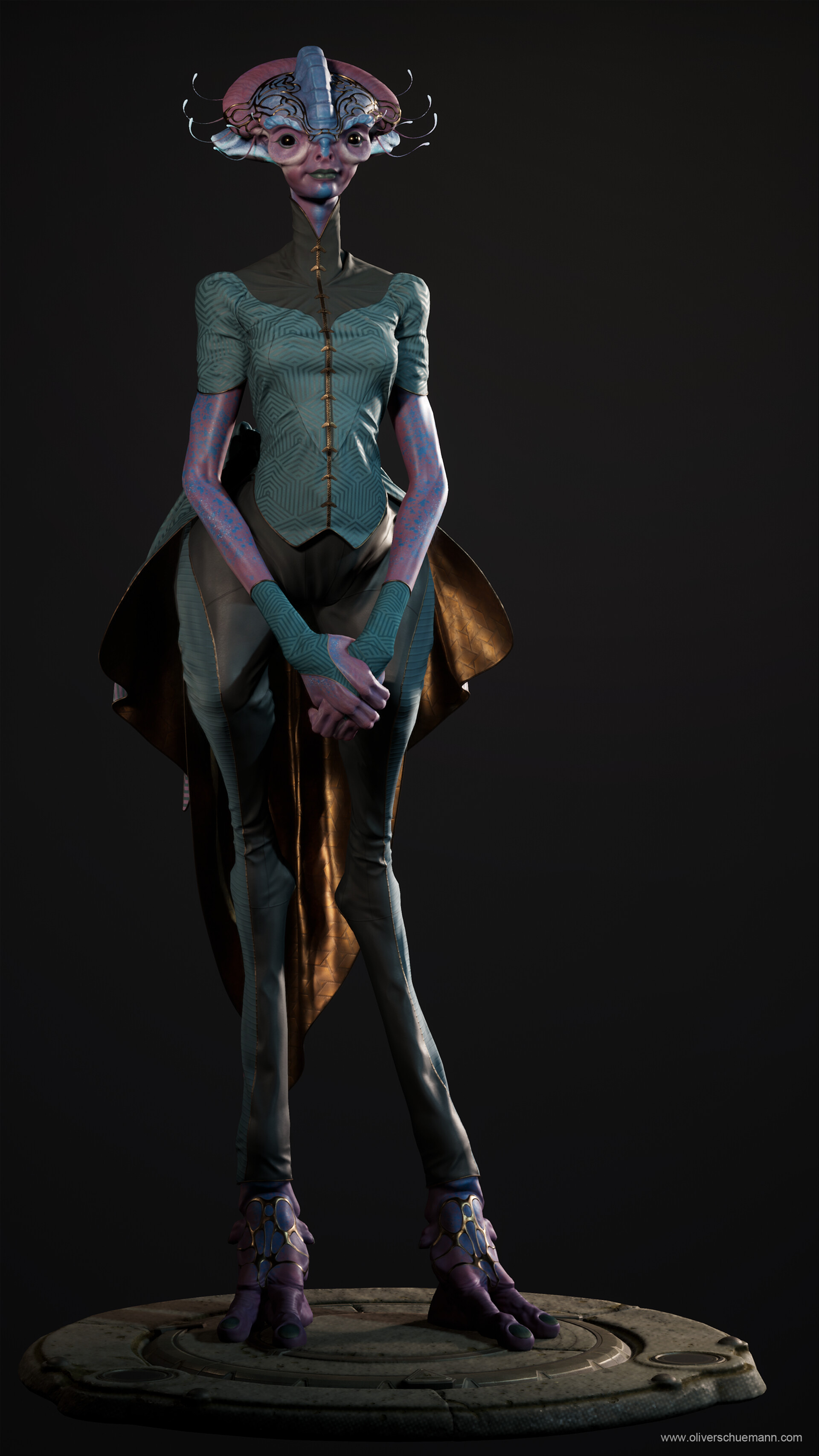
oliver-schumann-alien-detail-008.jpg
OUT OF CHARACTER INFORMATION
  • Intent: To make a unique, reclusive alien species native to one of Caragach’s moons.
  • Image Credit: Alien Politician by Oliver Schumann
  • Canon: N/A
  • Permissions: N/A
  • Links: Caragach
GENERAL INFORMATION
  • Name: Zuti-zudi
  • Designation: Sentient
  • Origins: Malkin (fourth moon of Caragach)
  • Average Lifespan: 3 years (natural lifespan), immortal with sufficient maintenance (post-technofusion)
  • Estimated Population: Planetary (~84 million as of 905 ABY, with 97% on Malkin)
  • Description: The Zuti-Zudi are a tall, reedy nonhuman sentient species native to Malkin, Caragach’s fourth moon. Reclusive and short-lived, Zuti-Zudi spend most of their collective energy developing advanced biotechnology, chiefly to extend their lifespans. Through a process translated as “technofusion”, most adult Zuti-zudi have their brain, nerves, and main arteries transferred into a mechanical body, making them nearly biologically immortal at the cost of their high intellect.
PHYSICAL INFORMATION
  • Breathes: Type I, N/A (post-technofusion)
  • Average Height of Adults: 2.3m (female), 2.5m (male)
  • Average Length of Adults: 19 cm (female), 17cm (male)
  • Skin color: Pink, turquoise cranial swell
  • Hair color: N/A
  • Distinctions: All Zuti-zudi have tall, spindly frames, backwards-bending knees, purplish skin, and have sensory antenna instead of hair follicles. Zuti-zudi exhibit moderate sexual dimorphism, with males generally being taller and thinner than shorter, wider females. Females can reproduce very rapidly after reaching maturity at a rate of up to 1 live birth every two months. Young Zuti-zudi mature at an incredibly fast speed compared to most other sentient beings, reaching an adult physical and mental state by the time they are one and a half years old. Past two and a half years of age, the skin and muscles, and internal tissues of all Zuti-zudi quickly begin degrading at a cellular level, giving them at most another two years to live without technofusion before their bodies can no longer sustain them.
  • Races: A small minority of Zuti-zudi have settled down on Caragach itself and over millennia have evolved subtle genetic differences compared to their Malkin cousins. Caragachi Zuti-zudi are on average around 10 cm shorter and slightly wider than their Malkin counterparts as an adaptation to Caragach’s relatively high gravity.
  • Force Sensitivity: Rare (natural), Non-Sensitive (post-transference)
Strengths:
  • Natural Genius: Though their lives may be fleeting, fully organic Zuti-zudi are extremely intelligent and have perfect memories, allowing them to quickly master nearly any intellectual field of study they choose to pursue.
  • Still I Stand: After technofusion, Zuti-zudi are effectively immortal as long as their mechanical body is maintained and their nutrient needs are met.
Weaknesses:
  • Expiration Date: By far the greatest burden to the Zuti-zudi is their short lifespan. Even the healthiest members of their species can at best hope to reach four years of age without technofusion.
  • Fragile: In their fully organic form, Zuti-zudi are soft-skinned and have long, thin bones that can easily be broken. Even after technofusion, Zuti-zudi remain vulnerable, especially to EMP attacks that can disable the life support in their mechanical bodies.
  • Brain Fog: After technofusion, Zuti-zudi lose their natural genius and develop slower reflexes.
CULTURE
  • Diet: In their natural form, Zuti-zudi are herbivores whose broad, fused teeth allow them to excel at crunching through the hard-shelled fruit commonly found on Malkin. Once they undergo technofusion, Zuti-zudi instead have nutrients and vitamins pumped directly into their bloodstream.
  • Communication: Zuti-zudi have advanced vocal cords and communicate primarily through Taz, their native language. After technofusion where their vocal cords are discarded, Zuti-zudi are still able to speak thanks to voice emulators that receive neural impulses from their brains. Though most Zuti-zudi speak Taz, they are capable of speaking other languages and many diplomats, business executives, and government officials are fluent in Galactic Basic.
  • Technology level: Though most Zuti-zudi tech is at Galactic Standard, they have exceeded the standard rate of innovation in the field of biotechnology. In their quest to prolong their painfully short lifespans, the Zuti-zudi have mastered the fields of implants, bionics, and prosthetics to the point where they can surgically transfer their consciousness into a mechanical body and do so on an industrial scale. Their expertise in biotechnology also extends to bioweapons research and even cloning operations.
  • Religion/Beliefs: Ever since the Zuti-zudi first acquired sentience, the main goal and greatest challenge of the species has been overcoming their short lifespan. It was to this end that the Zuti-zudi developed their society in the hopes of creating technology capable of extending their lives. Every new innovation and advancement made by the Zuti-zudi is in one way or another a step towards a longer life. Even with the invention of technofusion, the Zuti-zudi are not yet satisfied, and the brightest among them seek to truly perfect technofusion so that they can retain their genius and even preserve traits such as Force sensitivity.
  • General behavior: Until the moment of technofusion, Zuti-zudi life is an incredibly hectic and rushed affair. Within days of birth, young Zuti-zudi are taken to schools to discover their talents. They will study their chosen path for the next year until they reach fertile age. Upon becoming fertile, Zuti-zudi will be paired up by their local authorities, though often with the say of the paired Zuti-zudi themselves. Breeding is a quick affair and is carried out until the pair produce at least four children, at which point the Zuti-zudi can choose to either take technofusion or selflessly live a short organic life to use their natural genius for the benefit of the species. After technofusion, Zuti-zudi behavior is almost completely reversed. Technofused Zuti-zudi will toil for decades or even centuries on a single task, serving as the essential bureaucrats, laborers, and researchers ensuring that Zuti-zudi society continues to develop.
HISTORICAL INFORMATION

The Zuti-Zudi first acquired sentience on the planet Caragach’s moon of Malkin on 53 AE (Caragachi calendar) / 11,949 BBY. Descended from an insectoid species that had made a remarkable leap in size and intelligence, the Zuti-zudi also inherited from their insect ancestors their greatest curse: a cripplingly short lifespan. Now that they were sentient, the Zuti-zudi became all too aware of how brief and fleeting their lives were. Some frantically sought every experience they possibly could, throwing themselves into situations that a longer-lived species would consider suicidal. But to the Zuti-zudi, death was always right around the corner. At least they could say that their lives had been fulfilling.

As Zuti-zudi society advanced, their rapid learning and innovation skills became apparent. Over the course of only two millennia, the Zuti-zudi transformed from a species of primitive hunter-gatherers to a fully united, spacefaring civilization that had colonized all nine of Caragach’s moons. Despite their great advancements however, the Zuti-zudi could never truly shake the curse of their biology. Even the most advanced medical treatment could only extend their lives by months at most. Despondent, the Zuti-zudi came to the realization that the only way to escape their short lives would be to escape their own bodies.

Prior medical research, while failing to significantly extend the short lifespans of the Zuti-zudi, had resulted in a key discovery. Since only the skin and muscles of the Zuti-zudi were subject to rapid degradation past adulthood, a Zuti-zudi brain could outlive the body as long as it remained connected to arteries with nutrient-rich blood. It was from this research that the fundamentals of technofusion emerged.

At around the same time as technofusion entered its prototype stages, the Zuti-zudi made contact with two other spacefaring species: the Kogai and the Vasir. Both were native to Caragach, and both had significantly longer lifespans than the Zuti-zudi. Tensions over colonization of Caragach’s moons combined with jealousy over the relatively long lives of the Kogai and Vasir eventually led the Zuti-zudi to declare war on the nations of their two neighbors. Though decades ahead of their adversaries technologically, the superior numbers and toughness of the Kogai-Vasir alliance forced the Zuti-zudi into a long stalemate. Eventually, tired of a seemingly unchanging war and desiring to resume more productive endeavors such as technofusion research, Zuti-zudi leadership sued for peace.

After centuries of unsuccessful trials and countless lost generations, technofusion was at last perfected in 11,251 AE / 2,698 BBY. The research team behind the first successful prototype were immediately hailed as semi-divine heroes, and in the present day thousands of memorials large and small stand in their name across the cities of Malkin. Zuti-zudi flocked by the millions to access this new technology, but at first only a tiny portion of the species could experience a life measured in decades or even centuries rather than weeks. It would take several more iterations of technofusion before it became widely available across the species.

At first, many Zuti-zudi felt nothing but overwhelming joy and relief that their new bodies would never again wither and rot as their old flesh once did. Yet as years and then decades passed for the technofused Zuti-zudi, they began to realize that their new bodies came with significant downsides. The natural genius of the Zuti-zudi degraded with technofusion, making most little smarter than the average Human teenager while an unfortunate few were driven entirely insane. Technofusion also slowed the processing speed of the Zuti-zudi, making tasks that would have been practically thoughtless in an organic body require serious focus.

As the Zuti-zudi as a whole began to recognize the downsides of technofusion, it was decided that a select portion of their species would live out fully organic lifespans in order to preserve their high intellect, enabling them to function as effective state administrators and conduct research towards a truly perfect technofusion.

When the Gulag Plague struck Malkin, the Zuti-zudi were hit hard. Though nearly all the technofused Zuti-zudi avoided infection due to their mechanical bodies, the precious few organic Zuti-zudi left to run the higher positions of their society suffered massive casualties. Consequently, many technofused Zuti-zudi were deprived not only of leadership but the bioengineers maintaining their technofusion, and hundreds of thousands of Zuti-zudi perished simply because their machine bodies could no longer support them. Only by focusing all their efforts on reproduction at the cost of the technofused did enough organic Zuti-zudi survive the plague to keep the species alive.

In the centuries since the Gulag Plague, the Zuti-zudi have rebuilt the majority of their society. Though nearly all pre-Gulag technofused Zuti-zudi perished from a lack of maintenance during the plague, a new generation of technofused bureaucrats, paper-pushers, and simply ordinary civilians have emerged on the backs of their selfless, short-lived organic leadership. Though accepting the unity brought to Caragach and its moons by the Caragachi Enclave, the Zuti-zudi remain primarily centered on Malkin, where their political and cultural influence surpasses that of any other species.
 
Last edited:
iu
OUT OF CHARACTER INFORMATION


GENERAL INFORMATION


  • Planet Name: Caragach​
  • Demonym: Caragachi (singular & plural)​
  • Region: Unknown Regions
  • System Name: Ulfior​
  • System Features:
    • Ulfior Prime: The central star and namesake of the Ulfior system, Ulfior Prime is a red giant star roughly 8 million times the size of Caragach.​
    • Tyros: The only other planet in the Ulfior system, Tyros is around two-thirds the size of Caragach. Uninhabitable due to its extreme proximity to Ulfior Prime, Tyros’ original atmosphere has long since burnt away, leaving the world’s surface barren and lifeless. The lack of an atmosphere also contributes to extreme temperatures, with the side of Tyros that faces Ulfior Prime regularly reaches temperatures exceeding 500 degrees celsius while the side of Tyros facing away from the star experiences temperatures approaching absolute zero. Despite these inhospitable conditions, Tyros’ mineral wealth has motivated mining corporations from Caragach to develop underground, environmentally sealed colonies housing tens of thousands of laborers.​
    • Moons of Caragach
      • Yudi - The third-largest of Caragach’s moons, one of only two moons with a breathable atmosphere, and the closest moon to Caragach, Yudi was the earliest of the planetary satellites to be colonized. It is also the most prosperous of Caragach’s moons, with its natural beauty and lack of dangerous megafauna making it an extremely popular vacation spot.​
      • Faisad - The second-closest moon to Caragach and also the second-smallest of Caragach’s moons, Faisad is most notable for its immense concentration of heavy industry. Faisad’s shipyards and factory-domes manufacture over 60% of the Caragach system’s ships and industrial equipment respectively, making it a vital economic center for Caragach despite its barren, lifeless surface.​
      • Naurog - The third-closest moon to Caragach, Naurog is extremely rich in iron and durasteel ores. Much of its surface has been strip-mined to supply the factory-moon of Faisad’s inexhaustible demand for resources.​
      • Malkin - The fourth-closest moon to Caragach, Malkin is also the largest of Caragach’s moons, at nearly a third the size of Caragach itself. Malkin has an ecosystem nearly as vibrant as Caragach itself, but its biomes are on average less extreme and consequently more habitable. Malkin is also the original home to the Zuti-zudi species, the majority of whom still reside on the moon.​
      • Veyoz - The fifth-closest moon to Caragach and also the smallest of Caragach’s moons. Barren and with few natural resources to exploit, Veyoz is primarily occupied by scientific research labs, military test sites, and environmentally contained industrial parks.​
      • Toxteth - The sixth-closest moon to Caragach, Toxteth appears on the surface to be little more than a large ball of ice. Beneath a kilometers-deep layer of ice however is a planet-spanning ocean extending over 200 kilometers down to the small, rocky core. Much of the planetary ocean remains unexplored, and it is rumored that enormous sea monsters lurk deep in the darkness of the sunless sea.​
      • Vulgwinur - Often called the “gate to Caragach”, Vulgwinur is the fourth-largest and outermost of Caragach’s moons. Developed to be the first line of defense against galactic invaders, the surface of Vulgwinur is covered in forts, redoubts, and orbital defense guns.​
  • Location:
    IMG-0107.jpg
  • Major Imports: Doonium, non-native food, bacta, lithium, luxury goods​
  • Major Exports: Durasteel ore, iron, garach bone, sulphur, native plants, seafood, luxury goods​
  • Unexploited Resources: Small deposits of songsteel and kyber crystals
GEOGRAPHIC INFORMATION

  • Gravity: 1.6x Standard
  • Climate: Varied, Temperate (Average)
  • Primary Terrain: Oceans, Macroforests, Mountains
  • Atmosphere: Type I*
    • Applies to just over 99.9% of Caragach’s atmosphere, some areas such as the Hoga Wastes have Type III.
GEOGRAPHIC FEATURES


Capital City: Gaci

Planetary Features: Caragach includes several major cities, with the five most notable being Gaci, Xuadi, Johlmon, Barcarus, and Yezew. Major highways and rail networks link cities and towns across most of the Caragachi lowlands as well as the Gacian Plateau.

MAJOR LOCATIONS

Important Note:
All biomes on Caragach are given ratings to reflect how hospitable they are to organic life, specifically for its native population and its oldest immigrant species (Humans and Chiss). The list of ratings is posted below:
[Safe] - Type 1 atmosphere, no aggressive wildlife, and few or no natural hazards.
[Hazardous] - Type 1 atmosphere, some aggressive wildlife and/or some natural hazards.
[Deadly] - Localized Type 2 or 3 regional atmosphere, aggressive wildlife, and/or significant natural hazards.
[Lethal] - Localized Type 3 or 4 regional atmosphere, numerous aggressive wildlife and/or* extremely dangerous natural hazards.
*Some Lethal biomes have conditions inhospitable to all life.

The same scale applies to aquatic biomes but excluding atmosphere differences.

Land Area - 32% Safe, 48% Hazardous, 17% Deadly, 3% Lethal
Water Volume - 15% Safe, 30% Hazardous, 15% Deadly, 40% Lethal
Total Surface Area - 20.7% Safe, 36% Hazardous, 15.7% Deadly, 27.6% Lethal

The Five Continents- 95% of Caragach’s landmass is composed of five large continents - Arin, Cutlis, Jaha, Puki, and the Jagged Pole. All of the biomes listed below are organized by continent:

ARIN - Second largest continent, located in the central-west region of the planet. Unique for its lack of lethal biomes and its high population density.
  • Gacian Plateau [Safe] - Named after the planetary capital of Gaci, the Gacian Plateau is a large granite plateau crisscrossed with rivers and covered in low-growing grassy foliage. Its flat, fertile terrain and moderate climate has made it an extremely attractive location for settlement since the early days of Caragachi civilization. Presently, the Gacian Plateau is Caragach’s most heavily urbanized biome, housing nearly 20% of the planet’s entire population within towering cities including Gaci itself.
victor-hugo-harmatiuk-victor-hugo-harmatiuk-asdasdasd.jpg
  • Macroforest Ilyden [Safe] - To the southeast of the Gacian Plateau is Macroforest Ilyden, one of Caragach’s many macroforests. Found on every continent except the Jagged Pole, macroforests are formed primarily of the reddish, coral-like organism called garach. Nearly the entire organism can be harvested: its soft polyps are an edible delicacy or can be used to plant new garach, its hard, calcified branches can be ground up into duracrete or used to build basic structures, and its tube pores are often used for pottery or are carved to make musical instruments. In Macroforest Ilyden, most large predators have long since been hunted into extinction and several paved roads traverse the forest, making it safer than most.
philipp-a-urlich-cpncept506-cut.jpg
  • The Oira Stretch [Hazardous] - Between the northern coastline of Arin and the Gacian Plateau is the Oira Stretch, an east-to-west mountain range around 400 kilometers long and 15 kilometers wide. The Oira Stretch has long served as a barrier against invasion from the north, its steep slopes rising dramatically from sea level to as high as three and a half kilometers before its southern face gently drops off to the Gacian Plateau. There are only two major navigable passes from the coastline up the Oira Stretch.
CUTLIS - The largest continent of Caragach, located in the central-east region. Unique for its long, winding landmass surrounded by thousands of small and medium islands.
  • Macroforest Buydi [Hazardous] - Once spanning the entire southern two-thirds of Cutlis, Macroforest Buydi is now fractured into several smaller macroforests separated by towns, cities, and highways. Nonetheless, the separated forests retain enough ecological similarities to all be referred to as part of Buydi. Unlike Ilyden, Buydi still has large, elusive predators who sometimes claim the lives of planetary natives. The northernmost portion of Buydi in the foothills of the Jarvatan Range sometimes experience groundquakes and rockslides due to nearby tectonic activity.
  • Jarvatan Range [Deadly] - The Javartan Range might not be the largest mountain range in Caragach, but it is by far the tallest. Located at a convergence of three tectonic plates, the Javartans tower above their surroundings at an average of seven kilometers tall and include Ga Juri, Caragach’s tallest peak at 13,211 meters tall. Only the most seasoned or best-equipped of trekkers can hope to traverse the mighty Javartans.
jacek-irzykowski-alien-landscape-02-v006.jpg
  • Hoga Wastes [Lethal] - Located deep within the eastern Javartans are the Hoga Wastes, an ancient volcanic crater possessing enormous deposits of superheated sulphur. The boiling heat and abundance of sulphuric acid in the air of the Hoga Wastes can kill a humanoid in minutes, while pools of acidic sulphur can dissolve solid durasteel. Despite the extreme danger inherent to the Hoga Wastes, commercial sulphur mining is conducted using teams of custom-built droids dropped off and picked up from the air using cargo freighters.
JAHA - Third largest and northernmost continent in Caragach, separated from nearby Arin by the Napiog Sea. Surrounded by warm ocean currents, Jaha is itself unusually warm for its northern latitude.
  • Plains of Urax [Safe] - Rising gently from the southern and western coastline of Jaha, the Plains of Urax are a large, grassy plain extending up to the foothills of the Vaccan Mountains.
  • Vaccan Mountains [Hazardous] - Occupying nearly the entire interior of the Jahan continent, the Vaccan Mountains are Caragach's largest mountain range by area. Clouds rarely penetrate the imposing wall of peaks that make up the Vaccans, contributing to Jaha having the clearest skies and lowest average precipitation of all the continents.
PUKI - The second-smallest continent in Caragach, southeast of Cutlis. Much of the continent is near the planetary equator.
  • The Verdant Desert [Deadly] - Those who glimpse the Verdant Desert for the first time often confuse it for a grassy plain from afar. In reality, the jade green landscape of the Verdant Desert comes from verda, a unique green-colored sand found only on the continent of Puki. In stark contrast to a fertile plain, the Verdant Desert is devoid of nearly all plant life and is constantly subjected to withering heat with little cloud cover and even less precipitation. Settlements in the Verdant Desert are centered on isolated oases both natural and artificial made possible by underground aquifers. Verda sandstorms are a regular occurrence, requiring locals to stay indoors or wear respirators to avoid suffocation until the storm passes. Only the hardiest, deadliest, and most resourceful of creatures survive in the verda dunes, and they will not hesitate to prey on exposed travelers to keep themselves alive.
  • Calxap Savannah [Hazardous] - In southern Puki, verda sand gives way to true grass, isolated garach trees, and cooler temperatures. While still fairly dry and arid compared to the most habitable regions of other continents, the Calxap Savannah contains a number of decently sized rivers and lakes that provide a stable supply of freshwater to the cities of the region.

THE JAGGED POLE - The smallest and southernmost continent. Very cold and very dangerous, with no permanent settlements.

david-mork-25.jpg
  • The Jagged Pole [Deadly] - The entirety of the continent known as the Jagged Pole is covered in an ice sheet kilometers thick, filled with deep ravines and towering spikes of ice, the latter of which give the continent its name. These icy spikes range in size from only a few meters tall near the coastline to over two kilometers in height near the southern pole of Caragach. Regardless of their exact dimensions, the ice spikes and the ravines scattered across the glaciers between them make the Jagged Pole very dangerous to navigate or even land a starship on. The only lifeforms in this frigid wasteland are microscopic bacteria and vicious avian predators who scour the coastline for food, including unfortunate sentients.
THE HELIAD SEA - A single continuous saltwater ocean that forms around two-thirds of Caragach's surface area and 90% of its water surface. The Heliad Sea is host to an extremely diverse range of environments and organisms.

johannes-figlhuber-volcanobeach.jpg
  • The Shallows [Safe] - Consisting of all water from the coastline to the edge of the continental shelf’s upper slope, the Shallows play host to a great abundance of life. Fish and other small aquatic creatures frolic within underwater forests only rarely frequented by larger predators, with those large enough to threaten humanoids driven locally extinct millennia ago.
  • The Heliad Opens [Hazardous] - Roughly equivalent to the open ocean, the Heliad Opens include the vast stretch of the Heliad Sea beyond the upper slope of the continental shelf. Extending from sea level to 100 meters deep, the Heliad Opens are home to numerous migratory species, including some of the Heliad Sea’s largest known organisms. Storms in the Heliad Opens can produce treacherous conditions for even experienced sailors.
  • The Twilight Zone [Deadly] - Extending from 100 to 500 meters deep in the Heliad Sea, the Twilight Zone is a realm veiled in shadow. Most organisms in the upper half of the Twilight Zone have very large eyes to process what little light descends into the depths while those in the lower half of the Twilight Zone are either bioluminescent or depend on highly developed senses of hearing and smell. Since most of the Twilight Zone lies beyond Caragach’s photic zone, herbivores are few and far between, forcing carnivorous creatures to rely on stealthy ambushes or lures to conserve limited energy. Pressure in the Twilight Zone can kill an unprotected humanoid in a matter of seconds.
  • The Starry Sea [Deadly] - Beyond 500 meters deep in the Heliad Sea, sunlight penetrates no further. Yet the deep ocean is far from smothered in total darkness. Countless billions of tiny bioluminescent plankton light the depths of the Heliad Sea like the stars in space, kept nourished by tiny scraps of marine snow falling from far above. While beautiful to observe, the Starry Sea is very dangerous to enter due to its high water pressure, which is near-instantly fatal to any organism not specially adapted to survive under such immense weight.
  • The Lower Void [Lethal] - The single largest biome in Caragach, the Lower Void consists of all portions of the Heliad Sea deeper than two kilometers below sea level. Dark as the void and with pressure so extreme it can crush capital ships, the Lower Void has been visited by fewer than a thousand beings in Caragachi history using specialized submersibles. Of those brave or reckless enough to enter the Lower Void, over half have never returned, with those who have speaking of colossal, formless monsters invisibly lurking in the depths.
POPULATION

  • Native Species: Kogai, Vasir, Zuti-zudi
  • Immigrated Species: Humans, Chiss, Duros
  • Population: Moderate [1.085 billion sentient beings, excluding population of moons]
  • Demographics:
    • 41.23% Kogai, 34.36% Vasir, 12.27% Human, 7.59% Chiss, 3.67% Duros, 0.88% Zuti-zudi
  • Primary Languages: Galactic Basic, Kogali, Vaysa, Nuf
  • Culture:
    • Caragachi culture varies greatly across continents, cities, and moons, with each town, city, and settlement having unique customs. However, there are also a number of shared traditions and values that largely unite the peoples of Carahach. Most Caragachi residents are proud of their society’s growth and their planet’s ecological diversity, holding both as core values all governments should strive to maintain. The residents of Caragach are largely satisfied with what their planet can provide and as a result, few ever permanently leave their homeworld, excepting only merchants, criminals, and the politically persecuted. Caragachi pride over their homeworld also makes most Caragachi judgmental of other planets and societies, quick to point out their flaws while being oblivious to the fact that said flaws may also exist on Caragach itselff.
    • Caragach is home to a variety of major and minor religions, which are followed by the majority of the native population excluding only the reclusive Zuti-zudi. The most prominent faiths view either the Force (referred to as the Xoto) or the long-extinct land leviathans of Caragach as divine and worship them in forested temples to receive their blessings.
GOVERNMENT & ECONOMY

  • Government: Hybrid regime (Parliamentary republic under a competitive authoritarian dominant party system)
  • Affiliation: Caragach Enclave
  • Wealth: Medium - While not the wealthiest of worlds even by Unknown Regions standards, Caragach is also far from the poorest. Its towns and cities maintain a decent standard of living with a widespread availability of good jobs. The greatest wealth in Caragach is concentrated in its largest cities and the moon of Yudi, with smaller cities and towns further from major urban centers being on average less affluent.
  • Stability: Medium - The memory of the Four-Day War is still fresh in the mind of the Caragachi people and most of all in the Caragachi government. Despite holding nigh-uncontested control of the Caragachi Senate under the provisions of the Guod-Harnmi Agreement, the Principlist Coalition is not at all free of threats to its dominance. Grassroots remnants of the former Progressive parties and underground activist groups remain fervently committed to toppling what they see as an unjust regime and restoring true democracy to Caragach. For now, effective counterinsurgency operations have prevented any of these disparate opposition groups from seriously threatening the Principlist regime. Yet these bold rebels remain as determined as ever to depose their tyrants.
  • Freedom & Oppression:
    • While officially a parliamentary democratic republic with an elected Senate, the reality is that the government of Caragach is dominated by the Principlist coalition of right-wing political parties whose forces won the Four-Day War. Ruling with an iron fist beneath a velvet glove, the Principlists maintain the illusion of democratic rule in order to legitimize their authority in the eyes of the citizenry. In practice, the Principlists have uncontested control of the Caragachi government. Their former rivals have either been disenfranchised or bankrupted, leaving only a token, powerless opposition in the Caragachi Senate. Formerly independent media outlets have been seized and converted into propaganda mouthpieces, accused of sedition or even treason simply for not supporting the Principlist uprising as it took place. Independent politicians not affiliated with any party have been aggressively harassed by Principlist agents and forced either to take up Principlist positions or retire from politics.
    • Compared to opposition politicians and activists, the average Caragachi civilian experiences the government’s velvet glove far more often than it does its iron fist. As long as a Caragachi respects local laws and keeps political dissent to themselves, they can live fairly successful and meaningful lives with little outside intervention in their private affairs. Nonetheless, Caragachi civilians who are not Principlist functionaries or corporate executives have little to no real influence on the planetary government. Both local and planet-wide elections are rigged long before they begin, granting Principlist candidates an overwhelming advantage. All public communications are regularly screened, all public assemblies must be approved by government agents beforehand, and citizens can be taken in for interrogation at the slightest signs of sedition or dissent.
MILITARY & TECHNOLOGY

  • Military: Caragach has historically maintained a modern, medium sized military for both defensive and limited offensive purposes. After the Four-Day War, the Caragach Armed Forces (CAF) have undergone expansion and modernization, with an emphasis on power projection to more aggressively assert the interests of the Caragachi Enclave in the Unknown Regions. The CAF is headquartered in Gaci and has three distinct branches: the Army, Navy, and Starfighter Corps.
    • The Caragach Army is a modern ground force consisting of infantry, mechanized, armored, and artillery formations. It is best known for the Urada, an elite heavy infantry formation famed even outside Caragach for their phenomenal endurance and discipline in battle.
    • The Caragach Navy is composed of all capital warships under the control of the CAF. The Navy’s fleet is based out of the moon of Vulgwinur with auxiliary facilities on the moons of Malkin and Faisad as well as on Caragach proper. Since the end of the Four-Day War, the core of the Navy’s fleet has been modernized and is now composed of Palmerian-class heavy cruiser variants accompanied by a few larger vessels and numerous smaller escorts.
    • The Caragach Starfighter Corps (CSC) represents the combined might of all the CAF’s fighters, interceptors, bombers, and ground attack craft. Organized in flights each made of ten wings, the CSC is expected to take up a wide range of mission profiles including but not limited to air supremacy, interception, close air support, strategic bombing, anti-piracy, and anti-capital ship operations.
    • While the High Minister of Caragach is legally the commander-in-chief of the Caragach Armed Forces, it is the High First General of Caragach (FN-999 as of 905 ABY) who is the highest ranking uniformed officer and directly responsible for planning military campaigns.
  • Technology: Galactic Standard
    • Generally speaking, Caragachi technology is at or close to Galactic Standard, with certain materials and technologies substituted for native developments. For instance, garach bone and garacrete are analogous to wood and duracrete respectively.
HISTORICAL INFORMATION

ORIGINS

Recorded history in Caragach began around 12,000 years before the battle of Yavin when the Kogai first developed their civilization. They would be followed half a century later by the Vasir, and a few years later the Zuti-zudi when they arose on the distant moon of Malkin. The Kogai and Vasir civilizations of Caragach soon encountered each other and began to intermingle. As history advanced, so too did society on Caragach. Great empires rose and fell, ancient cities were founded and laid to waste, and goods and ideas were exchanged across every continent. The immense leviathans, once revered as gods, were hunted to the brink of extinction as interactions between the great beasts and the settlers of Caragach grew ever more hostile.

At around 7,306 AE (After Emergence, dated to 11,982 BBY), the natives of Caragach at last took to their stars, their first destinations being their world’s many moons. Yet when they arrived, they found that they were not the first to settle their homeworld’s seven satellites. The first encounter between the Kogai and Vasir nations and the Zuti-zudi took place on the moon of Yudi, with negotiations between the two sides beginning an era of cautious cooperation. This era would not last long, as tensions soon grew between the two sides who both desired unfettered access to the natural wealth of Caragach’s moons.

A diplomatic incident in 7,311 AE rapidly escalated into a full-scale war that devastated both sides, with neither having a clear advantage. After the war raged for nearly four decades, a new generation of leaders emerged desiring an end to the disastrous conflict. Peace was negotiated and a compromise established: henceforth, local authorities and a series of treaties would regulate commerce between Caragach and its satellites.

FIRST GOLDEN AGE

As war gave way to peace, all three sentient species of Caragach now freely intermingled with each other, sharing ideas and technology to their mutual benefit, even if some exchanges were more reluctant than others. By 7,380 AE (4,602 BBY), Caragach had entered its first and longest golden age. For the first time, the denizens of Caragach and its moons reached beyond their homeworld and its orbit, seeking to explore the stars and settle distant worlds.

Nearby Tyros was the first planet to be visited by the Caragachi, who by 7,415 AE had set up the first of the mining colonies beneath its inhospitable surface. On 7,430 AE, first contact was made with Human settlers from the Jurio system, and despite initial misunderstandings, the two groups soon developed a valuable economic relationship. It was from these first Human immigrants that the Caragachi acquired hyperdrive technology, vastly accelerating their space travel and dramatically extending the range of their voyages.

Over the following millennia, Caragachi traders and settlers spread far throughout the Unknown Regions while on Caragach itself great cities rose and new nations emerged. Through times of war and peace the Caragachi continued to prosper, continuously innovating not only in technology but also in the fields of art, culture, and governance.

Located as it was deep within the Unknown Regions, Caragach was never integrated into the Galactic Republic or any of its rival powers. Trading and interacting primarily with other worlds near the edge of the galactic rim, Caragach was thus shielded from the worst of the effects of the Sith Wars and Clone Wars. Though the emergence of the Galactic Empire from the ruins of the Republic was felt in Caragach, it too did not penetrate far enough into the Unknown Regions to directly influence the Caragachi. Overlooked further by the New Republic, Yuuzhan Vong, and pre-Gulag Galactic Alliance, Caragach garnered a well-earned reputation for being a beacon of peace and stability and its population surged with refugees from closer to the galactic core.

All good things must come to an end however, and even secluded Caragach was no exception.

GULAG PLAGUE

When the Gulag Plague first swept the galaxy, Caragach had mere weeks to prepare. Contact was lost with every Caragachi diaspora population in mere days, and every expedition sent out from Caragach never returned. Left in the dark and fearing the worst, the nations of Caragach united their fleets to form a defensive blockade above their shared homeworld. Yet for all their efforts, the Cargachi civilization had no match for the Gulag Plague.

It was early in 19,714 AE (426 ABY) that the Gulag Plague arrived in the Ulfior system. The mining colonies of Tyros were the first to fall to the plague, followed several days later by all nine moons of Caragach nearly simultaneously. Once the plague settled on the innermost moon of Yudi, Caragach’s fate was sealed.

From the wreckage of a spacefaring yacht the Gulag Plague spread through Caragach with devastating results. Societal collapse occurred within days and even rival warbands soon succumbed to the plague. The once-great cities of Caragach were abandoned as the remaining survivors fled to the furthest corners of the countryside and even the Jagged Pole itself. These tiny groups of Caragachi reverted to using whatever primitive technology they could build without industry, living off the land as hunter-gatherers.

After centuries where the Caragachi were at their lowest, the ravages of the Gulag Plague at last came to an end. Once they were confident the plague had truly passed, the remaining Caragachi regrouped in the cities and agricultural centers to determine the future of their collective species.

In all, the Gulag Plague killed 99.96% of the Kogai, 99.98% of the Vasir, and 99.99% of all immigrant species, leaving only around a million sentients on all of Caragach. When contact with the Zuti-zudi was restored half a century later, it was learned that only 3,500 organic members of their species remained. Collectively traumatized by the experience of the Gulag Plague and acutely aware of how few of their kind remained, the sentient species of Caragach agreed to do away with the artificial divisions of the past, for the first time uniting the world and its nine moons under one banner. From this understanding, the so-called Act of Union, the Caragachi Enclave was born.

SECOND GOLDEN AGE

The first task of the Caragachi Enclave was to secure political unity across Caragach, its nine moons, and eventually the entire Ulfior system. Though most residents of Caragach submitted to the Enclave’s democratic government with little issue, there remained isolated settlements to be rediscovered and armed raiders to be subdued. The Enclave achieved both in quick order, establishing the nucleus of the Caragachi Armed Forces in the process.

Next on the Enclave’s long task list was to restore the technological base once enjoyed by the pre-Gulag Caragachi. Ruined cities were scoured for any blueprints, intact tech, and industrial machinery. With the groundwork laid by the previous Caragachi civilizations, the Enclave was able to advance through millennia of technology in a matter of decades. By 20,055 AE (767 ABY), the Caragachi once more travelled the stars. One by one its moons were resettled, old infrastructure restored or recycled to once more benefit civilization. At last, in 21,058 AE, Tyros’ mining colonies were resettled, fully restoring Caragachi presence across its entire home system.

Though less populous than it was before the Gulag Plague, Caragach was stronger than ever before owing to its unprecedented political unity. Early Enclave governments launched vast megaprojects to revitalize the Ulfior system and better protect it from future galactic threats. It was during the Raswon government that the moon of Faisad was transformed into the industrial powerhouse it is today, while the following Yordike government turned the barren moon of Vulgwinur into a formidable fortress.

Despite this newfound prosperity, tensions were rising on Caragach. Before the Gulag Plague, its various nations each harbored unique forms of government and ideologies. Since the Act of Union, the Caragachi Enclave has had to inherit all these distinct and often conflicting ideologies within the framework of a single government, resulting in the creation of numerous major and minor political parties in constant competition with each other. Old grudges between cities, regions, and continents re-emerged in the form of increasingly prominent political polarization between all parties in the Caragachi Senate. By 20,188AE (900 ABY), Caragachi democracy and the Enclave itself would be in danger as the major factions of the Senate began to consider using any means necessary to defeat their political rivals.

By 20,191 AE, the bitterly quarreling factions of the Caragachi Senate had coalesced into two coalitions. On one side were the Principlists, a coalition of conservatives, right-wing senators, and Imperial apologists. Opposing them were the Progressives, a coalition of reformists, progressives, and revolutionaries. From 20,191-20,193 AE, the Progressives held a majority in the Senate. Confident in their authority, they began to plan their most ambitious agenda yet, one that would render the Principlists obsolete.

However, even the Progressives underestimated how far their rivals would go to gain the power they so rightfully deserved.

Behind closed doors, representatives of the Principlist coalition had secured a meeting with FN-999, a seasoned Imperial general who had recently departed the short-lived second iteration of the First Order. Recognizing that their interests aligned, the Principlists and FN-999 came to an agreement: the general would offer his forces to aid the Principlists in a coup in exchange for being granted the position of High First General, giving him nearly total control over the CAF.

Now having the trump card they had long desired, the Principlists at last took action.

FOUR-DAY WAR

On 2.1.905 at 13:12 local time, a signal code was given to Principlist politicians and sympathizers in the armed forces and civil society, marking the beginning of a coup against the Progressive-led government. While Senate was in session, the Senatorial Guard burst into the building and held the senators hostage, allowing only Principlists to leave the building. Entire divisions of the Caragach Army rose up in revolt, quickly taking control of key urban centers including several districts of Gaci itself. Riots spread in the cities of Caragach and its moons, and soon not a single settlement of note was spared of civil unrest.

Vulgwinur, the Gate of Caragach, was home to some of the most intense fighting of the first day of the Four-Day War as Principlists fought Progressives for control of the fortress moon. The tides soon turned in favor of the former however when FN-999 arrived to deliver upon his end of his arrangement with the Principlists. With a powerful fleet in tow, he quickly blasted through the scattered Progressive naval forces before descending upon Vulgwinur with his veteran stormtroopers, besieging and destroying the remaining Progressive holdouts in just under eight hours. Now possessing near-total control over the flow of beings and goods to and from Caragach as well as its most valuable naval assets, FN-999 and most of his fleet advanced swiftly through Caragach’s moons, seizing control of Malkin in a matter of hours while capturing Toxteth and Veyoz as little more than an afterthought. It was at Malkin that FN-999 and the Principlist forces he had linked up with paused their lightning advance, gathering supplies and sympathizers in preparation for a proper siege of the Inner Moons.

On 2.2.905, the Principlist fleet set out from Malkin, ignoring the factory moon of Faisad and instead blockading the lightly defended mining moon of Naurog. Their gambit soon paid off as Faisad was starved of the minerals it needed to make new weapons for the Progressive war effort, forcing most of their remaining naval forces face the Principlists above Naurog with a home field advantage. FN-999’s military engineers had used freshly mined durasteel ore to create improvised mines and small gun platforms deployed in Naurog’s orbit, which when combined with his fleet and ships captured by the Principlists contributed to a decisive victory over Naurog, destroying the last remaining Progressive capital ships. Following the Battle of Naurog, the Principlists would hold uncontested space supremacy for the remainder of the war.

By the third day of the war, clear battle lines had formed on Caragach proper. While the Progressives held more cities than the Principlists, the latter had nearly uncontested control of the countryside and remained bitterly entrenched in several of Gaci’s outer districts. For the moment, neither side had any clear advantage, with momentum shifting as rapidly as the winds themselves. However, that would soon change. In space, FN-999’s fleet had imposed blockades over Faisad and Naurog, ensuring supplies only arrived to Principlist holdouts on each moon. Deciding to starve out the remaining two moons rather than besiege them, FN-999 and the Principlist commanders in orbit began ferrying troops from the moons they occupied directly onto Caragach. Soon, millions of Principlist soldiers were gathering on the planet, quickly acquiring the numbers needed to seize Gaci and end the war.

On the final day of the war, hundreds of thousands of Principlist soldiers reinforced by most of FN-999’s legion broke out from their positions in outer Gaci, rapidly overwhelming the defenders with superior numbers and firepower as well as aerial supremacy. The Siege of Gaci was by far the bloodiest battle of the Four-Day War, with tens of thousands of soldiers dead on each side and a nearly equal number of civilian casualties as stray shells leveled apartment buildings. Ultimately, it was the Principlists that emerged triumphant. With the Caragachi Enclave’s capital now under Principlist control, the remaining Progressive forces on Caragach, Yudi, and Faisad capitulated.

The Caragachi Enclave had survived its greatest upheaval since its founding, but it would never be the same.

THE GUOD-HARNMI AGREEMENT

With the decisive defeat of the Progressive forces on the battlefield, they were forced to the negotiating table to avert total collapse of their position on Caragach. The resulting treaty was known as the Guod-Harnmi Agreement, named after their primary signatories: Alfin Guod, former Minister of State and leader of the Principlists, and Hod Harnmi, former High Minister of Caragach and leader of the Progressive bloc.

Under the agreement, the Progressive Bloc and all its member parties were outlawed as well as made to bear sole responsibility for the events leading up to the Four-Day War. Furthermore, the Caragachi Constitution was revised to weaken protections related to free speech, assembly, and political expression, enabling the triumphant Principlists to shut down remaining opposition parties and media outlets for alleged collaboration with the Progressives. Finally, the member parties of the Progressive Bloc were made to pay reparations for all damages suffered during the Four Day War, financially crippling the strongest opposition to Principlist rule.

After the signing of the Guod-Harnmi Agreement, the victorious Principlists began to reshape Caragach in their image, no longer restrained by strong political opposition. Anticipating widespread protests by the population at large in former Progressive strongholds, the Principlists initiated martial law, thoroughly and often violently cracking down on resistance from the general public. They also purposely offered little resistance to Progressives fleeing Caragach, recognizing that the High Republic and even the emerging Farworlds Alliance could scant afford to intervene in such a remote system.

A combination of draconian restrictions imposed by the Guod-Harnmi Agreement, effective counterinsurgency operations overseen by FN-999, and emigration of more affluent Progressives have eliminated nearly all internal threats to the Enclave’s new rulers as of 905 ABY. Yet even as Alfin Guod and FN-999 draw up plans to further expand Caragach’s sphere of influence, they must be careful not to underestimate the spirit of resistance that remains among segments of the Caragachi people.


Users who are viewing this thread

Top Bottom