
Architect


TEMPEST IV-CLASS
"ORDINANCE BOAT"
LINE ARTILLERY DEFENDER
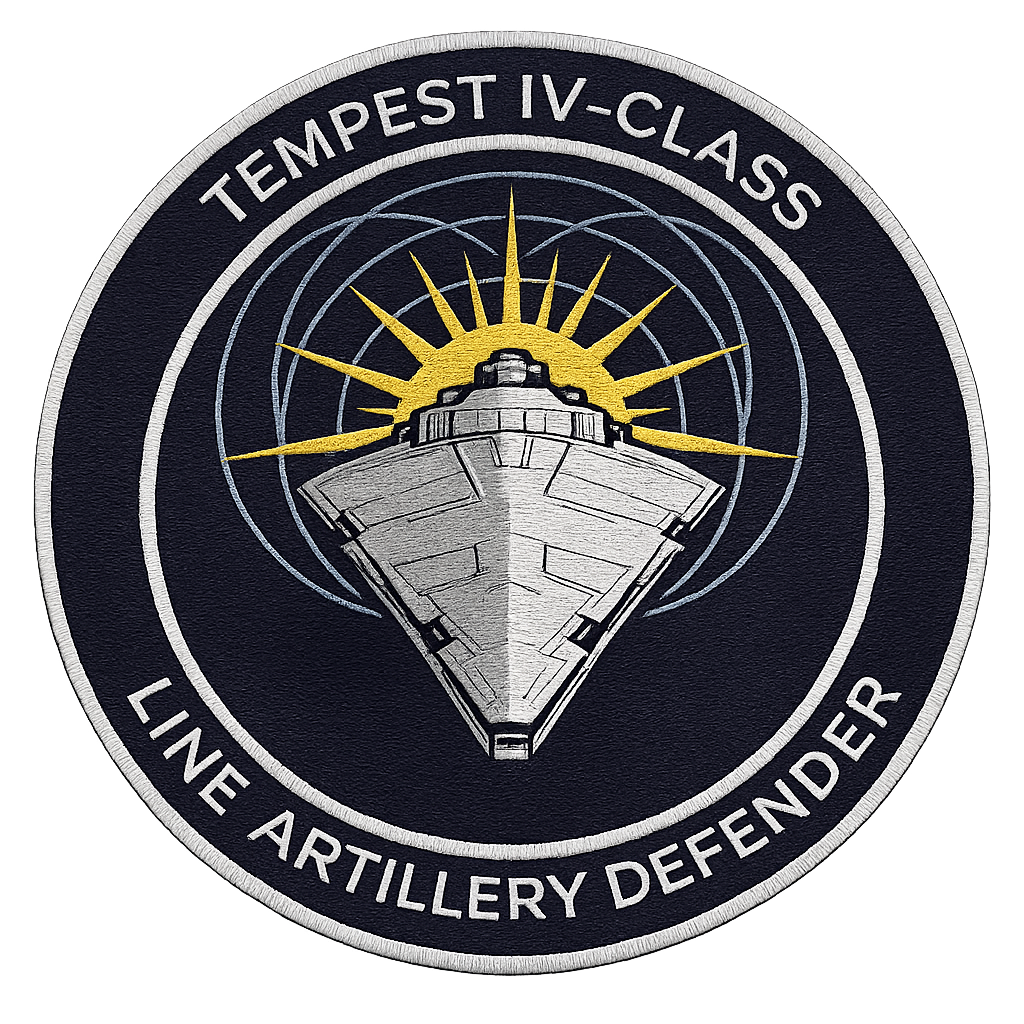
"ORDINANCE BOAT"
LINE ARTILLERY DEFENDER
OUT OF CHARACTER INFORMATION
- Intent: Modernize the old Stormcloud cruiser, carrying the hull over into the new Tempest IV.
- Image Source: ChatGPT | SciFi Meshes Forum
- Canon Link: N/A
- Permissions: Solarium Glasteel, Firestrikes + Thunderbolts
- Primary Source: Stormcloud III, Stormcloud II, Stormcloud
- Manufacturer: Primo Victorian Enterprises
- Affiliation: Imperial Commonwealth of Dosuun
- Market Status: Closed Market
- Model: CNC-LDAT4-M1 “Tempest”
- Production: Semi-Unique
- Material:
- Durasteel Reinforced Crystalamnium Hull
- Reinforced Duraplast with Latticed Crystaplast Liner
- Alusteel Reinforced Durasteel Hull [Interior]
- Tunqstoid Blast Doors, Turadium Blast Shields [Interior]
- Solarium Glasteel Viewports [Overlay]
- Glasteel Viewports [Underlay], Turadium Blast Shutters
- Agrinium, Dallorian Alloy [Key Areas/Critical Components]
- AR-0B Damage Reduction Plating [Key Areas/Critical
- Doonium Infused Impervium [Munitions Control]
- Hekakles-type + Judicant Composite [Composite Hull System +Force Resistance & EMP-Resistance]
- Reactive Polyfoam Buffer [High Internal Shock Absorption]
- Classification: Line Artillery Defender
- Length: 1000m
- Width: 400m
- Height: 250m
- Armament: Very High
- 3x Ares-type 512mm Mass Driver Cannons
- 1x dorsal spinal mount (forward primary axis)
- 2x dorsal offset spinal batteries positioned port and starboard aft of the primary mount
- 4x Sekhmet-type Space Mortars
- 2x dorsal mid-aft mortar emplacements
- 2x ventral mid-aft mortar emplacements
- 2x Hyperion-type Solar Ionization Arrays
- 2x dorsal forward superstructure mounts
- 10x Maher II-type Heavy Turbolasers
- 4x dorsal broadside turrets
- 4x ventral broadside turrets
- 2x forward axial batteries
- 8x Hawkthorne II-type Ion Cannons
- 4x dorsal port/starboard batteries
- 4x ventral port/starboard batteries
- 10x Valencia II-type Heavy Flak Cannons
- Distributed along dorsal and ventral hull edges
- Overlapping long-range anti-strikecraft and anti-ordnance coverage
- 8x Kyronis II-type Hypervelocity Plasma Cannons
- 4x dorsal lateral batteries
- 4x ventral lateral batteries
- 8x Atalanta II-type Twin-Barrel 127mm Mass Drivers
- 4x port broadside batteries
- 4x starboard broadside batteries
- 6x Persephone-type 234mm Mass Driver Cannons
- 3x portside heavy batteries
- 3x starboard heavy batteries
- 6x Tojil II-type Heavy Turbolasers
- 3x portside close-defense batteries
- 3x starboard close-defense batteries
- 14x Mogh III-type Rotary Hypervelocity Cannons
- Distributed across dorsal, ventral, and aft defensive arcs
- Battlefield-range interception of strikecraft, missiles, and corvette-class threats
- 12x Thunderbolt II-type Rotary CIWS
- Mounted along critical hull approach vectors and hangar/service access points
- Final-layer anti-swarm and anti-boarding defense
- 10x Ironfang Defensive Autocannons
- Positioned around sensor clusters, reactor zones, shield relay infrastructure, and command superstructure
- Specialized interception of advanced strikecraft, stealth platforms, and precision threats
- 24x Covenantor II-type Smart Flak Emplacements
- Distributed evenly along dorsal and ventral hull surfaces
- Integrated into layered close-in defensive envelope against fighters, drones, missiles, and strike ordnance
- 6x Bishop II-type Capital Missile Launchers
- 4x forward dorsal launch cells
- 2x ventral forward launch cells
- 6x Manogel Utility Torpedo Launchers
- Distributed port and starboard amidships
- Supplemental deployment of ECM, sensor-decoy, interdiction, and utility torpedoes
- 8x Ovmar II Defensive Missile Interceptor Launchers
- Mounted along dorsal and ventral defensive sectors
- Long-range interception of incoming torpedoes, missiles, and strike ordnance
- 3x Ares-type 512mm Mass Driver Cannons
- Defenses: Very High
- Rampart Shield Matrix [Primary All-Angle Shield]
- Phalanx Adaptive Shield Matrix [Attack-Adaptive Layer]
- Ballista Shield Array [Kinetic/Projectile Interception]
- Sentinel Defense System [Close-In Interceptor Grid]
- Boudica Kinetic Deflector [Localized Impact Mitigation]
- Vitralis Reflex Shield Generator [Reflexive Shield Layer]
- Crystalamnium Mesh + Crystaplast Shell [Radiant + Kinetic Dispersal]
- Hekakles Composite Hull [Core Durability Layer]
- Semira II Defensive System [Secondary Shield Layer]
- Ariadne ECM Assistant [Electronic Countermeasure Control]
- Arbalest Capacitor System [Emergency Power Surge Buffer]
- ERES-88 [Electronic Defense System]
- Testudo Guardian Matrix [Shield Extension System]
- Shardana Defensive Shield Relay [Formation Shield Redistribution & Relay Network]
- Russ Shield Suite (Emergency Redundancy Layer)
- Deflector Shield Generators (x2): Particle & Ray Overlay w/ Integrated Shield Boost
- Regenerative Reinforced Shield Generator: Self-healing layer + Shield Boost
- Ion Shield Generator: Specialized ion disruption protection
- Emergency Capacitor Boost System: Temporarily doubles absorption threshold on critical areas
- Tauros Defensive Suite
- Capacitor Drains, Socket Guards, and De-Ionizer Rigs
- Anti-Tractor Beam Shroud (Field Disruptor Pattern)
- Chaff and Flares Dispersal System (Multi-burst Countermeasure Ejectors)
- Anti-Ordnance EM Probe (Localized detonation field on missile proximity)
- Missile Deactivation Transmitter (Pulse jammer for active munition)
- Hangar Space: Very Low - 3
- Hangar Allocations:
- Starfighters: 1x Firestrike, 1x Thunderbolt
- Support Craft: 1x Scryver Repair Drone
- Maneuverability Rating: Very Low
- Speed Rating: Low
- Hyperdrive: Yes
- Primary Class: 1.0
- Backup Class: 10.0
- Auxiliary & Emergency Systems
- Auxiliary and reserve power generator suites
- Power conversion and control networks
- Emergency back-up generator systems
- Systems control center and supplemental control hub
- Auxiliary reactor and core coolant management
- Emergency shield and life-support management suites
- Emergency command operations center
- Escape pod control and ejection system management
- Automatic failsafe, containment, and isolation management
- Supplemental power control center
- Emergency power capacitor systems
- Arbalest Capacitor System integration for burst-power stabilization
- Emergency thermal bypass routing tied to the Amduat Thermal Regulation Network
- Flight & Navigation Systems
- Flight control and navigation suite
- Primary and secondary flight controller management
- Sublight and hyperdrive power management
- Propulsion systems control suite
- Hyperlane and jump-point navigation systems
- Galactic hyperspace holosite integration
- Impulse and vector thrust control systems
- FleetNet-linked navigational synchronization
- Formation-positioning and anchor-stability navigation support
- Engineering & Power Management
- Primary and secondary power management control suites
- Reactor core control and disengagement systems
- Core coolant management and safety containment suites
- Engineering control hub with secondary redundancy systems
- Weapons, shields, and holosite power distribution suites
- Dedicated and emergency weapons generator systems
- Capacitor control and power buffering systems
- Hazard and damage control management suite
- Tractor / pressor beam control systems
- Repulsor generator systems and waste-management control
- Safety management suite
- Weapons power generator management refinement
- Crystal-Fused Ion Engine (CFIE) infrastructure integration
- Crystal-Integrated Harmonic Regulator system integration
- Twin Treadshock-XS ion engine synchronization systems
- Amun Core stellar-radiation efficiency integration
- Amduat Thermal Regulation Network heat-routing and thermal cycling integration
- FRIES-IV Modular Suite compatibility architecture
- Communications Systems
- Coordinated command encryption network
- Encrypted short-range and fleet communications suites
- Hyperwave communications and encryption layer
- Interfleet and intrafleet communications systems
- Fleet data-exchange and relay management
- Standard communications management hub
- FleetNet node + AI-assisted data routing
- Formation-linked tactical synchronization support
- Distributed shield-relay coordination support for Shardana-enabled formations
- Tactical & Security Systems
- Tactical computer-assisted targeting and rangefinding
- Lock-on and target-lead automation systems
- Weapons control, reload management, and munition handling
- Shield monitoring, conversion, and containment systems
- Shield booster and tertiary generator management
- Automated reload, temperature monitoring, and safety systems
- Internal security monitoring and compartmental lockdown systems
- Multi-shield management system
- Redundant shield management systems
- Regenerative shield monitoring integration
- Shardana Defensive Shield Relay integration and load-balancing systems
- Thermal strain monitoring and relay stress-management systems
- Distributed fleet-defense synchronization support
- Sensor & Navigational Systems
- Multi-directional long-range sensor arrays
- Long-range gravitational and tachyon sensor suites
- Navigational and hyper-navigational sensor systems
- Starship signature identification systems
- Cargo sweep and standard identification suites
- Planetary and lifesigns identification systems
- FleetNet tactical data reception systems
- Passive formation-targeting relay integration
- External sensor-fusion compatible with tactical support vessels
- Hangar & Craft Support Systems
- Starfighter traffic and hangar control systems
- Diagnostic, repair, and refueling systems for embarked craft
- Weapon loading and maintenance bays
- Crash-hangar damage-control systems
- Fabrication and machinist workshops (limited scale)
- Dedicated repair-drone maintenance infrastructure
- Utility shuttle deployment and recovery systems
- Medical Systems
- Primary medical bay with surgical and trauma capability
- Secondary sickbay and overflow triage ward
- Intensive care unit and isolation chambers
- Cryogenic stasis and emergency suspension pods
- Biohazard containment and quarantine suites
- Automated medical diagnostics and imaging systems
- Emergency medivac response and casualty processing center
- Psychological services and combat-fatigue counseling
- Life-support integration and patient monitoring systems
- Battlefield stabilization station
- Extended-duration casualty support for sustained fleet engagements
- Internal Defense Management:
- Retractable Auto Blasters
- Retractable Turadium Bulkheads
- Retractable Turadium Ventilation Spikes
- Retractable Turadium Blast Barriers, Crystalamnium Coated.
- Automated War Droid Emergency Deployment
- Automated Anti-Concussion Field Emergency Deployment
- Advanced Biometric Security Systems
- Advanced Laser Grid, Emergency Deployment Only
- Advanced Mass Sensor Plating and Grid System
- Extensive Security Camera and Motion Detection System
- Extensive Thermal Energy Sensors and Biometric Detection Systems
- Emergency Lock-Down Tram & Lift Systems
- Emergency Pressure Plate and Compact Disposal Systems
- Power and Propulsion:
- Twin, Treadshock-XS Ion Engine [High-thrust vectored ion propulsion]
- Trinity Core Reactor [Reactor + ElectroFrost regulation system]
- Blackwake Core [Supplemental Reactor Core]
- Icarus Maneuvering Array [Micro-thrust and counter-gravity maneuvering system enabling fine attitude adjustments, arc alignment, and stabilization for heavy weapon platforms.]
- Crystal-Integrated Harmonic Regulator [Force-resonance and energy destabilization protection]
- Aether-IX Modular Suite [System integration and modulation overlay]
- Fries-IV Modular Suite [Thermal regulation and emergency power reroute]
- Amun Core [Supplemental Stellar Radiation Efficiency System]
- Amduat Thermal Regulation Network [Vessel-Wide Thermal Redistribution & Heat Cycling Network]
- Command, Datacore & Sensor Systems:
- Helion Data Core Matrix: Serves as the central data handling and analysis nexus. Integrates sensor inputs, targeting data, astrogation, and fleet relay processing. Blackwake interfaces with this directly to prioritize system resilience.
- ERALAM - FleetNet-integrated system supporting navigation, encrypted communications, targeting solution refinement, and real-time battlefield data processing. Designed to enhance fire-control efficiency rather than command-level coordination.
- NATASI - Supervisory logic framework responsible for system integrity monitoring, security verification, and combat-priority resource allocation. Provides adaptive system management under high-stress combat conditions.
- SPX Aetherveil Sensor Suite
- Long-range passive + active scanning
- Force-resonance tuned with Verityne crystal logic
- High-resolution mapping + gravitational anomaly detection
- Use: Early warning, fleet synchronization, sensor triangulation in crowded space.
- TCSX Strikeveil Sensor Suite
- Tactical fire control optimization
- Real-time target trajectory and maneuver prediction
- Integrated with Vanguard-GTS and weapons grid
- Mid-combat tactical locking and active countermeasure compensation.
- SCX Navicor Sensor Suite
- Dedicated for nav-hazard detection
- Hyperlane anomaly mapping and battlefield pathfinding
- Optimized for formation maneuvering and emergency reroute
- Strategic positioning, safe retreat vectors, escort formation cohesion.
- Advanced Communications:
- Electronic Interference Mast
- Dudley Communication Suite
- Countermeasures:
- Ion Encumbrance System [Drive-disrupting signature cloud]
- Phantom Short-Range Tactical Jammers (x2)
- SIG-220 Tactical Jammer [Broadband Disruption Layer]
- IFF Confuser / Screamer Sensor Jammer / Hail Comm Jammer
- Additional Sensors
- Bluford Sensor Suite [Short Trimmed]:
- Savić Tracking Sensor Suite [Short Trimmed]:
- Targeting Suite [Trimmed]:
- Vanguard-GTS Targeting Suite
- Active Matrix Targeting, Targeting Computer + Combat Multi-View Display
- Target-Aggressor Attack Resolution Software
- Sureshot Targeting Array - Short Range Target Acquiring Sensor, integrated with Icarus, Trinity, and Ariadne systems for seamless lock acquisition and coordination
- Bluford Sensor Suite [Short Trimmed]:
- Anchor Doctrine & Line Integrity: The Tempest IV is designed to hold position and hold it absolutely. Through the Shardana Defensive Shield Relay System, mounted along the ship's structural spine, the Tempest IV extends its defensive coverage to allied vessels operating within formation range, transforming a single cruiser into a force multiplier that raises the survivability of every ship sheltering beneath its umbrella. A line anchored by the Tempest IV is a line that does not break cheaply.
- Layered Combined Arms: From the Ares mass driver punishing capital hulls at long range to the Thunderbolt II and Ironfang rotary cannons suppressing boarders at close quarters, every threat band is addressed by a dedicated system with a distinct non-overlapping role. The Sekhmet mortars shape the approach, the Hawkthorne ion cannons strip shields, the Ares finishes the work. No single layer is asked to do more than its job.
- Commonwealth Power Ecosystem: The Amun Core, Arbalest Capacitor System, Crystal-Integrated Harmonic Regulator, Amduat Thermal Regulation Network, and FRIES-IV Modular Suite form an integrated power, thermal, and harmonic architecture rather than a collection of discrete components. Each system addresses a distinct operational layer — generation, regulation, storage, distribution, and thermal management — producing a platform capable of sustained high-output operations without the cascade failures that plague less coherently designed vessels.
- Sustained Endurance: Where comparable artillery platforms risk thermal shutdown or power starvation during prolonged engagement sequences, the Tempest IV is built to outlast the engagement. The Amduat manages vessel-wide heat redistribution, the FRIES-IV handles engine-level thermal output at the source, and the Arbalest buffers surplus power for burst dispatch during weapons cycling. The ship does not need to disengage to cool down.
- Formation Force Multiplication: Operating alongside Fortan V-class SIGINT corvettes, Conyers III-class tactical escort frigates, and Bercey IV-class fast corvettes, the Tempest IV becomes the weapons-heavy anchor of a formation that has solved its sensor, intelligence, and coordination dependencies externally through FleetNet integration. The whole formation fights as a single organism. The Tempest IV is its spine.
- Positional Commitment: The Tempest IV is built to hold a line, not maneuver one. Once positioned, repositioning under fire is a deliberate and costly decision. Commanders who expect a flexible, reactive capital ship will find the Tempest IV unsuited to that role. Its value is in presence and endurance, not in tactical mobility. An enemy that can force the Tempest IV to reposition has already partially won.
- Formation Dependency: The Shardana Defensive Shield Relay performs at its ceiling within a disciplined, cohesive formation. Stripped of formation partners — whether by attrition, separation, or deliberate enemy targeting of escort hulls — the Tempest IV loses the force-multiplying defensive value that defines its doctrine. It remains a capable warship alone, but it is not designed to fight alone.
- Sensor Reliance: The Tempest IV carries no organic long-range targeting suite. At extended range, effective weapons employment — particularly the Sekhmet mortars and Erebus torpedoes — depends on targeting telemetry fed through FleetNet from Fortan V and Conyers III formation partners. A Tempest IV cut off from its SIGINT and sensor coordination assets is a Tempest IV firing into fog.
- Profile and Signature: At 1,000 meters in length with a 400-meter beam and 250-meter height, the Tempest IV is not a subtle presence. It cannot hide, it cannot disengage cleanly, and it will draw fire precisely because of what it represents to an enemy formation. Destroying or suppressing the Tempest IV collapses the shield umbrella over every ship sheltering beneath it, making it a priority target in any engagement it enters.
- Recoil and Structural Stress: The Ares-type 512mm mass driver produces significant recoil forces that, on a hull of this size, require the inertial dampener justification built into the ship's design to manage safely. Sustained rapid-fire sequences, while tactically possible, place cumulative stress on the mounting cradle and adjacent hull bracing. Gunnery crews are expected to pace fire discipline accordingly. Similarly, the Sekhmet mortars under high-rate engagement produce structural stress that the Amduat manages but does not eliminate.
The Tempest IV-class Line Artillery Defender is the fourth generation of a hull lineage that began in the shipyards of Primo Victorian over three decades ago, when the first Stormcloud-class assault cruiser rolled off the line with the FIV Tempest as its lead vessel. That original ship was built for the First Order Navy as a fast, firepower-heavy cruiser aggressive, expendable in doctrine if not in construction, and named for the storms that Primo Victorian's engineers had always used as the language of their warships. Each successive generation of the Stormcloud moved further from that original aggression: slower, heavier, more defensively capable, more scientifically minded, trading speed for endurance and forward momentum for sustained presence. By the time of the Stormcloud III, the class had already begun to ask a different question than the one it was originally built to answer. The Tempest IV answers that question fully.
The assault doctrine is gone. What replaced it is something more considered and, in the judgment of the Imperial Commonwealth Naval Engineering Corps, considerably more dangerous: a ship designed not to advance but to remain, not to close but to hold, not to overwhelm but to outlast. The Tempest IV is a line artillery defender in the most literal sense — a vessel that stakes a position, extends its protection over the ships sheltering beside it, and makes the act of approach an act of attrition.
At the center of this doctrine is the Shardana Defensive Shield Relay System, housed along the vessel's structural spine. The Shardana does not generate independent shielding for allied vessels. It extends and redistributes existing defensive capacity through a network of relay emitters integrated into the hull, reinforcing nearby ships by channeling energy along defined vectors of incoming fire. The result is a shield umbrella that rewards formation discipline and punishes its absence — allies operating within range benefit directly, while the Tempest IV absorbs the elevated power draw and thermal load that sustained relay operation demands. This is not a passive capability. It is the ship's defining tactical offer: stay close, and live longer.
The weapons suite is organized around that offer. At long range, Hawkthorne II ion cannons strip shields from approaching capital hulls while Maher II heavy turbolaser batteries punish the hulls beneath. Valencia II flak batteries deny the escort screens that would otherwise cover a capital ship's approach. The Sekhmet-type space mortars — four batteries mounted dorsal and ventral at mid-aft, firing in controlled staggered salvos — saturate approach vectors with ordnance that does not care about evasion, punishing formations rather than individual targets. Concussion and ion rounds form the standard loadout, with plasma and cluster available for shield-bleed and screen-clearing work; the gravity round fouls maneuvering thrusters and degrades hyperspace transition windows, pinning committed targets within the engagement envelope. At average range, Kyronis II hypervelocity plasma cannons and Atalanta II twin-barrel mass drivers maintain sustained pressure on ships that have survived the long-range layer. The Tojil II heavy turbolaser batteries punish anything that closes to knife-fight range — a mistake, given that closing to that distance means operating inside the Tempest IV's full engagement envelope with no remaining approach phase to retreat through.
The Bishop II capital missile system extends the Tempest IV's reach beyond the direct-fire envelope. Its SMPS auto-loading mechanism selects the appropriate warhead for the acquired threat without requiring crew intervention — the Maquis ion torpedo for opening-salvo shield disruption, the Defiant proton torpedo for hull work on compromised targets, the Javelin concussion missile in variant-selected configuration for capital-grade sustained damage. The Erebus torpedo is the suite's most tactically consequential element: it seeds temporary mass-shadow interference along predicted enemy jump vectors, removing the microjump option from ships attempting to disengage. An enemy that commits to an engagement with the Tempest IV does so with the understanding that the Erebus can force that commitment to its conclusion. The targeting intelligence for Erebus deployment is not generated organically — it is provided by Fortan V-class SIGINT corvettes operating in formation, whose sensor and signal intelligence architecture feeds jump vector predictions to the Tempest IV through FleetNet in real time.
The absence of organic long-range sensor arrays in the Tempest IV's own hull is not an oversight. The Tempest IV operates as the anchor of a formation that has solved its intelligence and sensor dependencies externally. The Fortan V provides SIGINT, signal jamming, and enemy targeting disruption. The Conyers III-class tactical escort frigate provides battlefield illumination, long-range contact detection, and fire control relay through its Oracle Tactical Projection Engine — sharing targeting solutions with every FleetNet-linked vessel in the formation, including the Tempest IV. The Bercey IV-class survey corvette provides environmental analysis, early warning, and formation pathfinding. These ships operate under the Tempest IV's shield umbrella. The Tempest IV fires the guns. The formation fights as a single organism.
The propulsion and power architecture of the Tempest IV is built around the same principle of layered endurance that governs its weapons and defensive doctrine. The Crystal-Fused Ion Engine generates Frost Plasma through a crystal-fused fusion chamber, managing engine-level heat through integrated Boreas crystal cooling and redirecting enhanced output to weapons systems on demand. The Crystal-Integrated Harmonic Regulator maintains power stability across combat stress cycles, dampening surges and correcting microfluctuations that would otherwise degrade performance during simultaneous high-draw operations — the Ares cycling, the Shardana relay sustaining, the Sekhmet batteries firing. The Arbalest Capacitor System captures surplus generation during idle phases and dispatches burst power on demand, serving the Ares reload cycle particularly. The FRIES-IV Modular Suite manages engine-level thermal output at the source through its Cryo-Phase Field Generator, while the Amduat Thermal Regulation Network handles vessel-wide heat redistribution as a separate non-overlapping layer — neither system doing the other's job, both systems doing their own. The Amun Core supplements this architecture in stellar environments by harvesting ambient radiation through the CFIE's existing Solar Ionization Reactor pathway, improving efficiency across connected systems without replacing primary reactor output or functioning as a meaningful power source in deep space. The propulsion stack itself runs on twin Treadshock-XS ion engines — loud, forward-biased, and carrying reserve capacity for emergency repositioning that the Tempest IV's doctrine rarely demands but the ship's designers declined to remove.
The Treadshock's volume is, in one sense, the Tempest IV's signature. This is a ship that announces its presence. It does not hide. It arrives, it stakes its position, and it dares the enemy to approach. The crew aboard a Tempest IV-class vessel understands what that means: they are the wall, the anchor, the reason the ships beside them survive the engagement. That is not a metaphor inscribed on a patch. It is a doctrine written in hull steel, relay emitters, and 512mm mass driver rounds.
The Ares-type 512mm mass driver cannon occupies the spinal mount — the primary and decisive weapon, drawing power through the Amun Core and Arbalest discharge pathway, managed thermally by the Amduat, stabilized harmonically by the CIHR, and justified on a 1,000-meter hull by the comprehensive inertial dampener suite and the thermal management architecture that collectively address the recoil and heat concerns that would otherwise reserve this weapon for larger platforms. It does not fire often. When it fires, it is felt.
DECK LAYOUT
Decks 1–4: Command & Tactical Spine
- Primary Bridge [Deck 1, recessed and armored]
- Auxiliary Bridge & Emergency Command Node [Deck 2]
- Combat Information Center & Fire Control Nexus [Deck 3]
- Helion Data Core Matrix / FleetNet Integration Hub [Deck 3–4]
- Strategic Plotting Rooms & Holotactical Suites
- Long-Range Communications & Encrypted Signal Hub
- Captain's Ready Room & Senior Officer Conference Suites
- Central Fire-Direction Node [Arc-linked targeting for all primary batteries]
- Ares Mass Driver Control & Spinal Mount Oversight [Deck 5]
- Sekhmet Mortar Battery Fire Control [Dorsal & Ventral, Deck 6]
- Secondary Battery Coordination [Maher II, Hawkthorne II, Atalanta II]
- Bishop II VLS Sequencing & Torpedo Fire Control
- Erebus Jump-Vector Management Suite [FleetNet-integrated]
- Missile Magazine Oversight & Munitions Routing
- CIWS Fire Control Node [Ovmar II, Ironfang, Thunderbolt II, Mogh III]
- Weapons Thermal Monitoring & Automated Cycling Systems
- Officer Quarters & Command Staff Staterooms [Deck 11]
- Enlisted Crew Berthing [Decks 12–13, rotational]
- Mess Halls & Nutrition Centers [Multiple, distributed]
- Recreation Spaces, Gymnasium & Wellness Facilities
- Primary Medical Bay, Surgical Suite & Triage Ward [Deck 14]
- Psychological Services & Fatigue Management
- Isolation & Quarantine Chambers
- Cryogenic Stasis Pods [Emergency]
- Internal Security Stations & Rapid-Response Armories
- Life Support Regulation Hubs
- Shardana Defensive Shield Relay Control Center [Deck 17, spinal access]
- Relay Emitter Routing & Distribution Networks [Decks 17–19]
- Shield Sector Management & Prioritization Systems
- Rampart / Phalanx / Ballista Shield Matrix Control Nodes
- Russ Suite Emergency Redundancy Management
- Tauros Defensive Suite Control [Cap drains, socket guards, de-ionizers]
- Ion Shield Management & Faraday Cage Monitoring [Propulsion Stack]
- ECM / Ariadne Control Suite
- Primary Power Management & Reactor Control [Deck 23]
- Crystal-Fused Ion Engine Core [Deck 24]
- Crystal-Integrated Harmonic Regulator Housing
- Amun Core Integration & Solar Conversion Management [Deck 25]
- Arbalest Capacitor Bank Control & Surge Distribution
- FRIES-IV Thermal Regulation & Emergency Power Reroute [Deck 26]
- Amduat Thermal Network Distribution Hub [Deck 26–27]
- Trinity Core Reactor & Auxiliary Reactor Control
- Coolant Management & Safety Containment Suites
- Emergency Engineering Redundancy Node [Deck 28]
- Damage Control Hubs & Automated Bulkhead Systems
- Ventral Hangar Bay [Primary Launch/Recovery, Deck 29]
- Firestrike Interceptor Squadron Staging & Maintenance
- Thunderbolt Superiority Fighter Staging & Maintenance
- Scryver Repair Drone Deployment & Control Systems
- Emergency Launch & Retrieval Systems
- Diagnostic, Refueling & Weapons Loading Bays
- Crash-Hangar Damage Control Systems
- Twin Treadshock-XS Ion Engine Housings [Deck 29–30, aft]
- Ares Mass Driver Spinal Mount Housing & Recoil Buffer Arrays [Deck 29]
- Sekhmet Mortar Magazine Bays & Automated Reload Systems [Port/Starboard, Deck 30]
- Bishop II Missile Magazines & VLS Loading Systems [Deck 30]
- Kinetic Ammunition Storage [Atalanta II, Persephone]
- Manogel Torpedo Magazine & Utility Munitions Storage
- Structural Reinforcement Zones & Mass Dampening Systems
- Escape Pod Control & Routing Networks [Deck 31]
- Emergency Pressure Systems & Backup Life Support [Deck 31]
- Keel Deck & Maintenance Crawlspaces [Deck 32]
Out Of Character Info
Intent:
Modernize the old Stormcloud cruiser, carrying the hull over into the new Tempest IV.
Canon Link:
N/A
Permissions:
Solarium Glasteel, Firestrikes + Thunderbolts
Primary Source(s):
Stormcloud III, Stormcloud II, Stormcloud
Technical Information
Affiliation:
Imperial Commonwealth of Dosuun
Model:
CNC-LDAT4-M1 “Tempest”
Starship Class:
Cruiser (500-1000m)
Starship Role:
Ordinance
Modular:
No
Material:
Durasteel Reinforced Crystalamnium Hull Reinforced Duraplast with Latticed Crystaplast Liner Alusteel Reinforced Durasteel Hull [Interior] Tunqstoid Blast Doors, Turadium Blast Shields [Interior] Solarium Glasteel Viewports [Overlay] Glasteel Viewports [Underlay], Turadium Blast Shutters Agrinium, Dallorian Alloy [Key Areas/Critical Components] AR-0B Damage Reduction Plating [Key Areas/Critical Doonium Infused Impervium [Munitions Control] Hekakles-type + Judicant Composite [Composite Hull System +Force Resistance & EMP-Resistance] Reactive Polyfoam Buffer [High Internal Shock Absorption]
Armaments:
3x Ares-type 512mm Mass Driver Cannons
1x dorsal spinal mount (forward primary axis)
2x dorsal offset spinal batteries positioned port and starboard aft of the primary mount
4x Sekhmet-type Space Mortars
2x dorsal mid-aft mortar emplacements
2x ventral mid-aft mortar emplacements
2x Hyperion-type Solar Ionization Arrays
2x dorsal forward superstructure mounts
10x Maher II-type Heavy Turbolasers
4x dorsal broadside turrets
4x ventral broadside turrets
2x forward axial batteries
8x Hawkthorne II-type Ion Cannons
4x dorsal port/starboard batteries
4x ventral port/starboard batteries
10x Valencia II-type Heavy Flak Cannons
Distributed along dorsal and ventral hull edges
Overlapping long-range anti-strikecraft and anti-ordnance coverage
8x Kyronis II-type Hypervelocity Plasma Cannons
4x dorsal lateral batteries
4x ventral lateral batteries
8x Atalanta II-type Twin-Barrel 127mm Mass Drivers
4x port broadside batteries
4x starboard broadside batteries
6x Persephone-type 234mm Mass Driver Cannons
3x portside heavy batteries
3x starboard heavy batteries
6x Tojil II-type Heavy Turbolasers
3x portside close-defense batteries
3x starboard close-defense batteries
14x Mogh III-type Rotary Hypervelocity Cannons
Distributed across dorsal, ventral, and aft defensive arcs
Battlefield-range interception of strikecraft, missiles, and corvette-class threats
12x Thunderbolt II-type Rotary CIWS
Mounted along critical hull approach vectors and hangar/service access points
Final-layer anti-swarm and anti-boarding defense
10x Ironfang Defensive Autocannons
Positioned around sensor clusters, reactor zones, shield relay infrastructure, and command superstructure
Specialized interception of advanced strikecraft, stealth platforms, and precision threats
24x Covenantor II-type Smart Flak Emplacements
Distributed evenly along dorsal and ventral hull surfaces
Integrated into layered close-in defensive envelope against fighters, drones, missiles, and strike ordnance
6x Bishop II-type Capital Missile Launchers
4x forward dorsal launch cells
2x ventral forward launch cells
6x Manogel Utility Torpedo Launchers
Distributed port and starboard amidships
Supplemental deployment of ECM, sensor-decoy, interdiction, and utility torpedoes
8x Ovmar II Defensive Missile Interceptor Launchers
Mounted along dorsal and ventral defensive sectors
Long-range interception of incoming torpedoes, missiles, and strike ordnance
1x dorsal spinal mount (forward primary axis)
2x dorsal offset spinal batteries positioned port and starboard aft of the primary mount
4x Sekhmet-type Space Mortars
2x dorsal mid-aft mortar emplacements
2x ventral mid-aft mortar emplacements
2x Hyperion-type Solar Ionization Arrays
2x dorsal forward superstructure mounts
10x Maher II-type Heavy Turbolasers
4x dorsal broadside turrets
4x ventral broadside turrets
2x forward axial batteries
8x Hawkthorne II-type Ion Cannons
4x dorsal port/starboard batteries
4x ventral port/starboard batteries
10x Valencia II-type Heavy Flak Cannons
Distributed along dorsal and ventral hull edges
Overlapping long-range anti-strikecraft and anti-ordnance coverage
8x Kyronis II-type Hypervelocity Plasma Cannons
4x dorsal lateral batteries
4x ventral lateral batteries
8x Atalanta II-type Twin-Barrel 127mm Mass Drivers
4x port broadside batteries
4x starboard broadside batteries
6x Persephone-type 234mm Mass Driver Cannons
3x portside heavy batteries
3x starboard heavy batteries
6x Tojil II-type Heavy Turbolasers
3x portside close-defense batteries
3x starboard close-defense batteries
14x Mogh III-type Rotary Hypervelocity Cannons
Distributed across dorsal, ventral, and aft defensive arcs
Battlefield-range interception of strikecraft, missiles, and corvette-class threats
12x Thunderbolt II-type Rotary CIWS
Mounted along critical hull approach vectors and hangar/service access points
Final-layer anti-swarm and anti-boarding defense
10x Ironfang Defensive Autocannons
Positioned around sensor clusters, reactor zones, shield relay infrastructure, and command superstructure
Specialized interception of advanced strikecraft, stealth platforms, and precision threats
24x Covenantor II-type Smart Flak Emplacements
Distributed evenly along dorsal and ventral hull surfaces
Integrated into layered close-in defensive envelope against fighters, drones, missiles, and strike ordnance
6x Bishop II-type Capital Missile Launchers
4x forward dorsal launch cells
2x ventral forward launch cells
6x Manogel Utility Torpedo Launchers
Distributed port and starboard amidships
Supplemental deployment of ECM, sensor-decoy, interdiction, and utility torpedoes
8x Ovmar II Defensive Missile Interceptor Launchers
Mounted along dorsal and ventral defensive sectors
Long-range interception of incoming torpedoes, missiles, and strike ordnance
Defense Rating:
Very High
Speed Rating:
Low
Maneuverability Rating::
Very Low
Energy Resist:
High
Kinetic Resist:
High
Radiation Resist:
Very High
Other Resistance(s):
- EMP/ION: Very High
- Sonic: Average
- Force Disruption/Harmonics: Low
- Elemental (Fire/Cold/Corrosive): Low
Minimum Crew:
3200
Optimal Crew:
6000
Passenger Capacity:
600
Cargo Capacity:
Small
Last edited: