
The Golden Dragon




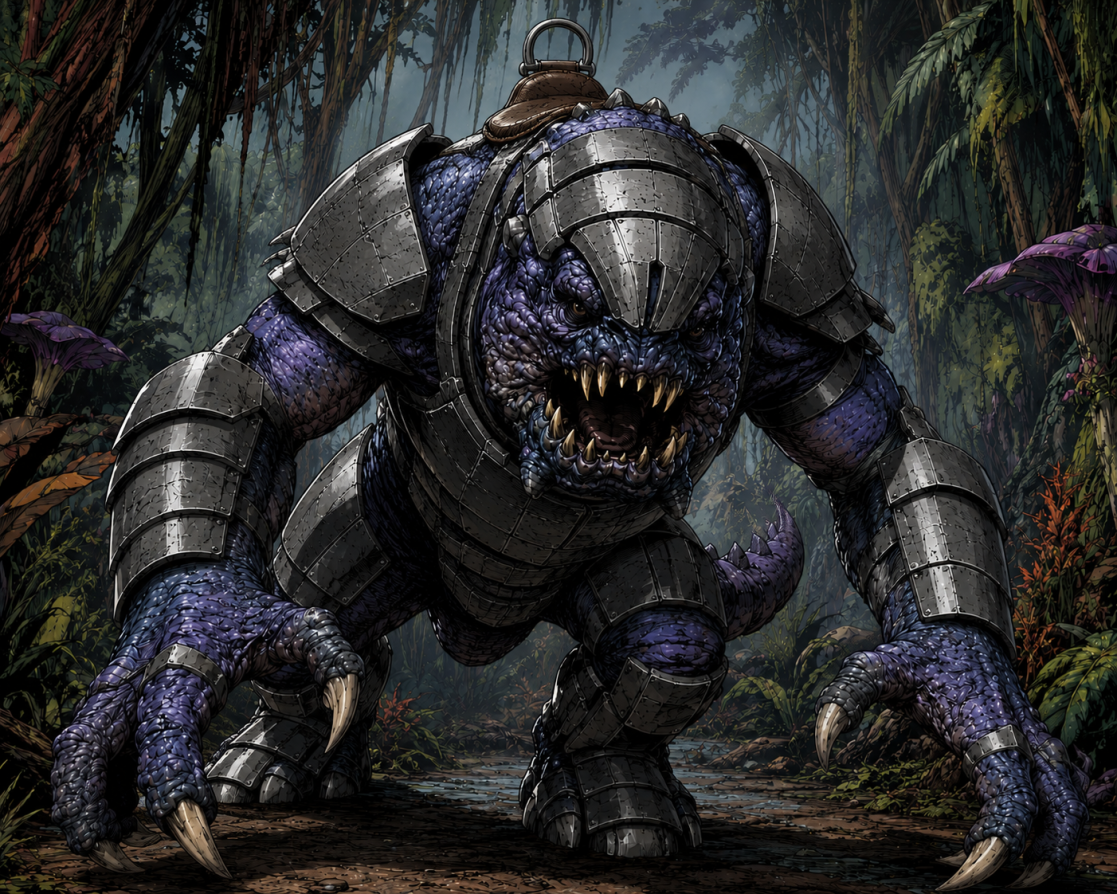

IRON COVENANT RANCOR WAR-BARDING
Heavy Battle Armor for Mandalorian War Rancors

OUT OF CHARACTER INFORMATION
Intent: To create a limited-production set of practical battle armor for Iron Covenant war rancors.
Image Source: ChatGPT
Canon Link: N/A
Permissions: N/A
Primary Source: Rancor
Manufacturer: Kyr'bes Buy'ce
Affiliation: The Iron Covenant; approved Iron Covenant beast-handlers and rancor riders
Market Status: Closed-Market
Model: Iron Covenant Sirla'gam Rancor War-Barding
Modularity: Yes. The armor is built around a core war-barding frame that can be adjusted for individual rancor size, removed in sections for treatment or transport, and fitted with mission-specific modules. Standard sets include heavy plating, spikes, Kestrisaur hide/down backing, Zûtsina Cold Steel lining, environmental sealant layers, a reinforced saddle, restraint points, and a diagnostic link. Optional modules include a kinetite impact lattice, Devaronian blood-poison crystal spike fittings, and a detachable heavy-drop grav-brake harness.
The armor does not support mounted cannons, missiles, powered limb systems, stealth systems, full flight systems, remote-control rigs, or other delicate battlefield gadgets unsuitable for a rancor.
Production: Limited
Material:
- Besk’jalya Superalloy
- Ve’vut beskar
- Gaht’yc Kuryida’edee / Kestrisaur hide and down
- Zûtsina Cold Steel
- Force-Tech Environmental Sealing Gel
- Armorweave
- Rancor leather padding
- Shock-absorbing gel layers
- Haysian Smelt wiring
- Ultrachrome micro-circuitry
- Leather, chain, and reinforced restraint hardware
- Optional: Kinetite impact components
- Optional: Devaronian blood-poison crystals
- Optional: Repulsor-brakes, gravitic dampeners, and stabilizing microthrusters
Classification: Multipurpose Beast Barding / Mounted War Harness
Weight: Very Heavy
Resistances:
- Energy: Very High
- Kinetic: Very High
- Lightsabers: Very High
- Thermal: High
- Ion/EMP: Average
- Acid/Corrosion: Average
- Sonic: Low
- Radiation: Low
- Heavy Sectional War-Plating: Starship-grade Besk’jalya plates protect the brow, crown, neck, shoulders, upper chest, forearms, spine, legs, and upper back. These sections are deliberately limited to areas where a rancor’s mass and strength can carry the extra burden without crippling mobility.
- Open-Face Head Guard: The head armor protects the brow, crown, cheeks, sides of the head, and upper snout while leaving the rancor’s eyes, mouth, lower face, jaw, and primary sensory areas unobstructed. The design protects without blinding, muzzling, or confusing the beast.
- Mandalorian Beast-Plating Profile: The barding uses thick, angular, overlapping plates inspired by heavy beskar’gam construction. The result is not a smooth shell or fitted bodysuit, but external war-plating strapped over a living beast through reinforced harness points, buckles, chains, and padded contact zones.
- Lightweight Ve’vut Reinforcement: Lighter ve’vut beskar sections reinforce articulation points, secondary plates, brow guards, claw-adjacent guards, spikes, and portions of the rider saddle where weight savings matter.
- Impact Spikes and Brow Horns: Reinforced ve’vut beskar spikes are mounted along the brow, shoulders, forearms, knuckles, and spinal ridge to enhance the rancor’s natural charges, swipes, grapples, stomps, and body-checks.
- Kestrisaur Hide and Down Backing: Layers of Kestrisaur hide are worked beneath the plates and around high-friction contact zones. Visible white and gray down sections act as padding, cold-weather insulation, and a distinctive Covenant aesthetic detail.
- Zûtsina Cold Steel Lining: Thin internal Zûtsina Cold Steel lining helps draw excess heat away from the rancor beneath the heavy barding, reducing overheating during charges, prolonged exertion, and hot battlefield conditions.
- Environmental Sealant Layers: Force-Tech Environmental Sealing Gel is applied around saddle electronics, diagnostic housings, plate seams, sensor contact points, and vulnerable internal channels to help keep out mud, water, spores, blood, dust, and battlefield grime. The gel protects the armor’s components, not the entire rancor, and does not make the barding airtight, vacuum-rated, underwater-capable, or fully environmentally sealed.
- Reinforced Rider Saddle: A built-in saddle-howdah gives one primary rider a stable mounted position with armored leg guards, grip rails, mag-lock stirrup plates, crash straps, and emergency release clamps.
- Handler Anchor Points: Heavy restraint rings, guide chains, transport locks, and harness attachment points allow the rancor to be secured, moved, treated, or restrained by trained handlers.
- Beast Diagnostic Link: Simple biometric sensors built into the saddle, girth straps, collar sections, and armor contact points can transmit the rancor’s vitals, injury warnings, heat stress, strap tension, and armor integrity to a rider’s helmet or armor HUD.
- Diagnostic De-Ion Buffer: A hardened combat de-ionizer and reserve buffer are built into the saddle diagnostic suite. The system does not prevent ion or EMP damage but can help purge residual interference and reboot the armor’s vitals link, saddle sensors, and diagnostic readouts after a disruption.
- Optional — Kinetite Impact Lattice: Ruggedized kinetite components can be built into sections of the barding expected to receive or deliver heavy impact, including the brow plate, shoulder plates, forearm guards, knuckle spikes, claw-adjacent guards, knee guards, hip guards, chest bracing, and selected spinal spike bases. The lattice absorbs and stores kinetic energy from the rancor’s movement, charges, impacts, stomps, grapples, and collisions, allowing a trained rider to release that stored force through specific striking zones at the proper moment.
- Optional — Devaronian Blood-Poison Crystal Spike Matrix: Selected ve’vut beskar spikes, brow horns, knuckle guards, and shoulder spurs can be set with Devaronian blood-poison crystals or crystal-lined cutting channels. These crystals give the spikes their blood-poisoning quality, causing severe pain when they cut, puncture, or become embedded in living tissue.
- Optional — Heavy-Drop Grav-Brake Harness: Select barding sets can be fitted with a detachable grav-brake and repulsor descent harness for ship-to-ground deployment. The system uses ruggedized gravitic dampeners, repulsor-brakes, and short-burst stabilizing microthrusters to slow a controlled fall from low-altitude drops, allowing armored rancors to be deployed without requiring a full landing zone.
- No Direct Control Interface: The diagnostic link monitors the beast but does not pilot it, override its instincts, replace training, or give the rider remote control over the rancor.
- Built for What Rancors Already Do: The barding does not try to turn a rancor into a tank, walker, or gun platform. It reinforces the beast’s natural strengths: charging, crushing, grappling, clawing, biting, and smashing through obstacles.
- Starship-Grade Impact Plates: Besk’jalya armor sections provide far greater protection than ordinary durasteel barding, especially against heavy impacts, debris, slugs, explosions, and concentrated battlefield punishment.
- Excellent Kinetic Protection: The armor is especially strong against impacts, slugs, debris, trampling damage, blunt trauma, and melee punishment, making it useful for a creature expected to physically crash into enemy lines.
- Strong Blaster Resistance: Heavy plates, layered padding, and ve’vut beskar reinforcement provide very strong protection against battlefield small arms and glancing blaster fire.
- Strong Lightsaber Resistance: Besk’jalya plating and ve’vut beskar reinforcement allow the armor to resist glancing lightsaber strikes, brief contact, and imperfect cuts far better than conventional beast barding.
- Spiked Momentum: Shoulder, brow, forearm, knuckle, and spinal spikes make the rancor even more dangerous when it charges, swipes, pins, grapples, or body-checks opponents and obstacles.
- Thermal Regulation: Kestrisaur down and Zûtsina Cold Steel lining help keep the rancor from freezing in hostile cold climates or overheating too quickly under heavy armor.
- Mission-Tailored Brutality: The barding can be fielded as simple armored plating or upgraded with optional melee and deployment modules. A calmer transport beast may only need plating and diagnostics, while an elite assault mount may carry kinetite impact zones, blood-poison crystal spikes, or a heavy-drop harness.
- Stored-Impact Brutality: The optional kinetite lattice allows the barding to store force from the rancor’s own movement and release it through impact zones, making already devastating strikes far more destructive when rider and mount are properly synchronized.
- Blood-Poisoned Spikes: Optional Devaronian blood-poison crystals set into the spikes and horns make puncture wounds especially punishing against living targets, adding crippling pain to the rancor’s natural ability to maul, gore, pin, and crush.
- Mounted Combat Ready: The saddle-howdah gives a Mandalorian rider a practical, secure fighting position without needing to install weapons that the rancor itself cannot use.
- Rider Awareness: The diagnostic link lets the rider know when the rancor is overheating, bleeding, panicking, injured, exhausted, or suffering armor failure before the beast becomes uncontrollable.
- Recoverable Armor Link: Ion and EMP attacks can still knock out the diagnostic systems, but the de-ion buffer gives the rider a chance to recover the vitals link and armor readouts instead of losing them for the entire engagement.
- No Landing Zone Needed: The optional heavy-drop harness allows Covenant ships to deploy armored rancors into rough terrain, battlefield openings, jungle clearings, siege zones, or forward assault areas without fully landing.
- Very Heavy: Even with lighter ve’vut beskar sections, the Besk’jalya plates make the armor massive. Prolonged use can potentially cause fatigue, overheating, reduced agility, and increased strain during long marches or extended combat.
- Moderated Starship Armor: Besk’jalya is used in moderation, not as full-body coverage. The rancor is strong enough to carry key plates, but it cannot wear a starship hull over its entire body without losing mobility.
- Incomplete Coverage: To preserve movement and prevent overheating, the armor does not fully enclose the rancor. Eyes, mouth, hands, feet, joints, underbelly, inner limbs, and sections of hide remain exposed.
- Not Environmentally Sealed: The barding protects armor components from grime and weather, but it does not seal the rancor itself. Vacuum, drowning, toxic atmospheres, hard radiation, extreme pressure, chemical clouds, and hostile environments can still harm or kill the beast.
- Poor Sonic Protection: The armor offers little help against sonic weapons, pain frequencies, disorientation pulses, and other attacks that target the rancor’s senses or nervous system.
- Average Ion/EMP Resistance: The diagnostic link is hardened, but the armor still takes ion and EMP hits like normal. A strong enough disruption can disable sensors, garble vitals, interrupt saddle readouts, and force the rider to rely on instinct and visual checks until the system reboots.
- De-Ionizer Is Recovery, Not Immunity: The combat de-ionizer helps restore the armor link after interference, but it does not block the initial hit, protect other electronics nearby, or guarantee instant recovery under repeated ion/EMP attacks.
- No Behavioral Override: The armor cannot control the rancor. A panicked, enraged, wounded, starving, or poorly trained rancor remains dangerous to enemies and allies alike.
- Requires Coordination: The optional kinetite lattice is only truly devastating when rider and rancor are synchronized. A poorly trained rider, panicked mount, disrupted saddle link, or mistimed release can waste the stored energy or even throw off the beast’s balance.
- Conditioning Required: Rancors must be trained not to panic, buck, or frenzy when the kinetite discharges or the heavy-drop harness activates. An untrained or newly equipped rancor may react violently to the sound, shock, vibration, or pressure of these systems.
- Impact and Motion Dependent: The kinetite lattice needs kinetic energy to absorb and store. If the rancor is restrained, bogged down, stunned, trapped, exhausted, or unable to build momentum, the system becomes far less useful.
- Not a Ranged Weapon: The stored force is released through contact and near-contact impact zones. It cannot replace artillery, missiles, cannons, or ranged shockwave projectors.
- Crystals Need Contact: Devaronian blood-poison crystals only matter if the spike cuts, punctures, scrapes, or embeds into a living target. Sealed armor, droids, vehicles, thick plating, heavy hide, or rapid treatment can reduce the effect.
- Drop Only: The heavy-drop harness is designed for descent, not flight. Once the rancor is on the ground, the harness is dead weight unless detached or jettisoned.
- Low-Altitude Requirement: The heavy-drop harness is not designed for orbital drops or high-atmosphere insertion. Extreme altitude, heavy anti-air fire, turbulence, or system damage can still turn deployment into a fatal fall.
- Large Target During Descent: A descending armored rancor is very visible and not especially agile. Anti-air weapons, heavy repeaters, missiles, flak, and tractor systems can threaten it before landing.
- More Modules, More Problems: Optional systems increase maintenance, training demands, risk, and handler workload. A rancor carrying kinetite impact nodes, blood-poison crystal spikes, and a heavy-drop harness is more dangerous, but also harder to transport, control, clean, repair, and safely approach.
- Transport Burden: Armored rancors require specialized loading frames, reinforced transports, heavy restraint systems, and handlers familiar with both the beast and the armor.
- Maintenance Intensive: After combat, the armor often needs plate realignment, strap replacement, spike repair, sensor recalibration, cleaning, and checks for wounds hidden beneath the padding.
The Iron Covenant Rancor War-Barding was developed after Covenant beast-handlers began adapting captured war rancors for battlefield use. A rancor did not need a complex weapons suite, powered armor, stealth coating, missile launcher, or delicate battlefield gadgetry. It needed protection where enemy fire was most likely to strike, reinforcement where its body already caused the most destruction, and a secure place for a Mandalorian rider to stay mounted while the beast did what rancors naturally do.
The resulting armor is intentionally practical. Heavy Besk’jalya plates protect the brow, neck, shoulders, chest, forearms, spine, and upper back, but only in sections the rancor can realistically carry without being slowed into uselessness. Lighter ve’vut beskar is used for secondary reinforcement, articulation guards, spikes, brow horns, and saddle protection, giving the barding a distinctive contrast between darker starship-grade armor and brighter Mandalorian metal.
The plating is deliberately shaped to resemble oversized Mandalorian armor rather than a vehicle shell or creature exoskeleton. Broad pauldrons, layered bracers, angular breast plates, reinforced ridge guards, and heavy segmented panels are strapped over the rancor’s body using beast-scale harnessing. The result is unmistakably armor worn by a living creature: protective, brutal, and modular, but still dependent on the rancor’s own body beneath it.
The head guard is deliberately open-faced. A rancor cannot fight effectively if it cannot see, bite, roar, smell, or use its jaws. Instead of enclosing the face, the armor protects the brow, crown, cheeks, sides of the head, and upper snout, leaving the eyes, mouth, lower jaw, and primary sensory areas free. The rancor remains the weapon. The armor simply helps keep that weapon alive.
Beneath the metal, layered Kestrisaur hide gives the barding a distinctly Covenant character. White and gray down can be intentionally left visible along some padded seams and collar sections, both as insulation and as an optional visual reminder of the armor’s Kestri origin. Zûtsina Cold Steel lining is worked into the inner armor frame and thermal-contact points, helping the rancor endure hot climates while also bleeding off excess heat during charges, prolonged movement, and heavy combat. The system is not a climate-control miracle; it simply makes a very heavy suit of monster armor less punishing for the monster wearing it.
The integrated saddle-howdah is the most refined part of the design. It gives a primary rider a protected mounted position with grip rails, mag-lock stirrup plates, leg guards, crash straps, and emergency releases. This allows a Mandalorian rider to guide the beast, fire personal weapons, coordinate with nearby infantry, or dismount quickly if the rancor becomes uncontrollable.
The diagnostic suite is similarly practical rather than miraculous. Haysian Smelt wiring, Ultrachrome micro-circuitry, and a combat de-ion buffer allow the saddle link to monitor vitals, strap tension, heat stress, injury warnings, and armor integrity. Ion or EMP attacks can still knock the system offline, but the buffer gives the rider a chance to recover the link after the hit instead of permanently losing the armor’s readouts.
The optional melee systems are deliberately simple and physical. The Kinetite Impact Lattice stores force from the rancor’s own movement and releases it through impact zones when rider and mount are properly synchronized. Devaronian blood-poison crystal fittings make selected spikes and horns nastier against living targets. Neither system turns the rancor into a gun platform. They only make its natural violence worse.
For battlefield deployment, some sets can accept a detachable heavy-drop grav-brake harness. This does not make the rancor airborne cavalry. It does not let the beast fly, hover, or maneuver like a jetpack warrior. Instead, it allows a ship, gunship, dropship, or assault transport to release the rancor from low altitude while gravitic dampeners, repulsor-brakes, and stabilizing microthrusters bleed off enough speed to keep the landing survivable.
Not every rancor receives every module. Some beasts are too easily agitated for kinetite discharges. Some missions do not justify blood-poison crystal fittings. Some deployments happen from the ground and do not require the heavy-drop harness. The armor’s greatest advantage is that it can be fitted to the beast, rider, and mission rather than forcing every rancor into the same configuration.
In Iron Covenant service, the barding is used by armored battle rancors assigned to trained handlers, mounted shock cavalry formations, siege assaults, intimidation deployments, and elite beast-riding Mandalorians. It is expensive, cumbersome, and difficult to maintain, but when used correctly, it turns an already terrifying creature into a living battering ram clad in Mandalorian steel.
The name Sirla'gam comes from Sirla'a, a Kestri Covenant slang-shortening of asalaramir, used by Covenant beast-handlers for rancors and other massive war-beasts. In practice, Sirla'gam became workshop shorthand for "rancor armor" or "beast war-gear."

Out Of Character Info
Intent:
To create a limited-production set of practical battle armor for Iron Covenant war rancors.
Permissions:
N/A
Primary Source(s):
Technical Information
Affiliation:
Iron Covenant Rancor Riders
Model:
Rancor War-Barding
Modular:
Yes
Material:
Listed
Classification:
Multipurpose
Defense Rating:
Very High
Energy Resist:
Very High
Kinetic Resist:
Very High
Sonic Resist:
Very High
Thermal Resist:
High
Radiation Resist:
Low