
Admiral Burtch
Newly Reinstated Admiral




- IMAGES
-
- OUT OF CHARACTER INFORMATION
-
- PRODUCT INFORMATION
-
- Manufacturer: Dornean Braha'ket Fleetworks Conglomerate
- Affiliation:
- Mahporeem Imperial Marines
- Market Status: Closed-Market
- Model: Angel Feather Shard Emitter
- Modularity: Yes. Not quite as modular as the previous versions, as the shards themselves are more fluidly configurable in their normal mode. But the system still has a toggleable reentry mode as a holdover from the original version.
- Production: Mass-Produced
- Material:
- Plastoid Casing
- Dedicated Power Core
- S.W.O.R.D.-F.I.H.S. software
- Complex Gravity Refraction Modulator Matrix
- Dedicated Complex Repulsor Matrix
- Dedicated Complex Shield Projection Matrix
- GPO-13 TPS & R.A.C.E.R. security
- TECHNICAL SPECIFICATIONS
-
-
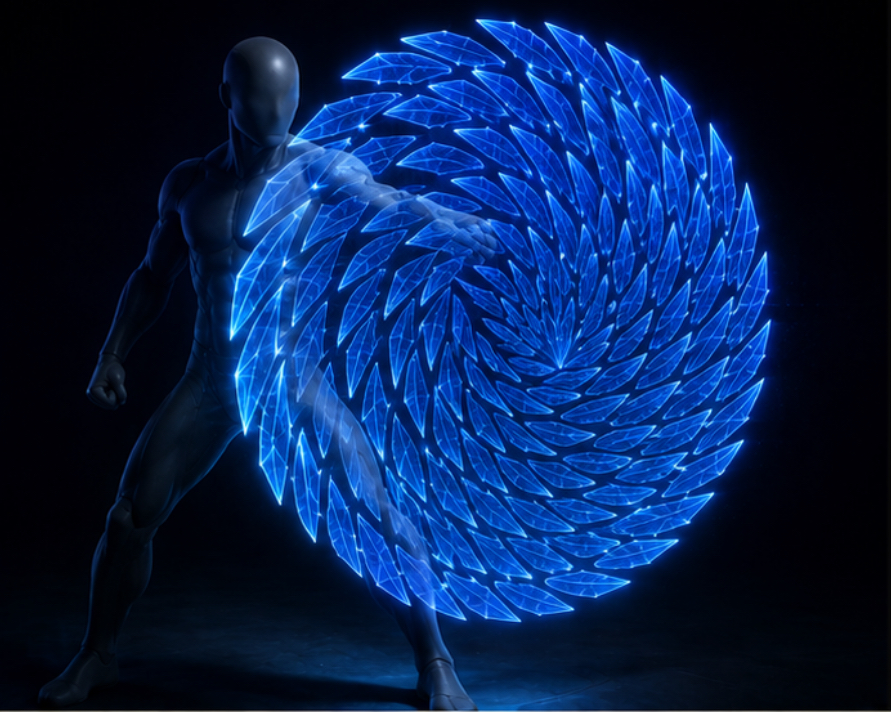

- Classification: Multirole shield configurations for reentry and combat protection.
- Weight: Light
- Resistances:
Resistance
TypeFeather Shard
ModeReentry
ModeRadiationLowHighEnergyVery HighLowKineticVery HighVery HighSonicVery HighVery HighIon/EMPVery HighHighExtreme
TemperaturesLowVery HighThe ForceHighNoneLightsabersHighNoneAcidHighNone
-
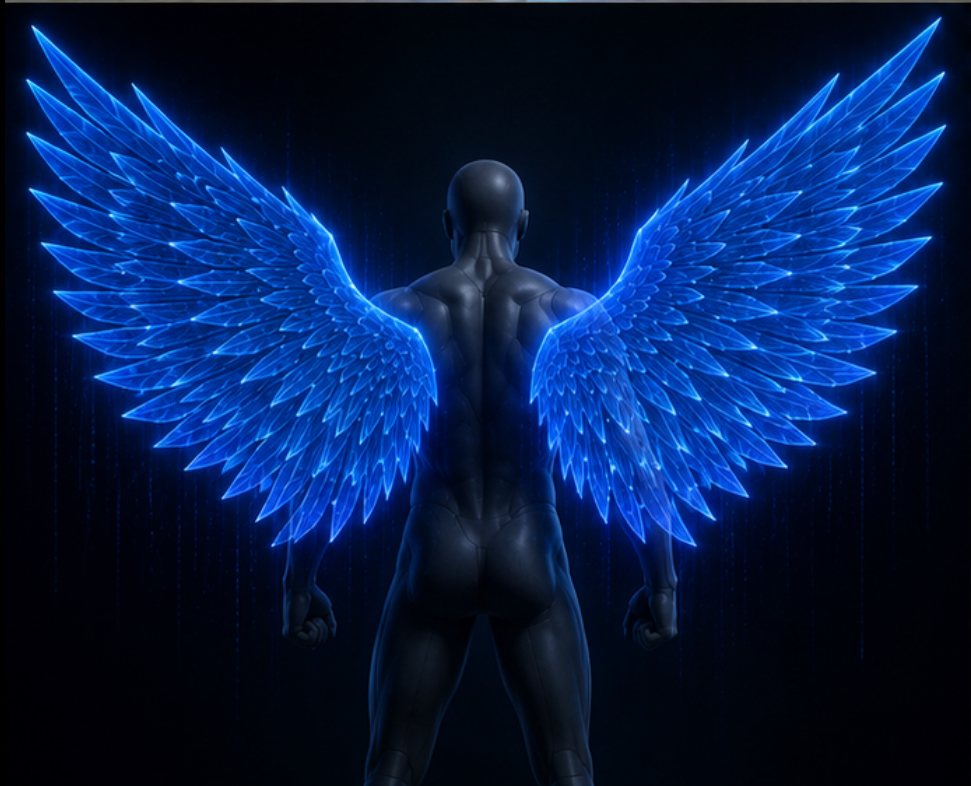
- Classification: Repulsorlift-Powered Wing configuration
- Role: Personal Flight Pack
- Size: Small, compared to a flight pack of a similar class, like a jetpack.
- Weight: Light again, compared to a flight pack of a similar class, like a jetpack.
- Armaments: Low (in flight mode)
- When being used for flight, most of the available feather shards are required to make up the wings. However, if the user is skilled enough, a relatively small detachment of shards can be retasked for short-ranged attacks without sacrificing too much flight capability.
- Defenses: Very Low (in flight mode)
- Same as with the armament rating, most of the shards must be dedicated to the wings to maintain flight when this system is used in this configuration. However, if the user is talented enough, a small detachment of shards can be retasked to provide meager protection from projectile attacks at the cost of some degree of flight performance. However, coverage in this case is scant at best.
- Maneuverability Rating: The shards in the wings are imbued with repulsorlift modulation, which gives them excellent maneuverability inside a gravity well. Furthermore, with practice, the wings articulate as control surfaces in atmosphere to achieve even greater agility.
- In a vacuum: High
- In Atmosphere: Very High
- Speed Rating: Very High. As with the maneuverability rating, the wings emit repulsorlift energy to generate thrust, which provides excellent speed in a gravity well. Furthermore, with an experienced user, the wings can articulate to "flap" which can be used to generate even more acceleration in an atmospheric environment.
- Propulsion:
- Repulsorlifts
- Wing flapping
- Minimum Crew: 1
- Optimal Crew: 1
- Passenger Capacity: possibly 1, but the user has to carry them
- Cargo Capacity: Very Small, whatever the user can personally carry.
-
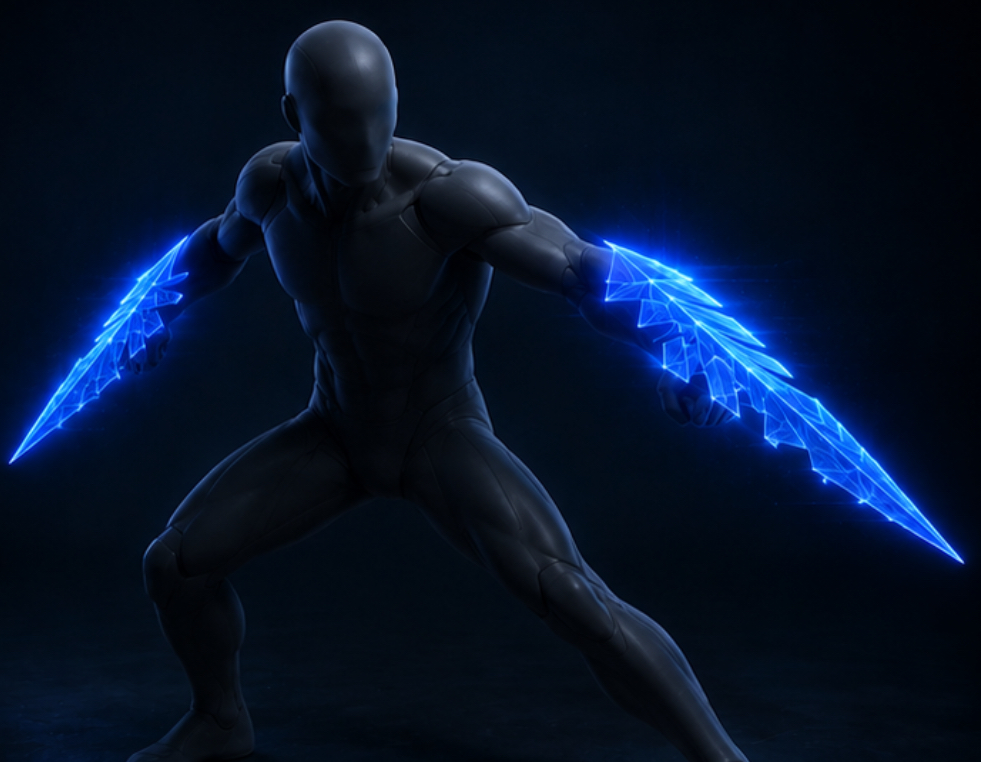
- Classification: Forearm Blade Configuration
- Size: Average
- Weight: Very Light
- Damage Type:
- Razor-sharp edge
- With extensive practice and training, the wielder can often focus the edge to a sub-mono-molecular edge, sharp enough to commonly slice through the likes of beskar steel.
-
*It takes some time for a user to become skilled enough to use this configuration- Classification: Hard-Edged Energy Shard Swarm Attack Configuration
- Size: Average
- Weight: Average
- Ammunition Type: Hard-edged Shield Shards, with sub-molecular edge sharpness. Sharper than mono-molecular edges, being honed to the atomic level.
- Ammunition Capacity: High, 200 shield shards
- Effective Range: Personal, about 50 meters
- Rate of Fire: Very High, shield shards can be produced out of the gloves at a very fast rate.
- Damage Output: Very High, shield shards have a sub-molecular hard edge that is often capable of cutting cleanly through the likes of Beskar Steel.
- Recoil: Average
-
- SPECIAL FEATURES
-
Shield Shard Mode
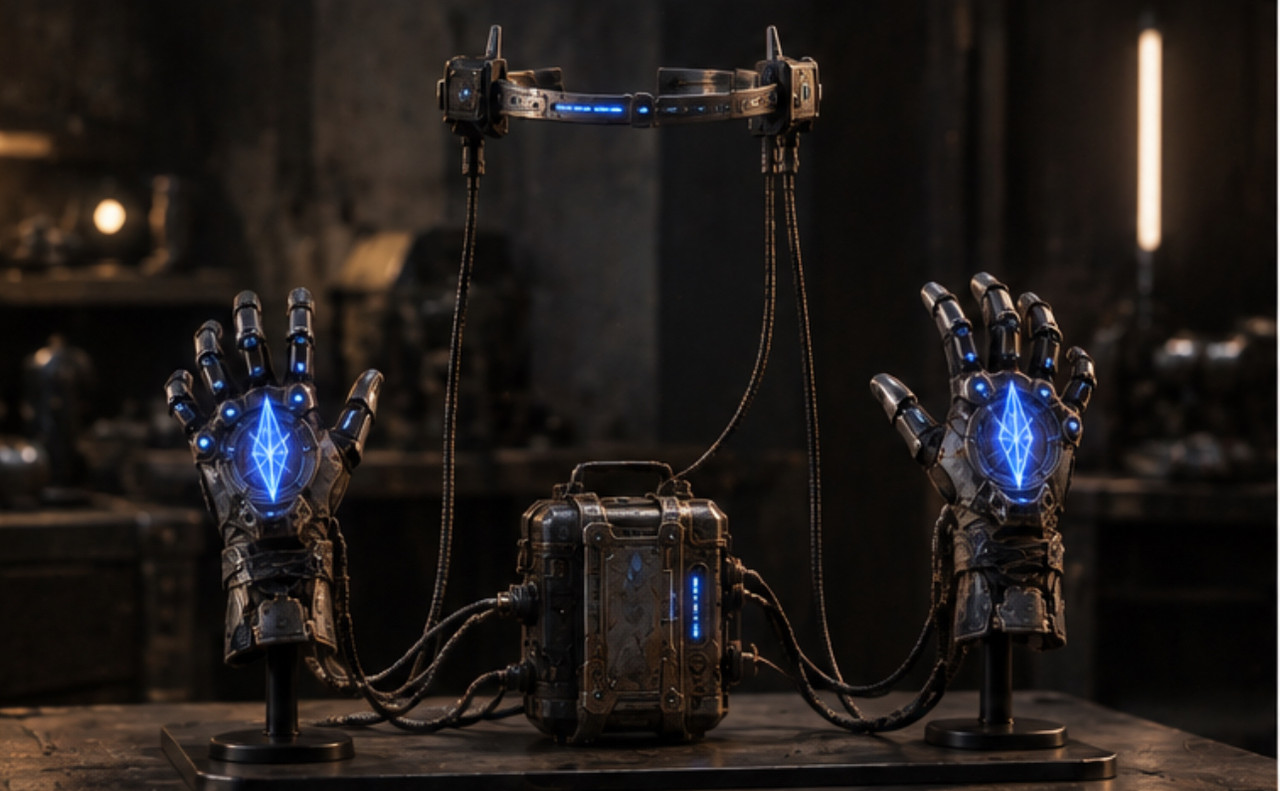
200 shield shards are generated and emitted from the gloves and then controlled by the user via a Neural Interface Device.
Skill Progression
The skill of the user will greatly determine how versatile the shield system can be. As the user gains more experience with the device, more features are unlocked. The user typically starts with the pre-programmed shard configurations and gradually progresses towards more freestyle applications:
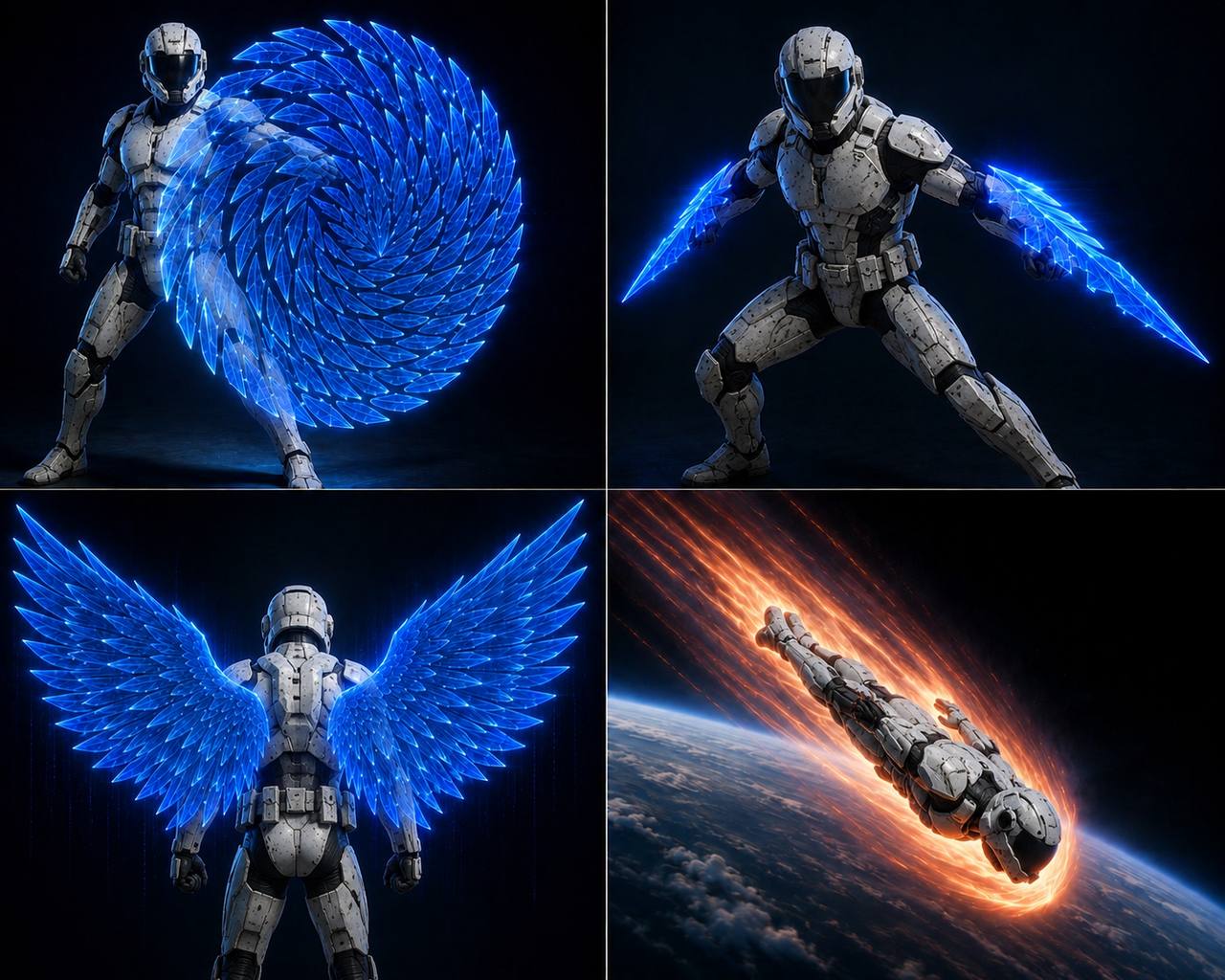
- Pre-programmed Configuration Mode - At first, the hundreds of shards can be easily assembled into pre-programmed configurations. These configurations require little in the way of focus from the user. Such configurations include:
- Flight mode
- Forearm blade mode
- Shield mode
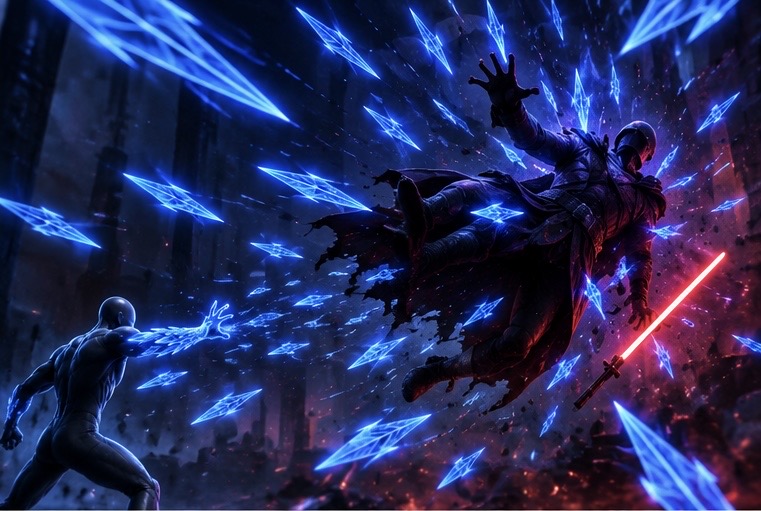
- Freestyle Control Mode - with a high degree of focus and skill, the user can task the shards to move in whatever way the user chooses… provided that the user has the skill to do so. In particular, using the shield shards for a ranged attack requires significant proficiency with freestyle control mode.
A holdover from the original version. This mode reroutes power from the primary shard emitters and into separate capacitors and fuses which are designed to protect the wearer from the hazards of atmospheric entry. This mode renders the wearer entirely immobile while the cycle runs to completion and burns out the reentry fuses. Once those fuses are burnt out and reentry velocity has reduced to safe levels, the power is rerouted back to the primary shard emitters for full combat functionality.
- STRENGTHS AND WEAKNESSES
-
STRENGTHSWEAKNESSESPhalanx – The shield configuration creates a barrier of shards that protects the user from harm Shard-By-Shard Erosion – as the shards lose power, they begin to disappear. The less power this system has remaining, the fewer shards are available to be used. De-orbital Entry – the reentry mode, followed up by the flight configuration allows the user to travel "safely" from the void of low orbit to a planet's surface. Temporary Coffin – atmospheric entry mode locks all limbs and extremities from movement for the sake of the user's safety. This is done to prevent the kinetic forces of atmospheric entry from causing serious trauma to joints and limbs "It's A Bird…" – with the shards arranged in the wing configuration, this system can achieve flight with incredible performance capabilities. Additionally, if the user becomes sufficiently skilled with this system, lesser performance flight capabilities can be achieved in the other modes as well. Exposure While Flying – when the shards are arranged in the wing configuration, little-to-no spare shards are available to be detached for other tasks. Even in the hands of an advanced user, detaching too many shards for offence or defence reduces flight performance drastically. Close Encounters – for close range combat, the shards can be arranged quite easily into a twin forearm blade configuration. This mode becomes sharper and more powerful as the user becomes more practiced in controlling the weapon, and can even become sharp enough to commonly cut through Beskar steel. Arc Limited – the shard emitters can only produce up to 200 shards when operating at full power. This is not enough for the user to wrap themselves in a full 360° cocoon, and therefore must form a shield which must be aimed. Meat Grinder – as the user becomes more familiar with the neural interface controls, they begin to unlock freestyle control mode. In this mode, the shards can be deployed in a saturating swarm attack to overwhelm enemies from all sides at once. Swim Out Too Far – repulsorlifts – or "antigrav generators" – are a key component of this design, which rely on nearby gravity fields in order to function. While the gravity refraction modules can focus and intensify local gravity fields around the shards to extend their operational range into deep space, there is still a limit to how far one can go into deep space before the shards no longer function. Level Up – as the user gains experience with this device and the neural interface, features will unlock and existing configurations will become more powerful (see skill progression for more information) Learning Curve – because the neural interface is analog based, many of the advanced features of this device are very difficult to master. While the three main pre-programmed configurations are easy to use, the user needs to practice and gain experience in order to gain proficiency with any applications that fall outside of those three modes or their basic capabilities. (see skill progression for more information) Outfit Integration – The emitter can indeed be worn as independent gear. However, the key components can also be broken down and seamlessly integrated into armor and "casual" outfits. Not a Lightsaber – Like a lightsaber, the blade configuration is an energy-based construct projected from an emitter device. However, that is where the similarities end. The blade does not burn or reflect blaster bolts. It does not have a circular cross-section that can cut in any direction and must be angled properly in order to penetrate whatever it is being used to cut.
______________________________________________________________________
- DESCRIPTION
-
-
The technology that would eventually become the Angel Feather Shard Emitter did not begin on Dornea. Its earliest ancestor was the Fallen Angel Reentry Shield, developed by Dar'Manda Industries as a compact defensive system capable of reconfiguring a projected energy barrier for several different purposes. Rather than burdening a soldier with separate equipment for personal defence, atmospheric entry, aerial descent, and close combat, the Fallen Angel consolidated these roles into a single adaptable projector. It was an unusually versatile concept, though still fundamentally limited by the technology of its time: regardless of its shape, the projected field remained one continuous construct performing one task at a time.
The design eventually found its way into Dornean hands during the long period of displacement and technological reconstruction that followed the destruction wrought by the Bryn'adûl. Dornean engineers had always favoured equipment that could survive changing environments and serve several purposes aboard ships, underwater, and in the field, making the Fallen Angel particularly attractive. The resulting Mk2 was less a reinvention than a careful modernization. Materials, power management, and defensive performance were improved while the underlying philosophy of the original was preserved. For a people rebuilding a military-industrial base while scattered among foreign allies and refugee populations, improving something that already worked was considerably more practical than replacing it simply for the sake of novelty.
The breakthrough that ultimately separated the Angel Feather from its predecessors came through the Dorneans' renewed relationship with Mahporeem. The two peoples already possessed an unusually tangled history. Dorneans had once fought alongside the Mahporeem against Imperial domination, while figures such as Nezu Du'mas became intertwined with both worlds' histories. Generations later, that connection survived in Jord Du'mas: Nezu's descendant, born on Mahporeem rather than Dornea and considerably more comfortable among the junkyards, workshops, and peculiar engineering culture of his homeworld than among the institutions of his ancestors.
Jord's involvement began with a deceptively simple criticism of the Fallen Angel concept. To him, the problem was not that the shield lacked enough configurations; the problem was that it had to have configurations at all. The projector could create wings, a shield, or blades, but only by reshaping essentially the same monolithic construct. Mahporeem engineering offered another way of looking at the problem. Rather than asking a single projector to continually redefine one complicated field, Jord proposed dividing that field into a large number of much simpler, independently maintained projections. Individually they accomplished very little. Collectively, however, they could be arranged into whatever structure their operator required.
The proposal proved particularly well suited to Dornean engineering philosophy. Dornean Braha'ket Fleetworks engineers developed the concept into an array of two hundred angular energy shards, while Jord remained involved in solving the considerably uglier problem of making two hundred independently mobile objects behave like one piece of equipment. The familiar shapes of the Fallen Angel were deliberately retained during development: its circular shield became an interlocking formation of shards, its blades became tightly compressed cutting formations, and its old gliding surfaces became articulated wings. What had previously been four mechanically distinct operating modes were gradually reduced to different arrangements of the same basic components.
This collaboration also produced an unexpected reversal in the relationship between Dornea and Mahporeem. For generations, the Du'mas name had represented Dorneans involving themselves in Mahporeem's affairs—sometimes heroically, sometimes inconveniently, and often without being asked. With the Angel Feather project, a Mahporeem-born Du'mas instead brought something home to Dornea. Jord never regarded the project with quite that degree of sentimentality, but Dornean engineers were not entirely blind to the irony.
The finished Angel Feather Shard Emitter consequently bears surprisingly little mechanical resemblance to the Fallen Angel systems from which it descends, despite performing many of the same functions. Its lineage survives primarily in purpose rather than construction. What began as a shield capable of becoming several different tools evolved into a collection of simple projected components capable of becoming a shield, wings, weapons—or potentially something its original designers never thought to give it a name for.
-
The Angel Feather system is built around three interdependent technologies: shield projection, repulsorlift manipulation, and gravity refraction. None of these systems alone is responsible for the behaviour of a feather shard. Instead, each shard is effectively the point at which all three systems intersect.
At the most basic level, the dedicated shield projection matrix generates the physical energy construct that forms each feather. Unlike a conventional shield generator producing one large continuous barrier, the matrix divides its output between as many as two hundred discrete hard-edged projections. Power can be distributed differently between these projections, allowing individual shards to be strengthened, weakened, dismissed, regenerated, or compressed together into larger structures. This is why the system gradually loses available feathers as its power supply is depleted rather than simply producing one progressively weaker shield.
The repulsor matrix provides those otherwise stationary projections with mobility. A modified implementation of S.W.O.R.D.-F.I.H.S. continuously couples repulsorlift energy into the projected shield structures, adapting the same principle previously used to reinforce shields with repulsor energy. In this application, however, the relationship is taken considerably further: each feather becomes an individually addressable repulsorlift-bearing shield construct. Changing the direction and intensity of that repulsor field allows a feather to accelerate, brake, hover, or resist displacement while remaining tethered to the emitter system. This interaction between shield and repulsor energy also contributes substantially to the shards' unusual resistance to kinetic forces. (Star Wars Roleplay: Chaos)
Repulsorlifts, however, remain dependent upon an external gravitational environment. A matrix of Dornean Gravity Refraction Modules therefore surrounds the repulsor system. These modules do not replace the repulsorlifts or independently propel the shards. Instead, they bend, concentrate, and redirect the gravitational gradients against which the repulsors operate. This serves two purposes. First, concentrating an available gravity field allows the repulsors to remain useful farther from a substantial gravity source than they ordinarily would. Second, extremely fine modulation of those gradients gives the system much greater directional control over each feather. A repulsor supplies the force; the refraction matrix effectively shapes the gravitational surface against which that force acts. (Star Wars Roleplay: Chaos)
This relationship is also responsible for much of the Angel Feather's extraordinary articulation. Movement is not accomplished by issuing a succession of digital commands telling a shard to occupy predetermined coordinates. Instead, the neural interface feeds the user's intended movement into an analogue control circuit, which continuously varies repulsor intensity and the surrounding gravitational gradients. Consequently, a feather does not simply move from point A to point B; its trajectory can be continuously curved, arrested, redirected, or blended into the motion of neighbouring feathers. Hundreds of tiny adjustments occur as continuous changes in field strength rather than discrete digital instructions. This produces the fluid behaviour necessary for articulated wings, moving shield formations, blade shaping, and eventually free-moving swarms.
Digital software instead occupies a supervisory role. S.W.O.R.D.-F.I.H.S. maintains the underlying shield/repulsor interaction, while pre-programmed configurations provide beginners with stable templates for common formations such as wings, shields, and forearm blades. These templates establish the approximate power distribution and geometry required for the desired configuration, leaving comparatively little for an inexperienced user to consciously manage. As proficiency increases, the user progressively overrides those templates with analogue neural control, eventually treating individual feathers—or groups of feathers—as naturally as additional limbs. This is why advanced capabilities cannot simply be "unlocked" through software: the limiting component eventually becomes the operator's ability to conceptualize and continuously control the formation.
The distinction becomes particularly apparent in flight. In wing configuration, most available shards are assembled into two broad articulated surfaces while their coupled repulsors provide the majority of lift and propulsion. Within a gravity well, the refraction matrix continually concentrates and redirects the local gravitational field to improve repulsor authority. In atmosphere, the operator can additionally articulate the feathers themselves into changing aerodynamic surfaces. An experienced user can therefore bank, twist, feather, or even "flap" the wings, combining repulsorlift propulsion with conventional aerodynamic forces. The same principle permits limited flight assistance in other configurations once the user becomes sufficiently proficient, although dispersing the feathers between several jobs necessarily reduces the amount of repulsorlift authority available for flight.
Blade and ranged configurations exploit the same architecture differently. Rather than distributing shield energy across a broad defensive surface, feathers can be overlapped and progressively compressed along a narrow plane. Increasingly precise analogue control allows that boundary to be focused from an ordinary razor-like edge toward molecular and eventually atomic scales. Freestyle ranged attacks simply remove the requirement that those sharpened projections remain assembled around the wearer's arms: repulsor force accelerates them outward while gravity refraction continuously alters their trajectories. Their approximately fifty-metre practical combat radius is therefore not an arbitrary communications limit, but the point at which maintaining useful shield intensity, repulsor authority, gravity-field manipulation, and precise neural control over a dispersed swarm becomes increasingly impractical.
Finally, the GPO-13 Threat Prevention Suite and R.A.C.E.R. protect the digital portions of this architecture rather than replacing its analogue control pathway. Threat-prevention software guards the system against hostile intrusion, while R.A.C.E.R. forces interconnected subsystems to cross-audit one another and restore corrupted components toward known-good states. This is particularly important in a device whose shield, repulsor, gravity, power-management, and neural-interface systems must constantly cooperate. A corrupted subsystem can therefore be identified and isolated without giving cybersecurity software direct authority over the user's moment-to-moment feather movements. (Star Wars Roleplay: Chaos)
The result is consequently not a swarm of miniature autonomous drones. There are no machines inside the feathers at all. Each feather is a projected shield construct carrying repulsorlift energy and moving within a deliberately manipulated gravitational environment. The hardware provides the force, the software keeps the machinery cooperating, and the neural interface supplies the finesse. At low proficiency the machine does most of the organizational work for its operator; at high proficiency, the machine increasingly becomes an extension of them.
-
- RECOMMENDED SKILL PROGRESSION
-
_____________________________________________________________________________________________________________________________________Threads completed 012345Features Unlocked - Fixed-wings flight mode
- Razor-sharp forearm blade mode
- Circular shield
- Forearm blades can become sharper than monomolecular edges, sharp enough to commonly cut through the likes of Beskar steel
- Wings can now articulate at the command of the user, providing greater agility and acceleration.
- User becomes skilled enough to use "freestyle mode" allowing for ranged swarm attacks, and custom shapes or actions.
- User becomes skilled enough to use Hybrid modes, attacking while flying, or using shield and blade at the same time, etc.
- User gains enough skill to be able to use limited flight or jump assistance when in modes other than wing configuration. Wing configuration still has the best performance, of course.
Out Of Character Info
Intent:
To create the next evolution of the Fallen Angel Shield System
Permissions:
n/a
Technical Information
Affiliation:
See main body
Modular:
Yes
Material:
See main body