

Architect




WINDSOR II-CLASS, MEDICAL STATION
REGIONAL HOSPITAL HUB
REGIONAL HOSPITAL HUB
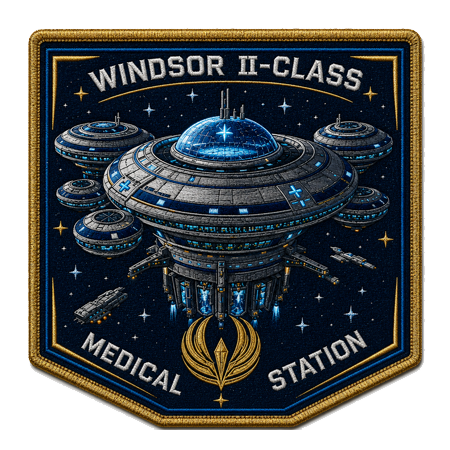
OUT OF CHARACTER INFORMATION
- Intent: To create a semi-unique medical station for the Imperial Commonwealth of Dosuun — a modern Commonwealth successor to the legacy Windsor-class medical station.
- Image Source: ChatGPT, Midjourney, DeviantArt
- Canon Link: N/A
- Permissions: Solarium Glasteel
- Primary Source: Windsor-class, Medical Station | Galidraan III-class, Space Station | Stargazer II-class, Research Station
- Manufacturer: Primo Victorian Shipwright
- Affiliation: Imperial Commonwealth of Dosuun
- Market Status: Closed-Market
- Modularity: No
- Model: VAIMC-WMS / Windsor-class MKII
- Production: Semi-Unique (5 active, 1 under construction)
- DCHS DERZELAS | REGISTERED ICDMH DERZELAS 01
- ———————————————————
- DCHS HAVEN | REGISTERED ICDMH: HAVEN 02
- DCHS LANTERN | REGISTERED ICDMH: LANTERN 03
- DCHS SANCTUARY | REGISTERED ICDMH: SANCTUARY 04
- DCHS SOLACE | REGISTERED ICDMH: SOLACE 05
- DCHS MERCY | REGISTERED ICDMH: MERCY 06
- DCHS KENDEIGH | REGISTERED ICDMH: KENDEIGH 07 (under construction)
- Material:
- Durasteel Reinforced Crystalamnium Hull
- Reinforced Duraplast with Latticed Crystaplast Liner
- Gravmire Gel Liner Reinforcement
- Alusteel Reinforced Durasteel Hull [Interior]
- Tunqstoid Blast Doors, Turadium Blast Shields [Interior — surgical suites, ICU, reactor]
- Solarium Glasteel Viewports [Overlay]
- Glasteel Viewports [Underlay], Turadium Blast Shutters
- Agrinium [Radiation Shielding — wards, nurseries, cryo]
- Hekakles-type + Judicant Composite [Composite Hull System + Force Resistance & EMP-Resistance]
- Classification: Medical Station | Regional Hospital & Casualty-Reception Hub
- Length: 3,200m
- Width: 3,200m
- Height: 3,600m
- Armament: Very Low — purely defensive point-defense; no offensive layer
- 72x Ironfang-type Rotary Hypervelocity Cannons — primary hull-integrated close-in defense
- 60x Hedgehog-type Counter-Ordnance Systems — final-phase flak intercept
- 48x Ovmar II-type Defensive Missile Systems — smart counter-missile interception
- 48x Valencia II-type Flak Driver Cannons — anti-starfighter / anti-ordnance flak
- Defenses: Average
- Baseline Shield Architecture
- Rampart Shield Matrix [Primary All-Angle Shield]
- Ballista Shield Array [Kinetic/Projectile Interception]
- Boudica Kinetic Deflector [Localized Impact Mitigation]
- Anchor-Doctrine — Receiving Node Only
- Shardana Defensive Shield Relay [Receiving node only — draws reinforcement from a defended formation; does not project or extend coverage outward]
- Hull & Dispersal
- Crystalamnium Mesh + Crystaplast Shell [Radiant + Kinetic Dispersal]
- Hekakles Composite Hull + Judicant Composite [Core Durability + Force/EMP Resistance]
- Electronic Defense & Power Buffering
- Ariadne ECM Assistant [Electronic Countermeasure Control]
- ERES-88 [Electronic Defense System]
- Arbalest Capacitor System [Emergency Power Surge Buffer]
- Baseline Shield Architecture
- Hangar Space: Average — 16
- Emergency Medical Service: 5 squadrons — Kinkela-class Emergency Medical Shuttles
- Combat Casualty Evacuation: 3 squadrons — Bradley-class Casualty Evacuation Shuttles
- Medical Courier: 3 squadrons — Ainsworth-class Medical Couriers
- Repair & Support: 5 squadrons — Scryver Repair Drones & Remora Utility Shuttles
- Maneuverability Rating: Very Low
- Speed Rating: Very Low
- Hyperdrive: None
- Auxiliary & Emergency Systems
- Auxiliary and reserve power generator suites; power conversion and control networks
- Emergency back-up generator systems; systems control center and supplemental control hub
- Emergency shield and life-support management suites
- Emergency command operations center
- Escape pod control and ejection system management
- Automatic failsafe, containment, and isolation management
- Arbalest Capacitor System integration for burst-power stabilization
- Redundant critical-care power isolation — surgical suites, ICU, and life-support held on independent protected circuits
- Stationkeeping & Navigation Systems
- Stationkeeping control and positional-hold suite
- Sublight and impulse power management
- Attitude, vector, and repulsorlift positioning control systems
- Sector traffic-control and approach-coordination systems (dual-laned: emergency/ambulatory traffic separated from cargo/freight)
- FleetNet-linked navigational synchronization
- Engineering & Power Management
- Primary and secondary power management control suites
- Trinity-core control, disengagement, and load-balancing systems
- Blackwake capacitor-cycling and surge-buffering control
- Amun Core intake regulation and Solar Ionization Reactor pathway integration
- Core coolant management and safety containment suites
- Amduat-integrated thermal regulation and strain monitoring
- FRIES-IV emergency thermal reroute control
- Hazard and damage control management suite
- Tractor / pressor beam control systems
- Safety management suite
- Communications Systems
- Encrypted short-range and fleet communications suites
- Hyperwave communications and encryption layer
- Fleet data-exchange and relay management
- FleetNet node + AI-assisted data routing
- Standard communications management hub
- Casualty-handoff and inter-facility medical coordination net (CMS-linked; coordinates Kinkela/Bradley/Ainsworth traffic)
- Tactical & Security Systems (point-defense only)
- Tactical computer-assisted targeting and rangefinding (point-defense only)
- Weapons control, reload management, and munition handling
- Shield monitoring, conversion, and containment systems
- Internal security monitoring and compartmental lockdown systems
- Redundant shield management systems
- Sensor & Navigational Systems (standard only — no SIGINT, no command intelligence)
- Multi-directional long-range sensor arrays (navigation, traffic, and medical-approach awareness only)
- Navigational and hyper-navigational sensor systems
- Starship signature identification systems
- Planetary and lifesigns identification systems (also serves casualty-location and triage-inbound coordination)
- FleetNet tactical data reception and distribution systems (receives the fleet's picture; does not generate one)
- Hangar & Carrier Operations Systems
- Medical-shuttle traffic, launch-sequencing, and recovery control systems
- Diagnostic, repair, and refueling systems for embarked craft
- Crash-hangar damage-control systems
- Ambulatory, casualty-evacuation, courier, and utility-craft deployment and recovery systems
- Dual-lane flight control separating medical-emergency traffic from logistics
- Logistics & Servicing Systems
- Internal repair slips servicing shuttle- and escort-scale vessels
- Cargo, loading, and bulk-storage bays
- Fuel, consumables, and pharmaceutical/medical-supply depots
- Fabrication and machinist workshops
- Habitation & Commercial Systems
- Habitation rotundas and long-duration quarters (staff, crew, and families of patients in ongoing care)
- Promenade, commercial concourse, market, and licensed-vendor facilities
- Mess, recreation, fitness, and wellness facilities
- Environmental and circadian regulation systems
- Medical Systems
- Urgent Care & Trauma: emergency department, trauma bays, mass-casualty reception and triage
- Surgical: primary and overflow surgical suites; operating theaters with battlefield-stabilization capacity
- Critical & Intensive Care: ICU, isolation chambers, cryogenic stasis and emergency suspension pods
- Primary & Specialty Care: primary care, neuroscience, heart & vascular, oncology
- Maternity & Childbirth: labor, delivery, and neonatal care
- Pediatrics: dedicated in/outpatient pediatric center with direct corridors to ER, ICU, and oncology
- Imaging & Diagnostics: automated medical diagnostics and full imaging suite
- Pharmaceuticals: in-patient pharmacy, pharmaceutical research, compounding and supply
- Rehabilitation & Alternative Therapy: rehabilitation services, arboretum, aquatic therapy center
- Behavioral & Supportive Care: psychological services, combat-fatigue and trauma counseling, spiritual care, support groups, patient relations
- Containment: biohazard containment and quarantine suites
- Life-Support Integration: patient monitoring and life-support integration across all wards
- Education & Training: medical and science teaching departments; EMS training and certification
ADVANCED SYSTEMS
- Internal Defense Management
- Retractable Auto Blasters
- Retractable Turadium Bulkheads
- Retractable Turadium Blast Barriers, Crystalamnium Coated
- Automated War Droid Emergency Deployment
- Automated Anti-Concussion Field Emergency Deployment
- Advanced Biometric Security Systems
- Advanced Mass Sensor Plating and Grid System
- Extensive Security Camera and Motion Detection System
- Emergency Lock-Down Tram & Lift Systems
- Quarantine-enforcement lockdown integration — security and biocontainment interlocked, sealing wards against both intrusion and contagion
- Power & Propulsion — Trinity-Core Plant with Amun Supplemental Harvesting
- Trinity Core Reactor [Primary station-scale reactor + ElectroFrost regulation]
- Trinity Core Blackwake cores [Auxiliary/emergency power; capacitor cycling and surge buffering for shields, life-support, and critical-care loads]
- Amun Core [Supplemental stellar-radiation harvesting — feeds the station's Solar Ionization Reactor pathways; smooths power distribution during sustained life-support, surgical, and imaging demand. Commonwealth-original. Supplemental only — not a primary plant.]
- Amduat Thermal Regulation Network [Primary thermal management — continuous-load heat dispersal and strain monitoring for surgical suites, imaging, cryogenics, sterilization, and laboratory systems running around the clock. Commonwealth-original.]
- FRIES-IV Modular Suite [Secondary thermal regulation and emergency power reroute]
- Crystal-Integrated Harmonic Regulator [Force-resonance and energy-destabilization protection]
- Destron-XR Ion Engine array [Heavy capital/siege ion drive; stationkeeping and slow positional adjustment only]
- Arbalest Capacitor System [Burst-power buffering for shields and emergency loads]
- Advanced Medical & Research Systems (primary mission)
- Clinical-Advanced
- Major surgical theater complex with automated micro-surgical and robotic-assist suites; anesthesiology and post-surgical recovery wards
- Bacta and kolto immersion-tank wards; synthflesh and limb-regeneration bays
- Advanced prosthetics, cybernetics, and neural-interface fitting and rehabilitation labs
- Burn, blast-trauma, decompression, and hyperbaric injury specialty units
- Comprehensive imaging: full-body scanners, deep-tissue and neural imaging, real-time surgical imaging
- Cryogenic stasis vaults and long-duration suspension wards for critical-stable transfer patients
- Diagnostics & Laboratory Medicine
- Clinical pathology and diagnostic laboratory complex
- Hematology and blood bank / transfusion services
- Microbiology, virology, and clinical-chemistry labs
- Medical genetics and genomics diagnostics
- Automated specimen handling, analysis, and results-distribution network
- Organ & Systems Medicine
- Nephrology and renal-dialysis center
- Gastroenterology and hepatology
- Pulmonology and respiratory care
- Endocrinology and metabolic medicine
- Immunology, infectious disease, and contagion-response
- Research & Laboratory
- Pharmaceutical research, compounding, and clinical-trial laboratories
- Bacta cultivation, kolto synthesis, and medicinal-compound production bays
- Xenobiology and comparative-physiology laboratories (multi-species patient care across the member worlds)
- Epidemiology and contagion-research labs with tiered biohazard containment
- Regenerative-medicine, tissue-engineering, and toxicology research decks
- Secure biological-sample preservation vaults and high-capacity medical-data archive
- Specialty Centers
- Neuroscience and neurosurgery center
- Cardiac and vascular center
- Oncology center (direct-corridor linked to pediatrics and ICU, per the original Windsor)
- Maternity, neonatal, and reproductive-medicine center
- Dedicated pediatric hospital-within-the-hospital
- Mental-health, combat-fatigue, and trauma-recovery institute
- Teaching & Coordination
- Medical and science teaching college; surgical simulation and training theaters
- EMS training and certification center
- Telemedicine and inter-facility consult suite (specialist support to frontier clinics and CMS facilities via the Ainsworth courier network)
- Clinical-Advanced
- Sensors (standard navigational/medical only — no SIGINT, no predictive intelligence)
- Bluford Sensor Suite [Trimmed]:
- Vanguard-GTS Targeting Suite [point-defense lock acquisition only], integrated with Ariadne
- The Windsor II carries no SIGINT array, no predictive monitoring suite, and no command-intelligence AI. It sees what it needs to dock ships, route ambulances, and find casualties — and relies entirely on the home fleet and the Commonwealth's Galidraan III anchor stations for the wider tactical picture.
- Bluford Sensor Suite [Trimmed]:
- Advanced Communications
- Dudley Communication Suite
- Hyperwave Beacon Scrambler, Hyperwave Signal Interceptor
- Hyperwave Transceiver / Transmitter, Encryption Modules, Ion Scrambler
- Comm-Laser, Holotransceiver, Holonet Connection
- Subspace Radio / Monitor, Subspace Emergency Signal Transceiver
- Treaty-protected medical-distress and casualty-coordination channels
- Dudley Communication Suite
- Countermeasures (defensive concealment & counter-ordnance only)
- IFF Confuser / Screamer Sensor Jammer [defensive concealment — buys time until the fleet arrives]
- Phantom Short-Range Tactical Jammer
- Missile Deactivation Transmitter [active-munition pulse jammer]
- Chaff and Flare Dispersal System (Multi-burst Countermeasure Ejectors)
- Tauros Defensive Suite: Capacitor Drains, Socket Guards, De-Ionizer Rigs; Anti-Tractor Beam Shroud
- A Regional Hospital, Made Permanent. The Windsor II exists to do one thing on a scale almost nothing else in the Commonwealth can match: heal. It is a full sector hospital and medical-research institution wrapped into a single 3,200-meter structure — emergency and trauma reception, surgical theaters, intensive and critical care, maternity and a dedicated pediatric hospital-within-the-hospital, oncology, neuroscience, cardiac and vascular medicine, full diagnostic and pathology laboratories, renal and respiratory and metabolic care, bacta and kolto wards, regenerative medicine, and a teaching college that trains the next generation of Commonwealth physicians. Where a field hospital stabilizes and a clinic refers, the Windsor II is where the hardest cases across an entire sector are sent to actually be solved. It is the institution the Kinkela runs toward, the Bradley fights its way back to, and the Ainsworth races the clock to supply — the fixed jewel at the center of a sector's entire medical network.
- Built to Never Go Dark. A hospital's worst enemy is not a warship — it is a power flicker in an operating theater or a failed life-support circuit in an ICU. The Windsor II is engineered against that above all else. Its distributed Trinity-core plant carries no single catastrophic failure point, letting the station shed and reroute power under damage rather than lose a ward; Blackwake auxiliary cores cycle and buffer the surges; the Amun Core supplements continuously, drinking ambient stellar radiation to smooth the relentless draw of surgical suites, imaging, sterilization, and cryogenics that run around the clock; and critical-care circuits — surgery, ICU, life-support — are held in protected isolation so that whatever else fails, the light over the operating table does not. The Amduat Thermal Regulation Network carries away the enormous, continuous heat load all of that generates, so the hospital never has to throttle its own care to cool down. The DCHS Lantern takes her name from exactly this: the light that stays lit.
WEAKNESSES
- It Cannot Fight, and It Cannot Run. The Windsor II has no hyperdrive, Very Low speed, and Very Low maneuverability, and its armament is Very Low — a thin defensive screen of point-defense cannons, counter-ordnance, and flak whose only purpose is to swat incoming missiles and fighters long enough for help to arrive. It has no capital weapons, no standoff armament, no offensive capability of any kind, and its defenses are merely Average. It cannot win a fight against a warship and it cannot withdraw from one. Once positioned, it stays — and a hospital that has chosen to hold a sector is a hospital that can be cornered.
- It Is Blind Beyond Its Own Doorstep, by Design. The Windsor II carries no SIGINT array, no predictive monitoring suite, and no command-intelligence AI. Its sensors are enough to dock ships, route ambulances, and locate casualties — and nothing more. It cannot see a threat coming the way a Galidraan III can; it depends utterly on the home fleet and the Commonwealth's anchor stations for the tactical picture. Worse, it neither projects nor extends a shield: its Shardana relay is a receiving node only, meaning the station can shelter under a defended formation's umbrella but can contribute nothing back, and the moment that formation thins or withdraws, the Windsor II is simply a vast, slow, unmissable target full of the helpless. It is the softest thing the Commonwealth builds, and everyone — its architects, its crew, its enemies — knows it.
- A Prize That Cannot Be Replaced Quickly. Everything that makes the Windsor II valuable makes it dangerous to lose. A sector hospital concentrates irreplaceable specialists, research, pharmaceutical production, and thousands of patients who cannot be evacuated at speed into a single structure that cannot move. There are only a handful of them. Losing one does not cost the Commonwealth a warship it can rebuild on a slipway — it costs a sector its medicine, its teaching, and its sickest citizens all at once. The Commonwealth guards them accordingly, and grimly: the Windsor II's survival is a promise made by the fleet around it, not by the station itself.
The Windsor lineage began, as so much of the Commonwealth's medicine did, as someone else's idea of mercy. The original FIMS Windsor was a First Order station — a state-of-the-art sector hospital built on the assumption that the navy would always be there to protect it, its defenses deliberately spread thin and concentrated over its vital areas because someone else was meant to hold the line. It was a good hospital and an honest one about what it was: a place built to heal, trusting in guns it did not carry. The Commonwealth inherited that idea the way it inherited so many — and, characteristically, rebuilt it from the keel out, kept what was true, and quietly corrected what the First Order's pride had gotten wrong.
The registry of the class begins not with a Windsor II at all, but with its ancestor. Hull 01, DCHS Derzelas, is no new construction — she is the former FIMS York, one of the original First Order Windsor-class stations, which had stood watch over Lanteeb since before the Commonwealth existed. When the First Order withdrew and Lanteeb passed into Commonwealth hands, the York simply remained: an old hospital inherited in place, too valuable and too storied to scrap. The Commonwealth refit her stem to stern, brought her systems up to the standard of the hulls that would follow, and relocated her to the Crown Sector, where she serves still. She is renamed for Dr. Fevris Derzelas, a medical officer who made the same crossing the station did — First Order trained, who carried their oath into the Commonwealth and never set it down — so that the one hull, honors the kind of physician who built it. She holds the first number by right of age, and the new stations take their places in her wake.
The five purpose-built hulls follow, one to each sector, each named not for a person but for a thing a hospital is for. DCHS Haven, registered 02, carries the name the original Windsor line's first hull bore — the word that meant the same thing then as now. DCHS Lantern, registered 03, for the light that stays lit. DCHS Sanctuary, registered 04, for refuge. DCHS Solace, registered 05, for comfort. DCHS Mercy, registered 06, plain and unembarrassed. And a sixth purpose-built hull is still on the slipway — DCHS Kendeigh, registered 07, the one name in the roster that belongs to a person rather than a virtue: a Commonwealth flight nurse who flew into an active battlefield to bring the wounded out and did not come back, and whose name now waits on a hull that itself waits on the resolution of where it is most needed — a sixth sector, or the splitting of one too large for a single station to serve. Six stations bearing the names of what a hospital does, one bearing the name of a woman who did it, and at their head an old ship that did it first.
At 3,200 meters the Windsor II is built from the same trusted parts as the rest of the Commonwealth's station fleet — the proven hull, power, and defensive systems already serving aboard the Galidraan III anchor stations and the Stargazer II observatories — and then tuned entirely toward care. Its power architecture is chosen against a hospital's truest enemy, which is not a warship but a flicker: a dark second in an operating theater, a failed circuit in an intensive-care ward. The primary plant is a station-scale Trinity Core Reactor, distributed deliberately so there is no single failure that takes the whole station with it; Blackwake auxiliary cores cycle the capacitors and buffer the surges; and critical-care circuits — surgery, intensive care, life-support — are held on protected, isolated pathways so that whatever else the station loses, it does not lose the light over the table. Supplementing all of it is the Amun Core, the Commonwealth-original stellar-radiation harvesting system that drinks the ambient light of the system the station sits in and feeds it into the reactor pathways, smoothing the relentless round-the-clock draw of surgical suites, imaging, sterilization, and cryogenics. It is supplemental and never pretends otherwise — it is not a reactor and could not run the station alone — but on a fixed installation bathed in a star's light it earns its keep continuously. The DCHS Lantern took her name from precisely this principle, and every hull in the class is built to it.
The heat that all of that generates is the work of the Amduat Thermal Regulation Network. A hospital this size runs hot by nature and never stops — there is no night shift for an emergency department, no cooldown window for an ICU — and Amduat carries the continuous load away as the primary thermal system, with the FRIES-IV suite held in reserve for emergency reroute and the Crystal-Integrated Harmonic Regulator damping the energy-destabilization and force-resonance surges that any large, high-value installation might face. The station never has to throttle its own care to keep from overheating. Stationkeeping falls to a Destron-XR ion engine array asked to do nothing more than hold position, because holding position — being there, fixed and findable, when a sector needs it — is the entire point.
What the Windsor II does not carry is as deliberate as what it does, and the Commonwealth has been honest with itself about every absence. It has no SIGINT array, no predictive monitoring suite, and no command-intelligence AI; its sensors see far enough to dock a ship, route an ambulance, and find a casualty, and no further. It cannot watch a sector the way a Galidraan III watches one — and it is not meant to. It neither projects nor extends a shield: its Shardana Defensive Shield Relay is fitted as a receiving node only, so the station can shelter beneath a defended formation's umbrella but contributes nothing outward, a quiet inversion of the doctrine the Commonwealth wrote into the Tempest IV's spine and the Galidraan III's foundation. Where those platforms are the wall, the Windsor II is what stands behind it. Its own defenses are merely Average and its armament Very Low — a thin screen of Ironfang point-defense, Hedgehog counter-ordnance, Ovmar II interceptors and Valencia II flak, enough to swat an incoming missile or a strafing fighter and buy minutes, paired with the old Windsor's own defensive instincts brought forward: IFF confusion, sensor and signal jamming, missile deactivation — confuse, conceal, and survive until the fleet arrives. The one place the station is allowed to be genuinely well-defended is inward, against boarders: retractable autoblasters and Turadium bulkheads, war-droid deployment, biometric security, and quarantine-interlocked lockdown, because a structure full of the helpless and the irreplaceable cannot afford to be taken from within. Everywhere else, the Windsor II's survival is a promise the Commonwealth makes to it, not one the station makes for itself.
That bargain is the lesson the First Order never learned and the Commonwealth did. The original Windsor was offered to the open market, parceled out under contract to whoever could petition for one — and the First Order's habit of generosity with its own hardware was repaid, again and again, in exactly the way such generosity tends to be. The Commonwealth does not make that mistake. The Windsor II is Closed-Market, full stop: these stations are sovereign Commonwealth medicine, and not one of them will ever pass into another power's hands. The Commonwealth is not ungenerous — if a friendly government wants Windsor-class care, the Commonwealth will gladly build them one of their own, crewed and run by their own people. But it will not give away its own hulls, its own systems, or its own sick to anyone, ever again. Mercy, it has decided, is something you extend; it is not something you hand over the keys to.
And mercy, in the end, is the whole of what the station is. The Windsor II restores and surpasses everything the original promised: an emergency and trauma complex built for mass-casualty reception; surgical theaters and intensive care; a dedicated pediatric hospital nested inside the larger one, corridor-linked to oncology and the ICU exactly as the first Windsor arranged it; maternity and neonatal care; neuroscience, cardiac and vascular medicine, renal and respiratory and metabolic care; full pathology, hematology, and diagnostic laboratories; bacta and kolto wards, regenerative medicine, and advanced prosthetics and cybernetics; a deep pharmaceutical research and production capability; and a teaching college and EMS academy that make the station a place medicine is taught as well as practiced. Around that clinical core lives a genuine community — residential rotundas for staff and for the families of patients in long care, a promenade and market, fitness and wellness and the arboretum and aquatic-therapy spaces the original carried, because a sector hospital is also a place people live for months at a stretch. From its bays fly the three craft that are the station's reach made physical: the Kinkela, the everyday ambulance that runs the secured lanes; the Bradley, the hardened casualty shuttle that crosses into contested ground and fights its way home; and the Ainsworth, the courier that races a failing organ or a dying patient between the fixed jewels of the Commonwealth Medical Service network — of which the Windsor II is the brightest. All three are unarmed. All three depend on a Commonwealth secure enough in its own space to build medical craft that need not carry a single gun.
Used as intended, the Windsor II is the reason a Commonwealth sector does not have to choose which of its wounded to save — the place the worst cases go to be solved, the hospital a whole region is built around, the fixed and findable point that means help has an address. Used carelessly, or caught in a sector the Commonwealth has lost the strength to hold, it is the softest and most terrible thing to lose that the Commonwealth builds: slow, blind beyond its doorstep, unable to fight and unable to flee, a single structure holding a sector's medicine and its sickest citizens and its irreplaceable physicians all at once. The Commonwealth builds them on the first assumption and guards them with everything it has, and the Windsor II is, in the end, exactly what its lineage always meant it to be — a place built to heal, that trusts someone else to hold the line, and is finally surrounded by a Commonwealth willing to.
DECK LAYOUT
- Decks 1–25: Command & Approach Control (uppermost structure)
- Primary station-command and operations deck
- Auxiliary command deck and emergency command operations center
- Sector traffic-control and medical-approach coordination center (dual-laned: emergency/ambulatory traffic separated from cargo/freight)
- Casualty-handoff and inter-facility medical coordination net (CMS-linked — Kinkela / Bradley / Ainsworth control)
- Hyperwave, encrypted, and FleetNet communications hub (reception and coordination only)
- Navigational sensor and signature-identification control
- Senior medical directorate, chief-of-staff offices, and conference suites
- Decks 26–90: The Main Tower — Acute & Critical Care (the hospital's heart)
- Emergency department and trauma bays; mass-casualty reception and triage
- Primary and overflow surgical-theater complex; anesthesiology and post-surgical recovery
- Intensive care, isolation chambers, and high-dependency wards
- Cryogenic stasis vaults and long-duration suspension wards
- Comprehensive imaging and real-time surgical imaging suites
- Primary care, internal medicine, and general inpatient wards
- Burn, blast-trauma, decompression, and hyperbaric injury units
- Bacta and kolto immersion-tank wards; synthflesh and limb-regeneration bays
- Casualty-reception lifts with direct corridors to the hangar ring
- Decks 91–150: The Specialty Tower — Centers of Excellence
- Neuroscience and neurosurgery center
- Cardiac and vascular center
- Oncology center (direct-corridor linked to pediatrics and the ICU)
- Nephrology and renal-dialysis center
- Gastroenterology, hepatology, pulmonology, and endocrinology wards
- Immunology, infectious disease, and contagion-response unit
- Advanced prosthetics, cybernetics, and neural-interface fitting and rehabilitation labs
- Specialty Clinics & Medical Directory: ophthalmology & vision, dental & oral/maxillofacial surgery, otolaryngology (ENT), dermatology, orthopedics & sports medicine, urology, rheumatology, audiology, podiatry, geriatrics, and outpatient ambulatory clinics
- Decks 151–200: The Maternal & Pediatric Tower
- Maternity, labor and delivery, and neonatal intensive care
- Reproductive-medicine center
- Dedicated pediatric hospital-within-the-hospital: pediatric ER, ICU, oncology, and inpatient wards
- Pediatric and family support, child-life, and play-therapy spaces
- Direct corridors linking pediatrics to emergency, intensive care, and oncology (per the original Windsor's design)
- Decks 201–245: The Pharmaceutical & Laboratory Tower
- In-patient and dispensing pharmacy
- Pharmaceutical research, compounding, and clinical-trial laboratories
- Bacta cultivation, kolto synthesis, and medicinal-compound production bays
- Clinical pathology and diagnostic laboratory complex
- Hematology and blood bank / transfusion services
- Microbiology, virology, and clinical-chemistry labs
- Medical genetics and genomics diagnostics
- Automated specimen-handling, analysis, and results-distribution network
- Secure biological-sample preservation vaults and high-capacity medical-data archive
- Decks 246–290: Research & Teaching Tier
- Xenobiology and comparative-physiology laboratories (multi-species patient care)
- Epidemiology and contagion-research labs with tiered biohazard containment
- Regenerative-medicine, tissue-engineering, and toxicology research decks
- Quarantine and isolation laboratory ring (hard-sealed, independent life support)
- Medical and science teaching college; surgical simulation and training theaters
- EMS training and certification center
- Telemedicine and inter-facility consult suite
- Decks 291–400: Central Habitation Ring — The Lived Station (broad mid-section)
- Habitation rotundas and long-duration quarters (staff, crew, and families of patients in ongoing care)
- Transient-billet wing for visiting specialists and students
- Promenade, market, commercial concourse, and licensed-vendor facilities
- Mess halls, recreation, fitness, and wellness facilities
- Arboretum and aquatic-therapy center (rehabilitation and alternative therapy)
- Mental-health, combat-fatigue, and trauma-recovery institute
- Spiritual care, support groups, and patient-relations offices
- Environmental and circadian regulation hubs
- Internal security command, biometric control, and rapid-response stations
- Decks 401–450: Hangar Ring & Medical Flight Operations (radial bays)
- Primary launch and recovery bays (12-squadron capacity — strictly medical/repair)
- Kinkela emergency-medical-shuttle staging and maintenance
- Bradley casualty-evacuation-shuttle staging (rapid-launch, casualty-reception linked)
- Ainsworth medical-courier bays (priority-traffic, stasis-cargo handling)
- Scryver repair-drone and Remora utility-shuttle bays
- Dual-lane flight control separating medical-emergency traffic from logistics
- Casualty-reception receiving bays with direct lift access to trauma and ICU
- Crash-hangar damage-control suites; diagnostic, refueling, and maintenance bays
- Decks 451–500: Logistics & Servicing Tier
- Internal repair slips servicing shuttle- and escort-scale vessels
- Cargo, loading, and bulk-storage bays
- Fuel, consumables, and pharmaceutical/medical-supply depots
- Fabrication and machinist workshops
- Mortuary and pathology services (respectful-transfer and forensic facilities)
- Decks 501–560: Engineering & Power Core (central spine)
- Trinity Core Reactor (primary station-scale plant, heavily shielded)
- Trinity Core Blackwake auxiliary cores (capacitor cycling and surge buffering)
- Critical-care isolated power pathways (protected circuits — surgery, ICU, life-support)
- Amun Core stellar-harvesting array and Solar Ionization Reactor pathway integration (hull-perimeter collectors)
- Amduat Thermal Regulation Network — primary heat-dispersal manifold
- FRIES-IV emergency thermal-reroute control
- Crystal-Integrated Harmonic Regulator housing
- Arbalest capacitor banks and surge distribution
- Core coolant management and safety-containment suites
- Destron-XR ion engine array and stationkeeping control (spine base)
- Decks 561–600: Keel & Survival Systems (lowermost structure)
- Backup control hubs and tertiary command redundancy
- Redundant life support and emergency power capacitor systems
- Escape-pod network and routing control (mass-evacuation provisioned)
- Structural reinforcement and mass-dampening zones
- Damage-control reserves and automated bulkhead systems
- Maintenance crawlways and keel access
Out Of Character Info
Intent:
To create a semi-unique medical station for the Imperial Commonwealth of Dosuun — a modern Commonwealth successor to the legacy Windsor-class medical station.
Image Source(s):
http://img06.deviantart.net/1945/i/2012/342/5/e/space_station_commission_by_marrekie-d3kd0ll.jpg
Canon Link:
N/A
Permissions:
Solarium Glasteel
Primary Source(s):
Windsor Medical Station
Technical Information
Affiliation:
Imperial Commonwealth of Dosuun
Model:
VAIMC-WMS / Windsor-class MKII
Starship Class:
Other
Starship Role:
Medical
Modular:
No
Material:
Durasteel Reinforced Crystalamnium Hull Reinforced Duraplast with Latticed Crystaplast Liner Gravmire Gel Liner Reinforcement Alusteel Reinforced Durasteel Hull [Interior] Tunqstoid Blast Doors, Turadium Blast Shields [Interior — surgical suites, ICU, reactor] Solarium Glasteel Viewports [Overlay] Glasteel Viewports [Underlay], Turadium Blast Shutters Agrinium [Radiation Shielding — wards, nurseries, cryo] Hekakles-type + Judicant Composite [Composite Hull System + Force Resistance & EMP-Resistance]
Armaments:
None
Defense Rating:
Average
Speed Rating:
Very Low
Maneuverability Rating::
Very Low
Energy Resist:
Average
Kinetic Resist:
Average
Radiation Resist:
High
Other Resistance(s):
EMP/ION: High
Sonic: Average
Force Disruption/Harmonics: Low
Elemental (Fire/Cold/Corrosive): Low
Minimum Crew:
28000
Optimal Crew:
72000
Passenger Capacity:
30000
Cargo Capacity:
Very Large
Last edited: