
Heir of Clan Kyron
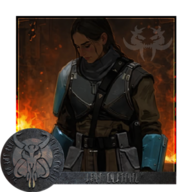




"Her light shines through even the darkest abyss."
- Vren Rook
OUT OF CHARACTER INFORMATION
- Intent: To create a Mandalorian location, fleshing out Tor Valum and the Iron Covenant.
- Image Credit: Midjourney
- Canon: N/A
- Permissions: N/A
- Links:
- Kadir'litr Codex
- Kyr'lyatr Crystal
- Sim'olan Droid Brain Core
- Tran'ca'nara-type Astrogation Computer
- The Blackwall
- Structure Name: Nau'braar
- Classification:
- Military Fortification
- Advance Sensor Beacon
- Location: Tor Valum, Kestri
- Affiliation: The Iron Covenant
- Accessibility: Access to Nau'braar itself is monitored but not necessarily restricted. There is regular Mandalorian traffic between those who operate at the Lighthouse's command and sensor stations and those using the structure as a forward operating base, or those who merely climb to the top for the view of Tor Valum and the Cin'cirri mountains below. The rare presence of a non-Mandalorian anywhere within the structure is immediately flagged and closely shadowed by the Mythos Guard. Non-clan visitors seeking access to the Astrocartograph Command or the Shaman's Astral Platform require explicit authorization from the Rekav'dral. Access to the summit ritual platform is restricted entirely to verified Shaman members of the Mythos Guard.
- Description: The Nau'braar, the Lighthouse, is the Iron Covenant's crowning fortification, its most vital strategic instrument, and the living heart of the Mythos Fleet's command on Kestri. It is constructed atop the peak of Mt. Valum, the mountain into which the capital city of Tor Valum is carved below, and it rises from the summit in a column of ditanium-reinforced durasteel and duracrete. Those who live in Tor Valum orient themselves by it the way ancient sailors once oriented themselves by stars. When its summit burns bright, every Mandalorian in the city below knows something is happening.
At the peak of the spire sits the Beacon itself, an open-air platform surrounding an eternal fire, burning in an iron brazier at the crown of Mt. Valum. In its resting state, the flame burns low and steady, a deep amber that can be seen from the valley floor at night, a fixed point above the city, much like a lighthouse after which the structure is named. Just below the crown, the Shaman's Astral Platform houses the ring of inlaid Kyr'lyatr crystals; when a shaman of the Mythos Guard takes that platform and begins a kadir'litr ritual, the crystals draw on the fire above as much as the Force below. The flame responds. It climbs. The color shifts toward white and crimson, the heat becomes something else entirely, and the beam that fires upward from the Nau'braar's crown during an active working is visible from orbit. In Tor Valum, people stop what they are doing when it blazes. They watch. They know something important is being attempted.
This duality runs through the entire structure. The Nau'braar is not purely sacred, and it is not purely practical. Its upper levels carry the weight of something close to reverence; the Astral Platform is a place of ritual and consequence, and the great hall just below it is a place where oaths are taken, honored dead are remembered. The business of the Covenant is conducted with full ceremony. Its lower levels are alive with the noise of a functioning military headquarters. Technicians, pilots, quartermasters, and off-duty soldiers moving through corridors that smell of caf and engine oil. The building holds both things without contradiction. The Mandalorians who work here would not have it any other way.
The Nau'braar serves three interlocking functions, each dependent on the others. At its foundation, it is a sensor fortress, its long-range stellar arrays fed by orbital emitters and satellite range-extenders that continuously map the space around Kestri, charting gravitational anomalies, mass shadows, hyperspace distortions, and the shifting borders of stellar phenomena. This data feeds into the Astrocartograph Command, where Iron Covenant navigators and droid-brain systems transform raw readings into actionable routes.
And at the summit, the Shaman's Astral Platform is a special-use platform for unnatural occurrences that need even more precise guidance. A shaman will stand in the middle of the platform and, enhanced by an array of kyr'lyatr crystals channelling power by the Manda through them, be able to use kadir'litr rituals to guide ships and even alter spatial conditions. The kyr'lyatr array amplifies the Force energy of the shaman working within it, sustaining a kadir'litr ritual long enough to read the stars as a living pattern in the Force, finding where the chaos breathes, where it thins, and threading a window of passage through it all. This is not fast or safe by conventional meansas the kyr'lyatr crystals are volatile under sustained channeling, the ritual is punishing, and the window is brief. But what is most important to the Mando'ade of Kestri is that it can be done.
Navigation by the Nau'braar is possible only with a Tra'ca'nara-type Astrogation Computer made for Iron Covenant ships, a specially-tuned navigation computer that does not work by conventional hyperspace charts but instead by the light and guidance provided by the Nau'braar. Constant attunement is required for the astrogation computer to interface with the Nau'braar, including regularly shifting encryption codes to enshrine the Iron Covenant's technology in the most absolute of secrecy and protection from sabotage.
- Kyr'bes Ve'vut: The open summit of Mt. Valum, above the Shaman's Astral Platform, where an eternal fire burns in a great iron brazier at the highest point of the structure. The flame has not gone out since the Nau'braar's completion — its continuity is a point of pride and, in quieter Covenant tradition, something closer to obligation. In its resting state, it burns low and amber, tended by a Mandokarla warden whose role is equal parts caretaker and sentinel. When the Kyr'lyatr crystals below are active, and a working is underway, the fire responds — fed by the Force energy channeling through the platform beneath it, it climbs and shifts, burning hotter and brighter in colors that have no clear explanation. No one has ever formally documented the mechanism. The shamans consider the question beside the point. explanation. No one has ever formally documented the mechanism. The shamans consider the question beside the point.
- Bral be Ka'ra: One level below the Kyr'bes Ve'vut, a ring of Kyr'lyatr crystals is set flush into the mountain stone of an open-air platform exposed to sky on all sides. This is where kadir'litr rituals are conducted, specifically, the Divination disciplines of Environmental Attunement and the Alteration school's Aspect of the Storm, amplified by the crystals' imprisoned Force-sensitive souls into something no single practitioner could sustain alone. The platform feeds upward into the Beacon Crown's fire and downward into the sensor data of the Astrocartograph Command, sitting at the junction of the Nau'braar's technological and spiritual functions. Access is restricted to verified Mandokarla during active work. A Mythos Guard shaman is always present, usually an experienced and powerful warrior, accompanied often by several junior shamans and non-force user guards.
- Trakaj'alom: A large operations center occupying the mid-levels of the structure, staffed around the clock by Iron Covenant astrocartographers working alongside advanced droid brains and navigational intelligence systems. Raw data from the emitter arrays is processed here into actionable charts — new hyperlane calculations, anomaly warnings, Void Storm movement assessments, and real-time intelligence on hyperspace conditions throughout Covenant-relevant space. The Command also maintains the Iron Covenant's encrypted navigational archive, a growing library of Mandalorian-exclusive lanes partitioned by clan and secured behind an authentication cycle rotated on an irregular basis. The room is quieter than it looks; the work done here tends to have consequences, and the people doing it know it.
- Kranak be Aryu'tasa: The center of the lower concourse, occupying the Nau'braar's upper interior, the Hall of the Covenant is the structure's ceremonial and social heart. Its ceiling is vaulted stone, hung with the banners of Iron Covenant clans. A long fire trench runs the length of the central floor, kept burning at all hours, its smoke venting through channels cut into the walls, its light warm against the stone. This is where oaths are sworn, where the honored dead are named aloud, where significant contracts and alliances are marked with ceremony. It is also, outside of formal occasions, simply a place where warriors eat, argue, drink, and keep each other's company. Long tables run the length of the hall. The fire is always going. The two uses, the sacred and the social, coexist easily, as they do throughout the building.
- Emitter Arrays: The exterior of the spire from the mid-levels upward is dedicated to sensor hardware; long-range stellar emitters, orbital relay connections, and the crystalline broadcast array that gives the Nau'braar its navigational reach. Mandalorian technicians and maintenance droids work the arrays constantly. This is the Nau'braar's most visible vulnerability. The arrays are necessarily exposed, visible from orbit, and hardened against atmospheric interference and moderate weapons fire, but not against a dedicated orbital strike. Every person who works in the Trakaj'alom knows that if the arrays go dark, so does everything else.
- The Lower Concourse: The base levels of the Nau'braar are where the building lives and breathes day to day. A wide interior concourse connects the garrison barracks, armory, medbay, secure communications room, and a cluster of small vendors and outfitters who have established semi-permanent stalls to serve the steady traffic of soldiers, pilots, and Covenant staff moving through the building. It is loud here, and crowded at shift changes, and it smells of machinery and food from the small canteen that operates out of what was originally a storage bay. All vendors are Mandalorian and vetted by the Rekav'dral, and they range from a weapons maintenance shop to a woman who has been selling the same three kinds of dried ration packs for eleven years and refuses to expand her inventory. Off-duty members of the Mythos Fleet's crew filter through the concourse constantly, making it one of the more reliable places in Tor Valum to find someone you're looking for, or to be found.
- Garrison and Command Barracks: Separate from the concourse, secured behind blast doors, the garrison quarters house the Nau'braar's permanent defense force and the rotating staff officers of the Verd'kandar, as well as detachments from the Mythos Fleet present on Kestri. A small briefing theater serves double duty as a planning room and, on occasion, a screening space for training footage and after-action reviews; it is the daily center of Kestri's command and relay between the Rekav'dral and the Mythos Fleet.
- Hangar Bay: A small hangar bay on the east side of the lower concourse serves as a place for shuttles to drop off materials and individuals at the Nau'braar, or for small craft to park. The hangar bay is extensive but cannot hold the entirety of the Covenant; access is strictly monitored and controlled, and prolonged parking must come with a very good reason. Shuttles regularly run between the Nau'braar and Tor Valum in order to facilitate transport and reduce traffic. Mythos Guard, including shamans and Astrocartographers, have a dedicated portion of the hangar bay at their disposal.
- Yust be Sitdrisa'yr: A processional ascending pathway that begins at the Ashen Commons and proceeds through the Bannerfall up to the Nau'braar at the summit of Mt. Valum, making a stop at the Rekav’drahl Keep. Memorial plaques and relics are embedded in crystal along the way, many such made independently to honor campaigns, legends, and forgotten stories. It is traditional for warriors to make the procession along the steps to the Nau'braar before a campaign or hunt to win favor with the Manda. It is a long, gruelling, and in certain places even treacherous path, often running along the exposed mountainside of Mt. Valum, making it more ritualistic than practical.
The Nau'braar's position atop Mt. Valum provides a natural defensive advantage; the only approach on the ground is from the city below along a switchbacked road easily covered by the garrison, and the peak's sheer faces make unassisted climbing difficult. Sensor coverage from the arrays extends to the mountain's immediate surroundings, making any covert approach difficult; moreover, it is the most important structure for the Iron Covenant and the centerpiece of a highly-fortified Mandalorian city. The structure itself is built to Mandalorian military specification, with reinforced walls, redundant blast doors at each level, and internal killzones designed to make the stairwells defensible in the event of a breach.
The Bral be Ka'ra and the Kyr'bes Ve'vut are the most heavily guarded points in the building. Mythos Guard sentinels -- Verd'kandar elite warriors -- are posted at the access stairwell at all times, and no unauthorized personnel ascend during an active ritual under any circumstances. The Kranak be Aryu'tasa also maintains a guard of Verd'kandar warriors, always combat-ready.
The entire structure is shielded by EWAR systems from electronic interference with the most advanced firewall systems and security systems, using generative intelligence powered by multiple Si'molan droid brain cores repurposed to manage the sensor systems of the Lighthouse.
The emitter arrays are the Nau'braar's most significant vulnerability. They are necessarily exposed on the exterior of the structure and visible from orbit. A determined enemy with orbital strike capability can easily locate the structure and determine what their destruction would cost the Iron Covenant. The arrays are hardened against atmospheric interference and moderate weapons fire, and additionally, a planetary shield generator, but are ultimately not invulnerable.
HISTORICAL INFORMATION
Plans for a structure atop Mt. Valum date back to the Mandalorian Enclave, as the Quartermaster's rebuilding councils discussed how best to improve their capital city as well as contribute to its defenses. Although these plans never came to fruition due to a variety of circumstances, including the Quartermaster's own demise at the hands of the Brotherhood of the Maw, they were saved in the Enclave's archives.
After the rise of the Iron Covenant from the ashes of the Enclave, the plans for the citadel were rediscovered. By that time, the Planetshift Calamity had occurred, altering the astral positions of star systems and erasing many ancient and well-charted hyperlanes from existence. In far-flung wildspace, Kestri was affected heavily by planetshift. Mandalorian engineers almost immediately concurred that some sort of technology was needed to navigate the new stars if the Iron Covenant was to project power beyond the Kestri System. Hyperspace beacons, while reliable, were a slow and gruelling process and not nearly as quick as hyperlane pathing, and so were discarded as a potential option. Recharting hyperlanes was also a time-consuming process that could last centuries.
The concept of the Nau'braar emerged from this necessity, a stationary beacon and highly advanced hyperspace sensor system that might be used as a hyperspace focal point for Mandalorian navigators. Iron Covenant engineers based their design on creating a stable reference for calculating new lanes to where they actually needed to go, rather than where the old routes had once run. Construction took a year. When the eternal fire was lit at the Kyr'bes Ve'vut for the first time, the flame was kindled from torches brought by representatives of each founding clan of the Covenant. It has not gone out since.
The addition of the Bral be Ka'ra came later, proposed as the Iron Covenant meditated on how they might overcome the impassable Blackwall of the Sith Order, an interstellar barrier of unheard-of proportions, a layered barrier of alchemically-anchored Void Storms and Stormseeds that made hyperspace transit into Sith-adjacent space lethal for any vessel. Mythos Guard shamans led by Tytos Saxon, working through Kadir'litr's Divination and Alteration disciplines, theorized that the Void Storms could be read directly through the Force as a living, shifting pattern, and that a sufficiently amplified practitioner could identify windows of passage that no machine could detect. The Kyr'lyatr crystal ring was installed at the platform below the Kyr'bes Ve'vut, the connection between crystal and flame was observed and studied, and the theory was tested. It worked. This transit is difficult, costly, and dangerous. But it works.
The Nau'braar now stands as the Iron Covenant's navigational heart as its Mythos Fleet strikes for the stars to become legend.