

Nothing's Like Before




MARAVAILA
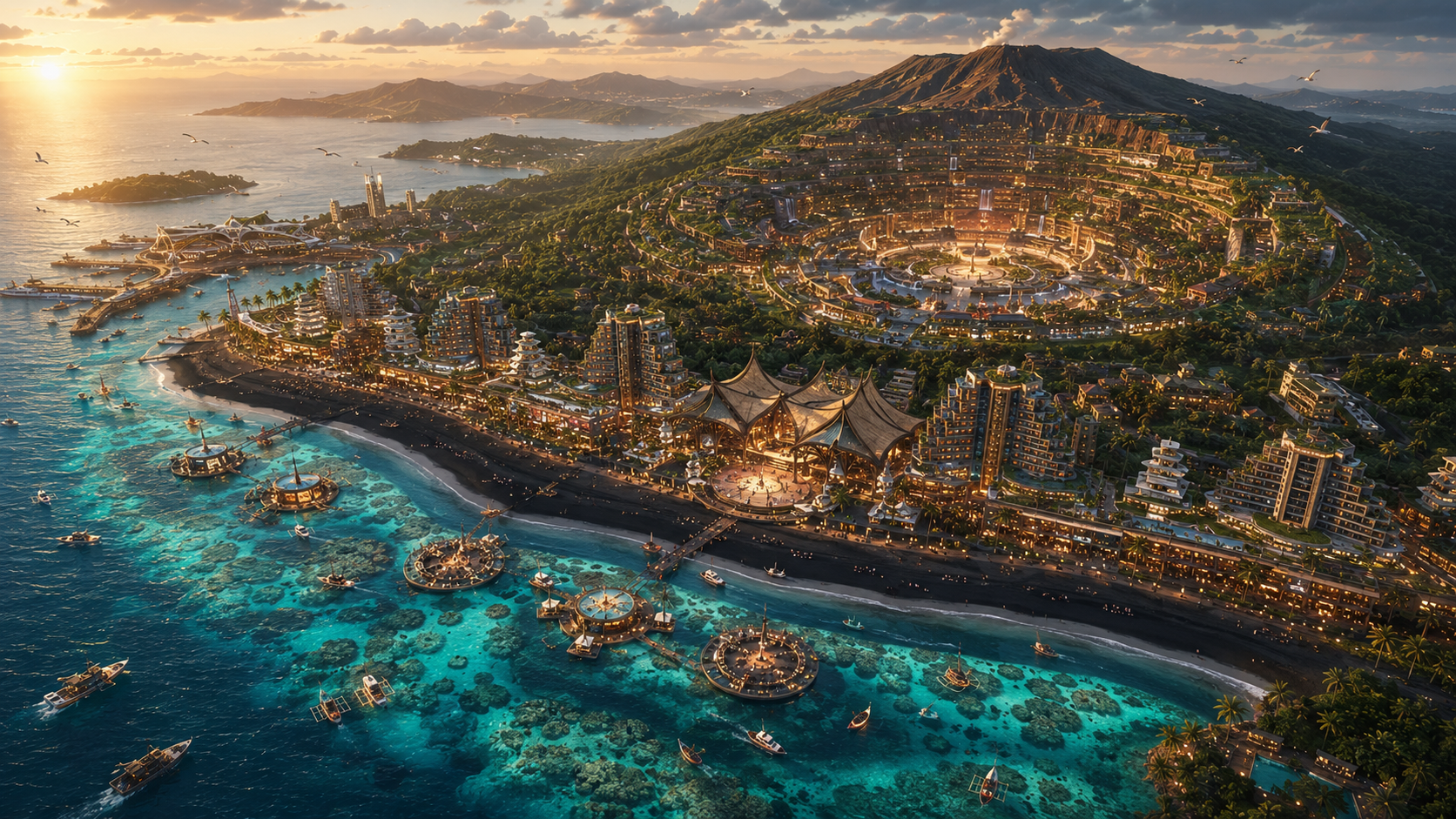
OUT OF CHARACTER INFORMATION
- Intent: To create a premier resort-and-gala city for Gilaria, suitable for the beach-party-to-tropical-gala thread — a city built on the bones of the old First Order resort era and reclaimed into the Commonwealth's high-society playground on the Waihokai Archipelago.
- Image Credit: ChatGPT
- Canon: N/A
- Permissions: N/A
- Links: Gilaria | Avalonia | Commonwealth Renewable Energy Platform | Commonwealth Micro-Refinery Platform | Pure Water Reclamation Module | Verdant Bastion | Commonwealth Adaptive Infrastructure Network | Commonwealth Medical Service | Commonwealth Central Bank
SETTING INFORMATION
- City Name: Maravaila
- Classification: [Urban Center]
- Location: Gilaria — largest island of the Waihokai Archipelago, in the shadow of the dormant volcano Pualei looks toward across the water.
- Affiliation: Imperial Commonwealth of Dosuun
- Population: Heavy
- Demographics:
- Age:
- 0 to 15 - 14%
- 16 to 64 38%
- 65 to 100 30%
- 100+ 8%
- Gender:
- 40% Male
- 43% Female
- 7% Non Binary
- Species:
- 31% Selkath
- 19% Nautolan
- 17% Human
- 11% Gilari
- 8% Aqualish
- 6% Herglic
- 8% Other (transient offworld visitors, Commonwealth nationals, seasonal labor)
- Note: Maravaila skews more human and more cosmopolitan than Gilaria's planetary average — a legacy of its resort-era guest economy and the offworld money that still flows through it.
- Age:
- Wealth: High
- Maravaila is the wealthiest city on Gilaria per capita, though its prosperity is narrow and visible rather than broad. The economy rests on luxury tourism, the gala and festival circuit, high-end aquaculture and pearl trade, geothermal spa medicine, and the hospitality infrastructure inherited from its years as a First Order leisure resort. Commonwealth reconstruction capital rebuilt the shattered waterfront into something grander than it ever was under the Order. Wealth concentrates along the Crescent and the crater districts; the service wards inland live comfortably but plainly.
- Stability: High
- Maravaila is orderly, safe, and almost aggressively pleasant. A city whose entire economy depends on visitors feeling at ease cannot afford disorder, and it does not tolerate it. CSG civic authority and a discreet, well-funded resort security apparatus keep the peace with a light visible touch and a heavier invisible one. Such friction as exists is the quiet resentment of seasonal workers priced out of the city they serve — a labor question, not a security one.
- Freedom & Oppression:
- Within Maravaila, life is as free and easy as anywhere on Gilaria. Visitors and residents move, worship, trade, and celebrate as they please, and the city wears its hospitality as both creed and commerce. The single quiet boundary is the one shared by all of Gilaria: the Commonwealth relationship is not up for debate, and dissent against it finds the resort city's velvet hospitality cooling with surprising speed. For the guest on the beach and the resident in the spa, the hand that guarantees Maravaila's prosperity is invisible — which is exactly how the Commonwealth prefers it.
- Description: Maravaila wraps a long crescent of black volcanic sand on the largest island of the Waihokai Archipelago, where the warm Guomoan waters meet geothermal heat rising from the seabed. From the air it reads as three bands of light: the pale glow of the beachfront hotels and pavilions along the shore, the deeper jewel-tones of the reef gardens just offshore, and behind it all the dormant cone of an old crater whose interior has been terraced into the city's grandest venue. By day the city is sun, salt, and the slow traffic of repulsor-outriggers ferrying guests between island and reef. By night it becomes something else entirely — a city of fire and water, where torch-lined boardwalks meet floating stages and the crater above glows from the lights of whatever gala is being held within it.
The architecture is the city's whole story told in stone and glass. The bones beneath are First Order resort construction — the clean, confident lines of a leisure economy built to impress visiting officers — but the Commonwealth and the Gilari have grown something warmer over that frame. Woven sky-bridges and tapa-cloth awnings soften the imperial geometry; volcanic-glass facades catch the light; reef-coral motifs and the old chant-carvings of the Waihokai people run along the colonnades. The result is glamorous without being cold: a resort city that remembers it sits on a sacred volcanic island and never quite lets the guest forget it either.
Maravaila exists to receive people and to send them home enchanted. It has done so for officers, for dignitaries, for Commonwealth high society, and now for anyone with the credits and the invitation. The Ssi-Ruuvi raids gutted it like the rest of Gilaria; the Commonwealth rebuilt it grander than before, because a Commonwealth that wished to be loved understood the value of a place its people could be happy. That is what Maravaila is, at bottom — the Commonwealth's argument, made in sand and firelight, that belonging to it feels good.
POINTS OF INTEREST
- The Crescent: Maravaila's famous beachfront and the heart of the city's hospitality trade — a long arc of black volcanic sand backed by an unbroken line of grand hotels, the towers and terraced resorts that are the true stars of Maravaila. Everything else in the city orbits them: the pavilions, the open-air venues, the boardwalk, all arranged to feed and flatter the great houses along the shore. The Crescent is where the city's public life happens: by day a beach, by night a promenade of torches, music, and open-air bars. It is the natural staging ground for the beach-party leg of any celebration, with the gala proper drawing guests up into the crater as the night turns formal.
- The Black Sand: The Crescent's signature curiosity and a favorite trick played on first-time visitors. The sand is a deep volcanic black, and every newcomer braces to step onto it expecting heat like sun-baked permacrete — and finds it cool, even faintly chill, beneath bare feet. The black grains drink the sun's heat greedily all day, drawing warmth down and out of the air above them, and what they give back at the surface is a steady coolness and a soft drift of cooled air rising off the beach. The effect makes the Crescent walkable barefoot at noon and pleasantly cool by night, and the hotels have learned never to spoil the surprise for an arriving guest.
- The Grand Houses: The line of luxury hotels and resort-towers along the Crescent, ranging from restored First Order-era leisure palaces to gleaming new Commonwealth construction. Each is a small world unto itself — private lagoon frontage, rooftop terraces, spa wings fed from the geothermal springs — and the competition between the great houses for the season's most prestigious galas is the closest thing Maravaila has to a blood sport.
- The Sunfire Pavilion: The Crescent's central open-air venue, a vast canopied platform of woven shade-cloth and volcanic-glass columns that opens directly onto the sand. It hosts beach concerts, fire-dance performances drawn from the Pualei tradition, and the informal early hours of the city's great events before the formal gala convenes uphill.
- The Tide Walk: A torch-lined boardwalk running the length of the Crescent, lined with bars, eateries, artisan stalls, and pearl-merchants. By night it is the social spine of the lower city.
- Lagoon Stages: A cluster of floating performance platforms anchored just off the sand, reachable by short repulsor-ferry, where musicians and dancers perform over the water. A Gilari maritime tradition turned to glamorous use.
- The Caldera: The city's crowning venue, set within the terraced interior of the dormant volcano that rises behind the Crescent. The crater floor and its stepped walls have been landscaped into tiered gardens, reflecting pools fed by geothermal springs, and a grand open-air ballroom-terrace open to the night sky. When a gala is held here the entire cone glows from within, visible across the archipelago. This is where the formal heart of any great Maravailan event takes place — the tropical gala in its truest form, fire below at the Crescent and starlight above the crater rim.
- The Ember Terrace: The principal gala floor — a sweeping tiered terrace of polished volcanic stone and inlaid mother-of-pearl, ringed by geothermal flame-basins and overlooking the reflecting pools. Built to hold a thousand guests in formal splendor.
- The Rapa Springs: Geothermal hot-spring pools terraced into the crater wall, a spa and ceremonial bathing site descended from the planet's Rapa Pool tradition, open to gala guests and patients of the spa-medicine clinics alike.
- The Lookout Rim: The crater's upper edge, a viewing walk offering the city's signature vista — the lit Crescent and the dark sea below, the reef gardens glowing faintly, and the open stars above.
- The Reef Gardens: The protected coral shallows just offshore, a marine sanctuary doubling as the city's premier daytime attraction. Glass-bottomed pleasure craft, guided dives, and the coming-of-age dive tradition borrowed from the Tauranga Reefs draw visitors into the water. The gardens are jointly managed as a tourist site and a genuinely protected ecosystem — a balance the Gilari insist upon and the Commonwealth has learned is good for business.
- The Pearl Quays: Floating docks where the archipelago's mana-pearl divers bring their harvest to market. Both a working quay and a tourist spectacle, with the city's finest pearl-jewelers seated alongside.
- The Ahurei Quarter: The city's cultural and spiritual ward, where Maravaila keeps faith with the island it sits on. Chant-houses, carving workshops, tapa-cloth and Mana-silk artisans, and small shrines to the maritime and volcanic spirits cluster here. It is the quarter that reminds the glittering resort that the Waihokai islands were sacred long before they were fashionable, and many of the city's signature fire-dance performers and musicians come from its families.
- The Chant-House of the Ember Tide: The quarter's central ceremonial hall, where the fire dances performed for visitors at the Sunfire Pavilion are first rehearsed and consecrated as genuine rite rather than mere spectacle.
- The Footlights: Maravaila's entertainment district, set just inland of the Crescent where the resort shore gives way to the working city. If the Caldera is where the city is grand and the Crescent is where it plays, the Footlights is where it performs — a dense, bright warren of theaters, cinemas, music halls, and open-air amphitheaters running late into every night. By day it is quiet and a little tawdry in the sun; by night its marquees and holo-signs throw colored light across the streets and the crowds spill between venues. It draws on the Ahurei Quarter for its performers and traditions and on the offworld money of the Crescent for its audiences, and the blend gives Maravailan entertainment its particular character — a Gilari maritime soul dressed in cosmopolitan polish.
- The Tideglass Amphitheater: The district's crown — a great open-air amphitheater of tiered volcanic stone built into a natural slope, facing the sea so that performances play against a backdrop of open water and, on gala nights, the lit crater beyond. It seats several thousand and hosts everything from classical Commonwealth concerts to the grand staged fire-and-water spectacles for which the city is known.
- The Lyric Houses: A cluster of formal indoor theaters and music halls along the district's main run, ranging from an opulent old resort-era opera house restored by Commonwealth funds to intimate playhouses and recital rooms. The season's theatrical calendar is a genuine point of civic pride.
- The Holodrome: Maravaila's cinema and holo-entertainment complex — a row of grand picture-houses and immersive holo-theaters showing offworld releases and Gilari productions alike, with the broad popular appeal the Lyric Houses hold themselves a little above.
- The Smaller Stages: A scatter of cabarets, comedy rooms, music clubs, and street-performance squares filling the gaps between the great venues, where the district's late-night life truly lives and where many a Crescent guest ends a night that began in formal dress at the Caldera.
- The Mooring: Maravaila's starport and arrival district, set on a reclaimed headland at the north end of the Crescent. Built grand and welcoming during the resort era to receive officers' transports, it now handles the offworld luxury traffic and gala arrivals — a deliberately impressive first impression, all soaring glass and reef-motif colonnades, designed so the visitor's enchantment begins the moment they disembark.
- The Welcome Hall: The starport's grand concourse, where arriving guests are received. The Commonwealth understands the value of a good first impression, and the Welcome Hall is built to make one.
- The Exchange Row: The Mooring's financial quarter, and the reason the district feels less like a mere starport than a small, polished capital of money. It exists for a specific kind of Maravailan: the professional who would rather not commute to the mainland or the larger islands to do their banking and business, and is willing to pay the premium of working from paradise to avoid it. Exchange Row obliges them. A regional office of the Commonwealth Central Bank anchors the row, handling regulatory and monetary affairs for the archipelago beneath the apex bank on Prosperia, and around it cluster the commercial houses that actually court the public.
- First Victorian Bank: The grand old name and Exchange Row's most prestigious commercial house, trading on Primo Victorian heritage and old-money respectability. It regards itself as the bank of consequence on the island and behaves accordingly.
- Ventana Credit Union: First Victorian's perennial rival and the people's choice, friendlier and less formal, with a loyal membership that delights in needling the older bank's pretensions. The two institutions' competition for the city's accounts is an old and faintly theatrical Maravailan rivalry.
- Commonwealth Imperial Credit Union: A solid, no-nonsense institution favored by Commonwealth nationals, servicemembers, and those who like their banking imperial and uncomplicated.
- The Tidewater Exchange: A small securities and commodities exchange — pearls, specialty produce, shipping futures, and modest equity trading. Nothing on the scale of a mainland bourse; it exists so that the island's work-from-paradise set can trade without ever leaving the archipelago, and it charges handsomely for the convenience.
- The Grand Mile: The Mooring's celebrated dining and shopping promenade, running from the Welcome Hall along the headland, and the district where Maravaila shows off the full cosmopolitan range of the Commonwealth on a single street. The restaurants are the draw: the hearty roasts and pub fare of Galidraani tradition, the refined kitchens of Anaxes, the bright bold cooking of Ferrixian houses, and the singular cuisine of Dosuun itself — that strange and wonderful marriage of old-world ceremony and sun-warmed eastern-sea flavors, all olive and citrus and slow-braised meat. Seoularian kitchens bring their fierce, fermented, deeply savory fare; Baralou houses bring warmth and spice and the rhythm of the islands. Between and above the restaurants run the boutiques and galleries — designer offworld fashion beside artisan stalls selling the genuine handmade goods of the archipelago: volcanic-glass jewelry, woven mats and tapa cloth, mana-pearl settings, and the carvings of the Ahurei families. The Grand Mile is where a guest spends the credits the Crescent put them in the mood to spend.
- The Verdance: Maravaila's sustainability and science district, set inland on the gentler slopes behind the resort shore where the city does the quiet, unglamorous work that lets the Crescent stay beautiful. If the rest of Maravaila is the Commonwealth's argument made in firelight, the Verdance is the same argument made in clean water and closed loops — a working showcase of Commonwealth environmental engineering that the city is openly, almost insufferably proud of. It is the reason Maravaila can market itself as a carbon-neutral resort and mean it, and a stop on the city's tour circuit in its own right: visitors who came for the beach leave having walked through greenhouses and algae galleries and come away faintly converted. The district is engineered as a single closed system, each installation feeding the next, and that integration is the point the Commonwealth most wants made.
- The Tidal Works: The district's power source and the literal foundation everything else stands on — a Commonwealth Renewable Energy Platform installation in its archipelago configuration. Submerged tidal-flow turbines anchored offshore, floating sea-platforms carrying hybrid solar-and-tidal arrays, and storm-hardened vertical wind spines along the headlands draw Maravaila's power from the same sea and sun the guests came to enjoy. Combined with the geothermal heat already rising beneath the island, it leaves the city very nearly off any external fuel entirely.
- The Bloom Galleries: Rows of long, transparent algae basins and photobioreactor towers — a marine-variant Commonwealth Micro-Refinery Platform array, fed by the kelp and seaweed of Gilaria's aquaculture trade. The high-lipid algae drink carbon out of the air as they grow, are pressed into biofuel for the city's boats and machinery, and leave behind a nutrient-rich residue that becomes fertilizer for the greenhouses uphill. It is the carbon-capture heart of the district's carbon-neutral claim, and the slow green glow of the galleries at dusk has become an attraction in its own right.
- The Wellsprings: Maravaila has no rivers, and an island that hosts ten thousand thirsty guests at festival time cannot drink the sea — so it makes the sea drink. A bank of Pure Water Reclamation Modules desalinates and purifies seawater through multi-stage filtration into water that meets galactic potable standards, supplying the hotels, the population, and the hydroponic and aquaponic systems of the greenhouses. The Wellsprings are why the Crescent's resorts can promise endless fresh water on a salt-locked island and never explain how.
- The Verdant Houses: The district's greenhouses — a cluster of Verdant Bastion systems running closed-loop hydroponics, aquaponics, and fogponics under Solarium Glasteel domes. Watered from the Wellsprings and fed by fertilizer from the Bloom Galleries, the Verdant Houses do not feed the island — the open taro terraces, reef aquaculture, and the wider planet do that — but they grow the specialty and luxury produce the hotels demand: rare offworld fruits, delicate greens and herbs, and controlled-environment crops that would never survive the open islands. They are as much a research facility as a farm, and the agronomists who run them trade findings across the Commonwealth.
- The Nexus: A modest, heavily secured building that is the brain of the whole district — a Commonwealth Adaptive Infrastructure Network node tying the Tidal Works, the Bloom Galleries, the Wellsprings, the Verdant Houses, and the city's geothermal and civil systems into a single adaptive grid. It generates nothing and grows nothing; it balances load, smooths the renewable fluctuations, prioritizes the hospitals and the water plants in a crisis, and anticipates stress before it becomes failure. It is also, quietly, where the seam between civilian comfort and Commonwealth oversight runs closest — the Nexus partitions and protects the city's lifeblood systems, and what protects them also watches them.
- The Saltreach Wards: The inland service districts where Maravaila's working population lives — the cooks, performers, divers, attendants, and laborers who make the resort run. Plainer and more genuinely local than the glittering shore, the Saltreach wards are where the city's real day-to-day Gilari life happens, with their own markets, eateries, and quiet pride. The quiet tension of the city lives here too: these are the people who serve the gala and cannot afford to attend it.
- The Lyceum Quarter: Maravaila's education and medical district, set just past the Saltreach Wards where the working city gives way to quieter, greener ground. It is the city's civic conscience made into buildings — the place that trains the people who run the Verdance, heals the people who staff the Crescent, and answers the calls when something goes wrong. Calmer and more rooted than the resort shore, the Lyceum Quarter is where many Maravailans actually grow up, study, are born, and are cared for, and it carries itself accordingly.
- Tideborn College: A small but well-regarded college, modest in size and serious in purpose. Its first and proudest focus is the environmental sciences — marine biology, ecological engineering, sustainable-systems study — drawing directly on the living laboratory of the Verdance and the Reef Gardens, and many of its graduates go straight into running them. Its second focus is the fine arts, feeding the Footlights and the Ahurei Quarter with trained performers, musicians, and craftspeople. Engineering and finance round out its faculties as third and fourth focuses, the practical disciplines that keep the city's infrastructure and its hospitality economy running. The college is intimate by design: Maravaila wanted a place that turned out competent, civic-minded graduates who stayed, not a sprawling university that exported them.
- The Commonwealth Medical Center: A Commonwealth Medical Service-run hospital, the district's anchor and the most advanced care on the archipelago. Built and staffed to Commonwealth standard, it handles serious medicine — surgery, trauma, the spa-medicine and geothermal-therapy specialties the city is known for — and works hand in hand with the island's older healing traditions rather than over them.
- The Healing Wards: A network of local Gilari healing centers and herbalist wards, descended from the planet's deep tradition of botanical medicine, poultices, and kolto-based care. The Commonwealth Medical Center refers patients to them and learns from them as often as the reverse; the arrangement is one of the city's genuine points of pride, a place where imperial medicine and native practice were folded together rather than one displacing the other.
- The Tide Watch: Maravaila's emergency-response station, housing the city's medical responders, fire-and-rescue crews, and water-rescue teams. Because so much of the city's emergency work happens on or under the water — divers in trouble, craft in distress, festival crowds on the boardwalks — the Tide Watch is as much a maritime rescue service as a conventional one, and its fast boats are a more common sight than any landspeeder.
- The Halewai Seaport: Maravaila's working harbor and gateway, set on the coast beside the Lyceum Quarter — and the only way most people actually reach this side of the island. The skies above this stretch of Gilaria are closed to shuttle and repulsor traffic by a standing Commonwealth-and-CSG preservation ordinance, kept clear so that the archipelago's native avian species can flourish undisturbed; the result is that to come to Halewai, the Lyceum Quarter, or the quieter wards behind them, you take a boat. Ferries, hydrofoils, repulsor-outriggers running low over the water, and the grand pleasure-craft of arriving guests all converge on the harbor, and the approach by sea — the island rising green and quiet under wheeling flocks, no contrails overhead — is considered one of the finest first impressions Maravaila offers. (The Mooring starport handles the offworld arrivals who come down elsewhere on the island and transfer to the water; nothing flies in over Halewai itself.)
- The Trade Quays: The commercial harbor proper, where Maravaila does the unglamorous business of import and export — landing the offworld luxuries the hotels require and the construction materials the city always needs, and shipping out mana-pearls, volcanic-glass craft, specialty produce from the Verdant Houses, and the artisan goods of the Ahurei Quarter. It is a genuine working port, and the sight of cargo lighters and pearl-boats sharing the water with gala yachts is pure Maravaila.
- The Ferry Landing: The passenger heart of the seaport, a grand sea-facing terminal built — like the Mooring — to make an impression, where the boats come in and the island's no-fly quiet first makes itself felt. From here water-taxis and ferry lines fan out to the Crescent, the Lyceum Quarter, and the residential wards.
- The Harborside: The dense, lively residential and dining district that has grown up around the working port — apartments and row-houses stacked above the water, and some of the best and least pretentious eating in the city. Where the Tide Walk on the Crescent feeds tourists, the Harborside feeds Maravailans: dockside fish-houses, family kitchens, late-night noodle and grill stalls serving the port workers and the college students from up the hill. Many residents consider it the city's true heart, the part that would still be here if every hotel on the Crescent went dark.
SECURITY
High — but deliberately soft to the eye. Maravaila's whole economy depends on guests feeling unobserved and at ease, and its security is designed around that contradiction: pervasive but discreet, present everywhere and visible almost nowhere.
- Resort Security Service: A well-funded, plainclothes-heavy civic security force operated jointly under CSG civic authority and the city's hospitality compact. Trained in de-escalation, crowd management, and the quiet removal of problems before guests notice them. Uniformed presence is kept light and pleasant; the heavier capability stays out of sight.
- Surveillance & Sensor Coverage: Discreet, comprehensive sensor and surveillance coverage across the Crescent, the Caldera, the Mooring, and the reef approaches, monitored centrally. Concealed within the architecture rather than displayed.
- Reef & Maritime Patrol: Light repulsor and submersible craft patrol the reef gardens and the offshore approaches, framed publicly as marine-sanctuary protection and search-and-rescue — which they genuinely also are.
- Commonwealth Garrison Overwatch: Maravaila sits within the protective umbrella of the Commonwealth military infrastructure established across Gilaria after the Ssi-Ruuvi raids. The garrison is not in the city and is not meant to be seen there; its presence is the quiet guarantee beneath the velvet, invoked only in genuine crisis.
- Event Security: For galas and major festivals, layered access control, identity verification at the Mooring, and reinforced (still discreet) coverage of the Caldera venues are brought online — the city's security apparatus shifting quietly into a higher gear while the guests see only a smoothly run party.
HISTORICAL INFORMATION
Maravaila is younger than most of Gilaria's cities and was, from the beginning, built to be enjoyed rather than lived in. Where Hrakert grew from a Selkath flotilla and Calimsgrad from highland settlers, Maravaila grew from a single idea held by a power that was not even Gilari: that the warm black-sand crescent of the Waihokai's largest island was the most beautiful place to rest in this corner of the galaxy, and that beauty could be sold.
The Waihokai people had lived on and around the island for generations before that — fisherfolk, fire-dancers, and keepers of the volcanic shrines, kin to the people of nearby Pualei. They regarded the dormant crater as sacred and the black beach as a place of ceremony. When the First Order, in the height of Gilaria's resort era, looked at that same beach and saw a playground for officers on leave, the two visions did not so much clash as get folded one inside the other. The Order built its pavilions and its grand starport and its crater venue; the Waihokai people, as Gilarians have always done, fell into the current and made their living within it, dancing their fire dances for offworld audiences who never quite understood what they were watching.
For a generation Maravaila was the jewel of Gilaria's leisure economy — a destination for First Order dignitaries, the place a tired officer dreamed of, its waterfront thick with money that had never been Gilari. Then the Ssi-Ruuk came. Lightly defended and richly appointed, Maravaila was exactly the kind of soft, glittering target the entech raiders fell upon hardest. The Crescent burned, the starport was shattered, and the crater venue stood empty and cracked for years. The patron that had built the city was itself coming apart and had nothing to spare for a broken resort on a far island.
The Imperial Commonwealth of Dosuun rebuilt it — not first, but deliberately. Relief went to the kolto chasms and the food-producing regions before it came to a luxury resort, and Maravailans noted the order of priorities. But come it did, and when it came the Commonwealth rebuilt Maravaila grander than the First Order had ever managed, because the Commonwealth understood something the Order had treated only as a transaction: that a place where people are happy is a place that learns to love the power that made them so. The new Maravaila kept the Order's confident bones and grew the warmer, Gilari skin over them — tapa awnings over imperial colonnades, chant-carvings along resort terraces. The fire dances that had once been performed for uncomprehending officers were now performed for Commonwealth high society, and the Waihokai families who performed them found, for the first time, that the city took some care to remember whose island it had always been.
Today Maravaila is the premier gala and resort city of Gilaria, and through Gilaria a favored playground of the wider Commonwealth — the place where the beach party at sunset becomes the grand gala under the crater stars. Its people are prosperous and its guests enchanted, and if the working wards inland carry a quieter view of who the city is really for, that too is an old Gilari story. Maravaila has been built for someone else's pleasure twice now, and twice made a life within it. That, more than the fire or the pearls or the black sand, is the most Gilari thing about her.
Last edited: