

Nothing's Like Before




KALIVENE
OUT OF CHARACTER INFORMATION
- Intent: To create the capital city of Verdi, a verdant member world of the Commonwealth.
- Image Credit: ChatGPT
- Canon: N/A
- Permissions: N/A
- Links:
SETTING INFORMATION
- City Name: Kalivene
- Classification: Urban Center
- Location: Verdi
- Affiliation: Imperial Commonwealth of Dosuun
- Population: Heavy
- Demographics:
- Age:
- 24% 0 - 15
- 46% 16 - 64
- 18% 65 - 100
- 12% 100+
- Gender:
- 46% Female
- 44% Male
- 10% Non-Binary
- Species:
- Human - 32%
- Kalivari - 18% [Submission Forthcoming]
- Zelosian - 12%
- Kiffar - 11%
- Thyrsian - 7%
- Echani - 5%
- Epicanthix - 5%
- Chiss - 4%
- Korun - 3%
- Other - 3%
- Age:
- Wealth:High
- Kalivene's prosperity rests on a distinctive export economy — terrace-grown tea, vine-bean calligraphy ink and botanical dye, prized terrace-pressed vinho verde, decorative-tinned conservas, fine silks, chronometers and silverwork, and the slow craft of grown-hull shipbuilding. Its botanical scholarship draws students and licensing trade from across Commonwealth space, and the regional Commonwealth Central Bank office anchors a mature financial quarter.
- Stability: High
- Kalivene is a long-settled, locally governed city. Verdi runs its own affairs by old custom through the council of elder houses, while its Commonwealth allegiance is expressed through trade, diplomatic protocol, and the standing Commonwealth garrison outside the city. Verdi's own planetary defense forces maintain order alongside the Commonwealth presence.
- Freedom & Oppression: Kalivene is, by every visible measure, a free city. Its people speak, gather, worship, and publish as they please; the markets are open, the guilds and elder houses govern by old custom, and the creole song traditions of the wharves are as quick to mock authority as to praise it. Yet the freedom of Verdi, like that of much of the Commonwealth, is a velvet glove over a firm hand. The liberty is real and daily, but it rests on an understood bargain: the city keeps its local governance and its open life so long as its allegiance to the Commonwealth is not in question. The Watch Station keeps its quiet eye on the skies, the regional Central Bank office holds the one lever the city does not control, and the garrison waits beyond the Rio Verde. None of this presses on ordinary life — most Kaliveners pass their whole lives never feeling the hand inside the glove — but it is there, and the elder houses have always understood that their cherished autonomy is a thing granted and, in principle, revocable. The city is free, and it is also careful.
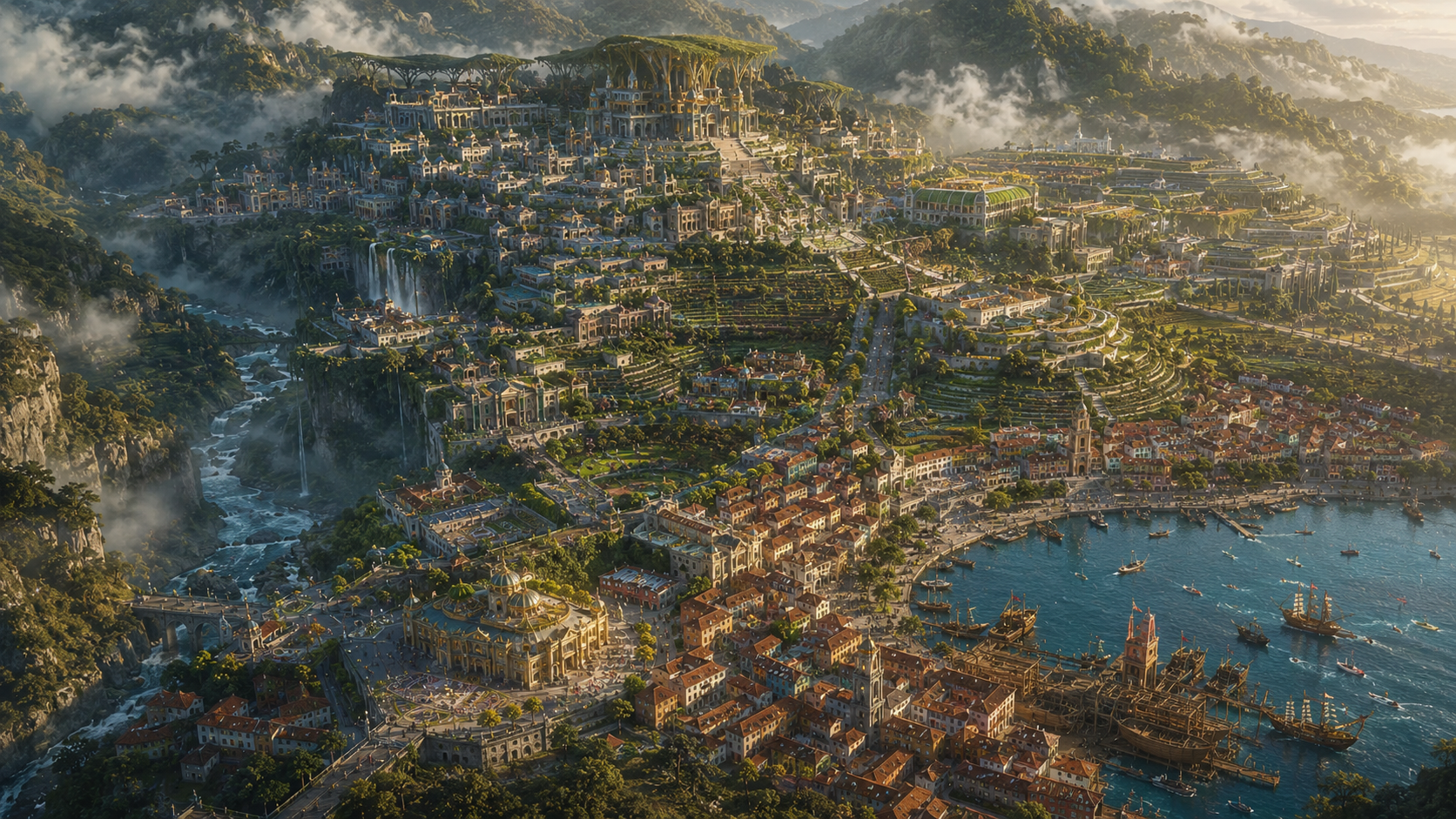
- Description: Kalivene clings to the side of a misty green mountain range and spills down into a crescent-shaped bay, a city built in two faces that have learned to live as one. The upper city is carved into pale stone and cloudforest plateau — sacred vine gardens, ancestral halls, and grown-wood council chambers inlaid with obsidian, where the mountain-spirits, the Apus, stand watch over terraces tended for centuries. The lower city hums with foreign trade: azulejo esplanades, bell towers, pastel stucco merchant houses, and a creole dialect sung along the wharves where the grown-hull ships are launched. Between the two, the trade-valley markets bargain in a patois that grinds the highland tongue against the dockside creole, and the maglev lines thread out from a single gilded concourse to every quarter of the capital.
What sets Kalivene apart from any other green-world port is its conviction that cultivation is a discipline of letters, not merely of labor. In the cloud-scholars' quarter, generations have catalogued the vine, pressed its beans into the calligraphy ink that is among Verdi's signature exports, and built a botanical scholarship that students cross the stars to study. That conviction runs through the whole city — into a medicine that braids old herb-lore with Commonwealth clinical care, into an agricultural university standing as peer to the city university, into the very way Kalivene builds, growing its shade and its hulls and its infrastructure rather than imposing them. Like all the Commonwealth's cities, Kalivene is sustainable by design: vine canopy and solar lattice over its plazas, harvested rain in its cisterns, the river drawn on for power.
Kalivene is not the seat of an empire; it is the proud capital of one green world among many in the Commonwealth, governing itself by old custom and turning a confident, polyglot face to the galaxy.
POINTS OF INTEREST
Alto Kalivene — The Crown
The oldest quarter of the city and its spiritual axis, Alto Kalivene occupies the highest of the cloudforest plateaus, where mist pools in the mornings and the peaks of the surrounding range — the Apus, the ancestor-mountains — stand watch over the bay far below. This is the ceremonial and civic heart of Verdi, governed by old custom rather than imperial appointment, where the vine-mother rites are kept and the council of elder houses convenes. The architecture here is unlike anywhere else in the city: structures grown and carved from living hardwood, inlaid with black obsidian, their forms following the contours of the terraces rather than imposing upon them.
- The Council Temple of the Vine-Mothers — A great hall of living wood and obsidian where the elder houses convene and the seasonal cultivation rites are observed; its central chamber is roofed by a canopy of trained vines kept alive for centuries.
- The Apus Terraces — Stone-walled ceremonial terraces facing the ancestor-peaks, planted with heirloom vine stock tended only by initiates; the highest terrace is reserved for offerings at the turning of the seasons.
- The Ancestral Halls — Cliff-set chambers holding the recorded lineages of Kalivene's founding houses, their walls hung with symbolic weavings that encode genealogy in pattern and color.
Yunvara — The Cloud-Scholars' Quarter
If Alto Kalivene is the city's spirit, Yunvara is its mind. This is the literati district, where Verdi's defining civic virtue — the treatment of vine cultivation as a literate, archival discipline rather than mere agriculture — finds its fullest expression. Generations of scholars have catalogued the vine strains, refined the production of vine-bean ink, and built a botanical scholarship that draws students from across Commonwealth space. The quarter has the hush of a place that values study: tiered libraries climb the hillside, ink-houses press the season's harvest into pigment, and academies teach cultivation as a branch of letters.
- The Verdant Archives — The principal botanical library of Verdi, its tiered halls holding cultivation records, pressed-strain catalogues, and illuminated manuscripts inked in vine-bean black; the deepest stacks preserve volumes predating the Commonwealth's arrival.
- The Ink-Houses of Yunvara — Workshops where vine beans are pressed and refined into the prized calligraphy ink that is among Verdi's signature exports; the master ink-makers guard their blending formulas as inherited craft.
- The Cultivation Academies — Schools where students read vine science as a scholarly tradition, combining field terraces, herbal pharmacology, and the calligraphic arts into a single course of civic learning.
The Terraces — The Working Slopes
Between the crown and the lower city spread the working terraces, the agrarian tier where the scholarship of Yunvara becomes the labor of the harvest. These cultivated slopes are the economic engine of Verdi: tea gardens, vine-bean fields, dye plots, and the fragrant-wood groves descend the mountainside in stepped tiers linked by cliff paths. Shrines dot those paths — small ones, built into natural caves or grown over by old vines — so that the spiritual life of the high city threads down through the fields where the work is actually done.
- The Tea & Dye Houses — Working establishments where terrace harvests are cured, fermented, and processed; the dye-houses produce the deep botanical colors used in Kalivene's symbolic weavings.
- The Cliff-Path Shrines — A network of small wayside shrines set into the rock along the terrace paths, tended by the cultivators themselves, where offerings are left at planting and harvest.
- The Fragrant Groves — Terraced stands of cultivated hardwood and aromatic vine, grown both for export and as the source timber for the city's distinctive grown-hull shipbuilding.
Mercavalle — The Trade-Valley
Where the high city meets the low, Mercavalle fills the saddle-valley that bridges them — the great market and caravanserai district where terrace goods come down to meet the foreign trade coming up from the wharf. It is the city's loudest, most polyglot quarter: the place where the tonal highland tongue and the Portuguese-loaned dock creole grind together into the bargaining patois of the stalls. Caravans rest here, goods change hands, and the cultural seams of Verdi are most visible in the open.
- The Grand Caravanserai — A walled court of lodgings, stables, and warehouses where overland traders and their beasts rest; its tiled central fountain is a recognized neutral ground for striking bargains.
- The Tiered Bazaar — A stepped market climbing the valley wall, its lower stalls heavy with foreign imports and its upper stalls with terrace goods — tea, ink, dye, and fragrant wood.
- The Weighing Hall — The civic house where trade is measured, taxed by local custom, and recorded; its standardized weights and stamped tallies are honored throughout the Verdian markets.
Micro-quarters of Mercavalle:
- The Becos do Sabor (the Flavor Alleys) — A warren of narrow lanes off the Tiered Bazaar where the city's finest street food is cooked over open flame and sold from stalls wedged shoulder to shoulder; the creole patois is thickest here and the steam never settles. Locals argue the merits of rival stalls the way they argue Limmie sides.
- The Hora Quarter (the Chronometers' Block) — A dignified block given over to the makers of fine chronometers, the patient craft of gears and springs practiced behind glass storefronts; the workshops supply timepieces prized across Commonwealth space, and the quarter keeps its own famously accurate public clock.
- The Joalheiros (the Jewelers' Row) — Directly across the way from the Hora Quarter, the jewelers work Verdian silver and beadwork alongside fine offworld settings — the two crafts of small precise things facing each other across the lane in a rivalry as old as either trade.
- The Tecelões (the Weavers' Lanes) — The silk, textile, and apparel quarter, where Verdi's prized terrace-dyed silks are woven, cut, and tailored; bolt-shops and ateliers crowd the lanes, supplied by the silkworks out in the green belt.
Baixo Kalivene — The Lower City
Spilling down to the crescent bay, Baixo Kalivene is the colonial-fusion port proper — the face Verdi turns to the galaxy. Pastel stucco merchant houses crowd narrow alleys, azulejo mosaics tile the public esplanades in plant-motif patterns rather than figural saints, and bell towers mark the hours over a waterfront thick with maritime guilds and dockside taverns. The creole of the docks is loudest here, sung in the taverns and called across the wharves. It is the most outward-looking quarter of the city and the one where the Portuguese-Macanese architectural inheritance reads clearest.
- The Azulejo Esplanades — Tiled public promenades sloping toward the wharf, their mosaics worked in vine and leaf motifs; the largest fronts the harbor and serves as the city's principal gathering space.
- The Maritime Guildhalls — The seats of the shipping and merchant guilds that govern Verdi's seaborne and offworld trade, housed in plastered halls with bell towers that ring the tide-hours.
- The Tavern Wharves — The dockside row of taverns and lodging-houses where the creole song tradition lives, frequented by crews, dockworkers, and the port's transient trade.
- The Conservas (the Cannery Row) — The tinning houses along the working waterfront where the bay's catch is cured, packed, and sealed in decorative tins — the prized conservas among Verdi's most recognizable exports. The tins themselves are small works, their labels printed in the azulejo plant-motifs of the lower city, and the best houses are old family names with generations of recipes.
The Wharf Yards — The Shipworks
The working waterfront and Verdi's most distinctive industry: the grown-hull shipyards, where native hardwoods and structural vines are trained over years into the curved frames of seagoing and atmospheric craft. This is a quarter of slow, generational craft — hulls begun by one master and finished by an apprentice — and it gives Verdi a shipbuilding signature found nowhere else in the sector.
- The Growing Frames — Open-air yards where living hardwood and vine are trained over armatures into hull-shapes; some frames have been growing for decades, tended like the terraces above.
- The Master-Shapers' Halls — Workshops of the shipwright lineages who guard the grown-hull craft, where seasoning, joinery, and finishing are completed.
- The Tide-Wharves — The fitting-out quays where finished hulls are launched, rigged, and handed over; the deepwater berths also receive the larger offworld traders.
Casavera — The Administrative Quarter
Where Mercavalle's bargaining patois quiets into the measured business of governance, Casavera holds the institutional life of the city — and the one place in Kalivene where the Commonwealth relationship takes built form. Verdi runs its own affairs by old custom, but allegiance to the Commonwealth lives here in the chancery halls, the trade-treaty offices, and the diplomatic residences where offworld envoys are received. The architecture splits the difference between the high city and the low: stucco-and-tile in the Baixo manner, but grown-wood council chambers in the Alto idiom, as if the quarter itself were translating between Verdi's two faces. It is a deliberate, dignified district, more concerned with records and protocol than with crowds.
- The Chancery of the Elder Houses — The administrative seat where the council's decisions are recorded, taxes reconciled, and local law kept; its archive of charters predates the Commonwealth charter that now sits among them.
- The Hall of Concord — The diplomatic chamber where Commonwealth envoys and foreign delegations are formally received, built in grown hardwood with an azulejo floor — the architectural handshake of the two traditions.
- The Envoys' Residences — A terraced row of guesthouses and consular lodgings for visiting dignitaries, screened by garden walls and tended vine, offering discretion to those conducting Verdi's external affairs.
Praçaverde — The Green Square
The living quarter of the city, where Kalivene is simply a place people inhabit rather than a place that produces, governs, or worships. Praçaverde wraps around a great central plaza — the green square that names it — and radiates into residential lanes, family shopfronts, teahouses, and the small daily markets that serve the city's own people rather than its trade. It is the most domestic and the most genuinely fused of the districts: a Baixo family might keep an Alto shrine in the courtyard and buy Yunvara ink for a child's schooling, all within a few streets. The rhythm here is ordinary life — laundry on the balconies, song from the teahouses, children on the tiled steps.
- The Green Square — A broad central plaza shaded by old canopy-vine, ringed by teahouses and family establishments; the city's everyday gathering place for festivals, markets, and evening promenades.
- The Lane-Markets — Networks of narrow residential shopping lanes selling household goods, prepared food, cloth, and daily necessities, where the family shopfronts pass down through generations.
- The Hearth-Shrines — Small domestic shrines kept in residential courtyards and lane-corners, blending the vine-mother devotions of the high city with the household customs of the port — the quarter's quiet spiritual texture.
- The Pequena Colina (the Little Hill) — A celebrated cluster of kitchens regarded across the Commonwealth as the home of the finest Kalivene cuisine — the highland-rooted cooking of mountain herbs, cured meats, fermented vegetables, fresh cheeses, and clear aromatic broths that defines the Verdian table; the restaurants range from generations-old family rooms to the city's most sought-after tables.
The Cloudmarches — The Upland Frontier
Beyond the highest terraces, where cultivation gives way to untamed cloudforest, the Cloudmarches are Verdi's wild edge — the misted upland wilderness that the city has never fully settled and does not wish to. Foragers range here for what cannot be cultivated: wild vine strains, rare medicinal herbs, fragrant resins, and the uncatalogued botanicals that feed both Yunvara's scholarship and the luxury trade below. It is beautiful and genuinely dangerous country, and it is the home of the Vinewardens — a small, local guild of Force-sensitive rangers who keep the marches.
The Vinewardens are not a Jedi or Sith tradition and claim no part in galactic Force politics. They are a custodial order in the older Verdian sense: trackers, foragers, and protectors who read the living forest through a Force-attunement they understand as listening to the land rather than wielding it. They guide foragers to safe ground, turn back those who would over-harvest the wild strains, and serve as the city's quiet wardens of the upland boundary — closer to a ranger's ward than a knightly order.
- The Warden's Lodge — The high stone-and-timber hall of the Vinewardens at the edge of cultivated land, part waystation and part chapter house, where foragers register their ranges and wardens take their charges.
- The Wild Stands — Stretches of uncultivated cloudforest where the rarest vine strains and medicinal botanicals grow; foraging here is permitted only under warden guidance and seasonal limit.
- The Listening Cairns — Stone markers set along the deep forest paths by generations of wardens, said to mark places where the land's Force-presence runs strongest; the order treats them as both navigation and devotion.
Os Jardins — The Garden Games Quarter
Verdi treats sport and spectacle the way it treats everything else — as something to be grown rather than merely built — and Os Jardins is the result: the city's entertainment and athletics quarter, where the great venues sit beneath trained vine canopies and terraced solar arrays so that the district generates much of its own power and shades its own crowds. Set on the gentler slopes between Praçaverde and the bay, the quarter is loudest on match-days, when the rival Limmie supporters fill the avenues and the creole match-songs of the Baixo carry up from the stands. It is the city at play, and like the rest of Kalivene it wears its sustainability not as a retrofit but as architecture: living shade, captured rain, and quiet power threaded through every venue.
- The Verdant Bowl — The grand Limmie stadium and beating heart of the quarter, home to the fierce city rivalry between Kalivene LC, the established club of the port, and Vinehawks LC, the upstart side that carries the identity of the upland Cloudmarches. Its great bowl is roofed by a retractable canopy of trained living vine over a solar lattice, shading the terraces and feeding the city grid; match-days fill it with the call-and-response creole anthems of the two supporter blocks.
- The Tidewright Grounds — The chin'bret pitch, home of the Kalivene Tidewrights, named for the wharf shipwrights whose grown-hull craft the club's supporters claim as their own; the open grounds are ringed by aromatic groves that double as natural windbreaks.
- The Stormcap Field — The get'shuk 7s ground of the Kalivene Stormcaps, a rugged terraced field named for the misted upland peaks, its banked earthwork stands turfed with hardy cloudforest grasses.
- The Azulejo Arena — The indoor venue for grav-ball and null-hockey — a convertible court-and-rink hall home to the Kalivene Azulejos on the court and the Kalivene Frostvines on the ice; its façade is worked in the plant-motif tilework that gives both the building and the basketball club their name, and its cooling and ice plant run on stored solar and night-air exchange.
- The Crescent Natatorium — The blitz-ball aquatics hall of the Kalivene Crescents, named for the bay it overlooks; in the off-season the great pool serves the city as public baths and a swimming venue, its waters warmed by solar collectors and circulated through reed-bed filtration.
- The Vine Amphitheatre & Playhouses — The quarter's performance heart: a terraced open-air amphitheatre grown into the hillside for festival drama and the creole song traditions, flanked by smaller roofed playhouses for chamber theatre and recital; canopy vines and solar awnings shade the seating through the long afternoons.
A Botica — The Healing & Sciences Quarter
Set on a sheltered terrace between Yunvara and Praçaverde, A Botica is where Verdi's two medical traditions meet as equals: the old Verdian healing arts — vine-mother herbalism, Andean-rooted folk pharmacology, the cliff-shrine medicine of the cultivators — and the Commonwealth Medical Service, which arrived not to replace them but, through its Applied Anthropology Unit, to braid the local practice into a galaxy-class standard of care. The quarter takes its name from the old creole word for an apothecary, a nod to the Baixo dispensaries that first married Portuguese pharmacy to highland herb-lore. It is a quiet, ordered district of pale stone and glass, its rooftops under solar lattice and its courtyards planted as living medicinal gardens, and it doubles as Verdi's center of bioscience and environmental research — the natural home for study of the vine-bean pharmacopeia and the wild botanicals foraged from the Cloudmarches.
- Kalivene General Hospital — The principal CMS facility on Verdi and seat of the world's Inspector-General and Head Nurse of Medical Services; a full-service hospital whose wards pair Commonwealth clinical medicine with an integrated traditional-medicine wing developed under the Applied Anthropology Unit.
- The House of Herbs (A Casa das Ervas) — The quarter's living heart and namesake institution: a guild-college of Verdian herbalists and vine-mother healers, its terraced physic gardens supplying both the hospital's traditional wing and the research institutes, its dispensary still mixing the old creole-and-highland remedies.
- The Verdi Institute of Botanical Medicine — A CMS-affiliated research institute studying the vine-bean pharmacopeia and the wild Cloudmarches botanicals; works closely with Yunvara's archives and the Vinewardens, who supply ethically foraged specimens under seasonal limit.
- The Commonwealth Environmental Sciences Station — A bioscience and ecological research center studying Verdi's cloudforest ecology, sustainable cultivation, and the health of the terraces and wild stands; the institutional anchor of the world's environmental stewardship and a partner to the quarter's sustainability infrastructure.
- The Responders' Station — The local seat of the Commonwealth Emergency Services Division and the Catalyst Response Division, sharing ground with the Commonwealth Fire and Rescue Services; its rapid-response craft are configured for the city's vertical terrain and the difficult upland reaches of the Cloudmarches.
- The Pinning Hall — A small CMS ceremonial and teaching building where Verdian doctors receive the white coat and nurses the pin; its teaching wards train local students who often go on to serve across Commonwealth space, and its walls honor Verdi's own in CMS service.
A Praça Dourada — The Gilded Quarter
Where Mercavalle handles the trade of goods, A Praça Dourada handles the trade of credits. Verdi's financial quarter occupies a run of grand plazas stepping down toward the lower city, its architecture the most ornamented in Kalivene — gilded stonework and azulejo facades in the Galidraani gilded-age manner the Commonwealth favors, softened by the canopy-vine and solar lattice that mark every Verdian district. This is the seat of the regional Commonwealth Central Bank office and the floor of the world's exchange, but it is also where the private institutions the apex bank supervises keep their houses: the merchant banks grown rich on terrace exports, the credit unions of the cultivator guilds, the wealth managers and underwriters. The quarter is also the city's transit heart — the central maglev hub from which the lines branch out to every district sits beneath the largest of the plazas.
- The Commonwealth Central Bank, Kalivene — The regional branch of the apex bank on Verdi, conducting the CCB's monetary operations and exercising its regulatory and supervisory authority over every financial house in the quarter; a deliberately imposing hall of gilded stone, its presence the one unmistakable mark of the Commonwealth's economic reach in an otherwise locally run city.
- The Verdi Exchange (A Bolsa Verde) — The planet's stock and commodities exchange, where shares, terrace-commodity futures, and the prized vine-bean ink and dye contracts are traded; its trading floor opens onto a colonnaded plaza where merchants have struck deals since long before the exchange was formalized.
- The Mercantile Houses — A row of private merchant banks, credit unions, and wealth-management firms, many founded on old terrace and shipping fortunes; the cultivator-guild credit unions here are a distinctive Verdian institution, pooling the savings of the working slopes.
- The Underwriters' Plaza — The seat of Verdi's insurance and maritime-assurance trade, where shipping, harvest, and grown-hull cargoes are insured; the maritime guilds of Baixo Kalivene keep assurance offices here, a financial echo of the wharf below.
- The Grand Concourse — The central maglev and hovertrain hub of Kalivene, a vaulted terminus beneath the largest plaza from which the city's lines radiate to every district; its concourse blends the gilded quarter's ornament with the practical bustle of a transit crossroads, and it is the point from which Verdi's intercity and offworld-linked rail also departs.
O Cinturão Verde — The Green Belt
On the far side of Kalivene from the Rio Verde Garrison, where the terraces broaden into open farmland and the city loosens into orchard, field, and pasture, lies the green belt — Verdi's educational and agricultural quarter, the two woven together as naturally here as scholarship and cultivation are woven in the Verdian character itself. This is where the capital's great universities stand among working farms and husbandry stations, where students of agronomy and veterinary science learn beside the cultivators and stockmen whose craft they study, and where the artisan workshops that turn the land's bounty into finished goods keep their benches. It is the most open and unhurried of the districts, a place of long avenues, demonstration fields, and the smell of growing things — and, like all of Kalivene, it runs on its own sun and rain.
- Kalivene City University — The capital's principal university, a broad academic institution spanning the letters, sciences, governance, and the arts; its campus of grown-wood halls and tiled courtyards draws students from across Verdi and the wider Commonwealth, and it partners closely with Yunvara's archives and the medical-quarter institutes.
- Kalivene A&M University — Verdi's agricultural and mechanical university, the applied counterpart to the city university, devoted to agronomy, animal husbandry, viticulture, and the engineering of sustainable cultivation; its working farms, vine fields, and veterinary stations are teaching grounds as much as productive land.
- The Demonstration Fields & Husbandry Stations — The belt's working agricultural heart: experimental terraces, orchards, and pasture where new cultivation methods and livestock practices are trialed, supplying the city's tables and the research that keeps Verdian farming sustainable.
- The Artisans' Row — A quarter of workshops and studios where the land's produce becomes craft: weavers working terrace dyes, woodwrights and luthiers shaping fragrant hardwoods, vine-bean ink-makers and bookbinders, potters and tilewrights; the goods of the green belt, made by hand and sold from the bench.
- The Granaries & Market Barns — The storehouses and farm-markets where the belt's harvest is gathered, kept, and sold, both to the city's own kitchens and into the Mercavalle trade; their great vine-screened halls are a gathering place at harvest festivals.
- The Sirgais (the Silkworks) — The silkworks among the farms where the fiber itself is raised and reeled before it ever reaches the Tecelões' looms; the mulberry-analogue groves and rearing houses are a quiet agricultural craft, the unseen first step of the city's celebrated textile trade.
- The Adega Verde (the Green-Wine Cellars) — A cluster of cellars and tasting rooms at the belt's edge where vineyard meets city, devoted to Verdi's celebrated young, faintly effervescent green wine, pressed from the terrace-grown vines and drunk fresh rather than aged; the cool vaulted cellar-courts beneath vine-shaded terraces are where the city gathers to drink it by the jug at long tables.
- The Green Halt — The district's maglev terminus on the Grand Concourse line, linking the outlying belt to the city center and carrying students, produce, and artisan goods inward; it sits at the belt's edge, the mirror to the garrison's River Halt on the opposite side of the capital.
The Rio Verde Garrison — The Defense Reservation
Set apart from the city along the broad Rio Verde, where the river runs down from the terraces toward the bay, the garrison district is Verdi's military reservation — deliberately outside Kalivene proper, on open ground the city can expand toward but does not crowd. It is where the Commonwealth's standing presence on Verdi is housed alongside the planet's own defense forces, the two layers sharing the river plain by long arrangement: the Commonwealth maintains its bases here under the Chiefs of Defence Staff, while Verdi's planetary defense forces keep their own camps in the local custom, a military expression of the same local-and-imperial balance that runs through the whole capital. Even here the Commonwealth's sustainability conventions hold — solar fields, vine-screened structures, and the river itself drawn on for power and cooling.
- Rio Verde Starfighter Base — The Commonwealth Starfighter Corps installation on Verdi, an aerospace base set on the river plain with the runways, hangars, and operations facilities of the independent aerospace service; home to the Corps elements assigned to the system and a visible mark of the Commonwealth's reach.
- Fort Kalivene — The Commonwealth Army base anchoring the reservation, housing the garrison assigned to Verdi, its training grounds, and its administrative commands; named for the capital it stands to defend.
- The Verdian Defense Camps — The locally raised and locally run planetary defense force encampments, kept in Verdian custom and crewed by the world's own people; they coordinate with the Commonwealth garrison while answering to local command, the militia counterpart to the standing forces.
- The River Depots — Military and arsenal depots along the Rio Verde, where materiel, vehicles, and supplies are stored and maintained; their riverside siting eases bulk transport to and from the city and the wider system.
- The Watch Station — The garrison's planetary surveillance and monitoring facility, the institutional eyes that keep watch over Verdi's skies and approaches; a quiet, restricted installation whose presence is acknowledged and whose particulars are not.
- The River Halt — The garrison's own maglev terminus, a spur off the Grand Concourse line that links the reservation to the city while keeping the military district at its deliberate remove; it also serves the families and civilian staff who live at the garrison's edge.
SECURITY
High — Kalivene is a long-settled, prosperous capital that has invested in the safety of its people without surrendering the open, mercantile character that defines it. Security here is layered: the city's own constabulary keeps daily order in the districts, Verdi's planetary defense forces and the Commonwealth garrison along the Rio Verde stand behind them, and the Vinewardens ward the wild upland approaches that no conventional patrol could easily cover. The measures below are the ordinary, visible apparatus of a peaceful city and are described in general terms only.
Perimeter & Approaches:
- The Watch Station's monitoring of the city's skies and approaches, the institutional eyes of the garrison over Verdi's airspace.
- The Commonwealth garrison and Verdian planetary defense camps along the Rio Verde, the standing forces held in reserve beyond the city proper.
- The Vinewardens of the Cloudmarches, who keep the upland boundary and the forest paths that lie beyond the reach of the city's patrols.
- Controlled approaches at the maglev halts and the wharf, where arrivals into the capital pass through the ordinary checks of a working port and rail hub.
Internal Security:
- The Kalivene Constabulary — The city's own civil police, drawn from its districts and keeping the peace by long local custom; a visible, community-rooted presence in the markets, plazas, and residential lanes rather than a heavy garrison force.
- A district-watch tradition in the older quarters, where the elder houses and guild wardens have kept informal order for generations and still assist the constabulary.
- Standard civic surveillance and monitoring of the public spaces, transit concourse, and wharf, consistent with the practice of any major Commonwealth city.
- The Responders' Station in A Botica, coordinating emergency, fire, and rescue response across the city's vertical terrain.
Other Assets:
- Commonwealth security forces available in support of the local constabulary when needed, by the same arrangement that governs the garrison's wider presence.
- The maritime guilds' own wharf wardens, who police the harbor and the shipping trade as they have since before the Commonwealth's arrival.
- Emergency response and rescue craft configured for the cliffs, terraces, and upland reaches unique to Kalivene's setting.
HISTORICAL INFORMATION
The Highland Settlement. Long before the bay city existed, Verdi belonged to the cloudforest plateaus. The first Verdians were a highland people who read the mountains as the Apus — the ancestor-peaks — and the vine as a thing to be tended in devotion as much as in labor. From these communities came the elder houses, the vine-mother rites, and the terraces that still climb the slopes above Kalivene. The lineages recorded in the Ancestral Halls of Alto Kalivene reach back into this era, and the spiritual life of the whole city still flows downhill from it. This was an inward, self-sufficient culture, governing itself by custom and council, with little need of the wider galaxy.
The Coming of the Port. Verdi's second face arrived by sea and sky. A later wave of maritime settlers established themselves on the crescent bay, bringing the tiled architecture, the bell towers, the guild trade, and the creole tongue that define Baixo Kalivene to this day. The encounter between the highland houses and the newcomers was not without friction — competition over the terraces and the harbor, the slow and sometimes uneasy mingling of two ways of living, the frictions of a settled people meeting an outward-facing one. Those tensions are honestly remembered rather than erased; what makes Kalivene distinctive is not that the meeting was gentle but that, over generations, the two faces reconciled into a single civic identity. The high city and the low city learned to need one another — the terraces feeding the port, the port carrying the terraces' goods to the stars — and the trade-valley markets of Mercavalle grew up in the seam between them as the literal meeting-ground of the two cultures.
The Scholars' Turn. Verdi's defining cultural achievement came when its people began to treat cultivation not merely as work but as a discipline of letters. In the quarter that became Yunvara, scholars catalogued the vine strains, pressed the vine bean into calligraphy ink, and built the botanical archives that gave the world its reputation as an archive-world as much as an agriworld. This was the moment Verdi became itself — a place where the highland reverence for the vine and the port's literate, mercantile habits fused into a single conviction: that to grow something well, one must first understand it deeply, and that understanding must be written down and kept. That conviction now runs through everything from the city's medicine to its universities.
Accession to the Commonwealth. Verdi entered the Commonwealth as part of the third great wave of its expansion, the push that carried the nation's frontier into the northwest and eventually saw the Ossingal Sector formally constituted. That wave was interrupted by Planeshift — the same upheaval that drifted worlds from their charted positions elsewhere in Commonwealth space and forced costly reclamations — and for a time Verdi's accession hung among the unfinished business the disruption left behind. When the Commonwealth steadied and resumed its work in the region, Verdi's entry was completed on terms the elder houses could accept: the world would keep its local governance and its old customs, and the Commonwealth relationship would be expressed through trade, allegiance, and a standing presence rather than through an appointed overseer.
The years since have borne that bargain out. The Commonwealth Medical Service arrived not to replace Verdian healing but, through its Applied Anthropology Unit — created precisely to answer the "Dosuunification" frictions felt on newly joined worlds — to braid the local tradition into a galaxy-class standard of care, a partnership now embodied in A Botica. The regional Commonwealth Central Bank office took its place in A Praça Dourada as the one unambiguous mark of imperial authority in an otherwise locally run city. The Commonwealth Army and Starfighter Corps established the Rio Verde garrison outside the capital, alongside Verdi's own planetary defense forces. Though the sector is still spoken of as "newly formed," several years have passed, and Verdi has settled comfortably into the Commonwealth — a confident member world that has lost none of its local character, turning its old polyglot face outward to a galaxy it now belongs to.