
✠ Nihilus Indomitus ✠


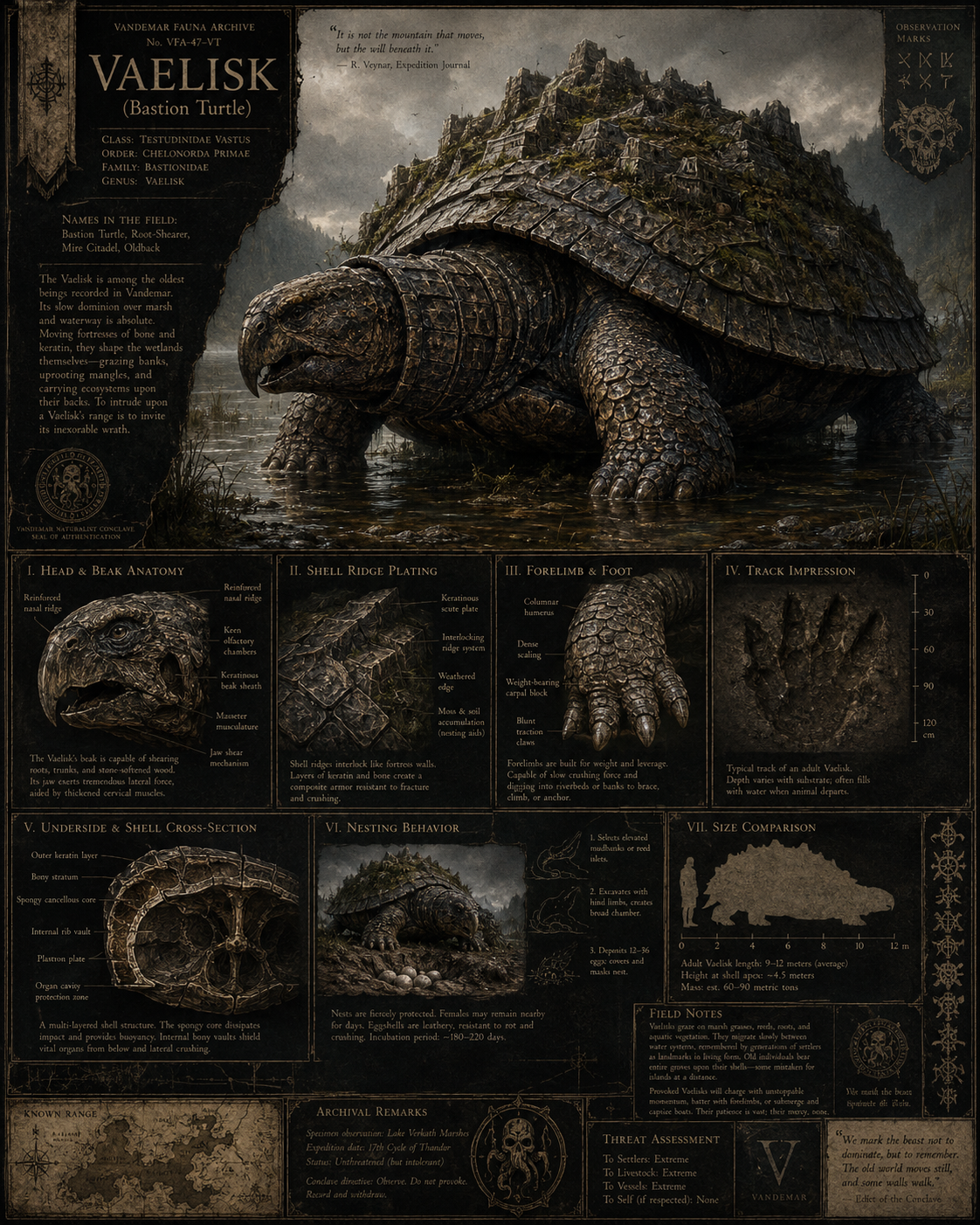
- Intent: To fill the world of Vandemar with interesting and diverse life that is intriguing to roleplay with.
- Image Credit:
- Canon: N/A
- Permissions: N/A
- Links: Vandemar
GENERAL INFORMATION
- Name: Vaelisk
- Designation: Non-sentient
- Origins: Vandemar; lake shores, slow rivers, flooded meadows and temperate wetlands
- Average Lifespan: 90–140 standard years
- Estimated Population: Planetary; widespread but locally concentrated around major freshwater systems
- Description: The vaelisk is a massive semi-aquatic grazer whose ridged shell resembles a low fortress of overlapping stone. Usually slow and placid, it becomes brutally direct when threatened, withdrawing its head behind a reinforced collar before surging forward with enough force to splinter trees and overturn light vehicles. Entire wetland communities have learned to build around the paths of animals older than their settlements.
PHYSICAL INFORMATION
- Breathes: Type I atmosphere; capable of remaining submerged for up to three standard hours
- Average Height of Adults: 1.8–2.5 metres at the highest shell ridge
- Average Length of Adults: 4.5–6.5 metres
- Skin color: Grey, olive, brown, black or muted ochre
- Hair color: None
- Distinctions: Vaelisks possess broad bodies, thick columnar limbs and a layered shell composed of interlocking keratinous plates over dense bone. The shell rises into irregular ridges that collect soil, moss and nesting material. Their head is protected by a reinforced neck collar, while the heavy beak can shear through roots, timber and light structural alloys. Males develop higher forward shell ridges and heavier jaw plates; females are generally broader and carry smoother rear shells suited to nesting. Elderly specimens accumulate extensive plant growth, eroded shell edges and pale mineral streaks.
- Races: None formally recognised. River vaelisks are narrower and more streamlined, while lake populations grow larger and develop heavier shells.
- Force Sensitivity: Non-Sensitive
- Extremely durable shell and reinforced frontal anatomy
- Powerful charge and crushing beak
- High resistance to cold, injury and poor-quality forage
- Slow turning speed and limited agility
- Exposed leg joints and softer underside
- Poor vision beyond short distances
CULTURE
- Diet: Herbivore. Vaelisks consume reeds, aquatic plants, bark, roots, fallen fruit and mineral-rich mud. They occasionally ingest carrion unintentionally while feeding but do not actively hunt.
- Communication: Low bellows, shell impacts, scent marking and vibrations produced by stamping or scraping against stone.
- Technology level: None.
- Religion/Beliefs: None.
- General behavior:Vaelisks are usually solitary or found in loose groups near abundant feeding grounds. They follow deeply ingrained seasonal routes between water, mineral licks and nesting sites. When threatened, a vaelisk lowers its body, retracts its head and advances behind its shell like a living battering ram. Females bury clutches in elevated banks and guard the surrounding territory until the young emerge. Juveniles remain near shallow water for several years, sheltering beneath adults when predators approach.
Small birds, insects and amphibious animals frequently nest within the shell ridges of mature vaelisks. Older individuals may carry entire miniature ecosystems across their backs.
HISTORICAL INFORMATION
Vaelisks are among Vandemar's oldest surviving megafauna. Fossil remains suggest that their ancestors were smaller river grazers whose shells thickened in response to increasingly powerful wetland predators.
Early settlers used abandoned vaelisk shells as shelters, barricades and building material. Attempts to domesticate living specimens failed; the animals tolerated human presence but resisted direction, confinement and artificial breeding.
Modern Vandemar protects established vaelisk routes and relocates settlements rather than forcing elderly animals to change course. Individuals that wander into urban districts are redirected with food trails, low-frequency sound and mobile barriers.
Their shell has become a symbol of patient defence in several provincial traditions. The creature itself is not regarded as noble or wise. It simply endures, crushing whatever mistakes endurance for weakness.