

✠ Nihilus Indomitus ✠


- Intent: To fill the world of Vandemar with interesting and diverse life that is intriguing to roleplay with.
- Image Credit:
- Canon: N/A
- Permissions: N/A
- Links: Vandemar
GENERAL INFORMATION
- Name: Vaedran Hornbeast
- Designation: Non-sentient
- Origins: Vandemar; temperate plains, broad valleys and open woodland
- Average Lifespan: 55–75 standard years
- Estimated Population: Planetary; several large herds distributed across Vandemar
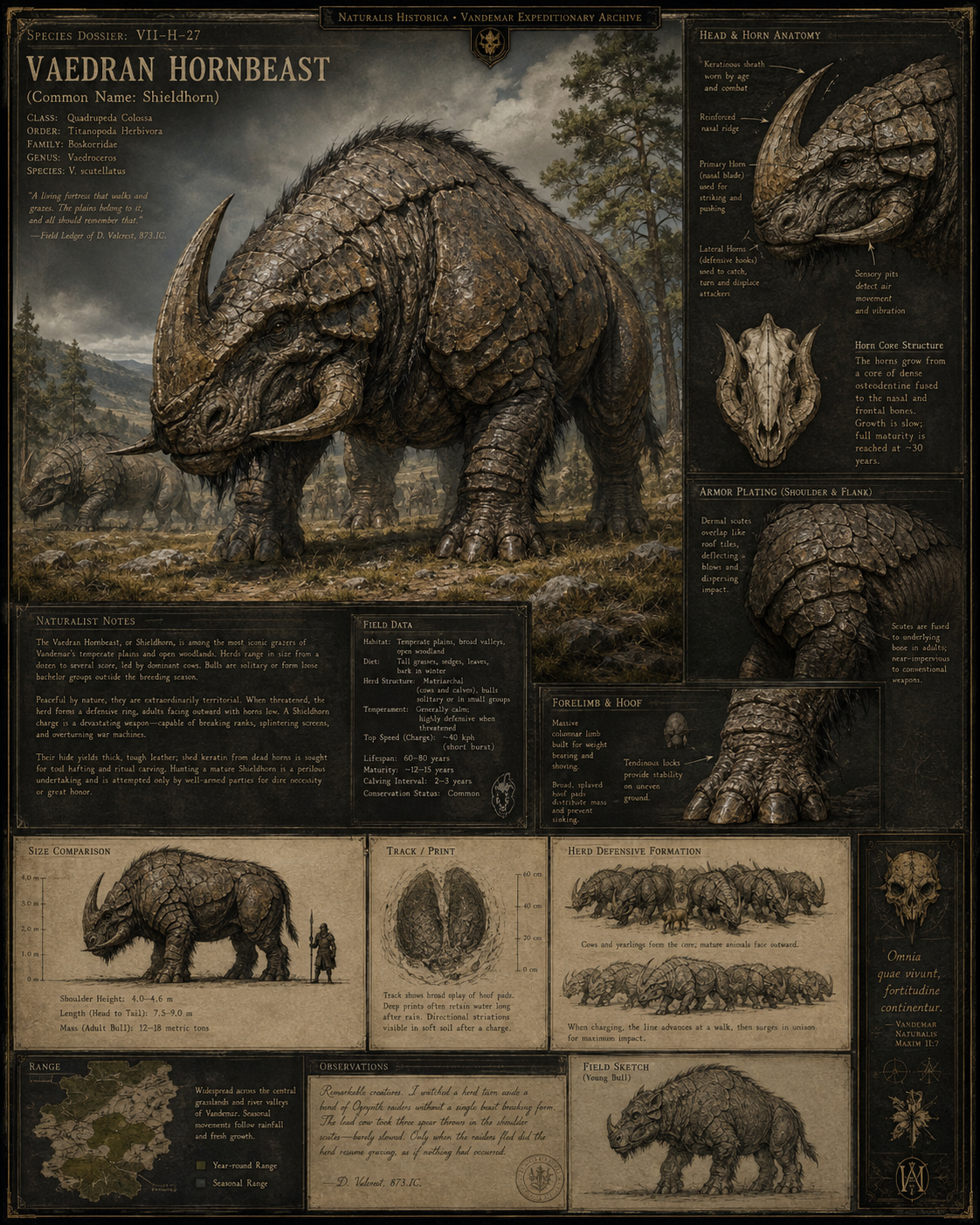
- Description: The Vaedran hornbeast is a colossal armoured grazer whose interlocking herds resemble advancing fortress walls. Calm when left undisturbed, shieldhorns become brutally coordinated when threatened, closing ranks around their young before crushing predators between converging adults. Once the herd begins to charge, little remains in its path but flattened earth and broken machinery.
PHYSICAL INFORMATION
- Breathes: Type I atmosphere
- Average Height of Adults: 2.4–3.1 metres at the shoulder
- Average Length of Adults: 5–6.8 metres
- Skin color: Grey, ash-brown, dark ochre or muted olive
- Hair color:Sparse black, brown or grey bristles
- Distinctions: Shieldhorns possess thick columnar limbs, a low body and overlapping plates across the head, shoulders and flanks. A broad, blade-shaped horn grows from the reinforced nasal ridge, supported by two shorter lateral horns used to hook and turn attackers. Males are larger and carry longer frontal horns, while females possess wider shoulder plates and form the central defensive line around calves. Older specimens develop chipped armour, polished horn edges and pale grooves where repeated impacts have worn through the outer keratin.
- Races: None formally recognised. Northern populations possess heavier coats and shorter horns, while lowland shieldhorns grow larger and carry broader facial armour.
- Force Sensitivity: Non-Sensitive
- Extensive natural armour and great physical mass
- Highly coordinated herd defence
- Powerful frontal charge capable of crushing light vehicles
- Poor rearward vision and limited mobility in confined terrain
- Vulnerable abdomen and rear leg joints
- Prone to mass panic when separated from the herd
CULTURE
- Diet: Herbivore. Shieldhorns feed on grasses, woody shrubs, bark and mineral-rich roots. Herds frequently excavate exposed clay and stone to obtain minerals required for horn and plate growth.
- Communication: Deep bellows, hoof impacts, horn scraping, scent marking and low-frequency calls transmitted through the ground.
- Technology level: None.
- Religion/Beliefs: None.
- General behavior: Shieldhorns live in herds of twenty to more than one hundred individuals led by several mature females. When threatened, calves and injured animals are driven into the centre while adults form an outward-facing ring. Rather than merely repel predators, the herd attempts to trap them between advancing groups. Males become more solitary during the breeding season and settle dominance disputes through prolonged pushing contests. Calves remain under collective protection for several years and are rarely left unattended.
HISTORICAL INFORMATION
Vaedran hornbeasts once ranged across most of Vandemar's open continental regions. Their armour evolved against large pack predators, while their defensive formations allowed them to survive species capable of killing isolated adults.
Early Vandemarian rulers attempted to domesticate them as living siege engines. Armour harnesses, neural restraints and stimulant implants were tested with limited success. The animals could be directed toward a target, but panic, pain or the loss of herd contact frequently caused them to turn upon handlers and supporting troops. Military use was eventually prohibited.
Modern Vandemar protects major herds and preserves their traditional grazing routes. Agricultural districts use reinforced diversion walls rather than conventional fences, and high-speed transit lines are elevated above known crossings.
Among provincial soldiers, a defensive formation that closes too tightly to be broken is still described as taking the Vaedran wall.