

Emberlene's Daughter, The Jedi Generalist
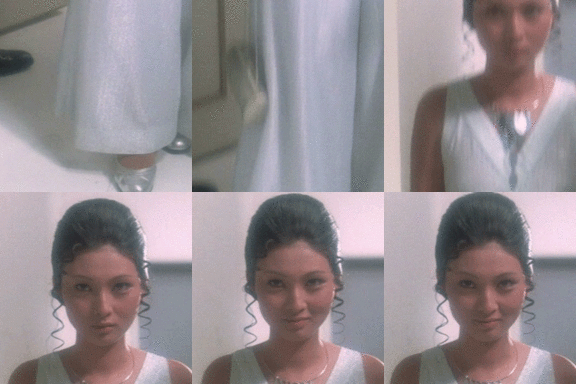




Affiliation: Sasori Research, Atrisian Commonwealth, Order of the Silver Jedi, Denon
Manufacturer: Sasori Research
Material: Refined Sleg Ultracapacitors, Sasori Kanamara, Materia, Hypertech Generator, Subcomb Back up System, "Aegis Echo", Chronal Recycling Engine
SPECIAL FEATURES
- Legion Protocol: Atrisian Model: S-Class Buddy MK.X - The Legion Protocol serves as the control and resource-management system for the Iota Armory. The full Legion Protocol possesses functions beyond the scope of the Iota, but within this system it is restricted primarily to fabrication management, diagnostics, resource allocation, and coordination between compatible Iota modules.
For example, damaged equipment can be identified as either repairable or suitable for reclamation. Recovered material can then be assigned toward repairs, ammunition, replacement components, tools, medical equipment, or another approved pattern according to the needs of the user.
When several Iota modules are connected, Legion can also exchange inventory and fabrication information between them. One module may therefore provide material or perform a fabrication task for another if its available resources make it better suited to do so.
Its purpose within the Iota is therefore logistical rather than omniscient: it determines what resources are available, what can be made from them, and how those resources can be used efficiently.
Reclamation System
The Iota incorporates a molecular reclamation system derived from established molecular furnace and converter technologies.
Suitable damaged equipment, raw material, scrap, and dedicated feedstock can be broken down and separated into material usable by the Iota. Material that is already suitable for fabrication can be retained directly, while other substances can undergo additional processing before being placed into the system's reserves.
The reclamation process is not perfectly efficient. Contamination, unsuitable materials, damage, and repeated processing cause some material to be lost during each cycle.
The Iota therefore extends the usefulness of its available resources but cannot recycle the same quantity of matter indefinitely without replacement feedstock.
Material Refinement and Synthesis
Once material has been reclaimed, the Iota processes it into forms usable by its fabrication system.
Molecular furnaces and molecular converters provide the underlying principles for breaking down and converting supplied matter, while material synthesis and material synthesizers provide precedent for transforming available elements into other useful substances.
The Iota uses these principles to produce many of the alloys, polymers, ceramics, chemicals, and other common materials required by its approved construction patterns.
This process rearranges and converts supplied matter rather than creating matter from nothing.
Certain rare, exotic, highly specialized, or otherwise incompatible substances cannot be practically manufactured by the Iota and must be supplied separately.
Constructor Fabrication System
Processed material is transferred to the Iota's fabrication assembly.
The system draws upon the principles of Gree constructors, which could manufacture equipment from supplied basic materials when given an example of the desired object.
The Iota replaces the requirement for a physical example with stored and approved Sasori construction patterns. These patterns contain the specifications required to fabricate compatible equipment.
Depending upon the size of the host platform and the resources available, the Iota can construct items such as ammunition, tools, replacement components, restraints, medical supplies, armor components, weapons, and other approved equipment.
More complicated devices may require specialist components that are stored separately and incorporated during assembly rather than fabricated from ordinary feedstock.
The Iota cannot independently invent unfamiliar technology or manufacture devices for which it does not possess an appropriate construction pattern.
Materia Fabrication Medium
Materia serves as an adaptable construction and repair medium within compatible Iota systems.
It assists with assembly, material distribution, and repairs to components for which the Iota possesses valid construction specifications. Damaged sections can be compared against stored patterns, reclaimed where necessary, and rebuilt using available reserves.
Materia can also provide temporary structural support while a more complete repair or fabrication process is performed.
Its capabilities remain dependent upon available material and energy. It cannot restore missing mass without feedstock, reproduce unknown technology, or instantly repair catastrophic damage.
Modular Architecture
The Iota Armory is designed as a universal module rather than a single wearable device.
Its core reclamation, processing, fabrication, and control systems can be scaled and incorporated into different compatible platforms. Personal equipment uses smaller systems with limited reserves, while vehicles, droids, starships, workshops, and fixed installations can support larger processors, greater material stores, and more substantial fabrication chambers.
The underlying process remains the same regardless of scale:
reclaim material → process material → fabricate approved equipment → reclaim equipment when no longer required.
The capability of an Iota installation is therefore directly related to the size, power supply, material reserves, and fabrication hardware available to the platform carrying it.
Resource Recovery
The Iota is designed to recover as much useful material and energy as reasonably possible from its operating environment.
Compatible waste material can be directed back into the reclamation system, while conventional fuel converters and solid fuel converters can supplement the system's power reserves where appropriate.
Larger installations may also incorporate collection systems derived from starship scoops to gather useful atmospheric, liquid, or environmental material for processing.
These systems supplement normal stores rather than replacing them. Dedicated feedstock and conventional power sources remain considerably more efficient.
Compact Storage
The Iota can use molecular-disruption technology for the temporary compact storage of selected specialist components that are impractical to manufacture on demand.
The established molecular disruptor temporarily reduces the physical dimensions of affected objects. The Iota uses related principles only for limited storage of completed components rather than as its primary method of fabrication.
Because the effect requires stabilization and does not provide unlimited capacity, most Iota equipment is manufactured from available material instead of being stored in reduced form.
STRENGTHS
Adaptive Fabrication
The Iota does not require its user to carry every possible piece of equipment in completed form.
Provided sufficient resources and an approved pattern are available, the same material reserve can be used to manufacture different equipment according to current requirements.
This allows the system to adapt its available inventory during an operation rather than relying entirely upon equipment selected beforehand.
Material Reclamation
Damaged, obsolete, or unnecessary compatible equipment can be reclaimed and returned to the Iota's material reserves.
This reduces waste and allows part of the material invested into one item to be reused for repairs or later fabrication.
Modular and Scalable
The Iota is not restricted to a single type of equipment.
Its architecture can be incorporated into personal gear, droids, vehicles, starships, workshops, or installations. Larger platforms can support more feedstock, power, specialist components, and fabrication capacity than smaller versions.
Field Repair
Because the Iota possesses construction patterns for compatible equipment, damaged components can be identified, reclaimed, and reconstructed when sufficient resources are available.
This can reduce dependence upon dedicated replacement parts during extended operations.
Resource Management
Integration with the Legion Protocol allows the Iota to monitor its own feedstock, power, specialist components, damaged equipment, and fabrication demands.
This helps prevent unnecessary duplication and allows limited resources to be assigned according to actual requirements.
Closed-Cycle Operation
Fabricated equipment can be returned to the same system that produced it.
An item that is no longer useful can therefore become part of the material reserve for whatever is required next.
WEAKNESSES
Imperfect Recycling
Reclamation is not completely efficient.
Repeated processing, contamination, damaged material, unusable compounds, and fabrication waste gradually reduce the quantity of recoverable matter.
Power Consumption
Breaking down matter, refining materials, synthesizing compounds, and constructing equipment consume substantial energy.
Small personal installations have considerably less fabrication capacity than vehicle, starship, or installation-scale systems because their available power is correspondingly limited.
Extensive fabrication can also compete with other systems for power.
Fabrication Time
The Iota is not an instantaneous equipment generator.
Simple items and replacement components can be produced comparatively quickly, while larger or more complicated equipment requires additional processing, assembly, and calibration time.
The amount of time required increases with the size and complexity of the requested object.
Specialist Components
Not every component can be produced from common feedstock.
Rare crystals, advanced electronics, unusual energy systems, exotic materials, proprietary components, and other specialized parts may need to be carried separately.
If the required specialist component is unavailable, the Iota cannot complete an equipment pattern that depends upon it.
Pattern Dependency
The Iota manufactures from stored construction patterns.
It cannot reproduce unfamiliar equipment merely by encountering it, nor can it independently invent a new technology simply because suitable material is available.
New equipment must first be properly designed, entered into the system, and authorized for fabrication.
Host Platform Limitations
An Iota module cannot exceed the practical limitations of the platform containing it.
A small personal installation cannot fabricate objects requiring the material reserves, fabrication volume, or power output of a starship installation.
The universal nature of the module refers to its ability to be integrated into different platforms, not identical performance regardless of scale.
Vulnerable During Fabrication
Fabrication requires functional processing equipment, power, feedstock, and time.
Damage to the reclamation chamber, material processors, fabrication assembly, power supply, or control systems can reduce or completely halt production until repairs are made.
Network Dependence for Shared Functions
An individual Iota remains capable of local operation without access to the larger Legion network, but shared inventory, distributed fabrication, and cross-unit resource management require communication between participating modules.
Jamming, communications disruption, slicing, or physical separation can therefore prevent Iota systems from sharing resources and information, forcing each module to operate independently.
Self-Repair Is Resource Dependent
The Iota's self-repair capabilities do not make it indestructible.
Repair requires an operational portion of the fabrication system, sufficient power, an intact construction pattern, and enough replacement material.
Severe damage to the fabrication system itself may require conventional external repair before the Iota can restore its own functions.
DESCRIPTION
The Iota Armory was developed as an extension of Sasori's Omega program and its continuing research into molecular fabrication. Its purpose was to reduce the amount of redundant equipment a soldier was required to physically carry while still allowing access to a broad range of weapons, tools and replacement components.
An Iota operates as a closed-cycle fabrication system rather than a conventional duplicator. Matter must first be supplied to it. Dedicated fabrication stock can be carried within compatible armor and equipment, while damaged weapons, broken components and suitable environmental materials can be reclaimed during operation.
Recovered material enters a miniature molecular processing assembly inspired by industrial molecular furnace and converter technology. The material is broken down, separated and sorted into substances the Iota can use. Material already suitable for fabrication enters storage directly, while unsuitable matter can be passed through additional conversion systems to produce usable feedstock.
Where the required substances are not immediately available, the Iota's synthesis chamber employs principles derived from Gree material synthesis. Common constituent elements can be reconfigured into selected elements, isotopes and chemical compounds required by the fabrication process. This does not eliminate the requirement for matter: the synthesizer rearranges supplied material rather than producing mass from nothing.
The prepared feedstock is then transferred to the Iota's constructor assembly. Stored Sasori equipment patterns function in much the same fashion as the examples required by ancient Gree constructors, providing the system with a complete model of the object it is expected to assemble. Fabrication swarms and micro-assembly systems construct the item from the prepared material, incorporating separately stored specialist components when the requested device requires parts that cannot practically be synthesized in the field.
This allows the Iota to manufacture a wide selection of approved Sasori equipment without physically storing every completed item. A soldier might reclaim an unwanted rifle and later use much of its mass in the fabrication of restraints, replacement armor plates, additional ammunition, survival equipment, tools or another approved weapon. When an item is no longer required it can be returned to the reclamation cycle, although losses, contamination and material incompatibility prevent perfect recovery.
The Iota's materia serves as both fabrication medium and active reserve. Programmable microscopic machines contained throughout compatible Sasori equipment can redistribute themselves where required, creating temporary structural frameworks, assisting assembly, replacing damaged components and reinforcing compromised sections of armor. Existing Sasori-resistant materials incorporated into the materia can likewise be concentrated across threatened areas rather than requiring every portion of a suit to carry the same amount of specialized protection.
The system possesses an extensive self-maintenance capability but is not independently inventive. Damage to known Iota components can be identified against stored specifications, the damaged material reclaimed, and replacement components manufactured from available reserves. Calibration software can improve fabrication tolerances and incorporate approved software or design revisions, but the Iota cannot spontaneously develop technologies for which it possesses neither a pattern nor the necessary technical information.
Power follows the same philosophy of recovery rather than unlimited generation. Starship fuel converters demonstrate that waste material and other substances can be processed into usable fuel, while solid fuel converters can convert a wide variety of matter into power for fuel cells. Iota systems use this principle as an auxiliary means of recovering energy from appropriate waste products. The conversion process remains inefficient enough that dedicated power cells and reactors are still preferable under normal circumstances.
Larger Iota installations can additionally incorporate technology inspired by starship scoops, allowing compatible vehicles and vessels to collect useful material from an atmosphere or body of water and feed it into their processing systems. Personal units lack the collection capacity necessary to make this efficient on their own and instead rely on carried reserves or material supplied through connected equipment.
Sasori also experimented with principles derived from the molecular disruptor. Unlike the Iota's reclamation systems, molecular disruptors do not deconstruct matter but temporarily reduce the physical size of objects exposed to them. Iota derivatives use the concept only for temporary compact storage of selected completed components that cannot conveniently be fabricated on demand. Because the original phenomenon was temporary, such storage requires continued stabilization and is intentionally restricted to a limited reserve rather than serving as the Iota's primary armory.
Ancient engineering studied by the Gree, Kwa, Rakaata, K'kybek, Karra, Zhell, Shadex contributed to Sasori's understanding of the exotic technologies involved in the project, but the Iota does not function as an unlimited dimensional storage space. Its apparent capacity instead comes primarily from repeatedly reusing the same material in different configurations.
This also establishes the Iota's primary limitation. It cannot violate conservation of available resources. Every constructed weapon or repair consumes feedstock and energy, specialized components must be supplied when the fabrication systems cannot reproduce them, and some material is inevitably lost during prolonged operation. Large equipment requires correspondingly large material reserves, making connection to vehicles or fixed installations considerably more capable than a personal unit.
TL;DR
The Iota Armory is a modular recycling, fabrication, and equipment-management system.
It does not create matter from nothing, provide unlimited equipment, predict the future, or ignore the limitations of its host platform.
Its basic operation is simple:
Material goes in → useful material is separated or converted → an approved item is fabricated → unwanted or damaged equipment can later be recycled.
The individual technologies behind that process already exist throughout Star Wars in various forms. Molecular furnaces and converters process matter, material synthesizers alter available substances into useful materials, constructors manufacture equipment from supplied material, fuel converters reclaim useful energy, droid and nanotechnology perform automated construction and repair, while targeting computers, heuristic processors, battle computers, and droid brains coordinate weapons, vehicles, sensors, and other systems.
The Iota's advancement is therefore not that Sasori invented a new law of physics. Sasori combined, miniaturized, and standardized existing technological principles into a single modular support system.
The Legion Protocol is simply the computer architecture that coordinates those functions. It manages targeting information, sensors, resources, fabrication requests, damage reports, shields, vehicles, and connected equipment. It can learn from previous data and share useful information between authorized systems, but it remains dependent upon sensors, communications, available resources, and existing programming.
The system can be installed into different platforms because it is a module rather than a specific piece of equipment. A suit of armor receives a small version. A droid or weapon receives a specialized version. A vehicle, starship, or installation can support a much larger version with greater power and material reserves.
The larger the host platform, the more capable the Iota becomes.
Its limitations remain straightforward:
Instead of carrying every possible spare part, weapon, tool, or repair component in finished form, the user carries a smaller amount of reusable material and lets the system configure that material into what is needed.
That is the entire concept.
Recycle what you have. Build what you need. Reuse it when you are finished.
It does not create matter from nothing, provide unlimited equipment, predict the future, or ignore the limitations of its host platform.
Its basic operation is simple:
Material goes in → useful material is separated or converted → an approved item is fabricated → unwanted or damaged equipment can later be recycled.
The individual technologies behind that process already exist throughout Star Wars in various forms. Molecular furnaces and converters process matter, material synthesizers alter available substances into useful materials, constructors manufacture equipment from supplied material, fuel converters reclaim useful energy, droid and nanotechnology perform automated construction and repair, while targeting computers, heuristic processors, battle computers, and droid brains coordinate weapons, vehicles, sensors, and other systems.
The Iota's advancement is therefore not that Sasori invented a new law of physics. Sasori combined, miniaturized, and standardized existing technological principles into a single modular support system.
The Legion Protocol is simply the computer architecture that coordinates those functions. It manages targeting information, sensors, resources, fabrication requests, damage reports, shields, vehicles, and connected equipment. It can learn from previous data and share useful information between authorized systems, but it remains dependent upon sensors, communications, available resources, and existing programming.
The system can be installed into different platforms because it is a module rather than a specific piece of equipment. A suit of armor receives a small version. A droid or weapon receives a specialized version. A vehicle, starship, or installation can support a much larger version with greater power and material reserves.
The larger the host platform, the more capable the Iota becomes.
Its limitations remain straightforward:
- It requires matter.
- It requires power.
- It requires stored construction patterns.
- Some advanced components must still be supplied separately.
- Recycling is not perfectly efficient.
- Large objects require greater resources and fabrication time.
- Legion can be jammed, deceived, sliced, damaged, or disconnected.
- It cannot fabricate technology it does not understand.
- It cannot predict genuinely unknown events.
- It cannot produce infinite equipment.
Instead of carrying every possible spare part, weapon, tool, or repair component in finished form, the user carries a smaller amount of reusable material and lets the system configure that material into what is needed.
That is the entire concept.
Recycle what you have. Build what you need. Reuse it when you are finished.
Out Of Character Info
Intent:
To develop a hybrid of canon technologies in the spirit of star wars
Canon Link:
N/A
Permissions:
N/A
Primary Source(s):
https://starwars.fandom.com/wiki/Molecular_disruptor
https://starwars.fandom.com/wiki/Molecular_furnace
https://www.programmable-matter.com/?embedable=true
https://starwars.fandom.com/wiki/Material_synthesis
https://starwars.fandom.com/wiki/Material_synthesizer
https://starwars.fandom.com/wiki/Constructor_(device)
https://starwars.fandom.com/wiki/Dimensional_engineering
https://starwars.fandom.com/wiki/Molecular_converter
https://starwars.fandom.com/wiki/Heat_generator_(Karra)
https://starwars.fandom.com/wiki/Exo-technology
https://starwars.fandom.com/wiki/Solid_Fuel_Converter
https://starwars.fandom.com/wiki/Fuel_converter
https://starwars.fandom.com/wiki/Scoop
Technical Information
Affiliation:
Sasori
Model:
Molecular Weaponry
Modular:
Yes
Material:
Refined Sleg Ultracapacitors, Sasori Kanamara, Materia, Hypertech Generator, Subcomb Back up System, Chronal Recycling Engine, Saotome Rill Frame
Last edited: