
Nothing's Like Before




RANAU
OUT OF CHARACTER INFORMATION
- Intent: To modernize the approved city of Ranau to current Imperial Commonwealth of Dosuun standards (907 ABY), deepening its cultural foundation and aligning its governance, institutions, and demographics with the present era.
- Image Credit: ChatGPT
- Canon: Vassek
- Permissions: N/A
- Links: Ranau OG
- City Name: Ranau
- Classification: Urban Center
- Location: Vassek
- Affiliation: The Imperial Commonwealth of Dosuun
- Population: Moderate
- Demographics:
- Age:
- 18% 0–15
- 57% 16–64
- 21% 65–100
- 4% 100+
- Gender:
- 47% Female
- 44% Male
- 9% Non-Binary
- Species:
- 30% Kaleesh
- 22% Human
- 10% Epicanthix
- 7% Korun
- 6% Echani
- 6% Chiss
- 5% Keshiri
- 4% Kiffar
- 4% Pantoran
- 6% Other
- Age:
- Wealth: Medium
Ranau has never measured its wealth in towers or treasuries. The city's prosperity is rooted in the terraces that climb the canyon walls — the orchards of Incu cactus-pear and the high-shelf rows of Apoko pepper — and in the older, slower fortunes of preservation: fermented fruit-leathers, smoke-dried pastes, sour grain breads, and mineral-cured snacks that travel well and keep for seasons. Under the Commonwealth, this agrarian base has been joined by a quiet creative economy. The conservatories, acoustic ateliers, and ritual-craft houses draw students and patrons from across the sector, and the city now exports its music and its preserved goods in roughly equal measure. It is a comfortable city rather than a rich one — but comfort, on Vassek, is a kind of wealth few canyon worlds achieve. - Stability: High
Ranau is a settled, low-friction city, and has been for generations. Public safety is handled by the Ranau Constabulary, a civil peace service drawn largely from the canyon's own families, supported where needed by a light Imperial Commonwealth presence rather than an occupying one. The Constabulary's work is less the suppression of crime than the maintenance of an old social contract: water discipline, terrace law, and the ritual codes that govern public contest. Disputes are more often settled in the contest-courts than the cells. Off-world threats — smuggling interests drawn to the canyon's quiet, the occasional raider testing an Outer Rim backwater — have been steadily discouraged, and the canyon's single controlled approach through Telle makes the city difficult to trouble and easy to defend. Heavier security sits above and apart at the Hauveth Joint Command beyond the rim, where Commonwealth forces and local defense volunteers share the watch — present and capable, but kept deliberately out of the canyon's daily life. - Freedom & Oppression: High freedom; legacy frictions acknowledged.
Ranau's defining liberty is older than any government that has flown a banner over it: the right of the canyon's people to keep their own rites. The Kaleesh families who descended from Vassek's third moon brought ancestor-veneration, the ceremonial mask, and a tradition of honor-contest that the city never suppressed but instead refined — folding it into civic life as ritual rather than bloodshed. Under the Imperial Commonwealth, that protection has been formalized: freedom of worship, of assembly, and of public performance are held as municipal guarantees, and the contest-courts that once might have been viewed with suspicion are now recognized cultural institutions. This is not a city without shadow. Old hierarchies between the founding Kaleesh lineages and the later-arriving human and refugee populations have not vanished, and the canyon's tight water-law can press hardest on its newest and poorest. But the trajectory is clear, and Ranau is widely regarded as one of the freer cities in the Commonwealth's reach — a place where a people's oldest traditions are treated as heritage to be safeguarded, not tolerated. - Description:
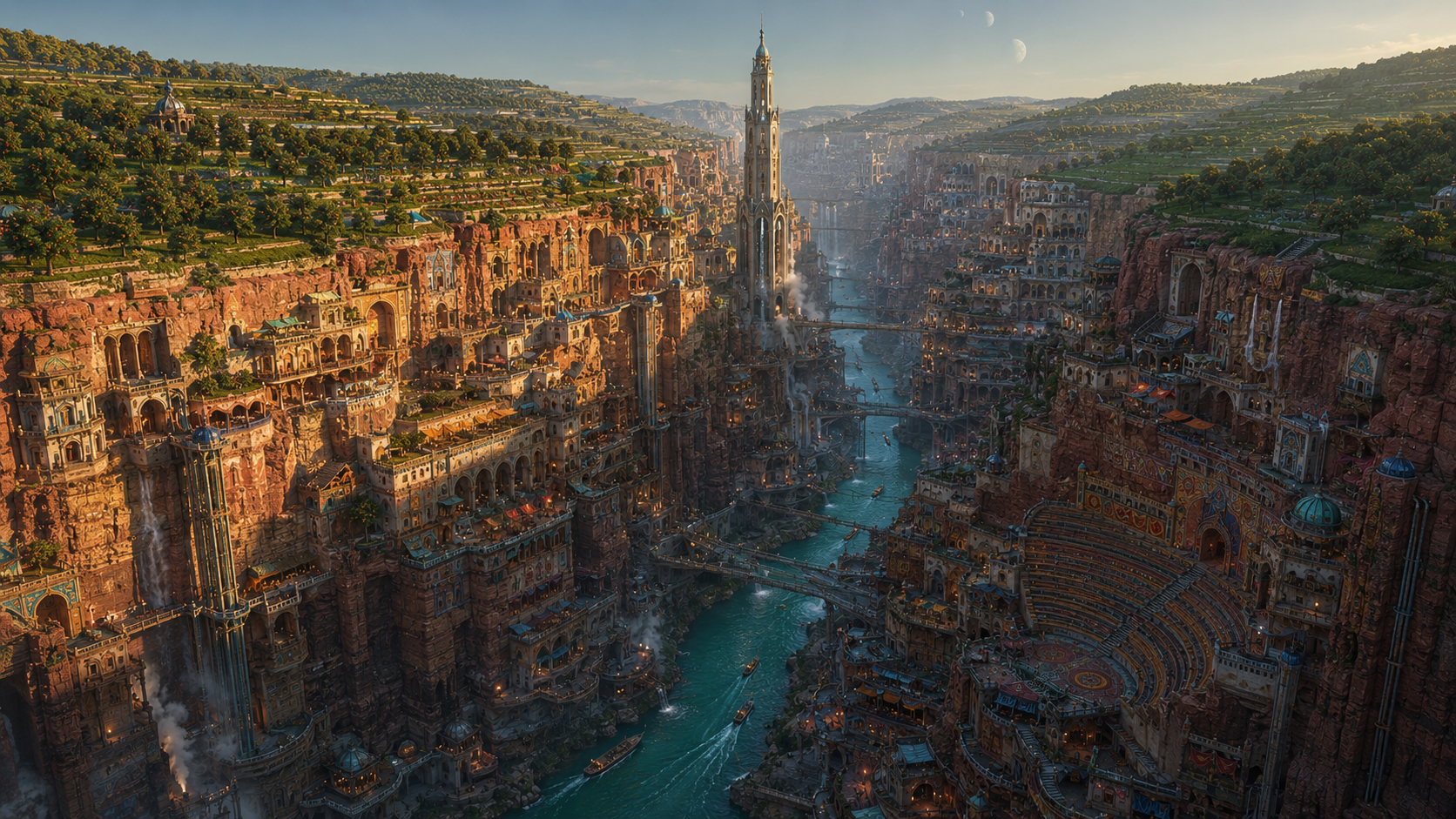
Ranau is built into the base and walls of a canyon along the Cynthonna River, and it is most often called the Painted City of Vassek — a name that earns itself twice a day. By daylight the terraces and stacked stone dwellings catch the sun in ochre, rust, and bone-white, the orchard greens vivid against the canyon's red. By night, when the work-lamps and the glow of the Ha'iiaago towers come up, the city seems to answer the stars, light pooling along the ledges and bridges in long warm seams. Nothing is built taller than it needs to be; the tallest structure remains the Ha'iiaago energy tower, by old custom and by law.
The canyon is not merely the city's setting but its instrument. Sound carries here — voice, drum, long horn, and string move through the stone corridors and open amphitheaters in a way that shaped the entire culture. A single concert in one quarter bleeds into the next until the whole canyon seems to be singing, and the Ranaui have spent generations learning to build, perform, and even speak with the canyon's acoustics in mind. This is the deep root of the city's identity: a people who learned that in a place this resonant, how a thing sounds is never separate from what it is.
Movement through Ranau runs along three arteries. United Speeder Services — "Yellow Speeder," or "Low-Sped" to the canyon's young — carries passengers along the ledges and bridges. The Ra-Met, a network of light trams, crosses the canyon on slender spans and threads between the zones — running terrace to terrace and wall to wall rather than burrowing beneath the stone, a lighter touch that suits the Painted City and gives riders the canyon's full painted face as they cross. And the Cynthonna itself carries river-craft: the taxi-boats locals call the Tourist River, threading past theaters, markets, museums, and memorial sites, stopping at quays cut into the canyon base. The Telle Spaceport sits beyond the energy tower, deep within the canyon, and remains the single controlled way in and out — a deliberate bottleneck. Craft over 140 meters cannot make the descent; larger vessels dock at the orbital station above and send passengers down by shuttle.
POINTS OF INTEREST
I. The Telle Approach
The city's threshold — the lower canyon mouth, where every visitor first arrives.
- Telle Spaceport The single controlled way in and out of Ranau, set deep in the canyon beyond the energy tower. The descent enforces its own law: craft over 140 meters cannot make the passage, and larger vessels dock at the orbital station above, sending passengers and cargo down by shuttle. Telle is deliberately the city's only gate — a bottleneck that makes Ranau difficult to trouble and easy to defend, and the reason the canyon has stayed quiet through eras that were anything but.
- The Lower Quays Where the spaceport's traffic meets the river, the Lower Quays form Ranau's first impression: a working waterfront of customs houses, freight cranes, and the upstream terminus of the Tourist River taxi line. Arriving travelers transfer here from shuttle to river-craft or speeder, and the quays' cantinas and lodging-houses cater to the in-between hours of those waiting on a berth or a boat.
II. The Cistern Spine — Vaalo'ren
The civic, administrative, and financial heart, grown around the city's most sacred infrastructure. Named in the founding tongue: the keeping-seat.
- Ha'iiaago Solar & Thermal Energy Center The heart of Ranau's survival, and now a Commonwealth-certified public utility and water-security institute. The Ha'iiaago draws water from the deep aquifer — filtering, treating, and distributing it through the city's pipes — and converts the heat of Vassek's core and sun into power. Drawing energy from the planet's heat has been the canyon's way of life for generations; under the Commonwealth, the facility doubles as a teaching institution, training the hydrologists and grid-techs who keep every other canyon settlement alive. Among the Ranaui, water-law is sacred, and the Ha'iiaago is treated less like a plant than a temple to it. Nothing in the city is permitted to rise above its tower.
- The Cistern Court At the base of the Ha'iiaago tower sits the Cistern Court, the civic seat where the canyon's old water-courts still convene. Here the water-witnesses — elders versed in the canyon's allotment law — mediate disputes over terrace rights, aquifer draw, and the seasonal division of the river. The Ranau Constabulary, stood up over the development decade to replace the First Order's military-police garrison, keeps its central station off this court. The two institutions together handle most of what governance the canyon requires.
- Sonnave (Civic Archive) The city's record-house — the stone-that-remembers — where lineage marks, builder's seals, and water-allotment records are kept. By old Vasseki custom a building is not finished until its foundation carries its lineage and its water-right, and Sonnave is where those records live. Under the Commonwealth it has absorbed the municipal registry as well, becoming the single archive of who holds what, and by what older claim.
- Mercaventa (Financial Row) The exchange-front: a short, dense row of cooperative banks, orchard-credit houses, and trade-floors in the trade tongue, anchored by Rojo Ventana Credit Union. Founded to serve musicians, artists, and writers, Rojo Ventana has grown into a true cooperative bank for arts and agriculture alike — the place where an orchard crew and a string ensemble keep their accounts side by side. Its cooperative model sits comfortably within the Commonwealth's civic economy, and the smaller houses of Mercaventa have grown up in its shadow on the same principle.
- Vaa'sonne (The Conservancy) The safeguarding — Ranau's green and sustainability quarter, and the modern institution of the canyon's oldest value. Waste is shameful is among the deepest Vasseki pillars, and Vaa'sonne is where it is now made policy: water-reclamation works, terrace-runoff capture, the canyon's grey-water and composting systems, and the offices that monitor the orchards' health and the river's load. Established over the development decade with Commonwealth backing, it operates less as an environmental ministry imposed from outside than as the formalization of something the canyon already believed — that a people who live inside stone survive only by wasting nothing.
III. The Conservatory Terraces
The acoustic and cultural core, terraced up the resonant canyon wall.
- Waimau University Ranau's flagship institution, historically strongest in music, engineering, and astrophysics, with mathematics, geology, and astronomy close behind. Over the development decade Waimau has expanded into the disciplines the canyon itself demands — hydrology, canyon architecture, and acoustical engineering — alongside a growing program in post-Imperial civic law. Its music conservatory remains its crown, regarded across the sector for the study of how sound moves through stone.
- Ranau Academy of Art The older, more tradition-bound of the city's two great cultural schools, devoted to the canyon's heritage arts: ceremonial music, the mask-craft of the founding lineages, and the moon-timed performance cycles that mark the Vasseki calendar. Where Waimau studies the science of sound, the Academy keeps the meaning of it — and under the Commonwealth has become the principal guardian of Ranau-Kaleesh ritual music, ensuring the oldest forms are taught rather than lost.
- Kachin Amphitheater The finest performance venue in the city and the spiritual center of its musical life. Carved to exploit the canyon's natural acoustics, Kachin is renowned for a clarity that lets a performance be heard, faintly, from the far end of the canyon. The top acts of Vassek perform here, and the great moon-calendar festivals fill its stone tiers to capacity.
- The Mask Courts The terraces' contest-grounds, where the canyon's oldest tradition is kept as living ritual rather than relic. Here the refined honor-contest of the founding Kaleesh lineages is practiced and performed — masked, formal, disciplined, judged as much on bearing and restraint as on skill. Once eyed with suspicion under Imperial rule, the Mask Courts are now recognized cultural institutions, and a contest here can settle a dispute that no court of law would touch. To take the mask is to argue with one's whole body, and to lose with grace is held a higher thing than to win without it.
- Kor'maaru (The Tempering-Grounds) Where the Mask Courts judge, Kor'maaru trains. These are the practice-halls and training terraces where the canyon's warriors are tempered — not the brawlers of Jathuun's fight-halls, but practitioners of the refined contest, schooled in form, restraint, and the discipline of the mask. Students of the Academy of Art cross over to Kor'maaru as a matter of course; the canyon has never fully separated the warrior from the artist, and a master here is as likely to teach breath and bearing as strike and stance. Under the Commonwealth the grounds also quietly train the canyon's planetary defense volunteers, the old tradition feeding the new militia without losing its character.
IV. Iri'aamaa — The Ancestral Terraces
The spiritual zone — place of the ancestors. Kaleesh ancestor-veneration dominates, but the Commonwealth's faiths are given room.
- The Wall-Shrines The oldest sacred sites in Ranau: ancestor-alcoves and worship-niches cut directly into the canyon walls, where the founding Kaleesh lineages have venerated their dead since the descent from the third moon. The First Order, for all its surveillance, left these untouched — it respected the canyon's spiritual traditions, and that single forbearance is part of why the city absorbed the regime without rupture. Under the Commonwealth the Wall-Shrines are protected outright, tended by lineage-keepers, and remain the beating heart of Ranaui spiritual life. The mask, the ancestor, and the canyon are one thing here.
- The Guest Halls Where Iri'aamaa makes room. As the Commonwealth's faiths followed its citizens to Vassek, Ranau did what it has always done with newcomers — it gave them a place rather than turning them away. The Guest Halls are a terrace of smaller houses of worship: a sanctuary of the Celestial Luminarium, whose teachings of cosmic harmony have spread quickly through Commonwealth institutions; a fire-house of the Chiss Red Flame; a hall of the Echani Silver Crescent, whose harmony-through-combat finds a quiet kinship with the canyon's own contest tradition; a shrine of the Panathan Faith, kept by the displaced of that lost world; and a circle of the Keshiri Skyborn. None displaces the Wall-Shrines; all are tolerated, and several are genuinely embraced.
- The Chapel of the Enlightened Balance The most quietly significant of the Guest Halls, set a little apart. The Church of the Enlightened Balance — the faith that teaches every action carries a corresponding reaction elsewhere, and that one's trials feed a greater equilibrium — keeps a modest chapel here. Its presence on so remote a canyon world is no accident: the faith carries weight in the highest Commonwealth circles, and its dignified, unobtrusive footing in Ranau is the kind of thread that ties an Outer Rim backwater quietly to the center of things.
V. Te'maaru — The Healing Terraces
The medical zone — the mending-terraces. Canyon herbal tradition married to Commonwealth medicine.
- The Te'maaru Infirmaries Ranau's hospitals, terraced into the quieter, cleaner upper reaches of the canyon where the air is still and the river-noise fades. Commonwealth accession brought modern medical facilities and bacta to the canyon; what they joined was an old tradition of canyon herbal medicine, drawing on the same orchard botany and fermentation craft that feeds the city. Te'maaru practice is known for blending the two — bacta ward beside herb-room — and for treating convalescence as seriously as cure.
- Aelune (Convalescent Quarter) The quiet-place: a quarter of recovery-houses and sanatoria where the canyon's stillness is itself the treatment. Ranau's clean air, mineral springs, and famous quiet have drawn the convalescent from across the sector for generations, and under the Commonwealth Aelune has grown into a recognized destination for long recovery — the gentle, restorative counterpart to the harder trauma-medicine of industrial Jathuun.
VI. The Cynthonna Quays
The river corridor — the Tourist River — and the makers' quarters that line it.
- The Tourist River The Cynthonna runs the length of Ranau, and the taxi-boats run with it. Locals call it the Tourist River with affection and a little irony; it is where visitors go, but it is also the city's central artery, its stops cut into the canyon base at theaters, markets, museums, and memorial sites. To ride the river at dusk, as the Painted City lights come up along the walls, is the experience every visitor is told not to miss — and most don't.
- Yazhi Parkade and Market Part vehicle-house, part open market. Privately owned speeders and river-craft are housed here, and around them has grown one of the canyon's great markets: produce and cured meats, river-fish fresh and dried, baked goods, spices, honey, and the handmade crafts of the local lineages. A trader's gallery within the market keeps an older custom alive — the exchange of goods by barter rather than coin. Yazhi is the seam made visible: a founding-tongue market full of trade-tongue goods.
- The Preserving Houses The fermenting- and drying-houses where Ranau turns its harvest into the goods it is known for: Incu fruit-leathers, smoke-dried Apoko pepper pastes, sour grain breads, and mineral-cured snacks. Long before the city could freeze food, it used the planet's own heat to preserve it — and that necessity became an industry and then an art. Many houses run tasting-rooms along the river, and the oldest preserving families are minor canyon nobility in their own right.
- Callaro (Tea & Brew Quarter) The steeping-row: a riverside cluster of tea houses and small breweries where the canyon's fermentation culture turns social. Incu wines, Apoko-spiced brews, and a long tradition of canyon herbal teas are made and taken here, and the tea houses double as the city's informal meeting-rooms — where a contest is arranged, a marriage discussed, or a water-dispute talked down before it ever reaches the Cistern Court.
- Tierromar (Pigment & Ceramic Quarter) The fired-earth quarter, and the reason Ranau is the Painted City in fact and not only in light. Here the canyon clays are thrown and fired, and the mineral pigments are ground — the ochres, rusts, and bone-whites that color the city's walls and the indigos and pepper-crimsons of its festival dress. The pigment-makers and ceramicists of Tierromar supply the whole canyon, and their craft is taught at the Academy of Art alongside music.
- Hilaventa (Textile Quarter) The weaving-front: the looms and dye-houses where the canyon's textiles are made — the layered cloth, the woven water-patterns, and the lineage embroidery that marks a family's cuffs and sashes. Hilaventa's geometric water-patterns are read as easily as names by those who know them, and a ceremonial mask is never complete without the cloth that frames it.
- Jabarosa (Soap & Cosmetic Quarter) The scented-wash: a small, fragrant quarter of fine soap-makers and cosmetic houses working in orchard oils, mineral salts, and Incu pressings. What began as the practical craft of a water-disciplined people — nothing wasted, every pressing used — refined over generations into a genuine luxury trade, and Jabarosa's soaps and scented oils are among the small exports that carry Ranau's name off-world.
- Braseca (Street-Food Row) The cook-fire row, and the best eating in the canyon if you don't mind doing it standing up. Braseca is where the preserving-and-fermentation culture turns into walking food: brazier-charred Apoko-spiced meat-sticks, the stuffed hand-pies the Ranaui call canyon-pockets — folded dough filled with spiced meat or orchard fruit, made to be eaten on the move — sweet Incu-glazed pastries, sour grain flatbreads, and the strong canyon coffee and steeped herb-teas that wash it all down. The row runs hottest in the hours around the moon-festivals, when the whole quarter smells of smoke and spice and the queues spill onto the quay.
- Cantoria (Instrument-Makers' Quarter) The song-makers' row — and the quiet reason Ranau's music carries as far as it does. Here the canyon's luthiers, coppersmiths, and woodwind masters build the instruments the city is known for: the long horns hammered in beaten copper to throw sound down the canyon, the resonant stringed instruments shaped to the canyon's own acoustics, the carved woodwinds voiced to the festival scales. The craft is generational and exacting, taught alongside performance at Waimau and the Academy, and some of the Commonwealth's finest musicians make the journey to Vassek for no reason other than to commission an instrument from a Cantoria master. The city that studies how sound moves through stone also builds the things that make it.
VII. Old Ranau & the High Orchards
The protected high settlement where the city began, under National Park Authority stewardship.
- Old Ranau (National Park / Heritage Site) The original canyon settlement, preserved as a protected heritage site. Once founded by those fleeing the Gulag Plague and later scarred by the Netherworld event, Old Ranau is maintained as the city's memory of itself — the place where the canyon's first homes, cisterns, and ancestor-alcoves were cut into stone. It is now overseen by the Commonwealth's National Park Authorities, which assumed stewardship of all Vasseki heritage and nature-preservation sites from the dissolved First Imperial Historical Sites Services at accession.
- The High Orchards & Apoko Rim The terraced orchards climb to the canyon's upper shelves, where the Apoko pepper grows along the rim. By old law — predating the Commonwealth and now enforced by the National Park Authorities — nothing may be built atop the canyon: no structure, no speeder pad, no landing platform may break the rim or shadow the high rows. The orchards are working land and protected land at once, and the rim-law is among the canyon's most fiercely kept traditions.
- Ute'Rao Geological Research Firm Founded to study Vassek's unusual canyon geology and once closely supervised by Imperial science authorities, Ute'Rao has shifted under the Commonwealth from data-extraction toward transparent planetary stewardship — hazard mapping, aquifer monitoring, and terrace-stability survey. Anchored near Old Ranau, where the oldest stone offers the deepest record, it still accepts study contracts from off-world institutions and exchanges data with the universities of the Commonwealth.
VIII. Hauveth — The High Seat
The Commonwealth joint command, set on the open tableland beyond the protected rim — respectfully distanced from the canyon it guards.
- Hauveth Joint Command Above and apart from the canyon, on the open tableland past the orchard rim, stands Hauveth — the high seat. The Commonwealth maintains a joint military command here in partnership with the locals: a garrison of the Commonwealth Army, a starfighter wing, and the Vasseki planetary defense volunteers trained up from the canyon's own contest tradition. Its siting is not incidental. The Apoko rim-law forbids any structure breaking the canyon's edge, and so the base was built well back from it, on the tableland — close enough to defend Ranau, far enough to honor the law that nothing may shadow the high orchards. From the canyon floor the city's defenders are all but invisible, which suits the Ranaui sense of how protection ought to work: present, capable, and unobtrusive. Hauveth coordinates the orbital approach to Telle, the patrol of Vassek's three-moon sky, and the joint exercises that keep the Commonwealth forces and the local volunteers working as one.
SECURITY
Security Rating: Medium
Ranau is not a fortress, and does not pretend to be one. Its security rests less on hardware than on geography and arrangement: a canyon with a single controlled gate, a city whose defenders are kept above and out of sight, and a population whose oldest traditions make it cohesive and difficult to subvert from within. The Commonwealth has invested in the canyon's defense since accession, but in the velvet-glove register the city prefers — the heaviest force is the least visible, and the daily texture of Ranau is policed by its own people rather than occupied by anyone's soldiers. The canyon's true defense is that it is hard to reach, hard to enter, and easy to hold.
1. Perimeter Defenses. Ranau's perimeter is the canyon itself. The gorge admits no easy approach: its walls are sheer, its rim protected and largely unbuilt, and its only practical entrance is the Telle Spaceport deep in the canyon floor — a single controlled bottleneck through which all traffic must pass, with the 140-meter size restriction barring any large vessel from the descent. Larger craft must dock at the orbital station above and transfer down by shuttle, passing through Telle's checks. Above, beyond the orchard rim, the Hauveth Joint Command holds the open tableland with its Commonwealth Army garrison, starfighter wing, and the orbital approach watch — guarding the sky and the rim-approach the canyon's own walls do not cover. Between the gorge and the high seat, an attacker faces the worst of both: nowhere to land, nowhere to mass, and a defending force looking down from the rim.
2. Internal Security. Day-to-day order is kept by the Ranau Constabulary, the civil peace service stood up over the development decade to replace the First Order's military-police garrison. Drawn largely from the canyon's own families and headquartered off the Cistern Court, the Constabulary handles the city's modest needs — water-discipline enforcement, terrace-law disputes, the ordinary frictions of a dense canyon population — and works hand in glove with the water-witnesses, who resolve in the contest-courts much of what elsewhere would reach a magistrate. Crime is low and cohesion high; the canyon's tight lineage structure and shared traditions leave little room for the anonymous, and disputes tend to be settled in the open rather than festering. The First Order's surveillance apparatus has been dismantled, and the Constabulary polices by presence and relationship rather than by watching.
3. Other Security Assets. Ranau's subtler defenses are the ones a visitor never sees. The Vasseki planetary defense volunteers, trained at Kor'maaru alongside the canyon's warriors, give the city a deep reserve of capable, locally rooted militia who can be raised quickly and who know every ledge and tram-span by heart. The canyon's acoustics serve as an early-warning system older than any sensor net — sound carries so far through the gorge that little moves through Ranau unheard. The Ha'iiaago water-works and Vaa'sonne conservancy harden the city against the slower threats of siege and disaster, securing water, power, and supply. And the National Park Authorities, in stewarding the rim and Old Ranau, keep the canyon's edge clear and monitored — preservation and perimeter-watch turning out, on Vassek, to be the same work.
HISTORICAL INFORMATION
The Founding People. Ranau's oldest population is Kaleesh — not arrivals but the canyon's founders, who descended from Vassek's third moon in ages past and cut the first homes into the Cynthonna's walls. They brought with them the things that still define the city beneath its later refinements: veneration of the ancestors, the ceremonial mask, and a code of honor-contest. Where other worlds let such codes harden into feud and bloodshed, the canyon's acoustics and close quarters demanded otherwise — and so the Kaleesh of Ranau did something distinctive. They redefined what it meant to be a warrior, turning the contest inward and upward, into ritual, performance, and disciplined display rather than killing. This is the deepest layer of Ranau's character, and everything the city later became grew from it.
The Orchard Cantons. As the settlement matured, the canyon terraces became formal orchards, and Ranau developed the institutions of a true city — water courts, agricultural guilds, early academies, and the first amphitheaters. Music became central, not as ornament but as infrastructure: in a canyon this resonant, voice and horn carried news, marked time, and bound the scattered terraces into one community. It was here that Ranau's enduring identity formed — the city that turns survival into culture, refinement without softness.
The Plague and the Netherworld. Ranau's recorded history is marked by two catastrophes. The first was the Gulag Plague, which drove refugees into the canyon hoping its walls might keep the sickness out; they did not, and the survivors founded what is now Old Ranau. Among these later waves came the Atrisians, and others whose paths to the canyon are still studied — the presence of the Houk among Vassek's peoples remains, to this day, an open question that the city's archivists have never fully answered. The second catastrophe was the Netherworld event, which halted the city's growth but, by old account, drew the canyon's peoples closer: it was in its aftermath that the founding Kaleesh and the later human settlers truly merged, the humans taking up part of the warrior tradition and the two populations binding into a single Ranaui culture.
The Imperial Era. Under the First Order, Ranau was modernized and polished into the canyon's refined face — universities, arts academies, energy and geological institutes, tourism, and a heavy security apparatus. The city flourished under the banner, and the regime's late build-out gave Ranau much of the infrastructure it still runs on. But it flourished within a framework of surveillance and military policing, and the First Order's single, telling restraint — its respect for the canyon's spiritual traditions, leaving the Wall-Shrines untouched — is part of why the city later absorbed the change of regime without rupture.
Second-Wave Accession (~897 ABY). Vassek was not a founding Commonwealth world. It came in with the second wave of accessions, roughly a decade before the present day, already built by the First Order and acquired rather than constructed. The handover dissolved the Imperial institutions — the science authorities that had supervised Ute'Rao, the historical-sites service that had held Old Ranau, the military-police garrison — and replaced them, over the years that followed, with Commonwealth bodies: the National Park Authorities, the civil Ranau Constabulary, the transparent stewardship of the canyon's research and utilities.
The Development Decade (~897–907 ABY). The ten years since accession have been quiet, steady, and visible in the city's shape. The surveillance state came down; the Constabulary stood up; the National Park Authorities took Old Ranau and the Apoko rim under protection. Freed of Imperial oversight, the canyon's older crafts surfaced again into quarters of their own — Callaro, Tierromar, Hilaventa, Jabarosa and the Commonwealth's faiths followed its citizens into the Guest Halls of Iri'aamaa. Modern medicine and bacta joined the old herbal tradition in the Te'maaru terraces. The build-out is recent enough to still be felt and settled enough to have taken root.
The Commonwealth, 907 ABY. Under the Imperial Commonwealth of Dosuun, Ranau has not been transformed so much as rebalanced. The useful infrastructure was kept; the surveillance state was dismantled. Military-police functions gave way to the civil Constabulary, the Imperial science authorities' grip on Ute'Rao was replaced by transparent stewardship, and the protection of the canyon's indigenous rites was formalized into municipal guarantee. The governing theme of the era is restraint: Ranau is no longer a world to be watched over or extracted from, but a city to be maintained — a luminous canyon of orchards, music, universities, and old water-law, teaching the galaxy how to live inside stone without killing the river.