

Fifth Brother




|| THE BASICS ||
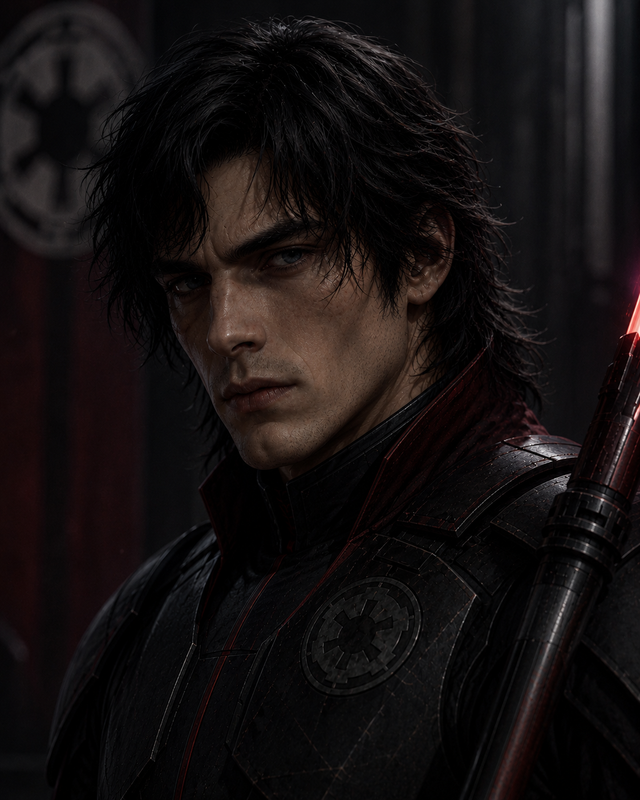
- Full name: Olorion Fossk (Ul-O-Ry-on Fo-ss-k)
- Preferred Name: Olorion
- Alias: Orion
- Titles: The Forgotten Son
- Species: Near Human
- Race:
- 1/2 Human
- 1/2 Firrerreo
- Birthworld: -
- Homeworld: -
- Faction(s):
- Brotherhood of the Maw (Defunct)
- Dark Empire (Defunct)
- Galactic Empire (Defunct)
- Imperial Reclamation Authority (IRA)
- Rank(s):
- Sith Acolyte (General)
- Fifth Brother (IRA)
- Class:
- Gloomstalker Ranger
- Battlemaster Fighter
- Echo Knight Fighter
- Mastermind Rogue
- Master(s):
- Padawan(s): No
- Force Sensitive: Yes
- Force Alignment: Lawful Evil

- Gender: Male
- Age: Young Prime
- Height: Six Foot
- Weight: 180 lbs
- Complexion: Caucasian
- Eye Color: Red/yellow Dark Side tint.
- Hair Color: Black
- Distinguishing Marks: A couple scars and marks from training as a Sith.
- Marital Status: Single
- Sexual Conduct: Pansexual
- Languages:
- Galactic Basic - Native
- Imperial Basic - Fluent
- Occupations: Sith Acolyte
- Residence: Carlac
- Relations
- Kaigann Fossk - Father
- Saan'an Gaelor - Older Brother
- Jem Fossk - Older Sister
- Cedric Grayson - "Cousin" (Godson of his father)
Olorion Fossk is often described as a contradiction. He is a dark side practitioner who values restraint, an Inquisitor who prefers understanding over intimidation, and the son of a fallen Emperor who has little interest in power for its own sake. While many who knew his father expected him to inherit the same ambitions, Olorion instead chose a different path.
His life has been shaped by service. First to the institutions built by his father and later to the Imperial Reclamation Authority and its Inquisition. Throughout those transitions, the underlying principles remained largely unchanged. Order matters. Duty matters. Purpose matters. The individuals who uphold those ideals may change, but the ideals themselves remain worth preserving.
Those who encounter Olorion often leave with the impression that he is difficult to know. There is truth in that assessment. He reveals little about himself willingly and rarely seeks attention or recognition. Most know him only as the Fifth Brother, a faceless hunter hidden behind a crimson visor and a reputation for relentless pursuit.
That reputation is not entirely undeserved.
Olorion is not the strongest Force user within the galaxy. He does not command fleets, reshape worlds, or unleash devastating displays of power. What he does possess is patience, discipline, and an unwavering willingness to continue pursuing a task long after others would have abandoned it. Whether tracking enemies of the Empire, investigating threats, or standing beside his fellow Inquisitors, he approaches every challenge with the same mindset.
Understand the target.
Identify the weakness.
Apply pressure.
Complete the mission.
Everything else is secondary.
|| APPERANCE ||
Olorion Fossk stands slightly above average height with a lean, athletic build shaped by years of military service and relentless physical conditioning. Unlike heavily armored warriors who rely upon sheer strength or intimidation, his physique reflects speed, endurance, and efficiency. Every movement tends to be measured and economical, giving the impression of someone who is constantly conserving energy for when it is actually needed.
Outside of armor, Olorion possesses pale features inherited from his father's bloodline, though most people rarely have the opportunity to see them. His dark hair is typically kept short and practical, while his expression often settles somewhere between neutral attentiveness and quiet disinterest. He is not particularly expressive and rarely wears his emotions openly, contributing to a reputation for being difficult to read.
Most individuals know Olorion not by his face, but by his armor.
As the Fifth Brother of the Imperial Reclamation Authority's Inquisition, he is most commonly seen wearing the Suppressor Pattern Inquisitor Armor. The suit's faceless helmet completely obscures his identity behind a narrow crimson visor, creating an intentionally inhuman appearance. A dark red armored ridge runs along the centerline of the helmet, while a high crimson collar transitions into a narrow strip of cloak-like fabric that trails down his back. The design conceals nearly every trace of individuality, reducing him to a silhouette and a title rather than a man.
The armor's appearance reflects its purpose. It lacks the ornate decoration commonly associated with nobility or the excessive armor plating favored by frontline shock troops. Instead, every component is designed around mobility, pursuit, and utility. The result is an appearance that often leaves others with the impression of a professional hunter rather than a traditional warrior. In many ways, that impression is accurate.
Those familiar with the Inquisition often recognize Olorion long before they recognize his voice. The crimson visor, the trailing cloth, and the unmistakable silhouette of the saberlance mounted across his lower back have become his defining features. For many, the armor has become inseparable from the man who wears it.
|| PERSONALITY ||
Olorion Fossk is a man who finds comfort in structure. While many Force sensitives spend their lives struggling against authority, questioning hierarchy, or seeking power for themselves, Olorion has never shared those instincts. Order has always been familiar to him. Chains of command make sense. Defined responsibilities make sense. The idea that individuals should serve something larger than themselves is not a burden in his eyes but a necessity. Civilizations survive because people are willing to place duty above personal desire, and Olorion has long believed that principle applies as much to Force users as it does to anyone else.
This perspective often leads others to misunderstand him. Some mistake his willingness to follow orders for blind obedience. Others assume that because he is the son of Darth Solipsis, he must secretly crave authority for himself. Neither assumption is true. Olorion does not worship authority, nor does he seek to possess it. He simply understands its purpose. Every organization requires leadership. Every institution requires discipline. Without those things, even the most noble intentions eventually collapse beneath confusion, ambition, and competing interests. His respect for authority stems from practicality rather than ideology. Someone must maintain order, and someone must be willing to uphold it.
As a result, Olorion is remarkably comfortable existing within a hierarchy. He does not need to be the strongest person in the room. He does not need to command every conversation. He does not need others to fear him or admire him. What matters to him is understanding where he stands, what is expected of him, and how those responsibilities contribute to the greater whole. This attitude has earned him a reputation among Imperial personnel as dependable, disciplined, and professional. Officers generally know where they stand with Olorion. He is not prone to political games, shifting loyalties, or personal agendas. If he accepts a duty, he performs it to the best of his ability.
His professionalism often creates an impression of emotional distance. Olorion is not particularly expressive and rarely volunteers personal information. Conversations with him tend to remain focused on practical matters, observations, or objectives rather than feelings or personal grievances. While he is capable of forming meaningful relationships, he seldom places those relationships above his responsibilities. Duty almost always comes first. This is not because he lacks empathy or affection, but because he views obligations as promises that must be honored regardless of personal cost.
Beneath this reserved exterior lies an intensely observant mind. Olorion rarely enters a room without assessing the people inside it. He pays attention to mannerisms, habits, strengths, weaknesses, and reactions with the same focus others might devote to studying a battlefield. This habit is not born from paranoia. It is simply how he understands the world. Every person possesses strengths that can be relied upon and weaknesses that can become liabilities. Understanding those traits allows him to work alongside others more effectively and prepare for circumstances before they arise.
This mentality extends naturally into conflict. Olorion approaches opponents much as he approaches everyone else: by understanding them. He is less interested in overpowering people than he is in identifying the flaws that already exist within them. Fear, pride, anger, doubt, ambition, grief, and pain are all pressures that influence decision-making. Olorion studies those pressures carefully, believing that understanding a person often reveals far more than defeating them. As a result, he tends to be patient, methodical, and deliberate both in conversation and combat.
Despite his connection to the dark side, Olorion is not motivated by cruelty. He is fully capable of inflicting suffering when necessary, particularly in his role as an Inquisitor, but he does not enjoy it for its own sake. Pain is useful because it creates mistakes. Fear is useful because it disrupts concentration. Doubt is useful because it weakens conviction. To Olorion, these are tools rather than pleasures. He views them with the same practical mindset that governs the rest of his life.
There is, however, one subject capable of disrupting his otherwise measured composure. References to Darth Solipsis remain a lingering wound that never fully healed. Olorion does not fear becoming his father, nor does he spend his life trying to escape that possibility. He made that decision long ago. What troubles him is the memory itself. The name carries with it reminders of loss, failure, expectations, and a past that cannot be reclaimed. When others speak of Darth Solipsis, whether in admiration, condemnation, or simple curiosity, Olorion often becomes visibly uncomfortable. The reaction is not one of loyalty or defense. It is the response of someone touching an old scar that never healed properly.
Those who know Olorion best often describe him as reliable before they describe him as powerful. While he possesses considerable skill as a Force user and warrior, he places little value on recognition or status. Power is a tool. Authority is a responsibility. Reputation is merely the consequence of one's actions. In the end, Olorion defines himself not by what he possesses, but by what he serves. The son of Darth Solipsis may be how others first know him, but it is duty that ultimately defines the man he became.
|| LEGACY ||
Olorion's life has been shaped by inheritance, though not always by choice. As the son of Darth Solipsis, much of his early life unfolded beneath the immense shadow of a man who commanded empires, armies, and unwavering devotion from countless followers. The Dark Empire was not simply a government to Olorion. It was home. The Dark Side Elite were not distant soldiers. They were the people who surrounded him throughout his formative years. For much of his life, purpose was never something he needed to search for. It was provided by the institutions and individuals around him.
When the Dark Empire fell and the galaxy once again fractured into competing powers, Olorion found himself confronting a question that had rarely required consideration before. Without the Empire his father had built, who was he meant to become? Unlike many who inherited powerful legacies, Olorion never sought to claim his father's throne, continue his ambitions, or rebuild what had been lost. He possessed neither the desire nor the delusion required for such pursuits. The collapse of the old order did not inspire him to seek power. Instead, it forced him to decide whether the values he carried belonged to Darth Solipsis or to himself.
The answer came through service.
While many former followers of the Dark Empire drifted toward mercenary work, isolation, criminal enterprise, or personal kingdoms, Olorion gravitated once again toward structure. He found purpose within the Imperial Reclamation Authority and eventually joined the Inquisition as the Fifth Brother. For the first time in his life, he served within an organization that did not belong to his father. The authority he carried was not inherited through blood, nor granted through family connections. It was earned through loyalty, competence, and service.
This distinction matters greatly to him. The rank of Fifth Brother represents more than a title. It represents independence. It is proof that Olorion Fossk can exist beyond the shadow of Darth Solipsis. He remains a product of his upbringing and carries many lessons learned during those years, but the path he now walks belongs entirely to him. The Inquisition did not ask him to become an emperor, a prophet, or a conqueror. It asked him to serve. In many ways, that simple expectation provided an answer he had been seeking for years.
Olorion understands that legacy is often spoken of as something left behind after death, but he views it differently. To him, legacy is built through choices made while living. Every decision, every act of service, every success, and every failure contributes to the mark a person leaves upon the galaxy. His father built a legacy through power, conquest, and fear. Olorion's legacy is still being written, but if he has any say in the matter, it will be built through discipline, duty, and the unwavering belief that power exists to serve a purpose rather than become the purpose itself.
|| HISTORY ||
Olorion Fossk was born into a galaxy that already knew his father's name. Long before he was old enough to understand politics, war, or the Force, Darth Solipsis had already carved his place into history through conquest, ambition, and the creation of the Dark Empire. As a result, Olorion's early life unfolded within institutions shaped by his father's influence. The Dark Empire was not simply a government to him, nor was it a distant political entity discussed by military officers and politicians. It was the environment in which he was raised. The people who served it became familiar faces, the soldiers who fought for it became role models, and the ideals it promoted became the foundation upon which much of his worldview was built.
Unlike many who grow up in the shadow of powerful figures, Olorion never developed aspirations of inheriting his father's position. He did not spend his youth imagining himself upon a throne or dreaming of one day commanding fleets and armies. His interests gravitated toward service rather than leadership. While others sought prestige and influence, Olorion found himself drawn toward structure, discipline, and the individuals responsible for maintaining them. He respected authority not because it belonged to his father, but because he understood the stability it provided. Even at a young age, he was far more interested in the soldiers who carried out orders than the politicians who issued them.
As he matured, Olorion eventually entered the ranks of the Dark Side Elite, serving within the military institutions that supported his father's empire. The experience exposed him to the realities of warfare, command structures, and the practical responsibilities required to sustain an interstellar state. While his connection to the Force continued to develop during these years, his identity became increasingly tied to service rather than ideology. He learned to operate within chains of command, to rely upon discipline rather than impulse, and to measure success through the completion of objectives rather than personal recognition.
The collapse of the Dark Empire marked a turning point in his life. For many who had served beneath Darth Solipsis, the destruction of the Empire represented the loss of purpose itself. Some attempted to rebuild what had been destroyed. Others abandoned their former loyalties entirely. Many simply disappeared into the chaos that followed. Olorion found himself facing a question he had never truly needed to answer before. Without the institutions built by his father, what remained?
The answer was not immediate.
For a time, Olorion drifted through a galaxy increasingly defined by fragmentation and uncertainty. The structure that had once guided every aspect of his life was gone, and with it came an uncomfortable freedom. Yet even during this period, he found himself repeatedly drawn back toward organizations that valued discipline, order, and purpose. The collapse of the Dark Empire had not changed his beliefs regarding duty. It had merely removed the framework through which those beliefs had previously been expressed.
Over time, this path eventually led him toward the Imperial Reclamation Authority. In many respects, the organization represented a familiar ideal. It sought to restore order to a fractured galaxy, rebuild Imperial institutions, and create stability where chaos had taken root. More importantly, it offered Olorion something he had lacked since the Empire's fall: a place to belong. Within the Authority he found purpose once again, not as the son of Darth Solipsis, but as an individual whose abilities and experience held value independent of his bloodline.
His induction into the Inquisition as the Fifth Brother solidified that transition. For the first time in his life, Olorion served within an organization entirely separate from his father's authority. The rank he carried was not inherited. The responsibilities entrusted to him were not granted through family connections. They were earned through service, competence, and loyalty. While others viewed the title as a position of power, Olorion viewed it as something much simpler. It was proof that he could stand on his own merits.
Today, Olorion serves as the Fifth Brother of the Imperial Reclamation Authority's Inquisition. He remains shaped by the lessons of his past and carries the legacy of his father whether he wishes to or not, but he no longer defines himself through that connection. The son of Darth Solipsis may be how his story began, yet it is not how he chooses to live it. His life is now measured not by the achievements of the man who came before him, but by the responsibilities he carries in the present and the legacy he will eventually leave behind.
|| STRENGTHS ||
Professional Discipline - Olorion possesses an unusual degree of emotional control for a dark side practitioner. He is difficult to provoke, resistant to intimidation, and rarely allows anger, pride, or frustration to dictate his decisions. While he is fully capable of drawing upon powerful emotions when necessary, he does not allow those emotions to control him. This discipline makes him exceptionally reliable in high-pressure situations and difficult to manipulate through conventional psychological tactics.
Exceptional Speed - Speed is the defining characteristic of Olorion's combat style. Through extensive training and mastery of Force Speed, he is capable of rapidly closing distances, exploiting openings, and maintaining relentless pressure against opponents. Many adversaries find themselves reacting to Olorion's actions rather than executing their own plans, placing them at a constant disadvantage throughout an engagement.
Hunter's Mentality - Olorion excels at observation, investigation, and target analysis. He approaches both combat and interpersonal interactions with the mindset of a hunter, seeking to identify weaknesses before committing himself. This allows him to exploit vulnerabilities others might overlook and adapt quickly when circumstances change.
Psychological Warfare - Through a combination of Dun Möch, Force Pain, Force Wound, and natural observation skills, Olorion is highly effective at destabilizing opponents mentally and emotionally. He understands how fear, doubt, frustration, and pain influence decision-making and frequently uses those factors to create opportunities for himself during combat.
Saberlance Mastery - Olorion's preferred weapon is a lightsaber lance, an uncommon weapon that grants him significant reach advantages over many opponents. Years of dedicated training have made him highly proficient with the weapon, allowing him to capitalize on its unique strengths while minimizing its limitations.
Loyalty to Duty - When given a mission, Olorion pursues it with remarkable focus and determination. He rarely becomes distracted by personal ambitions or political maneuvering, making him dependable in situations where others may allow personal interests to interfere with their responsibilities.
|| WEAKNESSES ||
Legacy of Darth Solipsis - Although Olorion has long since decided he will not follow in his father's footsteps, the legacy of Darth Solipsis remains an emotional wound. Discussions involving his father often provoke visible discomfort or irritation, making it one of the few subjects capable of disrupting his otherwise composed demeanor. While he rarely loses control, the topic remains deeply personal and difficult for him to navigate.
Duty Before Relationships - Olorion's commitment to responsibility often comes at the expense of personal relationships. He has a tendency to prioritize missions, obligations, and organizational goals above individual attachments. While this makes him dependable from a professional standpoint, it can create emotional distance between himself and those around him.
Limited Interest in Politics - Although he understands hierarchy and respects authority, Olorion has little interest in political maneuvering. He prefers clear objectives and defined responsibilities over complex social games. This occasionally leaves him at a disadvantage when dealing with individuals who excel at manipulation, influence, or intrigue.
Reluctance to Delegate - Olorion often trusts himself to complete difficult tasks more than he trusts others. This can lead him to shoulder responsibilities alone rather than distributing them among a team. While effective in some situations, it can limit his efficiency during larger operations.
Specialized Combat Style - Much of Olorion's combat effectiveness is built around speed, pressure, and controlling the pace of an engagement. Opponents capable of restricting movement, disrupting momentum, or forcing prolonged defensive exchanges can significantly reduce many of the advantages his fighting style normally provides.
Not a Force Scholar - Olorion's knowledge of the Force is practical rather than academic. He focuses on abilities that directly support his duties as an Inquisitor and hunter. As a result, he lacks the extensive scholarly understanding possessed by many dedicated Force researchers, mystics, and historians.
|| FORCE ABILITIES ||
Olorion's connection to the Force is centered around pursuit, control, and pressure rather than overwhelming displays of power. While he possesses a strong command of the dark side, he has never devoted himself to mastering the destructive abilities commonly associated with Sith Lords. Instead, his abilities have developed around the practical requirements of locating, pursuing, and neutralizing dangerous targets. Every power he employs serves a specific purpose within that broader objective.
Perhaps the most recognizable aspect of Olorion's fighting style is his mastery of Force Speed. Combined with years of physical training and extensive experience with a saberlance, this ability allows him to rapidly close distances, reposition during combat, and maintain constant pressure against opponents. Many adversaries find themselves struggling to establish momentum as Olorion repeatedly forces them to react to his actions rather than execute their own plans. This reputation for explosive speed has become one of his defining characteristics within the Inquisition.
Supporting this mobility is a strong command of Precognition and Force Sense. Olorion constantly gathers information through the Force, reading subtle shifts in movement, intent, and danger before they fully manifest. While not infallible, these abilities allow him to anticipate attacks, identify opportunities, and make rapid decisions during combat. He approaches these powers much as he approaches any investigation, treating them as additional sources of information rather than mystical solutions to every problem.
Telekinesis serves as one of his most versatile tools. Rather than relying upon it for overwhelming displays of force, Olorion frequently employs telekinetic abilities to manipulate positioning, disrupt enemy movements, create openings, and maintain control of engagements. Whether drawing a target off balance, interfering with a weapon, or creating a momentary advantage, telekinesis functions as another method of dictating the pace of battle.
The foundation of his endurance and aggression comes through Battlemind and Force Rage. Battlemind allows Olorion to maintain focus and combat effectiveness even while suffering significant physical strain or injury. Force Rage complements this by enhancing his physical capabilities and reinforcing his determination during combat. Unlike many practitioners who surrender themselves entirely to uncontrolled fury, Olorion employs Rage as a tool rather than a state of being. It is a weapon to be directed rather than an emotion to be obeyed.
What truly distinguishes Olorion from many Force users, however, is his emphasis on pain and psychological degradation. Through Force Pain and Force Wound, he specializes in reducing an opponent's effectiveness rather than simply inflicting direct damage. Pain disrupts concentration. Wounds limit movement. Both create opportunities. Olorion understands that even the most skilled combatants become vulnerable when forced to divide their attention between fighting and suffering. As a result, he often seeks to degrade an opponent's ability to perform before attempting to defeat them outright.
This philosophy extends naturally into his use of Dun Möch. Olorion does not employ psychological warfare through dramatic speeches or theatrical taunts. Instead, his approach is quiet, methodical, and observational. He studies opponents carefully, identifies insecurities, fears, frustrations, and doubts, then applies pressure precisely where it will be most effective. The goal is not to provoke emotional outbursts but to create hesitation. A moment of uncertainty is often more valuable than a moment of anger.
Taken individually, none of Olorion's abilities are particularly unusual among trained Force users. What makes them dangerous is the manner in which they operate together. Every power supports the same objective. His speed limits an opponent's options. His senses reveal weaknesses. His telekinesis controls positioning. His pain and wounds create mistakes. His psychological pressure magnifies those mistakes. By the time a confrontation reaches its conclusion, Olorion has often spent the entire engagement systematically dismantling his opponent's ability to resist.
For this reason, Olorion is not widely known for overwhelming displays of power or spectacular demonstrations of the Force. His reputation instead stems from something far less dramatic and often far more unsettling. Those who face him frequently discover that the battle becomes increasingly difficult with every passing moment until resistance itself feels impossible. By then, the hunt is usually over.
|| COMBAT STYLE ||
Olorion's combat style is built around control rather than domination. While many Force users seek to overwhelm opponents through superior strength, aggression, or raw destructive power, Olorion focuses on systematically reducing an enemy's ability to resist. Every action taken during a fight is intended to restrict options, create pressure, and force mistakes.
The centerpiece of his combat style is the saberlance. The weapon's extended reach allows him to threaten opponents from distances they may not be accustomed to defending against, creating constant pressure while limiting opportunities for retaliation. Combined with Force Speed, Olorion frequently dictates the pace of engagements, rapidly closing distances, repositioning, and exploiting openings before opponents can fully react. His movements often appear less like a traditional duel and more like a relentless pursuit.
Unlike many aggressive combatants, Olorion rarely seeks immediate victory. He is comfortable allowing a confrontation to develop over time if doing so provides information about his opponent. The longer a battle continues, the more opportunities he has to identify weaknesses, patterns, habits, and vulnerabilities. Once identified, those weaknesses become targets.
Force Pain, Force Wound, telekinetic interference, and psychological pressure are all employed toward this objective. Rather than focusing solely on inflicting damage, Olorion seeks to reduce concentration, impair movement, disrupt decision-making, and erode confidence. Opponents frequently discover that the battle becomes more difficult with every passing exchange as injuries accumulate, exhaustion grows, and mistakes become increasingly common.
His approach reflects his broader worldview. Every individual has limits. Every defense contains flaws. Every opponent can be understood. Olorion's strength lies not in overwhelming resistance, but in finding the point where resistance begins to fail and applying pressure until it collapses completely.
Although fully capable of killing when necessary, Olorion's role as an Inquisitor often places greater value on capture, interrogation, and intelligence gathering. As a result, many of his techniques are designed to incapacitate, control, or break an opponent's ability to continue fighting rather than immediately end their life. Death is frequently the conclusion of a hunt. It is not always the objective.
|| POSSESSIONS ||
- Weapons:
- Clothing/Armor:
- Imperial Uniform
- Suppressor Pattern Inquisitor Armor
- TXP SBG-01x Bodyglove
- Ships/Vehicles
- Droids/Companions
- BAF-120 Combat Automaton - Scry
|| CHARACTER KILLS ||

Last edited: