
Nothing's Like Before



Laepryn
OUT OF CHARACTER INFORMATION
- Intent: To establish the Laepryn, a native ground-dwelling sentient people of Skye, sharing the world with the winged S'kytri and giving the planet its agrarian backbone and frontier ranger-stock. Provides a playable small-folk race and a cultural counterweight to the sky-clans.
- Image Credit: Midjourney | ChatGPT
- Canon: N/A
- Permissions: N/A
- Links: Imperial Commonwealth of Dosuun.
GENERAL INFORMATION
- Name: Laepryn (sing. & pl. Laepryn; adj. Laepryn). The winged clans call them "Lairfolk," a mild condescension the Laepryn have long since worn as armour.
- Designation: Sentient
- Origins: Skye — native to the Lowland steadings about the great loch and the harsh Outland marches beyond, sharing the world with the winged S'kytri.
- Average Lifespan: 70–90 standard years.
- Estimated Population: Planetary (a large concentration on Skye, rarely found off-world).
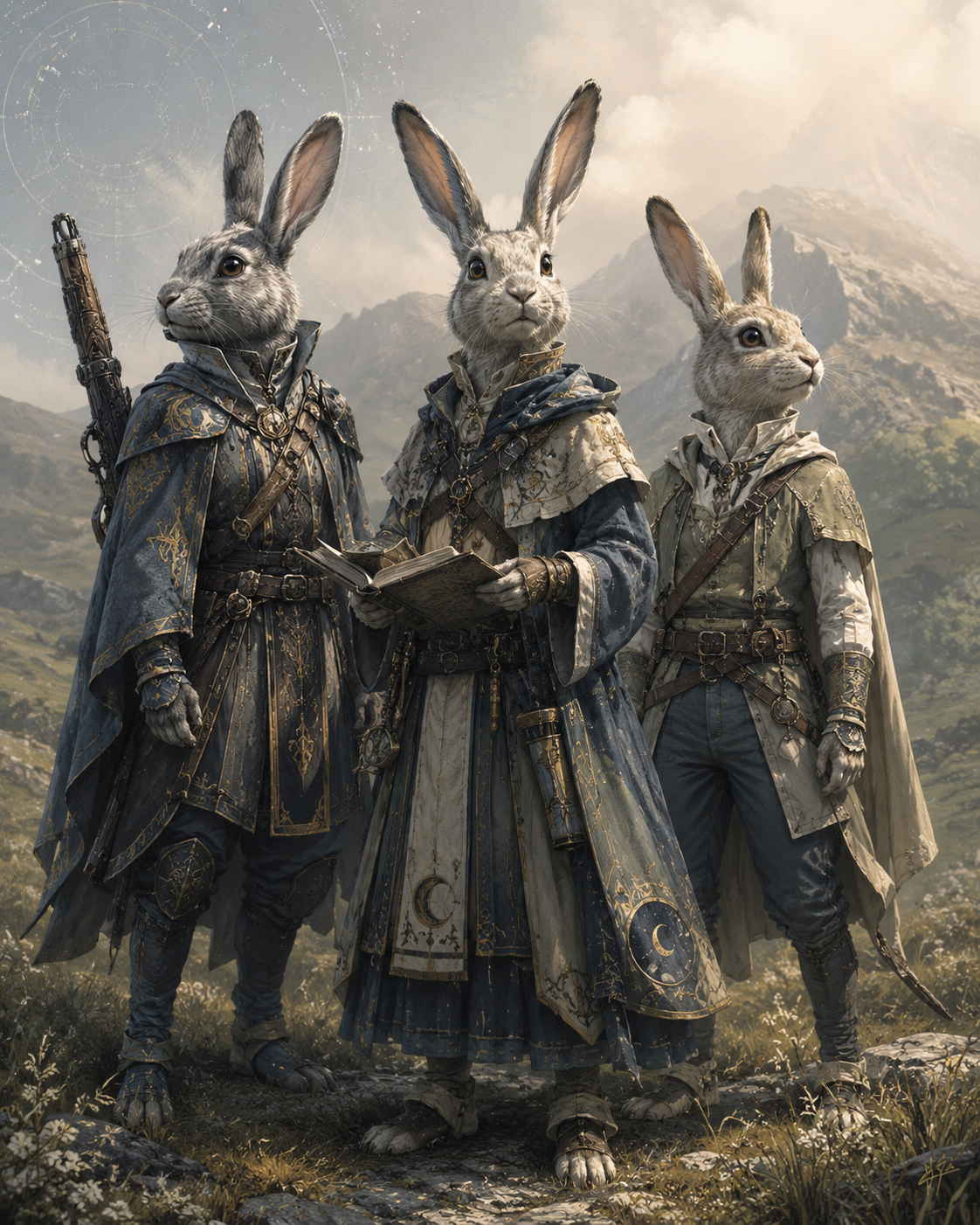
- Description: A small, hardy, ground-dwelling people of hill and burrow — slate- and silver-furred, long-eared, and powerfully legged despite their modest height. Where the winged S'kytri built their civilization upward into sacred eyries and cathedral-heights, the Laepryn built outward and downward: scattered villages of turf-roofed longhouses and worked burrow-warrens dug into brae and hillside. They are the farmers, brewers, and march-wardens of Skye — kind, fierce, and famously difficult to kill, a people of many small stubborn places that endure.
PHYSICAL INFORMATION
- Breathes: Type I (standard oxygen atmosphere).
- Average Height of Adults: 0.9–1.2 m, standing upright on the hind legs.
- Average Length of Adults: N/A.
- Skin color: Largely fur-covered; exposed skin (nose, inner ear, pawpads) ranges grey-pink to slate.
- Hair color (pelage): Slates, silvers, charcoals, and smoke-greys; creams and duns in the Lowland stock; heavier, darker coats among the Outlanders.
- Distinctions:
- Build: Small but powerfully muscled through the legs and lower back, with a low center of gravity, a standing leap that surprises larger folk, and strong, dexterous, digging-adapted hands turned to craft and entrenchment.
- Ears: Long and highly mobile, granting acute directional hearing. Ear-carriage forms a whole nonverbal language among Laepryn — a register of meaning the winged clans find unreadable.
- Sexual dimorphism: Slight. Bucks tend marginally larger and heavier-coated; does are often the keepers of the Old Art traditions (see Culture). Both sexes work, fight, and govern.
- Ageing: Coats silver and coarsen with age; elders ("greybacks") hold authority in the village moots.
- Races (distinct cultural/physical stocks):
- Loch Laepryn — the Lowland agrarian heart. Softer slate-and-cream fur, rounder build. Farmers, herders, brewers, the people who fed Skye back to life after the famine.
- March Laepryn — the Outland frontier stock. Leaner, harder, heavier silver-grey coats against the cold. The ranger and warden line; famine-forged and self-reliant.
- Crag Laepryn — the Highland fringe. Smaller, darker, insular; exceptional climbers and listeners who learned to live literally and socially beneath the winged clans.
- Regional tradition (not a stock):
- Force Sensitivity: Low. Sensitivity is real but uncommon, scattered thinly through the villages, and never trained as the Force. The Laepryn understand it as the Old Art — folk-magic, charm-craft, hedge-lore — passed down in village and clan traditions rather than any academy.
Strengths
- Sentinel senses & marksmanship: Acute directional hearing — keener than most humanoid species — paired with sharp eyes, steady hands, and startle-quick reflexes makes the Laepryn exceptional scouts and famously precise shooters. Their march-wardens are the finest marksmen and grenadiers on Skye, prized for fast, accurate snap-shooting and for lobbing charges into a target with uncanny placement.
- Leaping mobility & coordination: Powerful hind legs grant a standing and running leap far beyond their size, letting them vault cover, break line-of-sight, and reposition constantly. Crucially, they never fight as individuals — Laepryn skirmish in tight, wordlessly coordinated teams, reading one another through ear-cant and foot-drum signals to lay crossing fire, throw grenades in concert, and bound between firing positions so an enemy never gets a fixed target. Their strength is the team in motion, not the soldier.
Weaknesses
- Small & lightly made: Standing only chest-high to a human and light of frame, a Laepryn is outmatched in open melee by larger humanoids and cannot bear heavy armor without losing the mobility their whole doctrine depends on. Their fighting style is light-skirmisher to the bone — vault, fire, reposition — and it collapses the moment they are pinned, fixed in place, or cut off from their team. A lone, cornered Laepryn is a fraction of the threat a coordinated band represents.
- The startle — and the irony of the grenade: A deep prey-animal reflex no training fully erases. Sudden noise, a looming charge, or a Force-driven wave of fear can trigger a freeze-or-bolt response a disciplined opponent can read and exploit. Worst of all, the very acuteness of their hearing turns concussive blasts — flashbangs, stun charges, and the grenades they themselves love so well — into a sharper disorientation than most species suffer; a hard enough bang can scatter a Laepryn line that gunfire alone could not. They have developed folk-craft countermeasures over generations — ear-folding drills, muffling charms, and strict fire discipline — but these blunt the vulnerability rather than removing it.
CULTURE
- Diet: Omnivore, strongly herbivore-leaning, and where they do take animal protein they lean markedly pescatarian — the loch and the coastal waters provide far more of their table than any land meat. Barley and root crops, garden greens, dairy and soft cheeses, loch-fish and shellfish, and — above all — brewing and distilling. Laepryn ale, spirits, and tonics are the pride of the Lowland steadings and a staple of Skye's export trade.
- Communication: The Laepryn's first and most natural register is silent and percussive. They speak chiefly through a rich language of hand-sign, posture, and ear-carriage, layered with thumps, foot-drumming, and rapping taps — a rhythmic code that carries through burrow walls, across a field, and down a tunnel, and which strikes most humanoids as some half-cryptic drummed cipher — patterned, deliberate, and just legible enough to unsettle those who cannot read it. This silent-and-struck channel is how a small underground people coordinated, warned, and skirmished without ever raising a voice, and it doubles as their battlefield signaling. Spoken tongue is reserved for those who need it: they keep the indigenous languages of Skye, speak Galactic Basic for dealing with foreigners, and the trading and traveling sorts who actually leave the homeworld usually pick up a few of the Commonwealth languages besides.
- Technology level: Galactic Standard where it matters (comms, agriculture, medicine through the Commonwealth), wedded to a deep traditional craft culture — masonry, brewing, weaving, instrument-making, and the warden's gunsmithing of the marches.
- Language & naming: When the Laepryn do speak aloud, they speak the tongues of Skye, and their dialect betrays their stock. Loch Laepryn carry the softer Lowland speech (Lannskyen); the March wardens speak the harsher Highland tongue (Ardskyen); and the insular Crag and far-march folk keep the clipped Outer dialect (Ytterskyen) of the cold edges. Their settlements are known by a signature element all their own: -howe, the burrow-mound, marking a place as a Laepryn warren-village rather than a sky-clan hold — Craeghowe beneath the crags, Brynhowe in the green Lowlands, Kaldhowe out in the cold marches. Personal names follow the dialect of the home region: Lowland names run soft and Welsh-rooted (Arwel, Cered, Eluned, Seren, Branwen), Highland names harder and Gaelic-Norse (Eirik, Aodhan, Tormod, Mairenn, Brynja), and Outer names sharply Faroese (Kjartan, Haldor, Sigrun, Eydis, Thora).
- Religion/Beliefs — The Old Art: What the wider galaxy would name low Force-sensitivity, the Laepryn call the Old Art, and they hold it not as power but as craft— something inherited, practiced, and tied to home, hearth, and ground. It is passed down through four village traditions, each a folk "school" rather than a formal order:
- The Cunning (Glaslaw) — the healer's line. Herb-lore, bone-setting, the blessing of fields and births; Force-healing and empathy understood as "the laying-on of the green hand." The wise-folk of the Loch villages.
- The Warding (Skyldvar) — the protector's line. Ward-stones, threshold-charms, and the marks cut over every burrow-door to "turn ill weather and ill luck." Passive precognition reframed as a feeling in the ears before storm or raid.
- The Brewing (Bryggcraft) — the deepest and most Laepryn art, fusing their famous distilling with charm-work. Tonics, draughts, and smoke-charms — "courage in a cup" — half chemistry and half Old Art, and no one but the brewer knows which is which.
- The Listening (Hlustun) — the rarest and most disciplined line, prized by the March wardens. The far-hearing and the road-sense: reading wind and ground at distance. The most martially useful school, and the scarcest. Because the gift is Low and entirely self-taught through these lineages, the Laepryn never produced grand Force-knights — only hedge-healers, warding-wives, and brewers. The winged clans patronize them as superstitious lairfolk, never grasping that the Old Art is the Force wearing a homespun coat.
- General behavior: Village-dwelling and deeply rooted. The Laepryn build no cities, crown no king, and keep no capital; they govern village by village through moots of warren-elders ("greybacks"), loosely federated by clan and kin-line. Family and warren are the center of life. Laepryn rarely bear a single child — large families are the norm, four to six young being common and a warren ringing with kits the ordinary state of things; families of three or fewer exist but are considered unusually small. The young are raised communally within the steading, the whole warren sharing in their keeping; mates are chosen freely and bonded for life in most clans. Diurnal, industrious, and hospitable to a fault — but slow to forget a wrong. Small, kind, fierce, and hardy: a people who survive by being underestimated. One thing they will not abide is being underestimated to their faces — a Laepryn called "cute," "adorable," or some tall-folk's "wee bunny" hears the precise tone of contempt that once let the marches starve, and reacts accordingly. Most answer with cold offense; the proud, scrappy Crag and March stock are apt to answer with their fists, a bared tooth, and a torrent of furious dialect that belies their size. Among the Laepryn it is understood: you may fear them or you may respect them, but you will not pat them on the head.
HISTORICAL INFORMATION
The Laepryn have always shared Skye with the winged S'kytri, and always from below. The sky-clans read the world vertically — altitude as rank, the heights as sacred, flight as the mark of the noble-born — and from their cathedral-eyries they regarded the ground-dwelling Lairfolk as a lesser, earthbound people: useful, harmless, and beneath notice. For most of Skye's history that contempt cost the Laepryn little. They worked the Lowland steadings about the great loch, brewed and bartered, dug their warrens, and kept the Old Art in their villages, content to be overlooked.
The famine ended that contentment. When blight and the long war against the Ssi-Ruuvi Imperium broke Skye's harvests, the Highland and Lowland clans drew their stores up into the heights and the settled valleys — and let the Outland marches starve. The March Laepryn, abandoned at the cold edges of the world, learned in the hardest way that no one was coming to save them. They went to ground. They dug deeper, hoarded, fortified their burrow-villages into half-hidden warrens, and held — through hunger, through raids, through the long fighting in the tunnels and the dark where wings were of no use and small, patient, ground-wise folk were everything. In one march where the Ssi-Ruuvi entechment-machines fell thickest, a warden-clan went further still, learning to crack and turn the invaders' own technology back against them — a grim reclaimer-craft that survives there yet, local and closely held. The marches did not fall. The lesson was never forgotten.
When restoration came under the Commonwealth, it was Laepryn agriculture and Laepryn brewing that fed the loch-valleys back to plenty, and Laepryn endurance that had carried the planet's margins through its worst hour — facts the winged clans acknowledge only grudgingly, if at all. Today the Laepryn stand restored but not naive: the Lowland steadings prosper, the March wardens patrol the frontier the sky-clans still ignore, and the old grievance of the famine lives on beneath every cordial dealing with the heights. They are loyal subjects of a Commonwealth that, for once, did not leave the margins to starve — but they remember who did.
Last edited: