
✠ Nihilus Indomitus ✠


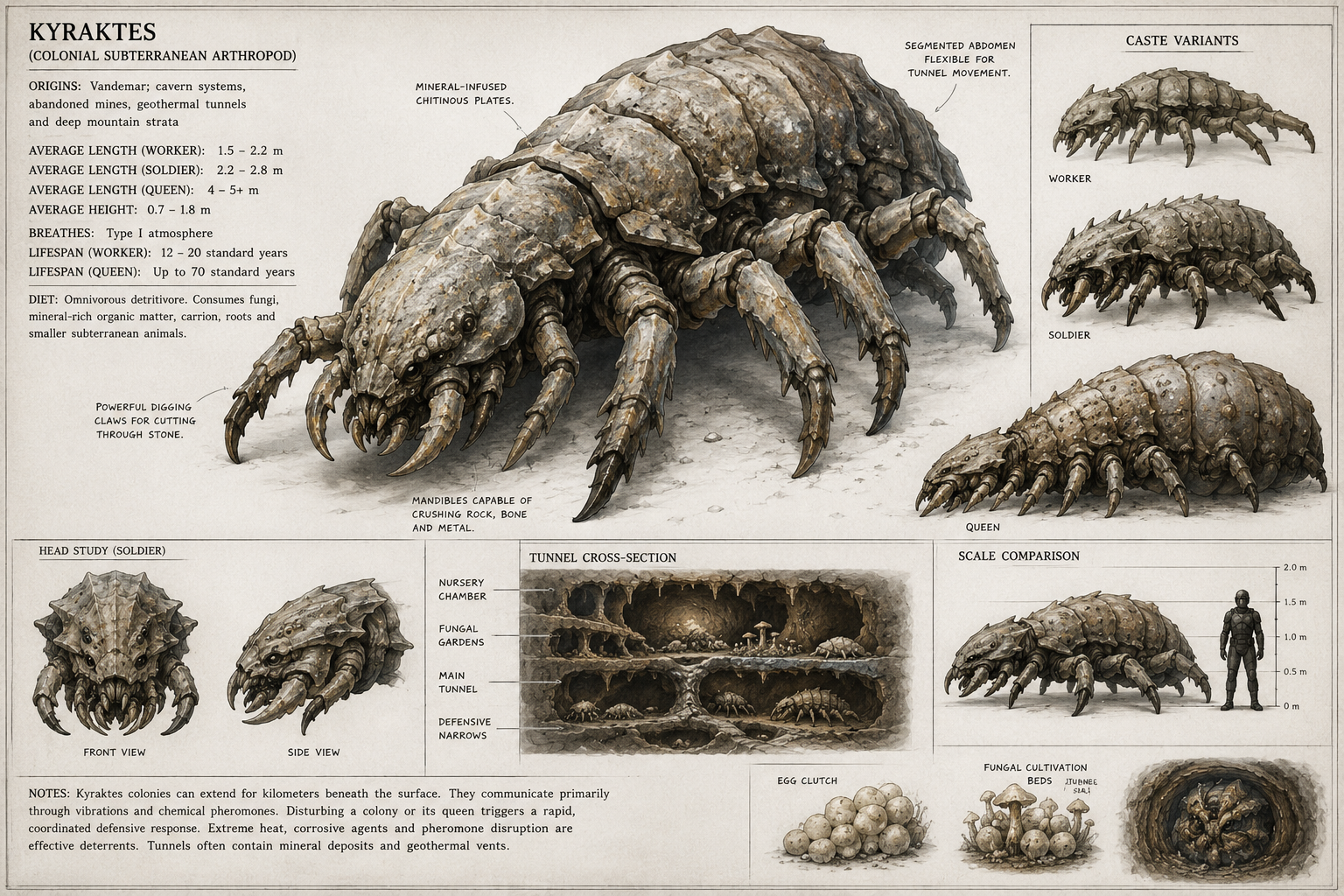
- Intent: To fill the world of Vandemar with interesting and diverse life that is intriguing to roleplay with.
- Image Credit:
- Canon: N/A
- Permissions: N/A
- Links: Vandemar
GENERAL INFORMATION
- Name: Kyraktes
- Designation: Non-sentient
- Origins: Vandemar; cavern systems, abandoned mines, geothermal tunnels and deep mountain strata
- Average Lifespan: 12–20 standard years for workers; up to 70 years for queens
- Estimated Population: Planetary; numerous colonies beneath Vandemar's mountain regions
- Description: The kyraktes is a heavily armoured colonial arthropod that carves immense warrens through stone and mineral seams. Most remain hidden beneath the mountains, cultivating fungal beds in darkness. When a colony is breached, however, the rock begins to move—first one plated body, then hundreds, emerging through cracks too narrow to have contained them.
PHYSICAL INFORMATION
- Breathes: Type I atmosphere; capable of surviving for several hours in oxygen-poor tunnels
- Average Height of Adults: 0.7–1.2 metres for workers; up to 1.8 metres for soldiers
- Average Length of Adults: 1.5–2.8 metres; queens may exceed 5 metres
- Skin color: Pale grey, black, ochre, rust-red or mineral-mottled
- Hair color: None
- Distinctions: Kyraktes possess six primary limbs, a segmented body and dense chitin reinforced by minerals drawn from the surrounding stone. Their forelimbs end in powerful digging claws, while the mandibles are capable of crushing rock, bone and industrial cabling. Workers are leaner and lighter, soldiers possess broader heads and reinforced frontal plates, and queens are vast, largely immobile organisms with swollen reproductive abdomens. Regional colonies display different armour colours and hardness depending on local geology. Older individuals develop chipped plating, fungal staining and asymmetrical mineral growths.
- Races: None recognised. Distinct colony forms exist, but these are environmental variations rather than separate races.
- Force Sensitivity: Non-Sensitive
- Mineral-reinforced armour and powerful excavation limbs
- Exceptional coordination through vibration and chemical signalling
- Capable of rapidly overwhelming confined positions
- Poor vision and dependence upon vibration sensing
- Highly vulnerable to extreme heat and corrosive compounds
- Disruption of queen pheromones can throw a colony into confusion
CULTURE
- Diet: Omnivorous detritivore. Kyraktes consume fungi, mineral-rich organic matter, carrion, roots and smaller subterranean animals. They cultivate fungal beds using decaying vegetation and biological waste.
- Communication: Chemical markers, mandible clicks and complex vibrations transmitted through tunnel walls.
- Technology level: None. Their tunnels, feeding chambers and fungal beds are instinctive biological constructions.
- Religion/Beliefs: None.
- General behavior: Kyraktes live in large colonies centred upon one or more queens. Workers excavate tunnels, gather food and maintain fungal chambers, while soldiers defend access points and respond to vibration disturbances. Colonies may remain quiet for decades before expanding into new territory. They do not actively hunt surface populations, but interpret drilling, blasting and mining activity as territorial intrusion. When alarmed, soldiers seal passages behind them and attack from multiple side tunnels, gradually isolating intruders from their point of entry.
HISTORICAL INFORMATION
Kyraktes are native to Vandemar's subterranean ecosystems and appear extensively in the planet's fossil record. Their ability to absorb minerals into their chitin allowed them to survive in regions inhospitable to most other large animals.
Early mining settlements frequently mistook dormant colonies for abandoned cavern systems. Several entire industrial sites were lost when excavation reached nursery chambers and triggered mass defensive responses. Attempts at complete eradication proved destructive, as kyraktes tunnels contribute to geothermal circulation and support extensive underground fungal ecologies.
Modern mining operations scan for pheromone traces, vibration patterns and characteristic tunnel geometries before excavation begins. Some colonies are harvested under strict regulation for chitin, adhesives and ceramic compounds.
Among Vandemarian miners, a wall that sounds hollow is tested once. A wall that answers is sealed.