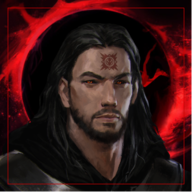
Chapter XX: Chains Broken
The Jedi believed their victory complete. Bound in null-energy manacles and sealed within a grav-shielded transport, Emperor Kaine Zambrano was to be ferried to Coruscant for judgment before the Senate. The galaxy rejoiced; the Black Iron Tyrant had fallen.
But not all celebrated his demise.
As the transport passed through the Deep Core, it was intercepted by vessels bearing no transponder and no name. The attackers moved with surgical precision, disabling communications and severing escort ships before the Republic could react. When the airlocks were breached, the Jedi guards found themselves face-to-face with crimson blades and warriors cloaked in the symbols of the One Sith — a sect that had survived in secret beneath the galactic underworld, waiting for a new god to lead them.
Kaine was freed from his restraints and delivered to Prakith, the desolate heart of the Deep Core. There, in the lightless catacombs beneath the citadel of the ancient Darths, he met Darth Sortis, the Dark Lord of the One Sith. To Sortis, Kaine was the living embodiment of an older promise — a perfect vessel for the ancient design of domination through unity.
Kaine knelt only once, and even then it was not submission, but calculation. He swore allegiance to the One Sith and was given a new title: Darth Vornskr, after the predatory beasts that hunted the Force itself. Sortis named him one of his Voices, the supreme generals and interpreters of his will.
The galaxy would once more tremble at the whisper of the name Zambrano.
Chapter XXI: Apocalyptic War
For eight years, Darth Vornskr led the One Sith's war across the Core Worlds. The Republic, already fractured by decades of attrition, could do little but fight to delay the inevitable. His fleets fell upon Coruscant, Alderaan, Balmorra, and Kashyyyk in a campaign so swift that even the Jedi Archives struggled to chronicle it. Planets burned, temples fell, and the once-mighty Republic became a desperate coalition of retreating worlds.
Under his direction, the One Sith became more than a cult — it became an empire reborn, the Ninth Sith Empire, built on terror and unity of doctrine. Vornskr's mastery of both strategy and sorcery allowed him to wage war on a scale unseen since the ancient Sith Crusades. He employed legions of fanatics, resurrected horrors from the tombs of Korriban, and wielded superweapons forged in secret by the remnants of the Blackblade foundries.
It was during this era that Vornskr allied himself with Taeli Raaf, a brilliant Sith scholar and sorceress whose hatred for the Jedi Order burned as fiercely as his own. Taeli sought vengeance for her sister, Corvus Raaf, who had died defending the Jedi only to be forgotten — her sacrifice dismissed, her name unspoken in the very halls she had died to protect. Together, Vornskr and Taeli forged a secret covenant to erase the Jedi utterly, not merely to conquer them, but to erase their memory from the galaxy's history. Their union of intellect and will became one of the most devastating partnerships in Sith history, each feeding the other's ambition and conviction until their shared vendetta became a doctrine unto itself.
As the Sith continued to raze and conquer across the Core, Vornskr took a bride — Mircalla, daughter of a once-prominent Republic dynasty that had turned traitor to save itself from annihilation. Her family, broken by debt and fear, sought survival in betrayal, offering their allegiance — and their daughter — to the Sith. Vornskr accepted their surrender with cold amusement, claiming Mircalla not as a gesture of mercy but as an act of ownership. To her credit, she adapted quickly, embracing the luxury and terror of her new life beside a god of war. In time, she became both ornament and instrument — a living symbol of the Republic's corruption and the futility of compromise before the Dark Side. Her marriage to Vornskr was not one of affection, but of conquest sanctified in blood and ambition.
In the midst of the war, Vornskr returned to his birthworld Panatha for the first time in decades. The royal house, fattened by centuries of peace, dared to deny him entry. He answered their arrogance with extermination. Within a single night, the palace of the ruling dynasty became a tomb. The royal line was erased from existence, their names stricken from records, their sigils burned from stone.
When dawn rose over the shattered spires of Canthar, Kaine Zambrano proclaimed himself King of Panatha — the first of his line to do so since Solomon the Black. His conquest spread through the surrounding systems, subjugating the Pacanth Reach, and within a year he crowned himself Arch-King of the Reach, sovereign of the Epicanthix people and the living heir of their imperial legacy.
The galaxy had thought him an emperor no longer. Now he was something far older — a monarch of blood and conquest, a god-king from myth reborn in flesh.
Chapter XXII: The Death of Vornskr
By the height of his power, Darth Vornskr ruled as both conqueror and god-king, his dominion stretching from the Deep Core to the Mid Rim. Yet, it seems that even gods are not immortal. In 844 ABY, his sanctum on Panatha became the stage of his unmaking.
It was there that Kiskla Grayson, revered Jedi Master, came for him. Their confrontation was inevitable — two forces of opposite essence drawn together across the Force like colliding stars. The duel that followed reshaped the palace itself. Floors melted beneath their feet, walls burst into molten stone, and thunder rolled through the halls as light and darkness contended.
Vornskr's strength was vast, but Kiskla fought with the desperation of one who understood she faced not merely a man, but the future's extinction. Cornered, outmatched, and burning through the last reserves of her power, she resorted to the unthinkable — reaching into the very essence of his life. The Force surged through his veins, transmuting blood into living flame. His scream tore through the fabric of reality as his body immolated from within, fire spilling from his eyes, mouth, and hands.
When the blaze subsided, all that remained of the Emperor was a blackened husk — half ash, half calcified bone — a body locked in the posture of defiance even in death. His followers, fanatics to the last, recovered what was left and sealed it within a sarcophagus of volcanic glass deep beneath Panatha's crust. There, suspended between life and death, the flesh refused to decay. It pulsed faintly, slow as a dying heartbeat, sustained by the residue of his will.
Over time, that remnant became an object of worship. His acolytes called it the ur-Lich — a vessel neither alive nor dead, caught in perfect equilibrium between existence and oblivion. They whispered that his spirit lingered in the necrotic tissues, whispering dreams to those who dared approach.
Vornskr's body fell, but his will did not. His spirit was drawn into the Netherworld of the Force, a realm he had studied but never truly believed in until that moment. There, in the abyss, he discovered that death was not an end, but an exile. His hatred, undiminished, burned through the barriers that separated spirit from flesh. By sheer defiance, he clawed his way back to the living.
Chapter XXIII: Splitting of the Soul
The first resurrection of Kaine Zambrano was born of desperation. His followers, unwilling to accept the death of their god, shaped a new body for him from imperfect means — cloned tissue, alchemical grafts, and the blood of volunteers who believed their sacrifice would quicken his return. Into this crude vessel, they drew his spirit from the void through bloodletting and invocation. It lived, but only barely; the body was weak, the flesh unstable, incapable of containing the magnitude of what it held.
In this fragile form, Darth Vornskr walked the galaxy once more, but his reign was short. Gabriel Sionoma, hero of the Jedi, struck him down before the year's end, ending the abomination with a single decisive blow. The cultists, undeterred, saw his second death not as failure but revelation. They came to understand that the true vessel of their master still lingered — the blackened corpse beneath Panatha, the ur-Lich, whose tissues had never ceased to pulse with trapped vitality.
Through forbidden experimentation, they learned to extract living cells from the ur-Lich's necrotic flesh — fragments suspended eternally between life and death. With these, they forged a second body, a vessel capable of enduring the return of a god. The resurrection succeeded beyond expectation. Kaine rose again, stronger than before, his presence in the Force deeper and darker, his mind sharpened by the memory of two deaths. The ur-Lich was sealed once more in its sarcophagus, still faintly alive, its heartbeat echoing in the deep crust of Panatha — a silent anchor binding all his incarnations to the mortal plane.
But power demanded understanding. Having twice defied death, Vornskr sought to master it. He performed upon himself an unprecedented ritual — a deliberate act of metaphysical vivisection designed to separate the eternal from the temporal, the divine from the human. In doing so, he split his essence in two.
From that act emerged Vornskr, the embodiment of flesh, wrath, and instinct — the living predator who ruled and destroyed. And from the same act emerged the Demiurge, the disembodied intellect, a mind detached from limitation, eternally calculating in the void.
Between them, the ur-Lich remained sealed within its tomb, the silent third aspect — neither alive nor dead, yet still faintly aware. Three manifestations of a single will: the body that devours, the spirit that designs, and the corpse that endures.
Chapter XXIV: The Birth of Carnifex
By 846 ABY, Darth Sortis had descended into madness. His mind fractured under the strain of his own ambition, convinced that he was the physical avatar of the Dark Side itself. The One Sith began to fracture as well, its legions dividing between the surviving Voices.
Vornskr — now a being half man, half spirit — struck in alliance with Darth Ophidia, a serpentine assassin whose loyalties lay only with power. Together they stormed the obsidian citadel of Coruscant, cutting down Sortis's acolytes and confronting their master in the sanctum where the One Sith had first risen to glory. The battle was apocalyptic — a contest of wills that shattered the foundations of the citadel and burned for three days.
When it ended, Sortis was dead. His body was never recovered, and neither Vornskr or Ophidia would ever speak of what truly transpired deep beneath Coruscant's surface.
The empire he had built collapsed into civil war just as the Galactic Republic, now reorganized as the Galactic Alliance, launched its counteroffensive. Sith strongholds fell one by one, the Deep Core purged in cleansing fire. Amid the destruction, Kaine Zambrano endured.
He cast off the title Darth Vornskr, rejecting the name that had bound him to the will of another. From that point forward, he was his own master once more. Those who saw him thereafter did not know what to call him — man, revenant, or god — and so they called him what history already whispered:
Darth Carnifex.
Chapter XXV: Return of the Emperor - The Second Emperorship
One year after the fall of the One Sith, Darth Carnifex returned from silence. The galaxy had been shattered by endless wars, and in the ruins of fallen empires he saw the opportunity to begin anew. On the fortress world of Bastion, amid the iron citadels of a thousand failed regimes, he proclaimed the birth of the Tenth Sith Empire.
He did not announce his return with fanfare. The declaration spread as rumor first, then terror: the Black Iron Tyrant had risen once more, and the stars themselves bent to his will.
At his right hand stood Braxus Zambrano, his great-uncle and eternal ally, now ascended as Darth Prazutis, the Shadow Hand and instrument of his master's designs. Together they fashioned an empire unlike any before — efficient, doctrinal, and merciless. The Sith Order was rebuilt from the ashes of sectarian ruin into a hierarchy of absolute obedience, the Brotherhood of the Sith. The remnant Republic's frontier defenses, still fractured from decades of war, fell one by one before the new Sith onslaught.
Carnifex's path would eventually lead him beyond the reach of known space, drawn by whispers of an anomaly that devoured light and time alike. There, suspended above the event horizon of a black hole, he discovered Ahani Najwa, an Echani Force-user whose body drifted weightless within a field of impossible gravity. Their meeting was chaos — power colliding with power, as Carnifex sought to command the singularity while Ahani bent its flow to her will. Yet from that turmoil came understanding. He freed her from the gravitational prison, and in the union of their strength they found kinship. In time, they married, and Ahani became both consort and teacher, instructing the Dark Lord in the esoteric arts of gravitational manipulation, spatial distortion, and the harmonics of the Force that underlie creation itself.
Beneath the banner of the Tenth Empire, Carnifex began constructing what would become his most enduring monument: the Kainate — a hidden infrastructure of dominion, a web of logistics, intelligence, and genetic programs designed to persist beyond the collapse of any single state. Under its shadow rose the Malsheem, a colossal worldcraft whose foundation had been laid generations earlier under Emperor Voracitos. Once a symbol of gluttony and excess, Kaine seized it and repurposed it into the nucleus of a future civilization.
While the galaxy looked upon Bastion and saw only the return of a Sith Empire, the true work of Eternal Rule had already begun beneath its surface. It was also in this era that the Demiurge, the disembodied intellect that had once been Kaine's other half, vanished from known space — its purpose fulfilled, or its path diverging into mysteries unseen.
Chapter XXVI: We Shall Have Peace
The new empire's first act was vengeance. The Mandalorian Clans, whose assaults had burned Dromund Kaas decades earlier, became the first victims of Kaine Zambrano's wrath. Yet before the extermination began, there was seduction.
At the time, the Mandalorians were united under a single warlord — Yasha Cadera, the Hell-Wolf of Mandalore, whose ferocity in battle was legendary even among her own kind. Where others saw only an enemy, Carnifex saw a mirror — a sovereign of fire and will, unbroken by fear. He approached her not as conqueror, but as equal, weaving a web of diplomacy, respect, and flattery that masked the machinery of his revenge. Over months of clandestine meetings and wars waged side by side, his charm and power drew her inward. What began as alliance deepened into fascination, and fascination into passion.
Through her, Carnifex gained intimate knowledge of Mandalorian politics, industry, and defense. He whispered of unity, of empire, of destiny — convincing Yasha that only through him could Mandalore reclaim its ancient glory. In truth, he guided her toward ruin. Each victory she won under his counsel brought her people closer to vulnerability, each treaty she signed sealed another of their fates. By the time she understood his design, it was already too late.
When the Mandalorians realized the betrayal, it was already far too late. Carnifex launched a surprise sacking of Mandalore, confronting Yasha in the throne room at Sundari. Their final meeting was neither gentle nor cruel — merely inevitable. They fought beneath a burning sky, two titans bound by love and betrayal, until the Dark Lord struck her down with his own hand. Yet even in that act, there was reverence. Refusing to let her spirit dissolve into the cosmic void, Carnifex preserved it through sorcery, binding her essence within a crystal sarcophagus of obsidian and blood. Years later, through alchemical resurrection, he granted her rebirth under a new name — Gunnr — and took her as his wife.
Only after Yasha's death and Gunnr's awakening did the slaughter begin. Over five long years, his fleets scoured the Mandalorian worlds with orbital fire, poisoned their atmospheres, and shattered their strongholds from Concord Dawn to Mandalore itself.
It was during this war that Mircalla, his wife and consort from the age of the One Sith, met her end. Commanding a Kainate warship in the Siege of Kalevala, she was struck down when a Mandalorian dreadnought rammed her vessel at full burn, igniting both fleets in a storm of flame. Witnesses claimed that even as the inferno consumed her flagship, she stood unyielding on the bridge, issuing orders until the moment of detonation. Her death was said to have blackened the stars over Kalevala for a full day, and when word reached Carnifex, his vengeance became absolute. What had begun as conquest transformed into genocide — an act of devotion, retribution, and sanctification in one.
Eighty-five percent of the Mandalorian population perished. The survivors were enslaved, dissected, or dispersed across the galaxy as indentured labor for Sith war foundries. The once-mighty Mandalorian civilization ceased to exist as a coherent culture. From their dead worlds, the empire harvested their sacred metal — beskar — forging it into weapons, armor, and monuments to imperial power.
Having erased his oldest enemies, Kaine Zambrano turned outward. The Galactic Alliance, risen from the ashes of the Republic, became his next crucible — and at his side once more stood Taeli Raaf, his oldest and most enduring ally. Their partnership, forged decades earlier in oaths of vengeance, had never broken. Both had been shaped by betrayal: Kaine by the exile of his bloodline, Taeli by the hypocrisy of the Jedi who had discarded her sister, Corvus Raaf, after she died defending their order. Together they had sworn that the galaxy would one day drown in the same indifference that had wronged them.
Now, they made good on that vow. Their bond had ripened into something beyond allegiance — a union of mind and purpose, intellect mirrored in intellect. Taeli's mastery of sorcery and manipulation guided the hidden architecture of the war, while Kaine's iron will and strategic genius carried it out with surgical brutality. They spoke often of justice but meant only retribution, crafting their campaign as both conquest and requiem.
In unison they unleashed the Sith crusades across the Core. Fleet by fleet, world by world, their vengeance devoured civilization itself. The campaign reached its crescendo with the razing of Coruscant — the ancient heart of the galaxy. For weeks the planet burned; the skyline became molten glass, the Jedi Temple crumbled into rivers of fire, and the air itself screamed beneath the weight of so much death.
The Jedi Order, fractured and leaderless, splintered into isolated enclaves. Some were consumed by despair, others by vengeance. A few — disillusioned, broken — bent the knee and swore service to the very tyrant they had once hunted. The Galactic Alliance dissolved into chaos, and the galaxy entered a new dark age — its history, its faith, and its morality rewritten in the language of fire and shadow.
Chapter XXVII: The Dissolution of Flesh
But even as the empire reached its zenith, its Emperor began to fade.
The consequences of his flawed immortality ritual revealed themselves slowly at first — the dulling of sensation in his hands, the fading of taste and touch, the gradual silence of the senses. Within years, Kaine could no longer feel pain, nor warmth, nor even the pulse of his own heart.
The greatest of all Sith found himself trapped within the husk of perfection, a consciousness severed from experience. He could still think, still command, still kill — but not feel. The realization filled him with dread unlike any battle or betrayal he had ever faced.
He scoured every archive, dissected every prophecy, and interrogated every cult of immortality across the stars. His search turned inward, descending into the metaphysical heart of the Dark Side. He studied the forbidden myths of Mortis, the legends of the Father, Son, and Daughter, and the elusive Wellspring of the Force — believing that within those ancient archetypes lay the cure to his encroaching numbness.
The empire continued to expand under Prazutis's stewardship, but its master's presence grew distant and spectral. Courtiers whispered that their Emperor no longer slept, that he wandered the halls of Bastion like a revenant, hearing the voices of gods no one else could perceive.
Chapter XXVIII: The Abdication
At seventy-eight years of age, Darth Carnifex relinquished the throne he had forged in blood. His empire stretched from the Tingel Arm to the Inner Rim, yet he no longer sought dominion over matter. His war had turned inward — a conquest of soul rather than state.
In a ceremony devoid of pomp or witnesses, he transferred power to those who had long served his will. Darth Prazutis was appointed Dark Lord of the Sith, steward of the doctrine and guardian of the Empire. Kaine's daughter, Joycelyn Zambrano, born of his union with Emma Cuilein, ascended as Sith Empress and ruler of the temporal realm.
Then the Emperor withdrew.
He retreated into the hidden sanctum of Malsheem, descending deeper into meditation and research, seeking answers in the whispers of the Dark Side that even the Demiurge had failed to uncover. Without his unifying presence, the Tenth Empire unraveled. The old Imperial hardliners rose in revolt, fiefdoms fractured, and warlords declared themselves sovereign. Within half a decade, the once-monolithic Sith Empire was reduced to a constellation of warring states — yet its underlying machinery, the Kainate, endured, silent and patient beneath the chaos.