Shadow Hand






- Intent: To create a Kainate exclusive, shipboard and installation surveillance "camera" system designed by Darth Prazutis and deployed throughout shadowed corridors, command sanctums, detention wings, and more, serving as the backbone of its feared intelligence and security apparatus.
- Image Source:
- Click - ChatGPT by Me
- Headers - Teresa Zambrano | Darth Pellax
- Canon Link: N/A
- Permissions: N/A
- Primary Source: N/A

- Manufacturer:
- Affiliation:
- Market Status: Closed-Market
- Model: Dread Eye Surveillance Node Mk. I
- Modularity: Yes (Mount assemblies, lens stacks, sensor coils, processing core, relay shard; internal components are replaceable but the core architecture remains proprietary)
- Production: Limited
- Material:
- Alchemized Sarrassian Iron
- Bloodsteel
- Bloodpane Optic
- Whisperstone

- Sable-Scry Optic Stack: Multispectral imaging (low-light, thermal, UV/IR), polarized glare-cut, and depth-mapping that retains usable tracking in smoke, darkness, harsh lighting, steam, suppression fog, and strobing emergency conditions.
- Corridor-Truth Reconstruction: The node does not rely on "perfect footage." It rebuilds movement from overlapping channels (depth silhouette + thermal drift + acoustic impulse + micro-vibration), allowing security teams to see where something moved even when the environment is deliberately compromised.
- Aberration Detection Suite: Flags "unnatural occlusion" patterns consistent with imperfect stealth, distortion fields, localized jamming voids, phased movement, and sensor-masking tricks—detecting wrongness and inconsistency rather than claiming clean "see-through-cloak" omniscience.
- Breath-Print & Gait-Print Recognition: Directional acoustics and micro-vibration sampling build identity likelihood from cadence, weight distribution, servo whine, and movement intent. Useful against masked intruders, disguised personnel, or counterfeit uniforms.
- Whisperstone Secure Relay (Burst Doctrine): Rather than a constant stream, the node transmits short encrypted telemetry bursts on hardened Kainate channels. This eliiminates exposure windows and makes interception far harder than conventional broadcasting, while allowing the grid to keep functioning during partial disruption.
- Shadow-Mind Event Packet Output: The Dread-Eye primarily emits events (who / where / vector / hostile probability), not raw video. The Kainate receives these packets for routing, prioritization, and response orchestration.
- The Panopticon Link: Dread-Eyes are not merely "cameras in a hallway." They are nodes in a predictive awareness lattice that learns normal traffic over time (patrol cadence, door cycling, authorized maintenance vibration signatures, common route timing). Suspiciousness is generated not only by presence, but by absence, too quiet, too clean, too perfectly still.
- Oath-Circuit Tamper Trap: Unauthorized access attempts trigger burn-wipe routines, false telemetry floods, and local "scar-tagging" (a temporary anomaly marker) that biases nearby nodes to heightened sensitivity against the intruder's signature.
- Judgment Playback Stitching: After an incident, the system compiles time-synced corridor reconstruction using multiple nodes (timeline + vectors + silhouette tracks) to produce a coherent after-action record and a reliable investigative trail.
- Silent Witness Mode: In high-risk compartments (sanctums, brig routes, vault corridors), the node can drop into low-emission sampling, recording locally and transmitting only anomaly packets, reducing its own detectability while preserving critical security awareness.

- Hard to Spoof: Correlates multiple channels (visual + depth + thermal + acoustic + micro-vibration), forcing intruders to defeat more than one sensing method at once.
- Supreme Detection: Imperfect stealth and distortion tricks often leave "behavioral scars" in airflow/thermal drift, depth discontinuity, or acoustic geometry; the Dread-Eye hunts those inconsistencies ensuring reliable detection.
- Graceful Degradation: Under jamming or partial damage, the grid prioritizes essential anomaly telemetry and routing instead of collapsing into total blindness.
- Behavioral Control: The system's omnipresent watching effect supports Kainate doctrine: Crew compliance, intruder stress, and rapid post-incident certainty. It does not only secure corridors; it shapes them into a psychological weapon.
- Intel Apparatus Integration: Dread-Eye outputs are designed to feed Kainate operational actors (security units, Eyes/Shikkari/Hands, or local command nodes) with actionable "hunt packets" rather than requiring constant human monitoring of footage.

- Force Nullification: While under Force Nullification, its scry-adjacent aberration advantages and predictive "wrongness" filters lose edge, reverting the node to an extremely advanced, but conventional, multispectral suite.
- Physical Destruction Still Works: A determined intruder can destroy or blind a node with heavy damage. The Dread-Eye emphasizes detection, routing, and pursuit, not invulnerability.
- Maintenance Hunger: The system requires tuning by skilled Kainate technicians. Due to the advanced sith technology involved, it requires owners to rely on a trained Kainate technician to keep it at top performance.

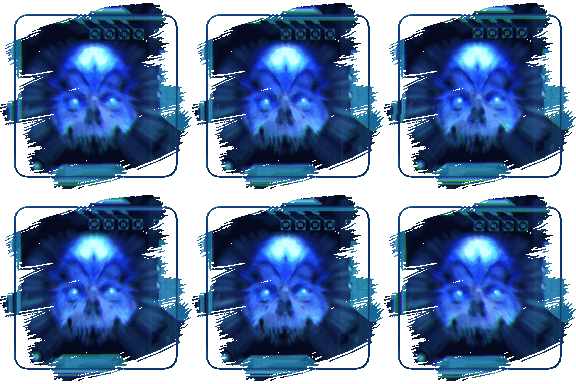
The Dread-Eye Surveillance Node Mk. I is not a "security camera" in the common sense. It is a doctrine-engineered surveillance organ, one of the quiet instruments by which Darth Prazutis made Kainate corridors feel as though they belonged to an intelligence presence rather than to the people walking them. Each node is a coffin-black ocular mount integrated into bulkheads, ceiling ribs, arch corners, or doorframe spines. In isolation, it is an exceptionally capable multispectrum sensor: Low-light amplification, thermal capture, glare-cut polarization, and depth-mapping allow it to retain usable tracking even under blackout conditions, emergency strobes, steam vents, smoke, or fire suppression fog. It is the all seeing eye.
Its defining purpose, however, is the Panopticon Link, a network architecture that treats every Dread-Eye as a nerve ending in a shipwide or facilitywide awareness lattice. Rather than endlessly streaming footage, the node transmits encrypted anomaly packets: identity likelihood, location, movement vectors, and hostile probability derived from cross-referenced sensor channels. Over time, the grid learns "normal" traffic: patrol cadence, door cycling habits, the vibration signature of a known maintenance crew, common route timings, and the subtle rhythm of life within each deck. This makes the Dread-Eye dangerous not only when it sees something, but when it notices something missing, too quiet, too clean, too perfectly still.
Where common surveillance networks are defeated by engineered absence, stealth fields, distortion matrices, slicing jammers, false transponder tricks, the Dread-Eye focuses on the environmental and behavioral scars such concealment leaves behind: micro-lidar discontinuities, thermal "holes" that do not match airflow, acoustic dead zones where footsteps should reverberate, and motion vectors that contradict the space. When tampered with improperly, its Oath-Circuit wipes critical memory, floods the segment with malicious telemetry noise, and "scar-tags" the intruder's signature so surrounding nodes become more sensitive, more suspicious, and more likely to tighten into pursuit behavior. While it cannot detect perfect stealth, imperfect devices it can decipher with ease.
In practice, the Dread-Eye excels as a pursuit-enabling grid rather than an omniscient oracle: it identifies, flags, routes, and reconstructs, granting Kainate security teams the ability to respond with speed and certainty, and to prosecute breaches afterward with stitched corridor reconstructions ("Judgment Playback"). Yet it remains bounded by real limitations: Under Force Nullification it becomes "merely" elite surveillance; and a sufficiently violent attacker can still destroy nodes. The Dread-Eye was designed not to make intrusion impossible, but to make it known, tracked, and answered in the Kainate's preferred language: Inevitability.
Out Of Character Info
Intent:
To create a Kainate exclusive, shipboard and installation surveillance "camera" system designed by Darth Prazutis and deployed throughout shadowed corridors, command sanctums, detention wings, and more, serving as the backbone of its feared intelligence and security apparatus.
Canon Link:
N/A
Permissions:
N/A
Primary Source(s):
N/A
Technical Information
Affiliation:
The Kainate
Model:
Dread Eye Surveillance Node Mk. I
Modular:
Yes
Material:
Alchemized Sarrassian Iron Bloodsteel Bloodpane Optic Whisperstone