

Nothing's Like Before




Ardiente
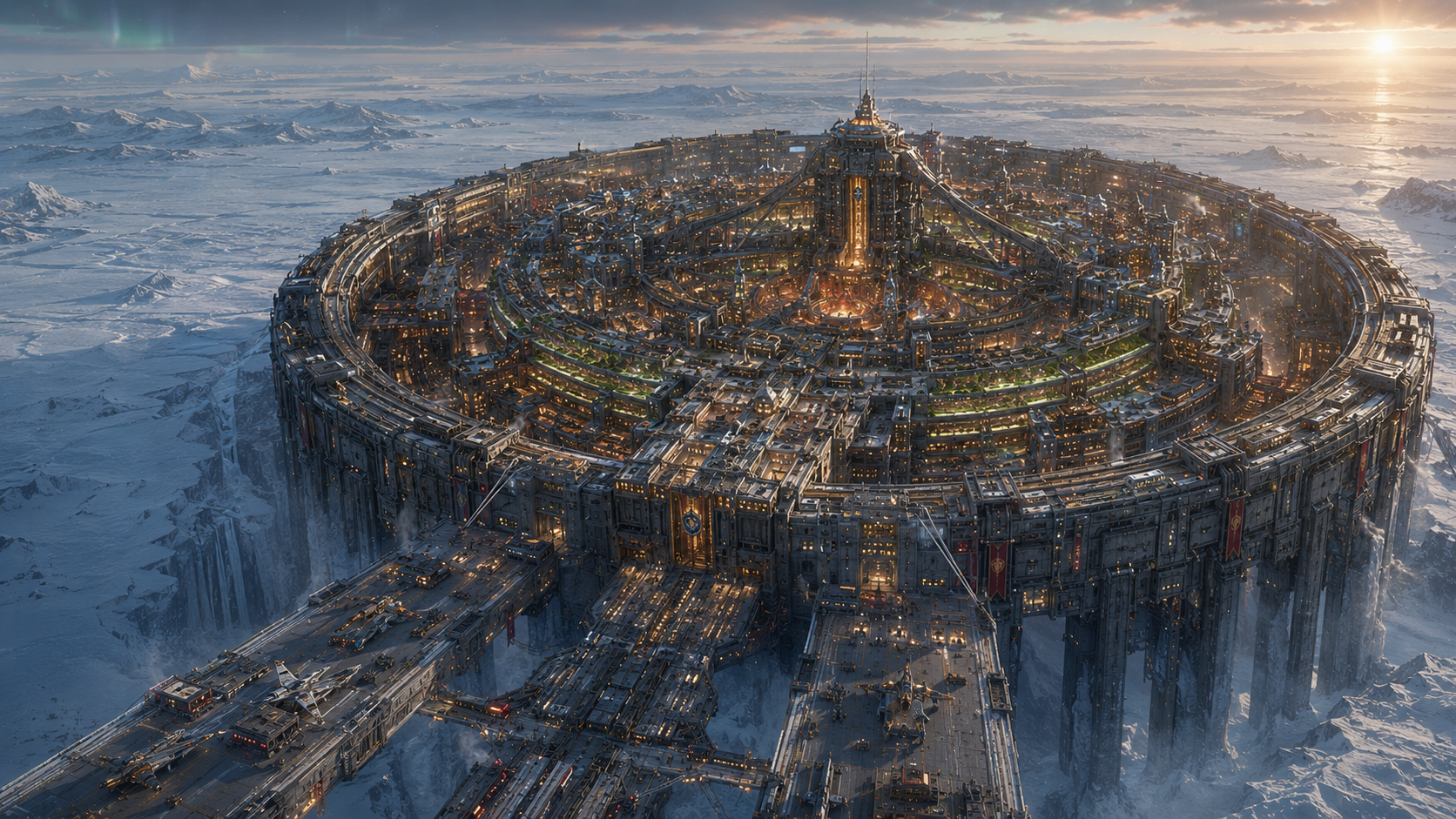
OUT OF CHARACTER INFORMATION
- Intent: To modernize the city of Ardiente
- Image Credit: ChatGPT
- Canon: N/A
- Permissions: N/A
- Links: Ardiente
- City Name: Ardiente
- Classification: Metropolis
- Location: Tokmia
- Affiliation: Imperial Commonwealth of Dosuun
- Population: Heavy
- Demographics:
- Wealth: Medium - Ardiente is not a wealthy city in the traditional sense, nor is it impoverished. Material luxury is rare, but basic needs are reliably met through tightly managed trade networks. Wealth exists primarily in the form of infrastructure integrity, resource control, and long-term stability, rather than visible affluence. Profits from ice, crystal, and ore exports are reinvested into structural maintenance, hydroponics, and civic services rather than private excess. Individual fortunes are uncommon; collective resilience is the city’s true capital.
- Stability: High - Ardiente is a highly stable city, shaped by generations of survival under extreme conditions. Lawfulness is quiet and procedural rather than forceful. Crime exists, but is typically non-violent and swiftly handled through civic systems rather than militarized enforcement. The population values order because disorder threatens survival.
Governance is pragmatic and layered: civic administrators handle trade and infrastructure, while indigenous councils and technical guilds hold real moral authority. After the fall of the First Order, Ardiente did not descend into chaos; instead, it closed ranks, relying on engineering discipline and communal trust. Travelers are generally safe, though outsiders are expected to respect local customs, silence norms, and infrastructure restrictions. - Freedom & Oppression: Ardiente is neither oppressive nor libertine. Citizens enjoy personal freedom, cultural expression, and economic participation, but within clearly defined communal boundaries. Activities that endanger infrastructure, waste heat or water, or disrupt critical systems are harshly restricted.
There is no single dictatorial ruler, and fear of authority is not prevalent. Instead, social accountability is strong. Certain things that might be tolerated elsewhere—unauthorized construction, excessive energy use, reckless flight operations, unlicensed excavation—are treated as serious offenses here.
- Unusual but accepted norms include:
- Strict energy and water rationing during seasonal extremes
- Mandatory compliance with transit and silence corridors
- Civic service expectations tied to infrastructure upkeep
- Freedom in Ardiente is understood as the freedom to survive together, not the freedom to act without consequence.
- Unusual but accepted norms include:
- Description: Ardiente is a dense, ring-supported coldworld capital, anchored into Tokmia’s frozen terrain and rising upward in compact vertical tiers. The city is built for containment and endurance: narrow corridors, enclosed plazas, layered residential blocks, and deep structural columns form a self-supporting urban organism. Outside the ring, the environment is lethal; inside, light, warmth, and life are carefully preserved.
Culturally, Ardiente blends highland communal warmth with circumpolar survival discipline and indigenous fire-centered traditions. Music, art, and storytelling flourish indoors, while public movement remains quiet and efficient. Engineers, hydroponic workers, and maintenance crews are respected as civic pillars. Fire—carefully controlled—serves as both cultural symbol and reminder of the city’s origins.
At a glance, Ardiente feels reserved but alive, austere yet human: a city that does not expand outward, but holds fast, sustaining not only itself, but entire worlds beyond Tokmia through the resources it provides.
- Árdring: Where other cities place their seat of government at the center, Ardiente places its engineering. Árdring is the central structural district — the point at which the massive load-bearing ring interfaces with the city's primary vertical columns, and every tier above and below depends on the constant balancing of stress, heat, and power that happens here. It is infrastructure and identity in equal measure. The name itself reflects the city's evolving Tokmian civic dialect, Árd evoking Ardiente, the ring standing as both literal boundary and symbol of the city that holds against the cold.
- The Structural Spine: At the heart of Árdring lies the Spine, an innermost chamber built like a circular industrial cathedral of steel, composite, and bedrock anchors. Primary columns descend deep into Tokmia's frozen crust while thermal exchangers redistribute captured heat, stress-compensation arrays hum in constant recalibration, and structural gyros absorb the planet's restless shifting. The air is warm but not comfortable, faintly metallic and recycled. This is the mechanical heart of the city, and only licensed engineers, Column Wardens, and authorized technicians may pass into the deepest ring interface.
- The Civic Galleries: Encircling the Spine are the Civic Galleries, open-access corridors where any citizen may observe the city's condition in real time. Great illuminated panels display column strain tolerances, ice reserve levels, power storage, hydrospire yield, atmospheric pressure, and seismic readings, and there is no attempt to soften bad news; when the reserves drop, the numbers show it. Here, transparency is not political branding but reassurance. School groups often visit the Galleries before any other district, and many Ardientans can still recall their first sight of the city's "vitals" glowing overhead.
- The Apprentice Tiers: Above the Galleries rise the tiered observation platforms and training corridors of the Ringwright Guild and its associated maintenance guilds. Apprentices watch live recalibration cycles, column inspections, emergency stress tests, and thermal redistribution simulations, learning a trade considered a civic inheritance. Many families trace generational ties to a specific column — "We hold Twelve," or "Our line serves the Eastern Spine" — and it is not uncommon for children to choose a guild apprenticeship before they have finished standard schooling.
- The Fireward Terraces: One of Ardiente's oldest and most culturally significant districts, the Fireward Terraces are built into sheltered interior escarpments along the inner face of the ring, occupying the transitional zone between infrastructure and community — high enough to receive controlled airflow and redistributed heat, yet shielded from Tokmia's lethal cold. Organized as a series of stepped ceremonial ledges, council chambers, and controlled burn platforms, the district answers to the Fire Wardens, who serve at once as cultural stewards and certified thermal-safety officers. Where Árdring sustains the city's body, the Terraces sustain its memory, carrying forward fire-traditions that reach back to the ancestral Oku who once burned great fires across the tundra in vigil for visitors who would one day return.
- The High Fire Circle: The central ceremonial plaza of Ardiente and the most publicly visible space within the Terraces, the High Fire Circle is a broad circular hearth basin ringed by retractable thermal shielding, heat-buffering stone composite flooring, and tiered arc seating carved into the terrace face. It hosts remembrance cycles, seasonal light transitions, ice convoy departures, and the recovery ceremonies that follow seismic or thermal events. Every burn here is documented, regulated, and announced in advance — never spectacle. Names are spoken. Losses are acknowledged. Milestones are marked.
- The Council Rings: Adjacent to the Circle sit several enclosed and semi-open Council Rings, circular assembly chambers that operate on a non-hierarchical speaking order. There is no raised platform, no permanent chair, no throne; participants sit at equal elevation, and engineers, hydroponic workers, Fire Wardens, and youth representatives may all speak in turn. Though Council decisions are technically advisory to the civic government, their cultural authority runs deep, and it is rare for administrators to act against a unified Ring. In their equal seating and shared voice, the Rings preserve the spirit of the old Oku tribal councils.
- The Ember Vault: Beneath the primary terrace level lies the Ember Vault, a restricted chamber holding preserved embers from the fires that shaped the city — the first city-wide burn after the First Order's collapse, the fire lit when the ring survived a near-structural failure, and flames carried from the pre-ring Oku settlements during the earliest days of integration. Stored in shielded alcoves kept at a minimal but continuous heat, these embers are never allowed to die unless formally retired, and the Vault answers to the senior Fire Wardens alone. They are the same fires, in an unbroken line, that the Oku once lit for absent gods.
- The Oral History Chambers: The acoustically engineered Oral History Chambers preserve the city's storytelling traditions in rooms built around a central controlled flame basin, with heat-retentive flooring, curved walls to soften the echo, and adjustable ventilation to keep the burn safe. Storytelling follows ritual: the flame is lit first, the speaker takes position opposite the fire, the audience sits in a full circle, and silence is kept between narratives. The accounts preserved here span Oku migratory history, early offworld contact, the years of First Order occupation and resistance, post-collapse survival, and the inter-district cooperation that carried the city through crisis. Here, firelight is considered witness, not ambiance.
- The Alto Enclave: Occupying a protected interior tier between the Fireward Terraces above and the mid-level residential corridors below, the Alto Enclave is the city's academic, ethical, and archival heart, formally designated a civic district under the oversight of the Ardiente Cultural Authority. It takes its name from Dr. Juana Alto, whose early anthropological mediation between the Oku councils and Human settlers shaped the city's founding integration, and it serves three intertwined roles: research and scholarship, ethical oversight of resource and expedition policy, and the preservation of cultural continuity. Unlike the industrial and trade districts, the Enclave is built to slow movement and encourage deliberation; its temperature runs slightly warmer than city standard, and acoustic dampening keeps conversation contained.
- The Alto Anthropological Center: The district's flagship institution houses departments devoted to Oku oral tradition and cosmology, diaspora integration and settlement history, cold-adapted urban sociology, resource ethics and extraction modeling, and linguistic preservation. Every expeditionary team operating out of Caguas Reach passes through the Center for a cultural-impact briefing before deployment and a debriefing upon return. The Center maintains cooperative partnerships with Commonwealth institutions, though all offworld projects require local council review, and its reputation, while high, is grounded rather than vain; its mandate is not prestige but continuity.
- The Cultural Preservation Archives: Set within the central Archive Atrium, the Preservation Vaults form a climate-controlled, multi-tier complex holding recorded Oku migration narratives, pre-ring settlement documentation, First Order occupation records, post-collapse survival journals, family lineage registries, and the crystal-field and ice-treaty transcripts. Access is tiered, and the most sensitive materials — those touching sacred land or early integration disputes — require the joint approval of Council delegates and Archive custodians. The Atrium itself is a quiet marvel: suspended data strands cascade between levels in warm tones, mimicking the drift of an aurora within a sheltered valley.
- The Commonwealth Ethics Chambers: A set of circular deliberation rooms designed for policy review, the Ethics Chambers convene to weigh ice-export expansion, crystal-refinement licensing, ore-extraction thresholds, industrial proposals, and the impact of any work on sacred sites. As in the Council Rings, seating is equal and there is no central seat of authority; representatives of the Ringwright Guild, the Fire Wardens, the Council, and Commonwealth liaisons take part in moderated discussion. The rulings issued here are advisory in the technical sense but culturally binding in practice, and civic leadership rarely acts against a unified Ethics decision.
- The Commons & Terrace Walk: The Enclave is not purely institutional. Its Commons sector keeps the district lived-in: Café Emberlight overlooks an interior moss garden, serving spiced root teas, fermented berry infusions, grain breads from the Hydrospire, and slow-cooked protein stews, with holo-communication volume restricted by ordinance so that conversation is expected to linger — it is common to find engineers, Fire Wardens, and students sharing a table. The Winter Library offers an open study hall of communal tables and recessed thermal panels, its light filtered through skylight shafts engineered to mimic a highland dawn. And the Highland Terrace Walk connects the district's institutions along an interior promenade, its murals depicting mountain settlements, fire ceremonies, ice convoy departures, and structural diagrams rendered in symbolic geometry, where street musicians sometimes perform — though amplification is prohibited.
- The Hydrospire: Rising through multiple tiers along Ardiente's inner structural arc, the Hydrospire is the city's life-support and agricultural district, integrating food production, seed preservation, aquaculture, research, and public green corridors into a single living organism. Unlike the hidden industrial food systems found elsewhere in the galaxy, the Hydrospire keeps cultivation visible and participatory; children here grow up knowing exactly where their meals come from.
- The Production Rings: Tiered hydroponic bands form the structural backbone of the district, their crops chosen for caloric density, nutrient stability, and cultural continuity, so that highland root vegetables sit beside alpine greens and cold-resistant legumes. Vertical crop arrays, adaptive lighting tuned to Tokmia's seasonal cycles, aquaculture tanks for cold-adapted protein, and closed-loop water reclamation tied directly into the ice reserves keep the district producing year-round. Workers move carefully through the narrow aisles, adjusting nutrient flows and pruning growth columns, and the air carries the faint smell of soil analog and clean water. It is labor-intensive, respected work.
- The Research & Nutrient Labs: Embedded among the growing tiers, the nutrient-development and crop-adaptation labs work closely with the Alto Enclave during policy review, pursuing cold-resistant hybrid strains, mineral balancing for long-term health, yield efficiency that does not strain the structure, and emergency-ration modeling against the possibility of export crisis. The science here is quiet and methodical, and breakthroughs tend to be celebrated modestly — more often with a shared meal than an announcement.
- The Public Green Corridors: Threaded between the production tiers, the green corridors serve as psychological relief within a high-density city, their light warmer and their air slightly more humid. Moss-lined walking paths wind past small tree clusters grown beneath skylight shafts, thermal benches in quiet alcoves, and communal herb gardens, and it is common to see elders tending small plots, children on school tours, off-duty engineers sitting in silence among the greenery, and couples sharing tea beneath the hydroponic vines. The corridors are not ornamental; they are preventative care for the human spirit.
- The Market & Commons Levels: Lower in the district, the Hydrospire becomes fully lived-in. At The Root Market, fresh produce is sold directly from the Production Rings — greens and root bundles, preserved vegetables, grain loaves baked on-site, fermented berry drinks, and ice-cooled protein cuts — at regulated prices, where waste is monitored and it is considered deeply rude to handle the produce carelessly. The district's restaurants and eating houses reflect Ardiente's layered identity, with highland stew houses, arctic-inspired smoked-fish kitchens, flatbread and spiced-grain cafes, and small tea rooms serving infusions grown in the tiers above; tables sit close together and meals are hearty but never extravagant, dining here being communal rather than private. The popular Emberleaf Café overlooks a vertical garden wall, its tables a place where holotablets open beside steaming cups of spiced root tea, honeyed grain cakes, fermented berry tonics, and thick winter soups, and quiet debates between researchers run long.
- Recreation & Games: Life happens in the Hydrospire, not merely work, and during the darker seasonal cycles the Commons levels fill with card clubs and games — dejarik tables recessed into communal benches, holochex boards for strategic matches, monitored chance-cube tables, star-dice clubs, and deck-game circles played with the spirit of old trick-taking and meld games. Tokmia's exterior may be hostile, but the city has adapted recreation to its interior: youth leagues compete during the winter-turn festivals on the Glide Lanes, controlled low-friction corridors for speed-skating, in the thermal-regulated Stonefield Curling Rings, and at the low-gravity Grav-Pool Tables, with injury prevention prioritized throughout.
- The Coldchain Exchange: Occupying the lower mid-tier arc nearest the primary cargo lifts and external docking interfaces, the Coldchain Exchange is the city's logistics and resource-transfer zone — its economic engine and primary interface with offworld trade. Every major export, ice, crystal, and ore alike, passes through this district before leaving Tokmia. The Exchange is built for movement: wide cargo corridors intersect reinforced vault chambers, thermal containment barriers divide the sectors by material type, overhead transit rails carry sealed containers toward the outbound lifts, and floor markings regulate the flow of foot and machine traffic. Where the Alto Enclave deliberates and the Hydrospire warms, the Coldchain Exchange runs at constant momentum — busy, but never reckless.
- The Ice Vault Complex: The largest physical footprint in the district, the Ice Vaults hold potable ice reserves, mineral-balanced ice for agricultural export, emergency relief stockpiles, and long-term strategic reserves, all maintained within strict thermal parameters that tolerate little fluctuation. Every block is scanned, graded, and logged before release, its purity readings entered into the public record, and when the reserves fall the dashboards in Árdring reflect it at once.
- The Crystal Grading & Stabilization Halls: Crystals harvested from Tokmia's fields are brought here to be graded and prepared for export — never militarily refined — through structural-integrity scanning, frequency-resonance testing, impurity removal, and stabilization encasement. The halls run cooler than the surrounding sectors, lit in a soft blue-white inspection light.
- The Ore Processing & Fabrication Lines: Unlike ice and crystal, ore undergoes its initial processing within the Exchange itself, feeding cold-resistant alloy refinement, structural component casting, industrial-grade fabrication, and replacement-part manufacturing. Many of Ardiente's own machine components originate here, with fabrication bays working alongside repair workshops, so that should external supply lines ever fail, the Exchange can sustain the city's internal infrastructure for an extended time.
- The Convoy Operations Center: The operational nerve center of the district tracks ice-convoy trajectories, docking schedules, weather across Tokmia, cargo load balancing, and offworld emergency requests across great holo-displays. The voice traffic here is crisp and minimal, the orders concise, the mistakes rare.
- The Worker Barracks & Living Rows: Because Coldchain operations never stop, many workers live within the district, in compact but insulated quarters served by communal kitchens, recreation alcoves, and rotational rest chambers. Conditions are modest but stable, and the workers are respected — their labor is the city's trade leverage made flesh.
- Transport Repair & Machine Maintenance: A critical sub-sector devoted to keeping the machines running, where heat regulation is balanced on a knife's edge — too warm and the ice destabilizes, too cold and the machinery seizes. Cargo-sled repair bays, grav-loader calibration pits, conveyor-track workshops, and thermal-regulator servicing stations keep failure at bay through constant preventative maintenance, because here machine failure is simply not tolerated.
- The Lower Columns: Beneath the mid-level civic districts, surrounding and descending alongside the primary load-bearing columns that anchor the city into Tokmia's crust, lies the industrial and structural-maintenance zone known as the Lower Columns. This is the district of heavy industry, ore refinement, fabrication, and the core mechanical systems that keep the city alive, organized radially around the individual columns so that each functions almost as its own neighborhood cluster — and many families here identify themselves not by street but by column number.
- The Ore Refinement Yards: Ore arrives through reinforced cargo shafts to be routed into temperature-regulated refinement plants, where thermal gradients must be carefully managed — excess heat threatens structural stress, too little compromises alloy integrity. Crushing and separation, smelting under controlled cycles, cold-resistant alloy infusion, and slag reclamation fill the yards with a molten glow that lights otherwise shadowed corridors, while workers labor in layered gear calibrated against both the heat and the surrounding cold.
- The Alloy & Component Fabrication Bays: Once refined, materials are shaped into structural reinforcement braces, conveyor components, thermal shielding plates, cargo-sled runners, ice-vault containment seals, and even replacement column segments. The city prides itself on self-sufficiency, and it is here that the boast is kept: if the supply lines ever fail, the Lower Columns can keep the ring standing on their own.
- The Structural Repair Docks: Embedded directly into the city's skeletal framework, the Repair Docks are where maintenance crews perform column-stress recalibration, microfracture sealing, thermal-conduit replacement, and reinforcement retrofitting. Great articulated lift rigs move slowly along the inner column shafts, and the scale here is cathedral-like — vertical, resonant, and imposing.
- The Worker Housing & Commons Rows: With shifts running continuously, many column workers live within the district, in reinforced modular units served by communal kitchens, shared wash stations, heated sleeping alcoves, and family quarters tied to specific column clusters. Conditions are modest but stable, and column identity is fierce; the walls are marked with column insignias, family crests, ice-route patches, and guild certifications, pride made visible.
- Recreation & Worker Culture: The Lower Columns are far from joyless. After shift rotation, workers gather in recreation halls carved between the structural braces, where racing leagues run during the winter-turn festivals — speed as a kind of controlled defiance against Tokmia's crushing weight, with strict safety oversight keeping injuries rare. The gravity-assisted Slideways wind along controlled slopes between the lower maintenance tunnels, lined with thermal guards and emergency braking fields, and are known locally as the Frostslides for sled-style racing and the Spine Runs for the face-forward, skeleton-style rigs.
- The Machine & Artisan Galleries: Not every worker goes home to sleep; some build. Craftsmanship is respected in the Lower Columns, and small artisan shops produce custom tool handles carved from reclaimed composite, hand-forged alloy bracelets, column-themed insignia pins, precision mechanical clocks, and engraved maintenance plates, many of them gifted during apprenticeship ceremonies.
- The Automat & Cafeteria Halls: Dining in the Lower Columns favors efficiency, with long communal tables and automat-style eateries serving steamed grain bowls, root-mash plates, protein stews, fermented berry drinks, and high-calorie shift rations — food that is hearty, fast, and affordable, with card games breaking out after the meal. Among the games and social tables are dejarik boards set into reinforced benches, holochex tournaments between column crews, monitored chance-cube games, deck-game clubs popular through the long shifts, and grav-pool tables bolted to the floor.
- The Enclosed Plazas: Rather than a single block, the Enclosed Plazas form a distributed district — interconnected civic commons embedded within the dense residential tiers, climate-controlled and acoustically insulated, set deliberately close to the housing corridors so they remain accessible across every generation. Where other districts focus on survival, trade, or memory, the Enclosed Plazas focus simply on living. At their largest, the grand plaza halls are the biggest communal spaces in the residential tiers, where children run between the tables, elders sit near the heat benches, and apprentices meet after shift. The market and bakery corridors are where Ardiente smells sweet: dairy bars are particularly beloved, their thick cultured drinks served chilled and flavored with berry, grain-honey, or toasted spice, while small bakeries work behind glass partitions, their ovens radiating gentle warmth into the corridor seating, and food waste stays minimal, leftovers repurposed or sent on to communal kitchens. The music and recreation galleries are essential to the plazas, with small stages set along the corridor bends where string ensembles perform, hand-percussion groups rehearse, voice circles practice layered chant, and youth learn both traditional and offworld instruments. And along the edges of the larger plazas, the artisan boutiques are modest but deeply personal places, where a purchase often marks a passage in life.
- The Quiet Corridors: Embedded throughout Ardiente's primary movement arteries, the Quiet Corridors are a city-wide transit and behavioral system — and though they are not geographically centralized like the other districts, their unified governance, regulation, and architectural continuity earn them formal recognition as a civic district in their own right. They connect the residential tiers, the Hydrospire, Árdring, the Coldchain Exchange, the Alto Enclave, the Lower Columns, and a great many other districts besides; every major pedestrian and transit flow in the city passes through a Quiet Corridor somewhere along its route. The primary transit arteries carry high-capacity pedestrian lanes and sealed grav-tram tracks beneath climate-stabilized airflow and a low-frequency ambient sound masking, with announcements delivered to personal devices rather than loudspeakers, and running discouraged except in emergencies. The capsule and sleeper lines serve long-distance internal transit through capsule sleeper pods, study compartments, reclined seating alcoves, and personal charging ports, so that a worker crossing between districts can nap safely without returning home and a student can study through a transit cycle. Commerce and convenience nodes appear at regular intervals, occasionally widening into small commercial bays of automat dispensaries, baker kiosks, supply vending, and water-and-nutrient refill stations, offering cheap disposable headphones, warm-beverage dispensers, utility-repair kiosks, and small pharmacy nodes — nothing flashy, everything practical. And set back from the main flow, the meditation and green alcoves form small recessed green bays where stress is eased and the energy of the traveler is preserved.
- The Lumen Tier: Positioned in an upper-interior band between the residential tiers and the Alto Enclave, the Lumen Tier is the city's civic-health and education zone, consolidating medical care, technical education, guild academies, and higher learning into a single coordinated ecosystem. Its name carries both meanings of light — lumen as a measure of brightness, and light as enlightenment — and the district is laid out for accessibility and calm, its wide corridors linking hospitals to teaching halls, its student housing within walking distance of the clinics, and its emergency transport lanes running directly to Árdring and the Lower Columns.
- The Medical Complex & Trauma Centers: Ardiente's medical facilities are cold-adapted and tightly integrated, their heat control precise, their air filtration redundant, their backup power tied directly into Árdring's priority circuits. The central hospital houses trauma-stabilization units for industrial accidents, frost-exposure wards, respiratory and thermal-regulation clinics, surgical theaters, maternal and pediatric care, and long-term rehabilitation suites.
- The Education & Guild Academies: Ranging from primary schooling to advanced technical colleges, the Lumen Tier's institutions occupy warm-lit, acoustically controlled classrooms set within walking distance of the apprenticeships they feed. Foundation schools, engineering preparatory academies, agricultural-sciences programs tied to the Hydrospire, medical-training institutes, logistics and convoy-coordination programs, and cultural and linguistic studies together ensure the city's future.
- The Student Housing & Apprentice Quarters: Student housing lines interior terraces overlooking modest green alcoves, affordable and often subsidized through guild sponsorship, with most units offering compact study pods, shared kitchens, thermal-regulated sleeping alcoves, and group-work commons.
- The Recreation & Rehabilitation Commons: Because the district houses both the injured and the learning, recreation is carefully integrated — variable-gravity physical-therapy pools, low-impact interior glide tracks, controlled Frostslide practice tunnels for the youth leagues, dejarik and holochex halls, card clubs and strategy leagues, and music-rehearsal rooms shared with the performers of the Enclosed Plazas.
Medium - While primarily a civilian and industrial hub, Ardiente's greatest defense is its environment; Tokmia's lethal exterior is the first and most absolute wall any threat must cross. The city's true vulnerabilities are infrastructure failure, resource diversion, and accident, and so its security posture is built around containment, access control, and structural integrity rather than militarized force. Enforcement is quiet and procedural, calibrated to preserve the freedoms of the populace while ensuring that no single act of negligence or sabotage can endanger a city wholly dependent on its own engineering. Ardiente maintains no standing army of its own; the broader defense of Tokmia falls to the Imperial Commonwealth garrison.
Perimeter Defenses:
- Sensor Arrays: Distributed sensor arrays ring the city's exterior shell and docking approaches, monitoring atmospheric conditions, structural stress, and unauthorized movement across the surrounding tundra in real time.
- Docking Control & Guard Posts: Manned checkpoints govern the starport and external cargo interfaces, the only viable points of entry. Crews assess incoming traffic and credential all arrivals before they are permitted into the city proper.
- Automated Defense Turrets: Point-defense emplacements integrated into the docking and starport structures, oriented against piracy and unauthorized landing rather than full-scale assault.
- Thermal Containment Barriers: Sealable bulkheads and barriers divide the city's outer tiers, able to isolate breached or compromised sections from the warm, life-sustaining interior in the event of structural or atmospheric emergency.
- Quiet Corridor Monitoring: The citywide transit arteries are passively monitored through integrated sensor and airflow-control systems, tracking population flow and load for safety and resource management rather than surveillance of dissent.
- Civic Compliance Officers: Trained personnel handling the bulk of day-to-day order; rationing enforcement, transit and silence-corridor compliance, and violations such as unlicensed construction or excessive energy use. Their work is administrative and non-violent, backed by strong social accountability.
- Holo Cybersecurity Protocols: Hardened protocols safeguard the city's vital infrastructure systems; the stress-compensation arrays, thermal exchangers, and reserve dashboards of Árdring, protecting against intrusion or tampering.
- Column Wardens: Licensed security-engineers controlling access to the Structural Spine and the deepest ring interface. Vetting is rigorous, as the deep columns are the single most critical and sensitive point in the city.
- Fire Wardens: Certified thermal-safety officers holding binding authority over all controlled-burn operations. In a sealed coldworld city, fire safety is a security function as much as a cultural one.
- Security Droids: Cold-adapted droids equipped with non-lethal deterrents assist Civic Compliance Officers in patrolling the Coldchain Exchange, cargo vaults, and high-traffic plazas.
- Emergency Response Crews: Specialized teams equipped for industrial accidents, frost exposure, structural failure, and fire; the most frequent genuine threats to life in Ardiente, capable of rapid mobilization to any tier.
HISTORICAL INFORMATION
Long before any starship marked Tokmia's sky, the planet belonged to the Oku — a white-furred people native to its frozen flatlands. In the ancient era, Figg Excavations stripped the world of its crystal and ore wealth, then abandoned it, leaving behind exhausted mines, a still-active automated security system guarding the deepest deposits, and a people who had grown accustomed to the offworlders' presence. In the centuries that followed, the Oku kept great fires burning across the tundra — landing lights for gods they believed would one day return. Over the long span that separated that age from the city's founding, the Oku evolved: isolation, hardship, and the slow turning of generations sharpened them from the primitive cargo-cult of legend into a deliberate, fire-keeping people governed by tribal councils.
The prophecy, in a sense, came true. Eli Caguas arrived seeking the ruins of the ancient Figg Excavation and its rumored abandoned mining colony. He brought with him Dr. Juana Alto, a xenocultural anthropologist drawn by stories of the Oku and their long vigil, alongside companions Stella Rojas, Fajardo Guyama, and Cidra Hondo. What Caguas found was not just ruins but arable soil, ore, and a people who received the newcomers as the fulfillment of their oldest hope. Where another expedition might have exploited or displaced the Oku, Juana Alto's mediation made integration the founding principle. The fires that had once called to absent gods became, instead, the shared hearth of a new city: Ardiente — a place of warmth built against a world of cold.
Word spread. As the One Sith's tyranny gripped the wider galaxy, refugees fled to Tokmia, and the expedition camp swelled into a true urban center. But Ardiente was poor and isolated, its survival forever weighed down by the cost of importing food, materials, and medicine. So when the First Order's banners crossed the sector, Carol Alto — Juana's descendant — chose pragmatism over pride. She welcomed the Order, explained her family's quest, and watched as Imperial engineers transformed the settlement. The First Order Corps of Imperial Engineers (FOCIE), drawing on technology from the First Order worlds of Ryoone and Riflor, sank the great load-bearing ring and the deep structural columns that let the city rise in vertical tiers and survive Tokmia's lethal exterior. Not everyone forgave Carol's decision — but none could deny it kept Ardiente alive. The First Order's survey teams resumed the old hunt for crystals, probing the abandoned Figg fields and their lethal automated guardians.
Then the First Order fell.
Ardiente did not. Where other dependent colonies fractured into chaos, Ardiente closed ranks. The discipline that survival had always demanded became its salvation: the engineers kept the ring balanced, the Fire Wardens kept the hearths lit, and the councils kept the peace. The FOCIE monitoring station beneath the city did not go dark — its engineers reorganized into the civilian Ringwright Guild, carrying their institutional knowledge of every column and stress-array forward as a civic inheritance. When the Imperial Commonwealth of Dosuun rose from the First Order's wreckage as a successor polity under Sith Empire suzerainty, Ardiente entered it not as a conquered holding but as a self-sustaining capital that had proven it could endure alone.
By 907 ABY, Ardiente stands as the Tokmian capital and a quiet pillar of the Commonwealth — exporting the ice, crystal, and ore that sustain worlds far beyond its frozen sky, governed by the layered authority of civic administrators, technical guilds, and the fire-keeping councils whose traditions reach back to a people who once lit fires for visitors who, against all expectation, finally came.
Last edited: