✠ Nihilus Indomitus ✠


- Intent: To fill the world of Vandemar with interesting and diverse life that is intriguing to roleplay with.
- Image Credit:
- Canon: N/A
- Permissions: N/A
- Links: Vandemar
GENERAL INFORMATION
- Name: Zaryx
- Designation: Non-sentient
- Origins: Vandemar; mountain ranges, rocky highlands and deep ravines
- Average Lifespan: 24–36 standard years
- Estimated Population: Planetary; scattered across Vandemar's major mountain systems
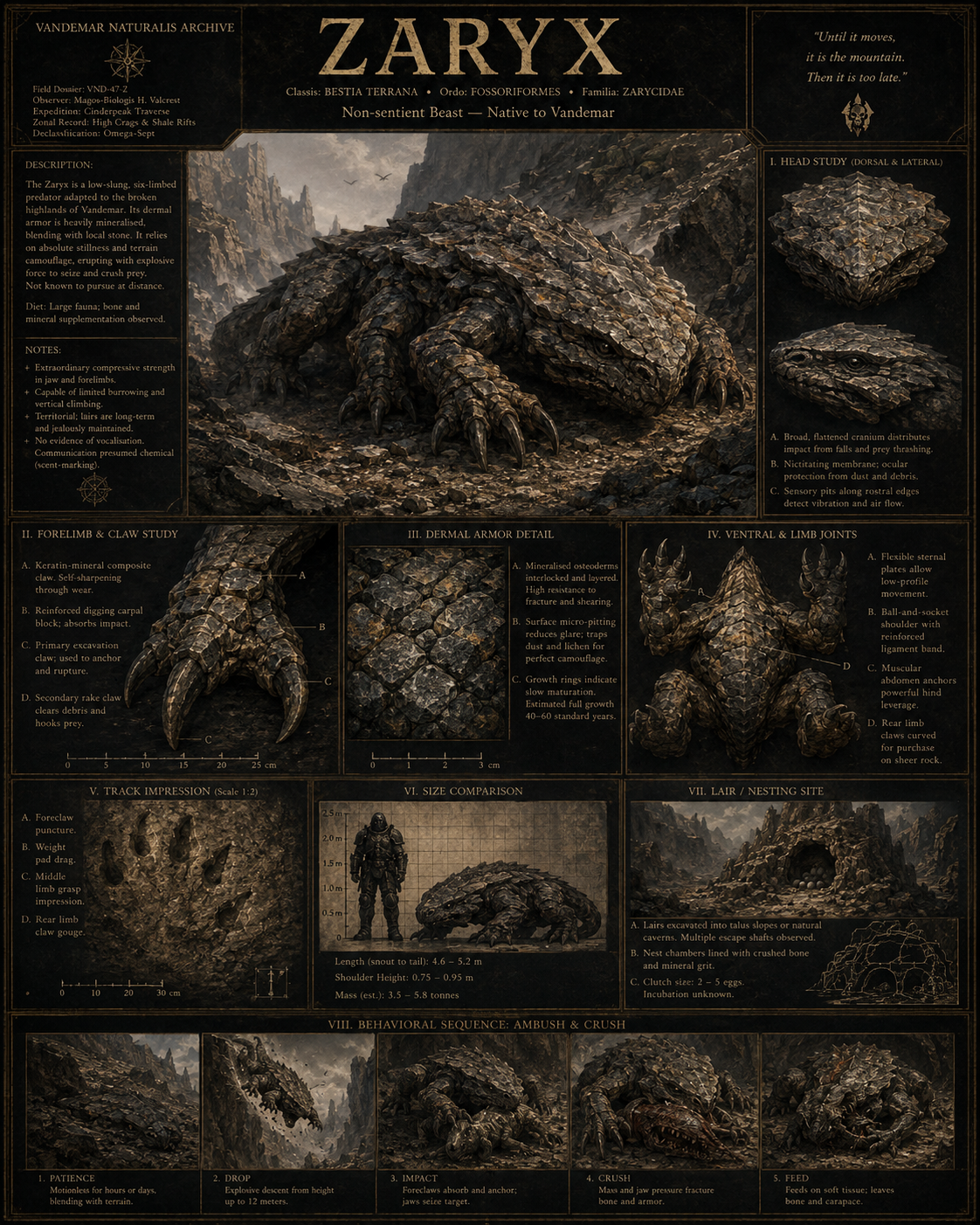
- Description: The zaryx is a low, six-limbed predator whose mineralised scales resemble weathered stone. It waits among boulders and cliff faces until prey passes beneath, then descends in a sudden avalanche of claws and crushing muscle. In the highlands, loose rock does not always fall by accident.
PHYSICAL INFORMATION
- Breathes: Type I atmosphere
- Average Height of Adults: 0.7–1 metre at the shoulder
- Average Length of Adults: 2.8–4 metres
- Skin color: Slate-grey, dark brown, ochre, black or pale granite
- Hair color: None
- Distinctions: Zaryxes possess six muscular limbs, a flattened skull and a broad body held close to the ground. Their outer scales absorb minerals from local stone, producing regional colouration and making resting specimens difficult to distinguish from surrounding rock. The forward limbs end in heavy excavation claws, while the middle and rear limbs possess gripping pads suited to steep surfaces. Their jaws are comparatively weak; prey is usually killed by being pinned and crushed beneath the body. Males develop taller dorsal ridges, while females are broader and more heavily muscled. Older specimens often carry cracked scales, broken claws and lichen growth across the back.
- Races: None formally recognised. Regional variation closely follows the local geology.
- Force Sensitivity: Non-Sensitive
- Exceptional camouflage against rock and mountain terrain
- Powerful gripping limbs and crushing body strength
- Excellent climbing ability across cliffs and steep slopes
- Limited speed across flat, open ground
- Softer underside and vulnerable limb joints
- Poor tolerance for prolonged immersion or marshy terrain
CULTURE
- Diet: Carnivore. Zaryxes prey upon mountain grazers, burrowing animals, nesting creatures and isolated travellers. They often consume mineral-rich bone and shell along with flesh.
- Communication: Stone scraping, claw impacts, scent markings and low vibrations transmitted through cliff faces.
- Technology level: None.
- Religion/Beliefs: None.
- General behavior: Zaryxes are solitary territorial hunters. They establish lairs in cliff hollows, collapsed tunnels and narrow ravines, usually overlooking well-travelled animal paths. Rather than chase prey, they climb above it and attack from elevation. Their six limbs lock around the victim while the body contracts downward with immense force. Females lay small clutches in warm stone chambers and guard the young until their scales begin to harden. Juveniles hunt insects and small animals before dispersing into separate territories.
HISTORICAL INFORMATION
Zaryx fossils are widespread throughout Vandemar's mountain strata. Their mineralised skin appears to have evolved both as camouflage and protection against rockfall, harsh weather and larger predators.
Early mountain settlements frequently mistook resting zaryxes for natural formations. Several roads were abandoned after repeated attacks from cliffs that appeared clear under visual inspection. Thermal scanning proved only partly effective, as resting animals lower their body temperature against the surrounding stone.
Modern highland routes use vibration emitters, overhead surveillance and regular cliff clearing to discourage nesting. Quarry crews are trained to inspect any boulder whose position changes between shifts.
Among Vandemarian mountaineers, the phrase "count the stones twice" is not cautionary folklore. It is field procedure.