✠ Nihilus Indomitus ✠


- Intent: To fill the world of Vandemar with interesting and diverse life that is intriguing to roleplay with.
- Image Credit:
- Canon: N/A
- Permissions: N/A
- Links: Vandemar
GENERAL INFORMATION
- Name: Vorask
- Designation: Non-sentient
- Origins: Vandemar; forest margins, rocky scrublands, river valleys and abandoned settlements
- Average Lifespan: 16–24 standard years
- Estimated Population: Planetary; widespread in small territorial populations
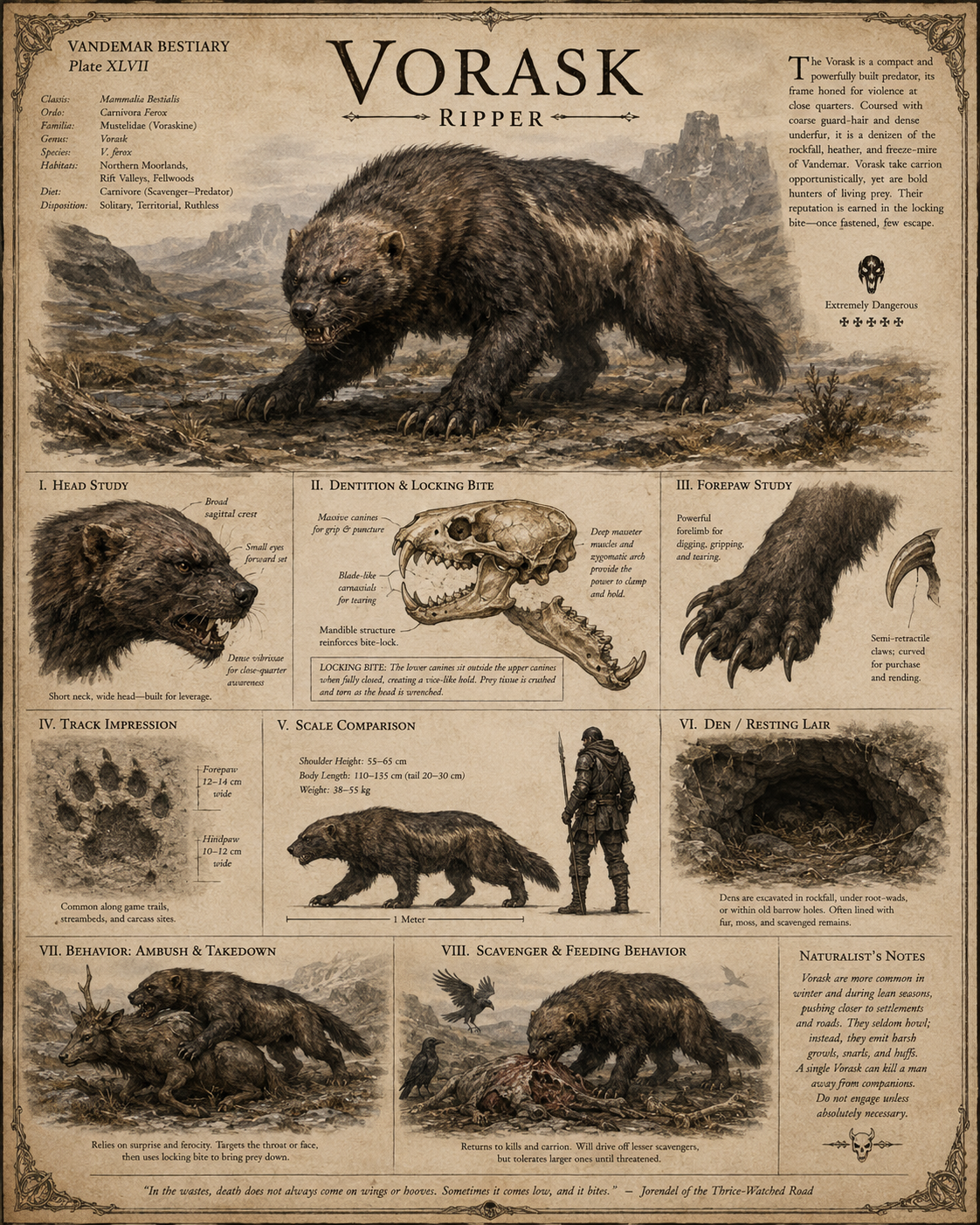
- Description: The vorask is a low, muscular predator built less for pursuit than for violent commitment. Once its jaws close, specialised tendons lock the bite in place, allowing the beast to remain attached through blows, falls and severe injury. A wounded vorask is not a retreating animal. It is a problem that has ceased to care whether it survives.
PHYSICAL INFORMATION
- Breathes: Type I atmosphere
- Average Height of Adults: 0.7–1 metre at the shoulder
- Average Length of Adults: 1.8–2.6 metres
- Skin color: Grey, dark brown, black or mottled ochre
- Hair color: Coarse black, rust-brown, grey or pale cream
- Distinctions: Vorasks possess broad skulls, short necks and dense bodies carried on powerful limbs. Their jaws contain thick conical teeth suited to puncturing and crushing, while a specialised ligament system can lock the mouth shut after a full bite. The hide is reinforced by fibrous dermal layers that resist tearing and reduce blood loss. Males are heavier through the shoulders and display pronounced cheek ridges; females are longer-bodied and more protective of denning sites. Elderly specimens develop worn teeth, split ears and pale scar tissue around the muzzle.
- Races: None formally recognised. Highland vorasks possess denser coats and shorter limbs, while lowland populations are leaner and more heat tolerant.
- Force Sensitivity: Non-Sensitive
- Locking bite and exceptional jaw strength
- Dense hide, high pain tolerance and resistance to blood loss
- Powerful short-range acceleration
- Limited endurance and poor long-distance speed
- Once locked onto prey, the animal has reduced situational awareness
- Vulnerable eyes, throat and exposed abdomen
CULTURE
- Diet: Carnivore and scavenger. Vorasks consume small and medium-sized animals, carrion, eggs and the kills of larger predators. They favour marrow, joints and nutrient-rich organs.
- Communication: Harsh growls, jaw clacking, scent markings and low body postures. Mothers use short rumbling calls to direct their young.
- Technology level: None.
- Religion/Beliefs: None.
- General behavior: Vorasks are solitary or live in small family groups centred around a breeding pair. They stalk prey through cover before attacking in a short burst and fastening onto a limb, throat or underside. Rather than release and strike again, they use body weight and violent twisting to pull prey off balance. Vorasks regularly challenge larger predators for kills and will remain attached even while being dragged or wounded. Females raise two to four cubs in root hollows, ruins or excavated dens and defend them with extreme aggression.
HISTORICAL INFORMATION
Vorasks are native to Vandemar's temperate lowlands and appear throughout the fossil record as compact scavenger-predators. Their locking jaws likely evolved to retain prey while competing with larger hunters capable of stealing a kill.
Early settlers considered them little more than oversized vermin until repeated attacks demonstrated that conventional attempts to beat or frighten one away only intensified its grip. Frontier communities developed forked extraction tools and reinforced limb guards specifically for vorask encounters.
Modern wardens remove individuals that become habituated to settlements, but the species remains widespread and ecologically useful as a scavenger and suppressor of smaller predators.
The Vandemarian expression "vorask-fastened" describes an enemy, grievance or duty that cannot be removed without tearing away part of whatever it has seized.