
✠ Nihilus Indomitus ✠


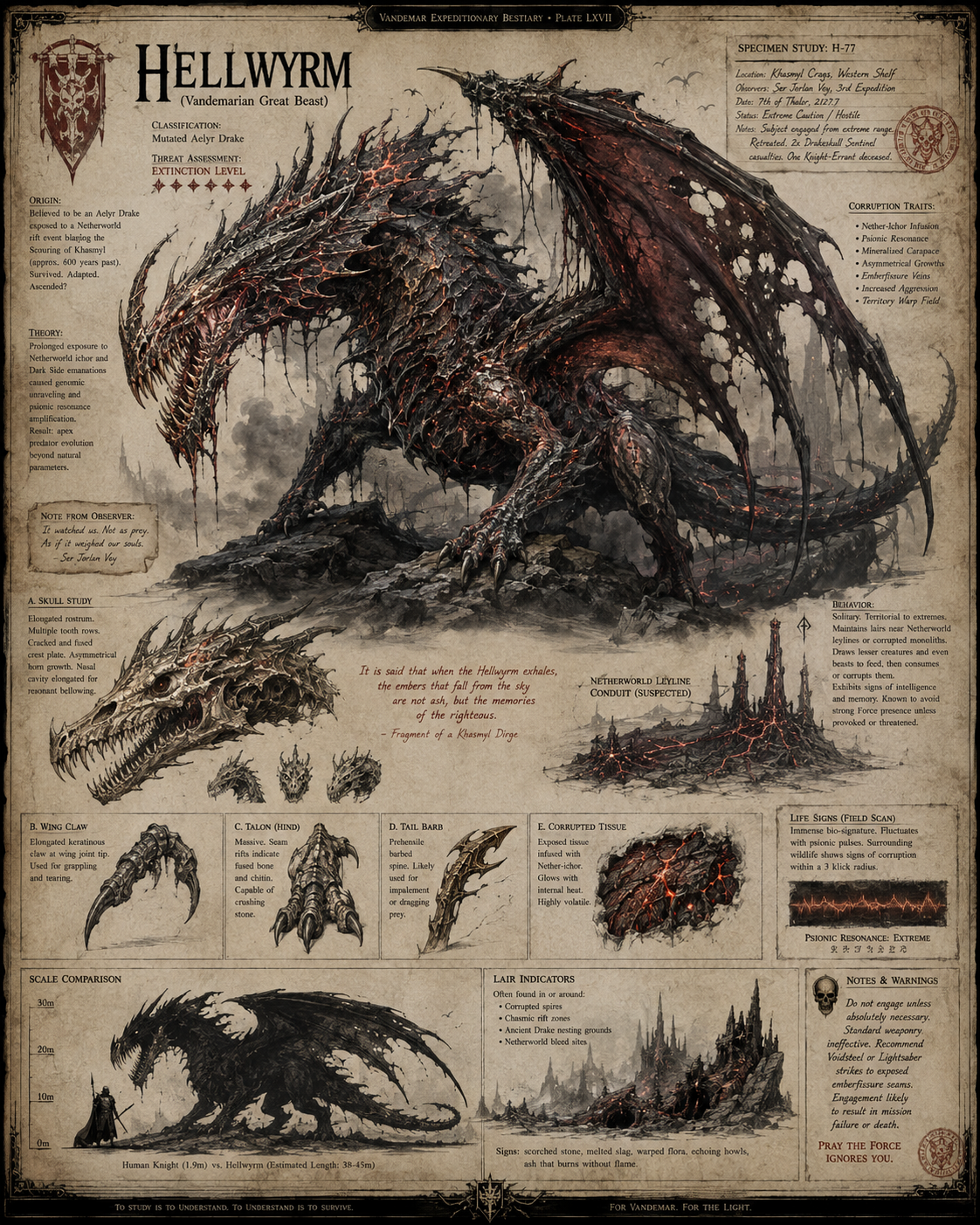
The Hellwyrm was a Great Beast that terrorised the Saervalon Southlands for several years before being killed by the Knight Order of the Ashen Guardians.
- Intent: To fill the world of Vandemar with its most interesting lifeforms that is intriguing to roleplay with, to hunt and be hunted by.
- Image Credit:
- Canon: N/A
- Permissions: N/A
- Links: Vandemar
GENERAL INFORMATION
- Name:Vandemarian Great Beast
- Official Classification: Bellua Magna Vandemaria
- Designation: Semi-sentient
- Origins: Vandemar; associated with regions where the boundary between the material galaxy and the Netherworld is unusually thin
- Average Lifespan: Indeterminate; estimated between 150 and 500 standard years, with some specimens potentially surviving considerably longer
- Estimated Population: Rare; only a limited number are believed to exist at any given time, though accurate censuses are impossible
- Description:Vandemarian Great Beasts are colossal predators shaped by prolonged exposure to the Netherworld and the Dark Side of the Force. They share a recognisable underlying anatomy and instinctive nature, yet no two mature specimens are entirely alike. Horns, limbs, armour, sensory organs and other physical traits may develop differently as the creature ages and absorbs corruption from its surroundings.
They are not malformed examples of ordinary Vandemarian fauna, nor are they a collection of unrelated monsters. Great Beasts form a distinct species whose biology is inherently unstable, capable of adapting through mutation without losing its fundamental identity.
To Vandemar, they are more than dangerous wildlife. They are the ancient adversaries around which much of the planet's knightly culture was forged.
PHYSICAL INFORMATION
- Breathes: Type I atmosphere. Mature specimens can survive for extended periods in toxic, oxygen-poor or partially extradimensional environments.
- Average Height of Adults: Commonly 3–8 metres at the shoulder or equivalent body point; substantial deviation is possible.
- Average Length of Adults: Commonly 7–18 metres; exceptional specimens may exceed this range.
- Skin color: Black, grey, dark brown, bone-white, deep crimson or other muted tones. Discolouration, luminous tissue and mineralised growths are common.
- Hair color: Variable. Hair, quills, filaments or mane-like structures may be black, grey, white, red or absent entirely.
- Distinctions:Despite extensive individual mutation, Vandemarian Great Beasts share a number of consistent physical characteristics.
All possess powerful, low-set bodies adapted for sudden violence and sustained pursuit. Their skeletal structures are exceptionally dense and reinforced by layered growths of bone, keratin or mineralised tissue. Most move primarily on four limbs, though additional limbs, partially developed secondary limbs or altered locomotive structures are common.
The skull is usually elongated and heavily protected, with pronounced brow ridges, horns, crests or reinforced jaw structures. Their mouths contain several rows of regenerative teeth or cutting plates capable of damaging armour and vehicle hulls.
Great Beasts possess at least one pair of highly developed sensory organs beyond ordinary sight and hearing. These may detect heat, vibration, electrical activity, fear responses or disturbances within the Force.
Their hides vary considerably but generally combine thick dermal tissue with plates, scales, quills or hardened growths. Wounds often heal through irregular scar formation, and damaged areas may regrow stronger or mutate into entirely new structures.
Age does not produce uniform decline. Older specimens often become larger, more armoured and more psychologically dangerous. Their bodies accumulate scars, asymmetrical growths and visible manifestations of corruption. A Great Beast may become less agile with age while gaining strength, regenerative capacity or more pronounced Force-related abilities.
Sexual differences are difficult to determine. Vandemarian scholars disagree whether all observed physical differences represent sex, age, reproductive condition or corruption-induced mutation. - Races: None. Regional and physical variations are expressions of individual mutation rather than distinct races or subspecies.
- Force Sensitivity: All. Every Vandemarian Great Beast possesses an instinctive connection to the Dark Side and the Netherworld. This sensitivity is not trained or disciplined, but manifests through predatory instinct, emotional influence and environmental corruption.
- Mutative adaptation: Great Beasts can develop new physical traits in response to injury, environment or prolonged exposure to hostile forces.
- Extreme durability: Dense bones, layered armour and rapid scar formation allow them to survive trauma that would kill ordinary megafauna.
- Instinctive Force use: They may sense fear, conceal their presence, influence lesser animals or unleash destructive Force phenomena without conscious training.
- Advanced predatory intelligence: Great Beasts remember enemies, recognise tactics and adapt to repeated attempts to hunt them.
- Environmental corruption: Their prolonged presence can alter nearby fauna, plant life, weather patterns and emotional conditions.
- Exceptional longevity: Individual specimens can shape the history of entire regions and become recurring enemies of particular Knight Orders.
- Unstable biology: Mutation is not always beneficial. New growths may create vulnerable joints, exposed organs or conflicting physiological systems.
- Dependence upon corruption: Separation from the Netherworld or sustained exposure to stabilising fields can weaken their regenerative and Force-related abilities.
- Psychological fixation: Many develop powerful territorial instincts, grudges or ritualised patterns that can be studied and exploited.
- Sensory overload: Their specialised senses may be disrupted through concentrated sonic, electromagnetic or Force-based interference.
- Resource demands: Their immense bodies require considerable food and energy, making long periods of activity difficult to conceal.
- Resistance, not immunity: Heavy weapons, coordinated knightly attacks and specialised containment technology can kill them.
CULTURE
- Diet: Carnivore or hypercarnivore. Great Beasts consume large animals, ordinary predators and sentient beings. Many favour organs, bone marrow, nervous tissue or prey displaying intense fear.
They can survive long periods without conventional food by drawing limited sustenance from Dark Side nexuses, Netherworld breaches or corrupted environments. This does not eliminate hunger; it changes its nature. A starved Great Beast may hunt emotion, suffering or Force presence as readily as flesh.
Some materials are poisonous or disruptive to them, particularly compounds designed to stabilise extradimensional energy. The effectiveness of such substances varies between individuals. - Communication: Roars, growls, body posture, scent marking and low-frequency vibration. Great Beasts also communicate through instinctive Force projection.
This communication rarely forms a true language. It conveys territory, threat, hunger, recognition and dominance. Sensitive beings may experience these projections as intrusive emotions, fragmented images or compulsions rather than words.
Great Beasts can recognise names, repeated commands and individual voices, but they do not speak in a conventional sense. - Technology level: None. Great Beasts do not create technology, though they may understand simple mechanisms, recognise weapons and deliberately sabotage machinery.
Some have been observed using ruins, wreckage or environmental hazards as extensions of their hunting behaviour. This represents adaptive intelligence rather than technological culture. - Religion/Beliefs: Great Beasts possess no organised religion. They nevertheless display ritualised behaviours that suggest an instinctive relationship with the Netherworld.
Individuals may repeatedly return to breaches, ancient ruins, mass graves or sites of intense suffering. They may arrange remains, mark territory through repeated patterns or react violently to specific symbols and rites.
Whether these actions represent belief, instinct or influence from entities beyond the material galaxy remains unresolved. - General behavior: Vandemarian Great Beasts are solitary. They tolerate their own kind only briefly during reproduction, territorial conflict or unusual periods of Netherworld activity.
Each establishes a vast domain centred upon a lair, feeding ground or source of corruption. The borders of such a territory are often marked through mutilated carcasses, damaged structures, unnatural silence or the displacement of ordinary predators.
Great Beasts are not mindless. They observe patrol routes, learn defensive patterns and distinguish between different types of opponents. A specimen repeatedly confronted by knights may begin avoiding armour, attacking support personnel or deliberately targeting vehicles and communication systems.
They remember injury and humiliation. Some have pursued individual hunters, bloodlines or Knight Orders across decades.
Their relationship with ordinary fauna varies. Lesser predators frequently flee, while scavengers may follow at a distance. Animals exposed for long periods can become unusually aggressive, deformed or submissive. In some cases, a Great Beast appears to exert crude dominance over surrounding creatures, using them as living alarms or driving them ahead of its own movement.
Reproduction is poorly understood. Great Beasts are believed to reproduce biologically, but mating events are rare and seldom observed. Young specimens already display unstable anatomy and Force sensitivity, though their mutations become increasingly pronounced with age.
Juveniles are not merely smaller adults. They are faster, more adaptable and often less territorial, making them difficult to track. Mature individuals become increasingly bound to particular domains, grudges and patterns of behaviour.
HISTORICAL INFORMATION
Vandemarian Great Beasts predate the modern Hegemony and appear throughout the oldest surviving legends, archaeological records and Knight Order chronicles. Some accounts describe them as children of the Netherworld, while others claim they originated as natural animals altered during an ancient age of planetary catastrophe.
Modern Techwright research rejects the theory that they are transformed examples of ordinary fauna. Genetic and structural evidence indicates that Great Beasts possess a shared biological foundation distinct from all other known Vandemarian species. Their extreme differences emerge through a highly unstable genome that responds to the Force, environmental stress and extradimensional contamination.
The precise origin of that genome remains contested.
Some researchers argue that Great Beasts evolved naturally around ancient rifts between Vandemar and the Netherworld. Others believe they were engineered as weapons, guardians or experimental organisms by a forgotten civilisation. A minority claim that the species did not originate entirely within material reality.
What is known is that their existence shaped early Vandemarian settlement. Great forests, valleys and mountain passes could not be secured through ordinary militias alone. Communities required specialised warriors capable of tracking, studying and confronting threats that adapted faster than conventional doctrine.
Many of Vandemar's earliest Knight Orders emerged from these hunts.
The killing of a Great Beast is never treated as routine pest control. It demands reconnaissance, field study, specialised weapons, containment preparations and an understanding of the individual creature's habits. Orders maintain private archives recording injuries, sightings, mutation patterns and failed hunts across generations.
These records are rarely complete. Great Beasts vanish for decades, retreat into the Netherworld or survive wounds believed fatal. Some return altered enough to invalidate earlier observations while remaining recognisably the same individual.
Their remains are treated as hazardous material. Bone, hide and organs retain traces of corruption long after death. Knight Orders, Techwright laboratories and Hegemonic authorities contest control over recovered specimens, as such materials can produce powerful weapons, advanced protective systems or catastrophic contamination.
The Great Beasts remain central to Vandemarian identity because they embody the danger beneath its civilisation. Vandemar possesses armies, high technology and cities suspended above the world, yet its deepest forests and oldest ruins still contain enemies that cannot be permanently engineered away.
A Knight does not prove dominion by pretending these beasts no longer exist.
A Knight proves it by entering their domain regardless.