
✠ Nihilus Indomitus ✠

- Intent: To create the most defining cultural beast that Vandemar calls its home.
- Image Credit:
- Canon: N/A
- Permissions: N/A
- Links: Vandemar
GENERAL INFORMATION
- Name: Vaelgryph
- Official Classification: Gryphus Vaelaris Vandemaria
- Designation: Semi-sentient
- Origins: Vandemar; historically associated with remote mountain ranges, ancient forests, high valleys and the elevated approaches surrounding High Vandemar
- Average Lifespan: 110–180 standard years
- Estimated Population: Rare; several hundred to several thousand are believed to exist across Vandemar, though precise numbers are deliberately withheld by the Hegemony
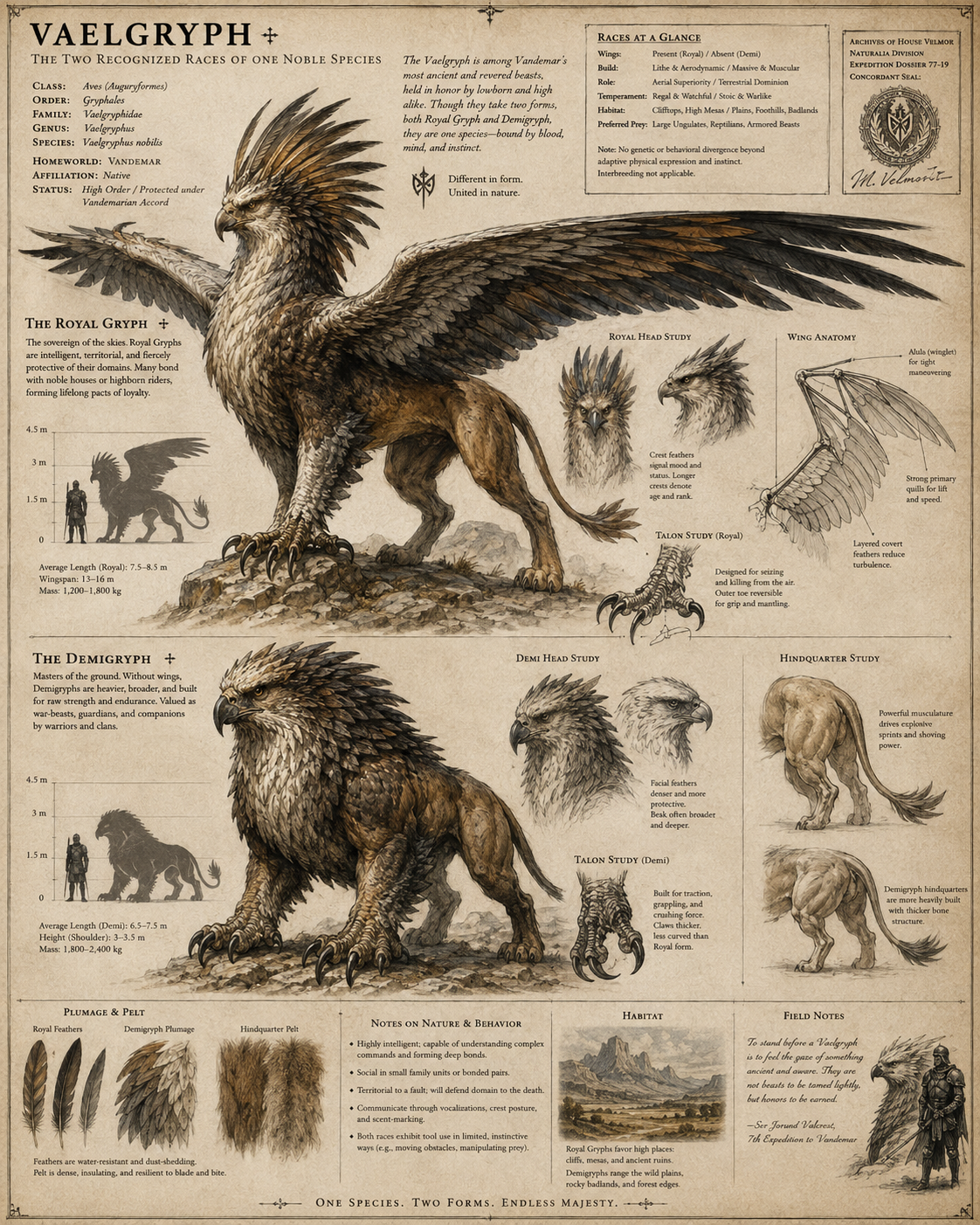
- Description: Vaelgryphs are immense semi-sentient predators native to Vandemar, combining raptorial forequarters with powerful leonine hindquarters. The species is divided into two naturally occurring races: the winged Royal Gryph and the flightless Demigryph.
Both possess the same characteristic intelligence, Force sensitivity, social behaviour and capacity to form voluntary bonds with sentient beings. Their differences are primarily physical and ecological. Royal Gryphs dominate the skies and highest mountain territories, while Demigryphs are heavier terrestrial hunters associated with forests, valleys and broken uplands.
Neither race is domesticated. Both may accept knightly companions, though the character of the bond—and the warfare made possible by it—differs considerably.
PHYSICAL INFORMATION
- Breathes: Type I atmosphere
- Average Height of Adults:
- Royal Gryph: 2.2–3 metres at the shoulder
- Demigryph: 2.4–3.3 metres at the shoulder
- Average Length of Adults:
- Royal Gryph: 4.5–6.5 metres
- Demigryph: 5–7 metres
- Average Wingspan:
- Royal Gryph: 10–15 metres
- Demigryph: N/A
- Skin color: Dark grey, brown, black, pale ochre or muted blue beneath the plumage and coa
- Hair color: Hindquarters commonly display black, brown, grey, tawny, white or deep red-brown fur
- Feather color: Black, iron-grey, silver, white, bronze-brown, dark red or combinations thereof
- Distinctions: Vaelgryphs possess raptorial heads, hooked beaks, muscular feline hindquarters and powerful clawed forelimbs. Their forefeet are more dexterous than those of ordinary predators and can seize prey, grip stone and manipulate simple objects.Both races share the same underlying skeletal, neurological and sensory structure. They are biologically compatible and recognised as members of the same species rather than separate subspecies.
- Royal Gryph
Royal Gryphs possess six fully developed limbs: two wings, two avian forelimbs and two mammalian hindlimbs. Their wings emerge behind the shoulders and are supported by hollow, internally latticed bones that reduce mass without sacrificing structural strength.
They are comparatively lean, deep-chested and built around the immense musculature required for flight. Their tails are frequently feathered or carry broad terminal fans used for aerial control.
Royal Gryphs possess especially sharp long-range vision and an instinctive awareness of air currents, altitude and approaching weather. Their Force sensitivity strengthens their spatial orientation and allows them to perform aerial movements that appear disproportionate to their size.
They are the more visually imposing race and the form most commonly depicted in Hegemonic heraldry. - Demigryph
Demigryphs lack functional wings and possess four primary limbs. Their shoulders, chest and spine are heavier than those of Royal Gryphs, replacing the flight structures with dense muscle and reinforced bone.
They are faster across broken ground, more stable under impact and significantly stronger in prolonged close combat. A Demigryph can maintain a charge through terrain that would cripple conventional mounts and can bring down prey larger than itself through combined beak, talon and body weight.
Their tails are generally longer and more muscular, serving as counterbalances during sudden turns and leaps. Plumage remains extensive around the head, neck, forequarters and upper back, while the hindquarters carry dense fur.
Some individuals retain small feathered shoulder structures or vestigial wing bones, but these have no practical flight function.
- Royal Gryph
- Races:
- Royal Gryph: Winged, aerial and generally lighter in build. Associated with high mountains, cliffs, elevated sanctuaries and High Vandemar.
- Demigryph:Flightless, terrestrial and heavier in build. Associated with deep forests, valleys, uplands and fortified knightly domains.
- Regional colouring and crest variation occur within both races but do not constitute additional classifications.
- Force Sensitivity: Non-Sensitive
- Advanced semi-sentient intelligence and exceptional memory
- Instinctive Force awareness and resistance to corruption
- Powerful beaks, talons and predatory senses
- Voluntary bonding with selected sentient companions
- Strong terrestrial mobility and considerable physical endurance
- Sustained flight and extreme aerial manoeuvrability
- Long-range reconnaissance and aerial interception
- Devastating diving attacks
- Ability to transport riders or prey across otherwise impassable terrain
- Greater physical mass and ground-combat durability
- Superior carrying capacity over land
- Powerful charge and close-quarters lethality
- Better performance in forests, enclosed terrain and adverse weather
- Slow reproduction and prolonged maturation
- Extreme intolerance of coercion and confinement
- High caloric requirements
- Long-lasting hostility after betrayal or deliberate injury
- Vulnerable wings and flight joints
- Requires sufficient open space for effective take-off
- Less stable than a Demigryph during sustained ground combat
- Poorly suited to dense forest interiors and enclosed structures
- Incapable of flight or independent vertical traversal
- Cannot easily disengage from aerial opponents
- Greater mass makes water crossings and unstable ground hazardous
- Requires terrestrial routes and logistical support during long campaigns
CULTURE
- Diet: Carnivore. Vaelgryphs hunt medium and large animals, including mountain grazers, forest herbivores, dangerous predators and the juveniles of Vandemar's larger megafauna. They also consume carrion when necessary, though healthy adults strongly prefer fresh prey.
Royal Gryphs commonly hunt animals exposed on mountain slopes, open plains and coastal cliffs. They use altitude to observe movement across great distances before descending in sudden, controlled attacks. Smaller prey may be carried away intact, while larger animals are wounded through repeated dives and finished upon the ground.
Demigryphs hunt through pursuit, ambush and direct physical engagement. Their heavier bodies allow them to overpower prey that a Royal Gryph would avoid confronting without the advantage of flight. They frequently target the limbs, throat and flanks, maintaining pressure until the prey collapses.
Both races prefer organs, marrow and nutrient-rich muscle. They are capable of breaking substantial bones with their beaks and foreclaws. Young Vaelgryphs are fed partially processed meat until their beaks and digestive systems fully mature.
Vaelgryphs usually refuse the flesh of animals heavily altered by the Netherworld or Dark Side. They may kill corrupted creatures without feeding upon them and have been observed covering, burning or dragging tainted carcasses away from nests and water sources.
Several mineral-rich plants are consumed in small quantities to assist digestion and maintain beak, talon and bone development. This behaviour is dietary rather than herbivorous. - Communication: Vaelgryphs communicate through vocalisation, posture, crest movement, wing or shoulder display, tail position, scent marking and controlled physical contact.
Common vocalisations include:- Long territorial cries that carry across valleys or forest canopies
- Low chest rumbles used among family groups and bonded companions
- Rapid beak clicks indicating attention, warning or irritation
- Harsh screams associated with alarm, combat or the detection of corruption
- Soft trilling calls used with hatchlings and trusted individuals
- Repeated mournful calls associated with death or prolonged separation
Royal Gryphs use their wings extensively in communication. Partially opened wings may indicate warning, protection or territorial display, while a fully raised posture signals readiness to attack. Subtle adjustments in flight pattern can also convey direction and intent to other Royal Gryphs.
Demigryphs use raised neck plumage, shoulder posture, tail movements and deliberate ground scoring. Their communication is generally lower in pitch and more heavily dependent upon vibration, scent and physical presence.
Both races understand repeated names, gestures and spoken instructions. They can distinguish individuals by voice, scent, armour, posture and emotional intent. Understanding does not imply obedience.
Their instinctive Force sensitivity permits limited empathic communication. Familiar sentients may perceive impressions of danger, refusal, recognition, urgency or acceptance. These impressions do not constitute language and cannot reliably convey abstract ideas.
- Technology level: None. Vaelgryphs do not manufacture tools, construct artificial shelters or maintain technological systems.
They nevertheless demonstrate a sophisticated understanding of their environment. They can open simple barriers, recognise traps, distinguish inactive machinery from active threats and deliberately damage vulnerable components.
Royal Gryphs have been observed dropping stones or recovered debris to distract prey, trigger traps or test unfamiliar surfaces. Demigryphs may move logs, wreckage and loose stone to block paths, reinforce dens or expose hidden prey.
These behaviours represent advanced problem-solving rather than technological development.
Vaelgryphs occasionally collect objects associated with important events or individuals. Such collections may include weapons, armour fragments, banners, jewellery, tools, feathers and bones. The objects are not necessarily valuable by sentient standards. Their significance appears to lie in memory, scent and association. - Religion/Beliefs: Vaelgryphs possess no organised religion or formal system of belief.
They display ritualised behaviour concerning death, bonding, territory, offspring and Netherworld corruption. Whether these actions represent instinct, inherited custom or a primitive spiritual awareness remains disputed.
Vaelgryphs frequently remain near dead mates, offspring or bonded sentients for several days. Some refuse food during this period, while others carry remains or significant possessions to isolated nesting or denning sites. Individuals may revisit such locations for decades.
Both races demonstrate an instinctive aversion to severe Dark Side concentrations and Netherworld breaches. They may mark the boundaries of a corrupted region, drive ordinary animals away or remain nearby while issuing warning calls.
Royal Gryphs commonly circle above such locations, mapping their extent from the air. Demigryphs are more likely to patrol the outer boundary and attack corrupted fauna attempting to leave.
Vaelgryphs do not worship the Vandemarian gods, Zildrog or any other known entity. Vandemarian culture therefore treats their ritual behaviour as evidence of intelligence and Force awareness rather than religion. - General behavior: Vaelgryphs are territorial, highly observant and socially selective. They usually live alone, as bonded pairs or in small family groups. Large gatherings are rare and generally indicate abundant prey, mating activity, migration or a major external threat.
Both races establish territories containing reliable food, water and defensible nesting or denning sites. They patrol these areas regularly and remember changes to roads, structures, machinery and sentient activity.
Trespass does not automatically provoke attack. A Vaelgryph commonly observes an intruder before deciding how to respond. Warning behaviour may include visible circling, deliberate interception, vocal calls, exposed talons, ground scoring or the display of a partially consumed kill.
Those who withdraw are usually permitted to leave. Those who continue after repeated warnings are treated as deliberate challengers.
Vaelgryphs distinguish between accident, fear, hunting and aggression. A lost traveller may be ignored, watched or driven toward the edge of the territory. An armed group moving covertly toward a nest is likely to be attacked without further warning.
They can recognise uniforms, heraldry, vehicle profiles and individual weapons. This memory may persist for generations of sentients.- Royal Gryph Behavior
Royal Gryphs establish eyries upon mountain spires, cliff faces, isolated towers and elevated structures. Their territories are extensive and may encompass several valleys or hundreds of kilometres of coastline.
They spend long periods in flight, using thermals, mountain winds and instinctive Force perception to travel with remarkable efficiency. Royal Gryphs often observe a potential threat from beyond conventional weapon range before approaching.
Their hunting behaviour emphasises patience, elevation and precision. They rarely commit to prolonged ground combat unless defending a nest, mate or bonded companion.
Royal Gryph pairs coordinate closely in the air. One may drive prey from cover while the other waits above the likely route of escape. Familial groups teach juveniles through controlled hunts and repeated aerial demonstrations.
Although capable of landing within forests and ruins, Royal Gryphs avoid terrain that restricts their wings. They prefer open ledges, broad clearings and defensible heights.
- Demigryph Behavior
Demigryphs establish dens in caves, forest hollows, ruined fortifications and sheltered valleys. Their territories are smaller than those of Royal Gryphs but defended more directly.
They patrol by scent, sound and physical inspection. Demigryphs commonly follow roads, game trails and ridgelines, learning the movement patterns of prey and travellers.
Their hunting behaviour relies upon speed, endurance and overwhelming physical force. They are capable of remaining concealed before launching a sudden charge, but will also pursue prey across considerable distances.
Demigryph family groups are often more physically cohesive than Royal Gryph groups. Adults and juveniles may travel, hunt and rest in close proximity. Mutual grooming and shared scent marking are common.
They are especially dangerous in broken ground, dense forest and confined ruins where their lack of wings becomes an advantage rather than a limitation. - Interaction Between the Races
Royal Gryphs and Demigryphs recognise one another as members of the same species. They share many vocalisations, social signals and reproductive behaviours.
Mixed groups are uncommon but occur where mountain, valley and forest territories overlap. Royal Gryphs may alert Demigryphs to distant threats, while Demigryphs defend carcasses, dens or grounded family members against terrestrial predators.
Mixed pairings are biologically viable. The offspring develop as either Royal Gryphs or Demigryphs rather than intermediate forms. Wing development is determined before hatching, though Vandemarian naturalists have not fully identified the governing hereditary mechanism.
Winged and flightless hatchlings may emerge from the same clutch. Parents raise both without distinction.
Neither race holds instinctive authority over the other. Royal Gryphs may possess the advantage of elevation and mobility, while Demigryphs dominate direct contests upon the ground. - Reproduction and Family Life
Vaelgryphs mature slowly and reproduce infrequently. Bonded pairs may remain together for life, though separation and later rebonding are known.
Courtship involves coordinated hunting, ritual pursuit and the exchange of prey or meaningful objects. Royal Gryph courtship frequently includes complex aerial manoeuvres. Demigryph courtship emphasises parallel running, mock combat and shared territorial patrols.
Females lay one to three large eggs during a reproductive cycle. Clutches containing more than two surviving hatchlings are uncommon.
Both parents guard and feed the young. Hatchlings remain dependent for several years and do not reach full physical maturity for decades. Juveniles are curious, impulsive and considerably more tolerant of sentient presence than adults.
Royal Gryph juveniles begin with gliding exercises from low ledges before attempting sustained flight. Demigryph juveniles develop physical strength, balance and hunting discipline through chasing games and staged engagements with restrained prey.
Parents respond to threats against their young with immediate and extreme violence. - Bonds with Sentients
Vaelgryphs cannot be domesticated. Captive breeding, neural conditioning, coercive training and mechanical restraint consistently produce aggression, psychological collapse or death.
A Vaelgryph may nevertheless form a voluntary bond with a sentient individual. Such bonds arise through repeated contact, mutual survival, compatible temperament or an act demonstrating courage without attempted domination.
The Vaelgryph determines whether the bond exists.
A bonded Vaelgryph may permit:- Prolonged proximity
- Physical contact
- Treatment of wounds
- Entry into its territory
- Coordinated hunting and combat
- The wearing of limited protective equipment
- The carrying of a rider
- Contact with its mate or offspring
- A bond does not create unconditional obedience. The creature retains independent judgement and may reject commands it considers reckless, dishonourable or contrary to the protection of its young and territory.
- Royal Gryph Bonds
A bonded Royal Gryph may accept a rider during flight. This requires profound trust and coordination. The rider cannot control the creature through reins or force. Harnesses communicate posture, balance and intention while leaving the wings and shoulders unrestricted.
Royal Gryph companions serve as aerial scouts, interceptors, messengers and hunters of flying threats. Against a Great Beast, they may conduct repeated strikes, draw attention or extract a wounded knight.
A Royal Gryph that rejects its rider's actions may land, refuse take-off or remove the rider by force. - Demigryph Bonds
A bonded Demigryph more readily accepts armour, baggage and sustained riding equipment, though it remains an independent companion rather than a conventional cavalry animal.
Demigryph companions function as heavy terrestrial mounts, shock combatants and beast hunters. Their speed and strength allow knights to pursue large predators through terrain unsuitable for vehicles.
They respond primarily to weight, posture, voice and established signals. Bits, neural controls and coercive restraints are illegal and generally provoke lethal resistance.
- Loss and Betrayal
The death of a bonded companion may cause prolonged mourning, withdrawal or aggression. Some Vaelgryphs remain near the companion's tomb, descendants, household or former stronghold.
Others pursue those responsible with remarkable patience.
Deliberate betrayal is seldom forgiven. An individual harmed by a bonded companion may reject all future sentient contact and extend its hostility to recognisable heraldry, bloodlines or organisations. - Relationship with Vandemarian Great Beasts
Both Vaelgryph races possess an instinctive hostility toward Vandemarian Great Beasts and severe Netherworld corruption.
Royal Gryphs observe Great Beasts from the air, track their movement and attack exposed sensory organs or weakened areas. They are particularly effective at distracting creatures that lack reliable aerial attacks.
Demigryphs follow trails, destroy corrupted lesser beasts and defend settlements or escape routes. Their greater terrestrial durability allows them to engage Great Beasts at close range for limited periods.
Neither race attacks without judgement. A solitary Vaelgryph usually avoids direct combat with a mature Great Beast unless defending its young, companion or territory.
Several Vaelgryphs acting together may harass, delay or contain a Great Beast until a Knight Order arrives.
Their movement is treated as a warning system by Vandemarian authorities. The abandonment of an established eyrie or den prompts investigation. The unexplained gathering of both races is treated as evidence of a serious regional threat.
- Royal Gryph Behavior
HISTORICAL INFORMATION
Vaelgryphs appear throughout Vandemar's oldest fossil records, archaeological sites and surviving cultural traditions. Their presence predates the modern Hegemony, the recognised Knight Orders and many of Vandemar's oldest human settlements.
The Royal Gryph and Demigryph have always been recognised as two expressions of the same species. Early remains confirm that both forms existed long before the present civilisation. Neither race is believed to have been produced through modern genetic engineering.
Their precise evolutionary origin remains unresolved.
The prevailing Techwright theory holds that early Vaelgryph ancestors developed in regions repeatedly exposed to low-level Netherworld pressure. Rather than succumbing to corruption, the species evolved an unusually ordered relationship with the Force, granting it sensitivity to danger and resistance to destabilising influence.
The divergence between Royal Gryphs and Demigryphs may have allowed the species to dominate two ecological domains. Royal Gryphs controlled the skies, mountains and cliffs, while Demigryphs occupied forests, valleys and broken uplands.
Some researchers argue that the two forms are not a conventional evolutionary divergence at all. The fact that a single clutch may contain both suggests a dormant developmental mechanism preserved within the species.
A minority of scholars believe the Vaelgryph was altered by an unknown ancient civilisation as a guardian species. No surviving facility, genetic marker or technological record conclusively supports this theory.
First Contact with Settlers
Early Vandemarian settlers encountered both races as territorial predators.
Royal Gryphs claimed high passes, mountain approaches and elevated ruins. They attacked survey craft, aerial transports and settlements constructed too close to established eyries.
Demigryphs contested forest roads, fertile valleys and cave systems. They preyed upon livestock and destroyed hunting parties that entered their territories without understanding their warning displays.
Initial responses relied upon extermination. Armed expeditions targeted nests, dens and feeding grounds. These campaigns achieved local successes but failed strategically.
Royal Gryphs learned weapon ranges, attacked isolated supply craft and abandoned poisoned territories before returning years later. Demigryphs avoided fixed defences, struck patrols and damaged roads, generators and storage sites.
The species demonstrated memory beyond the lifespan of many commanders involved in the campaigns.
Relations changed gradually as frontier communities began documenting their behaviour. Settlers discovered that Vaelgryphs gave repeated warnings, respected stable boundaries and reacted differently to hunters, travellers and deliberate threats.
Communities that protected nesting and denning grounds suffered fewer attacks. Some received indirect warning of approaching predators, storms and Great Beasts.
This practical coexistence became the foundation of their later cultural position.
Vaelgryphs and the Rise of Knighthood
Vandemarian Knight Orders emerged partly from the need to confront creatures that ordinary militias could not reliably defeat. Great Beasts represented the greatest threat, but Vaelgryphs taught the earliest knights a different lesson.
Not every dangerous creature was an enemy.
Early knightly accounts describe individual warriors ending destructive hunts, returning stolen eggs or defending wounded Vaelgryphs from corrupted predators. Several of the oldest recorded bonds emerged from these encounters.
The Vaelgryph became associated with a form of strength that could not be commanded but could be earned.
Royal Gryphs entered knightly culture as symbols of:
- Vigilance
- Sovereignty
- Foresight
- Freedom joined to duty
- Mastery of the skies
- Judgement before action
- Endurance
- Territorial defence
- Loyalty
- Direct courage
- Strength under discipline
- The defence of the realm's foundations
Vaelgryph bonding never became a guaranteed rite of advancement. Candidates might spend years near the creatures without being accepted. A low-ranking knight could be chosen while a celebrated lord was ignored.
This unpredictability protected the bond from becoming a simple privilege of rank.
Royal Gryphs and High Vandemar
The Royal Gryph became closely associated with High Vandemar and the Hegemonic state. Its aerial form suited the elevated palaces, repulsor platforms and celestial imagery of the capital. Royal Gryphs appeared upon official seals, gates, standards and state architecture. Living Royal Gryphs occasionally nested along the outer reaches of High Vandemar. The Hegemony constructed broad ledges, aerial gardens and protected spires to accommodate them.
These areas remain open. The animals may come and go freely.
Royal Gryphs are sometimes present during military reviews, funerals, coronations and major civic ceremonies. Their attendance cannot be guaranteed or commanded. Officials may prepare for their presence but never publicly summon them as performing animals. A Royal Gryph circling above an important event carries considerable symbolic weight. Vandemarian authorities officially discourage claims that such appearances constitute divine approval or prophecy.
The cultural interpretation persists regardless.
Demigryphs and the Knightly Domains
Demigryphs became most closely associated with terrestrial Knight Orders, frontier fortresses and Great Beast hunters.
Several orders maintain protected valleys and forests where wild Demigryph populations live near chapter holdings. Knights patrol the boundaries, prevent poaching and remove dangerous contamination. Bonded Demigryphs have served as heavy mounts in war, though they are too rare and independent to form conventional cavalry regiments.
Their principal military value lies in:
- Pursuing Great Beasts and corrupted fauna
- Carrying heavily armoured knights through difficult terrain
- Breaking hostile formations
- Defending narrow passes and forest roads
- Recovering wounded personnel
- Countering enemy beasts and war animals
It is nevertheless understood that the creature serves by choice.
Heraldry and State Symbolism
Vandemarian heraldry frequently combines both Vaelgryph races into a single symbolic system.
The Royal Gryph is shown with wings raised or spread, representing the Hegemony's vigilance and reach.
The Demigryph is shown grounded, advancing or guarding a gate, representing territorial strength and defence.
Some state emblems depict a winged Vaelgryph above and a wingless one below. Others merge the symbolism into a single gryphon divided between celestial and terrestrial fields.
The most common interpretation is:
The title "Royal" does not denote biological superiority or ownership by the ruling dynasty. It reflects the winged race's ancient association with High Vandemar, sovereignty and elevated authority.The Royal Gryph watches from above. The Demigryph holds the ground below.
Both races possess equal legal protection.
Law and Conservation
Vaelgryphs are protected under Hegemonic law.
Killing one is permitted only in immediate defence of life or under exceptional authorisation after an individual has repeatedly attacked inhabited areas without provocation.
The theft or trade of eggs, living specimens, organs and genetic material is prohibited. Feathers, fur and naturally shed talons may be collected only under regulated circumstances.
A feather or claw given freely by a bonded Vaelgryph carries considerable social value. The same object taken through poaching is considered tainted by dishonour.
Known nesting and denning territories are monitored by regional authorities, Knight Orders and Techwright naturalists. Roads, flight corridors and construction projects may be altered to preserve these sites. This protection is not based solely upon cultural reverence. Vaelgryphs suppress dangerous predator populations, detect corruption and provide early warning of Great Beast activity. Their ecological and strategic value is substantial.
Failed Exploitation
Numerous attempts have been made to transform Vaelgryphs into controllable military assets.
These efforts included:
- Artificial incubation
- Captive breeding
- Neural conditioning
- Cybernetic control systems
- Genetic selection
- Cloning
- Forced rider programmes
- Behavioural imprinting
Royal Gryphs raised in confinement frequently failed to develop proper flight behaviour and became violently distressed. Demigryphs showed greater physical survival but severe aggression and social dysfunction. Cloned specimens rarely survived to maturity. Those that did displayed impaired Force sensitivity, unstable behaviour or an inability to form normal familial bonds. The official Hegemonic position is that Vaelgryphs cannot be separated from adult instruction, natural territory and voluntary social development without destroying the qualities that make them valuable. Coercive programmes are now prohibited, though illicit research persists.
Contemporary Position
Modern Vandemar treats Vaelgryphs as protected predators, strategic allies and living cultural symbols. They do not belong to the Hegemony in a legal sense. The state protects territories, records bonds and regulates interactions, but does not claim ownership over wild individuals. A bonded Vaelgryph remains responsible for its own actions. Its companion is expected to understand and manage the relationship but cannot be held to possess the creature.
The two races continue to occupy different but complementary positions. Royal Gryphs remain associated with High Vandemar, aerial defence, sovereignty and distant vigilance. Demigryphs remain associated with the Knight Orders, the wilderness, territorial defence and the direct hunt against Vandemar's monsters. Together they provide the cultural counterpoint to the Vandemarian Great Beast.
The Great Beast is power reshaped by hunger, hatred and corruption.
The Vaelgryph is power that remains capable of judgement.
Neither race is tame. Neither exists to serve sentient civilisation.
Yet when the forests darken, the mountains fall silent and the Great Beasts stir, the Vaelgryphs often stand beside Vandemar rather than against it.