
Relationship Status: It's Complicated
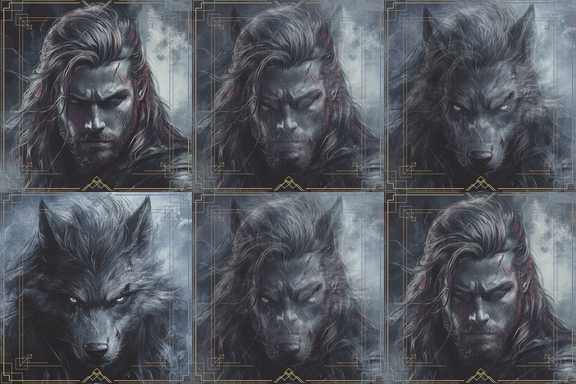





- Intent: To create a unit of soldiers for Gerwald Lechner and Naedira Darcrath to command
- Image Credit: created by me www.midjourney.com
- Role: This unit serves as an Direct Assault Force for the Dreadborne and Gerwald Lechner
- Permissions: Locke and Key
- Links: N/A

- Unit Name: The Dreadguard
- Affiliation:
 Gerwald Lechner
|
Gerwald Lechner
|
 Naedira Darcrath
- Classification: Special Operations and Assault
- Description: The Dreadguard are drawn from the most lethal elements of Gerwald Lechner’s Second Legion, formed from both Force users and non Force warriors who have proven they can endure sustained brutality without breaking cohesion. They fight like berserkers, but never without purpose. Where the Dreadborne are unleashed to shatter lines through momentum, the Dreadguard is committed when resistance hardens and refuses to give way. Their style is close, violent, and relentless, driven by aggression that is controlled rather than spent. Force users do not dominate the formation, but reinforce it, using the Force to extend endurance and sharpen timing, while non Force members anchor the unit through physical presence and refusal to yield. Under Gerwald Lechner, the Dreadguard stands as a deliberate expression of his doctrine. Violence is a tool. Fury is a weapon. Discipline ensures neither is wasted.

- Unit Size: Medium
- Unit Availability: Rare
- Unit Experience: Elite
- Equipment:
Armor:Ranged Weapons:Melee Weapons:Grenades and Detonators: - Combat Function: The Dreadguard functions as a Direct Assault Force, deployed when resistance must be broken rather than bypassed. They are committed at decisive points of a battle, often after initial momentum has stalled or when an objective must be taken regardless of cost. The unit advances as a tightly bound formation, mixing Force users and non Force warriors in close proximity to maintain cohesion under extreme pressure. Their purpose is not speed or subtlety, but dominance. Once engaged, the Dreadguard does not disengage. They apply constant forward pressure until opposition collapses or is destroyed.
In close combat, the Dreadguard fights at contact distance, favoring brutal, sustained engagement that denies enemies space to recover or reposition. Non Force members anchor the line through physical presence and aggression, while Force users reinforce the assault by driving endurance, summoning fear in the enemy, and disrupting enemy balance. Violence is applied continuously rather than in bursts, wearing down defenders through exhaustion and shock. Individual ferocity is expected, but never allowed to fracture formation. The unit advances as one body, overwhelming resistance through pressure rather than finesse.
At range, the Dreadguard does not attempt prolonged fire superiority. Ranged weapons are used to support advance rather than replace it. Fire is directed to suppress, disorient, and force enemies into defensive posture, creating openings for rapid closure. Force users contribute by enhancing accuracy, timing advances through incoming fire, and neutralizing key threats that could stall momentum. Ranged combat exists only to shorten distance. Once contact is made, the Dreadguard commits fully, turning the fight into a contest of endurance and will that few opponents survive intact.
- Force Abilities (Force User Units Only): Summon Fear, Painful Focus, Force Enrage.

- The Killing Pace - Once committed, the Dreadguard maintains relentless forward pressure that exhausts and overwhelms resistance. Like wolves on a long hunt, they do not rush the kill. They close distance methodically until escape and recovery are no longer possible.
- Pack Cohesion - Force users and non Force warriors fight as a single body, reinforcing one another without hierarchy breaking formation. Injuries, losses, and resistance are absorbed by the pack rather than the individual, allowing the unit to sustain momentum under conditions that would shatter lesser forces.
- Red Tooth Doctrine - The Dreadguard excels in close quarters where violence is personal and sustained. They deny enemies the space needed to regroup, applying continuous pressure until opposition collapses through fatigue, panic, or sheer physical failure.
- Howl of the Wolf - When operating under Gerwald Lechner’s direct command, the unit’s aggression sharpens rather than fractures. Orders propagate instantly through the formation, allowing rapid shifts in pressure, target focus, and advance without hesitation or confusion.

- The Long Hunt - The Dreadguard is built for sustained pressure, not rapid disengagement. If an engagement drags without progress or is deliberately prolonged by a withdrawing enemy, fatigue and attrition begin to dull their advantage.
- Overextended Pack - Their strength depends on cohesion. Terrain, fire, or maneuver that separates elements of the unit reduces their effectiveness quickly, as individual aggression is never meant to replace pack integrity.
- Blood Scent Fixation - Once committed, the Dreadguard has limited flexibility. Feints, sacrificial delays, or decoy objectives can draw them deeper than intended, creating openings elsewhere in the battlespace if command oversight is lost.
- Daylight Exposure - The Dreadguard thrives in close, violent conditions. Open terrain with layered fire support forces them to rely heavily on advance under suppression, increasing casualties before contact can be made.
- Blunted Fangs - When active nullification fields or Force dampening effects are in play, the Dreadguard loses a key layer of reinforcement. Force users can no longer bolster endurance, summon fear, or stabilize momentum, placing greater strain on the non Force members to carry the advance. While the unit remains dangerous through discipline and aggression alone, its ability to sustain prolonged pressure is reduced, and losses mount faster once the pack’s supernatural edge is stripped away.

The line had stopped moving.
That alone told Gerwald Lechner everything he needed to know. The Dreadborne had struck hard and early, breaking outer defenses and drowning the field in momentum, but the enemy had done something inconvenient. They had endured. The ground ahead was torn apart by fire and bodies, yet the fortification still held. Fury had met resistance and stalled.
Gerwald gave the order without raising his voice.
Hroth Valdrek felt it more than he heard it. He was broad even among the Dreadborne, his armor layered and scarred from campaigns that had ground lesser men into memory. Once, he had led berserkers at the point of the charge. Now he stood with those chosen for something different. To his left was Serik Vane, a Force user whose strength was not spectacle but persistence, a man who could fight through pain long after others collapsed. Around them stood warriors who carried no connection to the Force at all, only mass, discipline, and the refusal to step back.
They advanced without a charge.
The Dreadguard moved as one body, shields raised, weapons steady, pressure constant. Fire raked across them, armor ringing with impact, bodies absorbing punishment that should have broken formation. Serik reached into the Force, not to throw enemies aside, but to bind the line together, dulling pain and sharpening focus. Hroth took a hit that staggered him and kept moving, setting his weight into the push as if the wound were an inconvenience rather than a warning.
When they reached the defenders, the fight collapsed inward.
There was no room to maneuver, no space to reset. The Dreadguard crushed distance deliberately, step by step, denying the enemy time to breathe or think. Force users disrupted balance and timing, while non Force warriors anchored the advance with sheer physical presence. The defenders fought hard. They fought until their arms failed them. When the line finally broke, it did not scatter. It folded, leaving nothing intact to retreat with.
Afterward, Gerwald walked the field himself. He did not praise them. He did not need to. The Dreadguard understood their purpose. The Dreadborne would always be unleashed first, to tear open the world with fury and speed. The Dreadguard existed for the moment when that fury was not enough.
Their history would never be written in proclamations. It would be remembered in stalled battles that ended anyway, in fortifications that held until they did not. When violence alone failed, discipline finished the work. That was the lesson the Dreadguard carried forward, and it was one Gerwald intended the galaxy to learn.