

Titan Nine




STRAY KALEIDOSCOPIC-POLYMER

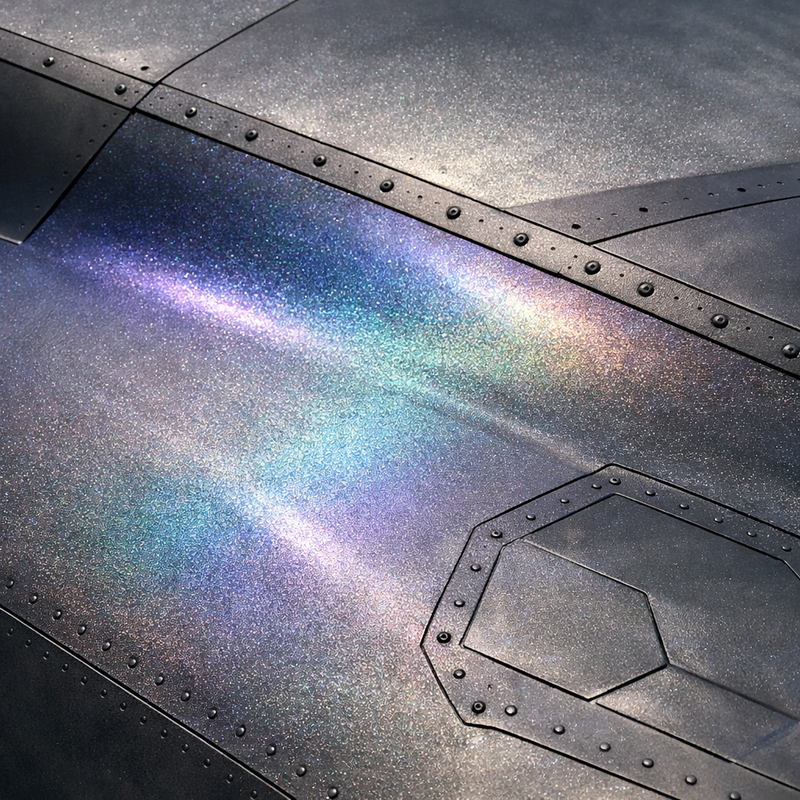
- Intent: Create the byproduct formed when poly-tibannalene becomes depleted of its excitation state.
- Image Source: ChatGPT
- Canon Link: n/a
- Permissions: n/a
- Primary Source:
- Manufacturer: Dornean Braha'ket Fleetworks Conglomerate (X)
- Affiliation: Dornean Braha'ket Fleetworks Conglomerate (X)
- Market Status: Open-Market
- Model: Stray Kaleidoscopic-Polymer
- Modularity: can be used as a protective coating, or deployed as a chaff-like dust cloud.
- Production: Limited Production
- When poly-tibannalene is fired into space and fails to detonate, a rare chemical reaction may occur that converts the projectile into kaleidoscopic-polymer. This stray byproduct is salvageable and can occasionally be obtained on the black market. Otherwise, it may be mass-produced under controlled conditions in Dornean manufacturing facilities.
- Material:
- Composed entirely of poly-tibannalene that has fully depleted its excitation state and congealed into a rubberized polymer
- Additives are often introduced to improve reliability and handling
- When used as a coating, instrumentation and electrical agitators can be embedded into the surface to provide functional control
- Classification: Rubberized polymer
- Weight: average
- Color: a rainbow shimmer that seems to favour purple hues.
- Resistances:
- Kinetic: Very Low
- ION canons: Very Low
- Directed Radiation: Very Low
- Energy: Low
- Blanket EMP: Average
- Ambient Radiation: High
- Extreme Temperatures: High
- Chemical / Acid Exposure: Very High
- Sonic: Very High
- Kaleidoscopic-Polymer is a byproduct of undetonated poly-tibannalene that has dissipated its molecular excitation and then congealed into a rubberized state.
- It naturally distorts multiple mediums of sensory input, making precise observation or targeting extremely difficult. The distortion effect may interfere with, but is not limited to:
- Electromagnetic emissions
- Thermal signatures
- Gravimetric or mass-shadow readings
- Subspace disturbances
- Radiation detection
- Biosign or life-form scanning
- Visual-spectrum imaging
- Magnetic field measurements
- The material may be applied as a surface coating or dispersed as a chaff-like dust cloud.
- Only when sufficiently unenergized, the polymer becomes "hungry," causing it to bend and refract nearby sensory data.
- When subjected to substantial electrical current or aggressive radiation, the polymer re-enters an excited state. This reduces or negates the distortion effect, though it does not return the material to volatile plasma form. The rubberized state is permanent.
- Additives are commonly included to prevent ambient radiation or background electromagnetic interference from disabling the effect. Blanket EMPs are generally insufficient to neutralize it, though aggressively focused ion or radiation attacks remain effective.
- When used as a coating, integrated sensors and analysis software can be embedded into the surface, allowing onboard systems to interpret and compensate for the distortion field.
- Electrical agitators may be installed to allow limited user control over the distortion effect.
- Can't touch this – The refraction and distortion of sensory mediums makes this material extremely difficult to track or target accurately.
- Protective coating – The polymer is highly resistant to chemical and acidic corrosion. When applied thickly, its pliable nature provides meaningful resistance to sonic damage.
- Ambient/blanket resistances – Additives help prevent indirect radiation or blanket electromagnetic pulses from disabling its distortion properties.
- "It's definitely there!" – This is not a stealth system. It may help prevent targeting computers or tracking systems from securing a lock on you. However, it also makes you faaaaar from inconspicuous. In fact, it makes you stand out rather dramatically against an otherwise calm and stable backdrop. When this system is active, people are definitely going to be asking questions…
- Just feed it – The distortion effect relies on the polymer remaining de-energized. Direct radiation or electrical stimulation will often collapse the effect.
- "Don't scratch my paint!!" – As a coating, it is only as durable as an expensive paint layer. Energy and kinetic damage can strip it away with relative ease.
Once the Dorneans perfected poly-tibannalene and brought it into operational use, its effectiveness was immediately apparent. However, in the aftermath of engagements involving the weapon, strange distortions began appearing at the edges of battlefields. These anomalies were difficult to locate or analyze, delaying investigation for some time.
Eventually, Dornean salvage teams recovered samples of the phenomenon. Analysis revealed that poly-tibannalene will sometimes undergo a rare chemical transformation once its excitation state is fully depleted. The material congeals into a rubberized form and begins emitting a field loosely analogous to a gravity well.
This field does not exert force in the traditional sense. Instead, it refracts and distorts observational mediums—light, radio waves, hyperspace echoes, tachyon signatures, and other sensor inputs. Dornean researchers theorize this effect is a residual artifact of the gravity modulation process used during poly-tibannalene's formation.
Once this mechanism was understood, the Dorneans successfully replicated the process under laboratory conditions and developed a controlled production method. They remain the sole legal producers of the official material.
Unfortunately, before the phenomenon was fully catalogued, scavengers recovered several stray samples from battlefield debris. Though difficult to locate, these fragments fetch high prices on the black market. As a result, Dornean authorities continue to struggle with preventing the uncontrolled circulation of stray kaleidoscopic-polymer.
Out Of Character Info
Intent:
Create the byproduct formed when poly-tibannalene becomes depleted of its excitation state.
Permissions:
N/a
Technical Information
Affiliation:
Dornean Braha'ket Fleetworks Conglomerate (X)
Modular:
Yes
Material:
Composed entirely of poly-tibannalene that has fully depleted its excitation state and congealed into a rubberized polymer Additives are often introduced to improve reliability and handling When used as a coating, instrumentation and electrical agitators can be embedded into the surface to provide functional control
Last edited: