✠ Nihilus Indomitus ✠


- Intent: To fill the world of Vandemar with interesting and diverse life that is intriguing to roleplay with.
- Image Credit:
- Canon: N/A
- Permissions: N/A
- Links: Vandemar
GENERAL INFORMATION
- Name: Saevra
- Designation: Semi-sentient
- Origins: Vandemar; coastal cliffs, offshore islands and fortified harbour regions
- Average Lifespan: 18–27 standard years
- Estimated Population: Planetary; numerous along Vandemar's temperate coastlines
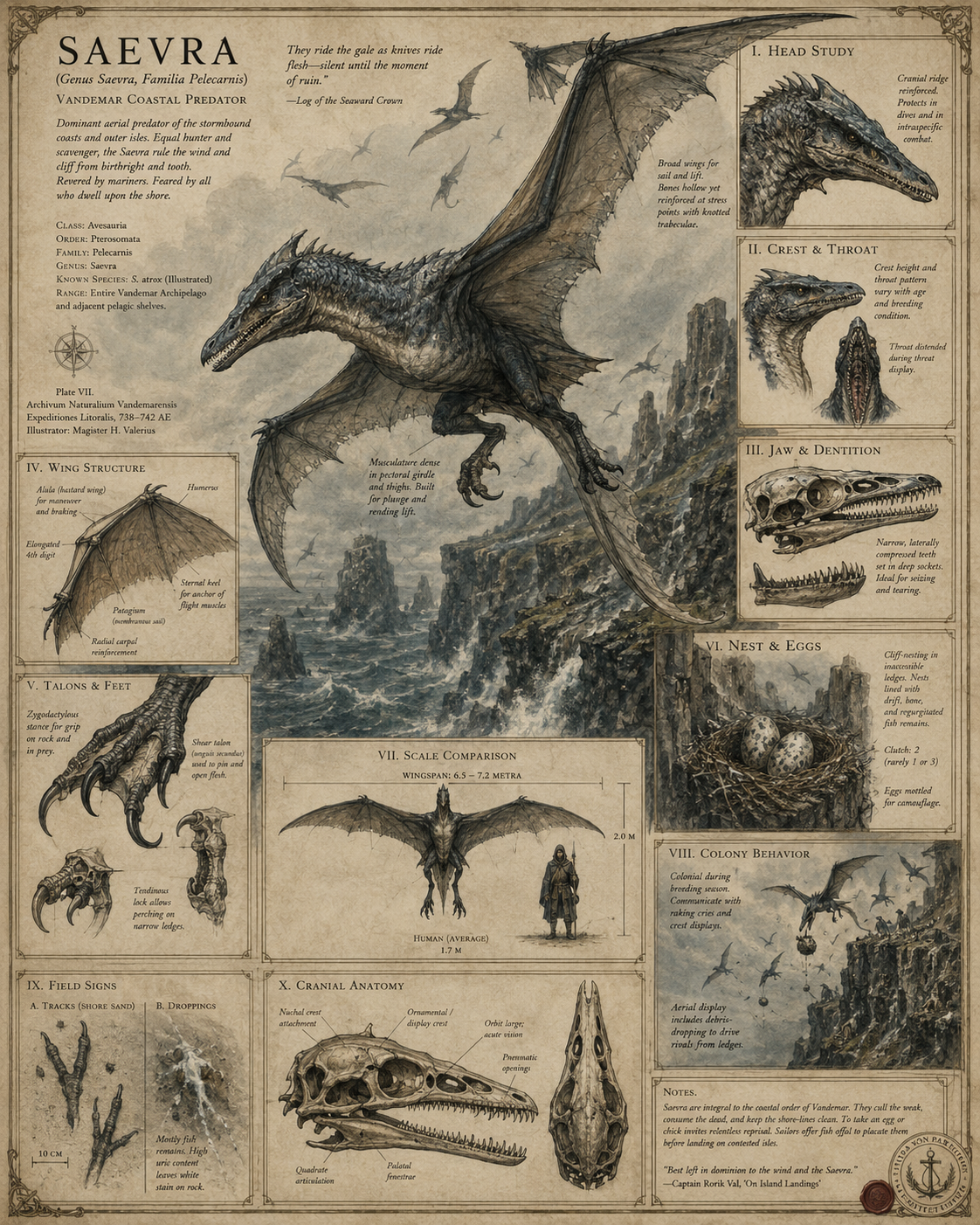
- Description: The saevra is a broad-winged coastal predator with the diving profile of a seabird and the jaws of a marine reptile. Colonies wheel above cliffs and storm-lashed waters, descending upon fish, carrion and weakened prey in coordinated waves. Around settled coasts, their habit of carrying sharpened debris aloft makes the sky itself a hazard.
PHYSICAL INFORMATION
- Breathes: Type I atmosphere
- Average Height of Adults: 0.9–1.2 metres while standing
- Average Length of Adults: 1.8–2.5 metres
- Average Wingspan: 4–5.8 metres
- Skin color: Slate-grey, dark blue, brown or pale coastal grey
- Hair color: None; narrow insulating filaments may be white, black or rust-red
- Distinctions: Saevras possess long membranous wings, two powerful hindlimbs and a streamlined reptilian body. Their narrow jaws are lined with hooked teeth suited to fish and slippery carrion, while a reinforced cranial ridge protects the skull during high-speed dives. The rear feet carry gripping talons capable of lifting prey and loose objects. Males develop brighter throat markings and taller head crests, while females are larger and more aggressive around nesting colonies. Older specimens show torn wing membranes, broken crests and salt-whitened scales.
- Races: None formally recognised. Island saevras are smaller and more agile, while mainland coastal populations are heavier and more tolerant of urban environments.
- Force Sensitivity: Non-Sensitive
- Excellent aerial agility and high-speed diving attacks
- Advanced object manipulation and group coordination
- Strong vision and ability to locate prey across open water
- Vulnerable wing membranes and hollow bones
- Poor mobility once grounded in confined terrain
- Highly territorial colonies can be predictably lured away from nests
CULTURE
- Diet: Carnivore and scavenger. Saevras consume fish, shell-bearing animals, carrion, eggs and small coastal fauna. Large colonies may attack wounded livestock, isolated sentients or the young of larger animals.
- Communication: Screeches, throat clicks, wing displays, crest posture and the deliberate striking of stones or metal against nesting surfaces.
- Technology level: None. Saevras use found stones, shells and discarded machine fragments as simple tools and projectiles but do not manufacture objects.
- Religion/Beliefs: None.
- General behavior: Saevras form dense colonies led by several dominant breeding pairs. They hunt individually over open water but cooperate when defending nests or overwhelming larger prey. Individuals have been observed dropping stones, shells and sharpened debris from the air to break armour, disable prey or drive intruders from ledges. They remember hostile individuals and vehicles for years and may repeatedly attack recognisable colours or engine profiles. Both parents guard a clutch and feed their young with regurgitated meat until the juveniles can glide.
HISTORICAL INFORMATION
Saevras evolved along Vandemar's cliff-lined coasts, where aerial agility and hard-shelled prey favoured both diving attacks and primitive object use. Their intelligence increased as colonies learned to exploit the hunting activities of marine predators and early coastal settlements.
The expansion of harbours and offshore industry initially benefited the species. Towers, cranes and defensive emplacements provided ideal nesting sites, while fishing fleets generated abundant waste. Colonies soon became dangerous enough to disrupt aircraft, bombard workers with debris and strip exposed machinery for reflective components.
Modern ports use rotating light barriers, sonic deterrents and designated artificial nesting cliffs to keep colonies away from flight lanes. Extermination is avoided where possible, as saevras suppress carrion, vermin and aggressive coastal scavengers.
Vandemarian dockworkers still inspect the sky before crossing open platforms. One saevra carrying metal is a nuisance. A hundred circling in silence have already chosen a target.