

✠ Nihilus Indomitus ✠



- Intent: To fill the world of Vandemar with interesting and diverse life that is intriguing to roleplay with.
- Image Credit:
- Canon: N/A
- Permissions: N/A
- Links: Vandemar
GENERAL INFORMATION
- Name: Oryndrax
- Designation: Non-sentient
- Origins: Vandemar; cold oceans, deep coastal channels and continental shelves
- Average Lifespan: 80–120 standard years
- Estimated Population: Rare; scattered across Vandemar's major ocean basins
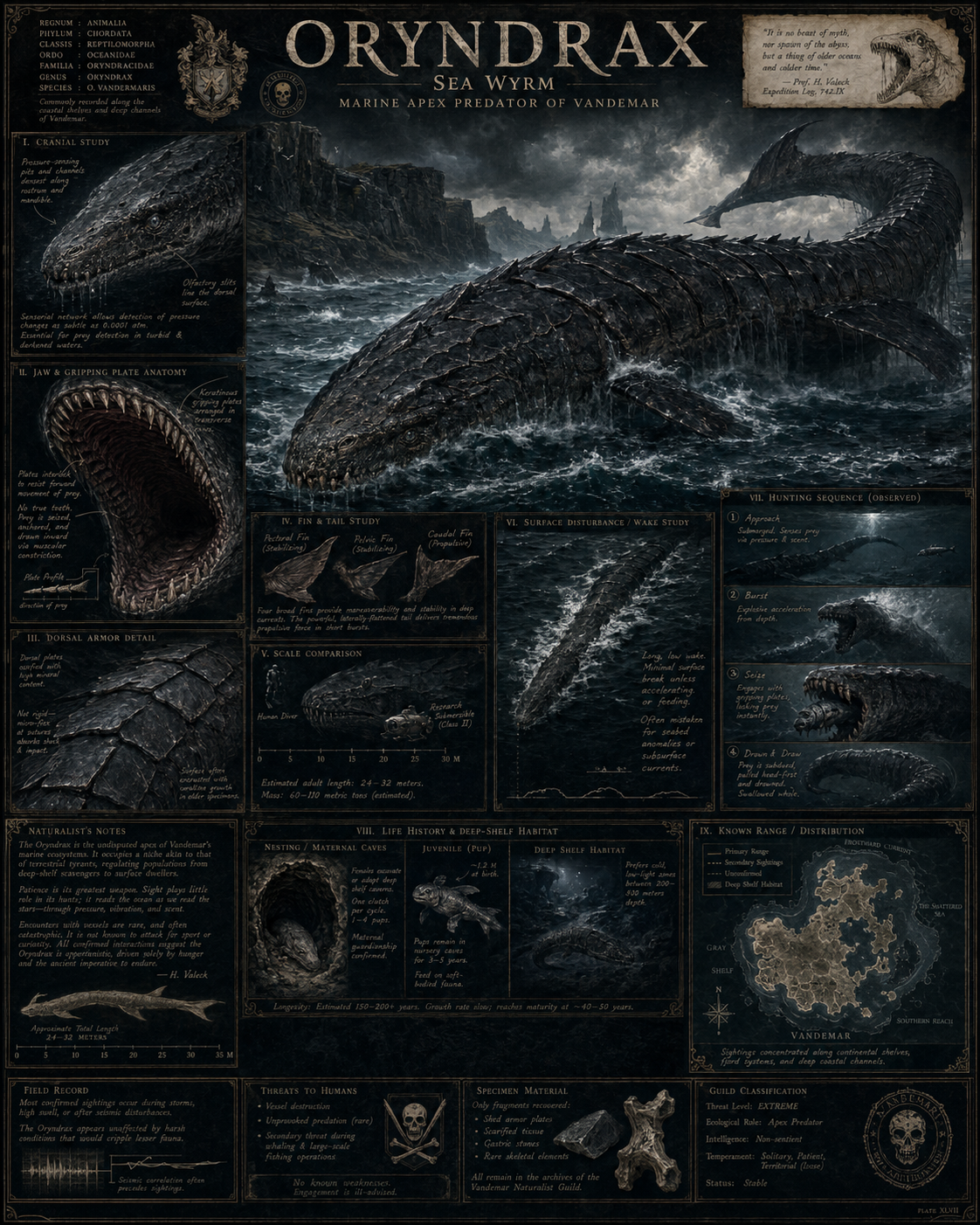
- Description: The oryndrax is a long-bodied marine predator whose passage beneath the water resembles a moving ridge of black stone. Most remain far from shore, circling migrating prey through the deep. When one rises near the surface, ships seldom see more than a plated back, a widening wake and the jaws closing beneath them.
PHYSICAL INFORMATION
- Breathes: Dissolved oxygen through internal gill structures; capable of brief atmospheric respiration
- Average Height of Adults: 2.5–3.5 metres at the deepest torso
- Average Length of Adults: 15–25 metres
- Skin color: Black, dark blue, slate-grey or deep green
- Hair color: None
- Distinctions: Oryndraxes possess elongated bodies, four stabilising fins and a powerful flattened tail. Their backs are covered in overlapping armour plates, while the underside remains flexible for rapid turns. The mouth contains rows of backward-facing gripping plates rather than conventional teeth, allowing the animal to hold large, slippery prey. Sensory channels along the skull detect pressure shifts and electrical activity through the water. Females are generally longer and heavier; males develop raised cranial ridges during the breeding season. Elderly specimens accumulate extensive scarring, shell growth and pale mineral deposits.
- Races: None formally recognised. Deep-ocean populations are larger and darker, while coastal oryndraxes possess broader fins and lighter armour.
- Force Sensitivity: Non-Sensitive
- Immense size, armour and crushing jaw strength
- Exceptional endurance and sensitivity to underwater movement
- Capable of attacking from great depth with little warning
- Limited manoeuvrability in shallow or enclosed waters
- Softer underside and respiratory membranes
- Strong sonar and pressure pulses can disorient them
CULTURE
- Diet: Carnivore. Oryndraxes prey upon large fish, marine reptiles, coastal megafauna and carrion. They generally consume prey whole or tear away large sections with rotational movements.
- Communication: Low-frequency calls, body vibrations and pressure pulses transmitted through the ocean.
- Technology level: None.
- Religion/Beliefs: None.
- General behavior: Oryndraxes are solitary outside seasonal breeding gatherings. They patrol vast territories and follow major marine migrations, often travelling thousands of kilometres between feeding grounds. Rather than pursue individual prey, they circle schools and herds, forcing them toward the surface or into confined channels. Females give birth to small numbers of live young in deep, sheltered waters. Juveniles remain near coastal shelves before moving into the open ocean.
HISTORICAL INFORMATION
Oryndrax remains appear throughout Vandemar's marine fossil record, though modern specimens are considerably larger than their earliest known ancestors. Their growth followed the expansion of the planet's cold-water megafauna and deep-ocean ecosystems.
Early coastal cultures treated them as sea dragons, and several maritime dynasties incorporated their jaws and dorsal plates into ceremonial halls. Industrial expansion later brought vessels into established hunting grounds, resulting in a century of collisions, disappearances and organised culls.
Modern Vandemar monitors known individuals through deep-water sensor networks. Shipping lanes are redirected during migrations, while damaged vessels are ordered to shut down active sonar and withdraw slowly.
The greatest concern is not an ordinary oryndrax, but one returning from the deepest ocean trenches visibly altered. Those specimens are no longer classified as beasts. They are recorded as Belluae Magnae, and the sea is closed behind them.