

✠ Nihilus Indomitus ✠
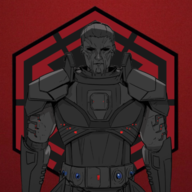



- Intent: To fill the world of Vandemar with interesting and diverse life that is intriguing to roleplay with.
- Image Credit:
- Canon: N/A
- Permissions: N/A
- Links: Vandemar
GENERAL INFORMATION
- Name: Nekkaryn
- Designation: Semi-sentient
- Origins: Vandemar; cavern systems, ancient root networks, ruins and abandoned subterranean infrastructure
- Average Lifespan: 18–28 standard years
- Estimated Population: Planetary; scattered colonies across Vandemar's forested and mountainous regions
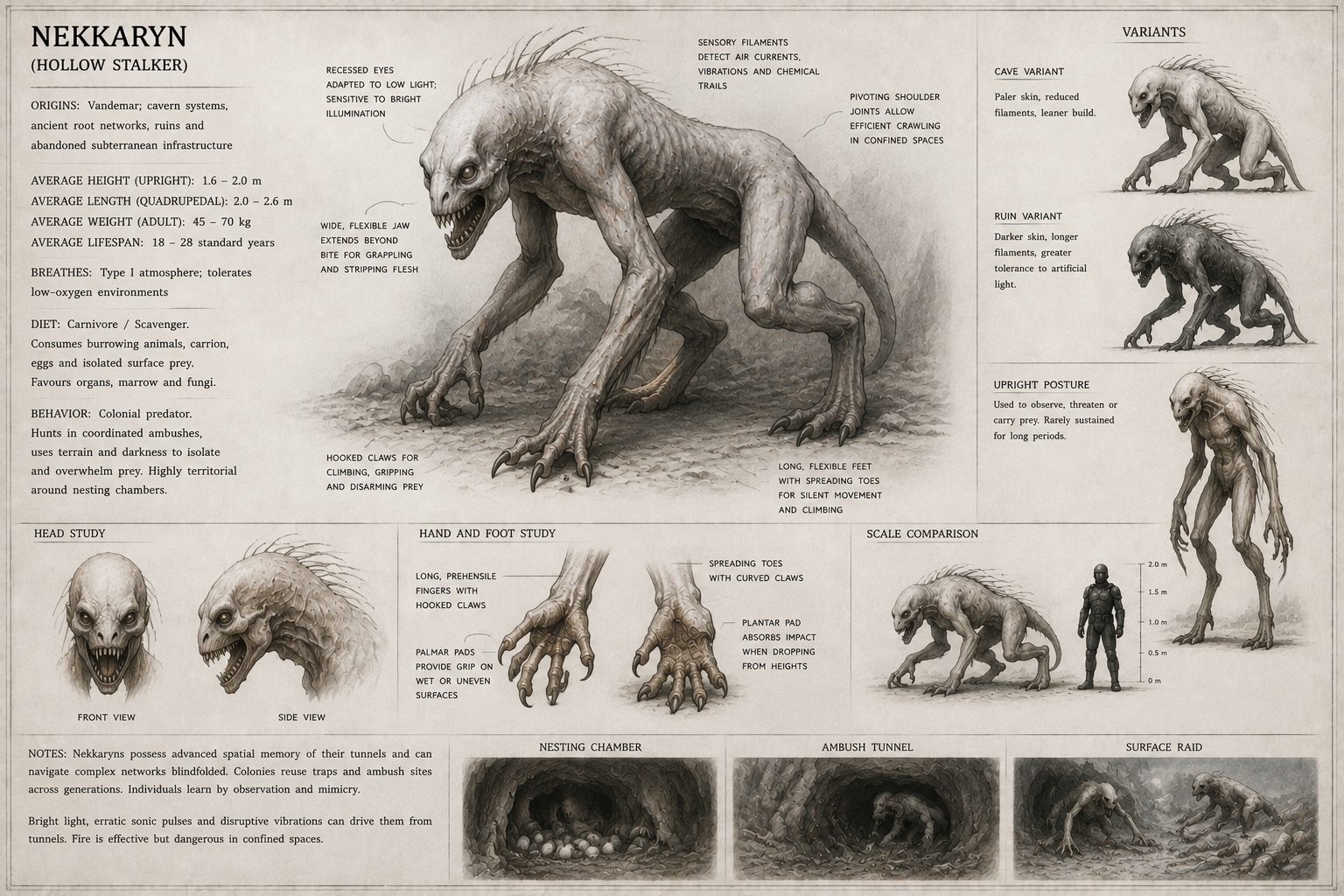
- Description: The nekkaryn is a pale, long-limbed predator adapted to darkness, confined passages and coordinated ambush. It moves on all fours when hunting, but rises onto two legs to observe, threaten or carry prey. Seen briefly in torchlight, its silhouette resembles something almost familiar—an impression that has killed more travellers than the beast itself.
PHYSICAL INFORMATION
- Breathes: Type I atmosphere; tolerates oxygen-poor subterranean environments
- Average Height of Adults: 1.6–2 metres when upright
- Average Length of Adults: 2–2.6 metres in quadrupedal posture
- Skin color: Pale grey, bone-white, ash-brown or muted violet
- Hair color: Sparse black, grey or colourless sensory filaments
- Distinctions: Nekkaryns possess elongated limbs, narrow torsos and flexible joints suited to crawling through confined spaces. Their hands and feet carry hooked claws capable of gripping stone, roots and corroded metal. A broad mouth extends beyond the jaw hinge, while recessed eyes and facial sensory pits detect heat and movement in near-total darkness. Males are leaner and develop longer dorsal filaments; females are larger through the torso and possess pronounced throat sacs used in colony communication. Older specimens display clouded eyes, worn claws and dark fungal staining across the limbs.
- Races: None formally recognised. Cave populations are paler and more lightly built, while ruin-dwelling nekkaryns often develop darker skin and greater tolerance for artificial light.
- Force Sensitivity: Non-Sensitive
- Exceptional mobility in darkness and confined terrain
- Coordinated colony ambushes and advanced spatial memory
- Capable climbers with strong heat and vibration sensing
- Light-sensitive eyes and exposed sensory organs
- Relatively fragile frame compared with larger predators
- Disoriented by intense illumination and irregular sonic pulses
CULTURE
- Diet: Carnivore and scavenger. Nekkaryns consume burrowing animals, carrion, eggs and isolated surface prey. Colonies favour organs, marrow and nutrient-rich fungi growing around their lairs.
- Communication: Throat clicks, hissing, claw taps, scent markings and low-frequency calls transmitted through tunnels.
- Technology level: None. Nekkaryns reposition loose debris, bones and natural hazards but do not manufacture true tools.
- Religion/Beliefs: None.
- General behavior: Nekkaryns live in colonies centred around several breeding females and communal nesting chambers. Hunting groups drive prey toward narrow passages, unstable ground or concealed pits repeatedly used across generations. Their behaviour resembles planning, though most patterns appear instinctive and reinforced through observation. Young are raised communally and learn routes, ambush sites and colony signals through imitation. They are primarily nocturnal near the surface and become highly aggressive when outsiders approach nursery chambers.
HISTORICAL INFORMATION
Nekkaryn remains have been discovered in natural caverns predating Vandemarian settlement, disproving persistent claims that they descend from lost colonists or mutated humanoids. Their disturbing posture appears to be convergent evolution rather than evidence of sapient ancestry.
As cities and fortresses expanded underground, colonies adapted quickly to maintenance tunnels, forgotten transit shafts and abandoned industrial sectors. Early clearance operations often failed because hunters pursued visible individuals while the larger colony redirected them deeper into prepared killing grounds.
Modern authorities map known colonies and seal inhabited tunnel networks rather than attempting indiscriminate extermination. Knightly hunters are deployed when nekkaryns establish themselves beneath settlements or begin carrying victims from the surface.
The oldest warning remains the most reliable: when something in the tunnel stands upright, it is not becoming human. It is deciding how best to reach you.