Architect




MCW-II | "Tide-Breaker"
OUT OF CHARACTER INFORMATION
- Intent: To create a Limited-production elite combat warplate for the Commonwealth's Marine Commandos — a lighter, faster, more capable refinement of the legacy First Order stormtrooper chassis, built around boarding actions, hostile-environment insertion, and the doctrine that the operator, not the armor, is the weapon.
- Image Source: Midjourney
- Canon Link: N/A
- Permissions: N/A
- Primary Source: FO-02 Stormtrooper Armor | VCSM II "Sentinel Badge"
- Manufacturer: Imperial Commonwealth of Dosuun
- Affiliation: Imperial Commonwealth of Dosuun; Commonwealth Marine Commandos
- Market Status: Closed-Market
- Model: MCW-II "Tide-Breaker" (Marine Commando Warplate, Mark II)
- Modularity: Yes — exterior attachments (combat webbing, environmental kits, additional plating); authorized enamel finishes (unit colors and camouflage variants).
- Production: Limited
- Material:
- Molytex armor plating (primary shell)
- Armorweave bodyglove and joint sheathing (sealed, environmental)
- Creshaldyne-pattern blast-gel impact layer (chest, back, shoulders)
- Integrated shock padding and ceramiplast bracing
- Military-grade electronics (helmet sensor suite)
- Issued VCSM-II "Sentinel Badge" command-link module
TECHNICAL SPECIFICATIONS
- Classification: Multipurpose/ Boarding-Insertion; Light Powered Combat Warplate
- Weight: Light
- Resistances as follows:
- Lightsaber Resistance - Low: The Tide-Breaker's resistance to lightsabers is a product of material density alone — the molytex shell and armorweave underlayer offer no dedicated anti-saber properties, and the suit incorporates no cortosis, phrik, or comparable lightsaber-resistant materials. In practice this means the armor protects the wearer from glancing contact, deflected energy, and incidental saber exposure in a melee, buying a commando precious moments in a close fight. It does not stop a committed strike: a focused blow from a trained duelist will breach the plate as readily as it would any standard composite armor. The suit is built to keep a Marine alive against blasters and boarding hazards, not to make them a match for a lightsaber — that, by design, is left to the planned semi-unique variant.
- Energy Weapon Resistance - High: The MCW-II's protective envelope is built on a molytex shell rather than the heavier reinforced duraplast of its FO-pattern ancestor. Molytex grants protection comparable to laminanium plating at a fraction of the mass, dispersing and shrugging off blaster particle bolts across the plate surface. Beneath the plating, the armorweave bodyglove independently dissipates blaster fire, and the Creshaldyne-pattern blast-gel layer over the torso diffuses energy through suspended reflective crystals while absorbing the bolt's thermal spike. The combined stack can safely withstand standard blaster fire and offers limited lightsaber resistance — a committed strike will breach the plate, but the wearer is protected from glancing contact and incidental saber exposure. Cast energy weapons such as flame projectors are defeated by the plate's heat tolerance and curvature, which prevents ignited propellant from adhering to the surface.
- Kinetic Weapon Resistance - Average: Molytex withstands considerable kinetic force, and the blast-gel layer absorbs significant impact energy from projectiles, bludgeoning, and falls. Slug-based weapons up to and including heavy slugthrowers are largely defeated by the shell, though — consistent with the physics that governed the parent chassis — a high-powered rifle round that fails to penetrate will still transfer its energy as deep bruising or internal trauma if the impact exceeds the padding's dispersion threshold. The trade made to keep the suit light is honest: this is not a heavy slab warplate, and sustained heavy kinetic fire is a genuine threat.
- Sonic Weapon Resistance - Average: The Creshaldyne-pattern blast-gel layer carries inherent resistance to sonic, thermal, and electrical energy, and the armorweave underlayer dampens pressure-wave propagation. The suit absorbs and diffuses the compression-rarefaction cycle of sonic weaponry, leaving the wearer protected from indirect or weakened sonic discharge, though a direct, focused sonic hit will still register.
- Melee / Shrapnel Resistance - Average: The molytex shell offers excellent protection against melee weapons and shrapnel; the blast-gel layer's combination of resilient exterior and absorbent interior slows and diminishes vibroblade vibration and resists piercing and slashing strikes. As with all segmented armor, the joints — sheathed in armorweave rather than solid plate — are the more vulnerable points, a deliberate concession to mobility.
- E/WAR Resistance (EMP / Ion) - Very Low: The helmet's sensor and processor lattice is shielded against incidental ion and electromagnetic exposure, but the MCW-II is a systems-dense suit, and that density is its single greatest vulnerability. Directed ion or EMP fire at close range can disrupt or temporarily down the helmet HUD and the integrated Sentinel Badge command-link, forcing a reboot and leaving the commando without sensor augmentation or fleet contact in the interim. The closer the source, the more complete the disruption. This is the suit's defining weakness and is not engineered around.
- Helmet:
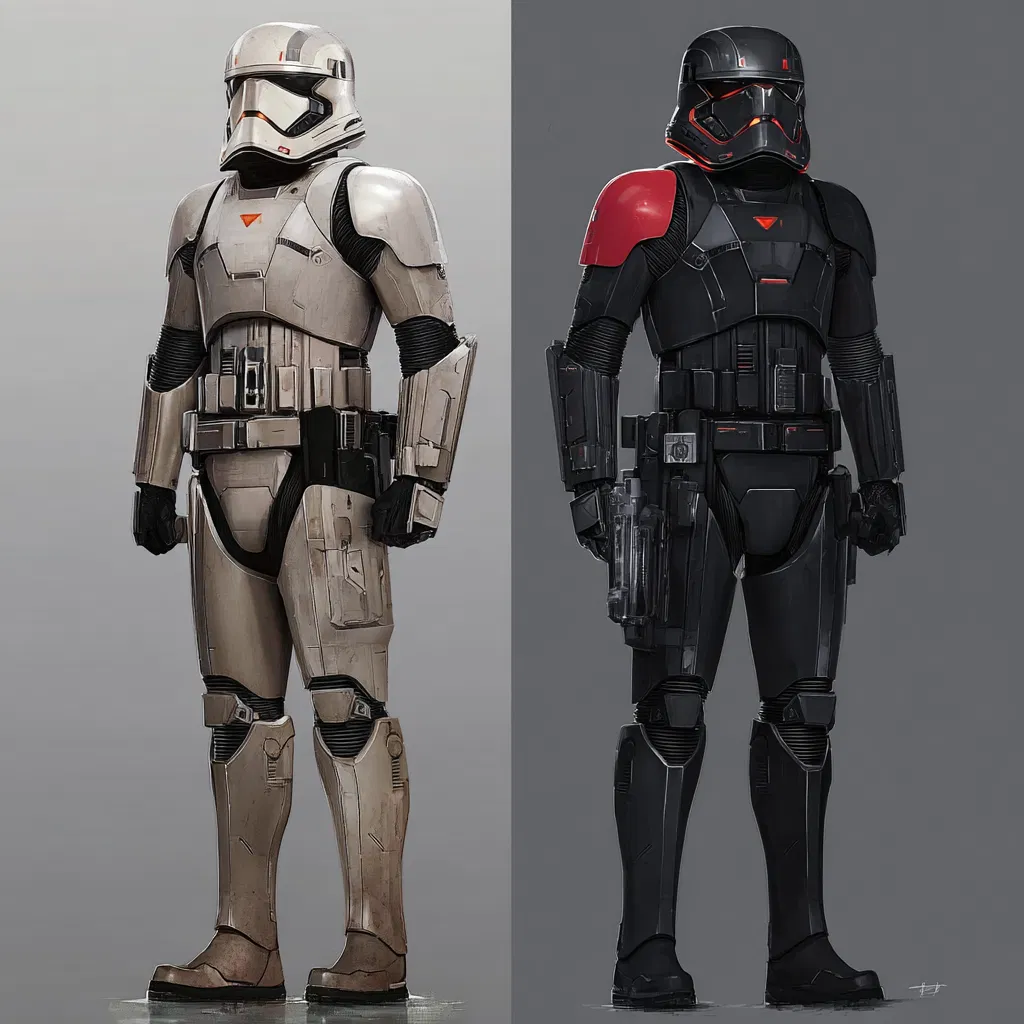
- Predatory FO-pattern faceplate; red active-optic band (sensor/targeting glow, not decorative)
- Holographic tactical HUD (blink- and voice-command capable)
- Combat microcomputer with multi-frequency targeting and acquisition system
- Biometric helmet lockout — purges and bricks if worn by an unauthorized user
- Visor modes: tactical, low-light/nightvision, infrared/thermal, ultraviolet, high-frequency sonar
- Combat / life-form scanner, motion scanner, integrated macrobinoculars
- Rebreather and environmental filtration; sealed for vacuum and hostile atmospheres
- Primary oxygen supply (two hours)
- Broadband antenna with rangefinder; short-range encrypted commlink
- Body Armour:
- Sealed, pressurized Class-E environmental suit (zero-G and vacuum operation)
- Backplate power cell (concealed/retractable solar ionization panels); reserve power pack
- Secondary oxygen supply (six hours)
- Auto-adrenal injection system
- Bio-restorative underlay (field wound-sealing)
- Magnetic adhesion / high-traction grips for zero-G hull work and boarding
- Magnetized mounting surfaces for primary and secondary weapons
- Reinforced knee plating and bracing
- Grav-chute / jetpack backplate mounting (attachment)
- Combat webbing clips and mountings; integrated thigh holster
- Forearm-mounted comms/holo-projector linked to helmet HUD
- Issued Command-Link — VCSM-II "Sentinel Badge":
- Encrypted subspace fleet/squad/command communications (hands-free)
- Biometric IFF transponder synced to Commonwealth systems
- Continuous vitals monitoring relayed to fleet command during boarding operations
- Emergency grav-ping for automated recovery if the wearer is unconscious, ejected, or cast into vacuum
- Core-burn self-destruct on tamper or unauthorized removal
- The Operator Is the Weapon: Issued only to selected, extensively trained Marine Commandos. The suit's edge is fit, integration, and the soldier inside it — not bulk.
- Light and Mobile: At roughly half the mass of its FO-pattern ancestor, the Tide-Breaker delivers a comparable protective envelope through superior materials, preserving the speed and endurance a commando needs across a long boarding action.
- Sealed for the Void: Full vacuum and hostile-environment rating with magnetic hull grips makes the suit purpose-built for ship-to-ship assault and zero-G operations.
- Integrated Recovery: The issued Sentinel Badge automatically pings for recovery if a commando is incapacitated or blown into vacuum — no commando is left behind.
- Systems-Dense — Ion/EMP Vulnerable: A close directed ion or EMP hit downs the helmet HUD and the Sentinel Badge link, stripping the commando of sensors and fleet contact until reboot. The suit's greatest capability is also its greatest vulnerability.
- Light Armor — Not a Slab: The mobility-first design means sustained heavy kinetic fire, anti-materiel rounds, and focused heavy weapons defeat the shell where a heavier warplate might endure. Speed is bought with protection.
- No True Force Defense: Lightsaber resistance is limited to material density only; a committed saber strike breaches the plate, and the suit offers no resistance to Force powers whatsoever.
- Exposed Joints: Armorweave-sheathed joints are deliberately less protected than the plated sections — the cost of the suit's mobility, and a known target for a disciplined enemy.
- Cannot Swap in the Field: Each suit is individually fitted to its assigned commando and biometrically locked; it cannot be exchanged, shared, or worn by another operator on the line.
When the First Order fell, its armories did not vanish — they were inherited. The Imperial Commonwealth of Dosuun took up the old stormtrooper pattern as it took up so much else of the Order's legacy: not as relic, but as foundation. The line marine still wears a recognizable descendant of the FO-02 warplate. The Marine Commando does not. For the Commonwealth's selected few — the boarding crews, the void-insertion specialists, the men and women drilled until the suit is an extension of the body rather than a burden upon it — the Commonwealth built the MCW-II.
It is called the Tide-Breaker, and the name is not idle. The Commonwealth's Marine Commandos are cut from the same cloth as the seaborne shock troops of old Earth's storied corps: selected hard, trained harder, and trusted to go first into the worst place on the field. The doctrine that governs them is simple and unromantic — nothing in the galaxy is more dangerous than a Marine, and the armor exists only to keep that Marine alive long enough to prove it.
To that end, the Tide-Breaker discards the one thing its ancestor was infamous for: weight. The FO-02 was a heavy slab, and it moved like one. The MCW-II is built on a molytex shell that protects nearly as well as self-healing droid plating at a fraction of the mass, an armorweave bodyglove that dissipates blaster fire while flexing with every motion, and a layer of blast-gel across the vitals that drinks the energy out of an impact. The result weighs roughly half what the old warplate did. A commando in a Tide-Breaker can run a full boarding action — corridor to corridor, deck to deck, hours of close work in vacuum and gravity both — and still be fast in the last minute of the fight.
The helmet keeps the predatory cast of its forebears. Where the old First Order helms wore an unsettling grin, the Commonwealth's commandos wear something colder: a smooth, aggressive faceplate banded with a low red glow that marks the active sensor and targeting optics within. To an enemy across a smoke-filled hold, it is the last thing many of them register before the boarding party is on top of them — a wall of faceless red-eyed shapes moving with terrible coordination. The psychological weight the stormtrooper once carried by uniformity, the Marine Commando carries by reputation.
Within, the suit is sealed against the void. It is a boarding suit first and foremost: vacuum-rated, magnetically gripped for work on a hull or in zero gravity, fed by redundant oxygen, and stitched into the Commonwealth's command network through the issued VCSM-II "Sentinel Badge" worn at the breast. The Sentinel is the suit's lifeline as much as its voice — it carries the commando's vitals back to the fleet, marks them as friend on every Commonwealth system, and, should they fall unconscious or be blown clear into open space, pings automatically for recovery. The Commonwealth's commandos go into the worst places in the galaxy on the understanding that the fleet is always listening, and that no one is left drifting.
What the Tide-Breaker does not pretend to be is invincible. It is light, and light armor is a bargain: speed and endurance paid for in protection. Sustained heavy fire will defeat it where a slab warplate might endure. Its joints are deliberately soft, sheathed in flexible weave so the wearer can move like water through a doorway. It offers no defense against the Force, and only the thinnest material resistance to a lightsaber. And for all its integrated brilliance, that integration is a vulnerability — a close ion burst can blind the helmet and silence the Sentinel in an instant, and a commando so struck must fight on by training alone until the systems come back.
That, in the end, is the entire philosophy of the suit. The Commonwealth does not armor its commandos to make them unkillable. It armors them to make them fast, aware, and recoverable — and then it trusts the soldier inside to be the most dangerous thing in the room. The armor breaks the tide. The Marine breaks the enemy.
Addendum: The MCW-II is issued in a plain heritage finish as standard. Authorized unit and command finishes — including the black-and-red of elite formations, full-crimson, and high-polish chrome — are cosmetic enamel variants and require no separate submission. The chassis is open to future upgrade-package submissions, including a planned semi-unique variant incorporating self-repairing laminanium plating and dedicated anti-Force / anti-lightsaber materials.
Out Of Character Info
Intent:
To create a Limited-production elite combat warplate for the Commonwealth's Marine Commandos — a lighter, faster, more capable refinement of the legacy First Order stormtrooper chassis, built around boarding actions, hostile-environment insertion, and the doctrine that the operator, not the armor, is the weapon.
Image Source(s):
https://www.midjourney.com
Canon Link:
N/A
Permissions:
N/A
Primary Source(s):
FO-02 Stormtrooper Armor | VCSM II "Sentinel Badge"
Technical Information
Affiliation:
Imperial Commonwealth of Dosuun
Model:
MCW-II "Tide-Breaker" (Marine Commando Warplate, Mark II)
Modular:
Yes
Material:
Molytex armor plating (primary shell) Armorweave bodyglove and joint sheathing (sealed, environmental) Creshaldyne-pattern blast-gel impact layer (chest, back, shoulders) Integrated shock padding and ceramiplast bracing Military-grade electronics (helmet sensor suite) Issued VCSM-II "Sentinel Badge" command-link module
Classification:
Multipurpose
Defense Rating:
Average
Energy Resist:
High
Kinetic Resist:
Average
Sonic Resist:
Average
Thermal Resist:
Average
Radiation Resist:
Average
Last edited: