

Architect




MANUL-CLASS
"GUNSHIP"
SNUB ESCORT FIGHTER
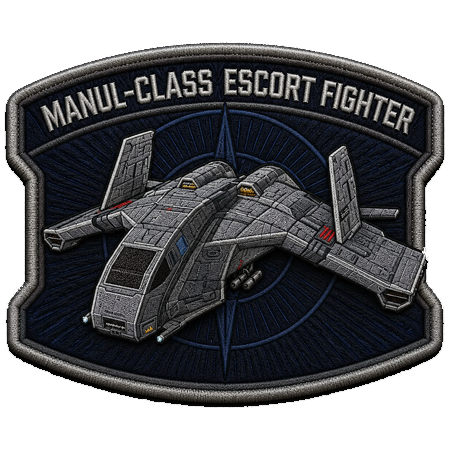
"GUNSHIP"
SNUB ESCORT FIGHTER
OUT OF CHARACTER INFORMATION
- Intent: To create an escort-fighter to compliment the Johnston-class.
- Image Source: Midjourney | ChatGPT
- Canon Link: N/A
- Permissions: Solarium Glasteel (x)
- Primary Source: N/A
- Manufacturer: Primo Victorian Shipwright,
- Affiliation: Imperial Commonwealth of Dosuun
- Market Status: Closed-Market
- Model: CNC-SEFMX-M1 “Manul”
- Production: Limited
- Material:
- Durasteel Reinforced Crystalamnium Hull
- Reinforced Duraplast with Latticed Crystaplast Liner
- Alusteel Reinforced Durasteel Hull [Interior]
- Tunqstoid Blast Doors, Turadium Blast Shields [Interior]
- Solarium Glasteel Viewports [Overlay]
- Glasteel Viewports [Underlay], Turadium Blast Shutters
- Agrinium, Dallorian Alloy [Key Areas/Critical Components]
- AR-0B Damage Reduction Plating [Key Areas/Critical Components]
- Doonium Infused Impervium [Munitions Control]
- Hekakles-type Composite Hull System
- Classification: Snub Escort Fighter
- Length: 20m
- Width: 11m
- Height: 5m
- Armament: Average
- 2x Boltfire-type Plasma Pulse Cannon (Snub Variant) [Forward-fixed, dorsal-spine hardpoint] — primary strike weapon for screening passes
- 1x Commonwealth Plasburst Cannon CPB-10 [Forward-fixed, ventral-nose hardpoint] — deterrent, disabling, and debris-clearing fire
- 1x Alecto-type MicroTorpedo Launcher (Snub Variant) [Compact wide-arc mount] — primary point-defense / interception system
- Defenses: Average
- Compact Deflector Shield (Snub Variant)
- Ion Shield Generator (environmental & avionics protection)
- Vitralis Reflex Shield Generator (Snub Variant)
- Boudica Kinetic Deflector (localized impact mitigation)
- Crystalamnium Mesh + Crystaplast Shell (radiant & kinetic dispersion)
- Hekakles Composite Hull (structural durability)
- Ariadne ECM Assistant (signal resilience)
- Tri-Fold Electromagnetic Barrier System (Navalized Snub Variant)
- Squadron Count: None - 1
- Maneuverability Rating: Very High [High w/ SurgePulse]
- Speed Rating: Very High [Extreme w/ SurgePulse]
- Hyperdrive: 3.0
- Commonwealth Standard Avionics Suite (Combat Configuration): Integrated flight control, navigation, and systems management optimized for high-G interception maneuvering and station-keeping at close proximity to a parent capital hull in interference-heavy combat environments.
- Hull-Adjacent Operations Hardening: Strengthened frame and shielded systems designed to operate safely within meters of the Johnston's active shields, exposed weapon arcs, and engine wash during the parent ship's firing and repositioning cycle.
- Advanced Environmental Sealing & Pressure Management: Reinforced compartment sealing and adaptive pressure regulation allowing operation in vacuum, radiation-heavy regions, and debris fields.
- Automated Post-Operation Decontamination Systems: External hull purge, intake scrubbers, and tool-head cleansing protocols prevent radiation, particulate, or hazardous residue from being transferred back to the parent vessel on recovery.
- Redundant Flight & Station-Keeping Control Pathways: Multiple independent control routes ensure continued maneuvering and stabilization during partial avionics degradation or under fire.
- Radiation, EM, and Ion Hardening (Commonwealth Spec): Shielded cabling, insulated power routing, and hardened electronics maintain functionality near active reactors, shield emitters, and during heavy electronic warfare.
- Fire-Control Deconfliction Link: Dedicated coordination channel slaving the Manul's targeting and munitions detonation to the Johnston's fire-control net, preventing the Alecto's EMP-cluster effects from fratriciding the parent ship's systems during close-aboard interception.
- Emergency Autonomy & Safe-Return Mode: Limited autonomous routines capable of stabilizing the craft and returning to the Johnston's docking interface if the pilot is incapacitated.
- Capital-Ship Docking & Recovery Interfaces: Reinforced docking collar, guidance beacons, and recovery alignment systems designed for retrieval into the Johnston's single-craft berth under combat conditions.
- Commonwealth Safety & Redundancy Standards: Fire suppression, emergency lighting, compartment isolation, and survival provisions consistent with Commonwealth naval auxiliary craft doctrine.
- Power & Propulsion
- Howlback-XC Ion Engines [Microburst-tuned vectored ion propulsion — sharp evasive maneuvers, fine directional thrust, short-duration overdrive]
- 2x Kestrel Core [Reactor + ElectroFrost regulation system]
- [SV] Icarus Maneuvering Array [Micro-thrust and counter-gravity agility system]
- [SV] Crystal-Integrated Harmonic Regulator [Force-resonance and energy destabilization protection]
- [SV] SurgePulse Accelerator [Burst-and-escape mode — for rapid repositioning to stay on station with the Johnston]
- [SV] Aether-IX Modular Suite [System integration and modulation overlay]
- [SV] Fries-IV Modular Suite [Thermal regulation and emergency power reroute]
- Internal Defense Management
- Emergency bulkheads and compartment isolation
- Biometric access controls
- Limited lockdown routing for crew safety
- Automated post-mission decontamination protocols prior to hangar reintegration
- Communications
- Compact Dudley Communications Suite (Limited)
- Compact Dudley Communications Suite (Limited)
- Countermeasures
- SIG-220 Tactical Jammer [Broadband Disruption Layer]
- Sensor & Data Systems
- Helion Data Core Matrix (Shuttle Variant): Centralized data fusion and processing backbone integrating structural diagnostics, environmental hazard data, drone telemetry, and repair task prioritization in real time.
- Neuracrys Gel Interface (Shuttle Variant): Semi-organic computational layer enhancing pattern recognition, predictive failure modeling, and adaptive response during complex repair operations.
- Resonance Lattice Chip (Shuttle Variant): Multispectral signal harmonization and interference mitigation, maintaining sensor and system stability near active shields, reactors, and fabrication systems.
- TCSX Strikeveil Sensor Suite (Shuttle Variant): Radiation, electromagnetic, thermal, and particulate hazard detection optimized for operations near damaged hull sections and exposed ship systems.
- SCX Navicor Sensor Suite (Shuttle Variant): Precision navigation, hull-relative positioning, and docking guidance for station-keeping and attachment-based operations.
- Bluford Sensor Suite (Trimmed):
- Passive & Short-Range Sensor Arrays (Shuttle Variant)
- Rangefinding, Light Detection & Proximity Tracking
- Basic Hazard & Obstruction Identification
- Savić Tracking Sensor Suite
- Imaging System (Shuttle Variant)
- Combat Multi-view Display (Shuttle Variant)
- Target-Aggressor Attack Resolution Software (Shuttle Variant)
- Countermeasures Compensation Computer (Shuttle Variant)
- Dedicated close-escort interceptor: Purpose-built to screen the Johnston during its most exposed moments — the seconds it is committed to a firing solution or repositioning — by intercepting priority threats rather than absorbing them.
- Credible point defense without gun-tracking dependence: The Alecto's proximity detonation, fragmentation bursts, and Hunter-Seeker payloads defeat incoming ordnance and harassing snubs through area effect and guided munitions, not pinpoint turret tracking — a realistic interception solution at snub scale.
- Real offensive bite: The Snub-Variant Boltfire gives the Manul genuine shield-stripping firepower on a screening pass, allowing it to punch out alongside the Johnston rather than merely orbit it defensively.
- Exceptional agility: The microburst-tuned Howlback-XC and Icarus array make the Manul a high-G interceptor; the SurgePulse Accelerator provides the burst speed to re-establish station with the Johnston after a reposition.
- One ship, not a screen: A single Manul cannot curtain an entire 320m hull against a saturation strike. It buys the Johnston seconds by killing the threats that matter most — it does not render the parent ship invulnerable. Overwhelming numbers will get through.
- Limited interception magazine: The Alecto's already-modest ammunition volume is further constrained by the snub's internal space. The Manul intercepts within a tight window and then has little left — a deliberate doctrinal limit reinforcing its dependence on the Johnston.
- Cannot sustain long burns: The Howlback-XC overheats under sustained full output. The Manul lives close to the Johnston by necessity; it operates in short, violent bursts and cannot range far or escort over long distances.
- Lightly protected: Defenses are tuned for a fast snub — survivability comes from speed, agility, and small signature, not from absorbing fire. A Manul that is caught and pinned does not last.
- Doctrinally dependent on the parent ship: Sensors, fleet coordination, magazine replenishment, and recovery all assume the Johnston. Detached and alone, the Manul's effectiveness and endurance fall sharply.
- Forward-weighted gunnery: Both cannons are fixed-arc and frontal. Off-axis defense rests almost entirely on the Alecto; an attacker that stays out of the forward cone denies the Manul its gun armament.
The Manul-class began with a problem unique to the Johnston. An Assault Artillery hull built around the shoot-and-scoot principle, the Johnston delivers disproportionate volleys and then repositions before the enemy can answer — but in the seconds it is committed to a firing solution, and again while its engines are hot and its profile is turned, it is at its most vulnerable. Enemy doctrine against such a platform is obvious: rush it during those windows with fast snubs and ordnance, force it to either eat the hits or abort the volley, and break the entire shoot-and-scoot cycle. At 320 meters the Johnston has room for a single small-craft berth and no more. It could not carry a screen. It could carry one wingman.
The Manul is that wingman. Where the Commonwealth's Remora and Sora shuttles are deliberate non-combatants — utility and reconnaissance craft that survive by avoidance — the Manul inherits their proven Commonwealth backbone and turns it toward a fight. It shares their hull material stack, their layered defensive suite, their Howlback-XC propulsion spine, and their sensor architecture, all resized to snub scale under the same shuttle-variant conventions. What it does not share is their doctrine. The Manul is built to put itself between the Johnston and the things trying to kill it.
Its loadout is layered for that single purpose. At the heart of the craft is a Snub-Variant Alecto MicroTorpedo Launcher — a high-rate, proximity-detonating, fragmenting system whose Hunter-Seeker and shrapnel payloads let a single pilot defeat incoming torpedoes and harassing fighters without needing the pinpoint gun-tracking a craft this size cannot carry. Backing it are two downscaled Boltfire plasma pulse cannon on the forward spine, the Manul's true bite: shield-stripping burst fire for the screening pass, the weapon it uses to punch out alongside the Johnston rather than simply guard it. A modest CPB-10 rounds out the nose for deterrent fire, disabling shots, and clearing the debris that a capital engagement throws into a snub's path.
The Manul asks for no new technology. Every system aboard is drawn from the established Commonwealth ecosystem and resized under the precedent the Remora and Sora set, which keeps the craft honest about what it is: a small, fast, single-purpose escort that lives and dies by the ship it protects. Its engine cannot range far. Its magazine runs dry quickly. One Manul cannot stop a determined saturation strike. But it was never meant to. It was meant to buy the Johnston the seconds it needs to fire and run — and for that, it bares its teeth and stays close. The Johnston buys time by repositioning. The Manul buys the Johnston the time it needs to reposition.
Out Of Character Info
Intent:
To create an escort-fighter to compliment the Johnston-class.
Image Source(s):
https://www.midjourney.com
Canon Link:
N/A
Permissions:
Solarium Glasteel
Primary Source(s):
N/A
Technical Information
Affiliation:
Imperial Commonwealth of Dosuun
Model:
CNC-SEFMX-M1 “Manul”
Starship Class:
Small Craft (1-50m)
Starship Role:
Gunship
Modular:
No
Material:
Durasteel Reinforced Crystalamnium Hull Reinforced Duraplast with Latticed Crystaplast Liner Alusteel Reinforced Durasteel Hull [Interior] Tunqstoid Blast Doors, Turadium Blast Shields [Interior] Solarium Glasteel Viewports [Overlay] Glasteel Viewports [Underlay], Turadium Blast Shutters Agrinium, Dallorian Alloy [Key Areas/Critical Components] AR-0B Damage Reduction Plating [Key Areas/Critical Components] Doonium Infused Impervium [Munitions Control] Hekakles-type Composite Hull System
Armaments:
2x Boltfire-type Plasma Pulse Cannon (Snub Variant) [Forward-fixed, dorsal-spine hardpoint] — primary strike weapon for screening passes
1x Commonwealth Plasburst Cannon CPB-10 [Forward-fixed, ventral-nose hardpoint] — deterrent, disabling, and debris-clearing fire
1x Alecto-type MicroTorpedo Launcher (Snub Variant) [Compact wide-arc mount] — primary point-defense / interception system
1x Commonwealth Plasburst Cannon CPB-10 [Forward-fixed, ventral-nose hardpoint] — deterrent, disabling, and debris-clearing fire
1x Alecto-type MicroTorpedo Launcher (Snub Variant) [Compact wide-arc mount] — primary point-defense / interception system
Defense Rating:
Average
Speed Rating:
Very High
Maneuverability Rating::
Very High
Energy Resist:
High
Kinetic Resist:
High
Radiation Resist:
Very High
Other Resistance(s):
- EMP/ION: Very High
- Sonic: Average
- Force Disruption/Harmonics: Low
- Elemental (Fire/Cold/Corrosive): Low
Minimum Crew:
1
Optimal Crew:
2
Passenger Capacity:
0
Cargo Capacity:
None