

Iron Wraith




OUT OF CHARACTER INFORMATION
Intent: To establish the sentient species native to Minrith
Image Credit: x edited very slightly by me
Canon: N/A.
Permissions: N/A.
Links: Moon 743 minrith, Iego System, Aethrava, Vaelkris, Kethrannis, Draevannis, Queen Eshvara
GENERAL INFORMATION
Name: Kharvaxi
Designation: Sentient
Origins: Moon 743 minrith, Iego System, The Slice.
Average Lifespan: Approximately 160 standard years.
Estimated Population: Scattered. The Kharvaxi population is concentrated primarily on Minrith, with smaller populations and individuals living throughout the wider galaxy. Encountering a Kharvaxi off-world is somewhat uncommon, but not unusual.
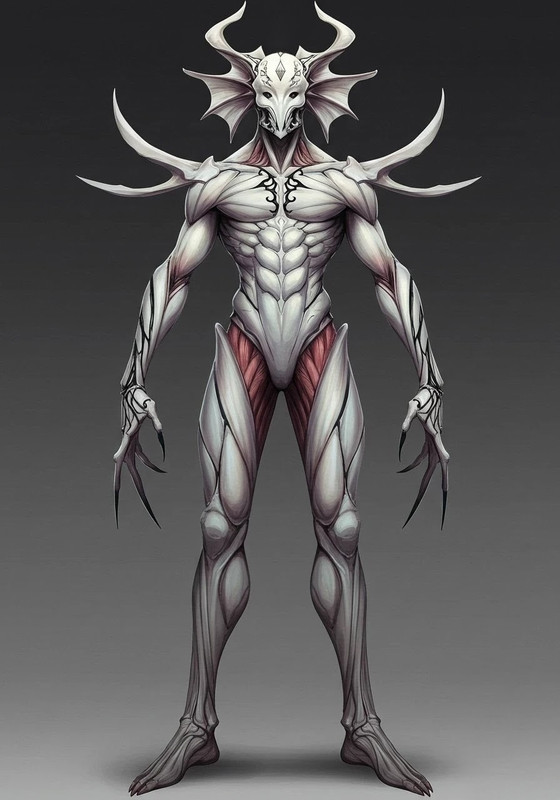
Description: The Kharvaxi are a tall, humanoid species native to Minrith, averaging approximately 2.1 meters in height. Their bodies are covered in ivory-white, chitin-like plates that form layered, armor-like patterns across their torsos, limbs, shoulders, and faces. Dark reddish-to-black tissue is visible between these plates, particularly around the joints and other flexible areas. Their heads feature elongated, skull-like facial structures, small dark eyes, and multiple sweeping horns that extend from the sides of the head. Additional spikes protrude from their shoulders, while their hands end in long, natural claws. Despite their intimidating appearance, their plating offers only limited protection against physical injury and does not replace manufactured armor. Kharvaxi are naturally somewhat stronger than average humans, with relatively consistent physical features across the species and only modest differences between individuals and sexes. They are adapted to warm, humid environments, as prolonged exposure to extreme dryness or cold can stiffen their plating and restrict movement. Most Kharvaxi live on their homeworld of Minrith, though smaller populations can be found throughout the wider galaxy. They are a technologically advanced, community-oriented species with a long history of interstellar trade and exploration.
PHYSICAL INFORMATION
Breathes: Oxygen-based atmosphere.
Average Height of Adults: Approximately 2.1 meters.
Average Length of Adults: N/A.
Skin Color: Ivory-white outer plating, with dark reddish-to-black underlying tissue visible between the plates.
Hair Color: None. Kharvaxi do not possess hair.
Distinctions: Kharvaxi possess ivory-white, chitin-like plates across much of their bodies, with dark reddish-to-black tissue visible between the plates, particularly around their joints. Their elongated, skull-like faces, relatively small dark eyes, multiple sweeping horns, shoulder spikes, and natural claws give them a distinctive appearance. Their outer plates are semi-flexible, allowing normal movement, but provide only limited protection against physical injury. Horns and shoulder spikes vary in size, thickness, and shape between individuals, without necessarily indicating strength or status. Young Kharvaxi have smaller horns and shoulder spikes that grow as they mature, but their overall appearance remains relatively consistent throughout adulthood. Females are generally slightly slimmer and an inch or two shorter than males on average, although considerable variation exists between individuals of both sexes.
Kharvaxi are naturally somewhat stronger than average humans, though their strength varies with individual fitness and training. They are adapted to warm, humid environments, and prolonged exposure to extreme dryness can make their plating less flexible, while extreme cold can stiffen or partially freeze it and restrict movement. Suitable clothing, environmental protection, and access to warmth and moisture can mitigate these effects.
Races: None. Kharvaxi share a consistent overall physical structure, with variations in individual features such as horn size, shape, and body build rather than distinct racial or regional groups.
Force Sensitivity: Standard. Some Kharvaxi are born Force-sensitive, while others are not. Force-sensitive individuals require training to develop active Force abilities.
STRENGTHS
Natural Plating: Kharvaxi possess ivory, chitin-like plates that provide limited natural protection against cuts and glancing blows. Forceful strikes and sufficiently powerful weapons can still penetrate or damage their plating, making manufactured armor necessary for serious combat.
Above-Average Strength: Kharvaxi are naturally somewhat stronger than the average human, giving them an advantage in physical labor, grappling, and close combat. Their strength still varies with individual fitness and training.
Protective Horns: Their sweeping horns can serve as natural defensive weapons in close quarters. Horns vary considerably in size and shape, and using them offensively carries risks.
Natural Claws: Kharvaxi possess claws that assist with gripping, climbing, and handling certain tasks. They can also be used in close combat, though they are no substitute for dedicated weapons.
Technological Expertise: Kharvaxi civilization has extensive experience in engineering, research, and technological manufacturing. Individuals with relevant education and experience can draw upon their society's advanced technological knowledge.
WEAKNESSES
Environmental Sensitivity: Kharvaxi plating can become dry and less flexible in arid environments, while extreme cold can stiffen or partially freeze it and restrict movement. Appropriate clothing, environmental protection, and access to warmth and moisture can mitigate these effects.
Limited Natural Protection: Their ivory, chitin-like plates can withstand ordinary knife or sword slashes, but forceful attacks can still damage them and injure the underlying tissue. Their natural plating is not a replacement for manufactured armor.
Vulnerable Joints: The dark tissue between their plates, particularly around joints, is less protected than the plated areas. Attacks that reach these gaps can injure them without needing to break through their outer plating.
Horn Interference: Their prominent horns can make tight spaces, enclosed vehicles, and conventional helmets or protective headgear awkward to navigate or use. Equipment often requires adjustments to accommodate their anatomy.
Limited Flexibility of Plating: Although their plates are semi-flexible, they can restrict certain movements compared with unplated tissue. Extreme contortions or awkward positions may be more difficult, particularly when their plating has stiffened due to environmental conditions.
CULTURE
Diet: Kharvaxi are omnivores who generally prefer plant-based foods, including fruits, leafy plants, roots, and seeds. They also readily eat meat and can maintain a varied diet.
Communication: Kharvaxi speak Galactic Basic and their native language, Kharvaxin. Kharvaxin remains important in everyday life and cultural traditions, even as the species participates in interstellar trade.
Technology Level: Kharvaxi civilization is technologically advanced, with capabilities comparable to those of the wider galaxy. Their society has established industries specializing in general technology, starships, weapons, armor, and defensive systems.
Religion/Beliefs: Kharvaxi society is largely secular, with no established religion or widespread religious tradition. Family, community, cooperation, and protecting their homeworld hold greater cultural importance, although individuals remain free to develop personal beliefs and philosophies.
General Behavior: Kharvaxi generally value community, cooperation, and looking after those around them. They are welcoming toward outsiders, participate actively in interstellar travel and trade, and are willing to defend their homes when necessary. Recreational sparring and organized fighting sports provide an outlet for those who enjoy combat, but violence is not a defining feature of their culture.
HISTORICAL INFORMATION
The Kharvaxi are an extremely ancient species whose history stretches back far beyond their oldest surviving written records. Although their civilization has existed for an immense period of time, its exact age remains unknown. Archaeological discoveries across Minrith have revealed ancient ruins, artifacts, and structures that suggest Kharvaxi civilization developed long before the beginning of their reliably documented history. Some of these discoveries possess features or apparent purposes that modern Kharvaxi scholars cannot fully explain. While these structures are not necessarily the work of another species, the knowledge surrounding their construction and original purpose has been lost to time.
The Forgotten Age
The earliest period of Kharvaxi history remains largely unknown. Their ancestors used early methods of recording information that were often unreliable over long periods. Materials deteriorated, records were destroyed during conflicts, and entire collections of knowledge disappeared when settlements were abandoned or collapsed. By the time more reliable methods of preserving historical information became widespread, vast portions of the species' earlier history were already irrecoverable.
As a result, the Kharvaxi possess only fragments of information about their earliest civilizations. Ancient ruins and recovered artifacts continue to provide insight into their distant past, but the origins of their species, the beginnings of their civilization, and the full extent of their earliest achievements remain uncertain.
The Early Communities
The earliest surviving historical records describe numerous small Kharvaxi communities scattered throughout Minrith. These communities developed independently, forming their own settlements and pursuing their own interests. Some grew larger over time, while others remained relatively small and separate from their neighbors.
Although these communities shared a common species and homeworld, they did not initially operate under a single unified authority. Different groups held competing interests regarding territory, valuable resources, and the manner in which their societies should be governed. As communities expanded and their interests increasingly overlapped, disagreements became more difficult to resolve.
The Civil War
Eventually, disputes between several communities escalated into a civil war. The conflict had no single cause, instead emerging from overlapping disagreements over territorial control, access to resources, and competing ideas about how the Kharvaxi should organize and govern themselves.
Several communities attempted to challenge others and impose their interests upon their rivals. These groups were ultimately defeated, bringing the conflict to an end. Although the surviving historical accounts do not preserve every detail of the war, its consequences profoundly influenced the Kharvaxi's understanding of unity, leadership, and the dangers of allowing competing communities to remain permanently divided.
The conflict encouraged the belief that the Kharvaxi would be better served by a unified society operating under a common ruler than by remaining separated into numerous independent groups. Preventing another civil war became an important consideration in the formation of a new political system.
The Founding of Aethrava and the First Queen
Following the civil war, the Kharvaxi established a unified system of government and founded Aethrava, which would become their primary capital and the seat of their monarchy.
The first queen was selected by the people for several reasons. A unified ruler was expected to reduce the likelihood of another civil war, provide a common authority for resolving disputes, and allow the Kharvaxi to pursue shared goals rather than remain divided among competing communities. The people recognized that cooperation under a central government could offer greater stability and opportunities for development than their previous arrangement.
Under the first queen's rule, the advantages of unification became increasingly apparent. With the Kharvaxi working toward common objectives, their society began to advance more rapidly. Mining operations expanded, construction projects grew in scale, and developments in manufacturing, shipbuilding, and technology became increasingly important to their civilization.
The establishment of a unified government did not immediately erase the differences between the original communities. Instead, their populations and settlements gradually became incorporated into the growing urban centers. Some communities merged with expanding cities, contributing their inhabitants, buildings, and existing infrastructure. Others were gradually abandoned as their inhabitants relocated to the larger settlements.
Over time, Aethrava developed into the center of Kharvaxi political life. The royal residence, known as the Temple, became an enduring symbol of their monarchy and national identity. The Temple has been maintained and renovated across generations while preserving its historic architecture, standing as a reminder of the founding of their unified society.
The Kharvaxi Monarchy
The Kharvaxi monarchy developed around the principle that the ruler's authority ultimately derives from the people. Queens are not automatically succeeded by their children or other relatives. Instead, a new queen is selected through a vote whenever the reigning queen dies, voluntarily steps down, or is impeached.
Every adult Kharvaxi has the right to participate in these elections. Candidates must meet specific qualifications, although the exact requirements are not detailed here. The system preserves the principle that leadership is a position entrusted to an individual through public choice rather than a title inherited automatically.
Impeachment is an established part of the political system and has been used on several occasions throughout Kharvaxi history. These removals were significant events, serious enough to be remembered as major moments in the historical record. Their existence demonstrates that even a queen can be removed from office under the appropriate circumstances.
Despite these events, the monarchy has endured for a very long time. The Kharvaxi have generally enjoyed prolonged political stability since their early unification, and the original civil war remains a defining event in their understanding of the importance of maintaining a unified society.
The Rise of Vaelkris
As Kharvaxi civilization continued to expand, Vaelkris emerged as the next major urban center. Its development marked an important stage in the growth of Minrith's economy and technological industries.
Vaelkris became a center for the development and production of technology across a broad range of fields. Its industries supported manufacturing, computing, electronics, machinery, medical technology, cybernetics, and other areas of technological development. As these industries matured, Kharvaxi products increasingly found buyers beyond their homeworld.
The expansion of technological exports created a significant economic boom. Trade brought wealth to Minrith, strengthened its commercial connections with the wider galaxy, and provided further opportunities for research, manufacturing, and infrastructure development.
Although other cities would eventually develop their own specializations, Vaelkris remained a major technological center. Its industries became an important foundation of Minrith's prosperity and helped establish the Kharvaxi as a technologically capable civilization with valuable products to offer other worlds.
The Rise of Kethrannis
Following Vaelkris's rise, Kethrannis developed into Minrith's principal center for starship manufacturing. As the Kharvaxi continued to advance technologically and strengthen their connections beyond their homeworld, the ability to construct their own vessels became increasingly important.
Kethrannis specialized in the construction of starships, ship-mounted weapons, and shielding systems. Its industries produced vessels for a variety of purposes, including military operations, patrols, transportation, commercial trade, cargo delivery, and exploration.
The growth of Kethrannis strengthened Minrith's economy further. Its shipyards supplied vessels to buyers throughout the wider galaxy, while its associated industries supported the development and maintenance of the Kharvaxi fleet. The city complemented Vaelkris's broader technological production by concentrating on the specialized systems and infrastructure required for starship construction.
Together, the two cities helped establish Minrith as an increasingly important center of technology, manufacturing, and interstellar commerce.
The Rise of Draevannis
Draevannis was established later in Kharvaxi history to provide the government and military with a reliable domestic source of weapons, armor, and defensive technology.
Initially, its industries primarily served the needs of Minrith itself. Manufacturing facilities produced personal weapons, protective equipment, armor, shielding systems, and other technologies required by Kharvaxi security forces and military units. Developing these industries allowed the Kharvaxi to equip their own forces without depending entirely upon outside suppliers.
As Draevannis grew and its manufacturers became more established, production expanded beyond domestic requirements. Its industries began supplying equipment to buyers throughout the wider galaxy, adding another major export sector to Minrith's economy.
Draevannis developed a specialization distinct from those of the other major cities. While Kethrannis focused on starships and their associated weaponry and shielding systems, Draevannis concentrated on personal and ground-based weapons, armor, protective equipment, and larger defensive systems. Its industries became an important part of both Minrith's economy and its ability to protect itself.
The Development of Spaceflight and Interstellar Expansion
The Kharvaxi eventually developed spaceflight through their own technological progress. Their first steps beyond Minrith were cautious. Rather than immediately expanding into distant regions of space, they initially tested their capabilities, learned to navigate unfamiliar systems, and gradually gained experience operating beyond their homeworld.
As their knowledge, engineering, and confidence improved, their exploration and travel expanded at a considerably faster pace. Spaceflight became an increasingly important part of Kharvaxi society, opening new opportunities for commerce, exploration, and contact with other civilizations.
Their expanding shipbuilding capabilities supported this development, while the technological industries of Vaelkris and the defensive manufacturing industries of Draevannis contributed to their growing ability to operate beyond Minrith.
Over time, the Kharvaxi established connections with the wider galaxy through trade and travel. They began exporting their products, visiting other worlds, and participating in broader interstellar commerce. Kharvaxi individuals and families could increasingly be found living and working beyond their homeworld, while visitors and merchants from other civilizations also came to Minrith.
The Kharvaxi did not remain isolated from the wider galaxy. Their society developed alongside these growing connections, maintaining its own traditions and political institutions while participating in interstellar trade and cultural exchange.
Minrith in the Modern Era
In the modern era, Minrith is a prosperous, politically stable, and technologically advanced world. Its four principal cities have developed distinct roles within Kharvaxi society, supporting a strong economy and a high standard of infrastructure.
Aethrava remains the primary capital and seat of the monarchy, serving as the center of government, commerce, agriculture, and public life. Vaelkris is a major center of general technological research, manufacturing, and exports. Kethrannis specializes in starship construction and associated ship systems, while Draevannis produces weapons, armor, and defensive technologies.
The cities developed over an extended period rather than appearing simultaneously. Their specializations emerged as the Kharvaxi economy grew and different urban centers became associated with particular industries and functions. Together, they support Minrith's population, domestic needs, and connections to the wider galaxy.
Outside the major urban centers, extensive tropical jungle remains a defining feature of the moon's landscape. The cities coexist with the surrounding natural environment, and the undeveloped regions between them remain distinct from the dense urban settlements.
Despite the Kharvaxi's ancient origins and long history, many details of their earliest civilization remain unknown. Their surviving records preserve the broad progression from scattered communities to a unified society, followed by technological advancement, urban development, and interstellar expansion. The exact dates and many events between these milestones have been lost or remain uncertain.
Minrith's long period of relative peace and prosperity continued into the modern era. Following the original civil war, the Kharvaxi experienced no other major wars or crises that fundamentally transformed their civilization. Although the monarchy experienced several impeachments that became important historical events, the wider society remained politically stable and economically successful.
This was the Minrith that existed before Zavik's arrival: an established civilization with its own government, military, industries, technology, and longstanding relationships with the wider galaxy. Zavik did not create Minrith's prosperity or bring civilization to an undeveloped world. Instead, he entered an already successful society and negotiated an agreement with Queen Eshvara that gave him authority over two of its four principal cities while preserving her rule over the other two and the established protections afforded to the native Kharvaxi.
Minrith's modern position is therefore the result of a long and gradual process: the survival of an ancient civilization, the unification of previously independent communities, the establishment of a monarchy chosen by the people, the growth of specialized urban centers, and the eventual development of spaceflight and interstellar trade.
Last edited: