

✠ Nihilus Indomitus ✠



- Intent: To fill the world of Vandemar with interesting and diverse life that is intriguing to roleplay with.
- Image Credit:
- Canon: N/A
- Permissions: N/A
- Links: Vandemar
GENERAL INFORMATION
- Name: Kaelvyr
- Designation: Non-sentient
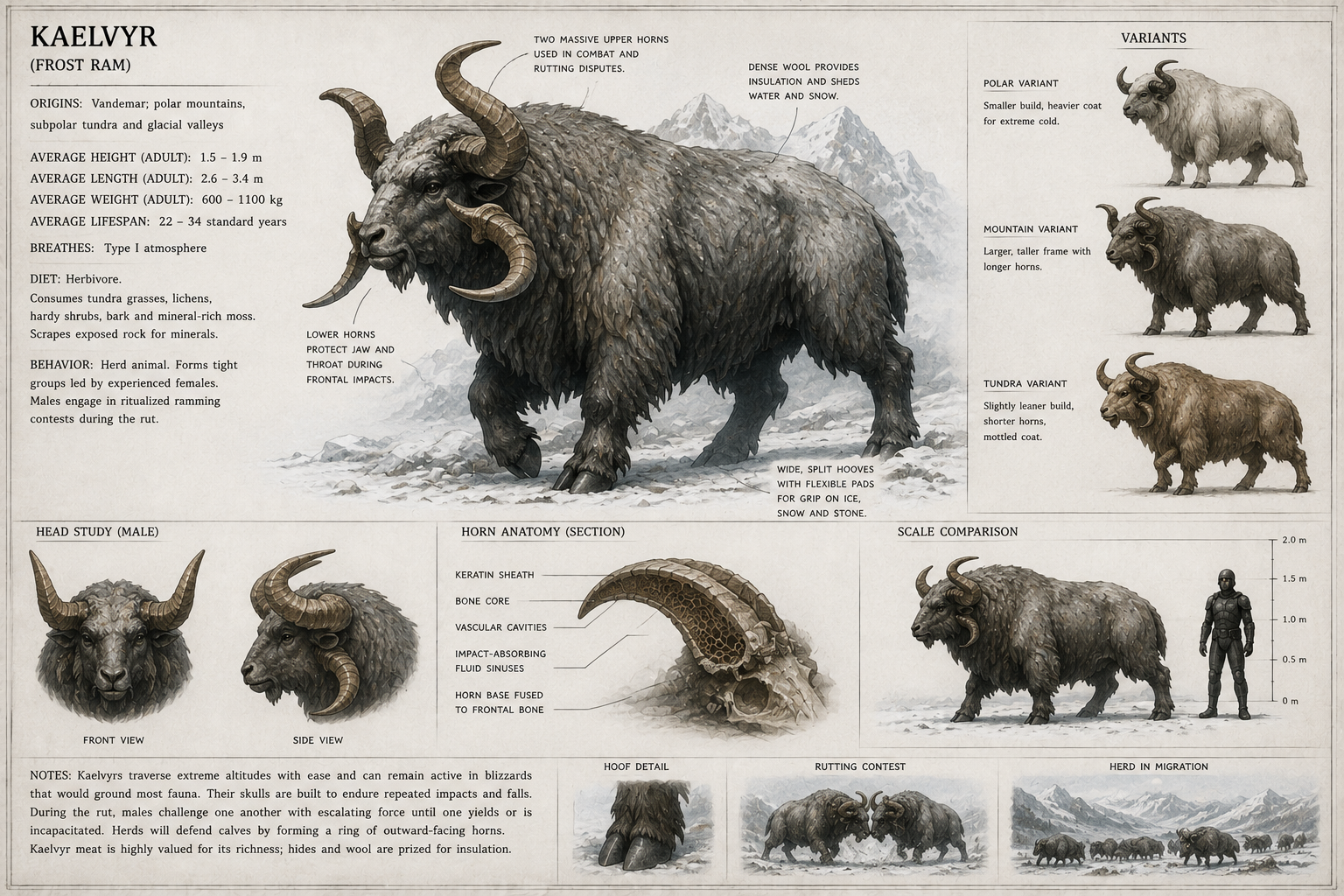
- Origins: Vandemar; polar mountains, subpolar tundra and glacial valleys
- Average Lifespan: 22–34 standard years
- Estimated Population: Planetary; concentrated across Vandemar's northern and southern highlands
- Description: The kaelvyr is a powerful mountain herbivore distinguished by four sweeping horns, metallic-grey wool and an almost suicidal refusal to yield ground. Herds move between frozen valleys and exposed ridges with little regard for weather or altitude. During the mating season, the impact of two adult males can be heard rolling across the mountains like distant artillery.
PHYSICAL INFORMATION
- Breathes: Type I atmosphere
- Average Height of Adults: 1.5–1.9 metres at the shoulder
- Average Length of Adults: 2.6–3.4 metres
- Skin color: Dark grey, black or blue-grey
- Hair color: Silver-grey, charcoal, white or muted brown
- Distinctions: Kaelvyrs possess dense torsos, short powerful legs and cloven hooves with flexible gripping pads. Two heavy upper horns curve forward and outward, while a smaller lower pair protects the jaw and throat. Their skulls contain layered fluid cavities that absorb repeated impacts, and their internal organs tolerate rapid changes in altitude and atmospheric pressure. Males carry larger horns and heavier frontal armour; females are slightly leaner and possess thicker winter coats. Older specimens develop chipped horn tips, pale facial scars and broad mineral bands around the horn bases.
- Races: None formally recognised. Polar kaelvyrs are smaller and heavily insulated, while mountain populations grow taller and possess longer horns.
- Force Sensitivity: Non-Sensitive
- Exceptional balance and traction on ice, snow and steep stone
- Reinforced skull capable of surviving extreme impacts
- High resistance to cold, altitude and physical exhaustion
- Aggressive response to movement within charging distance
- Vulnerable flanks and rear legs
- Dense coat causes rapid overheating in warmer climates
CULTURE
- Diet: Herbivore. Kaelvyrs consume tundra grasses, lichens, bark, hardy shrubs and mineral-rich moss. They frequently scrape exposed stone to supplement horn growth.
- Communication: Deep bleats, hoof strikes, horn scraping and scent marking. Herds also use low-frequency calls that carry through snow and mountain rock.
- Technology level: None
- Religion/Beliefs: None.
- General behavior: Kaelvyrs form herds of twelve to forty animals led by experienced females. They migrate vertically rather than across great distances, descending into valleys during severe storms and returning to high grazing grounds when conditions improve. Mature males form temporary bachelor groups outside the breeding season. Dominance disputes are settled through repeated frontal collisions, often on terrain where a single misstep means death. Calves remain near the centre of the herd and are defended by adults forming a ring of outward-facing horns.
HISTORICAL INFORMATION
The kaelvyr evolved among Vandemar's polar mountain systems, where unstable slopes, thin air and severe cold eliminated less specialised grazers. Its reinforced skull likely developed first as protection against falls and rock impact before becoming central to mating competition.
Early highland settlements hunted kaelvyrs for meat, hide and horn. Attempts at domestication produced strong but dangerously temperamental pack animals, and most breeding programmes were abandoned after repeated handler deaths.
Modern mountain communities manage kaelvyr herds rather than confine them. Roads are built away from seasonal rutting grounds, and travellers are warned never to stand downhill from an agitated male.
Among Vandemarian climbers, "the mountain has lowered its horns" means that retreat is no longer shameful. It is simply late.