

✠ Nihilus Indomitus ✠



- Intent: To fill the world of Vandemar with interesting and diverse life that is intriguing to roleplay with.
- Image Credit:
- Canon: N/A
- Permissions: N/A
- Links: Vandemar
GENERAL INFORMATION
- Name: Iskaryn
- Designation: Non-sentient
- Origins: Vandemar; polar ice fields, subpolar tundra and frozen coastlines
- Average Lifespan: 35–50 standard years
- Estimated Population: Rare; scattered across Vandemar's northern and southern polar regions
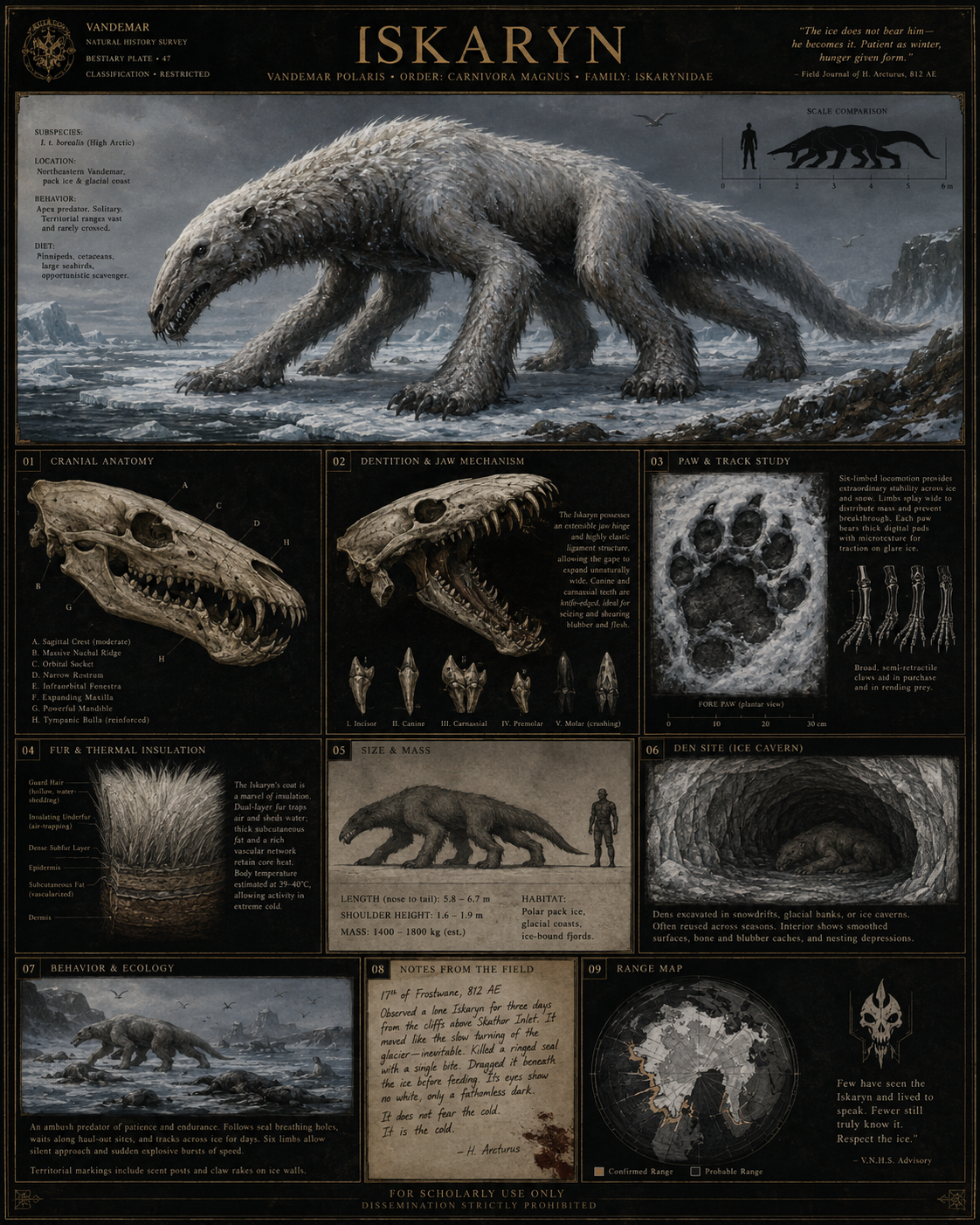
- Description: The iskaryn is a massive six-legged predator adapted to snow, thin ice and prolonged darkness. It does not waste strength on reckless pursuit, preferring to shadow prey for days until cold, injury or mechanical failure creates an opening. Across the polar wastes, a distant white shape is rarely as far away as it appears.
PHYSICAL INFORMATION
- Breathes: Type I atmosphere
- Average Height of Adults: 1.7–2.2 metres at the shoulder
- Average Length of Adults: 4.5–6 metres
- Skin color: Black, dark grey or blue-black beneath the coat
- Hair color:White, pale grey or yellowed ivory
- Distinctions: Iskaryns possess six broad limbs ending in heavily padded feet that distribute their weight across snow and unstable ice. Their hollow outer fur insulates the body and diffuses its thermal signature. The narrow skull expands at the jaw, revealing flexible cheek structures and backward-curving teeth suited to tearing large sections from prey. Males are heavier through the shoulders, while females possess longer bodies and larger fat reserves. Older specimens develop broken teeth, yellowed coats and extensive scarring around the muzzle.
- Races: None formally recognised. Coastal iskaryns are larger and darker beneath the coat, while inland populations possess longer limbs and denser fur.
- Force Sensitivity: Non-Sensitive
- Exceptional cold resistance and concealed thermal profile
- Great endurance and patient tracking behavior
- Powerful jaws and six-limbed stability on ice
- Rapidly overheats in temperate climates
- Vulnerable eyes and respiratory passages
- Poor agility on steep rock or dense forest terrain
CULTURE
- Diet: Carnivore. Iskaryns prey upon marine animals, tundra grazers, nesting creatures and stranded travellers. They consume fat and organs first, often leaving frozen muscle for later feeding.
- Communication: Low bellows, scent marking, snow scraping and subsonic calls transmitted through ice.
- Technology level: None.
- Religion/Beliefs: None.
- General behavior: Iskaryns are solitary hunters except during mating periods or when females raise cubs. They patrol enormous territories and remember migration routes, settlements and supply trails for decades. Rather than attack healthy groups, they follow from beyond visual range and wait for isolation, exhaustion or mechanical breakdown. Females raise one or two cubs in excavated snow dens and remain fiercely territorial until the young can hunt independently.
HISTORICAL INFORMATION
Iskaryn remains occur throughout Vandemar's polar fossil layers, suggesting that the species survived repeated periods of glacial expansion and retreat. Its six-limbed body and diffuse thermal profile developed as adaptations to unstable ice and prey capable of detecting approaching warmth.
Early polar expeditions often mistook iskaryn pursuit for coincidence. Predators followed convoys for days, remaining beyond weapon range until storms, equipment failure or separation exposed an individual target.
Modern outposts employ elevated sensors, thermal decoys and automated perimeter flares. Confirmed sightings are treated as security incidents, especially when the same animal appears repeatedly near established routes.
Polar soldiers are taught that an iskaryn rarely attacks the strongest member of a group. It waits until the group decides who can be left behind.