
H E G E M O N



"A Knight is not measured by the glory he claims, but by the oath he keeps when all else has failed. We are the Indomitus Legion - the sword carried beyond Vandemar's walls, the shield before its throne, and the judgement brought against every power that would stand above mankind."
✠ Out Of Character Information ✠
- Intent: To create the warrior and soldier order that works as an expeditionary and expansionary force of the Hegemony of Vandemar. Its secret purpose is to crusade against the Force orders of the Galaxy and restore a resemblance of order in the aftermath of fallen Empires and failed ambitions.
- Image Credit:
- Commissioned by me:
- Logo by 'araedes' (Discord)
- FloatingLeaf
- ArtAlais
- ChatGPT
- Commissioned by me:
- Canon: N/A
- Permissions: N/A
- Links: Vandemar, Knights of Zakuul, Imperial Knights, 1,001st Division, Krayt's Sith Troopers, Eternal Sith Troopers, Knights Templar, Teutonic Order, Shadowtrooper
✠ General Information ✠
- Organization Name: Indomitus Legion
- Classification:
- Knightly Order
- Military Order
- Military Branch
- Imperial Remnant
- Affiliation:
- Organization Symbol: See top
- Description:
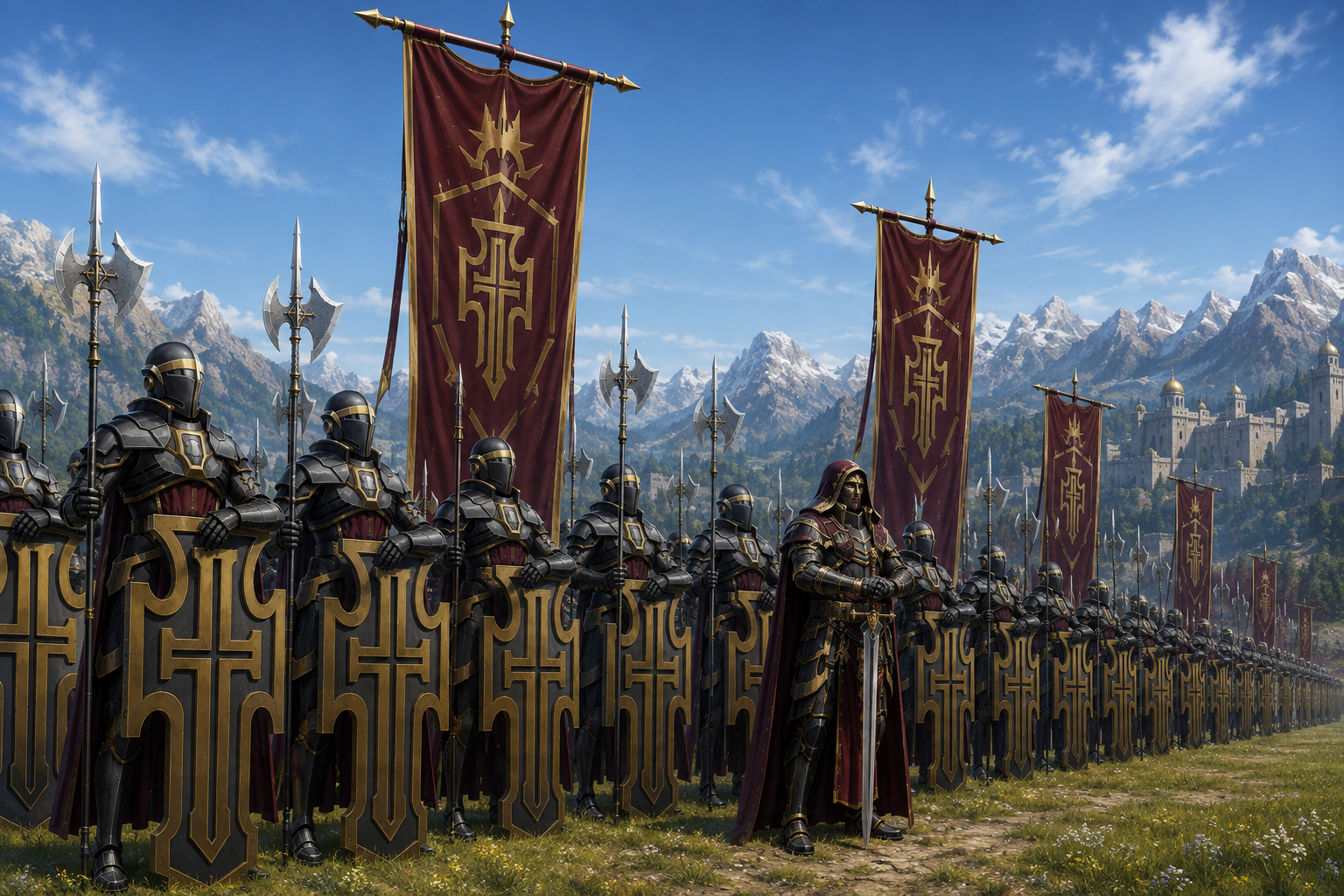
The Indomitus Legion is a knightly Imperial order dedicated to restoring unity, strength, and purpose to a fractured galaxy. Drawn from volunteers from any world; recruits, veterans and warriors alike, its members are forged through brutal trials, sacred oaths, and cybernetic enhancements into Indomitus Knights: crusaders bound by duty, discipline, and an unbreakable brotherhood. They are not merely soldiers, but inheritors of a martial tradition that places service above self and the future of the Empire above all else.
Within the Legion, warriors live, train, and fight as one. Shared hardship creates bonds stronger than blood, while ancient traditions, heraldry, and codes of honor transform individuals into members of a greater whole. Behind this unity stand hidden circles of commanders and keepers of secrets, guiding the Legion through shadowed wars and unseen struggles that few beyond their ranks can comprehend.
Across the galaxy, the Indomitus Legion wages an eternal crusade to expand Imperial influence, destroy corruption, hunt dangerous Force cults, and bring order to worlds abandoned by failing powers. To allies they are steadfast champions, to enemies relentless executioners, and to the Empire they are the sword without hesitation and the shield without doubt, an unyielding force marching beneath the Crescent Sword towards a stronger future.
✠ Geographical Information ✠
- Headquarters: Vandemar, Indomitus Citadel
- Domain:
- Notable Assets:
- Indomitus Citadel (Vandemar)
- Aethr Rhobar (Zakuul)
- Aethr Astelan (Iokath)
- Aethr Oreion (Nirauan)

- Hierarchy:
- Legion Command [All Members of the Inner Circle]
- Lord Indomitus - Founder of the Indomitus Legion.
- Lord Imperatant - Commander in Chief of the Indomitus Legion.
- High Command [All Members of the Inner Circle]
- Supreme Grandmaster - Seven Heads of the Heptazir.
- High Marshal - Theater Commander.
- Common Command [All Members of the Shadow Circle]
- Grandmaster - Host Commander.
- Paladin-Relictor - Training and philosophy overseer.
- Paladin-Ancient - Host Standard Bearer.
- Paladin-Champion - Best combatant in the Host.
- Lower Command
- Banner Master - Commander of a Banner (Cohort/Battalion)
- Banner Champion - Best combatant in the Banner.
- Banner Aquilor - Banner Standard Bearer.
- Company Master - Commander of a Company.
- Rank and File
- Paladin Lieutenant - Veteran Squad Commander.
- Paladin - Rank and file Veteran Knight.
- Knight-Lieutenant - Squad Commander.
- Knight - Rank and file Indomitus Knight.
- Squire - Indomitus Knight recruit.
- Unanointed - All Indomitus recruits before they receive their Anointment.
- Venerably Order of Armigers
- Head Armiger - General overseer of all armigers.
- Armiger - Armigers, squire and equerry to any Shadow Circle or Inner Circle member.
- Legion Command [All Members of the Inner Circle]
- Membership:
- Legion Recruitment
- Finding New Knights
- Volunteers - Volunteers are accepted into the program without physical checks and will enter the same basic training as those recruited otherwise.
- Seeker Trials - The Legion has members actively seeking out territories outside the realm, especially worlds with strong martial and warrior cultures, to find recruits through local trials and then induct them into the Legion's Unanointed training program.
- Remnant Militaries - From Imperial remnant militaries, proven and seasoned veterans are able to join the Legion equally, but will undergo the same procedures of training and induction as imperial draftees.
- Lex Valoris - The Lex Valoris is the swearing of the Oaths of Valor, Honor and Loyalty during their respective trials. After successfully passing them, the Knight will receive their Indomitus tattoo onto the left upper arm and be progressing to their Indomitus Anointment. Those that do not pass, are either returned to the Imperial military or if their zeal and willpower is outstanding, inducted into the Heralds of Zildrog.
- Indomitus Anointment - The anoinment is a surgical procedure where the Knight will receive their cybernetics and bio-enhancements from the Legion's Black Celestant Division. Afterwards they are being given their Knight Armor and becoming Squires to serve the Legion proper. Once risen as a Knight, they accept the title of Azir.
- Finding New Knights
- Support Recruitment - Recruitment for the support branches, especially the Engineering Corps and Intelligence Division is entirely on volunteer basis and merit-based. Only those that seek to serve alongside the Legion and have the necessary skills and experience to prove useful are being accepted into its ranks.
- Legion Recruitment
- Climate:
- Knightly Order - The Legion operates as a martial brotherhood bound by sacred oaths and unbreakable duty. Its warriors see themselves not as mere soldiers, but as inheritors of an Imperial knightly tradition - sworn to a higher purpose beyond personal ambition. Rituals, codes of honor, and a strict hierarchy define their existence, with each warrior expected to embody the virtues of duty, valor, and unrelenting resolve. Titles, heraldry, and ceremonial armor reinforce their identity as a chosen elite, standing apart from the common soldiery of the Empire. Disgrace is unthinkable; to fail in one's oath is to be unworthy of the Legion itself.
- Soldiers Comradery - Despite their knightly bearing, the Legion's greatest strength lies in the unshakable bonds between its warriors. They fight not as individuals, but as a single entity, forged in shared hardship and absolute trust. Training is brutal, but it is also communal - squads eat, sleep, and bleed together, their loyalty to one another second only to their devotion to the Empire. This comradery is not born of sentimentality, but necessity; in battle, hesitation means death, and only those who know their brothers and sisters without doubt can survive the Legion's wars. To betray this trust is the only unforgivable sin.
- Secret Warriors - Beneath the Legion's outward unity lies a web of secrets, known only to those deemed worthy. The rank-and-file Knights believe wholly in the Legion's Imperial mission, unaware of the deeper truths guarded by the Shadow Circle and Inner Circle. Those who ascend into these inner ranks find themselves bound by new oaths - sworn to hidden wars beyond the comprehension of ordinary soldiers. Suspicion is rare, but vigilance is constant; the Legion's unity is maintained through controlled knowledge, ensuring that none question what they are not meant to understand. Even among the most trusted, some truths remain unspoken.
- Reputation:
- Jedi, Republic, Lightsiders - To the Jedi, the Indomitus Legion is a grim reflection of what happens when duty eclipses compassion. They see not warriors, but fanatics—soldiers stripped of doubt, their minds honed into weapons as unyielding as their blades. The Legion's absolute loyalty to the Empire and its willingness to discard morality in the name of order unsettle those who believe in the Force's balance. Some Jedi whisper that the Legion is a greater threat than mere Sith, for its warriors do not crave power; they serve without question, making them far harder to sway or reason with.
- Sith, Dark side - The Sith respect the Legion's discipline and martial prowess but disdain its lack of ambition. To them, the Indomitus Knights are little more than well-trained hounds - loyal, deadly, but ultimately tools rather than masters. Some Sith see potential puppets, others dangerous rivals.
- Imperials - Among the Imperials, the Indomitus Legion is both admired and feared. Stormtroopers and officers respect their unmatched discipline, but few envy their brutal training or reclusive comradery. High Command values them as the ultimate enforcers - unshaken by doubt, unburdened by conscience. Yet even the most loyal officers keep a measured distance, aware that the Legion answers only to the Hegemony, its own code and the Hegemon's will. To serve alongside them is to witness war waged without hesitation, without remorse.
- Civilians, Criminals - To civilians, the Legion is a specter - an implacable force that can arrive as protectors as much as executioners. They bring order, but never mercy. Criminals and rebels speak of them in hushed tones; where stormtroopers may falter, the Indomitus do not. There are no negotiations, no second chances. Some worlds under their protection are eerily compliant; others whisper of disappearances, of those who questioned the Hegemony's rule and were quietly erased. The Legion does not rule through fear - it simply is fear, a fact as cold and certain as gravity.
- Curios:

- Tattoo - The insignia of the Legion, the rising sword, is tattooed on the left upper arm of every Unanointed who has their trials of the Lex Valoris.
- Project Black Celestant - The final cybernetical procedure every new member of the Indomitus Legion undergoes to become a fully anointed Indomitus Knight.
- Indomitus Knight Armor - Once Anointed, every Indomitus Squire receives their personal armor. It is revered as a central part of their equipment and identity, meant to last, even though not expected, it will eventually grow rich in personal details, decals, bear the unit markings and veterancy status as well as rank.
- Azir - The title Azir, Vandemarian for the Basic word "Sir" is the general title every Knight receives upon ascending from the rank of Squire.
- Rules:
- Lex Valoris:
We are Indomitus.
In darkness, we bring light.
In silence, we bring judgment.
In mastery, we bring victory.
Our loyalty is to the Empire, our will to the Warmaster.
We are the sword without hesitation, the shield without doubt.
Through war, we bring order.
Through strength, we bring unity.
We are the edge of His blade - unyielding, unbroken, eternal.- The Lex Valoris has been written by
 Aurelian of Vandemar
and
Aurelian of Vandemar
and
 Augustus Tassar
to follow the principles of past Empires and Orders, they are deeply engaved into every Indomitus Legion member's soul and mind, a code and verbatim to follow when in doubt. It does not evoke the same spiritual or metaphysical nuances such as Sith or Jedi Codes, but it is not meant to. It offers purpose, direction and unity to those who fight under the Crescent Blade.
Augustus Tassar
to follow the principles of past Empires and Orders, they are deeply engaved into every Indomitus Legion member's soul and mind, a code and verbatim to follow when in doubt. It does not evoke the same spiritual or metaphysical nuances such as Sith or Jedi Codes, but it is not meant to. It offers purpose, direction and unity to those who fight under the Crescent Blade.
- The Lex Valoris has been written by
- Lex Valoris:
- Goals:
- Hegemony of Civilisation
The Indomitus Legion prides itself to be of equal Imperial descent and heritage, founded by Imperial veterans from the Third Imperial Civil War, Second Great Hyperspace War, Core Wars, Wars against the Bryn'adûl and continuous battles against the forces of decadence and corruption across the Galaxy as well Vandemarian in culture. It is in their blood, the will of defiance and strife for order, the ideal of unity under the Hegemony.
It is their goal to bring back order, civilisation and stability at all costs. There is no alternative for the Galaxy to recover and prosper in the wake of the corroding influences that its waning realms have spread, other than their total annihilation. It is not through diplomacy, not through carefully planted agents and schemes nor through idleness that this is achieved. It requires total mobilisation and militarisation of all assets. The Indomitus Legion is that tool, the one that bears the standard of the Hegemony onto the battlefields of the Galaxy and shows its enemies that only submission is an option for survival. - Destruction of the Force [Inner Circle only]
Created by
Aurelian of Vandemar
from the ideals and goals of the Wardens of the Shroud, the Indomitus Legion does not merely strife for the rise and supremacy of Imperial values of Vandemar and the New Order with its successor ideologies, but its very heart strives to undo one of the greatest destroyers and warmongers of the universe.
Known only to what is known as the Inner Circle, the closest group of highest ranking officers of the Indomitus Legion, their aim is to annihilate the Force or at least the Will of the Force that allegedly brings balance, pushing the Galaxy into perpetual war. It is their intimate objective to achieve one or the other and due to its devastating and far-ranging effects, is kept a closely guarded secret that no outsider can or will ever learn. - Conditioning [Shadow Circle only]
All those who go through the Indomitus Anointment are secretly implanted with a derivative of the inhibitor chip, yet not to an extent that it becomes noticeable. It mildly alters the persons compliance to orders and makes the discipline and loyalty already indoctrinated in training more natural. To not raise suspicion or offer reason for doubt, this process is kept secret and subtle. - Crusade Against the Dormant
The Indomitus Legion and its attachments are unrelenting in their opposition to the Jedi and Sith and all orders, organisations and individuals that worship the Force in one way or another, either of its aspects and cling to ancient religions such as the Jedi or Sith. It is their sworn duty, their solemn vow to hunt and destroy these mindless minions and fight them with a ferocity that is as zealous as it is righteous.
- Hegemony of Civilisation

- Knight Specialisations
- The Heptazir - The Seven Orders
- Tharanatoi Order ~ The Tharanatoi are the Legion's foremost veterans, the spear-tip that breaks resistance and the shield-wall upon which the enemy's strongest blows are wasted. They are deployed where failure is unacceptable, serving as both first assault and final defence.
- Immortals ~ The distinct elite First Company of a Host.
- Praetorians ~ Guardians of commanders and strategic sites.
- Moritoi Order ~ The Moritoi are the bearers of death, entrusted with weapons and methods meant not merely to defeat an enemy, but to annihilate its capacity to endure. They are the final verdict of the Legion, unleashed when conquest, mercy, and containment are no longer sufficient.
- Obliterators ~ Masters of weapons and methods intended to erase entire enemy formations, fortifications, or species.
- Cenotaphs ~ Named for the monuments of the dead. Specialists in extermination campaigns and final pacification.
- Hykanatoi Order~ The Hykanatoi are the backbone of the Legion and the standard by which every Azir is first measured. Every Squire enters their discipline, every Knight is anointed through their ranks, and most of the Legion's enduring strength rests upon their shoulders.
- Knight Sentinels ~ Guardians and defensive experts tasked with holding the line.
- Knight Vigilators ~ Questing knights and those sworn to uphold law and order in conquered territory.
- Kataphraktoi Order ~ The Kataphraktoi are the Legion's lance: swift, armored, and decisive, striking with overwhelming precision before the enemy can gather itself. Whether upon the ground, through the skies, or across the void, they embody speed joined to crushing force.
- Knight Lancers ~ Speeder bike and mounted combat specialists.
- Storm Wardens ~ Experts in void warfare and orbital deployment.
- Dankanatoi Order ~ The Dankanatoi are executioners, champions, and duelists, trained to seek out the enemy's finest warriors and break them in single combat. By cutting down commanders, champions, and symbols of resistance, they turn courage into panic and command into silence.
- Swordmasters ~ The archetypal duelists and heroes of the Order.
- Kingslayers ~ Executioners entrusted with hunting enemy commanders.
- Ephoroi Order~ The Ephoroi are the eyes and hidden hands of the Legion, sent ahead of its banners to observe, infiltrate, deceive, and prepare. Where possible, they win wars before the first open blow is struck; where not, they ensure the Legion strikes exactly where it must.
- Nemesis Questors ~ Reconnaissance and intelligence specialists, black ops and counterintelligence operatives.
- Hetaeron Order~ The Hetaeron are the Legion's Force-sensitive Azir, bound to the same discipline as every Knight but trained to confront threats no ordinary warrior can safely face. They hunt enemy adepts, contain or destroy corrupted relics, and turn the Force into a tool of the Legion rather than a master over it.
- Aetherwardens ~ Protectors of Vandemar and its Veil Rifts, masters of combating threats from the Nether bound by a vow of silence.
- Nullifiers ~ Specialists in combating Force users and disrupting their influence.
- Shadow Guard ~ Custodians and destroyers of dangerous Force artifacts.
- Tharanatoi Order ~ The Tharanatoi are the Legion's foremost veterans, the spear-tip that breaks resistance and the shield-wall upon which the enemy's strongest blows are wasted. They are deployed where failure is unacceptable, serving as both first assault and final defence.
- The Heptazir - The Seven Orders
- Known Members
-
Aurelian of Vandemar
, Lord Indomitus - Founder of the Legion and Hegemon of Vandemar
-
Augustus Tassar
, Lord Imperatant, Commander in Chief of the Legion, Hykanatoi Order
-
 Achilleon Utraen
, Paladin-Lieutenant, Tharanatoi Order
Achilleon Utraen
, Paladin-Lieutenant, Tharanatoi Order - Belisarius Vactovion, Grandmaster of the Seventh Host, Haeteron Order
- Efried Halbrecht, Grandmaster of the Second Host, Hykanatoi Order
-
✠ Historical Information ✠
The History of the Indomitus LegionCompiled from the sealed rolls of the Legion, the annals of the Banners and those records released by authority of the Lord Indomitus. Matters pertaining to the Inner Circle remain subject to the highest seals of command.
Chapter I ~ Before the Legion
The Indomitus Legion was not the first military institution of Vandemar. The Hegemony already possessed armies, fleets, noble retinues, Dragonblooded and Knightly Orders, each rooted in ancient charters and obligations. These forces defended Vandemar against rebellion, invasion and the dangers of the Unknown Regions. Yet their strength was also their limitation. They belonged to particular territories, houses, traditions or duties, and their loyalties could never be separated entirely from the structures that had created them.
Aurelian understood that the same institutions which protected the realm could also constrain its ruler. The great houses possessed warriors of their own, the Knightly Orders guarded inherited privileges and the Dragonblooded remained a strategic power whose obedience could not be assumed. Vandemar required a force that owed nothing to province, bloodline or private charter. It required a sword belonging first to the reign of Aurelian and, through him, to the Hegemony itself.
Chapter II ~ The Lord's Own Sword
Aurelian formed the Indomitus Legion as an instrument through which his reign could be protected against both foreign danger and internal division. It answered to central authority, stood apart from the private power of the nobility and could act where the older institutions hesitated, disagreed or invoked ancient exemption. Through the Legion, the Hegemon possessed a force whose obedience did not depend upon inherited privilege or negotiated allegiance.
The Legion was never intended to remain a palace army or personal guard. Aurelian shaped it into a permanent expeditionary instrument through which the Hegemony could pursue its interests beyond Vandemar. It would combine armies, fleets, engineers, intelligence assets and Knightly formations within a single martial brotherhood, capable of conducting distant campaigns without reliance upon the established Orders of the realm.
Beneath these declared purposes lay another ambition, concealed among the highest authorities of the Legion. The Legion was to become more than a force capable of defeating Jedi, Sith and other servants of the Force. It was to be refined into a weapon against the Force itself. Aurelian considered the Force neither sacred nor worthy of reverence. It corrupted rulers, placed mystics above law and repeatedly subjected civilisation to the visions and ambitions of the few. The Legion would learn to resist it, master every method by which it might be opposed and seek the means by which its hold upon the galaxy could be broken.
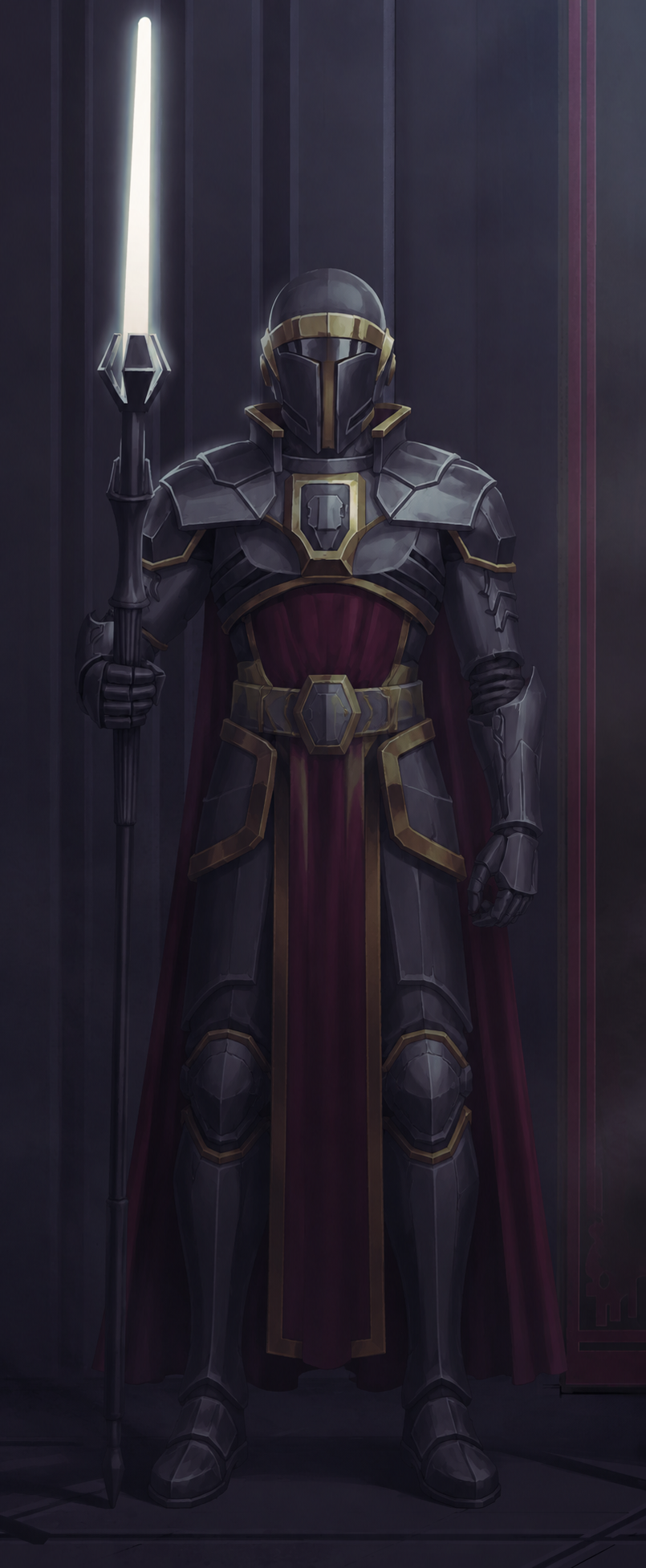
The Legion could not be built as an ordinary army. Its warriors were expected to serve beyond their homes, endure long campaigns and obey the Legion where family, house, province or former allegiance demanded otherwise. They therefore had to be remade into something more enduring than soldiers gathered beneath a temporary standard.
Candidates entered as the Unanointed. Former rank and social privilege offered little protection within the Legion's trials. Noble heirs, common soldiers and foreign volunteers were judged by the same measures of discipline, endurance, judgement and loyalty. Those who passed were marked with the rising sword, subjected to the Indomitus Anointment and prepared through biological and cybernetic alteration to bear the armour and burdens of the Legion. They entered active service as Squires and attained the full dignity of an Indomitus Knight only through proof beneath the Banner.
The Lex Valoris bound these warriors together. Order, Unity, Strength, Expansion and Purpose became the pillars of Legionary identity. A Knight might remember the house or world from which they came, but could no longer place it above the Legion. The Banner became their military household, the Legion their enduring brotherhood and Aurelian's purpose the measure against which all lesser loyalties were judged.
Chapter IV ~ The Banners and the Hexaton
The Banner became the Legion's permanent tactical and social foundation. Approximately equal to a cohort or battalion, each Banner possessed its own Companies and Lances, its own heraldry, campaign honours and lineage of service. Knights might change specialisation, but their Banner remained their closest military home. Through it, the Legion created traditions strong enough to replace those of hereditary retinues without reproducing the rivalries of the noble houses.
The Legion's six principal martial Orders were collectively known as the Hexaton. The Hykanatoi formed the enduring body of the Legion and received those newly raised into active service. The Tharanatoi served as its veteran spearhead, breaking the strongest resistance and holding where no retreat could be permitted. The Moritoi carried the weapons of final judgement, employed when an enemy was not merely to be defeated but annihilated. The Kataphraktoi mastered rapid warfare, armoured movement and decisive penetration. The Dankanatoi became champions, executioners and hunters of exceptional foes. The Ephoroi ranged ahead of the Banners as scouts, infiltrators, agents and keepers of the knowledge by which campaigns were prepared.
The Orders were not separate armies. A Banner drew upon several of them so that it might possess the full range of abilities required for independent war. A Knight could pass from one Order to another as experience, aptitude or necessity demanded. The Order taught a Knight how to wage a particular kind of war; the Banner ensured that no specialisation became a loyalty greater than the Legion itself.
Chapter V ~ The Wars Beyond Vandemar
The Legion carried its banners beyond Vandemar through the concealed systems, uncertain routes and isolated strongholds of the Unknown Regions. There it encountered forgotten machines, hostile enclaves, warlords, cults and powers that had developed beyond the knowledge of Vandemarian scholars.
Among these enemies were Jedi and Sith. The Legion had always distrusted the Force, but direct warfare transformed philosophical hostility into military certainty. Force-sensitive combatants broke formations without touching them, clouded thought, anticipated attacks and wielded powers for which conventional doctrine possessed no reliable answer. Individual Knights could defeat them through preparation, discipline and concentrated force, but the price was often severe.
To the Legion, the differences between Jedi and Sith did not alter the central danger. Both treated the Force as a source of authority unavailable to ordinary beings. Both elevated those who could perceive it above those who could not. Whether power was justified through serenity or passion mattered less than the fact that it remained power beyond common scrutiny. The Legion judged both traditions to be expressions of the same fundamental corruption.
Chapter VI ~ The Inner Circle
From this judgement emerged the hidden authority known as the Inner Circle. Its existence was concealed from the greater body of the Legion and reserved for its highest ranks. It stood outside the visible Orders, operating through sealed mandates, selected officers and agents whose true responsibilities seldom appeared within ordinary campaign rolls.
The Circle studied the Force so that it might be opposed. It examined captured teachings, artefacts, corrupted places and the remains of those altered by prolonged exposure. It developed countermeasures, methods of containment and procedures for identifying those who placed supernatural conviction above Legionary discipline. It observed the command structure itself, for no rank or history of service could render a Knight immune to corruption.
The Circle also guarded the Legion's ultimate purpose. Aurelian did not intend merely to prevent Jedi or Sith supremacy. He intended the Legion to gather the knowledge, weapons and discipline required to strike against the Force as a phenomenon. Whether it could be wounded, silenced, severed from the galaxy or destroyed remained unanswered. The Inner Circle existed to ensure that the question was never abandoned.

Experience demonstrated that knowledge and conventional countermeasures were not always sufficient. Against the strongest Jedi and Sith, the Legion required warriors capable of perceiving the same battlefield that its enemies inhabited. Refusing to employ Force-sensitive Knights would not diminish the Force; it would merely concede an advantage to those already willing to use it.
The first Hetaeron were gathered from Force-sensitive Legionaries and carefully selected recruits. Their formation was accepted as military necessity rather than celebrated as revelation. They remained Indomitus Knights first and were subjected to greater scrutiny than any other Order. Their power granted neither priesthood nor exemption. It imposed additional obligations and placed them beneath standards established by the Legion's High Command under the direct supervision of Aurelian and the Inner Circle.
Their doctrine became known as Limitless Power. No Jedi or Sith teaching was considered sacred, and no technique was rejected solely because its origin was hostile. Knowledge was to be captured, dissected and shared so that no individual Hetaeron could hoard secrets or make themselves indispensable. The Force was a tool—dangerous, corruptive and unworthy of obedience, but still a tool whose use could not be surrendered to the enemy.
With the Hetaeron recognised as the seventh Order, the Hexaton became the Heptazir. The Legion acknowledged that its war had expanded beyond armies, fleets and fortifications. The Hetaeron became the weapon by which Force-users could be directly contested. The Inner Circle remained the hand prepared to break that weapon should it ever turn against its makers.
Chapter VIII ~ The Planeshift
The Planeshift opened a direct hyperlane between Vandemar and Nirauan. The Hegemony had not moved, yet its strategic position was transformed. Routes that had demanded uncertain passage through the Unknown Regions now connected Vandemar to the powers, conflicts and remnants of the wider galaxy.
The Legion had been created for precisely such an opening. Its Banners were permanent, self-contained and accustomed to foreign theatres. Its recruitment was not restricted to Vandemarian blood, its Orders could be combined according to the needs of a campaign and its command structure remained independent of the older military institutions of the Hegemony. The Planeshift did not alter the Legion's purpose. It removed the boundaries that had limited its fulfilment.
Its operations beyond the new passage were Imperial in nature. Aurelian entered the conflicts of the wider galaxy in the service of the Galactic Empire, and the Legion marched with him. Vandemar had opened a road to Nirauan, but through Aurelian that road continued towards the centre of galactic power.
Chapter IX ~ The Empire of Solipsis
The Galactic Empire served by Aurelian stood under Darth Solipsis. Its banners and institutions claimed Imperial legitimacy, but its centre was shaped increasingly by Sith authority. Aurelian served among the regime's Dark Side Elite, though the title granted him no clearly defined military or political rank. His position remained deliberately ambiguous: recognised by the Empire, associated with its highest instruments of power, yet never wholly absorbed into its ordinary hierarchy.
The Indomitus Legion followed Aurelian rather than Solipsis. It fought beside Imperial armies and served Imperial campaigns, but remained Vandemarian in command, doctrine and internal law. Its Banners were not dissolved into the Empire's military establishment, nor were its Knights required to accept Sith doctrine. This allowed Aurelian to wield Imperial resources and participate in the imposition of galactic order while retaining a force capable of independent action should the Empire cease to serve that purpose.
The arrangement contained an unavoidable contradiction. The Legion had been created to oppose the Force, while the Empire was ruled through it. The Empire gained an expeditionary force of uncommon cohesion and strength. Aurelian gained access to the wars, knowledge and strategic opportunities of the wider galaxy. Neither side could wholly trust the other.
Chapter X ~ The Battle of the Temple Steps
The Legion's defining engagement during the invasion of Coruscant was the Battle of the Temple Steps. The defenders of the Jedi Temple stood under Jedi Master Caltin Vanagor, supported by Galactic Alliance troops and by Thurion Heavenshield, High King of Midvinter, together with Midvinter's elite formations.
The Temple was not merely a fortified position. It was one of the great seats of Force authority in galactic history and a symbol of the Jedi Order's claim to stand above governments while repeatedly determining their fate. For the Indomitus Legion, the assault therefore possessed a significance beyond the wider invasion. The Steps represented a direct confrontation between Legionary order and an institution whose power rested upon mystical privilege.
The Orders of the Heptazir advanced together. Hykanatoi formations sustained the assault, Tharanatoi broke the strongest resistance and the other Orders brought their distinct methods against the Alliance and Midvinter defenders. The Hetaeron contested the powers of the Jedi while remaining bound beneath Legionary command. Every lesson gathered in the Unknown Regions was brought against the defenders of Coruscant.
Aurelian met Caltin Vanagor in personal combat. Their contest became the central struggle within the greater battle: the founder of the Legion against a master of the Jedi Order, each representing an irreconcilable understanding of power and authority. Aurelian bested Vanagor, proving before his Knights that even a Jedi Master could be overcome without submission to the faith of the Force.
The Temple Steps entered the Legion's annals as both victory and vindication. The Force could be opposed. Its servants could be defeated upon ground they considered sacred. The Legion had required neither worship nor revelation—only preparation, unity and the willingness to bear the cost of the assault.
Chapter XI ~ The Breaking of the Imperial Bond
Victory on Coruscant did not reconcile the Legion with the Empire it served. Sith terror intensified, while the regime's judgement became obscured by its dependence upon the Dark Side. What had presented itself as an Imperial order employing Sith power revealed itself as an instrument increasingly shaped by Sith ambition.
To Aurelian, this confirmed the danger upon which the Legion had been founded. The Force did not remain a servant of government. It reshaped government around those who claimed to command it. The Empire of Solipsis ceased to represent an order that might be corrected and became another example of rule subordinated to supernatural appetite.
Aurelian removed the Indomitus Legion from the Empire's campaigns and directed it towards Nirauan. The separation was neither declared rebellion nor formal absolution of every Imperial claim. It was an act of deliberate withdrawal. The Legion would no longer spend its strength sustaining a regime whose Sith rulers had become indistinguishable from the threat it had been formed to oppose.
At the Battle of Atrisia, the Galactic Empire lost the momentum of its conquests together with the third Death Star. The Indomitus Legion did not march to its defence. Whatever ambiguity had surrounded its allegiance no longer carried practical meaning. Its ties to the Empire of Solipsis were severed.
Chapter XII ~ Nirauan and the Hand of Thrawn
At Nirauan, Aurelian turned the Legion towards the restoration of the Hand of Thrawn. The fortress and its surrounding military infrastructure offered a position from which Imperial knowledge, industry and strategic reach could be preserved without submission to Solipsis. It also stood at the mouth of the route to Vandemar, serving as both forward bastion and shield before the concealed Hegemony.
The work demanded more than garrison duty. The Legion restored defences, reorganised surviving assets and established the foundations of an independent military centre. Its engineers, fleets and Banners laboured to make Nirauan capable of supporting operations without reliance upon the fractured Empire from which they had withdrawn.
Nirauan was not permitted to replace Vandemar as the Legion's heart. Banners and personnel passed back through the Planeshift to restore their numbers, reinforce their institutions and consolidate the knowledge gathered in galactic war. The Hand remained the forward position: an Imperial fortress reclaimed beneath Vandemarian authority and a guarded threshold between the Hegemony and the wider galaxy.
The Indomitus Legion therefore stands between two inheritances. At Vandemar lie its foundations, its authority and the purpose for which Aurelian forged it. At Nirauan stands the instrument through which that purpose may again be projected beyond the Unknown Regions. The Banners have withdrawn from the Empire of Solipsis, but they have not abandoned the greater struggle. They remain the sword of the Hegemony, sharpened against Jedi and Sith alike, and held in readiness for the purpose still concealed within the highest circles of command.

Last edited: