
Imperial Sovereign Command




GREAT REVIEW AT CARIDA
Order • Authority • Continuity
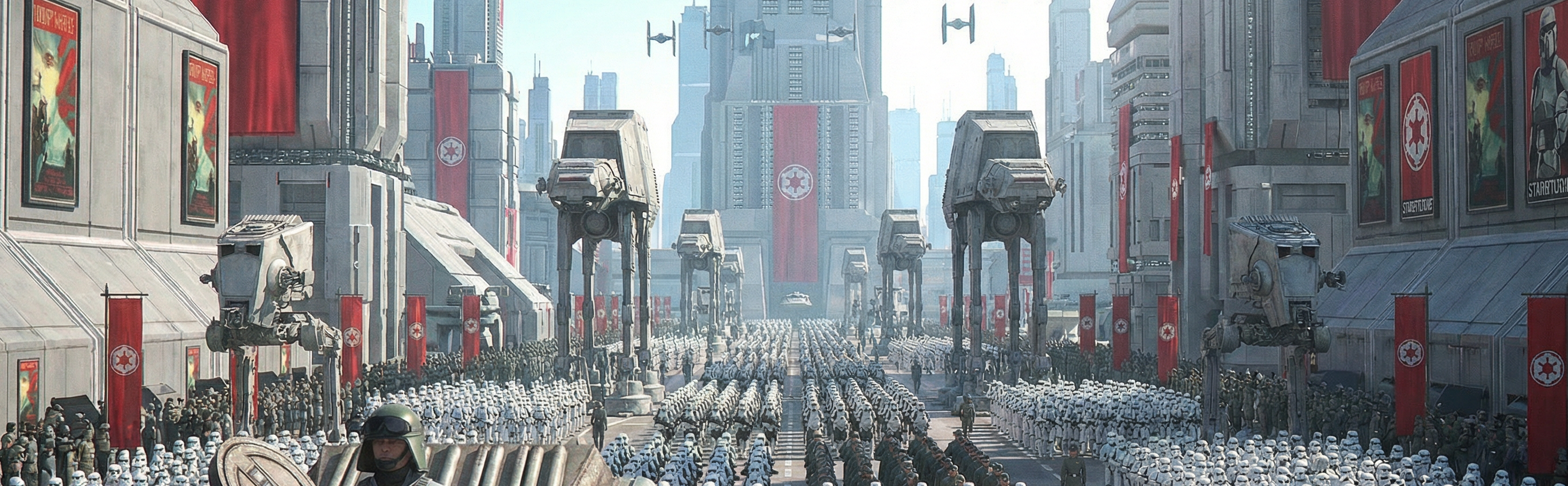
Carida did not celebrate softly.
Across the immense parade grounds of the Imperial Academy, order had been arranged with a precision so absolute that it seemed less prepared than engineered into the world itself. Banners hung from the high review galleries in black, crimson, white, and gunmetal grey. Academy standards stood in regimented rows beside campaign colors, officer pennants, and the preserved sigils of formations long absorbed, reformed, or remembered only in the language of ceremony. Every surface had been polished. Every line had been measured. Every cadet knew where to stand, where to look, when to breathe, and when not to.
The Academy had opened its grounds for the Great Review.
It was, officially, a celebration of Carida's martial legacy. A public review of its cadets, instructors, veterans, officers, and honored guests. A display of doctrine, discipline, endurance, and continuity. The sort of occasion in which the Empire reminded itself that its strength did not begin with a single ruler, a single war, or a single fleet, but with institutions capable of shaping ordinary recruits into instruments of command.
Unofficially, it was what all such Imperial gatherings inevitably became.
A place to be seen.
A place to measure others.
A place to speak in guarded courtesies, to exchange polished remarks beneath marching banners, to remember old campaigns, to inspect the next generation, and to decide which officers, units, and officials were worth further attention. The Academy provided the pageantry. The Empire provided the hierarchy.
Above the main parade avenue, the first formation of cadets already stood at attention in ranks so straight that the lines seemed carved into the stone of the square. Their armor and dress uniforms reflected the morning light in restrained flashes. Instructors moved between them with quiet severity, correcting a collar here, a shoulder angle there, a rifle held one degree too low. No correction was spoken loudly. It did not need to be. At Carida, embarrassment could be delivered in silence.
Beyond the parade field, the proving grounds were alive with preparation. Armored walkers stood in formation at the edge of the demonstration zone. Assault teams checked breaching charges under the supervision of academy engineers. Marksmanship cadres waited beside range officers and target drones. Further still, heavy weapons crews prepared for controlled live-fire exercises that would later thunder across the valley in timed sequence, each barrage designed not for destruction, but for instruction.
The day would proceed according to academy order.
First, arrival and formal reception.
Then the Grand Parade and inspection.
Then doctrinal demonstrations, veteran panels, live-fire displays, and academy presentations.
At dusk, the military tattoo would begin.
The final hours would belong to drums, torchlight, honor guards, the Roll of Service, and the lowering of the academy standard before the assembled Imperials.
For now, the event remained in its opening movement.
Shuttles descended in ordered intervals toward the reception concourse, each arrival logged, announced, and directed with exacting ceremony. Officers of the Academy stood ready to receive guests according to rank and station. Senior commanders were escorted toward the review galleries. Veterans were directed through the Hall of Service, where old campaign standards had been displayed beside the names of distinguished graduates and fallen instructors. Cadets selected for public duties stood at rigid attention along the processional route, their eyes fixed forward even as famous soldiers, officials, and commanders passed within arm's reach.
Some visitors came with retinues.
Some came alone.
Some wore medals earned in campaigns that had already become doctrine lectures. Others wore uniforms too new to have known battle but too ambitious to hide it. Intelligence personnel blended into the formal machinery of the event with practiced ease, indistinguishable from attachés, adjutants, aides, or quiet observers assigned to ensure that an Imperial celebration remained Imperial in every respect.
The Academy gave all of them the same thing.
A place in the order of arrival.
Nothing more. Nothing less.
At the far end of the parade ground, the central dais had been raised before the academy standard. Its design was severe and monumental: black stone, polished steel, narrow crimson banners, and the sigil of Carida set above the command lectern. Behind it, the review stand rose in tiered terraces for officers, dignitaries, academy command, and honored guests. From there, the entire field could be seen: cadet battalions arrayed in formation, armor waiting in reserve, ceremonial guards posted at fixed intervals, and the long avenue down which the Grand Parade would later march.
A deep tone sounded across the grounds.
Not loud. Not theatrical.
Final.
The arrival window was beginning to close.
Across the parade field, cadets adjusted into full ceremonial posture. Conversations in the reception galleries lowered. Academy adjutants stepped into position near the central walkway. Honor guards brought their rifles to the ready with a single synchronized movement that struck the stone like one weapon in one hand.
The Great Review had not yet begun in full.
That would come with speeches, marching ranks, engines, weapons fire, doctrine, music, and the disciplined spectacle of an institution presenting itself to the Empire.
But the Opening Phase had begun.
Now came the arrivals, the formal greetings, the inspections, the first quiet assessments between commanders and officials, the old comrades finding one another beneath campaign banners, the veterans measuring the cadets with hard eyes, and the recruits trying not to stare at the living weight of Imperial history walking past them.
Carida stood ready.
The Empire had been invited to look upon itself.
And one by one, beneath the academy standard, the Imperials arrived.
 Cadence Vex
|
Cadence Vex
|
 Ronhar Tane
|
Ronhar Tane
|
 Evander Thule
|
Evander Thule
|
 Marlon Sularen
|
Marlon Sularen
|
 Amarra Nova
|
Amarra Nova
|
 R'ayne Asara
OPEN TO ALL IMPERIAL CHARACTERS!
Issued under Imperial authority