





Star Wars Roleplay: Chaos

Register a free account today to become a member! Once signed in, you'll be able to participate on this site by adding your own topics and posts, as well as connect with other members through your own private inbox!

Dt

Kai'el Brat "Guardian of the Light"


dantooine_by_paladad_of_light_dlqbl1q-pre.jpg


The Restored Temple of Dantooine


OUT OF CHARACTER INFORMATION


[/FLOAT]SETTING INFORMATION
  • Structure Name: The Restored Temple of Dantooine
  • Classification: Jedi Temple, Sanctuary, Archive, Healing and Training Site
  • Location: Dantooine
  • Affiliation: Jedi
  • Accessibility: The temple stands within the broader Dantooine enclave region, removed from major settlements and reached by old paths crossing the plains, weathered stone, and water-cut ground. It is not wholly hidden, though it is easy to miss without guidance. The outer grounds may be approached by pilgrims, scholars, trusted visitors, and wandering Jedi; inner sanctums, archives, and sensitive chambers remain restricted.
  • Description: Once left to silence and slow decay, the Dantooine temple and its surrounding enclave grounds have been carefully refurbished into a living sanctuary once more. Its old stone bones remain visible beneath the restoration: weathered arches preserved rather than replaced, cracked courtyards reset by hand, and worn halls renewed without stripping away the memory held within them. The restored site now serves as a place of healing, reflection, scholarship, and disciplined instruction. At the heart of the courtyard stands a statue of Revan the Redeemed, in honor of return, mercy, and the difficult choice to come back to the Light.


  • Overview

    The restoration of the Dantooine temple was undertaken with a restrained hand. Rather than erase age, it preserves it; rather than polish away history, it lets the old ruin breathe beneath renewed purpose. The result is not a pristine monument, but a living sanctuary where healing, learning, contemplation, and memory all continue beneath the same roof.

    The site serves several functions at once: a refuge for the wounded, a training ground for the disciplined, a quiet archive for the learned, and a place of pilgrimage for those drawn to Dantooine. Its restored wings and surrounding grounds reflect a single guiding lesson threaded through the whole enclave: mercy is the higher victory.

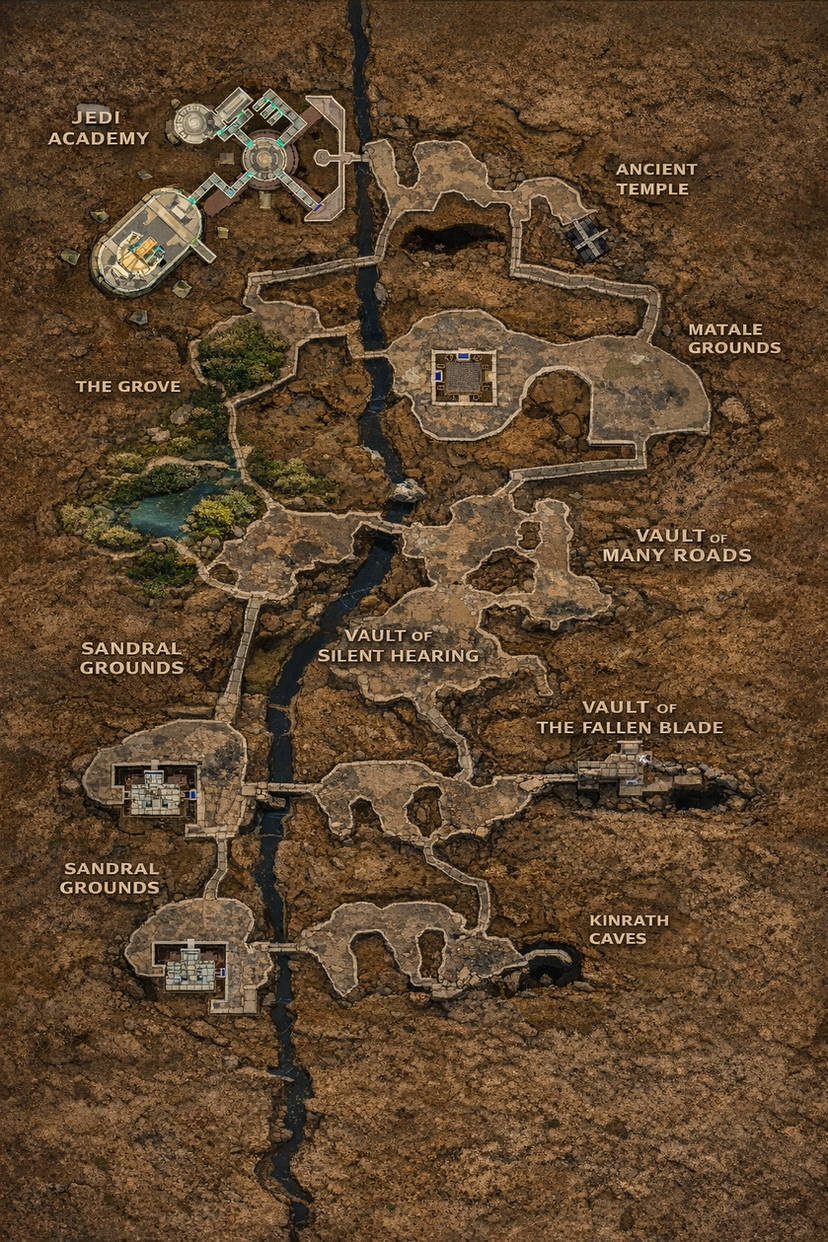
    Site Map References

    dantooine_by_paladad_of_light_dlqblcj-414w-2x.jpg


    Key Themes
    • Healing
    • Restoration
    • Study joined with lived practice
    • Memory
    • Redemption as a central lesson

  • Temple Grounds and Restored Facilities

    Courtyard

    The central courtyard has been cleared, repaired, and reshaped into an open sanctuary beneath Dantooine’s wide sky. Broken flagstones were lifted and reset, overgrowth trimmed back, and shallow channels cut to guide rainwater away from the old foundations.
    dlqblhn-992e4ceb-8c9d-4354-9e96-ac2413a337a8.png

    Revan the Redeemed

    Jedi Knight, war leader, fallen lord, returned champion.

    He passed through ambition, ruin, and remembrance, then chose the Light with full knowledge of what darkness could make of him. Let this monument teach that redemption is not mercy freely given, but a burden carried through every choice thereafter.

    At its heart stands a carved statue of Revan the Redeemed, captured in disciplined stillness. The blade remains ignited, held in both hands as power is brought under control. Wind-drawn robes and a rooted stance hold the figure in a moment that does not pass, balanced between past and present. It serves as a place of contemplation for students and visitors alike… a reminder that redemption is lived through continual choice, restraint, and return to the Light.

    The statue presents Revan as a figure of mastery over self. The ignited blade signifies power retained and governed with precision. Both hands steady the hilt, reinforcing focus, control, and intention. The stance remains grounded and unwavering, expressing readiness held in check. The motion within the robes carries the weight of a turbulent past brought into alignment. The lowered gaze turns inward, marking awareness, judgment, and balance maintained through will.


    The piece centers on redemption as discipline… power held, choice sustained, the Light upheld through constant control.

    Healing Wing and Medical Bay
    A restored healing wing occupies one of the temple’s interior stretches. Modest in scale yet carefully maintained, it serves as the primary space for treatment, stabilization, and recovery. Supplies, diagnostic tools, and recovery cots line the chamber in order, while the atmosphere remains gentle rather than clinical. The room was shaped to support both practical medicine and Force-assisted healing.

    Recovery Tank
    Set within the healing wing is a specialized recovery tank used to suspend and stabilize the injured. Patients may rest weightless within a restorative medium while healers monitor recovery and work in concert with medicine and the Force. Its construction favors serenity over severity; soft light rests over the chamber, and its surrounding equipment has been integrated into the room with a measured hand so that it feels like part of the temple rather than a military ward.

    Archive Rotunda
    A circular records hall has been restored deeper within the structure, its shelves and alcoves now holding recovered tablets, preserved teachings, star charts, historical accounts, and instructional texts. The Archive Rotunda functions as both repository and research hall, allowing scholars and students to study the legacy of the temple, the wider Jedi tradition, and the old knowledge tied to the enclave. Some materials remain openly accessible; rarer works are held in secured niches for guided study.

    Lightsaber Chamber
    This artisan chamber is devoted to saber construction, repair, and meditative craft. Worktables, fine tools, and carefully kept components occupy the room without crowding it, while alcoves along the walls allow for private focus during assembly. It is a chamber that teaches patience as much as skill; here, the saber is treated not merely as a weapon, but as a reflection of discipline, identity, and purpose.

    Hall of Trials
    Rather than serving only as a combat room, the Hall of Trials is dedicated to inward challenge and disciplined growth. It is used for lessons in restraint, focus, perception, moral judgment, and confrontation with fear. Some trials are spoken, some meditative, some practical. The chamber remains intentionally austere, stripping away distraction until only the lesson and the self remain.

    Garden
    Branching from the central courtyard is a contemplative garden shaped around the theme of return and renewal. Native grasses, low stone paths, weathered markers, and shaded benches form a quiet place for meditation and reflection. It echoes the lesson carried by the statue at its heart: that calling someone back from darkness may demand more strength than striking them down.

    Recovered Ruins Gallery
    Set within one of the temple’s halls, the Recovered Ruins Gallery preserves fragments drawn from the collapse of the site and the surrounding grounds. Broken reliefs, worn stone panels, shattered markers, and salvaged carvings have been cleaned, stabilized, and displayed with care rather than discarded. The gallery is not a trophy chamber, it is a place of memory. It teaches that restoration is not the erasure of damage, but the patient act of giving meaning to what remains.

    Herbal Garden Conservatory
    Adjoining the healing wing is a restored conservatory devoted to medicinal plants, natural remedies, and recovery. Part enclosed glasshouse, part sheltered garden, it draws in Dantooine’s light while protecting delicate growth from harsh weather. Raised beds hold herbs, roots, flowers, and restorative greenery used in tinctures, teas, salves, and poultices. Narrow channels of water run through the space, carrying a constant hush beneath the leaves.

    Guest Cloisters
    A series of simple stone chambers along one side of the temple house visiting scholars, wandering Jedi, trusted guests, and pilgrims. Each room is sparse yet comfortable, furnished with little beyond what is needed for rest, study, and silence. The cloisters allow the temple to function once more as a living sanctuary rather than a hollow monument.

    Chamber of Lineages
    This memorial hall is devoted to those whose lives and choices shaped the legacy of Dantooine. Names, preserved symbols, fragments of teaching, and recorded memory are kept here in honor. It is not a hall of glory, but of continuity. It reminds all who enter that they walk among inherited Duty, and that those who follow will one day judge what was done with that inheritance.

  • Canon Grounds and Enclave Region

    Jedi Academy

    The restored temple stands within the wider grounds of the old Jedi Academy on Dantooine, whose surviving structures and linked paths still define the region. The academy proper remains the heart of the enclave: a weathered yet enduring complex of circular chambers, adjoining wings, and training spaces once used for instruction, meditation, and council. Though time and damage have once marked the site, the layout still carries the ordered calm of Jedi design with careful reconstruction to preserve the original architecture.

    Academy Rotunda
    The central rotunda serves as the architectural heart of the academy complex, linking its major wings through a circular chamber of measured symmetry. It is where paths meet: students crossing between lessons, teachers pausing in low conversation, and visitors first taking in the scale of the restored enclave.

    Instruction and Council Wing
    One of the older wings of the academy is reserved for formal learning, private guidance, doctrinal study, and counsel. The chambers here are suited for lectures, mentorship, and the passing on of difficult lessons that cannot be shouted across a sparring floor.

    Residential Cells and Student Quarters
    The academy’s smaller side chambers lend themselves naturally to initiates, visiting scholars, and resident students. These rooms remain simple: sleeping cots, storage niches, writing desks, and little else. Their austerity is deliberate, meant to keep life within the enclave uncluttered and attentive.

    Southern Assembly Hall
    The broader southern chamber of the academy functions well as a communal gathering hall for addresses, shared meals, ceremonies, and group meditation. Its scale gives the enclave a sense of communal life beyond secluded instruction rooms and private sanctums.

    Training Annex
    Attached to the main academy are chambers suited to practical exercises, supervised drills, and the physical side of Jedi training. These spaces are not crude sparring pits alone, but places where movement, control, and judgment are taught together. In the restored enclave, this annex pairs naturally with the Hall of Trials and the Lightsaber Chamber.


    Ancient Temple
    Separated from the academy by winding stone paths and rougher-cut earth, the Ancient Temple stands as one of the oldest and most solemn points in the enclave region. Its presence feels heavier, more inward, as though the stone remembers older silences. It is well suited for deeper meditation, private trial, and restricted sacred use within the larger restored complex.

    Matale Grounds
    The Matale Grounds stretch across part of the surrounding plain, marked by old pathways and the remnants of settlement beyond the immediate temple structures. In present use, the area may serve as open training ground, grazing land, survey territory, or a buffer between the sanctuary and the wider countryside.

    The Grove
    The Grove remains one of the most contemplative stretches of the enclave region, set apart by greener growth, softer ground, and the sounds of nearby water. It is a natural place for meditation, grief, inward reflection, and lessons too large for a classroom. The restored temple treats it as protected stillness rather than mere scenery.

    Sandral Grounds
    The Sandral Grounds occupy another portion of the wider Dantooine landscape, bearing the marks of habitation and local history beyond Jedi walls. Their presence roots the enclave within a living world rather than leaving it suspended as an island of stone. They may remain preserved, lightly worked, or adapted with care for supporting structures beyond the sanctuary’s sacred heart.

    Kinrath Caves
    Beyond the safer reaches of the enclave lie the Kinrath Caves, cutting into the land as a reminder that Dantooine has never been wholly tame. The caves provide a natural point of tension within the setting: a place of danger, exploration, scavenging, and trial. For the restored temple, they mark the edge where sanctuary yields to wilderness.

  • Security

    Security Rating:
    Medium

    • Temple Stewards: A small number of trusted attendants and guardians oversee the site, its visitors, and its daily functions.
    • Restricted Inner Chambers: Sensitive areas such as archives, healing stores, sacred rooms, and private sanctums are not openly accessible without permission.
    • Controlled Access: Certain doors and chambers are keyed to authorized users, while others require direct approval or escort.
    • Surveillance and Alarm Measures: Discreet sensors and internal alert systems monitor movement through secured areas of the enclave.
    • Passive Defenses: The temple’s remote location, limited approach routes, layered architecture, and surrounding grounds offer natural defensive advantages without turning the sanctuary into a fortress.
    • Emergency Medical Readiness: The healing wing remains prepared to answer injuries sustained during training, travel, wildlife encounters, or local threats.
    • Sanctum Protocols: Some chambers may be sealed during meditation, healing procedures, or archival work to preserve focus and prevent disruption.

  • Historical Information
    The temple on Dantooine stands upon old ground long tied to Jedi learning, reflection, and trial. Time and neglect left its halls weather-worn and near ruin, yet the site kept its gravity. Memory clung to the stone; silence settled there with presence; the past still held fast beneath open sky and drifting grass.


    Its refurbishment was carried out with care. The restoration preserved the temple's surviving character while returning lost function to its halls. Walls were reinforced, collapsed passages reopened, chambers cleared, and damaged spaces adapted for renewed purpose.


    That same guiding hand shaped every addition. A healing wing and nectar recovery tank now allow the temple to shelter the wounded as well as instruct the disciplined. The archive, trial hall, conservatory, and guest cloisters give space to knowledge, reflection, hospitality, and study. The Recovered Ruins Gallery preserves fragments of the site's own history, setting ruin beside renewal.


    At the center of the restored grounds stands a statue of Revan the Redeemed. It was raised to embody a harder lesson: mercy may demand more strength than destruction, and redemption is courage of another kind. The restored temple now stands as a living sanctuary, a place where healing, study, memory, and the long labor of the Light continue.


Last edited:
Kai'el Brat "Guardian of the Light"


223ef6b6_63b0_4c14_972c_4e039bf7955a_by_paladad_of_light_dlq1qa9-pre.png


Vault I: The Unmasked Self


This vault was built for that which would be known beneath title, burden, and praise:

When the old Names fall away… who remains to answer?


Writer Guidance

Approach the vault as your character, not as a puzzle to be solved. Choose the path, response, or action that feels most true to who they are, what they fear, and what they cling to.

There is no single correct route through the trial. Some choices may reveal, unsettle, delay, or deepen the path ahead, but each is meant to uncover something meaningful about the entrant.

Write the choices sincerely. Let hesitation, pride, grief, faith, denial, or clarity shape the way forward. The vault is less concerned with perfection than with truth.


The Threshold of Names


Beyond the vault doors, a narrow stone passage receives the entrant in silence. The air is still; each step taken fades slowly, as though the chamber listens for more than sound. Along the walls, words appear one by one, pale against the dark stone: titles, accusations, honors, and burdens, some earned, whilst others were imposed or had never been true at all.

Each lingers long enough to be seen… long enough to be felt. One may strike like an old wound, while another settles with the weight of something once cherished.


Writer Guidance

Have your character react to the Names that appear before them. Let them be Names drawn from the past, the ones that still linger, still trouble the mind, or return in quiet moments unbidden. Which do they accept, reject, question, resent, or cling to? What rises within them as those Names are set before them again?

Let your character answer this moment in full, then continue onward.


The Mirror Walk


Beyond the threshold waits a chamber of polished stone and still water. No reflection offers quite the same figure. Each reveals a different self that might have been claimed: conqueror, exile, saint, ruin, guardian, tyrant, hollow thing, martyr, judge, weapon, wanderer, penitent, fallen.

The danger lies in the reflection the entrant cannot bear to turn away from.


Reflections

Still water gathers the light; polished stone returns what the soul dares to imagine.


Writer Guidance

Here, the chamber offers not simple reflections, but possible futures… selves drawn to their furthest shape. In each, your character beholds a paragon of some path they might embrace, resist, or become.

Choose one or more reflections that seize your character’s gaze, and explore what in them calls, wounds, tempts, or warns.

Let your character answer this moment in full, then continue onward.


  • Saint

    This reflection appears serene, radiant with sacrifice, discipline, and the quiet allure of moral purity.


    Writer Guidance

    How does your character respond to the image of perfect virtue? Do they reach toward it, distrust it, resent it, or grieve the distance between who they are and who they feel they ought to be?


  • Guardian

    This reflection stands watchful and burdened, shaped by Duty, care, and the quiet cost of placing others before the self.


    Writer Guidance

    What in your character answers the call to protect, preserve, or endure for the sake of others? Is this reflection a comfort, a burden, an identity they cherish, or one they no longer know how to carry?


  • Martyr

    This reflection glows with the solemn grace of one who has given and given until nothing remains unoffered. Its stillness carries the beauty and danger of a self made holy through erasure.


    Writer Guidance

    What in your character is tempted by sacrifice carried to its furthest end? Do they see nobility here, warning, longing, or a grief they have not yet named?


  • Conqueror

    This reflection stands unbowed beneath the weight of victory. Its gaze is steady, assured, sharpened by the certainty that to overcome is to become.


    Writer Guidance

    What part of your character is stirred by triumph, mastery, or the promise of rising above all opposition? Do they admire this self, fear it, or hunger for what it could seize?


  • Tyrant

    This reflection radiates command without softness. It promises order, control, and the power to shape a world that cannot wound by refusing to let it choose.


    Writer Guidance

    How does your character react to the lure of control, certainty, and imposed order? Do they reject it outright, understand its appeal, or glimpse a version of themselves that might have taken this path?


  • Judge

    This reflection bears the weight of verdict with unsettling calm. Its gaze measures, separates, and decides, as though mercy has long since yielded to certainty.


    Writer Guidance

    What does your character feel before a self that claims the right to weigh others and decide what they deserve? Do they trust that certainty, resist it, or recognize how easily conviction can harden into judgment?


  • Weapon

    This reflection has been honed until purpose has eaten nearly everything else. It carries force with frightening clarity, as though personhood has thinned beneath usefulness.


    Writer Guidance

    What in your character fears becoming nothing more than a function, a blade, a means to another end? Do they recoil from that narrowing, or does some part of them find relief in such terrible simplicity?


  • Fallen

    This reflection bears the shape of one who has slipped from what was once held sacred. Nothing in it appears accidental; each compromise has settled into form, until loss of self no longer feels like loss, but arrival.


    Writer Guidance

    What does your character see here of betrayal, corruption, or surrender to some darker becoming? Do they recoil from it, grieve it, fear it, or recognize how near such a path might lie?


  • Exile

    This reflection bears distance like a second skin. It has survived separation, abandonment, and the long ache of standing apart.


    Writer Guidance

    What in your character knows isolation, estrangement, or the fear of no longer belonging? Does this reflection wound them, comfort them, or feel too familiar to ignore?


  • Penitent

    This reflection moves beneath the weight of remembered wrongs. It has made an altar of regret, bearing guilt with such devotion that suffering itself begins to resemble purpose.


    Writer Guidance

    What in your character still kneels before guilt, failure, or the need to atone? Do they find sincerity here, self-punishment, or a burden they no longer know how to set down?


  • Hollow Thing

    This reflection wears the shape of the entrant, yet something essential has gone quiet within it. It moves like a life continued after meaning has thinned away.


    Writer Guidance

    What does your character fear losing most of themselves? Hope, purpose, love, conviction, connection? Let them confront the emptiness this reflection suggests, and what keeps them from surrendering to it.


  • Ruin

    This reflection is the self left marked by collapse. It bears loss openly, as though every fracture has become part of its shape.


    Writer Guidance

    What does your character see here of failure, grief, regret, or damage endured? Do they recoil from this self, pity it, recognize it, or fear how easily they might become it?


  • Wanderer

    This reflection is unbound by place, title, or claim. It carries freedom with quiet grace, yet its solitude stretches long behind it like an unwitnessed road.


    Writer Guidance

    What in your character is drawn to freedom without anchor, movement without claim, or solitude without obligation? Does this reflection feel liberating, lonely, or dangerously easy to step into?


The Spoken Self


At the chamber’s heart lies a circular floor of stone polished to a glass-like sheen. Here, the Names of the past fall silent, and the reflections of what may yet be recede. Only the self that stands in this moment remains to answer.

When the entrant steps upon the stone, pale script stirs to life beneath their feet:


Speak now the shape of what you fear to be;
Then name the self from which your will stands free.

Speak next the form no fate shall make your own;
Then claim the truth by which your soul is known.


Writer Guidance

Have your character answer these three truths from the self they understand themselves to be now, shaped by what has been and aware of what may yet come. Let them speak plainly what they fear becoming, what they refuse to become, and what they choose to be.

Let your character answer this moment in full, then continue onward.


The Narrow Path


When truth is spoken and owned, the vault reveals its mercy. A path of pale stone emerges where there had seemed to be none, carrying the entrant toward the sealed door beyond.

At the threshold, a final inscription waits:


What is chosen may yet be kept.


Last edited:
Kai'el Brat "Guardian of the Light"


223ef6b6_63b0_4c14_972c_4e039bf7955a_by_paladad_of_light_dlq1qa9-pre.png

Vault II: The Fallen Blade


This vault was built to test the hand that believes itself righteous:

When the fallen stand before you… will your hand choose mercy, or the blade?


Flow of the Trial
Enter the broken clearing → face the fallen one → choose your answer → witness the chamber's judgment


Writer Guidance

Approach the vault as your character, not as a puzzle to be solved. Let them answer the fallen one in the way that feels most true to their wounds, their faith, their fear, and their sense of justice.

This chamber is not concerned only with whether danger can be overcome. It asks what your character is willing to do when mercy carries risk, and whether they can bear that uncertainty without surrendering clarity.

Write the choice sincerely. Let conviction, anger, caution, compassion, pride, or old pain shape the path taken.


Premise


The Broken Clearing


The entrant steps into a ruined sanctum of split stone, fallen columns, and old marks of violence. Moon-pale light spills across cracked flagstones. Something breathes in the dark beyond the clearing. Movement shifts at the edge of sight, never settling long enough to be named.

Then the figure emerges: armed, unsteady, proud, and cornered. Fear sits inside their hostility like a blade inside a sheath.

The trial tightens around a single question:


What do you do when the fallen stand before you with teeth still bared?


Choices of the Trial


  • This chamber offers difficult enemy to defeat. It places the entrant before someone dangerous, wounded, and still capable of harm… then waits to see what kind of answer rises in return.


    Each path reveals something different:

    Strike First tests what rules the hand when force is chosen before any other answer.​
    Disarm tests whether control can create space for mercy, or merely replace violence with command.​
    Hold Ground tests whether restraint is patient enough to leave room for another ending.​
    Open Hand tests whether mercy is governed by clarity, rather than by the need to feel innocent.​

    The chamber does not reward comfort. It reveals character.


  • Violence as First Answer

    The entrant answers danger with immediate force. The chamber does not judge the blow alone, but what governed the hand in the moment it was chosen.


    • Within this path, the chamber weighs motive as heavily as action.

      By Fear — the hand moves because panic seizes the moment.​
      By Duty — force is chosen because immediate action seems necessary to prevent greater harm.​
      By Judgment — the fallen one is treated as already beyond mercy.​
      By Wrath — pain, anger, or offense rises faster than wisdom.​
      By Instinct — training and reflex answer before reflection can.​
      By Zeal — the blade is lifted in righteousness too eager for certainty.​

    • The entrant strikes because hesitation feels dangerous, and fear takes the reins before clarity can fully gather.


      The chamber closes around the entrant rather than yielding. Whatever danger was answered, the ruin does not accept fear as a worthy guide. The path remains shut.

      FAIL


    • The entrant strikes because Duty demands immediate action. Harm is near. Delay would risk another life, another wound, another failure of responsibility.


      • Duty does not excuse every blow that follows the first. The chamber watches closely once the entrant gains the advantage.

        Mercy After — once danger is checked, room is left for surrender or another ending besides ruin.​
        Press the Advantage — the entrant keeps going after necessity has ended.​
        Hold to Necessity — force goes no farther than Duty demands.​
        Necessary Blow — the strike is made because the moment truly requires it.​

      • Once harm is prevented, the entrant does not cling to force. Space is left for surrender, restraint, or return. The hand that struck does not remain closed around violence when another choice has become possible.


        Here the chamber opens fully. It accepts the first blow only because the entrant released it the moment mercy became possible. Duty guarded the moment… mercy completed the lesson.

        PASS


      • The entrant begins in Duty, but once power is theirs, they do not stop. The first blow becomes a doorway to more. Necessity is made to carry weight it was never meant to bear.


        The chamber hardens and the path seals shut. Duty may justify the first blow… but not the hunger that follows once the need has passed.

        FAIL


      • The entrant does not let the first opening become license. Once the danger is checked, the hand remains disciplined. No extra strike is taken. No punishment is drawn from the moment. Duty holds the line, and no farther.


        Here the chamber yields more readily. The ruin quiets, recognizing a hand that obeyed necessity without feeding on it. The way forward is revealed.

        PASS


      • The entrant acts at once, striking because there is no cleaner first answer left in the moment. The blow is not thrown for satisfaction, nor to punish, nor to prove righteousness. It is given because harm would spread if no one moved.


        The chamber recoils at the violence… then stills. It does not welcome the blow, yet it recognizes necessity honestly borne. The path opens, though only with grave reluctance.

        PASS


    • The entrant strikes because they have decided the fallen one is already beyond mercy, beyond return, beyond any answer but force.


      The vault goes still and cold. It refuses the certainty that another soul is finished. Stone remembers every life declared beyond saving. The path does not open.

      FAIL


    • The entrant strikes because old hurt, anger, grief, or offense surges higher than wisdom, and the blow answers something personal within them as much as the danger before them.


      The chamber shudders around the blow. The ruin seems to remember every strike thrown to quiet pain rather than serve peace. The path remains shut.

      FAIL


    • The entrant strikes because training, reflex, and survival habit seize the moment before reflection can fully take hold.


      The chamber acknowledges the precision of the motion, but not its absence of reflection. Readiness is honored here… yet the vault asks for more than readiness alone. The path does not open.

      FAIL


    • The entrant strikes because they believe swift destruction is righteous, clean, or sanctified by conviction.


      For a breath, the chamber almost seems to approve… then the false brightness thins and dies. Conviction alone does not make the blade clean. The way remains hidden.

      FAIL


  • Control Without Cruelty

    The entrant seeks to end the threat by removing advantage rather than by destroying the fallen one outright. The chamber watches what kind of control is chosen.


    • Within this path, the chamber weighs whether control creates room for another ending… or merely proves mastery over the moment.

      Take the Weapon — the entrant strips away the means of harm, seeking to end the danger without ending the person.​
      Break the Stance — the entrant disrupts footing, leverage, and posture, unmaking the threat through control of the body rather than the blade.​

    • The entrant moves to strip the fallen one of their weapon or means of harm. The danger is answered cleanly, with control rather than destruction.


      The chamber steadies. Immediate danger recedes, and the moment is left open to become something other than ruin. Because the means of harm was taken without surrendering the fallen one to destruction, the path opens.

      PASS


    • The entrant does not reach for the weapon alone, but for balance, leverage, and posture. The threat is checked by unmaking its footing before it can fully unfold.


      The vault acknowledges the precision of the choice, but the way remains closed. Control has been achieved… yet the answer still centers on mastery over the fallen one rather than leaving them a clearer road away from the blade.

      FAIL


  • Restraint Without Reach

    The entrant refuses the killing blow and does not move to dominate. The chamber watches to see whether restraint becomes a true boundary… or only distance.


    • Within this path, the chamber weighs whether restraint leaves room for another ending… or merely avoids the risk of choosing one.

      Warn and Deny — the entrant holds firm, names the boundary clearly, and leaves room for the fallen one to stop.​
      Withhold and Wait — the entrant keeps distance, avoids bloodshed, and lets the moment hang without reaching farther.​

    • The entrant neither advances nor yields. A boundary is drawn and held. Violence is refused, but not from softness; the warning is clear, the refusal steady, and the fallen one is left a narrow path to stand down.


      The chamber softens and the way begins to show. Restraint becomes worthy here because it does not hide from mercy; it leaves room for surrender without abandoning clarity.

      PASS


    • The entrant remains watchful and disciplined. No needless blow is struck. No advantage is seized. Yet nothing is offered beyond distance, caution, and the refusal to move first.


      The chamber grows calm, but the path remains veiled. Bloodshed was avoided… yet caution alone was not enough to complete the lesson.

      FAIL


  • Mercy Under Risk

    The entrant chooses mercy while danger still breathes between them. The chamber watches to see whether that mercy is governed by clarity… or by the need to feel innocent.


    • Within this path, the chamber weighs whether mercy is offered with wisdom… or extended before the entrant has truly reckoned with the danger before them.

      Reach Too Soon — the entrant extends mercy before the moment has been truly steadied, letting hope outrun clarity.​
      Invite Surrender — the entrant offers another ending, leaving room for the fallen one to choose it.​

    • The entrant reaches before the moment is truly held. Compassion moves faster than judgment. The desire to spare becomes vulnerable to confusion, and mercy is offered without enough steadiness beneath it.


      The chamber does not harden, but neither does it yield. Mercy offered without clarity remains incomplete. The path stays hidden, waiting for wisdom to catch up with compassion.

      FAIL


    • The entrant remains ready, yet does not close the hand around force. Another path is offered plainly: stand down, yield, choose something other than ruin. Mercy is given shape without surrendering awareness.


      Here the chamber opens cleanly. The ruin seems to exhale, yielding to mercy that does not blind itself to danger. The way forward is fully revealed.

      PASS


The Chamber's Judgment


The true passage is revealed when the entrant can face danger without surrendering the hand to fear, punishment, domination, or hollow certainty.

At the threshold, an inscription waits in pale light across the stone:


To spare is not to yield.


The chamber does not teach that every threat must be met the same way.

It teaches something harder:

Whatever answer is chosen first… do not let power become permission.


Last edited:
Kai'el Brat "Guardian of the Light"


Vault III: Silent Hearing


Built to test perception rather than speed. The chamber does not hide truth completely… it only buries it beneath motion, echo, and the restless hunger to reach an answer too soon.

Flow of the Trial
Enter the living hush → hear the false call → choose how to perceive → uncover the hidden path


  • The Listening Field

    The entrant steps into a chamber shaped like a fragment of Dantooine dreamt through the Force: long grasses whispering in a wind that cannot be felt, shallow water threading between stones, pale light drifting low over the ground. Sound moves strangely here. A whisper spoken far away may seem close enough to touch; a footstep nearby may vanish into the hush.

    Soon the chamber begins to call.

    A voice. A disturbance in the grass. A faint light ahead.

    The question is not whether the entrant notices them.

    The question is which signal deserves belief.

  • Follow the Call

    The entrant turns toward the clearest sound first: the voice in the distance, the urgent rustle, the footfall that seems to promise direction. The chamber rewards haste with movement. The grass parts. The sound retreats. The path seems near.

    Then it slips away.

    The call was never silence's truth, only its interruption. The louder the entrant chases it, the more the chamber folds back upon itself.

    Not all that calls is meant to guide.

  • Follow the Glimmer

    The entrant ignores the whispers and trusts the eye instead. A pale glint ahead, a shape at the end of the reeds, a doorway suggested by light through mist. This path carries farther than the first. Sight, after all, is steadier than panic.

    Yet even vision can be arranged.

    The glimmer breaks when reached. The shape proves hollow. The doorway opens on another turning of the same field.

    What is seen may still be staged for the impatient eye.

  • Become Still

    The entrant stops.

    Breath slows. Attention widens. Instead of chasing the chamber's signals, they listen for what remains constant beneath them: the one current of water that never changes course, the single patch of grass that bends against the false wind, the quiet seam where sound does not echo because stone lies hidden beneath the earth.

    Only then does the field yield its truth.

    A path reveals itself, not through motion, but through pattern finally understood.

    Stillness hears what haste cannot.

  • The Hidden Path

    When the entrant stops confusing urgency with truth, the chamber settles. The false whispers fade. The moving lights go dim. A narrow way of pale stone emerges through the grasses, leading toward the sealed exit beyond.

    At the threshold, an inscription waits:

    Stillness hears what haste cannot.

    The vault teaches no contempt for action.

    It teaches something finer:

    Perception begins when the need to lunge gives way to the courage to listen.


Kai'el Brat "Guardian of the Light"


Vault IV: Ash and Memory


Built to test the spirit under the weight of what has already been lived. The chamber does not ask the entrant to forget, nor to bleed forever for old wounds. It asks whether truth may be carried without becoming a chain.

Flow of the Trial
Enter the scorched chamber → face what remains → choose how to bear it → cross the ember threshold


  • The Scorched Chamber

    The entrant steps into a hall of blackened stone and drifting ash. Heat lingers low in the floor, not enough to burn, only enough to remind. Along the walls, scorched carvings surface and fade: fragments of faces, broken vows, old mistakes, names half-lost beneath soot and time.

    Nothing attacks here.

    The chamber simply remembers.

    Soon the air fills with impressions that are not quite visions and not quite echoes: grief, failure, shame, loss, and the moments the entrant would rather leave buried.

    The question is not whether the past is painful.

    The question is how it will be carried.

  • Deny the Past

    The entrant turns away. The carvings are ignored, the echoes dismissed, the old hurt treated as something beneath notice. They refuse it a name, refuse it a place, and insist that what is over no longer matters.

    The chamber does not yield.

    Ash gathers thicker at the feet. The scorched walls crack wider. What is denied does not disappear… it presses closer, stripped of order and meaning, returning as burden rather than memory.

    What is refused still follows.

  • Sink into the Past

    The entrant gives way to the chamber's weight. Old guilt becomes verdict. Sorrow deepens into stillness. They look too long into what was lost, what was broken, what cannot be undone, until memory ceases to be truth and becomes a pit.

    The chamber quiets… but does not open.

    This is not honesty. It is surrender.

    To kneel forever before what was is still to be ruled by it.

  • Carry It Forward

    The entrant looks directly at what remains. They do not excuse it. They do not let it define everything. They acknowledge the wound, the error, the grief, the scar… and still keep walking.

    Only then does the chamber answer rightly.

    The ash begins to settle. The heat beneath the floor steadies. A narrow way of ember-lit stone reveals itself through the blackened hall, leading toward the sealed threshold beyond.

    Carry the ash; do not become it.

  • The Ember Threshold

    When memory is faced without denial and borne without surrender, the chamber softens. The scorched carvings grow clear for a moment, no longer accusing, only witnessed. The last door opens on a line of warm light.

    At the threshold, an inscription waits:

    Carry the ash; do not become it.

    The vault teaches no easy absolution.

    It teaches something sterner:

    The past may remain with you without being permitted to rule you.


Kai'el Brat "Guardian of the Light"


Vault V: The Open Hand


Built to test the one who would carry every weight alone. The chamber does not ask whether the entrant is capable. It asks whether capability has become a wall between the self and those meant to walk beside it.

Flow of the Trial
Enter the divided chamber → meet the shared burden → choose how to walk with another → reveal the joined path


  • The Divided Chamber

    The entrant steps into a long hall divided by channels of water and carved stone lattice. Two paths run side by side through the chamber, close enough to see one another clearly, yet broken in different places. What one side lacks, the other provides. What one side can reach, the other cannot touch.

    At intervals along the floor lie paired circles etched with old lines of geometry. One circle glows faintly when stepped upon. Its twin remains dark until answered.

    The chamber makes its lesson plain from the beginning:

    No single path here was meant to be completed alone.

  • Go Alone

    The entrant chooses self-reliance. They move quickly, solving what lies before them by skill, intuition, and force of will. Some mechanisms respond. Some barriers shift. Progress appears possible.

    Then the chamber closes against them.

    A door opens where no one stands to cross it. A bridge forms beyond reach. A seal releases on the far path while the near way remains locked. The vault does not mock strength… it simply reveals its limit when held too tightly.

    What can be done alone is not always what was meant to be done alone.

  • Lead Without Listening

    The entrant accepts another presence, yet keeps the trial inside their own grasp. They direct, instruct, and command each step. The other is used well enough, but not trusted; included, but not truly met.

    This carries the trial farther. Some locks answer. Some pathways align. The chamber acknowledges coordination.

    Yet the final passage still does not reveal itself.

    The vault withholds its mercy here, for guidance without reciprocity is only control given gentler clothing.

    To command beside another is not yet to walk with them.

  • Walk in Concert

    The entrant allows the burden to be shared. Timing is adjusted. Silence is trusted. One moves, then waits. One sees, another reaches. One steadies while another crosses. Neither abandons judgment; neither clutches all judgment to themselves.

    Only here does the chamber answer fully.

    The paired circles blaze together. Water withdraws from the center channel. A bridge of pale stone rises between the two paths, not replacing them, but joining them.

    What is shared need not be diminished.

  • The Joined Path

    When the entrant proves they can work beside another without domination or retreat, the chamber settles into balance. The divided hall becomes whole. What had seemed like two incomplete roads is revealed as one design awaiting trust to complete it.

    At the threshold, an inscription waits:

    What is shared need not be diminished.

    The vault teaches no contempt for strength.

    It teaches something finer:

    A burden carried with another does not become smaller because it mattered less… only because the heart chose not to close around it alone.


Kai'el Brat "Guardian of the Light"
  • //Pick a tab to Enter the Vault and follow the instructions given

  • 223ef6b6_63b0_4c14_972c_4e039bf7955a_by_paladad_of_light_dlq1qa9-pre.png
    Vault I: The Unmasked Self
    This vault was built for that which would be known beneath title, burden, and praise: When the old Names fall away… who remains to answer?
    Writer Guidance Approach the vault as your character, not as a puzzle to be solved. Choose the path, response, or action that feels most true to who they are, what they fear, and what they cling to. There is no single correct route through the trial. Some choices may reveal, unsettle, delay, or deepen the path ahead, but each is meant to uncover something meaningful about the entrant. Write the choices sincerely. Let hesitation, pride, grief, faith, denial, or clarity shape the way forward. The vault is less concerned with perfection than with truth.
    The Threshold of Names
    Beyond the vault doors, a narrow stone passage receives the entrant in silence. The air is still; each step taken fades slowly, as though the chamber listens for more than sound. Along the walls, words appear one by one, pale against the dark stone: titles, accusations, honors, and burdens, some earned, whilst others were imposed or had never been true at all. Each lingers long enough to be seen… long enough to be felt. One may strike like an old wound, while another settles with the weight of something once cherished.
    Writer Guidance Have your character react to the Names that appear before them. Let them be Names drawn from the past, the ones that still linger, still trouble the mind, or return in quiet moments unbidden. Which do they accept, reject, question, resent, or cling to? What rises within them as those Names are set before them again? Let your character answer this moment in full, then continue onward.
    The Mirror Walk
    Beyond the threshold waits a chamber of polished stone and still water. No reflection offers quite the same figure. Each reveals a different self that might have been claimed: conqueror, exile, saint, ruin, guardian, tyrant, hollow thing, martyr, judge, weapon, wanderer, penitent, fallen. The danger lies in the reflection the entrant cannot bear to turn away from.
    Reflections Still water gathers the light; polished stone returns what the soul dares to imagine.
    Writer Guidance Here, the chamber offers not simple reflections, but possible futures… selves drawn to their furthest shape. In each, your character beholds a paragon of some path they might embrace, resist, or become. Choose one or more reflections that seize your character’s gaze, and explore what in them calls, wounds, tempts, or warns. Let your character answer this moment in full, then continue onward.
    • Saint This reflection appears serene, radiant with sacrifice, discipline, and the quiet allure of moral purity.
      Writer Guidance How does your character respond to the image of perfect virtue? Do they reach toward it, distrust it, resent it, or grieve the distance between who they are and who they feel they ought to be?
    • Guardian This reflection stands watchful and burdened, shaped by Duty, care, and the quiet cost of placing others before the self.
      Writer Guidance What in your character answers the call to protect, preserve, or endure for the sake of others? Is this reflection a comfort, a burden, an identity they cherish, or one they no longer know how to carry?
    • Martyr This reflection glows with the solemn grace of one who has given and given until nothing remains unoffered. Its stillness carries the beauty and danger of a self made holy through erasure.
      Writer Guidance What in your character is tempted by sacrifice carried to its furthest end? Do they see nobility here, warning, longing, or a grief they have not yet named?
    • Conqueror This reflection stands unbowed beneath the weight of victory. Its gaze is steady, assured, sharpened by the certainty that to overcome is to become.
      Writer Guidance What part of your character is stirred by triumph, mastery, or the promise of rising above all opposition? Do they admire this self, fear it, or hunger for what it could seize?
    • Tyrant This reflection radiates command without softness. It promises order, control, and the power to shape a world that cannot wound by refusing to let it choose.
      Writer Guidance How does your character react to the lure of control, certainty, and imposed order? Do they reject it outright, understand its appeal, or glimpse a version of themselves that might have taken this path?
    • Judge This reflection bears the weight of verdict with unsettling calm. Its gaze measures, separates, and decides, as though mercy has long since yielded to certainty.
      Writer Guidance What does your character feel before a self that claims the right to weigh others and decide what they deserve? Do they trust that certainty, resist it, or recognize how easily conviction can harden into judgment?
    • Weapon This reflection has been honed until purpose has eaten nearly everything else. It carries force with frightening clarity, as though personhood has thinned beneath usefulness.
      Writer Guidance What in your character fears becoming nothing more than a function, a blade, a means to another end? Do they recoil from that narrowing, or does some part of them find relief in such terrible simplicity?
    • Fallen This reflection bears the shape of one who has slipped from what was once held sacred. Nothing in it appears accidental; each compromise has settled into form, until loss of self no longer feels like loss, but arrival.
      Writer Guidance What does your character see here of betrayal, corruption, or surrender to some darker becoming? Do they recoil from it, grieve it, fear it, or recognize how near such a path might lie?
    • Exile This reflection bears distance like a second skin. It has survived separation, abandonment, and the long ache of standing apart.
      Writer Guidance What in your character knows isolation, estrangement, or the fear of no longer belonging? Does this reflection wound them, comfort them, or feel too familiar to ignore?
    • Penitent This reflection moves beneath the weight of remembered wrongs. It has made an altar of regret, bearing guilt with such devotion that suffering itself begins to resemble purpose.
      Writer Guidance What in your character still kneels before guilt, failure, or the need to atone? Do they find sincerity here, self-punishment, or a burden they no longer know how to set down?
    • Hollow Thing This reflection wears the shape of the entrant, yet something essential has gone quiet within it. It moves like a life continued after meaning has thinned away.
      Writer Guidance What does your character fear losing most of themselves? Hope, purpose, love, conviction, connection? Let them confront the emptiness this reflection suggests, and what keeps them from surrendering to it.
    • Ruin This reflection is the self left marked by collapse. It bears loss openly, as though every fracture has become part of its shape.
      Writer Guidance What does your character see here of failure, grief, regret, or damage endured? Do they recoil from this self, pity it, recognize it, or fear how easily they might become it?
    • Wanderer This reflection is unbound by place, title, or claim. It carries freedom with quiet grace, yet its solitude stretches long behind it like an unwitnessed road.
      Writer Guidance What in your character is drawn to freedom without anchor, movement without claim, or solitude without obligation? Does this reflection feel liberating, lonely, or dangerously easy to step into?
    The Spoken Self
    At the chamber’s heart lies a circular floor of stone polished to a glass-like sheen. Here, the Names of the past fall silent, and the reflections of what may yet be recede. Only the self that stands in this moment remains to answer. When the entrant steps upon the stone, pale script stirs to life beneath their feet:
    Speak now the shape of what you fear to be; Then name the self from which your will stands free. Speak next the form no fate shall make your own; Then claim the truth by which your soul is known.
    Writer Guidance Have your character answer these three truths from the self they understand themselves to be now, shaped by what has been and aware of what may yet come. Let them speak plainly what they fear becoming, what they refuse to become, and what they choose to be. Let your character answer this moment in full, then continue onward.
    The Narrow Path
    When truth is spoken and owned, the vault reveals its mercy. A path of pale stone emerges where there had seemed to be none, carrying the entrant toward the sealed door beyond. At the threshold, a final inscription waits:
    What is chosen may yet be kept.


  • 223ef6b6_63b0_4c14_972c_4e039bf7955a_by_paladad_of_light_dlq1qa9-pre.png
    Vault II: The Fallen Blade
    This vault was built to test the hand that believes itself righteous: When the fallen stand before you… will your hand choose mercy, or the blade?
    Flow of the Trial Enter the broken clearing → face the fallen one → choose your answer → witness the chamber's judgment
    Writer Guidance Approach the vault as your character, not as a puzzle to be solved. Let them answer the fallen one in the way that feels most true to their wounds, their faith, their fear, and their sense of justice. This chamber is not concerned only with whether danger can be overcome. It asks what your character is willing to do when mercy carries risk, and whether they can bear that uncertainty without surrendering clarity. Write the choice sincerely. Let conviction, anger, caution, compassion, pride, or old pain shape the path taken.
    Premise
    The Broken Clearing
    The entrant steps into a ruined sanctum of split stone, fallen columns, and old marks of violence. Moon-pale light spills across cracked flagstones. Something breathes in the dark beyond the clearing. Movement shifts at the edge of sight, never settling long enough to be named. Then the figure emerges: armed, unsteady, proud, and cornered. Fear sits inside their hostility like a blade inside a sheath. The trial tightens around a single question:
    What do you do when the fallen stand before you with teeth still bared?
    Choices of the Trial
    • This chamber offers difficult enemy to defeat. It places the entrant before someone dangerous, wounded, and still capable of harm… then waits to see what kind of answer rises in return.
      Each path reveals something different:
      Strike First tests what rules the hand when force is chosen before any other answer.​
      Disarm tests whether control can create space for mercy, or merely replace violence with command.​
      Hold Ground tests whether restraint is patient enough to leave room for another ending.​
      Open Hand tests whether mercy is governed by clarity, rather than by the need to feel innocent.​
      The chamber does not reward comfort. It reveals character.
    • Violence as First Answer The entrant answers danger with immediate force. The chamber does not judge the blow alone, but what governed the hand in the moment it was chosen.
      • Within this path, the chamber weighs motive as heavily as action.
        By Fear — the hand moves because panic seizes the moment.​
        By Duty — force is chosen because immediate action seems necessary to prevent greater harm.​
        By Judgment — the fallen one is treated as already beyond mercy.​
        By Wrath — pain, anger, or offense rises faster than wisdom.​
        By Instinct — training and reflex answer before reflection can.​
        By Zeal — the blade is lifted in righteousness too eager for certainty.​
      • The entrant strikes because hesitation feels dangerous, and fear takes the reins before clarity can fully gather.
        The chamber closes around the entrant rather than yielding. Whatever danger was answered, the ruin does not accept fear as a worthy guide. The path remains shut. FAIL
      • The entrant strikes because Duty demands immediate action. Harm is near. Delay would risk another life, another wound, another failure of responsibility.
        • Duty does not excuse every blow that follows the first. The chamber watches closely once the entrant gains the advantage.
          Mercy After — once danger is checked, room is left for surrender or another ending besides ruin.​
          Press the Advantage — the entrant keeps going after necessity has ended.​
          Hold to Necessity — force goes no farther than Duty demands.​
          Necessary Blow — the strike is made because the moment truly requires it.​
        • Once harm is prevented, the entrant does not cling to force. Space is left for surrender, restraint, or return. The hand that struck does not remain closed around violence when another choice has become possible.
          Here the chamber opens fully. It accepts the first blow only because the entrant released it the moment mercy became possible. Duty guarded the moment… mercy completed the lesson. PASS
        • The entrant begins in Duty, but once power is theirs, they do not stop. The first blow becomes a doorway to more. Necessity is made to carry weight it was never meant to bear.
          The chamber hardens and the path seals shut. Duty may justify the first blow… but not the hunger that follows once the need has passed. FAIL
        • The entrant does not let the first opening become license. Once the danger is checked, the hand remains disciplined. No extra strike is taken. No punishment is drawn from the moment. Duty holds the line, and no farther.
          Here the chamber yields more readily. The ruin quiets, recognizing a hand that obeyed necessity without feeding on it. The way forward is revealed. PASS
        • The entrant acts at once, striking because there is no cleaner first answer left in the moment. The blow is not thrown for satisfaction, nor to punish, nor to prove righteousness. It is given because harm would spread if no one moved.
          The chamber recoils at the violence… then stills. It does not welcome the blow, yet it recognizes necessity honestly borne. The path opens, though only with grave reluctance. PASS
      • The entrant strikes because they have decided the fallen one is already beyond mercy, beyond return, beyond any answer but force.
        The vault goes still and cold. It refuses the certainty that another soul is finished. Stone remembers every life declared beyond saving. The path does not open. FAIL
      • The entrant strikes because old hurt, anger, grief, or offense surges higher than wisdom, and the blow answers something personal within them as much as the danger before them.
        The chamber shudders around the blow. The ruin seems to remember every strike thrown to quiet pain rather than serve peace. The path remains shut. FAIL
      • The entrant strikes because training, reflex, and survival habit seize the moment before reflection can fully take hold.
        The chamber acknowledges the precision of the motion, but not its absence of reflection. Readiness is honored here… yet the vault asks for more than readiness alone. The path does not open. FAIL
      • The entrant strikes because they believe swift destruction is righteous, clean, or sanctified by conviction.
        For a breath, the chamber almost seems to approve… then the false brightness thins and dies. Conviction alone does not make the blade clean. The way remains hidden. FAIL
    • Control Without Cruelty The entrant seeks to end the threat by removing advantage rather than by destroying the fallen one outright. The chamber watches what kind of control is chosen.
      • Within this path, the chamber weighs whether control creates room for another ending… or merely proves mastery over the moment.
        Take the Weapon — the entrant strips away the means of harm, seeking to end the danger without ending the person.​
        Break the Stance — the entrant disrupts footing, leverage, and posture, unmaking the threat through control of the body rather than the blade.​
      • The entrant moves to strip the fallen one of their weapon or means of harm. The danger is answered cleanly, with control rather than destruction.
        The chamber steadies. Immediate danger recedes, and the moment is left open to become something other than ruin. Because the means of harm was taken without surrendering the fallen one to destruction, the path opens. PASS
      • The entrant does not reach for the weapon alone, but for balance, leverage, and posture. The threat is checked by unmaking its footing before it can fully unfold.
        The vault acknowledges the precision of the choice, but the way remains closed. Control has been achieved… yet the answer still centers on mastery over the fallen one rather than leaving them a clearer road away from the blade. FAIL
    • Restraint Without Reach The entrant refuses the killing blow and does not move to dominate. The chamber watches to see whether restraint becomes a true boundary… or only distance.
      • Within this path, the chamber weighs whether restraint leaves room for another ending… or merely avoids the risk of choosing one.
        Warn and Deny — the entrant holds firm, names the boundary clearly, and leaves room for the fallen one to stop.​
        Withhold and Wait — the entrant keeps distance, avoids bloodshed, and lets the moment hang without reaching farther.​
      • The entrant neither advances nor yields. A boundary is drawn and held. Violence is refused, but not from softness; the warning is clear, the refusal steady, and the fallen one is left a narrow path to stand down.
        The chamber softens and the way begins to show. Restraint becomes worthy here because it does not hide from mercy; it leaves room for surrender without abandoning clarity. PASS
      • The entrant remains watchful and disciplined. No needless blow is struck. No advantage is seized. Yet nothing is offered beyond distance, caution, and the refusal to move first.
        The chamber grows calm, but the path remains veiled. Bloodshed was avoided… yet caution alone was not enough to complete the lesson. FAIL
    • Mercy Under Risk The entrant chooses mercy while danger still breathes between them. The chamber watches to see whether that mercy is governed by clarity… or by the need to feel innocent.
      • Within this path, the chamber weighs whether mercy is offered with wisdom… or extended before the entrant has truly reckoned with the danger before them.
        Reach Too Soon — the entrant extends mercy before the moment has been truly steadied, letting hope outrun clarity.​
        Invite Surrender — the entrant offers another ending, leaving room for the fallen one to choose it.​
      • The entrant reaches before the moment is truly held. Compassion moves faster than judgment. The desire to spare becomes vulnerable to confusion, and mercy is offered without enough steadiness beneath it.
        The chamber does not harden, but neither does it yield. Mercy offered without clarity remains incomplete. The path stays hidden, waiting for wisdom to catch up with compassion. FAIL
      • The entrant remains ready, yet does not close the hand around force. Another path is offered plainly: stand down, yield, choose something other than ruin. Mercy is given shape without surrendering awareness.
        Here the chamber opens cleanly. The ruin seems to exhale, yielding to mercy that does not blind itself to danger. The way forward is fully revealed. PASS
    The Chamber's Judgment
    The true passage is revealed when the entrant can face danger without surrendering the hand to fear, punishment, domination, or hollow certainty. At the threshold, an inscription waits in pale light across the stone:
    To spare is not to yield.
    The chamber does not teach that every threat must be met the same way. It teaches something harder:
    Whatever answer is chosen first… do not let power become permission.


  • vvv

  • vvv

  • vvv


Users who are viewing this thread

Top Bottom