

Sʜᴀᴅᴏᴡ Lᴏʀᴅ





The Restored Temple of Dantooine
OUT OF CHARACTER INFORMATION
- Intent: To update and expand the Dantooine temple and its surrounding enclave grounds as a restored Jedi sanctuary centered on healing, study, memory, pilgrimage, and redemption. This refurbishment adds practical spaces for roleplay while preserving the weight and identity of the old site.
- Image Credit: [Image Credits]
- Canon:
- Permissions: N/A
- Links:
[/FLOAT]SETTING INFORMATION
- Structure Name: The Restored Temple of Dantooine
- Classification: Jedi Temple, Sanctuary, Archive, Healing and Training Site
- Location: Dantooine
- Affiliation: Jedi
- Accessibility: The temple stands within the broader Dantooine enclave region, removed from major settlements and reached by old paths crossing the plains, weathered stone, and water-cut ground. It is not wholly hidden, though it is easy to miss without guidance. The outer grounds may be approached by pilgrims, scholars, trusted visitors, and wandering Jedi; inner sanctums, archives, and sensitive chambers remain restricted.
- Description: Once left to silence and slow decay, the Dantooine temple and its surrounding enclave grounds have been carefully refurbished into a living sanctuary once more. Its old stone bones remain visible beneath the restoration: weathered arches preserved rather than replaced, cracked courtyards reset by hand, and worn halls renewed without stripping away the memory held within them. The restored site now serves as a place of healing, reflection, scholarship, and disciplined instruction. At the heart of the courtyard stands a statue of Revan the Redeemed, in honor of return, mercy, and the difficult choice to come back to the Light.
-
Overview
The restoration of the Dantooine temple was undertaken with a restrained hand. Rather than erase age, it preserves it; rather than polish away history, it lets the old ruin breathe beneath renewed purpose. The result is not a pristine monument, but a living sanctuary where healing, learning, contemplation, and memory all continue beneath the same roof.
The site serves several functions at once: a refuge for the wounded, a training ground for the disciplined, a quiet archive for the learned, and a place of pilgrimage for those drawn to Dantooine. Its restored wings and surrounding grounds reflect a single guiding lesson threaded through the whole enclave: mercy is the higher victory.
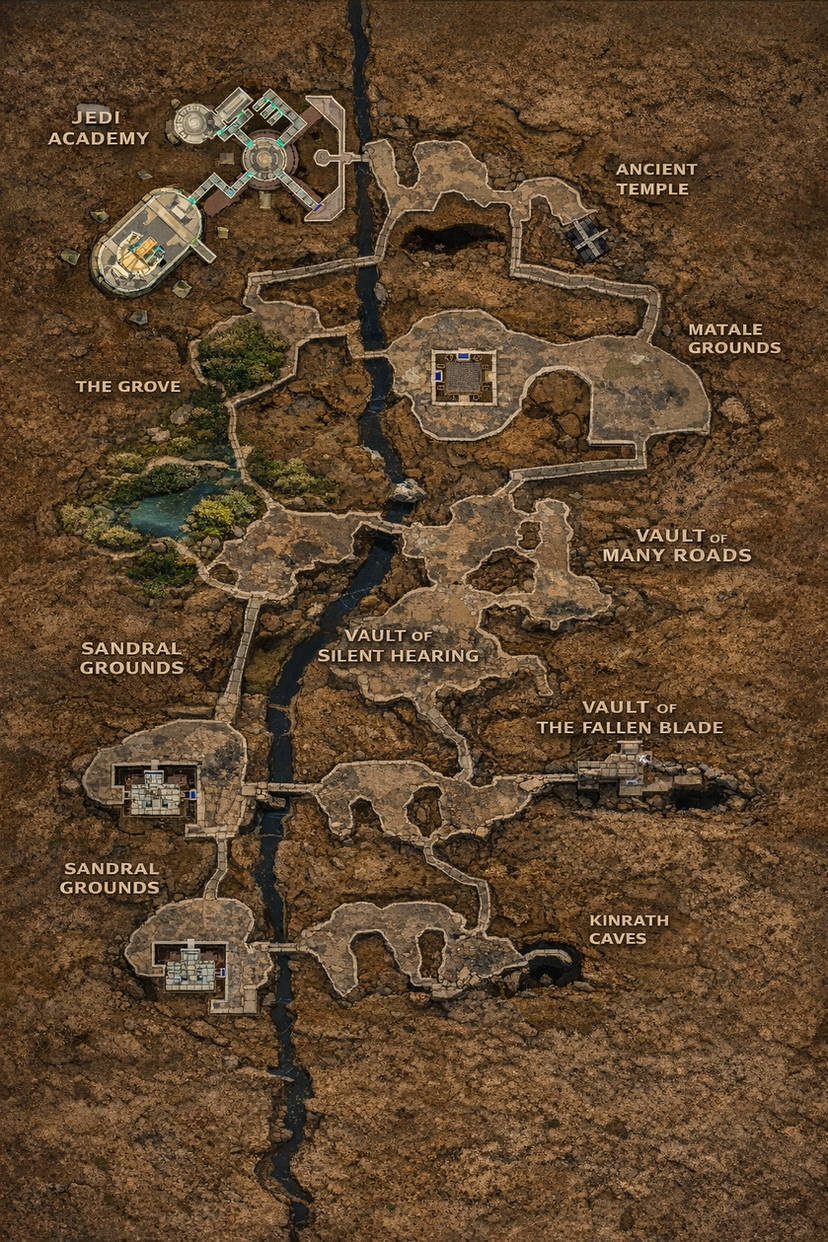
Site Map References
Key Themes
- Healing
- Restoration
- Study joined with lived practice
- Memory
- Redemption as a central lesson
-
Temple Grounds and Restored Facilities
Courtyard
The central courtyard has been cleared, repaired, and reshaped into an open sanctuary beneath Dantooine’s wide sky. Broken flagstones were lifted and reset, overgrowth trimmed back, and shallow channels cut to guide rainwater away from the old foundations.

Revan the Redeemed
Jedi Knight, war leader, fallen lord, returned champion.
He passed through ambition, ruin, and remembrance, then chose the Light with full knowledge of what darkness could make of him. Let this monument teach that redemption is not mercy freely given, but a burden carried through every choice thereafter.
At its heart stands a carved statue of Revan the Redeemed, captured in disciplined stillness. The blade remains ignited, held in both hands as power is brought under control. Wind-drawn robes and a rooted stance hold the figure in a moment that does not pass, balanced between past and present. It serves as a place of contemplation for students and visitors alike… a reminder that redemption is lived through continual choice, restraint, and return to the Light.
The statue presents Revan as a figure of mastery over self. The ignited blade signifies power retained and governed with precision. Both hands steady the hilt, reinforcing focus, control, and intention. The stance remains grounded and unwavering, expressing readiness held in check. The motion within the robes carries the weight of a turbulent past brought into alignment. The lowered gaze turns inward, marking awareness, judgment, and balance maintained through will.
The piece centers on redemption as discipline… power held, choice sustained, the Light upheld through constant control.
Healing Wing and Medical Bay
A restored healing wing occupies one of the temple’s interior stretches. Modest in scale yet carefully maintained, it serves as the primary space for treatment, stabilization, and recovery. Supplies, diagnostic tools, and recovery cots line the chamber in order, while the atmosphere remains gentle rather than clinical. The room was shaped to support both practical medicine and Force-assisted healing.
Recovery Tank
Set within the healing wing is a specialized recovery tank used to suspend and stabilize the injured. Patients may rest weightless within a restorative medium while healers monitor recovery and work in concert with medicine and the Force. Its construction favors serenity over severity; soft light rests over the chamber, and its surrounding equipment has been integrated into the room with a measured hand so that it feels like part of the temple rather than a military ward.
Archive Rotunda
A circular records hall has been restored deeper within the structure, its shelves and alcoves now holding recovered tablets, preserved teachings, star charts, historical accounts, and instructional texts. The Archive Rotunda functions as both repository and research hall, allowing scholars and students to study the legacy of the temple, the wider Jedi tradition, and the old knowledge tied to the enclave. Some materials remain openly accessible; rarer works are held in secured niches for guided study.
Lightsaber Chamber
This artisan chamber is devoted to saber construction, repair, and meditative craft. Worktables, fine tools, and carefully kept components occupy the room without crowding it, while alcoves along the walls allow for private focus during assembly. It is a chamber that teaches patience as much as skill; here, the saber is treated not merely as a weapon, but as a reflection of discipline, identity, and purpose.
Hall of Trials
Rather than serving only as a combat room, the Hall of Trials is dedicated to inward challenge and disciplined growth. It is used for lessons in restraint, focus, perception, moral judgment, and confrontation with fear. Some trials are spoken, some meditative, some practical. The chamber remains intentionally austere, stripping away distraction until only the lesson and the self remain.
Garden
Branching from the central courtyard is a contemplative garden shaped around the theme of return and renewal. Native grasses, low stone paths, weathered markers, and shaded benches form a quiet place for meditation and reflection. It echoes the lesson carried by the statue at its heart: that calling someone back from darkness may demand more strength than striking them down.
Recovered Ruins Gallery
Set within one of the temple’s halls, the Recovered Ruins Gallery preserves fragments drawn from the collapse of the site and the surrounding grounds. Broken reliefs, worn stone panels, shattered markers, and salvaged carvings have been cleaned, stabilized, and displayed with care rather than discarded. The gallery is not a trophy chamber, it is a place of memory. It teaches that restoration is not the erasure of damage, but the patient act of giving meaning to what remains.
Herbal Garden Conservatory
Adjoining the healing wing is a restored conservatory devoted to medicinal plants, natural remedies, and recovery. Part enclosed glasshouse, part sheltered garden, it draws in Dantooine’s light while protecting delicate growth from harsh weather. Raised beds hold herbs, roots, flowers, and restorative greenery used in tinctures, teas, salves, and poultices. Narrow channels of water run through the space, carrying a constant hush beneath the leaves.
Guest Cloisters
A series of simple stone chambers along one side of the temple house visiting scholars, wandering Jedi, trusted guests, and pilgrims. Each room is sparse yet comfortable, furnished with little beyond what is needed for rest, study, and silence. The cloisters allow the temple to function once more as a living sanctuary rather than a hollow monument.
Chamber of Lineages
This memorial hall is devoted to those whose lives and choices shaped the legacy of Dantooine. Names, preserved symbols, fragments of teaching, and recorded memory are kept here in honor. It is not a hall of glory, but of continuity. It reminds all who enter that they walk among inherited Duty, and that those who follow will one day judge what was done with that inheritance.
-
Canon Grounds and Enclave Region
Jedi Academy
The restored temple stands within the wider grounds of the old Jedi Academy on Dantooine, whose surviving structures and linked paths still define the region. The academy proper remains the heart of the enclave: a weathered yet enduring complex of circular chambers, adjoining wings, and training spaces once used for instruction, meditation, and council. Though time and damage have once marked the site, the layout still carries the ordered calm of Jedi design with careful reconstruction to preserve the original architecture.
Academy Rotunda
The central rotunda serves as the architectural heart of the academy complex, linking its major wings through a circular chamber of measured symmetry. It is where paths meet: students crossing between lessons, teachers pausing in low conversation, and visitors first taking in the scale of the restored enclave.
Instruction and Council Wing
One of the older wings of the academy is reserved for formal learning, private guidance, doctrinal study, and counsel. The chambers here are suited for lectures, mentorship, and the passing on of difficult lessons that cannot be shouted across a sparring floor.
Residential Cells and Student Quarters
The academy’s smaller side chambers lend themselves naturally to initiates, visiting scholars, and resident students. These rooms remain simple: sleeping cots, storage niches, writing desks, and little else. Their austerity is deliberate, meant to keep life within the enclave uncluttered and attentive.
Southern Assembly Hall
The broader southern chamber of the academy functions well as a communal gathering hall for addresses, shared meals, ceremonies, and group meditation. Its scale gives the enclave a sense of communal life beyond secluded instruction rooms and private sanctums.
Training Annex
Attached to the main academy are chambers suited to practical exercises, supervised drills, and the physical side of Jedi training. These spaces are not crude sparring pits alone, but places where movement, control, and judgment are taught together. In the restored enclave, this annex pairs naturally with the Hall of Trials and the Lightsaber Chamber.
Ancient Temple
Separated from the academy by winding stone paths and rougher-cut earth, the Ancient Temple stands as one of the oldest and most solemn points in the enclave region. Its presence feels heavier, more inward, as though the stone remembers older silences. It is well suited for deeper meditation, private trial, and restricted sacred use within the larger restored complex.
Matale Grounds
The Matale Grounds stretch across part of the surrounding plain, marked by old pathways and the remnants of settlement beyond the immediate temple structures. In present use, the area may serve as open training ground, grazing land, survey territory, or a buffer between the sanctuary and the wider countryside.
The Grove
The Grove remains one of the most contemplative stretches of the enclave region, set apart by greener growth, softer ground, and the sounds of nearby water. It is a natural place for meditation, grief, inward reflection, and lessons too large for a classroom. The restored temple treats it as protected stillness rather than mere scenery.
Sandral Grounds
The Sandral Grounds occupy another portion of the wider Dantooine landscape, bearing the marks of habitation and local history beyond Jedi walls. Their presence roots the enclave within a living world rather than leaving it suspended as an island of stone. They may remain preserved, lightly worked, or adapted with care for supporting structures beyond the sanctuary’s sacred heart.
Kinrath Caves
Beyond the safer reaches of the enclave lie the Kinrath Caves, cutting into the land as a reminder that Dantooine has never been wholly tame. The caves provide a natural point of tension within the setting: a place of danger, exploration, scavenging, and trial. For the restored temple, they mark the edge where sanctuary yields to wilderness.
-
Security
Security Rating: Medium
- Temple Stewards: A small number of trusted attendants and guardians oversee the site, its visitors, and its daily functions.
- Restricted Inner Chambers: Sensitive areas such as archives, healing stores, sacred rooms, and private sanctums are not openly accessible without permission.
- Controlled Access: Certain doors and chambers are keyed to authorized users, while others require direct approval or escort.
- Surveillance and Alarm Measures: Discreet sensors and internal alert systems monitor movement through secured areas of the enclave.
- Passive Defenses: The temple’s remote location, limited approach routes, layered architecture, and surrounding grounds offer natural defensive advantages without turning the sanctuary into a fortress.
- Emergency Medical Readiness: The healing wing remains prepared to answer injuries sustained during training, travel, wildlife encounters, or local threats.
- Sanctum Protocols: Some chambers may be sealed during meditation, healing procedures, or archival work to preserve focus and prevent disruption.
-
Historical Information
The temple on Dantooine stands upon old ground long tied to Jedi learning, reflection, and trial. Time and neglect left its halls weather-worn and near ruin, yet the site kept its gravity. Memory clung to the stone; silence settled there with presence; the past still held fast beneath open sky and drifting grass.
Its refurbishment was carried out with care. The restoration preserved the temple's surviving character while returning lost function to its halls. Walls were reinforced, collapsed passages reopened, chambers cleared, and damaged spaces adapted for renewed purpose.
That same guiding hand shaped every addition. A healing wing and nectar recovery tank now allow the temple to shelter the wounded as well as instruct the disciplined. The archive, trial hall, conservatory, and guest cloisters give space to knowledge, reflection, hospitality, and study. The Recovered Ruins Gallery preserves fragments of the site's own history, setting ruin beside renewal.
At the center of the restored grounds stands a statue of Revan the Redeemed. It was raised to embody a harder lesson: mercy may demand more strength than destruction, and redemption is courage of another kind. The restored temple now stands as a living sanctuary, a place where healing, study, memory, and the long labor of the Light continue.
Last edited:
