
H E G E M O N



- Intent: To fill the world of Vandemar with interesting and diverse life that is intriguing to roleplay with.
- Image Credit:
- Canon: N/A
- Permissions: N/A
- Links: Vandemar
GENERAL INFORMATION
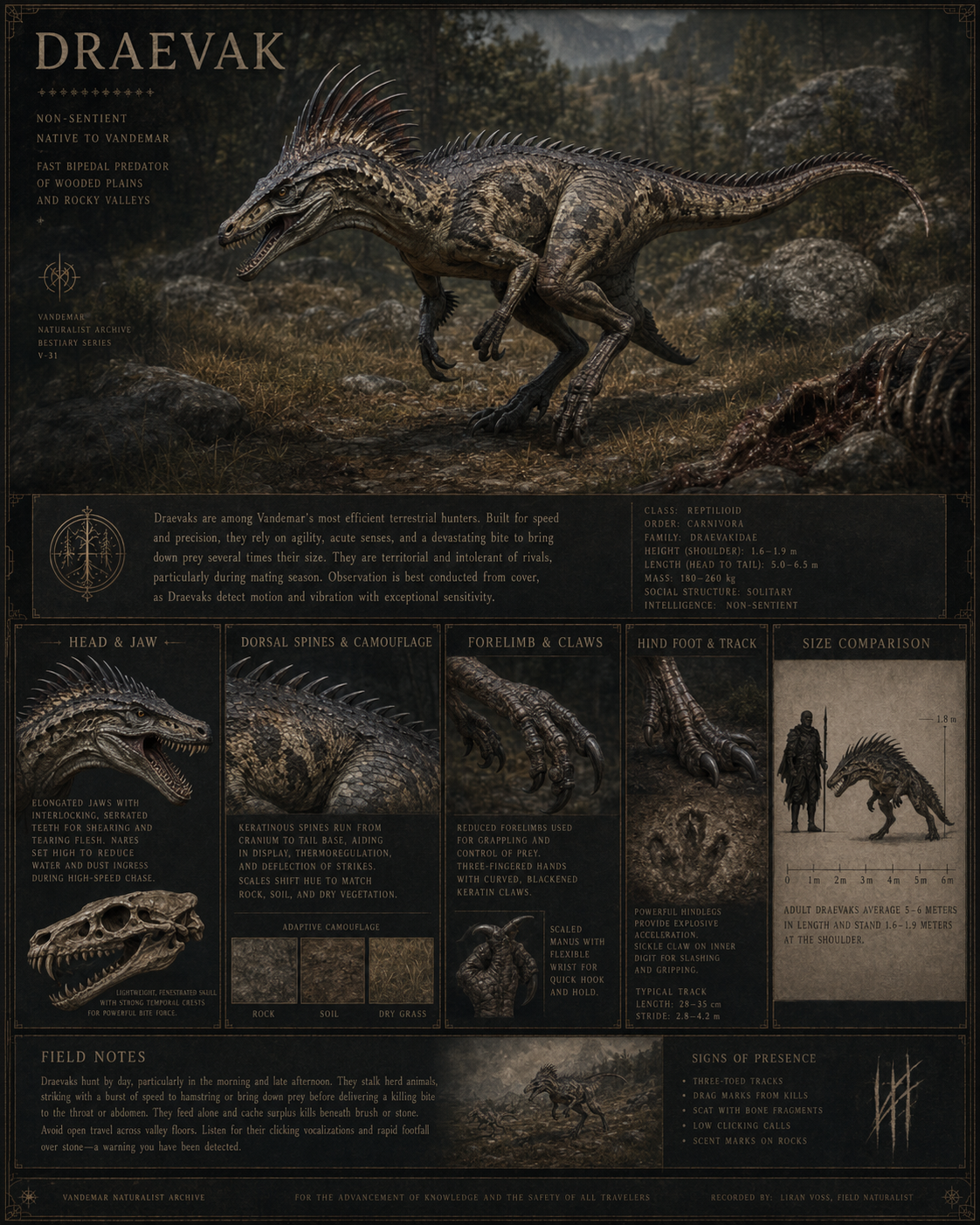
- Name: Draevak
- Designation: Non-sentient
- Origins: Vandemar; wooded plains, rocky valleys and forest clearings
- Average Lifespan: 14–22 standard years
- Estimated Population: Planetary; widespread across Vandemar's temperate continental regions
- Description: The draevak is a swift bipedal predator built for pursuit, harassment and sudden violence. Hunting groups circle their prey through broken terrain, striking only long enough to draw blood before vanishing again into grass or stone. A draevak hunt rarely begins with a charge. It begins with movement at the edge of vision.
PHYSICAL INFORMATION
- Breathes: Type I atmosphere
- Average Height of Adults: 1.4–1.8 metres at the hip
- Average Length of Adults: 2.8–3.8 metres, including the tail
- Skin color: Grey, brown, olive, muted green or rust-red
- Hair color: None; sparse sensory filaments may be black or dark brown
- Distinctions: Draevaks possess narrow bodies, powerful hindlimbs and long balancing tails. Their forelimbs are short but functional, ending in hooked gripping claws. The elongated jaw contains interlocking teeth designed to cut rather than hold. Pigment cells within the scales allow limited colour shifting between earth, stone and vegetation tones. Males develop larger throat crests used in display, while females are generally heavier through the hips and abdomen. Older specimens develop faded scales, scarred muzzles and stiffened tail ridges.
- Races: None formally recognised. Valley draevaks are darker and more compact, while plains populations possess longer legs and lighter colouration.
- Force Sensitivity: Non-Sensitive
- High speed and excellent mobility across broken terrain
- Coordinated harassment tactics and silent group communication
- Adaptive skin pigmentation provides effective natural camouflage
- Light frame offers limited protection against heavy weapons
- Poor endurance during prolonged direct pursuit
- Fragile forelimbs and vulnerable lower neck
CULTURE
- Diet: Carnivore. Draevaks prey upon medium-sized herd animals, young megafauna, burrowing species and isolated sentients. They prefer fresh meat and often abandon a kill once larger predators arrive.
- Communication: Low-frequency chest vibrations, tail movements, scent marking and short clicks produced within the jaw. Much of their hunting coordination occurs below normal human hearing.
- Technology level: None.
- Religion/Beliefs: None.
- General behavior: Draevaks live in family hunting groups of four to ten animals. They do not maintain the rigid hierarchy of varkhai packs; instead, the most experienced adults direct movement through repeated signals and learned behaviour. Draevaks test prey through false charges, flank attacks and deliberate retreats. Once a target weakens, several individuals converge upon the legs and lower body. Nests are established in rocky hollows, ruined structures or dense grass depressions. Both parents guard the clutch, while older offspring assist in feeding and defence.
HISTORICAL INFORMATION
Draevak fossils are common throughout Vandemar's plains and valley regions, suggesting that the species evolved alongside large migratory herbivores. Its adaptive pigmentation appears to have developed as forests repeatedly expanded and retreated across the planet's climatic cycles.
Early Vandemarian settlers underestimated the species because of its comparatively light frame. Entire survey teams were lost after mistaking harassment behaviour for fear or indecision. Later military studies revealed that draevaks instinctively exploit weak formations, exposed flanks and retreating individuals.
Modern settlements use vibration fences and cleared approach zones to keep hunting groups at distance. Provincial infantry still train against draevak-pattern combat automata, as few natural predators punish broken discipline so quickly. In Vandemarian military speech, a draevak retreat describes an apparent withdrawal intended only to draw pursuit into an ambush.