
The real real Nines.





- OUT OF CHARACTER INFORMATION
-
- Intent: To create a unique planetary setting in the Unknown Regions.
- Image Credit (top to bottom):
- Planet image: Earth planet by MhsmDK
- Macroforest: Alien Landscape by Victor Hugo Harmatiuk
- Oira Stretch: Mountain range by Philipp A. Urlich
- Hoga Wastes: Alien landscape by Jacek Irzykowski
- Jagged Pole: Peaceful winter landscape by David Mork
- Heliad Sea: Beachy blast by Johannes Figlhuber
- Canon: N/A
- Permissions: N/A
- GENERAL INFORMATION
-
- Planet Name: Caragach
- Demonym: Caragachi (singular & plural)
- Region: Unknown Regions
- System Name: Ulfior
- System Features:
- Ulfior Prime: The central star and namesake of the Ulfior system, Ulfior Prime is a red giant star roughly 8 million times the size of Caragach.
- Tyros: The only other planet in the Ulfior system, Tyros is around two-thirds the size of Caragach. Uninhabitable due to its extreme proximity to Ulfior Prime, Tyros’ original atmosphere has long since burnt away, leaving the world’s surface barren and lifeless. The lack of an atmosphere also contributes to extreme temperatures, with the side of Tyros that faces Ulfior Prime regularly reaches temperatures exceeding 500 degrees celsius while the side of Tyros facing away from the star experiences temperatures approaching absolute zero. Despite these inhospitable conditions, Tyros’ mineral wealth has motivated mining corporations from Caragach to develop underground, environmentally sealed colonies housing tens of thousands of laborers.
- Moons of Caragach
- Yudi - The third-largest of Caragach’s moons, one of only two moons with a breathable atmosphere, and the closest moon to Caragach, Yudi was the earliest of the planetary satellites to be colonized. It is also the most prosperous of Caragach’s moons, with its natural beauty and lack of dangerous megafauna making it an extremely popular vacation spot.
- Faisad - The second-closest moon to Caragach and also the second-smallest of Caragach’s moons, Faisad is most notable for its immense concentration of heavy industry. Faisad’s shipyards and factory-domes manufacture over 60% of the Caragach system’s ships and industrial equipment respectively, making it a vital economic center for Caragach despite its barren, lifeless surface.
- Naurog - The third-closest moon to Caragach, Naurog is extremely rich in iron and durasteel ores. Much of its surface has been strip-mined to supply the factory-moon of Faisad’s inexhaustible demand for resources.
- Malkin - The fourth-closest moon to Caragach, Malkin is also the largest of Caragach’s moons, at nearly a third the size of Caragach itself. Malkin has an ecosystem nearly as vibrant as Caragach itself, but its biomes are on average less extreme and consequently more habitable. Malkin is also the original home to the Zuti-zudi species, the majority of whom still reside on the moon.
- Veyoz - The fifth-closest moon to Caragach and also the smallest of Caragach’s moons. Barren and with few natural resources to exploit, Veyoz is primarily occupied by scientific research labs, military test sites, and environmentally contained industrial parks.
- Toxteth - The sixth-closest moon to Caragach, Toxteth appears on the surface to be little more than a large ball of ice. Beneath a kilometers-deep layer of ice however is a planet-spanning ocean extending over 200 kilometers down to the small, rocky core. Much of the planetary ocean remains unexplored, and it is rumored that enormous sea monsters lurk deep in the darkness of the sunless sea.
- Vulgwinur - Often called the “gate to Caragach”, Vulgwinur is the fourth-largest and outermost of Caragach’s moons. Developed to be the first line of defense against galactic invaders, the surface of Vulgwinur is covered in forts, redoubts, and orbital defense guns.
- Location:

- Major Exports: Durasteel ore, iron, garach bone, sulphur, native plants, seafood, luxury goods
- Unexploited Resources: Small deposits of songsteel and kyber crystals
- GEOGRAPHIC INFORMATION
-
- Gravity: 1.6x Standard
- Climate: Varied, Temperate (Average)
- Primary Terrain: Oceans, Macroforests, Mountains
- Atmosphere: Type I*
- Applies to just over 99.9% of Caragach’s atmosphere, some areas such as the Hoga Wastes have Type III.
- GEOGRAPHIC FEATURES
-
Capital City: Gaci
Planetary Features: Caragach includes several major cities, with the five most notable being Gaci, Xuadi, Johlmon, Barcarus, and Yezew. Major highways and rail networks link cities and towns across most of the Caragachi lowlands as well as the Gacian Plateau.
MAJOR LOCATIONS
Important Note: All biomes on Caragach are given ratings to reflect how hospitable they are to organic life, specifically for its native population and its oldest immigrant species (Humans and Chiss). The list of ratings is posted below:
[Safe] - Type 1 atmosphere, no aggressive wildlife, and few or no natural hazards.
[Hazardous] - Type 1 atmosphere, some aggressive wildlife and/or some natural hazards.
[Deadly] - Localized Type 2 or 3 regional atmosphere, aggressive wildlife, and/or significant natural hazards.
[Lethal] - Localized Type 3 or 4 regional atmosphere, numerous aggressive wildlife and/or* extremely dangerous natural hazards.
*Some Lethal biomes have conditions inhospitable to all life.
The same scale applies to aquatic biomes but excluding atmosphere differences.
Land Area - 32% Safe, 48% Hazardous, 17% Deadly, 3% Lethal
Water Volume - 15% Safe, 30% Hazardous, 15% Deadly, 40% Lethal
Total Surface Area - 20.7% Safe, 36% Hazardous, 15.7% Deadly, 27.6% Lethal
The Five Continents- 95% of Caragach’s landmass is composed of five large continents - Arin, Cutlis, Jaha, Puki, and the Jagged Pole. All of the biomes listed below are organized by continent:
ARIN - Second largest continent, located in the central-west region of the planet. Unique for its lack of lethal biomes and its high population density.
- Gacian Plateau [Safe] - Named after the planetary capital of Gaci, the Gacian Plateau is a large granite plateau crisscrossed with rivers and covered in low-growing grassy foliage. Its flat, fertile terrain and moderate climate has made it an extremely attractive location for settlement since the early days of Caragachi civilization. Presently, the Gacian Plateau is Caragach’s most heavily urbanized biome, housing nearly 20% of the planet’s entire population within towering cities including Gaci itself.

- Macroforest Ilyden [Safe] - To the southeast of the Gacian Plateau is Macroforest Ilyden, one of Caragach’s many macroforests. Found on every continent except the Jagged Pole, macroforests are formed primarily of the reddish, coral-like organism called garach. Nearly the entire organism can be harvested: its soft polyps are an edible delicacy or can be used to plant new garach, its hard, calcified branches can be ground up into duracrete or used to build basic structures, and its tube pores are often used for pottery or are carved to make musical instruments. In Macroforest Ilyden, most large predators have long since been hunted into extinction and several paved roads traverse the forest, making it safer than most.

- The Oira Stretch [Hazardous] - Between the northern coastline of Arin and the Gacian Plateau is the Oira Stretch, an east-to-west mountain range around 400 kilometers long and 15 kilometers wide. The Oira Stretch has long served as a barrier against invasion from the north, its steep slopes rising dramatically from sea level to as high as three and a half kilometers before its southern face gently drops off to the Gacian Plateau. There are only two major navigable passes from the coastline up the Oira Stretch.
- Macroforest Buydi [Hazardous] - Once spanning the entire southern two-thirds of Cutlis, Macroforest Buydi is now fractured into several smaller macroforests separated by towns, cities, and highways. Nonetheless, the separated forests retain enough ecological similarities to all be referred to as part of Buydi. Unlike Ilyden, Buydi still has large, elusive predators who sometimes claim the lives of planetary natives. The northernmost portion of Buydi in the foothills of the Jarvatan Range sometimes experience groundquakes and rockslides due to nearby tectonic activity.
- Jarvatan Range [Deadly] - The Javartan Range might not be the largest mountain range in Caragach, but it is by far the tallest. Located at a convergence of three tectonic plates, the Javartans tower above their surroundings at an average of seven kilometers tall and include Ga Juri, Caragach’s tallest peak at 13,211 meters tall. Only the most seasoned or best-equipped of trekkers can hope to traverse the mighty Javartans.
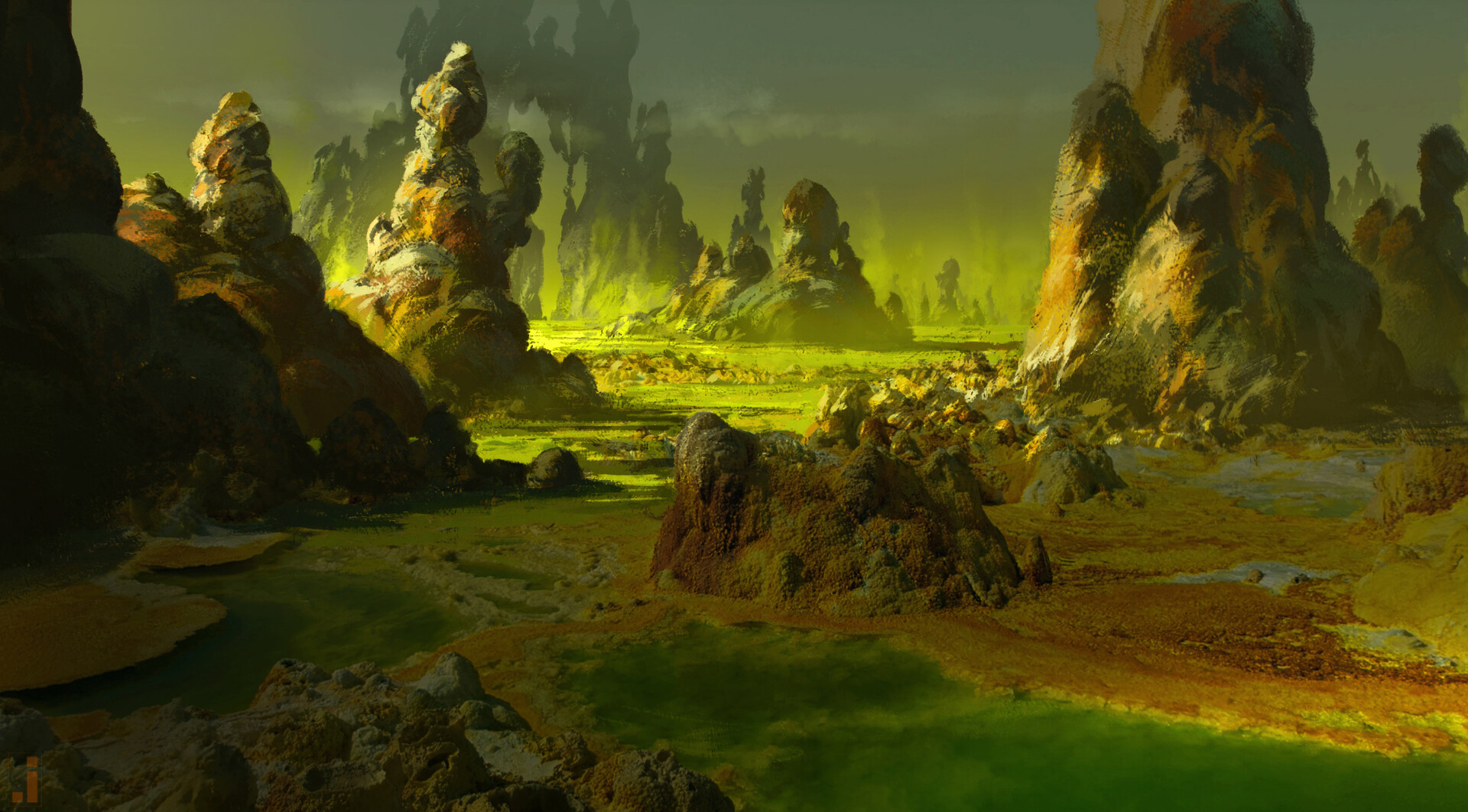
- Hoga Wastes [Lethal] - Located deep within the eastern Javartans are the Hoga Wastes, an ancient volcanic crater possessing enormous deposits of superheated sulphur. The boiling heat and abundance of sulphuric acid in the air of the Hoga Wastes can kill a humanoid in minutes, while pools of acidic sulphur can dissolve solid durasteel. Despite the extreme danger inherent to the Hoga Wastes, commercial sulphur mining is conducted using teams of custom-built droids dropped off and picked up from the air using cargo freighters.
- Plains of Urax [Safe] - Rising gently from the southern and western coastline of Jaha, the Plains of Urax are a large, grassy plain extending up to the foothills of the Vaccan Mountains.
- Vaccan Mountains [Hazardous] - Occupying nearly the entire interior of the Jahan continent, the Vaccan Mountains are Caragach's largest mountain range by area. Clouds rarely penetrate the imposing wall of peaks that make up the Vaccans, contributing to Jaha having the clearest skies and lowest average precipitation of all the continents.
- The Verdant Desert [Deadly] - Those who glimpse the Verdant Desert for the first time often confuse it for a grassy plain from afar. In reality, the jade green landscape of the Verdant Desert comes from verda, a unique green-colored sand found only on the continent of Puki. In stark contrast to a fertile plain, the Verdant Desert is devoid of nearly all plant life and is constantly subjected to withering heat with little cloud cover and even less precipitation. Settlements in the Verdant Desert are centered on isolated oases both natural and artificial made possible by underground aquifers. Verda sandstorms are a regular occurrence, requiring locals to stay indoors or wear respirators to avoid suffocation until the storm passes. Only the hardiest, deadliest, and most resourceful of creatures survive in the verda dunes, and they will not hesitate to prey on exposed travelers to keep themselves alive.
- Calxap Savannah [Hazardous] - In southern Puki, verda sand gives way to true grass, isolated garach trees, and cooler temperatures. While still fairly dry and arid compared to the most habitable regions of other continents, the Calxap Savannah contains a number of decently sized rivers and lakes that provide a stable supply of freshwater to the cities of the region.
THE JAGGED POLE - The smallest and southernmost continent. Very cold and very dangerous, with no permanent settlements.

- The Jagged Pole [Deadly] - The entirety of the continent known as the Jagged Pole is covered in an ice sheet kilometers thick, filled with deep ravines and towering spikes of ice, the latter of which give the continent its name. These icy spikes range in size from only a few meters tall near the coastline to over two kilometers in height near the southern pole of Caragach. Regardless of their exact dimensions, the ice spikes and the ravines scattered across the glaciers between them make the Jagged Pole very dangerous to navigate or even land a starship on. The only lifeforms in this frigid wasteland are microscopic bacteria and vicious avian predators who scour the coastline for food, including unfortunate sentients.
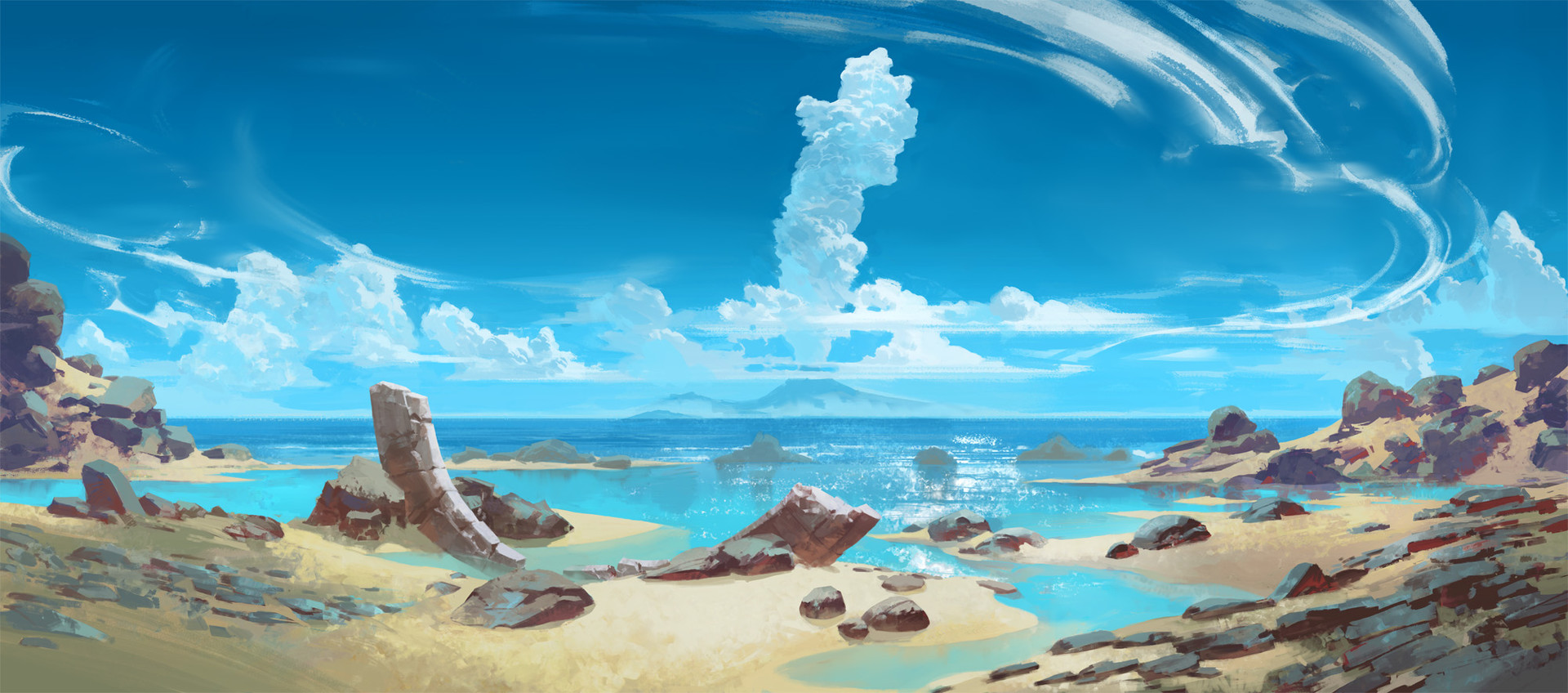
- The Shallows [Safe] - Consisting of all water from the coastline to the edge of the continental shelf’s upper slope, the Shallows play host to a great abundance of life. Fish and other small aquatic creatures frolic within underwater forests only rarely frequented by larger predators, with those large enough to threaten humanoids driven locally extinct millennia ago.
- The Heliad Opens [Hazardous] - Roughly equivalent to the open ocean, the Heliad Opens include the vast stretch of the Heliad Sea beyond the upper slope of the continental shelf. Extending from sea level to 100 meters deep, the Heliad Opens are home to numerous migratory species, including some of the Heliad Sea’s largest known organisms. Storms in the Heliad Opens can produce treacherous conditions for even experienced sailors.
- The Twilight Zone [Deadly] - Extending from 100 to 500 meters deep in the Heliad Sea, the Twilight Zone is a realm veiled in shadow. Most organisms in the upper half of the Twilight Zone have very large eyes to process what little light descends into the depths while those in the lower half of the Twilight Zone are either bioluminescent or depend on highly developed senses of hearing and smell. Since most of the Twilight Zone lies beyond Caragach’s photic zone, herbivores are few and far between, forcing carnivorous creatures to rely on stealthy ambushes or lures to conserve limited energy. Pressure in the Twilight Zone can kill an unprotected humanoid in a matter of seconds.
- The Starry Sea [Deadly] - Beyond 500 meters deep in the Heliad Sea, sunlight penetrates no further. Yet the deep ocean is far from smothered in total darkness. Countless billions of tiny bioluminescent plankton light the depths of the Heliad Sea like the stars in space, kept nourished by tiny scraps of marine snow falling from far above. While beautiful to observe, the Starry Sea is very dangerous to enter due to its high water pressure, which is near-instantly fatal to any organism not specially adapted to survive under such immense weight.
- The Lower Void [Lethal] - The single largest biome in Caragach, the Lower Void consists of all portions of the Heliad Sea deeper than two kilometers below sea level. Dark as the void and with pressure so extreme it can crush capital ships, the Lower Void has been visited by fewer than a thousand beings in Caragachi history using specialized submersibles. Of those brave or reckless enough to enter the Lower Void, over half have never returned, with those who have speaking of colossal, formless monsters lurking invisibly in the depths.
- POPULATION
-
- Native Species: Kogai, Vasir, Zuti-zudi
- Immigrated Species: Humans, Chiss, Duros
- Population: Moderate [1.085 billion sentient beings, excluding population of moons]
- Demographics:
- 41.23% Kogai, 34.36% Vasir, 12.27% Human, 7.59% Chiss, 3.67% Duros, 0.88% Zuti-zudi
- Primary Languages: Galactic Basic, Kogali, Vaysa, Nuf
- Culture:
- Caragachi culture varies greatly across continents, cities, and moons, with each town, city, and settlement having unique customs. However, there are also a number of shared traditions and values that largely unite the peoples of Carahach. Most Caragachi residents are proud of their society’s growth and their planet’s ecological diversity, holding both as core values all governments should strive to maintain. The residents of Caragach are largely satisfied with what their planet can provide and as a result, few ever permanently leave their homeworld, excepting only merchants, criminals, and the politically persecuted. Caragachi pride over their homeworld also makes most Caragachi judgmental of other planets and societies, quick to point out their flaws while being oblivious to the fact that said flaws may also exist on Caragach itselff.
- Caragach is home to a variety of major and minor religions, which are followed by the majority of the native population excluding only the reclusive Zuti-zudi. The most prominent faiths view either the Force (referred to locally as the Xoto) or the long-extinct land leviathans of Caragach as divine and worship them in forested temples to receive their blessings.
- GOVERNMENT & ECONOMY
-
- Government: Hybrid regime (Parliamentary republic under a competitive authoritarian dominant party system)
- Affiliation: Independent
- Wealth: Medium - While not the wealthiest of worlds even by Unknown Regions standards, Caragach is also far from the poorest. Its towns and cities maintain a decent standard of living with a widespread availability of good jobs. The greatest wealth in Caragach is concentrated in its largest cities and the moon of Yudi, with smaller cities and towns further from major urban centers being on average less affluent.
- Stability: Medium - The memory of the Four-Day War is still fresh in the mind of the Caragachi people and most of all in the Caragachi government. Despite holding nigh-uncontested control of the Caragachi Senate under the provisions of the Gudo-Harnami Agreement, the Principlist Coalition is not at all free of threats to its dominance. Grassroots remnants of the former Progressive parties and underground activist groups remain fervently committed to toppling what they see as an unjust regime and restoring true democracy to Caragach. For now, effective counterinsurgency operations have prevented any of these disparate opposition groups from seriously threatening the Principlist regime. Yet these bold rebels remain as determined as ever to depose their tyrants.
- Freedom & Oppression:
- While officially a parliamentary democratic republic with an elected Senate, the reality is that the government of Caragach is dominated by the Principlist coalition of right-wing political parties whose forces won the Four-Day War. Ruling with an iron fist beneath a velvet glove, the Principlists maintain the illusion of democratic rule in order to legitimize their authority in the eyes of the citizenry. In practice, the Principlists have uncontested control of the Caragachi government. Their former rivals have either been disenfranchised or bankrupted, leaving only a token, powerless opposition in the Caragachi Senate. Formerly independent media outlets have been seized and converted into propaganda mouthpieces, accused of sedition or even treason simply for not supporting the Principlist uprising as it took place. Independent politicians not affiliated with any party have been aggressively harassed by Principlist agents and forced either to take up Principlist positions or retire from politics.
- Compared to opposition politicians and activists, the average Caragachi civilian experiences the government’s velvet glove far more often than it does its iron fist. As long as a Caragachi respects local laws and keeps political dissent to themselves, they can live fairly successful and meaningful lives with little outside intervention in their private affairs. Nonetheless, Caragachi civilians who are not Principlist functionaries or corporate executives have little to no real influence on the planetary government. Both local and planet-wide elections are rigged long before they begin, granting Principlist candidates an overwhelming advantage. All public communications are regularly screened, all public assemblies must be approved by government agents beforehand, and citizens can be taken in for interrogation at the slightest signs of sedition or dissent.
- MILITARY & TECHNOLOGY
-
- Military: Caragach has historically maintained a modern, medium sized military for both defensive and limited offensive purposes. After the Four-Day War, the Caragach Armed Forces (CAF) have undergone expansion and modernization, with an emphasis on power projection to more aggressively assert the interests of the Caragachi Enclave in the Unknown Regions. The CAF is headquartered in Gaci and has three distinct branches: the Army, Navy, and Starfighter Corps.
- The Caragach Army is a modern ground force consisting of infantry, mechanized, armored, and artillery formations. It is best known for the Urada, an elite heavy infantry formation famed even outside Caragach for their phenomenal endurance and discipline in battle.
- The Caragach Navy is composed of all capital warships under the control of the CAF. The Navy’s fleet is based out of the moon of Vulgwinur with auxiliary facilities on the moons of Malkin and Faisad as well as on Caragach proper. Since the end of the Four-Day War, the core of the Navy’s fleet has been modernized and is now composed of Palmerian-class heavy cruiser variants accompanied by a few larger vessels and numerous smaller escorts.
- The Caragach Starfighter Corps (CSC) represents the combined might of all the CAF’s fighters, interceptors, bombers, and ground attack craft. Organized in flights each made of ten wings, the CSC is expected to take up a wide range of mission profiles including but not limited to air supremacy, interception, close air support, strategic bombing, anti-piracy, and anti-capital ship operations.
- While the High Minister of Caragach is legally the commander-in-chief of the Caragach Armed Forces, it is the High First General of Caragach (FN-999 as of 905 ABY) who is the highest ranking uniformed officer and directly responsible for planning military campaigns.
- Technology: Galactic Standard
- Generally speaking, Caragachi technology is at or close to Galactic Standard, with certain materials and technologies substituted for native developments. For instance, garach bone and garacrete are analogous to wood and duracrete respectively.
- Military: Caragach has historically maintained a modern, medium sized military for both defensive and limited offensive purposes. After the Four-Day War, the Caragach Armed Forces (CAF) have undergone expansion and modernization, with an emphasis on power projection to more aggressively assert the interests of the Caragachi Enclave in the Unknown Regions. The CAF is headquartered in Gaci and has three distinct branches: the Army, Navy, and Starfighter Corps.
- HISTORICAL INFORMATION
-
ORIGINS
Recorded history in Caragach began around 12,000 years before the battle of Yavin when the Kogai first developed their civilization. They would be followed half a century later by the Vasir, and a few years later the Zuti-zudi when they arose on the distant moon of Malkin. The Kogai and Vasir civilizations of Caragach soon encountered each other and began to intermingle. As history advanced, so too did society on Caragach. Great empires rose and fell, ancient cities were founded and laid to waste, and goods and ideas were exchanged across every continent. The immense leviathans, once revered as gods, were hunted to the brink of extinction as interactions between the great beasts and the settlers of Caragach grew ever more hostile.
At around 7,306 AE (After Emergence, dated to 11,982 BBY), the natives of Caragach at last took to their stars, their first destinations being their world’s many moons. Yet when they arrived, they found that they were not the first to settle their homeworld’s seven satellites. The first encounter between the Kogai and Vasir nations and the Zuti-zudi took place on the moon of Yudi, with negotiations between the two sides beginning an era of cautious cooperation. This era would not last long, as tensions soon grew between the two sides who both desired unfettered access to the natural wealth of Caragach’s moons.
A diplomatic incident in 7,311 AE rapidly escalated into a full-scale war that devastated both sides, with neither having a clear advantage. After the war raged for nearly four decades, a new generation of leaders emerged desiring an end to the disastrous conflict. Peace was negotiated and a compromise established: henceforth, local authorities and a series of treaties would regulate commerce between Caragach and its satellites.
FIRST GOLDEN AGE
As war gave way to peace, all three sentient species of Caragach now freely intermingled with each other, sharing ideas and technology to their mutual benefit, even if some exchanges were more reluctant than others. By 7,380 AE (4,602 BBY), Caragach had entered its first and longest golden age. For the first time, the denizens of Caragach and its moons reached beyond their homeworld and its orbit, seeking to explore the stars and settle distant worlds.
Nearby Tyros was the first planet to be visited by the Caragachi, who by 7,415 AE had set up the first of the mining colonies beneath its inhospitable surface. On 7,430 AE, first contact was made with Human settlers from the Jurio system, and despite initial misunderstandings, the two groups soon developed a valuable economic relationship. It was from these first Human immigrants that the Caragachi acquired hyperdrive technology, vastly accelerating their space travel and dramatically extending the range of their voyages.
Over the following millennia, Caragachi traders and settlers spread far throughout the Unknown Regions while on Caragach itself great cities rose and new nations emerged. Through times of war and peace the Caragachi continued to prosper, continuously innovating not only in technology but also in the fields of art, culture, and governance.
Located as it was deep within the Unknown Regions, Caragach was never integrated into the Galactic Republic or any of its rival powers. Trading and interacting primarily with other worlds near the edge of the galactic rim, Caragach was thus shielded from the worst of the effects of the Sith Wars and Clone Wars. Though the emergence of the Galactic Empire from the ruins of the Republic was felt in Caragach, it too did not penetrate far enough into the Unknown Regions to directly influence the Caragachi. Overlooked further by the New Republic, Yuuzhan Vong, and pre-Gulag Galactic Alliance, Caragach garnered a well-earned reputation for being a beacon of peace and stability and its population surged with refugees from closer to the galactic core.
All good things must come to an end however, and even secluded Caragach was no exception.
GULAG PLAGUE
When the Gulag Plague first swept the galaxy, Caragach had mere weeks to prepare. Contact was lost with every Caragachi diaspora population in mere days, and every expedition sent out from Caragach never returned. Left in the dark and fearing the worst, the nations of Caragach united their fleets to form a defensive blockade above their shared homeworld. Yet for all their efforts, the Cargachi civilization had no match for the Gulag Plague.
It was early in 19,714 AE (426 ABY) that the Gulag Plague arrived in the Ulfior system. The mining colonies of Tyros were the first to fall to the plague, followed several days later by all nine moons of Caragach nearly simultaneously. Once the plague settled on the innermost moon of Yudi, Caragach’s fate was sealed.
From the wreckage of a spacefaring yacht the Gulag Plague spread through Caragach with devastating results. Societal collapse occurred within days and even rival warbands soon succumbed to the plague. The once-great cities of Caragach were abandoned as the remaining survivors fled to the furthest corners of the countryside and even the Jagged Pole itself. These tiny groups of Caragachi reverted to using whatever primitive technology they could build without industry, living off the land as hunter-gatherers.
After centuries where the Caragachi were at their lowest, the ravages of the Gulag Plague at last came to an end. Once they were confident the plague had truly passed, the remaining Caragachi regrouped in the cities and agricultural centers to determine the future of their collective species.
In all, the Gulag Plague killed 99.96% of the Kogai, 99.98% of the Vasir, and 99.99% of all immigrant species, leaving only around a million sentients on all of Caragach. When contact with the Zuti-zudi was restored half a century later, it was learned that only 3,500 organic members of their species remained. Collectively traumatized by the experience of the Gulag Plague and acutely aware of how few of their kind remained, the sentient species of Caragach agreed to do away with the artificial divisions of the past, for the first time uniting the world and its nine moons under one banner. From this understanding, the so-called Act of Union, the Caragachi Enclave was born.
SECOND GOLDEN AGE
The first task of the Caragachi Enclave was to secure political unity across Caragach, its nine moons, and eventually the entire Ulfior system. Though most residents of Caragach submitted to the Enclave’s democratic government with little issue, there remained isolated settlements to be rediscovered and armed raiders to be subdued. The Enclave achieved both in quick order, establishing the nucleus of the Caragachi Armed Forces in the process.
Next on the Enclave’s long task list was to restore the technological base once enjoyed by the pre-Gulag Caragachi. Ruined cities were scoured for any blueprints, intact tech, and industrial machinery. With the groundwork laid by the previous Caragachi civilizations, the Enclave was able to advance through millennia of technology in a matter of decades. By 20,055 AE (767 ABY), the Caragachi once more travelled the stars. One by one its moons were resettled, old infrastructure restored or recycled to once more benefit civilization. At last, in 21,058 AE, Tyros’ mining colonies were resettled, fully restoring Caragachi presence across its entire home system.
Though less populous than it was before the Gulag Plague, Caragach was stronger than ever before owing to its unprecedented political unity. Early Enclave governments launched vast megaprojects to revitalize the Ulfior system and better protect it from future galactic threats. It was during the Raswon government that the moon of Faisad was transformed into the industrial powerhouse it is today, while the following Yordike government turned the barren moon of Vulgwinur into a formidable fortress.
Despite this newfound prosperity, tensions were rising on Caragach. Before the Gulag Plague, its various nations each harbored unique forms of government and ideologies. Since the Act of Union, the Caragachi Enclave has had to inherit all these distinct and often conflicting ideologies within the framework of a single government, resulting in the creation of numerous major and minor political parties in constant competition with each other. Old grudges between cities, regions, and continents re-emerged in the form of increasingly prominent political polarization between all parties in the Caragachi Senate. By 20,188AE (900 ABY), Caragachi democracy and the Enclave itself would be in danger as the major factions of the Senate began to consider using any means necessary to defeat their political rivals.
By 20,191 AE, the bitterly quarreling factions of the Caragachi Senate had coalesced into two coalitions. On one side were the Principlists, a coalition of conservatives, right-wing senators, and Imperial apologists. Opposing them were the Progressives, a coalition of reformists, progressives, and revolutionaries. From 20,191-20,193 AE, the Progressives held a majority in the Senate. Confident in their authority, they began to plan their most ambitious agenda yet, one that would render the Principlists obsolete.
However, even the Progressives underestimated how far their rivals would go to gain the power they so rightfully deserved.
Behind closed doors, representatives of the Principlist coalition had secured a meeting with FN-999, a seasoned Imperial general who had recently departed the short-lived second iteration of the First Order. Recognizing that their interests aligned, the Principlists and FN-999 came to an agreement: the general would offer his forces to aid the Principlists in a coup in exchange for being granted the position of High First General, giving him nearly total control over the CAF.
Now having the trump card they had long desired, the Principlists at last took action.
FOUR-DAY WAR
On 2.1.905 at 13:12 local time, a signal code was given to Principlist politicians and sympathizers in the armed forces and civil society, marking the beginning of a coup against the Progressive-led government. While Senate was in session, the Senatorial Guard burst into the building and held the senators hostage, allowing only Principlists to leave the building. Entire divisions of the Caragach Army rose up in revolt, quickly taking control of key urban centers including several districts of Gaci itself. Riots spread in the cities of Caragach and its moons, and soon not a single settlement of note was spared of civil unrest.
Vulgwinur, the Gate of Caragach, was home to some of the most intense fighting of the first day of the Four-Day War as Principlists fought Progressives for control of the fortress moon. The tides soon turned in favor of the former however when FN-999 arrived to deliver upon his end of his arrangement with the Principlists. With a powerful fleet in tow, he quickly blasted through the scattered Progressive naval forces before descending upon Vulgwinur with his veteran stormtroopers, besieging and destroying the remaining Progressive holdouts in just under eight hours. Now possessing near-total control over the flow of beings and goods to and from Caragach as well as its most valuable naval assets, FN-999 and most of his fleet advanced swiftly through Caragach’s moons, seizing control of Malkin in a matter of hours while capturing Toxteth and Veyoz as little more than an afterthought. It was at Malkin that FN-999 and the Principlist forces he had linked up with paused their lightning advance, gathering supplies and sympathizers in preparation for a proper siege of the Inner Moons.
On 2.2.905, the Principlist fleet set out from Malkin, ignoring the factory moon of Faisad and instead blockading the lightly defended mining moon of Naurog. Their gambit soon paid off as Faisad was starved of the minerals it needed to make new weapons for the Progressive war effort, forcing most of their remaining naval forces face the Principlists above Naurog with a home field advantage. FN-999’s military engineers had used freshly mined durasteel ore to create improvised mines and small gun platforms deployed in Naurog’s orbit, which when combined with his fleet and ships captured by the Principlists contributed to a decisive victory over Naurog, destroying the last remaining Progressive capital ships. Following the Battle of Naurog, the Principlists would hold uncontested space supremacy for the remainder of the war.
By the third day of the war, clear battle lines had formed on Caragach proper. While the Progressives held more cities than the Principlists, the latter had nearly uncontested control of the countryside and remained bitterly entrenched in several of Gaci’s outer districts. For the moment, neither side had any clear advantage, with momentum shifting as rapidly as the winds themselves. However, that would soon change. In space, FN-999’s fleet had imposed blockades over Faisad and Naurog, ensuring supplies only arrived to Principlist holdouts on each moon. Deciding to starve out the remaining two moons rather than besiege them, FN-999 and the Principlist commanders in orbit began ferrying troops from the moons they occupied directly onto Caragach. Soon, millions of Principlist soldiers were gathering on the planet, quickly acquiring the numbers needed to seize Gaci and end the war.
On the final day of the war, hundreds of thousands of Principlist soldiers reinforced by most of FN-999’s legion broke out from their positions in outer Gaci, rapidly overwhelming the defenders with superior numbers and firepower as well as aerial supremacy. The Siege of Gaci was by far the bloodiest battle of the Four-Day War, with tens of thousands of soldiers dead on each side and a nearly equal number of civilian casualties as stray shells leveled apartment buildings. Ultimately, it was the Principlists that emerged triumphant. With the Caragachi Enclave’s capital now under Principlist control, the remaining Progressive forces on Caragach, Yudi, and Faisad capitulated.
The Caragachi Enclave had survived its greatest upheaval since its founding, but it would never be the same.
THE GUDO-HARNAMI AGREEMENT
With the decisive defeat of the Progressive forces on the battlefield, they were forced to the negotiating table to avert total collapse of their position on Caragach. The resulting treaty was known as the Gudo-Harnami Agreement, named after their primary signatories: Alkanin Gudo, former Minister of Foreign Affairs and leader of the Principlists, and Hod Harnami, former High Minister of Caragach and leader of the Progressive bloc.
Under the agreement, the Progressive Bloc and all its member parties were outlawed as well as made to bear sole responsibility for the events leading up to the Four-Day War. Furthermore, the Caragachi Constitution was revised to weaken protections related to free speech, assembly, and political expression, enabling the triumphant Principlists to shut down remaining opposition parties and media outlets for alleged collaboration with the Progressives. Finally, the member parties of the Progressive Bloc were made to pay reparations for all damages suffered during the Four Day War, financially crippling the strongest opposition to Principlist rule.
After the signing of the Gudo-Harnami Agreement, the victorious Principlists began to reshape Caragach in their image, no longer restrained by strong political opposition. Anticipating widespread protests by the population at large in former Progressive strongholds, the Principlists initiated martial law, thoroughly and often violently cracking down on resistance from the general public. They also purposely offered little resistance to Progressives fleeing Caragach, recognizing that the High Republic and even the emerging Farworlds Alliance could scant afford to intervene in such a remote system.
A combination of draconian restrictions imposed by the Gudo-Harnami Agreement, effective counterinsurgency operations overseen by FN-999, and emigration of more affluent Progressives have greatly weakened all internal threats to the Enclave’s new rulers as of 905 ABY. Yet even as newly appointed First Minister Alkanin Gudo and FN-999 draw up plans to further expand Caragach’s sphere of influence, they are careful not to underestimate the spirit of resistance that remains among segments of the Caragachi people.
Last edited: