
Shuklaar Kyrdol
CEO of Breshig War Forge Consolidated





- IMAGE
-
- OUT OF CHARACTER INFORMATION
-
- Image Source: Here.
- PRODUCTION INFORMATION
-
- Manufacturer: Breshig War Forge Consolidated.
- Affiliation: Breshig War Forge Consolidated and Strill Securities.
- Material: Duranium frame, reinforced Duraplast reinforcements, Reflec laced fiberplast coating, miscellaneous missile components and Ultrachrome wires and electronics.
- SPECIAL FEATURES
-
- Explosive Type
-
- Trihexalon Dispersal Charge.
- Targeting Mode(s)
-
- Air-to-ground: Air-to-ground targeting mode covers engaging of targets on the ground by airborne launch platforms.
- Surface-to-Air (Low Flying): Surface-to-air targeting mode covers engaging of low-flying targets by ground-based launch platforms.
- Guidance Mode(s)
-
- Active Homing
-
- Pre-launch: The missile downloads sensor data, targeting and tracking information of the target as well as the IFF codes of all friendly assets in the area from the launch platform before launching.
- Launch: The missile acquires a sensor lock on target and begins accelerating toward the target.
- Midcourse: Using active sensor and scanner data from its own sensors, the missile determines how best to approach the target. At this stage, the missile can switch to Home on Jam mode if the amount of interference is too high such that it loses its original target. If there is no interference yet the missile has lost track of its target, the missile will revert to Inertial Guidance. The presence of hostile point-defense is also checked for, determining what if any terminal phase maneuvering the missile carries out.
- Terminal: The missile expends the remainder of its fuel in a sustained high energy acceleration toward the target.
- Control Guidance
-
- Pre-launch: The missile downloads sensor data, targeting and tracking information of the target as well as the IFF codes of all friendly assets in the area from the launch platform before launching.
- Midcourse: The missile receives updated targeting and tracking information from the launching platform via an encrypted frequency hopping comms link. Using active sensor and scanner data from the launch platform, the missile determines how best to approach the target. Detonation mode and exact flight path can still be programmed by the launching platform, however. The presence of hostile point-defense is also checked for by the missile's sensors, determining what if any terminal phase maneuvering the missile carries out, though the launch platform can change this at any point during the midcourse phase. If at any point in the midcourse phase the missile loses communications with the launch platform, it reverts to home on jam guidance.
- Terminal: The missile expends the remainder of its fuel in a sustained high energy acceleration toward the target.
- Home on Jam
-
- Midcourse: If the missile switches to home on jam targeting during the midcourse phase, it will identify the strongest source of electronic interference that does not bare a friendly IFF signature and locks onto it.
- Waypoint
-
- Pre-launch: The missile downloads the waypoints, detonation location and mode as well as a sensor map of the area of the flight path charted out by the set of waypoints.
- Midcourse: The missile follows the waypoints using its own sensors to path find.
- Terminal: On reaching the final waypoint the missile expends the remainder of its fuel in a sustained high energy acceleration toward the detonation location.
- Waypoint Search and Destroy
-
- Functions precisely the same as the waypoint mode with the exception that once it has reached the final waypoint the missile attempts to locate a hostile target. Following acquisition of said target, the missile will enter the terminal phase. This terminal phase is the same as the Waypoint guidance mode's.
- Inertial Guidance
-
- Utilizing a laser gyroscope system to calculate distance travelled, the missile checks it against the previously computed distance to target and then initiates detonation once the missile has reached that distance.
- Salvo Mode
-
- When fired in Active Homing or Waypoint mode or if the missile switches to home on jam and salvo mode is enabled, a 'predesignated' missile will network with the other missiles launched to share data for a better sensor picture and will additionally assess the targets in the area and assign targeting including of subcomponents such as individual batteries or exposed communications equipment on capital ships and stations. Alternatively, this missile can relay this information back to the launch platform if in range, and can receive targeting priority from it.
- Launch Mode(s)
-
- Standard Launch
-
If not loaded into a mass-driver missile launcher, the missile can still be launched normally.
- Hot: The container's gasses are vented and the missile's engines are activated straight away following the pre-launch sequence.
- Cold: The missile is cold launched from it's container out of the tube using gas expansion before the missile's engines are activated.
- Magnetically Accelerated Launch
-
- Hot: The missile is magnetically accelerated out of the launch tube and then immediately activates its engines.
- Cold: The missile relies on initial launch velocity from the magnetic launch system to close the distance during the launch and mid course phase before activating its engines on full burn in the terminal phase.
- Detonation Mode(s)
-
- Airburst: The missile detonates above the target for a more even effect on target whilst also being theoretically less impeded by obstacles.
- Post Terminal Self-destruct: If for whatever reason the missile does not detonate once the terminal phase boost is complete, it will detonate automatically at that point.
- Sensor, Scanner and Tracking Suite
-
The missile creates a composite sensor picture by cross checking data from all of its sensors when in guidance modes where it actively uses the to acquire/track targets.
- Dedicated Energy Receptor
- Electro Photoreceptor
- Long-range Heat Detector
- Long-range Energy Scanner
- Magnetic Signature Sensor
- Gravity-wave Anomaly Tracker
- Silhouette Signature Tracking
- Countermeasures Compensation Computer: The C3 analyzes any countermeasures the target deploys, such as jamming, "dummy" drones, flares or chaff, and predicts the target's path. The C3 continues to make minor adjustments up to the microsecond before the missile impacts.
- Propulsion and Maneuvering
-
- TibannaX burning IR suppressed thrust trace dampened vectral equipped ion-atmospheric hybrid drive w/ scramjet booster
- Etheric rudder(s)
- Security
-
- Tamper Detection: Any attempt to reprogram the missile including through the use of Mechu Deru and similar abilities will result in the missile either triggering a micro-ion charge to fry its own circuits.
- Defenses
-
- Communications Suite
-
- Encryption/Decryption Suite
- Location Spoofing/Scrambling:
- Communications Suite: When connected to compatible systems, the communication suite is an auto-negotiating, frequency hopping system with a self-modulating encryption key, making it extremely resistant to jamming and interception. The comm-lasers can mimic this by rapidly shifting their broadcast spectrum.
- STRENGTHS
-
- Low-profile: The missile has a IR-suppressed, sound dampened atmospheric-ion drive and etheric rudders scaled down for use on a micro-missile, giving it a low sound and IR profile, which makes it harder to detect and potentially harder to evade and/or intercept.
- Fast and Maneuverable: The missile is both extremely fast and maneuverable, allowing it to potentially track and successfully engage anything from preternaturally fast and maneuverable humanoid targets to particularly fast and mobile vehicles.
- Good Tracking: The missile has good sensors and a fast processor combined with sensor fusion, which gives it fantastic tracking capabilities. When backed up by its inertial navigation system, the missile rarely ever misses a target.
- Lethal Blast: The missile has a large blast radius and is positively lethal to any organic matter it touches, causing "complete biomass conversion".
- WEAKNESSES
-
- Sensor Range (Control Guidance mode): The missile's range is very much affected by the range and resolution of the sensor suite of the launch platform.
- EMP/Ion: Though well protected against EMP and Ion damage, should any damage bypass its defenses, the missile's electronics would likely be fried.
- Inert: At extremely low temperatures, Trihexalon becomes inert, making this grenade useless to deploy in environs with such conditions.
- Sealed Suits: Trihexalon only affects biological matter, as such organics in fully sealed suits are entirely unaffected by the Trihexalon payload of the missile.
- DESCRIPTION
-
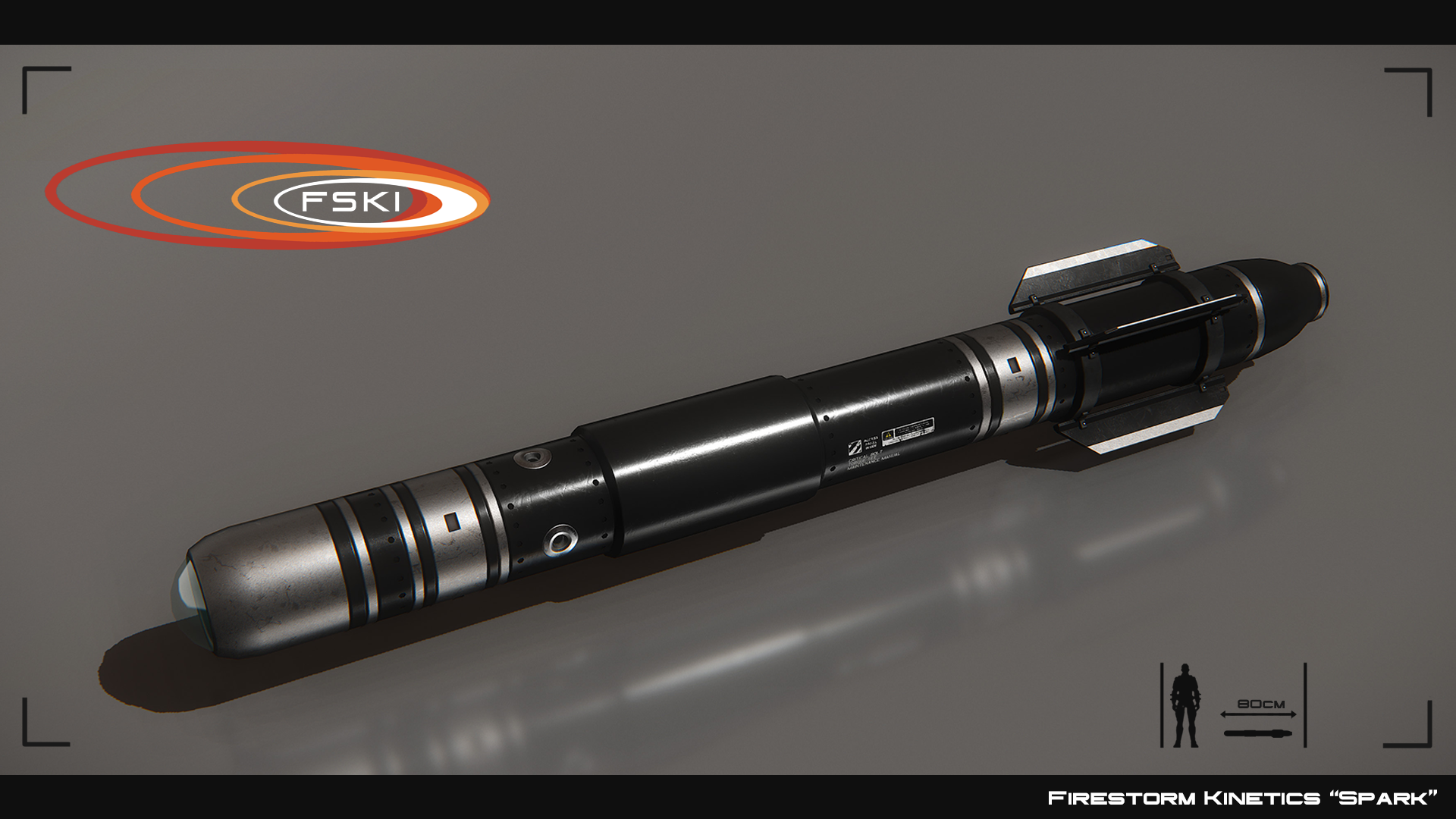
The Dar'jetii'aad Oya'karur was designed as be used against both low-flying and ground-based Sithspawn in particular but all high priority organic targets. This missile was designed using the company's newer missile framework giving it an extremely impressive speed and maneuverability, a low sensor signature and notably excellent detection, targeting and tracking capabilities. In addition, the missile has a large blast radius and is extremely lethal or organic matter it comes into contact with, almost always resulting in "complete biomass conversion".
Unfortunately, appropriately protected targets such as those in sealed armor or vehicles will be unaffected by the Trihexalon. Additionally, at extremely low temperatures, Trihexalon becomes inert, making this missile useless to deploy in environs with such conditions. Finally, though well protected against EMP and Ion damage, should any damage bypass its defenses, the missile's electronics would likely be fried.
Out Of Character Info
Intent:
To create a new guided trihexalon missile for use and sale by Breshig War Forge Consolidated and for use by Strill Securities.
Image Source(s):
https://www.artstation.com/artwork/dOyrX
Canon Link:
N/A.
Permissions:
N/A.
Primary Source(s):
Technical Information
Affiliation:
Breshig War Forge Consolidated and Strill Securities.
Model:
Dar'jetii'aad Oya'karur-class Brilliant Trihexalon Missile
Modular:
Yes
Material:
See description.