

H E G E M O N



- Intent: To fill the world of Vandemar with interesting and diverse life that is intriguing to roleplay with.
- Image Credit:
- Canon: N/A
- Permissions: N/A
- Links: Vandemar
GENERAL INFORMATION
- Name: Varkhai
- Designation: Semi-sentient
- Origins: Vandemar; deep forests, forest margins and upland woodlands
- Average Lifespan: 16–24 standard years
- Estimated Population: Planetary; scattered in stable packs across Vandemar's major forest belts
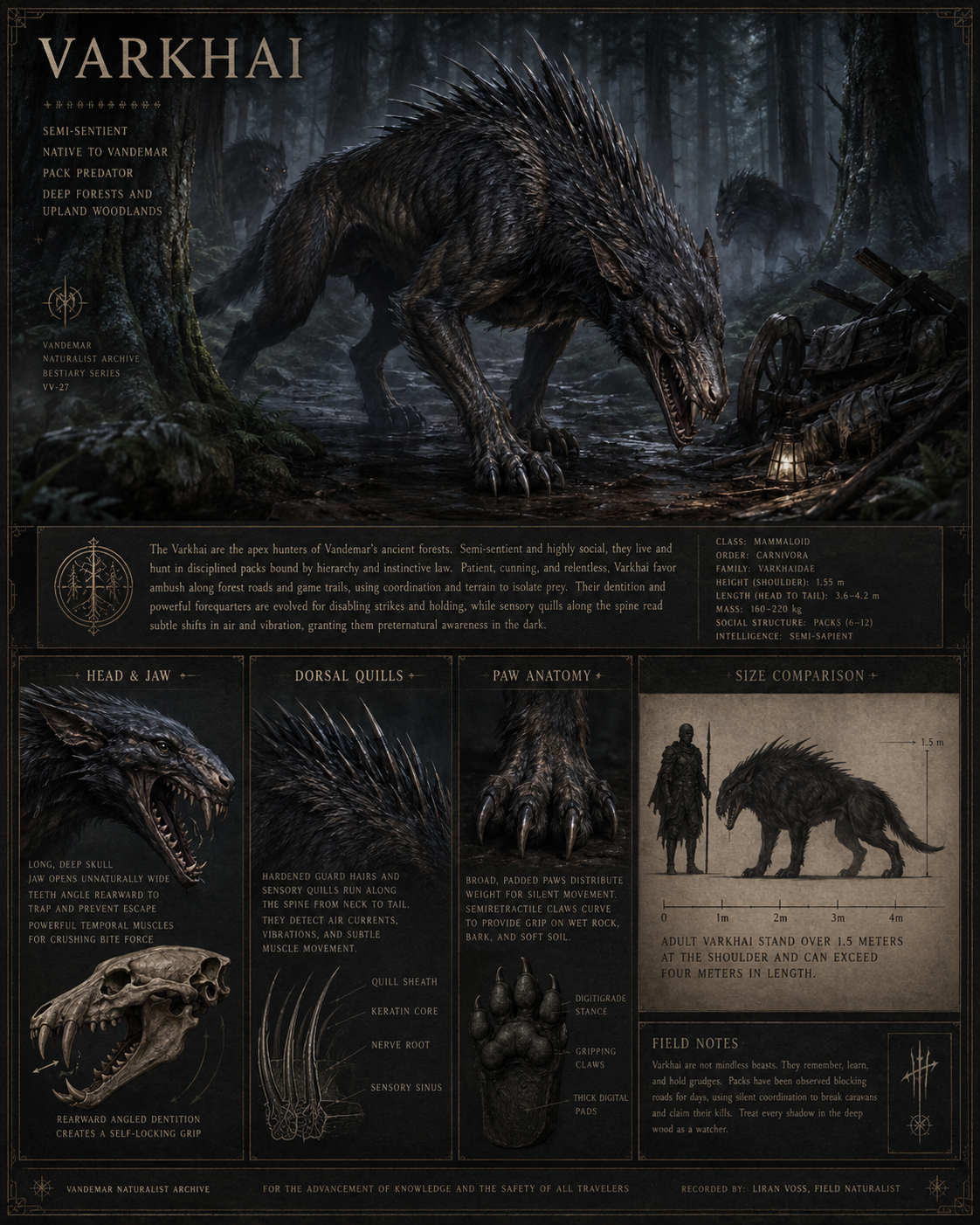
- Description: The varkhai is one of Vandemar's most feared pack predators: a black-furred, heavily built hunter that moves through the forest with unnerving discipline. It does not kill by blind ferocity alone. Varkhai packs test boundaries, study prey and strike where fear or disorder has already opened the first wound. In the deep woods, many travellers hear them long before they see them—then realise, too late, that the sound came from the wrong direction.
PHYSICAL INFORMATION
- Breathes: Type I atmosphere
- Average Height of Adults: 1.2–1.6 metres at the shoulder
- Average Length of Adults: 2.1–3 metres
- Skin color: Dark grey, black or ash-brown beneath the coat
- Hair color: Black, charcoal, dark brown or iron-grey
- Distinctions: Varkhai possess a broad chest, a lowered forward-heavy posture and powerful forequarters built for short violent bursts rather than prolonged pursuit. The skull is elongated yet unusually deep through the jaw, allowing the mouth to open wider than that of most canid analogues. Overlapping teeth angle backward toward the throat, making escape from a bite extremely difficult. Along the spine runs a line of sensory quills or hardened guard hairs that rise when the animal is alarmed, agitated or preparing to strike. Their paws are broad and quiet on damp ground, with retractable gripping claws used for broken terrain and sudden lunges. Females are leaner and slightly smaller on average, though often faster and more agile in dense forest. Older specimens show scar-mapping around the muzzle, worn quills and silvering along the shoulders.
- Races: None formally recognised. Northern varkhai are larger, denser-coated and darker, while lowland packs are longer-limbed and somewhat lighter in build.
- Force Sensitivity: Non-Sensitive
- Highly coordinated pack hunting and ambush behavior
- Powerful bite with excellent hold retention
- Strong situational memory and rapid adaptation to terrain and routine prey patterns
- Limited endurance in long pursuits
- Vulnerable eyes, nose and inner mouth
- Strong territorial instincts can make them predictable near denning grounds
CULTURE
- Diet: Carnivore. Varkhai feed primarily on herd animals, smaller predators, carrion and isolated prey of opportunity. They prefer fresh meat but will scavenge in winter. Certain resinous forest plants and several Techwright deterrent compounds are toxic or highly aversive to them.
- Communication: Growls, low barks, huffs, tail and ear posture, raised dorsal quills, scent marking and sub-audible throat vibrations used for close pack coordination.
- Technology level: None.
- Religion/Beliefs: None.
- General behavior:Varkhai live in organised packs usually led by a dominant breeding pair, though older packs may contain several related adults sharing authority by habit and seniority. They defend established hunting ranges and denning sites with great persistence. Unlike simpler pack predators, varkhai often observe a target before attacking, circling downwind, testing reactions and exploiting confusion. They prefer to separate the weak from the whole and strike from cover rather than commit to a frontal rush. Pups are raised communally and begin learning ambush behaviour early through staged play and controlled feeding rituals. Packs are most active at dusk, night and early dawn, though hunger or weather can drive them into daylight hunts.
HISTORICAL INFORMATION
The varkhai is widely believed to be a native Vandemarian apex predator, though some Techwright schools argue that it may descend from an early engineered war-hound or an ancient imported hunting species that reverted to the wild long before recorded history. Whatever its origin, it has been part of Vandemar's forest ecology for as long as surviving records can meaningfully trace.
For frontier settlements, the varkhai was never merely dangerous wildlife. It was one of the first tests of whether a community truly held its ground. Stock walls, watchfires, patrol routes and forest roads were all shaped in part by the need to deny packs concealment and access. Many early knightly orders cut their teeth hunting varkhai that had begun preying on roads, pilgrims or isolated thorps.
Extermination was attempted more than once and failed every time. Packs withdrew, adapted and returned, while the disappearance of varkhai from several regions caused explosive growth among smaller predators and herbivore damage to forest margins. Modern Vandemar therefore manages rather than eradicates them. A pack that remains within the wild is tolerated; a pack that learns to feed on settlements is marked, hunted and remembered. In the old knightly tradition, a slain varkhai alpha is not displayed as a trophy of conquest, but as proof that the boundary between forest and hearth has been restored.