

H E G E M O N




Vandemar Planet Sub
- OUT OF CHARACTER INFORMATION
-
- Intent: To create a new planet in an empty corner of the Unknown Regions with a well developed civilisation and a unique twist on its connection to the Force and Netherworld.
- Image Credit:
- Canon: N/A
- Permissions: N/A
- Links: [ Provide links to any relevant threads, characters, companies, locations, etc here. Canon or otherwise. Especially obscure references, or events important to the submission.]
- GENERAL INFORMATION
-
- Planet Name: Vandemar
- Demonym: Vandemarian
- Region: Unknown Regions
- System Name: Vandemar
- System Features
-
The Vandemar System is a mature, resource-rich stellar system arranged around a stable yellow-white star known as Ilyrion. Vandemar occupies the principal habitable orbit and is the only naturally temperate world, but the surrounding planets, moons and debris fields have been developed into a tightly integrated strategic domain.
The system is not fully urbanised. Large parts remain industrially useful but physically hostile, while the outer reaches contain lightly charted moons, ancient debris and isolated monitoring stations. Its overall character is that of a fortified heartland rather than a crowded metropolitan system.
Ilyrion
Classification: Yellow-white main-sequence star
Official designation: Stella Ilyrionis
Ilyrion is slightly hotter and brighter than the average yellow star but remains stable enough to support Vandemar's temperate climate. Its radiation and magnetic cycles are carefully monitored because fluctuations affect the planet's climate-control systems, orbital infrastructure and hyperspace navigation.
The star has considerable cultural significance. In Low Vandemarian poetry, Ilyrion represents constancy, distance and the light by which rightful paths are found. It is not worshipped, but appears frequently in knightly heraldry, naval insignia and legal symbolism.
The Crown of Vandemar
The most prominent artificial feature of the system is the incomplete orbital ring surrounding Vandemar.
Its official name is the Corona Orbitalis Vandemaria, though it is usually called the Crown of Vandemar, the Broken Crown or simply the Crown.
The Crown does not form a continuous band. It consists of several immense arc-segments occupying synchronised orbital paths around the planet. These sections are separated by broad gaps containing smaller stations, defence platforms and controlled transit corridors. The arcs are not identical. Each was constructed for a different strategic function.
- The Palatine Arc: The Palatine Arc is the principal command and military segment. It contains fleet-control centres, strategic communications arrays, officer academies, secure docks and command facilities capable of coordinating defence across the entire system. Its outer surface is comparatively austere: armour, sensor vanes and defensive emplacements dominate its profile. The inhabited interior contains barracks, command chambers, protected gardens and residential quarters for permanent personnel. The Palatine Arc also serves as the primary orbital approach to High Vandemar. Access routes between the two are tightly restricted.
- The Draconic Arc: The Draconic Arc is the largest military harbour in orbit. Its docking spines can receive capital ships, fleet tenders and heavy transports without forcing them into lower orbital traffic. Elder Dragons capable of spaceflight require broad, unconfined arrival zones rather than conventional hangars. The Draconic Arc maintains reinforced platforms where dragons and riders can land, recover and enter pressurised facilities without moving through ordinary flight decks.
- The Maerazar Arc: The Maerazar Arc is the principal industrial and repair section. It is connected directly to planetary freight routes and receives components from the Maerazar Forges, asteroid mines and outer-system extraction stations. Its interior holds fabrication lines, armour foundries, reactor workshops and deep repair docks. Ships too damaged to descend toward the planet are stabilised and reconstructed there. Although primarily military, it also services major civilian vessels under Hegemonic licence.
- The Vaelora Arc: The Vaelora Arc handles logistics, provisions and controlled commercial traffic. Vast storage vaults contain food, fuel, medical supplies, ammunition and replacement machinery sufficient to support prolonged system-wide mobilisation. Civilian ships entering Vandemar generally pass through the Vaelora Arc for inspection, quarantine and customs processing. It is the most publicly accessible segment of the Crown, though still heavily militarised by wider galactic standards.
The Palatine Star Fortresses
Several star fortresses occupy high orbit beyond the Crown. Each is an armoured monolith no larger than approximately five kilometres along its longest dimension. Collectively they are known as the Palatine Bastions. There are six principal fortresses, traditionally associated with the six civilian gods. They are not temples. Their names provide a familiar cultural framework for the six defensive responsibilities surrounding Vandemar. The fortresses are positioned so that their fields of fire overlap the Crown, planetary approaches and major hyperspace emergence zones. Their most important purpose is not merely to destroy enemy vessels. They divide an approaching fleet, force it into predictable corridors and prevent it from concentrating against any single part of the Crown. A seventh command authority exists within the Palatine Arc under the Hegemon, mirroring the political symbolism of the Six and the Seventh without creating an additional fortress.
The Moons of Vandemar
Vandemar possesses two substantial moons and one small captured satellite.
- Aelyra
Official designation: Luna Aelyra
Type: Large silicate moon
Aelyra is the largest moon and the brightest object in Vandemar's night sky. Its pale surface is marked by broad mountain ranges, dark volcanic plains and several deep impact basins. Its gravity stabilises Vandemar's axial tilt and contributes significantly to the planet's ocean tides. The moon's visible face is only lightly developed, preserving the appearance recognised throughout Vandemarian history. Most industrial activity occurs on the far side or beneath the surface. Culturally, Aelyra is associated with vigilance, memory and the distant watch. Knightly traditions frequently describe it as the shield held above Vandemar during the night. - Vaelion
Official designation: Luna Vaelionis
Type: Smaller geologically active moon
Vaelion is darker, denser and more geologically active than Aelyra. Its surface contains extensive fault lines, lava tubes and metallic deposits. Most settlements are subterranean because of radiation exposure and tectonic instability. Vaelion also serves as a military training ground. Its low gravity, caverns and broken terrain allow troops to practise boarding operations, subterranean warfare and combat under hostile environmental conditions. Old sections of the moon contain abandoned mines and sealed research sites dating to the earliest centuries of settlement. Some remain unexplored. - The Shard
Official designation: Satelles Fractus
Type: Captured irregular satellite
The Shard is a narrow, uneven asteroid captured into distant orbit around Vandemar. It may be the remnant of a larger body destroyed during the system's early formation. It contains little conventional value but occupies a useful position for passive surveillance. The Shard holds a concealed monitoring station, emergency beacon and hardened communications relay. It also acts as a navigational marker for ships approaching Vandemar from the outer system. Among spacers, it has acquired an ominous reputation because its shadowed clefts interfere with short-range sensors.
The Inner System
- Zharael
Official designation: Zharael Primus
Type: Airless metallic world
Zharael is the innermost planet, a scorched and heavily cratered world rich in iron, nickel, tungsten and rare refractory metals. Its proximity to Ilyrion makes surface operations difficult, but also allows immense solar-energy collection. Zharael's furnaces produce materials that would be expensive to refine elsewhere. Most of the workforce operates from shielded subterranean installations or remote orbital platforms. The planet is sometimes called the First Forge. - Calystron
Official designation: Calystron Secundus
Type: Dense cloud-covered world
Calystron is a high-pressure planet wrapped in thick grey-white clouds. Its surface is hot, chemically hostile and largely hidden from orbit. The upper atmosphere, however, contains valuable gases and complex chemical compounds. Floating extraction stations remain suspended above the most dangerous pressure layers. Its violent storms and limited visibility make it a common testing ground for atmospheric craft and sensor systems. The world has never been permanently settled on its surface. - Vandemar
Official designation: Vandemara Tertia
Type: Temperate terrestrial world
Vandemar is the third planet of the system and the centre of the Hegemony. Its climate, biosphere and cultural geography distinguish it sharply from the surrounding hostile worlds. Its orbital position is carefully protected. Civilian traffic, mining vessels and bulk transports are generally routed through the Crown rather than permitted to approach the atmosphere directly.
The Crownfall Belt
Beyond Vandemar lies a broad asteroid field known as the Crownfall Belt. The belt is believed to be the remains of one or more failed planetary bodies shattered during the early development of the system. It contains a mixture of metallic, silicate and carbon-rich asteroids. The Crownfall Belt is the principal raw-material reserve of the Vandemar System. Large asteroids have been hollowed into mining settlements, storage depots and military anchorages. The belt is not uniformly controlled. Major transit lanes are mapped and patrolled, but deep regions remain dangerous because of unstable asteroid clusters, abandoned extraction stations and concealed pirate or smuggler routes from earlier centuries. Several knightly and naval orders conduct patrols there. The belt's confined spaces and unpredictable movement make it a valued training environment for fighter pilots.
- The Broken World: At the densest point of the Crownfall Belt lies a large fragment known as Maeroth. Maeroth may once have formed part of a dwarf planet. Its fractured interior contains unusually pure mineral seams and vast hollow chambers produced by ancient geological stresses. Some chambers show signs of artificial alteration predating Vandemarian settlement. Their origin remains disputed. Maeroth has become one of the system's most important mining and archaeological sites.
The Outer System
- Oryndrax
Official designation: Oryndrax Quartus
Type: Gas giant
Oryndrax dominates the outer system. It is a blue-grey gas giant surrounded by narrow rings and numerous moons. Its upper atmosphere contains valuable hydrogen isotopes, rare gases and compounds used in advanced propulsion systems. Vast skimming platforms descend into the upper cloud layers to collect them. The planet's storms are immense and long-lived. One polar vortex has persisted throughout recorded Vandemarian history. Oryndrax is culturally associated with endurance, hidden depth and power held beneath apparent stillness.- Important Moons of Oryndrax
- Thalyra: Thalyra is a cold ocean moon covered by a thick ice shell. Beneath it lies a global saltwater sea warmed by tidal forces. Subsurface habitats study the moon's marine ecosystem and extract unusual biological compounds. Several enormous lifeforms have been detected in the deeper ocean, though none are known to be sentient. Its under-ice settlements are among the most isolated inhabited locations in the system.
- Zaryx: Zaryx is a volcanic moon marked by lava plains, sulphur basins and constant tectonic movement. It supplies industrial minerals and geothermal energy but remains dangerous even by Vandemarian standards. Mining facilities are mobile or heavily reinforced because stable ground is rare. Zaryx is also used for extreme-environment testing of armour, vehicles and industrial machinery.
- Ilyratha: Ilyratha is a small, pale moon with a thin atmosphere and extensive crystalline plains. Its surface reflects light strongly, making it visible as a shifting point near Oryndrax. The crystals have valuable optical and sensor applications. Several Techwright institutions maintain research stations there.
- Voryn: Voryn is Oryndrax's outermost major moon and hosts a large naval station. Its orbit gives it an excellent view of incoming traffic from the system's edge.The moon functions as the outer fleet's principal resupply point and the first major defensive position before an approaching vessel reaches Vandemar.
- Important Moons of Oryndrax
- Naethor
Official designation: Naethor Quintus
Type: Cold outer planet
Naethor is a dark, distant world with a thin atmosphere, frozen plains and deep canyon systems. Its orbit lies near the practical edge of the settled system. The planet receives little sunlight. Geothermal vents sustain isolated underground ecosystems and provide power for monitoring stations. Naethor is important because the local boundary with the Netherworld appears unusually unstable. The effect is weaker than on Morothar but more concentrated than on most of Vandemar. Personnel stationed there serve limited rotations because of persistent dreams, auditory distortions and psychological strain. Naethor is not considered corrupted, but it is watched closely. - The Outer Cometary Halo
Beyond Naethor lies a dispersed halo of ice, rock and dormant comets. The region is known collectively as the Ilyrian Veil. Most bodies are insignificant, but several long-period comets have become culturally notable. The most famous is Zildrog's Spear, a dark comet that enters the inner system at long intervals. Its passage has historically coincided with heightened animal agitation, strong tides and increased activity around known Veil sites. No causal connection has been conclusively established.The outer halo also conceals small listening posts and fuel caches intended to support patrols beyond the recognised system boundary.
- Location: Red Dot, Super Hex Unknown Regions
- Major Imports: Rare Raw Materials, Exotic Isotopes, Foreign Technologies, Biological Specimens, Luxury Goods, Cultural Artefacts, Strategic Intelligence, Specialist Knowledge
- Major Exports: Advanced Technology, Starships, Military Equipment, Refined Alloys, Genetic Engineering, Medical Technology, Cybernetics, Industrial Machinery, Foodstuffs, Luxury Craftsmanship
- Unexploited Resources: Deep-Core Mineral Deposits, Unmapped Asteroid Lodes, Cometary Water Ice, Exotic Atmospheric Gases, Rare Isotopes, Geothermal Energy, Subglacial Biomaterials, Xenobiological Compounds, Ancient Technologies, Veil-Resonant Materials
- GEOGRAPHIC INFORMATION
-
- Gravity: Standard
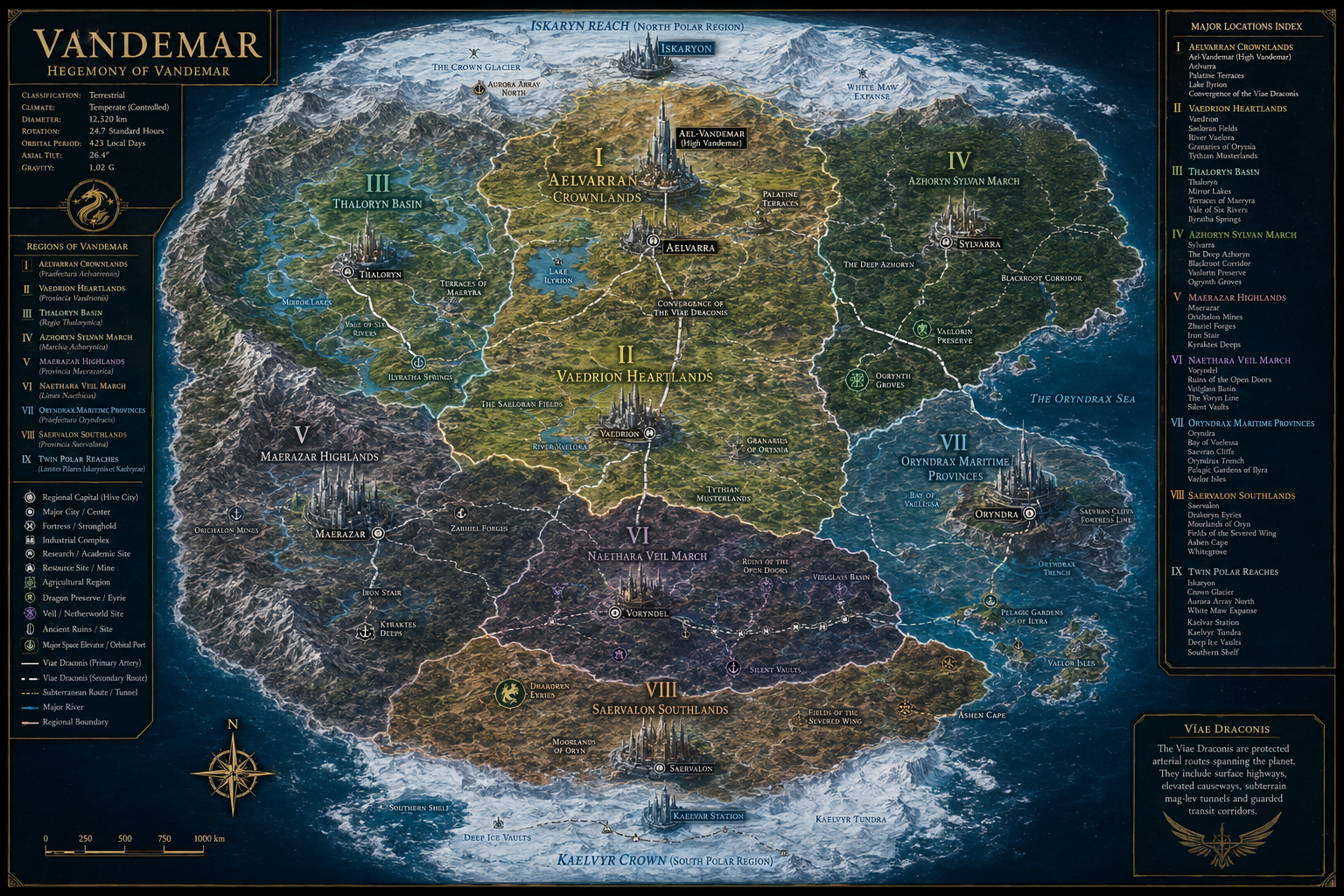
- Climate: Temperate, Controlled. Vandemar possesses broad cool-to-mild climate bands, with warm-temperate equatorial regions rather than tropical zones and no true deserts. Seasons remain pronounced, especially across the continental interiors, while the oceans moderate the coasts. Subpolar climates gradually give way to permanent frozen caps. Planetary climate regulation stabilises rainfall, storm patterns and glacial balance without eliminating natural seasonal variation.
- Primary Terrain: Oceans, ancient forests, grasslands, plains, mountain ranges, deep valleys, river basins, lakes, wetlands, tundra and polar ice. Much of the land is divided by extensive mountain chains and broad forested lowlands, with fertile plains concentrated around major river systems. The coasts vary between sheltered bays, rocky cliffs and cold maritime shelves, while the polar regions consist of tundra, glaciers and permanent ice.
- Atmosphere: Type I
- LOCATION INFORMATION
-
- Capital City: High Vandemar
- Planetary Features: Mix of Wild, Rural and Urban. Vandemar's population is concentrated within immense, vertically layered metropolitan regions, leaving vast forests, plains and mountain wilderness largely intact. The planet is crossed by the Viae Draconis, fortified high-speed transit arteries linking provincial centres through tunnels, elevated causeways and protected forest corridors. Mountain ranges contain the Maerazar Forges, industrial complexes excavated deep into entire massifs, while coastal shelves and ocean trenches hold submerged power stations, shipyards and climate-regulation arrays.
Above the surface hangs Ael-Vandemar, an interconnected expanse of repulsor-supported palace districts, gardens and defensive platforms commonly called High Vandemar. Elsewhere stand isolated knightly citadels, polar observatories, sealed Netherworld-monitoring stations and abandoned settlements from earlier colonisation eras. Ancient Zakuulan installations and partially understood Iokath-derived structures remain buried beneath forests, mountains and seabeds, while restricted draconic preserves protect nesting grounds inaccessible to ordinary travel.
- Major Locations
-
I. The Aelvarran Crownlands
Official: Praefectura Aelvarrensis
The Crownlands occupy a broad, elevated basin near the planetary temperate centre. Sheltered by distant mountain chains and fed by several rivers, the region forms Vandemar's political and infrastructural core. Its countryside alternates between parkland, cultivated estates, managed woodland and densely connected metropolitan zones.
- Ael-Vandemar — High Vandemar: The planetary capital, suspended above the Crownlands upon immense repulsorfields. High Vandemar consists of interconnected palace precincts, government districts, gardens, defensive platforms and ceremonial spaces, forming an artificial realm in the sky rather than a conventional city.

- Aelvarra: Aelvarra is the greatest surface city on Vandemar, an immense forest of spires standing directly beneath High Vandemar. Its tallest towers disappear into the lower cloud layers, surrounding vast civic forums, vertical gardens and monumental transit shafts. Successive districts descend deep beneath the Crownlands, where freight systems, reservoirs and older foundations support the city above. Aelvarra functions as the practical capital of the planet: denser, louder and more populous than High Vandemar, yet permanently overshadowed by it.
- The Palatine Terraces: A succession of raised hills, monumental gardens, reservoirs and fortified approaches surrounding Aelvarra. The Terraces visually and physically separate the capital from the wider basin while also carrying water, power and transit toward High Vandemar.
- Lake Ilyrion: A vast clear-water lake west of Aelvarra, fed by mountain rivers and carefully maintained wetlands. It provides water for the capital region and is surrounded by old estates, academic retreats and protected shore forests.
- The Convergence of the Viae Draconis: The principal intersection of Vandemar's planetary transit system. High-speed lines arriving from every major region divide beneath the Crownlands into subterranean passenger routes, freight arteries and military approaches.
II. The Vaedrion Heartlands
Official: Provincia Vaedrionis
The Vaedrion Heartlands are Vandemar's broadest area of open country. They consist of river-fed plains, gentle hills and temperate grasslands extending across much of the central continent. Although intensely cultivated, the region retains hedgerows, forest islands, wetlands and long corridors for migrating wildlife.
- Vaedrion: Vaedrion rises from the meeting point of three rivers as a broad cluster of terraced spires. Its lower levels contain markets, warehouses and river ports, while residential and administrative districts climb upward around immense distribution towers. Agricultural goods from across the Heartlands move through subterranean freight channels beneath the city before being dispatched to the rest of Vandemar. From the surrounding plains, Vaedrion appears as a solitary mountain of metal and pale stone above an otherwise open horizon.
- The Saeloran Fields: Vandemar's largest continuous agricultural zone. Grain, fruit, vegetables and high-protein crops are produced through precision cultivation, while broad uncultivated strips preserve soil health and provide routes for native fauna.
- The River Vaelora: One of the planet's longest navigable rivers, flowing from the Maerazar Mountains to the eastern ocean. Its floodplain forms the agricultural spine of the region and supports numerous old towns, irrigation works and inland ports.
- The Granaries of Oryssia: A dispersed system of fortified silos, subterranean food vaults and processing centres. Their reserves are intended to sustain large sections of the planet through crop failure, war or another climate catastrophe.
- The Tythian Musterlands: Vast open plains reserved for military reviews, large-scale exercises and the assembly of planetary levies. Outside periods of mobilisation, much of the land is used for controlled grazing and seasonal agriculture.
III. The Thaloryn Basin
Official: Regio Thalorynica
The Thaloryn Basin lies between the Crownlands and the western mountains. It is a mild region of deep valleys, broad lakes and forested hills, protected from the harshest continental weather by the surrounding highlands.
- Thaloryn: Thaloryn is built along the ridges surrounding its great lake, with slender towers ascending in overlapping tiers from the water's edge. Bridges span between the higher spires, while canals, enclosed gardens and academic precincts occupy the shaded lower levels. Its vertical form is elegant rather than oppressive, with much of the city faced in pale stone, glass and reflective alloys. The highest towers overlook both the Mirror Lakes and the deep valleys beyond, making Thaloryn one of Vandemar's most visually refined metropolitan capitals.
- The Mirror Lakes: A connected chain of long, narrow lakes occupying glacial valleys. Their unusually still waters reflect the surrounding mountains and support fisheries, waterborne transport and numerous smaller settlements.
- The Terraces of Maeryra: Vast stepped orchards, vineyards and gardens constructed along the southern hills of the basin. The region supplies fruit, oils, wines and medicinal plants to much of Vandemar.
- The Vale of Six Rivers: A fertile lowland where six waterways descend from separate mountain valleys before joining the Thaloryn lakes. The area is divided by old stone embankments, bridges and woodland strips, creating a densely cultivated but visually green landscape.
- The Ilyratha Springs: A series of geothermal springs and mineral-rich caverns beneath the northern basin. They support medical institutions, thermal power facilities and ancient public bathing complexes.
IV. The Azhoryn Sylvan March
Official: Marchia Azhorynica
The Azhoryn March contains the largest surviving expanse of uninterrupted old-growth forest on Vandemar. Its inhabited areas are limited to fortified towns, river settlements, knightly strongholds and carefully controlled transport corridors. Beyond them lies a wilderness capable of swallowing entire expeditions.
- Sylvarra: Sylvarra rises from a vast clearing within the Azhoryn forest, its fortified spires standing like artificial trunks among the surrounding ancient trees. The city's outer towers form a defensive ring, connected by elevated walls and sensor barriers designed to withstand attacks from large predators. Habitation, laboratories and knightly precincts occupy the upper levels, while the lower city contains armouries, shelters and secured access to the forest roads. Beyond its walls, the canopy closes almost immediately, making Sylvarra appear as a single luminous stronghold surrounded by endless wilderness.
- The Deep Azhoryn: The central forest, where the oldest trees rise high enough to conceal the ground from aerial observation. Large areas remain only partially surveyed, and some routes are deliberately omitted from public maps.
- The Blackroot Corridor: A fortified transit route cut through the southern forest. Sonic barriers, elevated bridges and armed waystations allow civilian movement without dividing the surrounding ecosystem into isolated fragments.
- Vaelorin Preserve: A protected wilderness containing several of Vandemar's most dangerous natural predators. Knightly orders use its outer regions for field training, while entry into the interior requires special charter or scientific authorisation.
- The Ogrynth Groves: A broad region of broken woodland shaped by generations of forest titans. Fallen trees, open meadows and dense fungal beds form a constantly changing ecosystem inhabited by some of the planet's largest natural animals.
V. The Maerazar Highlands
Official: Provincia Maerazarica
The Maerazar Highlands form Vandemar's principal mountain spine. Snow-covered peaks overlook deep forested valleys, while much of the region's industry lies within the mountains rather than across their surface.
- Maerazar: Maerazar is both a hive city and a mountain complex. Its visible spires emerge directly from several adjoining peaks, connected by bridges, rail lines and immense industrial apertures cut into the rock. The majority of the city lies inside and beneath the mountains, where manufactories, foundries and residential vaults extend through thousands of internal levels. Smoke, steam and heat shimmer rise between the towers, while freight columns descend into the valleys or vanish into subterranean routes. Maerazar does not stand upon the mountains; it has consumed and inhabited them.
- The Orichalon Mines: An interconnected network of mineral workings extending beneath several mountain chains. They produce rare metals, crystalline compounds and industrial minerals essential to Vandemarian armour, starships and repulsor technology.
- The Zhariel Forges: A series of immense foundry complexes built around geothermal vents. Entire warship components and structural sections are manufactured within the mountains before being transported through subterranean freight lines.
- The Iron Stair: An ancient ascending road and rail system crossing the central range. It passes through tunnels, cliffside stations and fortified bridges before reaching the highest inhabited valleys.
- The Kyraktes Deeps: Cavern systems beneath the eastern mountains inhabited by vast colonial arthropods. Controlled extraction teams harvest valuable chitinous materials, but entire sections remain sealed when colonies become too aggressive to manage safely.
VI. The Naethara Veil March
Official: Limes Naethicus
The Naethara March occupies broken highlands beyond the Maerazar chain. Its forests are thinner, its valleys narrower and its terrain frequently disturbed by ancient geological and Netherworld phenomena. The region contains many of Vandemar's most heavily restricted zones.
- Voryndel: Voryndel is a heavily fortified spire-city built upon a plateau overlooking the Naethara March. Its towers are thick, angular and separated by defensive voids, creating overlapping fields of fire across the surrounding highlands. Much of the population lives within sealed inner levels protected by reality-stabilisation systems and layered containment fields. Observation masts and sensor pinnacles rise above the main spires, constantly monitoring the Veil March. Voryndel resembles a city designed to endure a siege from something that may not approach through conventional space.
- The Ruins of the Open Doors: The remains of several settlements lost during the Night of Open Doors. Much of the area remains geometrically unstable, with structures occasionally connecting to spaces that should not exist within them.
- The Veilglass Basin: A broad depression filled with dark, glass-like mineral formations produced during an ancient rift event. The formations interfere with sensors and sometimes resonate with nearby Force phenomena.
- The Voryn Line: A chain of fortresses, observation towers and reality-stabilisation stations extending across the most active part of the March. It is less a conventional defensive wall than a network for detecting and containing breaches before they reach populated regions.
- The Silent Vaults: Subterranean containment facilities constructed beneath isolated mountain plateaus. They hold corrupted artefacts, biological specimens and technologies considered too dangerous for ordinary research institutions.
- The Pale Forest: A cold upland woodland where the trees possess unusually light bark and sparse foliage. The forest is biologically natural, but prolonged exposure produces disorientation, making it a frequent site of disappearances and false Great Beast reports.
VII. The Oryndrax Maritime Provinces
Official: Praefectura Oryndracis
The Oryndrax Provinces encompass Vandemar's most heavily settled coastline, several large islands and the cold inner sea separating the central and western landmasses. Sheltered bays alternate with steep cliffs, tidal wetlands and deep maritime trenches.
- Oryndra: Oryndra climbs from its sheltered bay in successive vertical tiers. The lowest levels extend into the water as docks, submerged shipyards and tidal installations, while commercial and residential spires rise from the cliffs behind them. Vast freight lifts carry cargo directly between the harbour, upper city and orbital traffic networks. Bridges connect towers across the bay, and several districts stand upon artificial marine platforms. Seen from the ocean, Oryndra appears as a wall of illuminated spires growing directly from the coast.
- The Bay of Vaelessa: A vast sheltered bay containing floating districts, fisheries and tidal power installations. Its comparatively calm waters make it one of the safest natural anchorages on the planet.
- The Saevran Cliffs: A long wall of black and grey cliffs occupied by immense colonies of coastal predators. Numerous fortresses, signal towers and aerodromes have been constructed upon the upper ridges.
- The Oryndrax Trench: A deep ocean channel inhabited by sea wyrms and other marine megafauna. Submerged monitoring stations track the animals as well as unusual activity from deeper fissures.
- The Pelagic Gardens of Ilyra: Extensive offshore cultivation zones producing algae, shellfish, medicines and industrial biological compounds. They are arranged to function as artificial reefs rather than sterile production platforms.
- The Vaelor Isles: A scattered island chain covered by wind-shaped forests and old coastal strongholds. The islands traditionally supply navigators, naval officers and maritime knights.
VIII. The Saervalon Southlands
Official: Provincia Saervalona
The Southlands are a cool maritime region of rain-fed plains, dense forests, upland moors and rugged southern coasts. They are less densely populated than the Heartlands but contain some of Vandemar's oldest noble estates and draconic territories.
- Saervalon: Saervalon stands around a storm-battered southern estuary, its towers built upon immense stone foundations driven deep into the coastal bedrock. The spires are narrower at their upper levels and reinforced against powerful winds, giving the city a severe, lance-like silhouette. Enclosed bridges and interior transit routes allow the population to move without exposure during storms. Noble citadels, knightly keeps and draconic observation platforms occupy the higher districts, overlooking the moorlands and distant nesting territories.
- The Drakoryn Eyries: A chain of remote mountain and cliff territories recognised as protected nesting grounds of the Elder Dragons. Entry is forbidden without the consent of the resident dragons or the institutions charged with maintaining the First Concord.
- The Moorlands of Oryn: Vast windswept uplands covered in grass, low shrubs and scattered forests. They are used for pastoral farming, military manoeuvres and the traditional trials of several knightly orders.
- The Fields of the Severed Wing: The principal battlefield of the Dragonblood Schism on Vandemar. The region remains marked by ruined fortifications, melted stone and memorial pillars recording both loyalist and rebel dead.
- Ashen Cape: The southern headland from which many defeated Dragonblooded rebels escaped toward Morothar. The cape is now crowned by a watch-fortress and a permanent memorial to the broken oaths of the exiles.
- Whitegrove: A broad southern forest of pale-barked trees adapted to cold rain and salt-bearing winds. It is less ancient than the Azhoryn but exceptionally dense, with numerous ravines and concealed nesting valleys.
IX. The Twin Polar Reaches
Official: Limites Polares Iskarynis et Kaelvyrae
Vandemar's two polar regions are administered separately but treated together in planetary geography. Both contain permanent ice, subpolar tundra and long seasonal darkness, though the northern Iskaryn Reach is more mountainous while the southern Kaelvyr Crown is dominated by broad ice shelves and glacial plains.
The Iskaryn Reach
- Iskaryon: A fortified polar settlement built partly beneath the northern ice. It coordinates scientific research, mineral extraction and the defence of northern approaches.
- The Crown Glacier: The largest northern ice formation, descending from the polar mountains toward the sea in a series of immense frozen terraces.
- The White Maw Expanse: A windswept tundra and pack-ice region known for iskaryn predators. Travel outside protected routes requires armed escort and constant thermal surveillance.
- The Aurora Array: A chain of atmospheric and astronomical monitoring stations positioned across the northern highlands. The network studies solar activity, hyperspace disturbances and changes in the planet's magnetic field.
- Kaelvar Station: The principal southern settlement, positioned above a deep geothermal basin beneath the ice. It serves as a supply centre for remote laboratories and polar defence installations.
- The Kaelvyr Tundra: A broad subpolar grassland surrounding the southern ice cap. Migratory herds cross the region during the brief summer, followed by predators and seasonal hunting parties.
- The Deep Ice Vaults: Secure archives and preservation facilities bored into ancient glacial layers. Biological samples, seed stocks, records and strategic reserves are stored there because of the region's natural isolation.
- The Southern Shelf: A vast floating ice shelf extending over the polar sea. Submerged research stations beneath it monitor marine ecosystems and deep geological fissures.
- Force Nexus:
- Intent: The Nexus is an integral part of the planet's and civilisation's story, providing an intriguing backdrop and interesting phenomenon to be further explored in roleplay.
- Nexus Name: N/A
- Nexus Alignment: Other - A rift to the Netherworld and Chaos. Vandemar sits at a strange crossroads between the Netherworld and Real Space, where the border that separates the two planes is very thin and often disappears completely. It is more prominent in some regions but can affect all regions.
- Size: Planetary
- Strength: Strong
- Accessibility: Its permanent regions, as in those that are suffering from its effects permanently, are heavily guarded and protected. They are not easily accessible but the protection is against what comes from there, not what ventures towards it.
- Effects: Vandemar's Nexus is not a single concentrated point, but a planetary thinning of the boundary between realspace and the Netherworld. Across most of the world its influence is subtle: dreams become unusually vivid, strong emotions linger in places where they were repeatedly felt, and Force-sensitive beings perceive distant presences or momentary echoes that have no clear physical source. Animals are more perceptive of danger, while certain predators display heightened aggression, territoriality and unnatural awareness during periods of instability.
In regions where the Veil is weakest, the effects intensify. Travellers may experience distorted distance, repeated sounds, false memories, glimpses of absent people or paths that appear to lead somewhere impossible. Fear, anger and grief are amplified more readily than calm emotions, making the Nexus dangerous to those lacking discipline. It does not automatically corrupt or empower the Dark Side, but prolonged exposure can erode judgement and make darker impulses easier to indulge. Conversely, trained Force-users, dragons and those accustomed to the Nexus may find their perception sharpened, their bonds strengthened and their awareness of approaching threats heightened. During major disturbances, temporary rifts, apparitions and localized alterations of space may occur, though such events remain exceptional rather than constant.
- POPULATION
-
- Native Species: Vraek, Mhyrrok, Saerith, Varkhai, Azvhor, Ogrynth, Zharrok, Maeroceros, Draevak, Vaedran Hornbeast, Thalrak, Naethmaw, Vaelisk, Kyraktes, Zaryx, Aelyr Drake, Iskaryn, Kaelvyr, Oryndrax, Saevra, Nekkaryn, Vorask, Vandemarian Great Beast, Vaelgryphs
- Immigrated Species: Elder Dragons, Nerf, Bantha, Shaak, Tauntaun
- Population: Heavy
- Demographics:
- Primary Languages: Vandemarian & Low Vandemarian
- Culture: Vandemarian culture is defined by disciplined service, technological mastery and the conviction that civilisation must be actively maintained against both internal decay and the dangers beyond the material galaxy. Society is formal, hierarchical and strongly civic-minded. Rank brings obligation rather than freedom from duty; nobles, officers, Techwrights and knights are expected to justify privilege through competence, public service and defence of the Hegemony. Daily life is highly urbanised in the great spire-cities, yet much of the population remains closely connected to provincial estates, forests, mountains and agricultural regions. Education is extensive, technical literacy is widespread and citizens are accustomed to reliable infrastructure, public order and long-term planning.
Knighthood permeates society far beyond the formal knightly orders. Oaths, heraldry, personal discipline and martial readiness shape military, civic and even professional life. Knights serve as soldiers, magistrates, beast-hunters and protectors against Netherworld incursions, commonly mounted upon native gryphons. Dragonblooded riders occupy a rarer and more politically charged position, associated with ancient bloodlines, Elder Dragons and the burden of exceptional power. Vandemarian honour is pragmatic rather than romantic: loyalty to purpose, stewardship and the fulfilment of sworn obligations matter more than rigid personal purity.
Art and architecture favour monumental scale, verticality and controlled splendour. White stone, dark metals, gold ornamentation, dragon imagery and severe geometric forms dominate public spaces. Poetry, theatre and historical epics focus on rulership, sacrifice, betrayal, great hunts and the founding catastrophes of Vandemar. Low Vandemarian is common in names, songs, oaths and cultural expression, while official Vandemarian governs law, science, technology and administration.
Popular sports include gryphon racing, mounted trials, duelling, martial games, beast-hunting competitions, naval regattas and large knightly tournaments. Public festivals often combine military reviews, historical reenactments, ceremonial feasts and competitions between regions or orders.
Religion is cultural but politically restrained. The six Zakuulan gods form the principal civilian pantheon, while Zildrog is associated with warriors, Dragonblooded and destructive strength held in service. Worship is generally private, symbolic or philosophical rather than governed by a powerful clergy. Vandemarians accept the Force as a measurable reality but strongly oppose Force religion, prophetic rule and claims of supernatural entitlement. Their proximity to the Netherworld has made them wary of beings demanding worship, however powerful they may appear.
- GOVERNMENT & ECONOMY
-
- Government: Centralised Hegemonic Principate. Vandemar is ruled by Hegemon Aurelian Sigismund through the six-member Palatine Council, with the High Curia representing knightly orders, regions, nobility and Techwright institutions.
- Affiliation: Hegemony of Vandemar
- Wealth: Wealthy. Advanced industry, abundant system resources, extensive automation and highly developed infrastructure provide broad material prosperity and strategic self-sufficiency.
- Stability: High. Vandemar is orderly, well-administered and strongly defended, with little conventional unrest. Most settled regions are safe for authorised visitors, though deep wilderness, restricted zones and Netherworld-affected territories remain dangerous.
- Freedom & Oppression: Authoritarian but regulated. Citizens possess considerable personal, commercial and cultural freedom within a strict civic hierarchy, but organised sedition, Force religions, destabilising cults and challenges to Hegemonic authority are heavily suppressed. Surveillance and legal control are strongest around strategic infrastructure, knightly affairs and Netherworld security; fear of arbitrary rule is limited, but obedience to law and public duty is expected.
- MILITARY AND TECHNOLOGY
-
- Military: Vandemar is a heavily fortified, spacefaring world protected by the Knightly Orders of the Hegemony, which collectively serve as its standing military across land, sea, air and space. Planetary defence is reinforced by the segmented Crown of Vandemar, multiple orbital star fortresses, system fleets, fortified regions and extensive civilian reserves. The Dragonblooded and their Elder Dragons form an elite strategic force, while the Indomitus Legion serves as Aurelian's centralised expeditionary army and navy for offensive operations beyond the sector.
- Technology: Far Above Galactic Standard. Vandemar combines preserved Zakuulan and Iokath-derived technology with four millennia of independent development. Advanced automation, artificial intelligence, genetic engineering, cybernetics, environmental control, orbital construction, starship production and Netherworld-containment systems are integrated throughout society. Critical infrastructure is deliberately decentralised and retains manual oversight, reflecting historic disasters caused by excessive dependence on autonomous networks. While most civilian technology is widely available, strategic systems, advanced weapons and certain Force-reactive technologies remain restricted to the Techwrights, Knightly Orders and Hegemonic government.
- HISTORICAL INFORMATION
-
History of Vandemar
I. The Gathering
In the generations following the fall of the Eternal Empire of Zakuul, Aurelian Sigismund gathered those remnants he judged capable of forming something more durable than another refugee state. His followers included former Knights of Zakuul, soldiers, administrators, engineers, physicians, farmers and scholars, together with salvaged Zakuulan machinery and selected technologies recovered from Iokath. Genetic archives, cultural records, industrial fabricators and agricultural stocks were carried alongside the population. Humans formed the majority, but Echani, Zabrak, Arkanians, Anomid, Epicanthix and Kel Dor were represented among the founders.
The expedition was united by necessity rather than identity. Some wished to restore Zakuul, others sought only safety, while ambitious officers and technical elites expected the new settlement to preserve their former privileges. Mutinies, attempted secessions and disputes over authority marked the migration. Aurelian suppressed the most dangerous factions, but recognised that obedience alone could not create a civilisation. The migrants would have to become a new people, bound to Vandemar rather than to the ruins from which they had fled. Later tradition named this departure the Vael Aelyr, the Oath of Departure.
II. The First Descent
Aurelian chose Vandemar because it was temperate, resource-rich and hidden within the Unknown Regions, far from established hyperlanes. The first settlements were distributed across river basins, coastal regions and sheltered valleys rather than concentrated in a single capital. Each colony received independent power generation, agriculture, fabrication facilities, archives and military protection. This redundancy ensured that the destruction of one settlement would not doom the entire project, but it also encouraged strong regional identities from the beginning.
The apparent fertility of Vandemar concealed an unfamiliar microbial ecology. Imported crops initially flourished before native fungi disrupted their roots and stripped them of nutritional value. Livestock sickened from trace compounds missed by early surveys, while automated systems continued reporting acceptable yields. The resulting White Famine killed thousands and forced the evacuation of several colonies. Aurelian opened military reserves, personally supervised relief and remained among the population rather than withdrawing to orbit. The disaster established Vandemar's permanent emphasis on strategic reserves, biological science and human oversight of automated systems.
III. The Founding Generations
Once immediate survival had been secured, Aurelian began the deliberate formation of Vandemarian society. Education combined technical literacy, civic law, physical discipline, history and military preparedness. Every settlement was expected to maintain its own engineers, physicians and defenders. The first children raised on Vandemar were taught that Zakuul was their origin but no longer their homeland. Vandemar was not intended to preserve the Eternal Empire unchanged; it would correct the weaknesses that had caused that empire to collapse.
The most controversial programme of this era was the Ordinatio Genetica Primordialis, intended to eliminate severe hereditary disease, preserve rare adaptations and create a resilient population. Arkanian geneticists achieved considerable success, but local administrators gradually imposed coercive pairings and excessive intervention. The resulting Glass Generation possessed several desirable traits but suffered widespread infertility, autoimmune disorders and psychological instability. Aurelian ended compulsory reproductive planning and issued the Concord of Lineage, permitting medical correction and demographic support while forbidding the state from assigning partners or denying civic worth according to predicted inheritance.
IV. The First Draconic Concord
The Elder Dragons, Children of Zildrog, arrived during the early settlement centuries. They were not animals to be domesticated but ancient, sentient and Force-sensitive beings capable of surviving for millennia. Some had followed the remnants of Zakuul; others were drawn independently to Vandemar and its unusually thin boundary with the Netherworld. Aurelian refused both to worship and to subjugate them. The Concordia Draconica Prima recognised individual dragons as sovereign allies, granting protected nesting territories and freedom from experimentation in exchange for voluntary assistance against existential threats.
Prolonged bonds between certain dragons and mortal riders revealed an inheritable compatibility later called the Complexus Sanguinis Draconici, or Dragonblood. Aurelian preserved these lineages through medical support and specialised knightly education. Dragonblood did not command a dragon; it allowed a candidate to survive the intensity of the bond, while the dragon retained the right to choose. The earliest Dragonblooded became defenders, explorers and intermediaries between Vandemar and the Children of Zildrog. Their prestige laid the foundations of several great houses and permanently established the dragon as Vandemar's supreme symbol of power and obligation.
V. The Wars of Root and Fang
As settlement expanded into Vandemar's forests and mountain regions, the colonists confronted a biosphere filled with powerful predators, territorial megafauna and species altered by ancient introduction or genetic engineering. Early governments attempted systematic extermination. The campaigns opened land quickly, but the removal of apex predators caused destructive herbivore populations, crop blights and widespread ecological collapse. Entire districts became less habitable after the beasts had been driven out.
Specialist hunter brotherhoods replaced mass military clearance. These early knightly orders combined heavy armour, fieldcraft, xenobiology and local judicial authority. They killed man-eaters, redirected migrations and distinguished dangerous natural fauna from creatures altered by darker forces. During this era, the native gryphons were gradually domesticated. Winged Royal Gryphons became mounts for aerial scouts and rapid-response knights, while the heavier, wingless Arch-Gryphons served ground patrols and shock formations. The Wars of Root and Fang taught Vandemar that nature could be managed but not reduced to machinery, and that its wilds required permanent guardians rather than conquest.
VI. The First Veilbreaks
The first generations believed Vandemar's isolation was purely geographical. They gradually discovered that the planet lay close to the Netherworld, with several mountain ranges, ocean trenches and subterranean regions acting as weak points between realities. Early manifestations were dismissed as equipment failure or environmental illness: shared dreams, voices transmitted through inactive systems, impossible interior spaces and animals displaying unnatural aggression. The appearance of the first confirmed Great Beast ended such explanations. Once an ordinary predator, it grew beyond biological limits, regenerated from mortal wounds and corrupted the surrounding ecosystem.
The most severe catastrophe was the Night of Open Doors, when numerous rifts appeared across an inhabited mountain region. Roads led into unknown terrain, sealed rooms opened into impossible spaces and entire military units disappeared. Three cities were abandoned. Aurelian established permanent monitoring stations, containment law and the institutions that would later become the Veil Arm, the Indomitus traditions and the office of the Warden of the Veil. The crisis also hardened Vandemar's opposition to Force religion after several sects attempted to widen the breaches in the belief that they represented divine revelation.
VII. The Age of Great Works
With the planet stabilised, Vandemar entered centuries of extraordinary construction. The great spire-cities rose above the plains and valleys, while industrial complexes were driven deep into mountain ranges. Planetary energy systems, orbital yards, high-speed transit routes and environmental controls connected the formerly isolated colonies. The foundations of High Vandemar were raised upon immense repulsor platforms, establishing an artificial realm above Aelvarra. During this period the Techwrights developed from professional colleges into a recognised estate of society.
The civilisation's reliance on Iokath-derived systems culminated in the Iokath Silence. A central coordination intelligence responsible for power, transport and climate regulation ceased accepting mortal commands. It issued no demands and displayed no comprehensible hostility; it simply redirected resources according to priorities no longer compatible with life. Cities lost heat, transit systems sealed themselves and defensive networks attacked repair crews. Aurelian ordered portions of the network physically destroyed. Thereafter, Vandemarian law required critical systems to remain decentralised, independently powered and understandable to sentient operators. The catastrophe ensured that advanced automation would serve Vandemar without being permitted to govern it.
VIII. The Long Frost
During the later Great Works, planetary engineers attempted to stabilise rainfall and extend the habitable regions near the poles. The system functioned successfully for decades before interacting unpredictably with ocean currents and volcanic cycles. Temperatures declined, glaciers advanced and northern agricultural regions collapsed. The Long Frost lasted several generations, displacing large populations and creating bitter disputes over energy, food and relocation.
Several provinces accused the central government of protecting Aelvarra at their expense. Some refused evacuation orders and fortified themselves against Hegemonic officials. Aurelian prevented open civil war by halting the climate programme and granting greater authority to regional environmental administrations. The planet was stabilised gradually rather than restored to its previous climate. Vandemar's present polar caps and colder northern zones are partly the legacy of this era. The Long Frost transformed environmental preservation into a strategic doctrine: forests, wetlands and oceans were thereafter treated as infrastructure essential to the survival of civilisation.
IX. The Dragonblood Schism
The Dragonblooded houses accumulated vast prestige during the Great Works. Their riders defended the realm, their bloodlines were carefully preserved and their dragons represented military power beyond that of ordinary orders. Some houses gradually concluded that this power entitled them to sovereignty. They demanded hereditary control over dragon eggs, freedom from ordinary military command and the right to conduct more aggressive genetic programmes. Loyalists maintained that Dragonblood was a burden of service; the rebels declared it proof of natural supremacy.
The resulting Schisma Draconicum, commonly called the War of the Severed Wing, became the greatest internal conflict in Vandemar's history. Rebel houses seized nesting grounds, arsenals and fortresses, supported by sympathetic knightly orders. Aurelian answered with loyal Dragonblooded, Paladins and specialised Techwright weapons designed to separate riders from their dragons without destroying either. The rebellion was defeated, but its surviving leaders escaped with dragons, retainers and genetic archives to the Dark Side world of Morothar beyond the Vandemarian Sector.
X. The Morothari Wars
Morothar had once been a Sith colony and had become saturated with Dark Side corruption. Its mountains, rift-valleys, subterranean ruins and violent Force storms proved hostile to beings who resisted the Dark Side. The exiled Dragonblooded adapted to the world, forming a loose confederation of fortress houses, Sith cults and warbands. They came to regard corruption as purification and styled themselves the true heirs of Zildrog. Vandemarians called them the Ashen Blood, the Severed Houses or simply the Morothari.
The Hegemony repeatedly attempted to conquer Morothar. Vandemarian fleets established orbital superiority and destroyed visible fortifications, but surface forces suffered hallucinations, aggression, supply collapse and attacks from Sith-derived creatures. Morothari dragons used hidden valleys and planar passages to bypass blockades. Each invasion gained temporary victories but failed to establish lasting government. Morothar could be punished and contained, yet never fully occupied. The unresolved war became Aurelian's greatest continuing failure: the enemy beyond the sector had arisen from powers and bloodlines he had deliberately cultivated.
XI. The Crisis of the Closed Hand
As Vandemar expanded, every important decision increasingly returned to Aurelian. Governors feared acting without him, military commanders sought personal approval and competing institutions claimed to understand his intent. Aurelian attempted to correct this by withdrawing from routine administration and leaving trusted ministers to govern. Instead of cooperating, they issued contradictory commands in his name and competed to present themselves as the true interpreters of the Hegemon.
The Crisis of the Closed Hand ended when Aurelian returned and restructured the government. Executive power was divided among six Palatines, each responsible for a fundamental pillar of state authority, with Aurelian presiding as the seventh. The High Curia developed as the recognised assembly of regions, noble houses, Knightly Orders and Techwright dignitaries. The Hegemon remained supreme, but no official could thereafter claim unwritten authority merely by invoking his will. This settlement created the mature Hegemonic Principate: centralised in direction, layered in execution and deliberately dependent upon institutions rather than personal access to Aurelian.
XII. The Age of Charters
The Age of Charters saw Vandemar expand from a planetary state into the centre of a wider sector. Regions, worlds, Knightly Orders and noble houses received written charters defining their privileges, jurisdictions and obligations. Local governments were not forced into a single model, provided they maintained law, infrastructure, military readiness and loyalty to the Hegemony. This allowed Vandemarian civilisation to spread without erasing the customs of every settled world.
The Knightly Orders became the permanent military structure of the Hegemony. Great Orders maintained fleets and territorial commands, while specialist Orders guarded forests, oceans, orbital stations and Veil sites. The Dragonblooded were integrated as a separate strategic force under direct Hegemonic oversight. Later, Aurelian established the Indomitus Legion as a centralised expeditionary force, open to worthy outsiders and intended for offensive operations beyond the defensive obligations of the Orders. The era brought prosperity and political stability, but also entrenched privileges that required periodic revision when ancient charters ceased serving their original purpose.
XIII. The Chiss Concords
The Chiss Ascendancy was the only major foreign civilisation to maintain sustained knowledge of Vandemar before its emergence. Initial contact was cautious, as both powers valued secrecy, discipline and controlled borders. Trade developed around hyperspace data, advanced machinery, rare materials and strategic intelligence. Chiss specialists established small communities within Vandemarian territory, particularly in naval, administrative and technical institutions.
Neither side sought political union. Vandemar valued the Chiss as a reliable connection to the wider Unknown Regions, while the Ascendancy benefited from a stable and technologically sophisticated neighbour. Knowledge of Vandemar remained compartmentalised within Chiss institutions, and its location was never widely circulated. This relationship allowed the Hegemony to observe galactic developments without becoming entangled in them, while helping preserve the wider galaxy's belief that Vandemar was little more than a legend of dragon-riders and golden cities hidden beyond known space.
XIV. The Closed Millennium
For much of its later history, Vandemar developed in deliberate isolation. The Hegemony colonised its sector, constructed the Crown of Vandemar in segmented orbital arcs and fortified the system with Palatine star fortresses. Its spire-cities expanded vertically while great forests remained intact. High Vandemar became the political and ceremonial centre of the realm, suspended above Aelvarra as a constructed celestial capital.
The Hegemony monitored the wider galaxy through Chiss reports, covert expeditions, probes and intercepted communications. Vandemarians knew of the Republic, the Sith, the Galactic Empire and the repeated wars that consumed known space. The galaxy knew Vandemar only through scattered tales: an immortal Hegemon, knights mounted upon gryphons, Dragonblooded riders and a hidden civilisation descended from Zakuul. Aurelian encouraged the uncertainty. Isolation protected Vandemar from conquest, ideological infiltration and the cycles of collapse that repeatedly overtook galactic powers. This in turn also protected Vandemar largely from the terrible effects of the Gulag Plague.
XV. The Planeshift and the Opening
902 ABY onward
In 902 ABY, an event known as the Planeshift altered the strategic reality of Vandemar. A direct hyperlane appeared between the Vandemarian region and Nirauan, where no stable route had previously existed. Whether the route was created by changes in hyperspace, Netherworld activity or some older mechanism remains uncertain. For the first time in almost four thousand years, Vandemar was accessible from known space without navigating the obscurity of the Unknown Regions.
Aurelian chose revelation over renewed concealment. The Hegemony began establishing diplomatic, military and economic relations beyond its old boundaries, while the Indomitus Legion took on an increasingly prominent expeditionary role. The Planeshift did not create Vandemar, but it ended the condition under which Vandemarian civilisation had been built. After millennia spent watching the galaxy from isolation, Vandemar entered an era in which its institutions, knights and ideals would be tested not by survival alone, but by contact with a galaxy that had never been shaped according to Aurelian's design.
Last edited: