

A B S O L U T I O N




OUT OF CHARACTER INFORMATION
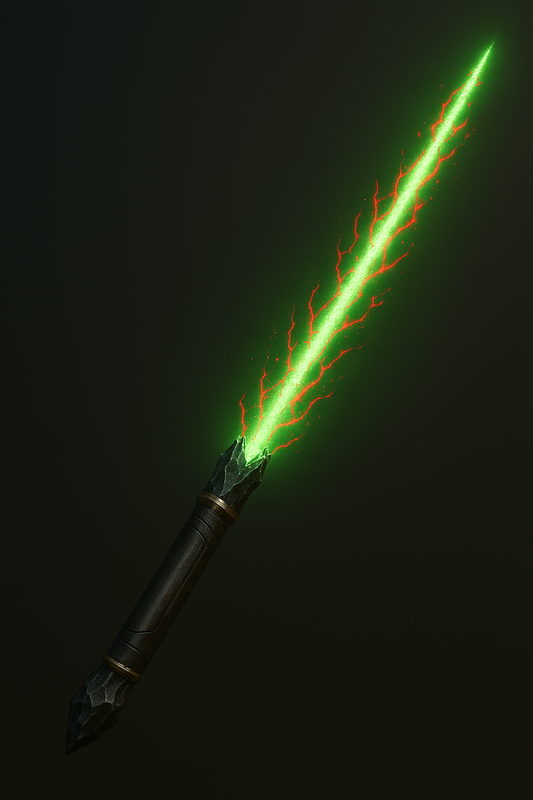
Intent: To create the Obsidian Shard as Delsin Shaw's personal Forcesaber; an arcane weapon embodying his mastery of Shatterpoint perception, Force sorcery, and his philosophy that all things possess fractures waiting to be understood. The weapon serves as both a ritual implement and a symbolic final measure, drawn only when observation has ended and decisive action remains.
Image Source: ChatGPT Image Generation / Prompt Done myself.
Canon Link: N/A
Permissions: N/A
Primary Source:
PRODUCTION INFORMATION
Manufacturer: Delsin Shaw
Affiliation: Delsin Shaw
Market Status: Closed-Market
Model: Obsidian Shard
Modularity: Limited
Material:
TECHNICAL SPECIFICATIONS
Classification: Forcesaber
Size: Average
Weight: Average
SPECIAL FEATURES
Arcane Forcesaber - Unlike a conventional lightsaber, the Obsidian Shard's blade is sustained through a combination of Forcesaber principles, Sith alchemy, arcane ritual bindings, and direct Force channeling. The weapon can accept additional Force energy from its wielder, increasing both blade potency and the effectiveness of its unique abilities.
Convergence - The defining phenomenon of the Obsidian Shard. As Delsin studies a target, structure, ritual, artifact, battlefield, or situation, the blade gradually narrows his focus toward meaningful weaknesses, vulnerabilities, and Shatterpoints. The weapon does not create these weaknesses. Rather, it assists the wielder in identifying fractures already present within a situation.
Fractured Sight - Functions as a focusing lens for Delsin's existing Shatterpoint abilities.
The blade assists in identifying:
As additional Force energy is channeled through the weapon:
Arcane Resonance - The blade possesses a unique affinity for Force-based constructs and supernatural phenomena.
The Obsidian Shard is particularly adept at identifying flaws within:
Echoes of Collapse - Through meditation and examination, the blade may reveal lingering fractures left behind by significant events. Battlefields. Failed rituals. Destroyed structures. Broken artifacts. Moments of consequence often leave impressions that the Obsidian Shard can help interpret.
Resonant Memory - Years of Force channeling, conflict, and ritual use have caused the weapon to accumulate lingering resonances. The blade remembers significance. Individuals who have repeatedly shaped Delsin's life may leave impressions upon the weapon.
This includes:
Ritual Focus - The Obsidian Shard functions as an exceptionally powerful focus for Force rituals, arcane studies, and alchemical experimentation.
Adaptive Manifestation - Through concentrated Force manipulation, Delsin may alter the blade's shape.
Extended Form - The blade lengthens beyond conventional dimensions. With the following benefits:
In this state:
WEAKNESSES
Force Dependency - The Obsidian Shard is fundamentally sustained through Force energy. Without the Force, the weapon cannot function.
Force Nullification
Within:
Does Not Create Weaknesses - The weapon cannot generate vulnerabilities where none exist. It only reveals fractures that are already present.
No Automatic Answers - Convergence reflects the wielder's understanding. If Delsin's assumptions are flawed, incomplete, or manipulated, the conclusions reached through the weapon may be equally flawed.
No Anti-Force Properties - The Obsidian Shard does not suppress, negate, disable, or counter Force powers.
Cortosis Resistance, Not Immunity - Because the blade is sustained through Force channeling and arcane bindings, Cortosis does not trigger the traditional lightsaber shutdown effect.
However:
Overchanneling
The more Force energy invested into the weapon:
Adaptive Manifestation Strain
The further the blade deviates from its natural shape:
Complexity Reliance - The blade performs best when confronting layered situations, intricate defenses, complex rituals, or meaningful conflicts. Straightforward brute-force encounters provide fewer opportunities for Convergence to operate effectively.
DESCRIPTION
The Obsidian Shard is neither a conventional lightsaber nor a traditional Force artifact. It exists somewhere between the two. Forged through the fusion of Forcesaber principles, Sith alchemy, arcane ritual practices, and Delsin Shaw's personal understanding of the Force, the weapon was never intended to be a simple instrument of destruction. It was created as a weapon of understanding. While most legendary weapons seek to overwhelm opponents through superior power, the Obsidian Shard was built around a single question: where will this break?
When activated, the weapon manifests as an emerald blade threaded with shifting crimson fractures. These fissures constantly move throughout the blade, spreading, reforming, and aligning in patterns that appear random to outside observers. In reality, these fractures are visual manifestations of the blade's defining phenomenon, known as Convergence. Convergence is not a singular ability so much as the fundamental principle through which the weapon operates. The blade continually seeks weaknesses, instabilities, and fractures within whatever Delsin turns his attention toward. In combat this may manifest as repeated habits within an opponent's defense, lingering injuries, moments of hesitation, or subtle flaws in their technique. Against structures it may reveal damaged supports, stress fractures, or unstable foundations. When confronting rituals, enchantments, wards, alchemical creations, or other arcane phenomena, the blade assists in identifying weak anchor points, imperfect bindings, and flaws hidden within the architecture sustaining those effects.
The weapon does not create these weaknesses. Nor does it automatically reveal them. Instead, the Obsidian Shard acts as a lens through which Delsin focuses abilities he already possesses. The blade amplifies his understanding rather than replacing it. If his assumptions are flawed, the conclusions reached through Convergence may be equally flawed. The weapon reflects perception, experience, and intuition rather than objective truth. This limitation is fundamental to its design. The Obsidian Shard cannot manufacture vulnerabilities where none exist, nor does it provide easy answers. It merely helps narrow countless possibilities toward those most likely to matter.
As a true Forcesaber, the Obsidian Shard differs significantly from conventional lightsabers. The blade is sustained not solely through technological emitters, but through the direct channeling of Force energy. Delsin may actively feed the weapon additional power, increasing both its destructive potential and the depth of Convergence itself. The more Force invested into the blade, the further its search expands. Minor flaws become significant vulnerabilities. Individual weaknesses begin connecting to larger patterns. A duel may reveal a decisive opening. A battle may reveal a critical turning point. A ritual may reveal the singular anchor upon which its success depends. The blade's search grows broader and more meaningful as additional Force energy is committed to it.
This process is not without cost. Greater output requires greater investment from the wielder. The more Force channeled through the weapon, the more demanding it becomes to maintain. Fatigue accumulates. Concentration becomes increasingly important. At its highest levels of operation, the Obsidian Shard ceases to function as a simple weapon and becomes an extension of Delsin's will, requiring constant attention to sustain. The blade rewards commitment, but demands it in equal measure.
The weapon's unique nature also allows Delsin to alter the blade's manifestation. In its default state, the Obsidian Shard functions similarly to a traditional lightsaber, possessing a full cutting field capable of striking from any angle. Through additional Force manipulation, however, the blade may be lengthened to extend its reach or compressed into a more refined sword-like profile. In this refined state the blade develops a defined edge, flat, and spine, behaving more like a traditional sword than a lightsaber. Precision improves considerably, allowing Delsin to exploit narrow vulnerabilities with greater accuracy, but this comes at the cost of requiring proper edge alignment and significantly greater concentration. The blade becomes less forgiving, demanding greater skill from its wielder in exchange for enhanced precision.
At the height of its operation lies a state known as Fracture Form. As Convergence approaches completion, the crimson fissures within the blade gradually cease their movement. The fractures align. The shifting chaos that once filled the blade resolves into a singular pattern. Visually, the weapon appears less like a lightsaber and more like shattered emerald crystal held together through sheer Force of will. This state represents the culmination of observation, analysis, and understanding. The blade's cutting potential becomes concentrated rather than expanded. Precision reaches its highest point. Force consumption rises dramatically. Most importantly, Convergence narrows toward what Delsin believes to be the most significant fracture present within the situation before him. Whether that fracture exists within a person, a structure, a ritual, or a larger conflict, Fracture Form represents the moment the search is over and action begins.
Beyond combat, the Obsidian Shard possesses a unique relationship with resonance. Years of Force channeling, ritual use, and repeated exposure to moments of great significance have left impressions upon the weapon. The blade is not sentient, nor does it possess memories in the traditional sense. Instead, it accumulates echoes. Allies, rivals, students, mentors, and enemies who have repeatedly shaped Delsin's life leave subtle traces behind. The weapon remembers significance. Returning to a battlefield where pivotal events occurred, encountering a long-standing rival, or placing the blade into the hands of a trusted ally may cause these lingering resonances to stir. Such impressions do not communicate, offer visions, or provide knowledge, but they do allow the weapon to recognize people and places that have become woven into its history. In this way, the Obsidian Shard serves as a quiet archive of the relationships and conflicts that helped shape its wielder.
Because the blade relies so heavily upon the Force, its greatest strength is also its greatest weakness. Conventional Cortosis interactions do not disable the weapon as they would a standard lightsaber, as the blade is sustained through arcane Force channeling rather than solely technological containment systems. Cortosis remains highly resistant to the blade itself, however, and offers no less protection than it would against any other energy weapon. More importantly, Force suppression presents a severe threat to the Obsidian Shard. Within Force dead zones, ysalamiri fields, voids, or similar nullification effects, Convergence weakens, arcane functions cease, and the blade itself may fail entirely. If deprived of the Force completely, the weapon becomes little more than an inert hilt.
Ultimately, the Obsidian Shard embodies Delsin Shaw's understanding of existence itself. Every structure possesses a weakness. Every ritual contains flaws. Every empire eventually fractures. Every life comes to an end. The weapon exists not to create those fractures, but to find them. It is a blade dedicated to understanding where things break, and providing the means to strike when that moment finally arrives.
Intent: To create the Obsidian Shard as Delsin Shaw's personal Forcesaber; an arcane weapon embodying his mastery of Shatterpoint perception, Force sorcery, and his philosophy that all things possess fractures waiting to be understood. The weapon serves as both a ritual implement and a symbolic final measure, drawn only when observation has ended and decisive action remains.
Image Source: ChatGPT Image Generation / Prompt Done myself.
Canon Link: N/A
Permissions: N/A
Primary Source:
- The Obsidian Shard - Denied due to Ban of Anti-Force
PRODUCTION INFORMATION
Manufacturer: Delsin Shaw
Affiliation: Delsin Shaw
Market Status: Closed-Market
Model: Obsidian Shard
Modularity: Limited
- Blade length may be altered through Force channeling.
- Blade profile may be altered through Force channeling.
- Configuration changes require active concentration and Force expenditure.
Material:
- Otherspace Obsidian
- Phrik
- Alchemically Reinforced Lightsaber Components
- Force-Attuned Crystal Matrix
- Alchemical Binding Compounds
- Arcane Ritual Inscriptions
- Force-Imbued Conduits
TECHNICAL SPECIFICATIONS
Classification: Forcesaber
Size: Average
Weight: Average
SPECIAL FEATURES
- Arcane Forcesaber
- Force-Amplified Blade
- Convergence
- Fractured Sight
- Arcane Resonance
- Echoes of Collapse
- Resonant Memory
- Ritual Focus
- Adaptive Manifestation
- Fracture Form
- Cortosis Resistant Blade Manifestation
- Alchemically Reinforced Construction
- Strong Force Signature Attunement
Arcane Forcesaber - Unlike a conventional lightsaber, the Obsidian Shard's blade is sustained through a combination of Forcesaber principles, Sith alchemy, arcane ritual bindings, and direct Force channeling. The weapon can accept additional Force energy from its wielder, increasing both blade potency and the effectiveness of its unique abilities.
Convergence - The defining phenomenon of the Obsidian Shard. As Delsin studies a target, structure, ritual, artifact, battlefield, or situation, the blade gradually narrows his focus toward meaningful weaknesses, vulnerabilities, and Shatterpoints. The weapon does not create these weaknesses. Rather, it assists the wielder in identifying fractures already present within a situation.
Fractured Sight - Functions as a focusing lens for Delsin's existing Shatterpoint abilities.
The blade assists in identifying:
- Structural weaknesses
- Defensive flaws
- Combat habits
- Tactical vulnerabilities
- Arcane instabilities
- Significant turning points
As additional Force energy is channeled through the weapon:
- Blade intensity increases
- Cutting potential increases
- Convergence accelerates
- Larger and more significant fractures become perceptible
Arcane Resonance - The blade possesses a unique affinity for Force-based constructs and supernatural phenomena.
The Obsidian Shard is particularly adept at identifying flaws within:
- Ritual circles
- Force wards
- Enchantments
- Spiritual bindings
- Alchemical creations
- Arcane constructs
Echoes of Collapse - Through meditation and examination, the blade may reveal lingering fractures left behind by significant events. Battlefields. Failed rituals. Destroyed structures. Broken artifacts. Moments of consequence often leave impressions that the Obsidian Shard can help interpret.
Resonant Memory - Years of Force channeling, conflict, and ritual use have caused the weapon to accumulate lingering resonances. The blade remembers significance. Individuals who have repeatedly shaped Delsin's life may leave impressions upon the weapon.
This includes:
- Allies
- Rivals
- Students
- Mentors
- Significant enemies
Ritual Focus - The Obsidian Shard functions as an exceptionally powerful focus for Force rituals, arcane studies, and alchemical experimentation.
Adaptive Manifestation - Through concentrated Force manipulation, Delsin may alter the blade's shape.
Extended Form - The blade lengthens beyond conventional dimensions. With the following benefits:
- Increased reach
- Larger field of perception for Convergence
- Greater Force expenditure
- Reduced maneuverability
- Defined edge
- Defined flat
- Defined spine
- Greater precision
- Improved edge alignment
- Enhanced exploitation of small weaknesses
- Requires proper swordsmanship
- Edge alignment becomes necessary
- Greater concentration requirements
In this state:
- Convergence reaches maximum clarity
- Cutting power becomes highly concentrated
- Precision is greatly increased
- Force consumption rises dramatically
WEAKNESSES
Force Dependency - The Obsidian Shard is fundamentally sustained through Force energy. Without the Force, the weapon cannot function.
Force Nullification
Within:
- Force Dead Zones
- Force Voids
- Ysalamiri fields
- Force suppression effects
- Similar phenomena
Does Not Create Weaknesses - The weapon cannot generate vulnerabilities where none exist. It only reveals fractures that are already present.
No Automatic Answers - Convergence reflects the wielder's understanding. If Delsin's assumptions are flawed, incomplete, or manipulated, the conclusions reached through the weapon may be equally flawed.
No Anti-Force Properties - The Obsidian Shard does not suppress, negate, disable, or counter Force powers.
Cortosis Resistance, Not Immunity - Because the blade is sustained through Force channeling and arcane bindings, Cortosis does not trigger the traditional lightsaber shutdown effect.
However:
- Cortosis remains resistant to the blade
- Cortosis weapons remain effective
- Cortosis armor remains protective
Overchanneling
The more Force energy invested into the weapon:
- The greater the strain upon the wielder
- The more difficult the blade becomes to maintain
- The greater the mental and physical fatigue
Adaptive Manifestation Strain
The further the blade deviates from its natural shape:
- The greater the Force cost
- The greater the concentration required
Complexity Reliance - The blade performs best when confronting layered situations, intricate defenses, complex rituals, or meaningful conflicts. Straightforward brute-force encounters provide fewer opportunities for Convergence to operate effectively.
DESCRIPTION
The Obsidian Shard is neither a conventional lightsaber nor a traditional Force artifact. It exists somewhere between the two. Forged through the fusion of Forcesaber principles, Sith alchemy, arcane ritual practices, and Delsin Shaw's personal understanding of the Force, the weapon was never intended to be a simple instrument of destruction. It was created as a weapon of understanding. While most legendary weapons seek to overwhelm opponents through superior power, the Obsidian Shard was built around a single question: where will this break?
When activated, the weapon manifests as an emerald blade threaded with shifting crimson fractures. These fissures constantly move throughout the blade, spreading, reforming, and aligning in patterns that appear random to outside observers. In reality, these fractures are visual manifestations of the blade's defining phenomenon, known as Convergence. Convergence is not a singular ability so much as the fundamental principle through which the weapon operates. The blade continually seeks weaknesses, instabilities, and fractures within whatever Delsin turns his attention toward. In combat this may manifest as repeated habits within an opponent's defense, lingering injuries, moments of hesitation, or subtle flaws in their technique. Against structures it may reveal damaged supports, stress fractures, or unstable foundations. When confronting rituals, enchantments, wards, alchemical creations, or other arcane phenomena, the blade assists in identifying weak anchor points, imperfect bindings, and flaws hidden within the architecture sustaining those effects.
The weapon does not create these weaknesses. Nor does it automatically reveal them. Instead, the Obsidian Shard acts as a lens through which Delsin focuses abilities he already possesses. The blade amplifies his understanding rather than replacing it. If his assumptions are flawed, the conclusions reached through Convergence may be equally flawed. The weapon reflects perception, experience, and intuition rather than objective truth. This limitation is fundamental to its design. The Obsidian Shard cannot manufacture vulnerabilities where none exist, nor does it provide easy answers. It merely helps narrow countless possibilities toward those most likely to matter.
As a true Forcesaber, the Obsidian Shard differs significantly from conventional lightsabers. The blade is sustained not solely through technological emitters, but through the direct channeling of Force energy. Delsin may actively feed the weapon additional power, increasing both its destructive potential and the depth of Convergence itself. The more Force invested into the blade, the further its search expands. Minor flaws become significant vulnerabilities. Individual weaknesses begin connecting to larger patterns. A duel may reveal a decisive opening. A battle may reveal a critical turning point. A ritual may reveal the singular anchor upon which its success depends. The blade's search grows broader and more meaningful as additional Force energy is committed to it.
This process is not without cost. Greater output requires greater investment from the wielder. The more Force channeled through the weapon, the more demanding it becomes to maintain. Fatigue accumulates. Concentration becomes increasingly important. At its highest levels of operation, the Obsidian Shard ceases to function as a simple weapon and becomes an extension of Delsin's will, requiring constant attention to sustain. The blade rewards commitment, but demands it in equal measure.
The weapon's unique nature also allows Delsin to alter the blade's manifestation. In its default state, the Obsidian Shard functions similarly to a traditional lightsaber, possessing a full cutting field capable of striking from any angle. Through additional Force manipulation, however, the blade may be lengthened to extend its reach or compressed into a more refined sword-like profile. In this refined state the blade develops a defined edge, flat, and spine, behaving more like a traditional sword than a lightsaber. Precision improves considerably, allowing Delsin to exploit narrow vulnerabilities with greater accuracy, but this comes at the cost of requiring proper edge alignment and significantly greater concentration. The blade becomes less forgiving, demanding greater skill from its wielder in exchange for enhanced precision.
At the height of its operation lies a state known as Fracture Form. As Convergence approaches completion, the crimson fissures within the blade gradually cease their movement. The fractures align. The shifting chaos that once filled the blade resolves into a singular pattern. Visually, the weapon appears less like a lightsaber and more like shattered emerald crystal held together through sheer Force of will. This state represents the culmination of observation, analysis, and understanding. The blade's cutting potential becomes concentrated rather than expanded. Precision reaches its highest point. Force consumption rises dramatically. Most importantly, Convergence narrows toward what Delsin believes to be the most significant fracture present within the situation before him. Whether that fracture exists within a person, a structure, a ritual, or a larger conflict, Fracture Form represents the moment the search is over and action begins.
Beyond combat, the Obsidian Shard possesses a unique relationship with resonance. Years of Force channeling, ritual use, and repeated exposure to moments of great significance have left impressions upon the weapon. The blade is not sentient, nor does it possess memories in the traditional sense. Instead, it accumulates echoes. Allies, rivals, students, mentors, and enemies who have repeatedly shaped Delsin's life leave subtle traces behind. The weapon remembers significance. Returning to a battlefield where pivotal events occurred, encountering a long-standing rival, or placing the blade into the hands of a trusted ally may cause these lingering resonances to stir. Such impressions do not communicate, offer visions, or provide knowledge, but they do allow the weapon to recognize people and places that have become woven into its history. In this way, the Obsidian Shard serves as a quiet archive of the relationships and conflicts that helped shape its wielder.
Because the blade relies so heavily upon the Force, its greatest strength is also its greatest weakness. Conventional Cortosis interactions do not disable the weapon as they would a standard lightsaber, as the blade is sustained through arcane Force channeling rather than solely technological containment systems. Cortosis remains highly resistant to the blade itself, however, and offers no less protection than it would against any other energy weapon. More importantly, Force suppression presents a severe threat to the Obsidian Shard. Within Force dead zones, ysalamiri fields, voids, or similar nullification effects, Convergence weakens, arcane functions cease, and the blade itself may fail entirely. If deprived of the Force completely, the weapon becomes little more than an inert hilt.
Ultimately, the Obsidian Shard embodies Delsin Shaw's understanding of existence itself. Every structure possesses a weakness. Every ritual contains flaws. Every empire eventually fractures. Every life comes to an end. The weapon exists not to create those fractures, but to find them. It is a blade dedicated to understanding where things break, and providing the means to strike when that moment finally arrives.
Out Of Character Info
Intent:
To create the Obsidian Shard as Delsin Shaw's personal Forcesaber; an arcane weapon embodying his mastery of Shatterpoint perception, Force sorcery, and his philosophy that all things possess fractures waiting to be understood. The weapon serves as both a ritual implement and a symbolic final measure, drawn only when observation has ended and decisive action remains.
Permissions:
N/A
Technical Information
Affiliation:
Delsin Shaw
Modular:
Yes
Material:
Listed in Sub