
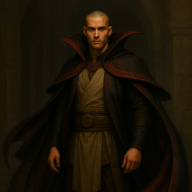
Diarch Rellik
Lord of the Diarchy



THE DIARCHS
Reign & Rellik

The Diarchy is led by two consuls: Reign and Rellik.
They are brothers, raised together under extreme conditions, and shaped by shared responsibility. Their leadership is defined not by hierarchy, but by balance. Neither rules alone.
While both Diarchs hold ultimate executive authority, the Diarchy is not designed to be a single-voice regime. Reign and Rellik govern alongside institutions deliberately structured to distribute power, responsibility, and influence across the state.
Diarch Reign
Public Authority • Cohesion • Command
Reign is most often seen as the public and martial face of the Diarchy. He leads from the front during times of war, represents the state in diplomacy, and serves as a stabilizing presence during crises.
He values loyalty, discipline, and direct action, but is not detached from civilian life. Reign places great importance on morale, visibility, and the belief that leadership must share in the burdens it demands of others.
His role centers on cohesion—holding the state together under pressure and ensuring that decisions are carried through decisively.
Diarch Rellik
Foresight • Systems • Stability
Rellik operates more quietly, focusing on long-term stability, intelligence, and systemic balance. He oversees strategic planning, intelligence coordination, research initiatives, and the deeper mechanisms that allow the Diarchy to function beyond the battlefield.
While less visible to the public, Rellik's influence is felt throughout the state's institutions. He is invested in preventing collapse through foresight, and in ensuring that power—Force-based or otherwise—is understood, regulated, and applied with intent.
Shared Leadership
The Diarchs do not divide the Diarchy into "two halves." Instead, they act as mutual checks, advisors, and collaborators. Major decisions are often debated internally before being brought before broader governing bodies.
While either Diarch can act unilaterally, the Diarchy is intentionally structured so that governance does not depend solely on their presence or survival. The High Council, Diarchal Assembly, military leadership, and civil institutions all play active roles in shaping the state.
The Diarchs main responsibility is to ensure the ideals and vision of the Diarchy remain the same. It matters not who has the position as long. It matters that they uphold and preserve the Diarchy as a concept until the end of their days.